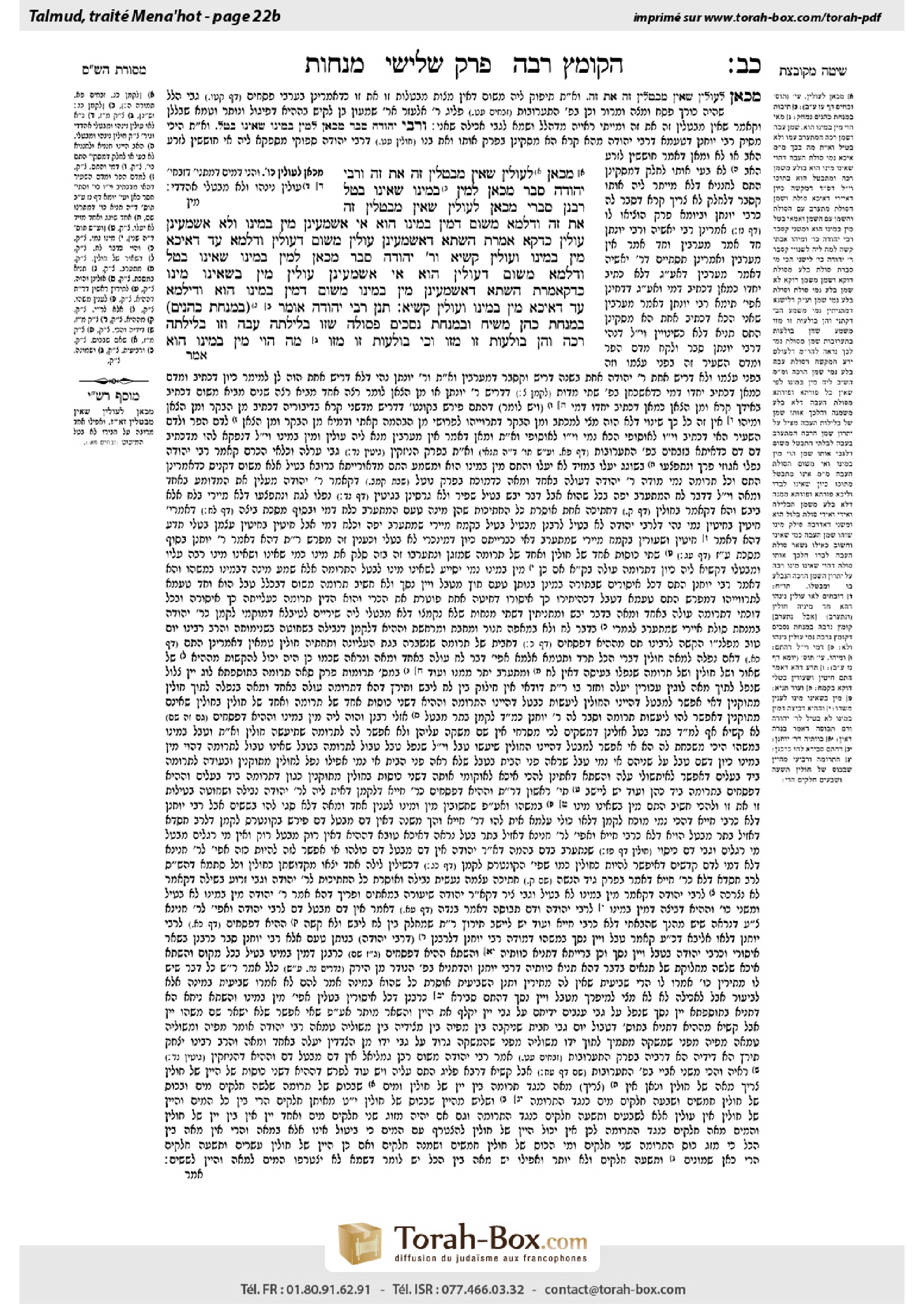
Menachot 22b: Talmud study for Daf Yomi
Daf Yomi is the daily study of one Talmud folio. Explore 37 tractates with scans, Hebrew text, Sefaria English and AI-generated French translations where annotated.
Passage selection and English or AI-generated French translation are available where the scan has annotations. Daf Study is independent of Torah-Box and Sefaria.
Browse Menachot · מנחות · All tractatesMenachot 22b text and translations
This page of Menachot includes the Aramaic text, an English translation and an AI-generated French translation, alongside the scan above.
מנחות כ״ב ב · Aramaic and Hebrew text
מִכָּאן לָעוֹלִין שֶׁאֵין מְבַטְּלִין זֶה אֶת זֶה, וְרַבִּי יְהוּדָה סָבַר: מִכָּאן לְמִין בְּמִינוֹ שֶׁאֵינוֹ בָּטֵל.
רַבָּנַן סָבְרִי מִכָּאן לָעוֹלִין שֶׁאֵין מְבַטְּלִין זֶה אֶת זֶה, וְדִלְמָא מִשּׁוּם דְּמִין בְּמִינוֹ הוּא!
אִי אַשְׁמְעִינַן מִין בְּמִינוֹ, וְלָא אַשְׁמְעִינַן עוֹלִין, כִּדְקָא אָמְרַתְּ. הַשְׁתָּא דְּאַשְׁמְעִינַן עוֹלִין, מִשּׁוּם דְּעוֹלִין.
וְדִלְמָא עַד דְּאִיכָּא מִין בְּמִינוֹ וְעוֹלִין? קַשְׁיָא.
וְרַבִּי יְהוּדָה סָבַר מִכָּאן לְמִין בְּמִינוֹ שֶׁאֵינוֹ בָּטֵל, וְדִלְמָא מִשּׁוּם דְּעוֹלִין הוּא!
אִי אַשְׁמְעִינַן עוֹלִין מִין בְּשֶׁאֵינוֹ מִינוֹ – כִּדְקָאָמְרַתְּ, הַשְׁתָּא דְּאַשְׁמְעִינַן מִין בְּמִינוֹ – מִשּׁוּם דְּמִין בְּמִינוֹ הוּא.
וְדִילְמָא עַד דְּאִיכָּא מִין בְּמִינוֹ וְעוֹלִין? קַשְׁיָא.
תְּנַן: רַבִּי יְהוּדָה אוֹמֵר: בְּמִנְחַת כֹּהֲנִים, בְּמִנְחַת כֹּהֵן מָשִׁיחַ, וּבְמִנְחַת נְסָכִים – פְּסוּלָה, שֶׁזּוֹ בְּלִילָתָהּ עָבָה וְזוֹ בְּלִילָתָהּ רַכָּה, וְהֵן בּוֹלְעוֹת זוֹ מִזּוֹ. וְכִי בּוֹלְעוֹת זוֹ מִזּוֹ מָה הָוֵי? מִין בְּמִינוֹ הוּא!
Menachot 22b · English translation
From here it is learned that with regard to a mixture of items that ascend to the altar, e.g., the blood of the bull and the goat, the different components of the mixture do not nullify one another. And Rabbi Yehuda holds: From here it is learned that any substance in contact with the same type of substance is not nullified.
The Gemara examines Rabbi Yoḥanan’s explanation of the dispute between the Rabbis and Rabbi Yehuda. With regard to the first part of his explanation, that the Rabbis hold: From here it is learned that with regard to a mixture of items that ascend to the altar the different components of the mixture do not nullify one another, the Gemara suggests: But perhaps the blood of the goat is not nullified when mixed with the blood of the bull due to the fact that it is a substance in contact with the same type of substance.
The Gemara answers: Had the verse taught us this halakha by using an example of a substance in contact with the same type of substance, and not taught us a case of a mixture of items that ascend to the altar, the verse would be interpreted as you said. But now that the verse taught us this halakha through a case of a mixture of items that ascend to the altar, it is understood that the reason it is not nullified is due to the fact that it is part of a mixture of items that ascend to the altar, not because the substances are of the same type.
The Gemara suggests: But perhaps it is not nullified until both criteria are met, and unless the mixture is both a substance in contact with the same type of substance and a mixture of items that ascend to the altar, one nullifies the other. The Gemara concedes: This is difficult.
With regard to the second part of Rabbi Yoḥanan’s explanation: And Rabbi Yehuda holds: From here it is learned that any substance in contact with the same type of substance is not nullified, the Gemara suggests: But perhaps the blood of the goat is not nullified when mixed with the blood of the bull due to the fact that it is a mixture of items that ascend to the altar.
The Gemara answers: Had the verse taught us this halakha by using an example of a mixture of items that ascend to the altar where the substance is in contact with a different type of substance, the verse would be interpreted as you say. But now that the verse taught us this halakha in a case of a substance in contact with the same type of substance, it is understood that the reason it is not nullified is due to the fact that it is a substance in contact with the same type of substance.
The Gemara suggests: But perhaps it is not nullified until both criteria are met, and unless the mixture is both a substance in contact with the same type of substance and a mixture of items that ascend to the altar, one nullifies the other. The Gemara concedes: This is difficult.
The Gemara raises another objection to the explanation of Rabbi Yoḥanan: We learned in the mishna here that Rabbi Yehuda says: If the handful was intermingled with the meal offering of priests, with the meal offering of the anointed priest, or with the meal offering of libations, the mixture is unfit because with regard to this, the handful from the standard meal offering, its mixture is thick, and with regard to that, the meal offering of the anointed priest and the meal offering of libations, its mixture is loose. And the mixtures, which are not identical, absorb from each other, invalidating both. The Gemara asks: But when the mixtures absorb from each other, what of it? This is a case of a substance in contact with the same type of substance, and therefore neither oil nullifies the other and both should be sacrificed on the altar.
Menachot 22b · Traduction française (IA)
On apprend de là que, dans un mélange d’éléments qui montent sur l’autel, comme le sang du taureau et celui du bouc, les différents composants ne s’annulent pas les uns les autres. Rabbi Yehouda, lui, soutient qu’on apprend de là que toute substance en contact avec une substance de même nature n’est pas annulée.
La Guemara examine l’explication que Rabbi Yoḥanan donne du désaccord entre les Rabbins et Rabbi Yehouda. Au sujet de la première partie de son explication, selon laquelle les Rabbins soutiennent qu’on apprend de là que, dans un mélange d’éléments qui montent sur l’autel, les différents composants ne s’annulent pas les uns les autres, la Guemara objecte : mais peut-être le sang du bouc n’est-il pas annulé lorsqu’il est mélangé à celui du taureau parce qu’il s’agit d’une substance en contact avec une substance de même nature.
La Guemara répond : si le verset nous avait enseigné cette halakha à l’aide de l’exemple d’une substance en contact avec une substance de même nature, sans nous enseigner le cas d’un mélange d’éléments qui montent sur l’autel, le verset aurait été interprété comme tu l’as dit. Mais puisque le verset nous a enseigné cette halakha à travers le cas d’un mélange d’éléments qui montent sur l’autel, on comprend que la substance n’est pas annulée parce qu’elle fait partie d’un mélange d’éléments qui montent sur l’autel, et non parce que les substances sont de même nature.
La Guemara objecte : mais peut-être la substance n’est-elle pas annulée tant que les deux critères ne sont pas réunis ; si le mélange n’est pas à la fois une substance en contact avec une substance de même nature et un mélange d’éléments qui montent sur l’autel, l’un annule l’autre. La Guemara reconnaît : c’est difficile.
Au sujet de la seconde partie de l’explication de Rabbi Yoḥanan — Rabbi Yehouda soutient qu’on apprend de là que toute substance en contact avec une substance de même nature n’est pas annulée —, la Guemara objecte : mais peut-être le sang du bouc n’est-il pas annulé lorsqu’il est mélangé à celui du taureau parce qu’il s’agit d’un mélange d’éléments qui montent sur l’autel.
La Guemara répond : si le verset nous avait enseigné cette halakha à l’aide de l’exemple d’un mélange d’éléments qui montent sur l’autel, dans lequel la substance est en contact avec une substance de nature différente, le verset aurait été interprété comme tu l’as dit. Mais puisque le verset nous a enseigné cette halakha dans le cas d’une substance en contact avec une substance de même nature, on comprend qu’elle n’est pas annulée parce qu’il s’agit d’une substance en contact avec une substance de même nature.
La Guemara objecte : mais peut-être la substance n’est-elle pas annulée tant que les deux critères ne sont pas réunis ; si le mélange n’est pas à la fois une substance en contact avec une substance de même nature et un mélange d’éléments qui montent sur l’autel, l’un annule l’autre. La Guemara reconnaît : c’est difficile.
La Guemara soulève une autre objection à l’explication de Rabbi Yoḥanan. Nous avons appris dans la Michna, ici, que Rabbi Yehouda dit : si la poignée s’est mélangée à l’offrande de farine des prêtres, à l’offrande de farine du prêtre oint ou à l’offrande de farine des libations, le mélange est impropre, car, d’une part, le mélange de la poignée provenant de l’offrande de farine ordinaire est épais et, d’autre part, le mélange de l’offrande de farine du prêtre oint et celui de l’offrande de farine des libations sont fluides. Ces mélanges, qui ne sont pas identiques, s’absorbent mutuellement, ce qui rend les deux impropres. La Guemara demande : mais quelle conséquence faut-il tirer de cette absorption mutuelle des mélanges ? Il s’agit d’une substance en contact avec une substance de même nature ; aucune des deux huiles n’annule donc l’autre, et toutes deux devraient être offertes sur l’autel.
Traduction française générée par IA à partir de l’édition anglaise de Sefaria. Vérifie toujours un passage avec le texte source.
Text from Sefaria: William Davidson Edition - Vocalized Aramaic (unknown); William Davidson Edition - English (CC BY NC).