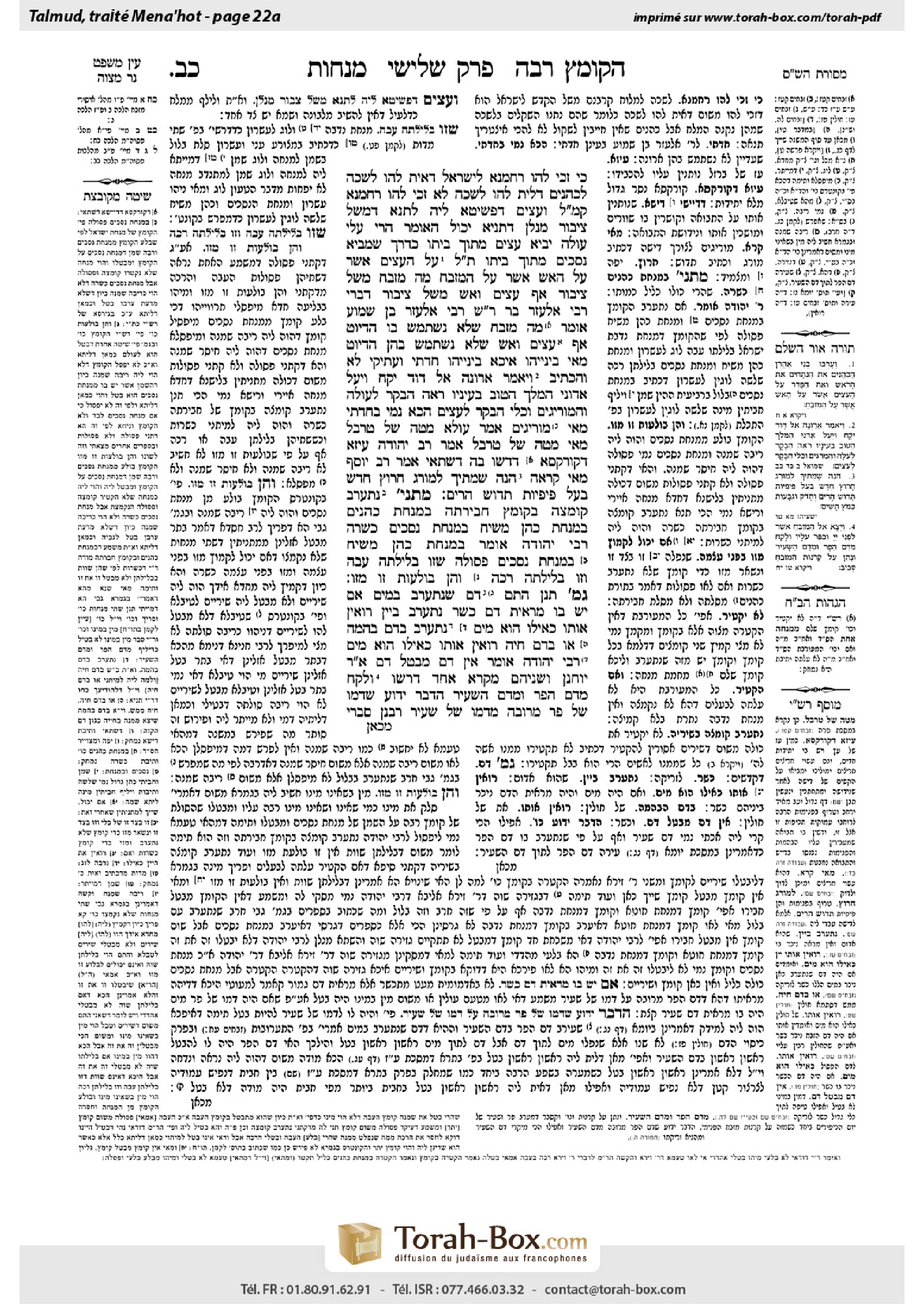
Menachot 22a: Talmud study for Daf Yomi
Daf Yomi is the daily study of one Talmud folio. Explore 37 tractates with scans, Hebrew text, Sefaria English and AI-generated French translations where annotated.
Passage selection and English or AI-generated French translation are available where the scan has annotations. Daf Study is independent of Torah-Box and Sefaria.
Browse Menachot · מנחות · All tractatesMenachot 22a text and translations
This page of Menachot includes the Aramaic text, an English translation and an AI-generated French translation, alongside the scan above.
מנחות כ״ב א · Aramaic and Hebrew text
כִּי זַכִּי לְהוּ רַחֲמָנָא – לְיִשְׂרָאֵל, דְּאִית לְהוּ לִשְׁכָּה. לְכֹהֲנִים, דְּלֵית לְהוּ לִשְׁכָּה – לָא זַכִּי לְהוּ רַחֲמָנָא, קָא מַשְׁמַע לַן.
וְעֵצִים, דִּפְשִׁיטָא לֵיהּ לְתַנָּא דְּמִשֶּׁל צִיבּוּר, מְנָלַן? דְּתַנְיָא: יָכוֹל הָאוֹמֵר ״הֲרֵי עָלַי עוֹלָה״ יָבִיא עֵצִים מִתּוֹךְ בֵּיתוֹ, כְּדֶרֶךְ שֶׁמֵּבִיא נְסָכִים מִתּוֹךְ בֵּיתוֹ? תַּלְמוּד לוֹמַר: ״עַל הָעֵצִים אֲשֶׁר עַל הָאֵשׁ אֲשֶׁר עַל הַמִּזְבֵּחַ״ – מָה מִזְבֵּחַ מִשֶּׁל צִיבּוּר, אַף עֵצִים וָאֵשׁ מִשֶּׁל צִיבּוּר, דִּבְרֵי רַבִּי אֶלְעָזָר בַּר רַבִּי שִׁמְעוֹן.
רַבִּי אֶלְעָזָר בֶּן שַׁמּוּעַ אוֹמֵר: מָה מִזְבֵּחַ – שֶׁלֹּא נִשְׁתַּמֵּשׁ בּוֹ הֶדְיוֹט, אַף עֵצִים וָאֵשׁ – שֶׁלֹּא נִשְׁתַּמֵּשׁ בָּהֶן הֶדְיוֹט. מַאי בֵּינַיְיהוּ? אִיכָּא בֵּינַיְיהוּ חַדְתֵי.
וְעַתִּיקֵי לָא? וְהָכְתִיב: ״וַיֹּאמֶר אֲרַוְנָה אֶל דָּוִד יִקַּח וְיַעַל אֲדֹנִי הַמֶּלֶךְ הַטּוֹב בְּעֵינָיו רְאֵה הַבָּקָר לָעֹלָה וְהַמֹּרִגִּים וּכְלֵי הַבָּקָר לְעֵצִים״! הָכָא נָמֵי בְּחַדְתֵי.
מַאי ״מוֹרִיגִּים״? אָמַר עוּלָּא: מִטָּה שֶׁל טַרְבֵּל. מַאי מִטָּה שֶׁל טַרְבֵּל? אָמַר רַב יְהוּדָה: עִיזָּא דְּקוּרְקְסָא דְּדָשׁוּ בַּהּ דִּשְׁתָּאֵי. אָמַר רַב יוֹסֵף: מַאי קְרָאָה? ״הִנֵּה שַׂמְתִּיךְ לְמוֹרַג חָרוּץ חָדָשׁ בַּעַל פִּיפִיּוֹת תָּדוּשׁ הָרִים״.
מַתְנִי׳ נִתְעָרֵב קוּמְצָהּ בְּקוֹמֶץ חֲבֶירְתָּהּ, בְּמִנְחַת כֹּהֲנִים, בְּמִנְחַת כֹּהֵן מָשִׁיחַ, בְּמִנְחַת נְסָכִים – כְּשֵׁרָה.
רַבִּי יְהוּדָה אוֹמֵר: בְּמִנְחַת כֹּהֵן מָשִׁיחַ, בְּמִנְחַת נְסָכִים – פְּסוּלָה, שֶׁזּוֹ בְּלִילָתָהּ עָבָה, וְזוֹ בְּלִילָתָהּ רַכָּה, וְהֵן בּוֹלְעוֹת זוֹ מִזּוֹ.
גְּמָ׳ תְּנַן הָתָם: דָּם שֶׁנִּתְעָרֵב בְּמַיִם, אִם יֵשׁ בּוֹ מַרְאִית דָּם – כָּשֵׁר. נִתְעָרֵב בְּיַיִן – רוֹאִין אוֹתוֹ כְּאִילּוּ הוּא מַיִם. נִתְעָרֵב בְּדַם בְּהֵמָה אוֹ בְּדַם חַיָּה – רוֹאִין אוֹתוֹ כְּאִילּוּ הוּא מַיִם. רַבִּי יְהוּדָה אוֹמֵר: אֵין דָּם מְבַטֵּל דָּם.
אָמַר רַבִּי יוֹחָנָן: וּשְׁנֵיהֶם מִקְרָא אֶחָד דָּרְשׁוּ, ״וְלָקַח מִדַּם הַפָּר וּמִדַּם הַשָּׂעִיר״. הַדָּבָר יָדוּעַ שֶׁדָּמוֹ שֶׁל פַּר מְרוּבֶּה מִדָּמוֹ שֶׁל שָׂעִיר. רַבָּנַן סָבְרִי:
Menachot 22a · English translation
when the Merciful One granted the Jewish people the right to use the salt when eating their offerings, he granted this to Israelites, who have an obligation to donate their half-shekels to the chamber, as this fund supplies the salt that is applied to the offerings. With regard to the priests, who do not have an obligation to donate their half-shekels to the chamber, the Merciful One did not grant them the right to make use of the salt. To counter this, the mishna in tractate Shekalim teaches us that the court granted to the priests the right to use the salt when eating their offerings.
The Gemara asks: And with regard to the wood, concerning which it is obvious to the tanna of the baraita that it is brought from communal supplies, from where do we derive this halakha? The Gemara answers: As it is taught in a baraita: One might have thought that one who says: It is incumbent upon me to bring a burnt offering, must bring wood from his home on which the burnt offering will be sacrificed, just as he brings libations from his home along with a burnt offering (see Numbers, chapter 15). Therefore, the verse states with regard to the burnt offering: “On the wood that is on the fire which is upon the altar” (Leviticus 1:12); the Torah juxtaposes the wood to the altar, teaching that just as the altar was built from communal funds, so too, the wood and fire are brought from communal supplies. This is the statement of Rabbi Elazar bar Rabbi Shimon.
The baraita continues: Rabbi Elazar ben Shammua says: Just as the altar was not used by an ordinary person, as it was built for the purpose of serving as an altar for God, so too, the wood and fire should not have been used previously by an ordinary person, so one does not bring the wood from his home. The Gemara asks: What is the difference between the two opinions? The Gemara answers: The difference between the two is whether there is a requirement that the wood be new, i.e., that it had never been used. According to the opinion of Rabbi Elazar bar Rabbi Shimon, the wood is fit provided that it comes from communal supplies, even if it is not new wood, whereas according to Rabbi Elazar ben Shammua it must be new wood.
The Gemara asks: And is it in fact the halakha that old, i.e., previously used, wood is not fit to be burned on the altar? But isn’t it written: “And Araunah said to David: Let my lord the king take and offer up what seems good to him; behold the oxen for the burnt offering, and the threshing instruments [morigim] and the equipment of the oxen for the wood” (II Samuel 24:22)? Despite the fact that the threshing instruments and equipment of the oxen have been used previously, apparently they are fit to be used when offering a burnt offering. The Gemara answers: Here too, the verse is speaking of new instruments and equipment that had not been previously used.
Tangentially, the Gemara asks: What is the meaning of the term morigim mentioned in this verse? Ulla said: It is a turbal bed. This was not a known expression in Babylonia, so the Gemara asks: What is a turbal bed? Rav Yehuda said: It is referring to a serrated [dekurkesa] board that the threshers use for threshing, which is dragged over the grain by an animal in order to separate the kernels from the stalks. Rav Yosef said: What is the verse from which the meaning of morigim is derived? It is the verse that states: “Behold, I have made you a new threshing sledge [morag] having sharp teeth; you shall thresh the mountains” (Isaiah 41:15).
MISHNA: If a handful of one meal offering, which is to be burned on the altar, was intermingled with a handful of another meal offering, or with the meal offering of priests, or with the meal offering of the anointed priest, i.e., the High Priest, or with the meal offering of libations accompanying burnt offerings and peace offerings, all of which are burned in their entirety on the altar, it is fit for sacrifice, and the mixture is burned on the altar.
Rabbi Yehuda says: If the handful was intermingled with the meal offering of the anointed priest, or with the meal offering of libations, the mixture is unfit because with regard to this, the handful from the standard meal offering, its mixture is thick, one log of oil mixed with a tenth of an ephah of flour, and with regard to that, the meal offering of the anointed priest and the meal offering of libations, its mixture is loose, three log of oil mixed with a tenth of an ephah of flour. And the mixtures, which are not identical, absorb from each other, increasing the amount of oil in the handful and decreasing the amount of oil in the meal offering of the anointed priest or the meal offering of libations, thereby invalidating both.
GEMARA: We learned in a mishna there (Zevaḥim 77b): In the case of blood of an offering fit for sacrifice that was mixed with water, if the mixture has the appearance of blood, it is fit for presenting on the altar, even though the majority of the mixture is water. If the blood was mixed with red wine, one views the wine as though it were water. If that amount of water would leave the mixture with the appearance of blood, it is fit for presentation. Likewise, if the blood was mixed with the blood of a non-sacred domesticated animal or the blood of a non-sacred undomesticated animal, one considers the blood as though it were water. Rabbi Yehuda says: Blood does not nullify blood. Therefore, the priest presents the blood of the mixture on the altar regardless of the ratio of sacred to non-sacred blood.
Rabbi Yoḥanan says: And both the first tanna and Rabbi Yehuda derived their opinions from one verse. With regard to the sacrificial rites performed by the High Priest on Yom Kippur, the Torah teaches that after sprinkling of the blood of the bull and of the goat separately between the staves of the Ark and on the Curtain, the blood of the two animals is mixed together and presented on the golden altar inside the Sanctuary. The verse states: “And he shall take of the blood of the bull and of the blood of the goat and put it on the corners of the altar” (Leviticus 16:18). It is a known matter that the blood of the bull is more than the blood of a goat. Why then is the blood of the goat not nullified? Rabbi Yoḥanan explains: The Rabbis, i.e, the first tanna, hold:
Menachot 22a · Traduction française (IA)
Lorsque le Miséricordieux accorda au peuple juif le droit d’utiliser le sel pour manger ses offrandes, il l’accorda aux Israélites, qui sont tenus de verser leurs demi-sicles dans la chambre, puisque ce fonds fournit le sel appliqué aux offrandes. Quant aux prêtres, qui ne sont pas tenus de verser leurs demi-sicles dans la chambre, le Miséricordieux ne leur accorda pas le droit d’utiliser le sel. Pour réfuter cela, la Michna du traité Chekalim nous enseigne que le tribunal accorda aux prêtres le droit d’utiliser le sel pour manger leurs offrandes.
La Guemara demande : Et concernant le bois, dont le tanna de la baraïta considère manifestement qu’il provient des ressources communautaires, d’où déduisons-nous cette halakha ? La Guemara répond : Comme il est enseigné dans une baraïta : On aurait pu penser que celui qui dit : « Je m’engage à apporter un holocauste » doit apporter de chez lui le bois sur lequel l’holocauste sera offert, tout comme il apporte de chez lui les libations accompagnant un holocauste (voir Nombres, chapitre 15). C’est pourquoi le verset dit au sujet de l’holocauste : « Sur le bois qui est sur le feu placé sur l’autel » (Lévitique 1:12) ; la Torah rapproche le bois de l’autel pour enseigner que, de même que l’autel a été construit avec des fonds communautaires, le bois et le feu proviennent eux aussi des ressources communautaires. Telle est la déclaration de Rabbi Elazar bar Rabbi Shimon.
La baraïta poursuit : Rabbi Elazar ben Shammua dit : De même qu’un particulier n’utilisait pas l’autel, puisqu’il avait été construit pour servir d’autel à Dieu, de même le bois et le feu ne doivent pas avoir été utilisés auparavant par un particulier ; ainsi, on n’apporte pas le bois de chez soi. La Guemara demande : Quelle est la différence entre les deux opinions ? La Guemara répond : La différence porte sur l’obligation que le bois soit neuf, c’est-à-dire qu’il n’ait jamais été utilisé. Selon l’opinion de Rabbi Elazar bar Rabbi Shimon, le bois convient à condition qu’il provienne des ressources communautaires, même s’il n’est pas neuf ; selon Rabbi Elazar ben Shammua, il doit être neuf.
La Guemara demande : Est-il vraiment conforme à la halakha que du bois ancien, c’est-à-dire déjà utilisé, ne puisse pas être brûlé sur l’autel ? Pourtant, n’est-il pas écrit : « Arauna dit à David : Que mon seigneur le roi prenne et offre ce qui lui semble bon ; voici les bœufs pour l’holocauste, les instruments de battage [morigim] et l’équipement des bœufs pour le bois » (II Samuel 24:22) ? Bien que les instruments de battage et l’équipement des bœufs aient déjà été utilisés, ils semblent convenir pour offrir un holocauste. La Guemara répond : Ici aussi, le verset parle d’instruments et d’équipement neufs, qui n’avaient pas été utilisés auparavant.
Incidemment, la Guemara demande : Que signifie le terme morigim mentionné dans ce verset ? Oula dit : C’est un lit turbal. Comme cette expression n’était pas connue en Babylonie, la Guemara demande : Qu’est-ce qu’un lit turbal ? Rav Yehouda dit : Il s’agit d’une planche dentelée [dekurkesa] que les batteurs utilisent pour battre le grain ; un animal la traîne sur le grain afin de séparer les grains des tiges. Rav Yosef dit : Quel verset permet de déduire le sens de morigim ? Celui qui dit : « Voici, j’ai fait de toi un traîneau de battage neuf [morag], muni de dents acérées ; tu écraseras les montagnes » (Isaïe 41:15).
Michna : Si une poignée d’une offrande végétale, destinée à être brûlée sur l’autel, s’est mélangée à une poignée d’une autre offrande végétale, ou à l’offrande végétale des prêtres, ou à celle du prêtre oint, c’est-à-dire du Grand Prêtre, ou à l’offrande végétale des libations accompagnant les holocaustes et les sacrifices de paix — toutes étant brûlées entièrement sur l’autel —, le mélange convient au sacrifice et est brûlé sur l’autel.
Rabbi Yehouda dit : Si la poignée s’est mélangée à l’offrande végétale du prêtre oint ou à l’offrande végétale des libations, le mélange ne convient pas, car la poignée de l’offrande végétale ordinaire forme un mélange épais : un log d’huile mêlé à un dixième d’épha de farine ; tandis que l’offrande végétale du prêtre oint et celle des libations forment un mélange fluide : trois logs d’huile mêlés à un dixième d’épha de farine. Ces mélanges, qui ne sont pas identiques, s’absorbent mutuellement, ce qui augmente la quantité d’huile dans la poignée et diminue celle d’huile dans l’offrande végétale du prêtre oint ou dans celle des libations, invalidant ainsi les deux.
Guemara : Nous avons appris dans une Michna, là-bas (Zevaḥim 77b) : Si le sang d’une offrande apte au sacrifice s’est mélangé à de l’eau, le mélange convient à être présenté sur l’autel si son apparence est celle du sang, même si la majeure partie du mélange est de l’eau. Si le sang s’est mélangé à du vin rouge, on considère le vin comme s’il était de l’eau. Si cette quantité d’eau laissait au mélange l’apparence du sang, celui-ci convient à être présenté. De même, si le sang s’est mélangé au sang d’un animal domestique non consacré ou au sang d’un animal sauvage non consacré, on considère ce sang comme s’il était de l’eau. Rabbi Yehouda dit : Le sang n’annule pas le sang. Par conséquent, le prêtre présente sur l’autel le sang du mélange, quel que soit le rapport entre le sang consacré et le sang non consacré.
Rabbi Yoḥanan dit : Le premier tanna et Rabbi Yehouda ont tous deux déduit leurs opinions d’un même verset. Au sujet des rites sacrificiels accomplis par le Grand Prêtre à Yom Kippour, la Torah enseigne qu’après avoir aspergé séparément le sang du taureau et celui du bouc entre les barres de l’Arche et sur le rideau, on mélange le sang des deux animaux et on le présente sur l’autel d’or, à l’intérieur du Sanctuaire. Le verset dit : « Il prendra du sang du taureau et du sang du bouc, et en mettra sur les cornes de l’autel » (Lévitique 16:18). Il est notoire que la quantité de sang du taureau est supérieure à celle du sang du bouc. Pourquoi, alors, le sang du bouc n’est-il pas annulé ? Rabbi Yoḥanan explique : Les Rabbins, c’est-à-dire le premier tanna, considèrent :
Traduction française générée par IA à partir de l’édition anglaise de Sefaria. Vérifie toujours un passage avec le texte source.
Text from Sefaria: William Davidson Edition - Vocalized Aramaic (unknown); William Davidson Edition - English (CC BY NC).