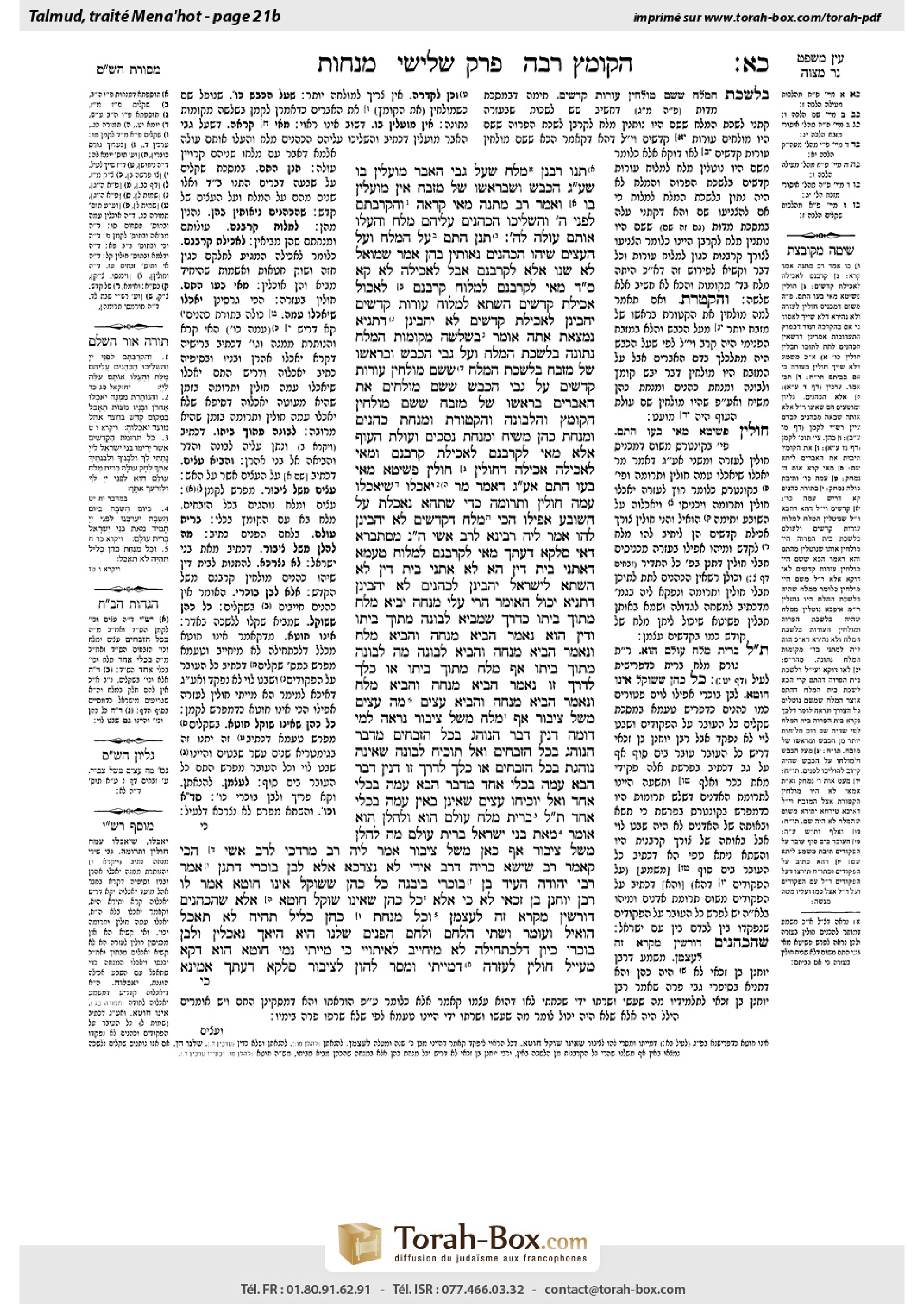
Menachot 21b: Talmud study for Daf Yomi
Daf Yomi is the daily study of one Talmud folio. Explore 37 tractates with scans, Hebrew text, Sefaria English and AI-generated French translations where annotated.
Passage selection and English or AI-generated French translation are available where the scan has annotations. Daf Study is independent of Torah-Box and Sefaria.
Browse Menachot · מנחות · All tractatesMenachot 21b text and translations
This page of Menachot includes the Aramaic text, an English translation and an AI-generated French translation, alongside the scan above.
מנחות כ״א ב · Aramaic and Hebrew text
תָּנוּ רַבָּנַן: מֶלַח שֶׁעַל גַּבֵּי הָאֵבֶר – מוֹעֲלִין בּוֹ, שֶׁעַל גַּבֵּי הַכֶּבֶשׁ וְשֶׁבְּרֹאשׁוֹ שֶׁל מִזְבֵּחַ – אֵין מוֹעֲלִין בּוֹ. (ואמר) [אָמַר] רַב מַתְנָה: מַאי קְרָאָה? ״וְהִקְרַבְתָּם לִפְנֵי ה׳ וְהִשְׁלִיכוּ הַכֹּהֲנִים עֲלֵיהֶם מֶלַח וְהֶעֱלוּ אוֹתָם עֹלָה לַה׳״.
תְּנַן הָתָם: עַל הַמֶּלַח וְעַל הָעֵצִים, שֶׁיְּהוּ הַכֹּהֲנִים נְאוֹתִין בָּהֶן. אָמַר שְׁמוּאֵל: לֹא שָׁנוּ אֶלָּא לְקׇרְבָּנָם, אֲבָל לַאֲכִילָה – לָא.
קָא סָלְקָא דַּעְתִּין, מַאי לְקׇרְבָּנָם – לִמְלוֹחַ קׇרְבָּנָם. לֶאֱכוֹל – אֲכִילַת קָדָשִׁים. הַשְׁתָּא לִמְלוֹחַ עוֹרוֹת קָדָשִׁים יָהֲבִינַן, לַאֲכִילַת קֳדָשִׁים לָא יָהֲבִינַן?
דְּתַנְיָא: נִמְצֵאתָ אַתָּה אוֹמֵר, בִּשְׁלֹשָׁה מְקוֹמוֹת הַמֶּלַח נְתוּנָה: בְּלִשְׁכַּת הַמֶּלַח, וְעַל גַּבֵּי הַכֶּבֶשׁ, וּבְרֹאשׁוֹ שֶׁל מִזְבֵּחַ. בְּלִשְׁכַּת הַמֶּלַח – שֶׁשָּׁם מוֹלְחִין עוֹרוֹת קָדָשִׁים, עַל גַּבֵּי הַכֶּבֶשׁ – שֶׁשָּׁם מוֹלְחִים אֶת הָאֵבָרִים, בְּרֹאשׁוֹ שֶׁל מִזְבֵּחַ – שֶׁשָּׁם מוֹלְחִין הַקּוֹמֶץ וְהַלְּבוֹנָה וְהַקְּטוֹרֶת, וּמִנְחַת כֹּהֲנִים וּמִנְחַת כֹּהֵן מָשִׁיחַ וּמִנְחַת נְסָכִים, וְעוֹלַת הָעוֹף.
אֶלָּא מַאי לְקׇרְבָּנָם – לַאֲכִילַת קׇרְבָּנָם, וּמַאי לַאֲכִילָה – אֲכִילָה דְחוּלִּין.
חוּלִּין, פְּשִׁיטָא! מַאי בָּעוּ הָתָם? אַף עַל גַּב דְּאָמַר מָר ״יֹאכְלוּ״, שֶׁיֹּאכְלוּ עִמָּהּ חוּלִּין וּתְרוּמָה כְּדֵי שֶׁתְּהֵא נֶאֱכֶלֶת עַל הַשּׂוֹבַע, אֲפִילּוּ הָכִי מֶלַח דְּקָדָשִׁים לָא יָהֲבִינַן לְהוּ.
אֲמַר לֵיהּ רָבִינָא לְרַב אָשֵׁי: הָכִי נָמֵי מִסְתַּבְּרָא, דְּאִי סָלְקָא דַּעְתָּךְ מַאי לְקׇרְבָּנָם – לִמְלוֹחַ, טַעְמָא דְּאַתְנִי בֵּית דִּין, הָא לָא אַתְנִי בֵּית דִּין – לָא? הַשְׁתָּא לְיִשְׂרָאֵל יָהֲבִינַן, לְכֹהֲנִים לָא יָהֲבִינַן?
דְּתַנְיָא: יָכוֹל הָאוֹמֵר ״הֲרֵי עָלַי מִנְחָה״ – יָבִיא מֶלַח מִתּוֹךְ בֵּיתוֹ, כְּדֶרֶךְ שֶׁמֵּבִיא לְבוֹנָה מִתּוֹךְ בֵּיתוֹ? וְדִין הוּא: נֶאֱמַר הָבֵיא מִנְחָה וְהָבֵיא מֶלַח, וְנֶאֱמַר הָבֵיא מִנְחָה וְהָבֵיא לְבוֹנָה, מָה לְבוֹנָה מִתּוֹךְ בֵּיתוֹ – אַף מֶלַח מִתּוֹךְ בֵּיתוֹ.
אוֹ כְּלָךְ לְדֶרֶךְ זוֹ: נֶאֱמַר הָבֵיא מִנְחָה וְהָבֵיא מֶלַח, וְנֶאֱמַר הָבֵיא מִנְחָה וְהָבֵיא עֵצִים – מָה עֵצִים מִשֶּׁל צִיבּוּר, אַף מֶלַח מִשֶּׁל צִיבּוּר!
נִרְאֶה לְמִי דּוֹמֶה, דָּנִין דָּבָר הַנּוֹהֵג בְּכׇל הַזְּבָחִים מִדָּבָר הַנּוֹהֵג בְּכׇל הַזְּבָחִים, וְאַל תּוֹכִיחַ לְבוֹנָה שֶׁאֵינָהּ נוֹהֶגֶת בְּכׇל הַזְּבָחִים.
אוֹ כְּלָךְ לְדֶרֶךְ זוֹ: דָּנִין דָּבָר הַבָּא עִמָּהּ בִּכְלִי אֶחָד, מִדָּבָר הַבָּא עִמָּהּ בִּכְלִי אֶחָד, וְאַל יוֹכִיחוּ עֵצִים שֶׁאֵינָן בָּאִין עִמָּהּ בִּכְלִי אֶחָד!
תַּלְמוּד לוֹמַר: ״בְּרִית מֶלַח עוֹלָם הִוא״, וּלְהַלָּן הוּא אוֹמֵר: ״מֵאֵת בְּנֵי יִשְׂרָאֵל בְּרִית עוֹלָם״, מָה לְהַלָּן מִשֶּׁל צִיבּוּר, אַף כָּאן מִשֶּׁל צִיבּוּר.
אֲמַר לֵיהּ רַב מָרְדֳּכַי לְרַב אָשֵׁי: הָכִי קָאָמַר רַב שִׁישָׁא בְּרֵיהּ דְּרַב אִידִי: לֹא נִצְרְכָא אֶלָּא לְבֶן בּוּכְרִי.
דִּתְנַן: אָמַר רַבִּי יְהוּדָה, הֵעִיד בֶּן בּוּכְרִי בְּיַבְנֶה: כׇּל כֹּהֵן שֶׁשּׁוֹקֵל אֵינוֹ חוֹטֵא. אָמַר לוֹ רַבָּן יוֹחָנָן בֶּן זַכַּאי: לֹא כִי, אֶלָּא כׇּל כֹּהֵן שֶׁאֵינוֹ שׁוֹקֵל חוֹטֵא, אֶלָּא שֶׁהַכֹּהֲנִים דּוֹרְשִׁין מִקְרָא זֶה לְעַצְמָן:
״וְכׇל מִנְחַת כֹּהֵן כָּלִיל תִּהְיֶה לֹא תֵאָכֵל״, הוֹאִיל וְעוֹמֶר וּשְׁתֵּי הַלֶּחֶם וְלֶחֶם הַפָּנִים שֶׁלָּנוּ הִיא, הֵיאַךְ נֶאֱכָלִין?
וּלְבֶן בּוּכְרִי, כֵּיוָן דִּלְכַתְּחִילָּה לָא מִיחַיַּיב לְאֵיתוֹיֵי, כִּי מַיְיתֵי נָמֵי חוֹטֵא הוּא, דְּקָא מְעַיֵּיל חוּלִּין לָעֲזָרָה, דְּמַיְיתֵי וּמָסַר לְהוֹן לְצִיבּוּר.
סָלְקָא דַּעְתָּךְ אָמֵינָא:
Menachot 21b · English translation
The Sages taught in a baraita (Tosefta 6:4): With regard to salt that is on the limb of an offering, one who derives benefit from it is liable for misuse of consecrated property, but in the case of salt that is on the ramp or that is on top of the altar, one who derives benefit from it is not liable for misuse of consecrated property. And Rav Mattana said: What is the verse from which it is derived that the salt found upon a sacrificial limb is subject to the halakhot of misuse of consecrated property? The verse states: “And you shall sacrifice them before the Lord, and the priests shall cast salt upon them, and they shall offer them up for a burnt offering to the Lord” (Ezekiel 43:24). In this verse, the limbs, together with the salt, are termed a burnt offering, and therefore the salt on the limb is also subject to the halakhot of misuse of consecrated property.
With regard to the halakha that salt is not subject to the halakhot of misuse of consecrated property, we learned in a mishna elsewhere (Shekalim 7:7): The court instituted an ordinance about the salt and about the wood in the Temple to the effect that the priests may derive benefit from them. Shmuel says: They taught only that the priests may derive benefit from the salt for use on their offerings, but not for eating it.
The Gemara comments: It enters our mind to say: What did Shmuel mean by the expression: For use on their offerings? He meant that the priests were permitted to salt their personal offerings. And when Shmuel states that for the purpose of eating it is not permitted for the priests to derive benefit from the salt, he is referring to adding salt when eating the meat of sacrificial animals, e.g., the portions of the sin offering and guilt offering that are given to the priests. The Gemara challenges this explanation: Now, if we give the priests salt in order to salt the hides of sacrificial animals that are given to the priests to keep, so that they can process them, is it reasonable to rule that we do not give them salt in order to add it when they eat the meat of sacrificial animals?
The Gemara explains its challenge: As it is taught in a baraita (Tosefta 6:2): You are found to be saying that the salt is placed in three locations in the Temple: In the Chamber of the Salt, and on the ramp, and on top of the altar. It is placed in the Chamber of the Salt, since the priests salted there the hides of sacrificial animals that are given to them. It is placed on the ramp, since the priests salted there the sacrificial limbs. It is placed on top of the altar, since the priests salted there the handful of the meal offering, the frankincense, the incense, the meal offering of priests, the meal offering of the anointed priest, the meal offering that accompanies the libations, and the bird burnt offering. Evidently, it was permitted for the priests to add salt to their portions of sacrificial meat.
The Gemara suggests a different explanation of Shmuel’s statement: Rather, what did Shmuel mean by the expression: For use on their offerings? He meant that it is permitted for the priests to add salt when they eat the meat of their offerings, e.g., the portions of the guilt offerings and sin offerings that are given to the priests, as well as when they eat the remainder of the meal offering. And what is meant when Shmuel states that for the purpose of eating it is not permitted for the priests to derive benefit from the salt? He is referring to using the salt for the purpose of eating non-sacred food.
The Gemara objects: Isn’t it obvious that the salt is not to be eaten with non-sacred food? What would non-sacred food be doing there in the Temple courtyard? The Gemara answers: Even though the Master says in the baraita that the verse stated with regard to the meal offering: “And that which is left of it Aaron and his sons shall eat” (Leviticus 6:9), teaching that the priests shall eat non-sacred food and teruma along with the remainder of the meal offering so that the remainder of the meal offering will be eaten in a manner that the priest will be satiated when he finishes eating it, demonstrating that non-sacred food may be brought to the Temple courtyard, even so we do not give them consecrated salt.
Ravina said to Rav Ashi: So too, it is reasonable to explain that Shmuel’s explanation of the mishna in Shekalim is that the ordinance of the court permitted the priests to eat the salt with sacrificial foods. As, if it enters your mind to say: What did Shmuel mean by the expression: For use on their offerings? He meant that the priests were permitted to salt their personal offerings; then one must extrapolate from the mishna that the reason this is permitted is that the court stipulated that it should be, but had the court not stipulated this, it would not be permitted. That cannot be, as now that we give salt to Israelites to salt their offerings, will we not give salt to priests for the same purpose?
As it is taught in a baraita that we provide salt for the offerings of Israelites: One might have thought that one who says: It is incumbent upon me to bring a meal offering, must bring salt from his home, i.e., his own salt, to salt the handful that is burned on the altar, just as he brings frankincense from his home for his meal offering. And this would seem to be a logical inference: It is stated in the Torah that one shall bring a meal offering, and it is stated that one shall bring salt, as it is written: “And every meal offering of yours you shall season with salt” (Leviticus 2:13); and it is stated that one shall bring a meal offering, and it is stated that one shall bring frankincense. Therefore, just as one brings frankincense from his home, as it is written: “And put frankincense on it. And he shall bring it to Aaron’s sons the priests” (Leviticus 2:1–2), so too, one must bring salt from his home.
Or perhaps, go this way: It is stated in the Torah that one shall bring a meal offering and that one shall bring salt, and it is stated that one shall bring a meal offering and that one shall bring wood, as the meal offering cannot be burned on the altar without the wood. Therefore, just as the wood comes from communal supplies, so too, the salt shall come from communal supplies.
The baraita continues: Let us see to which salt is more similar, i.e., which comparison seems more reasonable: We derive the halakha of salt, which is a matter that applies to all offerings, from the halakha of wood, which is also a matter that applies to all offerings. And do not let the halakha of frankincense prove otherwise, as it does not apply to all offerings, only to the meal offerings.
Or perhaps, go this way: We derive the halakha of salt, which is a matter that accompanies the meal offering in one vessel, from the halakha of frankincense, which is also a matter that accompanies the meal offering in one vessel. And do not let the halakha of wood prove otherwise, as it does not accompany the meal offering in one vessel.
The baraita continues: The verse states: “It is an everlasting covenant of salt” (Numbers 18:19), and there, with regard to the shewbread, it states: “It is from the children of Israel, an everlasting covenant” (Leviticus 24:8); Therefore, just as the phrase written there: “From the children of Israel, an everlasting covenant,” means that it is brought from communal supplies, as the shewbread is a communal offering, so too here, the verse that speaks of the everlasting covenant of salt means that the salt is brought from communal supplies. Evidently, salt is provided for offerings of Israelites, and should likewise be provided for the offerings of priests. Accordingly, there would have been no need for the court to permit the priests to salt their offerings, and it must be that the ordinance of the court permitted the priests to use salt when eating sacrificial foods.
Rav Mordekhai said to Rav Ashi: This is what Rav Sheisha, son of Rav Idi, says: The initial understanding of Shmuel’s interpretation of the mishna is correct, i.e., that the ordinance of the court permitted the priests to salt their offerings; and the ruling of the mishna is necessary only according to the opinion of ben Bukhri, who holds that priests are not obligated to contribute a yearly half-shekel to purchase the communal supplies.
As we learned in a mishna (Shekalim 1:4): Rabbi Yehuda said that ben Bukhri testified in Yavne: Any priest who contributes his shekel is not considered a sinner, despite the fact that he is not obligated to do so. Rabbi Yehuda added that Rabban Yoḥanan ben Zakkai said to ben Bukhri: That is not the case; rather, any priest who does not contribute his shekel is considered a sinner, as they are obligated in this mitzva like all other Jews. But the priests who do not contribute the shekel interpret this following verse to their own advantage in order to excuse themselves from the mitzva.
The verse states: “And every meal offering of the priest shall be wholly made to smoke; it shall not be eaten” (Leviticus 6:16). Those priests claim as follows: Since the omer offering and the two loaves, i.e., the public offering of two loaves from the new wheat, brought on the festival of Shavuot, and the shewbread placed on the Table in the Sanctuary each Shabbat, which are all meal offerings, are ours, then if we contribute shekels we will have partial ownership of these communal offerings, as they are purchased with the shekels. How, then, can they be eaten? They would then be regarded as priests’ meal offerings, which must be wholly burned.
The Gemara clarifies: But according to the opinion of ben Bukhri, why is a priest who contributes a half-shekel not considered a sinner? Since he is not obligated to bring it ab initio, when he brings the half-shekel he is also a sinner, since he is causing the bringing of a non-sacred item into the Temple courtyard. He is not contributing the half-shekel as part of the communal offering, as he is exempt from this obligation. Therefore, his donation is the donation of an individual, and a communal offering cannot be brought on behalf of an individual. His donation should disqualify all offerings brought from the communal funds. The Gemara answers: The priest brings and transfers the half-shekel to the community, so it is considered part of the communal funds.
The Gemara states the relevance of the opinion of ben Bukhri to the statement of Shmuel: According to the opinion of ben Bukhri it might enter your mind to say that
Menachot 21b · Traduction française (IA)
Les Sages ont enseigné dans une baraïta (Tossefta 6:4) : Celui qui tire profit du sel qui se trouve sur un membre d’un sacrifice est passible pour détournement de biens consacrés. En revanche, celui qui tire profit du sel qui se trouve sur la rampe ou au sommet de l’autel n’est pas passible pour détournement de biens consacrés. Rav Mattana a dit : De quel verset apprend-on que le sel qui se trouve sur un membre sacrificiel est soumis aux règles du détournement de biens consacrés ? Le verset dit : « Vous les présenterez devant le Seigneur, les prêtres jetteront du sel sur eux, puis ils les offriront en holocauste au Seigneur » (Ézéchiel 43:24). Dans ce verset, les membres, avec le sel, sont désignés comme un holocauste ; le sel qui se trouve sur un membre est donc lui aussi soumis aux règles du détournement de biens consacrés.
Concernant la halakha selon laquelle le sel n’est pas soumis aux règles du détournement de biens consacrés, nous avons appris dans une Michna, ailleurs (Shekalim 7:7) : Le tribunal a institué une ordonnance au sujet du sel et du bois du Temple, selon laquelle les prêtres peuvent en tirer profit. Shmuel dit : Les Sages ont enseigné que les prêtres peuvent tirer profit du sel pour leurs sacrifices, mais pas pour en manger.
La Guemara fait remarquer : On pourrait se demander ce que Shmuel entend par l’expression « pour leurs sacrifices ». Il veut dire que les prêtres sont autorisés à saler leurs sacrifices personnels. Et lorsque Shmuel affirme que les prêtres ne peuvent pas tirer profit du sel pour en manger, il parle du sel que l’on ajoute lorsqu’on mange la viande des animaux sacrifiés, par exemple les portions du sacrifice expiatoire et du sacrifice de culpabilité qui reviennent aux prêtres. La Guemara conteste cette explication : Si nous donnons aux prêtres du sel pour saler les peaux des animaux sacrifiés qui leur sont attribuées afin qu’ils puissent les apprêter, est-il raisonnable de décider que nous ne leur donnons pas de sel à ajouter lorsqu’ils mangent la viande des animaux sacrifiés ?
La Guemara explique son objection : Comme il est enseigné dans une baraïta (Tossefta 6:2) : On en conclut que le sel est placé à trois endroits dans le Temple : dans la Chambre du Sel, sur la rampe et au sommet de l’autel. Il est placé dans la Chambre du Sel, car les prêtres y salent les peaux des animaux sacrifiés qui leur sont attribuées. Il est placé sur la rampe, car les prêtres y salent les membres sacrificiels. Il est placé au sommet de l’autel, car les prêtres y salent la poignée de l’offrande de farine, l’encens, l’encens aromatique, l’offrande de farine des prêtres, l’offrande de farine du prêtre oint, l’offrande de farine qui accompagne les libations et l’holocauste d’oiseau. Il est donc évident que les prêtres étaient autorisés à ajouter du sel à leurs portions de viande sacrificielle.
La Guemara propose une autre explication de la déclaration de Shmuel : Que veut-il dire par l’expression « pour leurs sacrifices » ? Il veut dire que les prêtres sont autorisés à ajouter du sel lorsqu’ils mangent la viande de leurs sacrifices, par exemple les portions des sacrifices de culpabilité et des sacrifices expiatoires qui leur sont attribuées, ainsi que lorsqu’ils mangent le reste de l’offrande de farine. Et que veut dire Shmuel lorsqu’il affirme que les prêtres ne peuvent pas tirer profit du sel pour en manger ? Il parle de l’utilisation du sel pour manger des aliments profanes.
La Guemara objecte : N’est-il pas évident qu’il ne faut pas manger le sel avec des aliments profanes ? Que feraient des aliments profanes dans la cour du Temple ? La Guemara répond : Même si le Maître dit dans la baraïta que le verset concernant l’offrande de farine — « Ce qui en restera, Aaron et ses fils le mangeront » (Lévitique 6:9) — enseigne que les prêtres doivent manger des aliments profanes et de la terouma avec le reste de l’offrande de farine, afin que celui-ci soit consommé de telle sorte que le prêtre soit rassasié à la fin du repas, ce qui montre que des aliments profanes peuvent être apportés dans la cour du Temple, nous ne leur donnons tout de même pas de sel consacré.
Ravina dit à Rav Ashi : Il est également raisonnable d’expliquer que, selon Shmuel, la Michna de Shekalim signifie que l’ordonnance du tribunal a autorisé les prêtres à manger du sel avec les aliments sacrificiels. En effet, si l’on pensait que, par l’expression « pour leurs sacrifices », Shmuel voulait dire que les prêtres étaient autorisés à saler leurs sacrifices personnels, il faudrait déduire de la Michna que cela est permis parce que le tribunal l’a stipulé ; sans cette stipulation, cela ne serait pas permis. Or, cela ne peut pas être : puisque nous donnons du sel aux Israélites pour saler leurs sacrifices, n’en donnerions-nous pas aux prêtres dans le même but ?
Car une baraïta enseigne que nous fournissons du sel pour les sacrifices des Israélites : On aurait pu penser que celui qui dit : « Je m’engage à apporter une offrande de farine » doit apporter de chez lui son propre sel pour saler la poignée qui est brûlée sur l’autel, tout comme il apporte de chez lui l’encens pour son offrande de farine. Cette déduction semblerait logique : la Torah dit qu’on doit apporter une offrande de farine, et elle dit qu’on doit apporter du sel, comme il est écrit : « Tu assaisonneras de sel toute offrande de farine que tu présenteras » (Lévitique 2:13) ; elle dit aussi qu’on doit apporter une offrande de farine et de l’encens. Par conséquent, de même qu’on apporte l’encens de chez soi, comme il est écrit : « Tu y mettras de l’encens. Puis il l’apportera aux fils d’Aaron, les prêtres » (Lévitique 2:1–2), de même doit-on apporter le sel de chez soi.
Ou peut-être faut-il raisonner ainsi : la Torah dit qu’on doit apporter une offrande de farine et du sel, et qu’on doit apporter une offrande de farine et du bois, puisque l’offrande de farine ne peut être brûlée sur l’autel sans bois. Par conséquent, de même que le bois provient des réserves communautaires, le sel doit lui aussi provenir des réserves communautaires.
La baraïta poursuit : Examinons à quoi le sel ressemble le plus, c’est-à-dire quelle comparaison paraît la plus raisonnable : nous déduisons la halakha du sel, qui concerne tous les sacrifices, de celle du bois, qui concerne également tous les sacrifices. Et que la halakha de l’encens ne serve pas à réfuter cette déduction, car elle ne concerne pas tous les sacrifices, mais seulement les offrandes de farine.
Ou peut-être faut-il raisonner ainsi : nous déduisons la halakha du sel, qui accompagne l’offrande de farine dans un même récipient, de celle de l’encens, qui accompagne elle aussi l’offrande de farine dans un même récipient. Et que la halakha du bois ne serve pas à réfuter cette déduction, car le bois n’accompagne pas l’offrande de farine dans un même récipient.
La baraïta poursuit : Le verset dit : « C’est une alliance de sel perpétuelle » (Nombres 18:19), et, à propos des pains de proposition, il est dit : « De la part des enfants d’Israël, une alliance perpétuelle » (Lévitique 24:8). Par conséquent, de même que l’expression écrite là, « de la part des enfants d’Israël, une alliance perpétuelle », signifie que les pains de proposition proviennent des réserves communautaires, puisqu’il s’agit d’une offrande communautaire, de même, ici, le verset parlant de l’alliance de sel perpétuelle signifie que le sel provient des réserves communautaires. Il est donc évident que le sel est fourni pour les sacrifices des Israélites et qu’il devrait également être fourni pour ceux des prêtres. Le tribunal n’aurait donc pas eu besoin d’autoriser les prêtres à saler leurs sacrifices ; il faut donc comprendre que son ordonnance les a autorisés à utiliser du sel lorsqu’ils mangeaient des aliments sacrificiels.
Rav Mordekhaï dit à Rav Ashi : Voici ce que dit Rav Sheisha, fils de Rav Idi : La compréhension initiale de l’interprétation de Shmuel concernant la Michna est correcte, à savoir que l’ordonnance du tribunal a autorisé les prêtres à saler leurs sacrifices. La décision de la Michna n’est nécessaire que selon l’opinion de ben Bukhri, qui estime que les prêtres ne sont pas tenus de contribuer au demi-sicle annuel destiné à l’achat des réserves communautaires.
Comme nous l’avons appris dans une Michna (Shekalim 1:4) : Rabbi Yehouda a dit que ben Bukhri a témoigné à Yavné : Tout prêtre qui apporte son sicle n’est pas considéré comme un pécheur, bien qu’il n’y soit pas obligé. Rabbi Yehouda ajouta que Rabban Yoḥanan ben Zakkaï dit à ben Bukhri : Ce n’est pas le cas ; au contraire, tout prêtre qui n’apporte pas son sicle est considéré comme un pécheur, car les prêtres sont tenus d’accomplir cette mitsva comme tous les autres Juifs. Mais les prêtres qui ne contribuent pas au sicle interprètent à leur avantage le verset suivant afin de se soustraire à cette mitsva.
Le verset dit : « Toute offrande de farine du prêtre sera entièrement consumée par le feu ; elle ne sera pas mangée » (Lévitique 6:16). Ces prêtres prétendent ceci : puisque l’offrande de l’omer, les deux pains — c’est-à-dire l’offrande publique de deux pains faits avec le blé nouveau, apportée à la fête de Chavouot — et les pains de proposition déposés chaque Chabbat sur la Table dans le Sanctuaire sont tous des offrandes de farine qui nous appartiennent, si nous contribuons en apportant des sicles, nous aurons une part de propriété dans ces offrandes communautaires, puisqu’elles sont achetées avec les sicles. Comment pourraient-elles alors être mangées ? Elles seraient alors considérées comme des offrandes de farine des prêtres, qui doivent être entièrement brûlées.
La Guemara précise : Mais selon l’opinion de ben Bukhri, pourquoi un prêtre qui apporte un demi-sicle n’est-il pas considéré comme un pécheur ? Puisqu’il n’est pas tenu de l’apporter à l’origine, il est également un pécheur lorsqu’il apporte le demi-sicle, car il fait entrer un bien profane dans la cour du Temple. Il ne contribue pas au demi-sicle dans le cadre de l’offrande communautaire, puisqu’il est exempt de cette obligation. Son don est donc un don individuel, et une offrande communautaire ne peut être apportée au nom d’un individu. Son don devrait invalider toutes les offrandes apportées avec les fonds communautaires. La Guemara répond : Le prêtre apporte le demi-sicle et le transfère à la communauté ; il est donc considéré comme faisant partie des fonds communautaires.
La Guemara expose la pertinence de l’opinion de ben Bukhri pour la déclaration de Shmuel : Selon l’opinion de ben Bukhri, on pourrait penser que
Traduction française générée par IA à partir de l’édition anglaise de Sefaria. Vérifie toujours un passage avec le texte source.
Text from Sefaria: William Davidson Edition - Vocalized Aramaic (unknown); William Davidson Edition - English (CC BY NC).