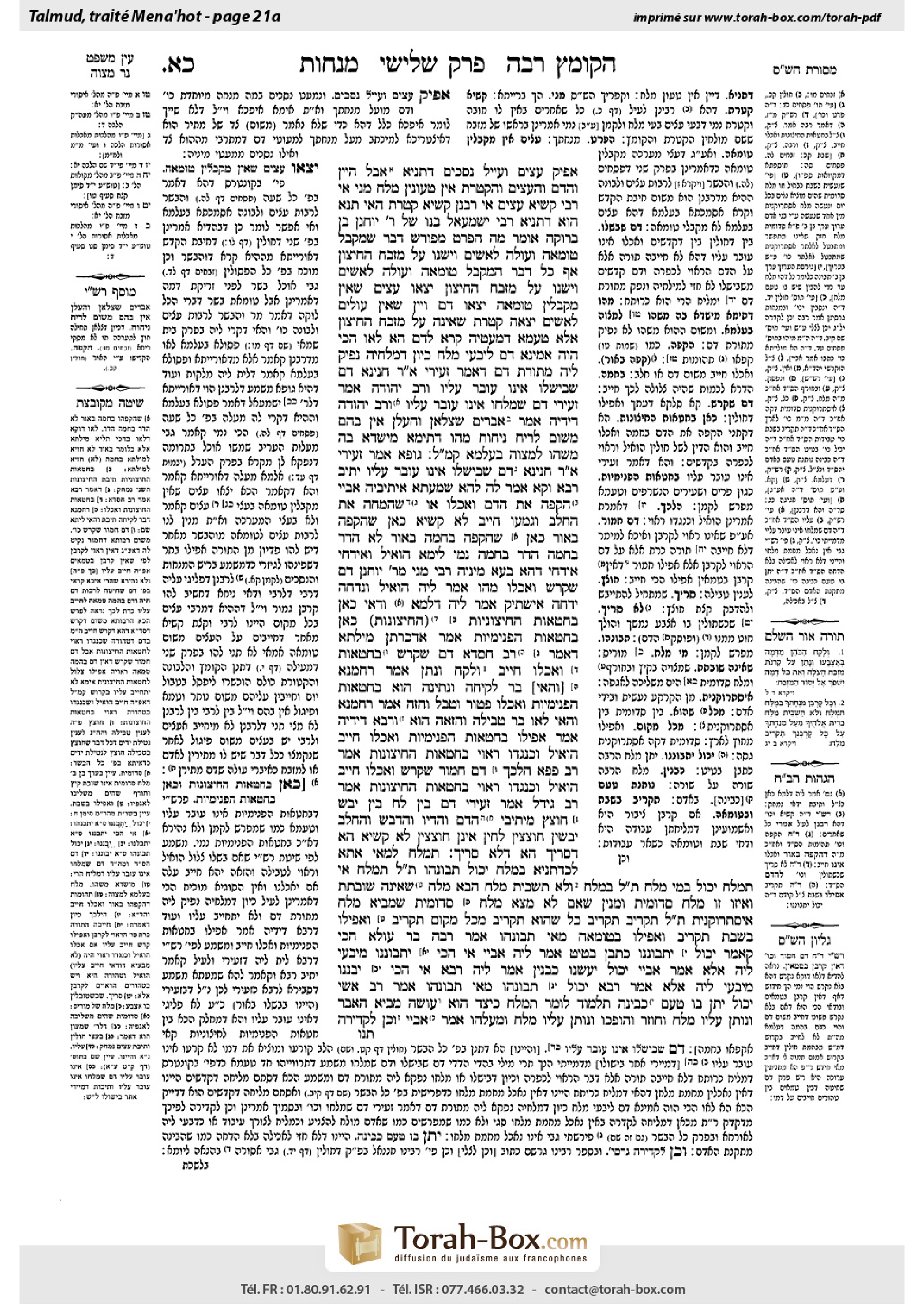
Menachot 21a: Talmud study for Daf Yomi
Daf Yomi is the daily study of one Talmud folio. Explore 37 tractates with scans, Hebrew text, Sefaria English and AI-generated French translations where annotated.
Passage selection and English or AI-generated French translation are available where the scan has annotations. Daf Study is independent of Torah-Box and Sefaria.
Browse Menachot · מנחות · All tractatesMenachot 21a text and translations
This page of Menachot includes the Aramaic text, an English translation and an AI-generated French translation, alongside the scan above.
מנחות כ״א א · Aramaic and Hebrew text
אַפֵּיק עֵצִים וְעַיֵּיל נְסָכִים, דְּתַנְיָא: אֲבָל הַיַּיִן וְהַדָּם וְהָעֵצִים וְהַקְּטֹרֶת אֵין טְעוּנִין מֶלַח.
מַנִּי? אִי רַבִּי – קַשְׁיָא עֵצִים, אִי רַבָּנַן – קַשְׁיָא קְטֹרֶת.
הַאי תַּנָּא הוּא, דְּתַנְיָא: רַבִּי יִשְׁמָעֵאל בְּנוֹ שֶׁל רַבִּי יוֹחָנָן בֶּן בְּרוֹקָה אוֹמֵר: מָה הַפְּרָט מְפוֹרָשׁ – דָּבָר שֶׁמְּקַבֵּל טוּמְאָה, וְעוֹלֶה לָאִשִּׁים, וְיֶשְׁנוֹ עַל מִזְבֵּחַ הַחִיצוֹן, אַף כׇּל דָּבָר הַמְקַבֵּל טוּמְאָה וְעוֹלֶה לָאִשִּׁים וְיֶשְׁנוֹ עַל מִזְבֵּחַ הַחִיצוֹן.
יָצְאוּ עֵצִים – שֶׁאֵין מְקַבְּלִין טוּמְאָה, יָצְאוּ דָּם וָיַיִן – שֶׁאֵין עוֹלִים לָאִשִּׁים, יָצְאָה קְטֹרֶת – שֶׁאֵינָהּ עַל מִזְבֵּחַ הַחִיצוֹן.
אֶלָּא טַעְמָא דְּמַעֲטֵיהּ קְרָא לְדָם, הָא לָאו הָכִי הֲוָה אָמֵינָא דָּם לִיבְעֵי מֶלַח? כֵּיוָן דְּמַלְחֵיהּ נָפֵיק לֵיהּ מִתּוֹרַת דָּם, דְּאָמַר זְעֵירִי אָמַר רַבִּי חֲנִינָא: דָּם שֶׁבִּישְּׁלוֹ אֵינוֹ עוֹבֵר עָלָיו, וְרַב יְהוּדָה אָמַר זְעֵירִי: דָּם שֶׁמְּלָחוֹ אֵינוֹ עוֹבֵר עָלָיו.
וְרַב יְהוּדָה דִּידֵיהּ אָמַר: אֵבָרִים שֶׁצְּלָאָן וְהֶעֱלָן, אֵין בָּהֶם מִשּׁוּם ״לְרֵיחַ נִיחוֹחַ״.
מַהוּ דְּתֵימָא: מִישְׁדֵּא בַּהּ מַשֶּׁהוּ לְמִצְוָה בְּעָלְמָא – קָא מַשְׁמַע לַן.
גּוּפָא, אָמַר זְעֵירִי אָמַר רַבִּי חֲנִינָא: דָּם שֶׁבִּישְּׁלוֹ אֵינוֹ עוֹבֵר עָלָיו. יָתֵיב רָבָא וְקָא אָמַר לַהּ לְהָא שְׁמַעְתָּא, אֵיתִיבֵיהּ אַבָּיֵי: הִקְפָּה אֶת הַדָּם וַאֲכָלוֹ, אוֹ שֶׁהִמְחָה אֶת הַחֵלֶב וּגְמָעוֹ – חַיָּיב.
לָא קַשְׁיָא, כָּאן שֶׁהִקְפָּה בָּאוּר, כָּאן שֶׁהִקְפָּה בַּחַמָּה. בְּאוּר – לָא הָדַר, בַּחַמָּה – הָדַר.
בַּחַמָּה נָמֵי לֵימָא: הוֹאִיל וְאִידְּחִי אִידְּחִי, דְּהָא בְּעָא מִינֵּיהּ רַבִּי מָנִי מֵרַבִּי יוֹחָנָן: דָּם שֶׁקָּרַשׁ וַאֲכָלוֹ, מַהוּ? אֲמַר לֵיהּ: הוֹאִיל וְנִדְחָה יִדָּחֶה. אִישְׁתִּיק.
אֲמַר לֵיהּ: דִּלְמָא וַדַּאי, כָּאן בְּחַטָּאוֹת הַחִיצוֹנִיּוֹת, כָּאן בְּחַטָּאוֹת הַפְּנִימִיּוֹת!
אֲמַר, אַדְכַּרְתַּן מִילְּתָא דְּאָמַר רַב חִסְדָּא: דָּם שֶׁקָּרַשׁ בְּחַטָּאוֹת וַאֲכָלוֹ – חַיָּיב, ״וְלָקַח וְנָתַן״ אָמַר רַחֲמָנָא, בַּר לְקִיחָה וּנְתִינָה הוּא. בְּחַטָּאוֹת הַפְּנִימִיּוֹת וַאֲכָלוֹ – פָּטוּר, ״וְטָבַל וְהִזָּה״ אָמַר רַחֲמָנָא, וְהַאי לָאו בַּר טְבִילָה וְהַזָּאָה הוּא.
וְרָבָא דִּידֵיהּ אָמַר: אֲפִילּוּ בְּחַטָּאוֹת הַפְּנִימִיּוֹת וַאֲכָלוֹ – חַיָּיב, הוֹאִיל וּכְנֶגְדּוֹ רָאוּי בְּחַטָּאוֹת הַחִיצוֹנוֹת. אָמַר רַב פָּפָּא: הִלְכָּךְ דָּם חֲמוֹר שֶׁקָּרַשׁ וַאֲכָלוֹ – חַיָּיב, הוֹאִיל וּכְנֶגְדּוֹ רָאוּי בְּחַטָּאוֹת הַחִיצוֹנוֹת.
אָמַר רַב גִּידֵּל, אָמַר זְעֵירִי: דָּם, בֵּין לַח בֵּין יָבֵשׁ, חוֹצֵץ. מֵיתִיבִי: הַדָּם וְהַדְּיוֹ וְהַדְּבַשׁ וְהֶחָלָב, יְבֵשִׁין – חוֹצְצִין, לַחִין – אֵינָן חוֹצְצִין. לָא קַשְׁיָא, הָא דְּסָרֵיךְ, הָא דְּלָא סָרֵיךְ.
״תִּמְלָח״, לְמַאי אֲתָא? לְכִדְתַנְיָא: ״בַּמֶּלַח״ – יָכוֹל תְּבוֹנֵהוּ? תַּלְמוּד לוֹמַר: ״תִּמְלָח״. אִי ״תִּמְלָח״ – יָכוֹל בְּמֵי מֶלַח? תַּלְמוּד לוֹמַר: ״בַּמֶּלַח״.
״וְלֹא תַשְׁבִּית מֶלַח״ – הָבֵא מֶלַח שֶׁאֵינָהּ שׁוֹבֶתֶת, וְאֵיזוֹ זוֹ? מֶלַח סְדוֹמִית. וּמִנַּיִן שֶׁאִם לֹא מָצָא מֶלַח סְדוֹמִית שֶׁמֵּבִיא מֶלַח אִיסְתְּרוֹקָנִית? תַּלְמוּד לוֹמַר ״תַּקְרִיב״ – ״תַּקְרִיב״ כׇּל שֶׁהוּא, ״תַּקְרִיב״ מִכׇּל מָקוֹם, ״תַּקְרִיב״ וַאֲפִילּוּ בְּשַׁבָּת, ״תַּקְרִיב״ וַאֲפִילּוּ בְּטוּמְאָה.
מַאי ״תְּבוֹנֵהוּ״? אָמַר רַבָּה בַּר עוּלָּא: הָכִי קָאָמַר, יָכוֹל יִתְבּוֹנֶנּוּ כְּתֶבֶן בְּטִיט. אֲמַר לֵיהּ אַבָּיֵי: אִי הָכִי, ״יִתְבּוֹנֶנּוּ״ מִיבְּעֵי לֵיהּ! אֶלָּא אָמַר אַבָּיֵי: יָכוֹל יַעֲשֶׂנּוּ כְּבִנְיָן. אֲמַר לֵיהּ רָבָא: אִי הָכִי, ״יִבְנֶנּוּ״ מִיבְּעֵי לֵיהּ! אֶלָּא אָמַר רָבָא: יָכוֹל תְּבוּנֵהוּ.
מַאי ״תְּבוּנֵהוּ״? אָמַר רַב אָשֵׁי: יָכוֹל יִתֵּן בּוֹ טַעַם כְּבִינָה? תַּלְמוּד לוֹמַר: ״תִּמְלָח״. כֵּיצַד הוּא עוֹשֶׂה? מֵבִיא הָאֵבֶר וְנוֹתֵן עָלָיו מֶלַח, וְחוֹזֵר וְהוֹפְכוֹ וְנוֹתֵן עָלָיו מֶלַח, וּמַעֲלֵהוּ.
אָמַר אַבָּיֵי: וְכֵן לִקְדֵירָה.
Menachot 21a · English translation
The Gemara responds: Wood is removed from the baraita, and insert in its place wine libations, teaching that they do not require the addition of salt. As it is taught in a baraita: But the wine libations and the blood, and the wood and the incense, do not require salt.
The Gemara asks: In accordance with whose opinion is this baraita? If you say it is in accordance with the opinion of Rabbi Yehuda HaNasi, the ruling of the baraita concerning wood is difficult, as the baraita rules that wood does not require salt, whereas Rabbi Yehuda HaNasi holds that wood does require salt. If you say it is the opinion of the Rabbis, the ruling of the baraita concerning incense is difficult, as they taught in the baraita on 20a that any item for which another item is necessary requires salt, and this includes the incense, which is burned with wood.
The Gemara suggests: The baraita is in accordance with this following tanna, who explains the verse that was interpreted in the baraita in a different manner. As it is taught in a baraita: Rabbi Yishmael, son of Rabbi Yoḥanan ben Beroka, says: The verse states: “And every meal offering of yours you shall season with salt” (Leviticus 2:13). Just as the specified detail, i.e., the meal offering, is an item that is susceptible to ritual impurity, and is brought on the fire of the altar, and is sacrificed on the external altar, so too, any item that is susceptible to ritual impurity, and is brought on the fire of the altar, and is sacrificed on the external altar requires salting.
Therefore, wood is excluded, as it is not susceptible to ritual impurity. Wine and blood are excluded, as they are not brought on the fire of the altar but rather are sprinkled on the corner of the altar. The incense is excluded, as it is sacrificed not on the external altar but rather on the inner altar.
The Gemara asks: But how can it be that according to all opinions, the reason that blood does not require salting is that the verse excluded blood, indicating that if not for that, I would say that blood requires salt? Once one salts the blood, it exits the category of blood, as Ze’eiri says that Rabbi Ḥanina says: With regard to blood that one cooked, one does not transgress the prohibition against consuming blood by drinking it, since it no longer has the status of blood that is fit to be presented on the altar. And Rav Yehuda says that Ze’eiri says: With regard to blood that one salted, one does not transgress a prohibition by drinking it, since salted blood has the status of cooked blood.
And similarly, Rav Yehuda himself says: With regard to the limbs of a burnt offering that one first roasted and afterward brought them up to the altar, they do not constitute fulfillment of the requirement of the verse that an offering be “an aroma pleasing to the Lord” (Exodus 29:25).
The Gemara answers: It is still necessary to derive that blood does not require salt, lest you say that the priest should sprinkle any amount of salt, even a minute quantity, on the blood, merely for the fulfillment of the mitzva, as such an amount would not render the blood as cooked. To counter this, the verse teaches us that blood requires no application of salt.
§ The Gemara discusses the matter itself: Ze’eiri says that Rabbi Ḥanina says: With regard to blood that one cooked, one does not transgress a prohibition by drinking it. Rava was sitting and saying this halakha. Abaye raised an objection to him from a baraita (Tosefta, Karetot 2:19): If one curdled blood and consumed it, or in a case where one melted forbidden fat and swallowed it, even though he changed its form, he is liable. This demonstrates that even after its form is changed, the blood’s status remains unchanged.
Rava responded: This is not difficult, as here, Ze’eiri’s statement relates to a case where he curdled the blood by means of the fire, whereas there, in the case of the baraita, he curdled the blood by means of the sun. Blood curdled by means of a fire cannot return to its former state, so one is not liable, whereas blood curdled by means of the sun can return to its former state, so one is liable.
Abaye objected: But even when blood is curdled by means of the sun, let us say that since it was disqualified from being presented on the altar, it was disqualified, i.e., excluded, from the prohibition against consuming blood; as Rabbi Mani inquired of Rabbi Yoḥanan: With regard to blood that was congealed and one ate it, what is the halakha? Rabbi Yoḥanan responded: He is not liable; since it was disqualified from being presented on the altar, it shall be disqualified from the prohibition against consuming blood. Rava was silent and had no answer.
Abaye said to him: Perhaps here the baraita is certainly referring to the blood of the external sin offerings, which is sprinkled on the external altar in the Temple courtyard, whereas there Ze’eiri is referring to the blood of the inner sin offerings, which is sprinkled inside the Sanctuary.
Rava said to him: You have reminded me of a matter, as Rabbi Ḥisda says: With regard to blood that became congealed, if it is blood of the external sin offerings and one ate it, he is liable, as the Merciful One states in the Torah: “And the priest shall take of the blood of the sin offering with his finger, and place it upon the corners of the altar of burnt offering” (Leviticus 4:25), and congealed blood is suitable for taking and placing, as one can take the congealed blood and place it upon the altar. By contrast, if it is blood of the inner sin offerings and one ate it, he is exempt, as the Merciful One states in the Torah: “And the priest shall dip his finger in the blood, and sprinkle of the blood” (Leviticus 4:6), and this congealed blood is not suitable for dipping and sprinkling.
And Rava himself says: Even if there was blood of the inner sin offerings and one ate it, he is liable, since blood corresponding to this blood is suitable to be placed on the altar in the case of the external sin offerings. Rav Pappa says: Therefore, according to the same reasoning, in the case of the blood of a donkey that became congealed and one ate it, he is liable, despite the fact that a donkey’s blood is not fit to be brought as an offering, since blood corresponding to this blood is suitable to be placed on the altar in the case of the external sin offerings.
In the context of the halakhot of blood, Rav Giddel says that Ze’eiri says: Blood, whether moist or dry, interposes during ritual immersion. The Gemara raises an objection from a baraita (Tosefta, Mikvaot 6:9): With regard to blood, ink, honey, or milk on a person’s skin, when they are dry, they interpose during immersion; but when they are moist, they do not interpose. The Gemara explains: This is not difficult; this statement of Rav Giddel is referring to a case where the blood adheres to the skin, as it has begun to congeal and therefore interposes. That baraita is referring to a case where the blood did not adhere and therefore does not interpose.
§ The Gemara returns to its interpretation of the verse: “And every meal offering of yours you shall season with salt” (Leviticus 2:13), and asks: For what purpose does the expression “you shall season” come? The Gemara answers: It is written for that which is taught in a baraita: Had the verse stated only: And every meal offering of yours shall be with salt, one might have thought that the halakha is tevonehu, a term that will be explained in the Gemara. Therefore, the verse states: “You shall season.” Conversely, had the verse stated only: “You shall season,” one might have thought that this obligation can be fulfilled by means of adding salt water. Therefore, the verse states “with salt.”
The continuation of the verse: “And you shall not omit [tashbit] salt from your meal offering,” teaches that one should bring salt that never rests [shovetet], i.e., it is found continuously. And what type of salt is this? This is referring to salt of Sodom. And from where is it derived that if one did not find salt of Sodom that he should bring salt of istrokanit, which is quarried from rock? The verse states immediately afterward: “With all your offerings you shall sacrifice salt” (Leviticus 2:13), in order to emphasize that you should sacrifice any type of salt; you should sacrifice salt from any place, even from a location outside of Eretz Yisrael; you should sacrifice salt even on Shabbat; and you should sacrifice salt even in a state of ritual impurity.
The Gemara clarifies: What is the meaning of the term tevonehu? Rabba bar Ulla said: This is what the baraita is saying: One might have thought that one should mix into it [yitabonenu] large quantities of salt, just as one mixes straw [teven] into clay. Abaye said to him: If so, the baraita should have said: Yitabonenu, and not tevonehu. Rather, Abaye said: The baraita is saying that one might have thought one should form the addition of salt just as one builds a building [binyan], by adding layer upon layer. Rava said to him: If so, the baraita should have said: He should build it [yivnenu] and not tevonehu. Rather, Rava said: The baraita states: One might have thought tevonehu.
The Gemara asks: What is meant by tevonehu? Rav Ashi said: One might have thought that one should infuse the entire offering with the taste of salt, just as understanding [bina] infuses a person with wisdom. To counter this, the verse states: “You shall season.” How does he act? He brings the limb that is to be sacrificed on the altar and applies salt, and then turns it over and again applies salt, and brings it up to the altar.
Abaye says: And one acts similarly before placing meat into a pot. If one wishes to cook meat and needs to salt it in order to extract its blood, it is sufficient to apply salt to both sides and let it sit until the blood drains. Then, after it is washed, the meat is ready to be cooked and eaten.
Menachot 21a · Traduction française (IA)
La Guemara répond : On retire le bois de la baraïta et on le remplace par les libations de vin, pour enseigner qu’elles ne nécessitent pas l’ajout de sel. En effet, il est enseigné dans une baraïta : les libations de vin, le sang, le bois et l’encens ne nécessitent pas de sel.
La Guemara demande : De l’avis de quel tanna cette baraïta relève-t-elle ? Si tu dis qu’elle est conforme à l’opinion de Rabbi Yehouda HaNassi, la décision de la baraïta au sujet du bois pose difficulté, car elle statue que le bois ne nécessite pas de sel, tandis que Rabbi Yehouda HaNassi estime que le bois en nécessite. Si tu dis qu’elle reflète l’opinion des Sages, la décision de la baraïta concernant l’encens pose difficulté, car ils ont enseigné dans la baraïta, en 20a, que tout élément pour lequel un autre élément est nécessaire requiert du sel ; cela inclut l’encens, qui est brûlé avec du bois.
La Guemara propose : La baraïta suit l’opinion du tanna suivant, qui interprète le verset commenté dans la baraïta d’une autre manière. En effet, il est enseigné dans une baraïta : Rabbi Yishmaël, fils de Rabbi Yoḥanan ben Beroka, dit : Le verset déclare : « Vous salerez de sel toute votre offrande végétale » (Lévitique 2,13). De même que l’élément explicitement mentionné, c’est-à-dire l’offrande végétale, est susceptible d’impureté rituelle, est porté sur le feu de l’autel et est offert sur l’autel extérieur, de même tout élément susceptible d’impureté rituelle, porté sur le feu de l’autel et offert sur l’autel extérieur nécessite d’être salé.
Le bois est donc exclu, car il n’est pas susceptible d’impureté rituelle. Le vin et le sang sont exclus, car ils ne sont pas portés sur le feu de l’autel, mais aspergés sur l’angle de l’autel. L’encens est exclu, car il n’est pas offert sur l’autel extérieur, mais sur l’autel intérieur.
La Guemara demande : Mais comment se fait-il que, selon toutes les opinions, la raison pour laquelle le sang ne nécessite pas de sel soit que le verset l’a exclu, ce qui indique que, sans cela, j’aurais dit que le sang nécessite du sel ? Dès lors qu’on sale le sang, il sort de la catégorie du sang, puisque Ze’eiri dit que Rabbi Ḥanina dit : Celui qui boit du sang qu’on a fait cuire ne transgresse pas l’interdit de consommer du sang, car celui-ci n’a plus le statut de sang apte à être présenté sur l’autel. Et Rav Yehouda dit que Ze’eiri dit : Celui qui boit du sang qu’on a salé ne transgresse aucun interdit, car le sang salé a le statut de sang cuit.
De même, Rav Yehouda lui-même dit : Si l’on a d’abord rôti les membres d’un holocauste, puis qu’on les a portés sur l’autel, cela ne satisfait pas à l’exigence du verset selon laquelle une offrande doit être « un parfum agréable pour le Seigneur » (Exode 29,25).
La Guemara répond : Il est néanmoins nécessaire de déduire que le sang ne nécessite pas de sel, de peur que tu ne dises que le prêtre doit saupoudrer le sang d’une quantité quelconque de sel, même infime, simplement pour accomplir la mitsva, car une telle quantité ne rendrait pas le sang semblable à du sang cuit. Pour écarter cette possibilité, le verset nous enseigne que le sang ne nécessite aucun ajout de sel.
§ La Guemara examine la question elle-même : Ze’eiri dit que Rabbi Ḥanina dit : Celui qui boit du sang qu’on a fait cuire ne transgresse aucun interdit. Rava était assis et énonçait cette halakha. Abayé souleva contre lui une objection tirée d’une baraïta (Tossefta, Karetot 2,19) : Si quelqu’un a fait coaguler du sang et l’a consommé, ou s’il a fait fondre de la graisse interdite et l’a avalée, il est passible, bien qu’il en ait changé la forme. Cela montre que, même après que sa forme a changé, le statut du sang reste inchangé.
Rava répondit : Il n’y a pas de difficulté, car ici, la déclaration de Ze’eiri concerne un cas où le sang a coagulé sous l’effet du feu, tandis que là, dans le cas de la baraïta, il a coagulé sous l’effet du soleil. Le sang coagulé par le feu ne peut pas retrouver son état antérieur ; on n’est donc pas passible. En revanche, le sang coagulé par le soleil peut retrouver son état antérieur ; on est donc passible.
Abayé objecta : Mais même lorsque le sang a coagulé au soleil, ne devrions-nous pas dire que, puisqu’il a été disqualifié pour être présenté sur l’autel, il est disqualifié, c’est-à-dire exclu, de l’interdit de consommer du sang ? Rabbi Mani demanda à Rabbi Yoḥanan : Quelle est la halakha concernant le sang qui a coagulé et que quelqu’un a mangé ? Rabbi Yoḥanan répondit : Il n’est pas passible ; puisqu’il a été disqualifié pour être présenté sur l’autel, il est exclu de l’interdit de consommer du sang. Rava se tut et ne trouva pas de réponse.
Abayé lui dit : Peut-être que, ici, la baraïta parle assurément du sang des sacrifices expiatoires extérieurs, aspergé sur l’autel extérieur, dans la cour du Temple, tandis que là, Ze’eiri parle du sang des sacrifices expiatoires intérieurs, aspergé à l’intérieur du Sanctuaire.
Rava lui dit : Tu m’as rappelé une chose, car Rabbi Ḥisda dit : Si le sang a coagulé, s’il s’agit du sang des sacrifices expiatoires extérieurs et que quelqu’un l’a mangé, il est passible. En effet, le Miséricordieux déclare dans la Torah : « Le prêtre prendra avec son doigt du sang du sacrifice expiatoire et en mettra sur les cornes de l’autel de l’holocauste » (Lévitique 4,25), et le sang coagulé peut être pris et placé, puisqu’on peut le prendre et le déposer sur l’autel. En revanche, s’il s’agit du sang des sacrifices expiatoires intérieurs et que quelqu’un l’a mangé, il est exempt, car le Miséricordieux déclare dans la Torah : « Le prêtre trempera son doigt dans le sang et aspergera du sang » (Lévitique 4,6), et ce sang coagulé ne peut être trempé ni aspergé.
Rava lui-même dit : Même s’il s’agissait du sang des sacrifices expiatoires intérieurs et que quelqu’un l’a mangé, il est passible, puisque le sang correspondant à ce sang peut être déposé sur l’autel dans le cas des sacrifices expiatoires extérieurs. Rav Pappa dit : Par conséquent, selon le même raisonnement, si quelqu’un a mangé du sang d’âne qui avait coagulé, il est passible, bien que le sang d’un âne ne soit pas apte à être offert en sacrifice, puisque le sang correspondant à ce sang peut être déposé sur l’autel dans le cas des sacrifices expiatoires extérieurs.
Dans le cadre des halakhot relatives au sang, Rav Giddel dit que Ze’eiri dit : Le sang, qu’il soit humide ou sec, fait écran lors de l’immersion rituelle. La Guemara soulève une objection tirée d’une baraïta (Tossefta, Mikvaot 6,9) : Le sang, l’encre, le miel ou le lait présents sur la peau d’une personne font écran lors de l’immersion lorsqu’ils sont secs, mais ne font pas écran lorsqu’ils sont humides. La Guemara explique : Il n’y a pas de difficulté. La déclaration de Rav Giddel concerne un cas où le sang adhère à la peau, car il a commencé à coaguler et fait donc écran. La baraïta concerne un cas où le sang n’adhère pas et ne fait donc pas écran.
§ La Guemara revient à son interprétation du verset : « Vous salerez de sel toute votre offrande végétale » (Lévitique 2,13), et demande : À quoi sert l’expression « vous salerez » ? La Guemara répond : Elle est écrite pour enseigner ce qui est rapporté dans une baraïta : si le verset avait seulement dit « toute votre offrande végétale sera avec du sel », on aurait pu penser que la halakha est tevonehu, terme que la Guemara expliquera. Le verset dit donc : « Vous salerez. » Inversement, si le verset avait seulement dit : « Vous salerez », on aurait pu penser que cette obligation peut être accomplie en ajoutant de l’eau salée. Le verset dit donc : « avec du sel ».
La suite du verset : « Tu ne laisseras pas manquer [tashbit] le sel de ton offrande végétale », enseigne qu’il faut apporter du sel qui ne cesse jamais [shovetet], c’est-à-dire qui est présent en permanence. De quel type de sel s’agit-il ? Il s’agit du sel de Sodome. Et d’où déduit-on que, si l’on n’a pas trouvé de sel de Sodome, on doit apporter du sel d’istrokanit, extrait de la roche ? Le verset dit immédiatement après : « Avec toutes tes offrandes, tu offriras du sel » (Lévitique 2,13), afin de souligner qu’il faut offrir n’importe quel type de sel ; il faut offrir du sel de n’importe quel endroit, même d’un lieu situé en dehors d’Erets Israël ; il faut offrir du sel même le Chabbat ; et il faut offrir du sel même en état d’impureté rituelle.
La Guemara précise : Que signifie le terme tevonehu ? Rabba bar Oulla dit : Voici ce que dit la baraïta : On aurait pu penser qu’il faut y mélanger [yitabonenu] de grandes quantités de sel, de même qu’on mélange de la paille [teven] à l’argile. Abayé lui dit : Si tel était le cas, la baraïta aurait dû dire yitabonenu, et non tevonehu. Abayé dit plutôt : La baraïta enseigne qu’on aurait pu penser qu’il fallait former l’ajout de sel comme on bâtit un édifice [binyan], en ajoutant couche après couche. Rava lui dit : Si tel était le cas, la baraïta aurait dû dire qu’il faut le bâtir [yivnenu], et non tevonehu. Rava dit plutôt : La baraïta énonce : On aurait pu penser tevonehu.
La Guemara demande : Que signifie tevonehu ? Rav Ashi dit : On aurait pu penser qu’il fallait imprégner toute l’offrande du goût du sel, de même que la compréhension [bina] imprègne une personne de sagesse. Pour écarter cette possibilité, le verset dit : « Vous salerez. » Comment procède-t-on ? On prend le membre destiné à être offert sur l’autel, on le sale, puis on le retourne, on le sale de nouveau et on le porte sur l’autel.
Abayé dit : On procède de même avant de mettre de la viande dans une marmite. Si quelqu’un veut faire cuire de la viande et doit la saler pour en extraire le sang, il suffit de la saler des deux côtés et de la laisser reposer jusqu’à ce que le sang s’écoule. Ensuite, après l’avoir rincée, la viande est prête à être cuite et consommée.
Traduction française générée par IA à partir de l’édition anglaise de Sefaria. Vérifie toujours un passage avec le texte source.
Text from Sefaria: William Davidson Edition - Vocalized Aramaic (unknown); William Davidson Edition - English (CC BY NC).