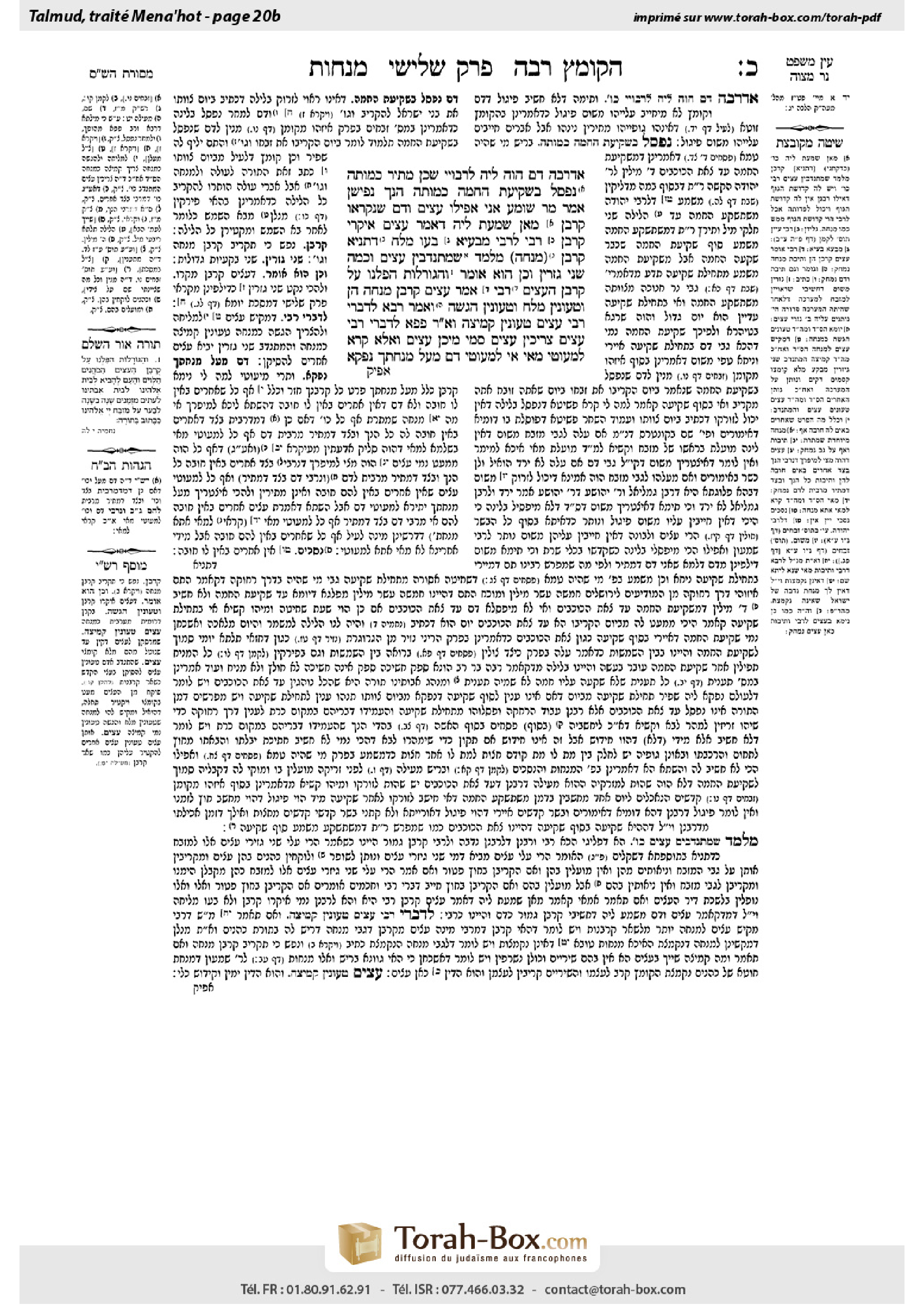
Menachot 20b: Talmud study for Daf Yomi
Daf Yomi is the daily study of one Talmud folio. Explore 37 tractates with scans, Hebrew text, Sefaria English and AI-generated French translations where annotated.
Passage selection and English or AI-generated French translation are available where the scan has annotations. Daf Study is independent of Torah-Box and Sefaria.
Browse Menachot · מנחות · All tractatesMenachot 20b text and translations
This page of Menachot includes the Aramaic text, an English translation and an AI-generated French translation, alongside the scan above.
מנחות כ׳ ב · Aramaic and Hebrew text
אַדְּרַבָּה: דָּם הֲוָה לֵיהּ לְרַבּוֹיֵי, שֶׁכֵּן מַתִּיר כְּמוֹתָהּ, נִפְסָל בִּשְׁקִיעַת הַחַמָּה כְּמוֹתָהּ! הָנָךְ נְפִישָׁן.
אָמַר מָר: שׁוֹמֵעַ אֲנִי אֲפִילּוּ עֵצִים וָדָם שֶׁנִּקְרְאוּ קׇרְבָּן. מַאן שָׁמְעַתְּ לֵיהּ דְּאָמַר עֵצִים אִיקְּרוֹ קׇרְבָּן? רַבִּי! לְרַבִּי מִבַּעְיָא בָּעוּ מֶלַח!
דְּתַנְיָא: ״קׇרְבַּן מִנְחָה״ – מְלַמֵּד שֶׁמִּתְנַדְּבִין עֵצִים, וְכַמָּה? שְׁנֵי גְּזִרִין, וְכֵן הוּא אוֹמֵר: ״וְהַגּוֹרָלוֹת הִפַּלְנוּ עַל קֻרְבַּן הָעֵצִים״, רַבִּי אָמַר: עֵצִים קׇרְבַּן מִנְחָה הֵן, וּטְעוּנִין מֶלַח, וּטְעוּנִין הַגָּשָׁה.
וְאָמַר רָבָא: לְדִבְרֵי רַבִּי, עֵצִים טְעוּנִין קְמִיצָה. וְאָמַר רַב פָּפָּא: לְדִבְרֵי רַבִּי, עֵצִים צְרִיכִין עֵצִים.
סְמִי מִיכָּן עֵצִים, וְאֶלָּא קְרָא לְמַעוֹטֵי מַאי? אִי לְמַעוֹטֵי דָּם – מֵ״עַל מִנְחָתֶךָ״ נָפְקָא!
Menachot 20b · English translation
The Gemara rejects this proof: On the contrary, blood should be included in the requirement to have salt applied, since it renders the offering permitted to be sacrificed and eaten, as is so with regard to the handful, which renders the remainder of the meal offering permitted to be eaten. In addition, blood becomes invalid at sunset and can no longer be sprinkled on the altar, as is the halakha with regard to the handful of a meal offering, whereas the limbs of the burnt offering may be sacrificed at any point during the night. The Gemara responds: These characteristics shared by the meal offering and the limbs of the burnt offering are more than those shared by the blood and the meal offering.
§ The Gemara continues discussing the baraita: The Master said above: Had the verse stated only: And every offering you shall season with salt, I would derive that this applies to even the wood and the blood, which are also termed: An offering. Therefore, the verse states “and every meal offering of yours” (Leviticus 2:13), to teach that just as the meal offering is unique in that other items come as a requirement for it, so too, anything that is unique in that other items come as a requirement for it requires the application of salt. Therefore, the wood and the blood do not require salting, as in their case no other item is needed. The Gemara asks: Whom did you hear who says that the wood is termed an offering? It is Rabbi Yehuda HaNasi. But according to Rabbi Yehuda HaNasi, doesn’t the wood in fact require salting?
This is as it is taught in a baraita: The verse states: “And when one brings a meal offering [korban minḥa]” (Leviticus 2:1). The superfluous word korban teaches that one can voluntarily give wood as an offering for the altar. And how much wood must one bring if he does not specify an amount? Two logs. And the support for the fact that wood can be brought as a voluntary offering is from a verse, as the verse states: “And we cast lots for the wood offering” (Nehemiah 10:35). Rabbi Yehuda HaNasi says: This voluntary donation of wood is an offering like a meal offering, and therefore it requires salt and requires bringing to the corner of the altar, like a meal offering.
And Rava says: According to the statement of Rabbi Yehuda HaNasi, wood donated in this manner requires the removal of a handful, just as in the case of a meal offering, a portion of the wood must be removed and sacrificed separately. And Rav Pappa says that according to the statement of Rabbi Yehuda HaNasi, since it is an offering for the altar, the wood that is brought as an offering needs to be placed on other wood to burn, like any other offering that is burned on wood on the altar. Apparently, this means that Rabbi Yehuda HaNasi, who holds that the wood is termed an offering, also holds that it requires the application of salt, in contrast to the ruling in the baraita.
The Gemara responds: Remove wood from the baraita here, as it is not excluded by the term “and every meal offering of yours.” The Gemara asks: But then, the phrase in the verse “and every meal offering of yours” is to exclude what? If it serves to exclude blood, this is derived from the continuation of the verse, which states: “From your meal offering,” as explained in the continuation of the baraita.
Menachot 20b · Traduction française (IA)
La Guemara rejette cette preuve : au contraire, le sang devrait être soumis à l’obligation d’être salé, puisqu’il rend le sacrifice apte à être offert et consommé, comme la poignée, qui rend le reste de l’offrande de farine apte à être consommé. De plus, le sang devient invalide au coucher du soleil et ne peut alors plus être aspergé sur l’autel, comme la poignée d’une offrande de farine, tandis que les membres de l’holocauste peuvent être offerts à tout moment de la nuit. La Guemara répond : les caractéristiques communes à l’offrande de farine et aux membres de l’holocauste sont plus nombreuses que celles communes au sang et à l’offrande de farine.
§ La Guemara poursuit l’étude de la baraïta : Le Maître a dit plus haut : si le verset avait seulement dit : « Tu assaisonneras de sel toute offrande », j’en aurais déduit que cela s’applique même au bois et au sang, qui sont eux aussi appelés « offrande ». Le verset dit donc : « et toute offrande de farine qui est à toi » (Lévitique 2,13), pour enseigner que, de même que l’offrande de farine se distingue par le fait que d’autres éléments sont requis pour elle, tout ce qui se distingue par le fait que d’autres éléments sont requis pour lui doit également être salé. Par conséquent, le bois et le sang n’ont pas besoin d’être salés, puisqu’aucun autre élément n’est requis dans leur cas. La Guemara demande : Qui as-tu entendu dire que le bois est appelé « offrande » ? Rabbi Yehouda HaNassi. Mais selon Rabbi Yehouda HaNassi, le bois ne doit-il pas, en réalité, être salé ?
C’est ce qui est enseigné dans une baraïta : Le verset dit : « Lorsqu’un homme apporte une offrande de farine [korban minḥa] » (Lévitique 2,1). Le mot superflu korban enseigne qu’on peut faire don volontairement de bois pour l’autel. Et quelle quantité de bois faut-il apporter si l’on n’en précise pas la quantité ? Deux bûches. La preuve que le bois peut être apporté comme offrande volontaire se trouve dans un verset, qui dit : « Nous tirâmes au sort pour l’offrande de bois » (Néhémie 10,35). Rabbi Yehouda HaNassi dit : Ce don volontaire de bois est une offrande semblable à une offrande de farine ; il doit donc être salé et apporté à l’angle de l’autel, comme une offrande de farine.
Et Rava dit : selon l’opinion de Rabbi Yehouda HaNassi, le bois offert de cette manière requiert le prélèvement d’une poignée ; comme dans le cas d’une offrande de farine, une partie du bois doit être prélevée et offerte séparément. Et Rav Pappa dit que, selon l’opinion de Rabbi Yehouda HaNassi, puisque le bois est une offrande destinée à l’autel, le bois apporté comme offrande doit être placé sur d’autres bûches pour brûler, comme toute autre offrande brûlée sur du bois sur l’autel. Cela signifie apparemment que Rabbi Yehouda HaNassi, qui considère que le bois est appelé « offrande », considère également qu’il doit être salé, contrairement à la décision de la baraïta.
La Guemara répond : retire le bois de la baraïta, car il n’est pas exclu par les mots « et toute offrande de farine qui est à toi ». La Guemara demande : mais alors, qu’est-ce que les mots du verset « et toute offrande de farine qui est à toi » viennent exclure ? S’ils servent à exclure le sang, cela se déduit de la suite du verset, qui dit : « de ton offrande de farine », comme cela est expliqué dans la suite de la baraïta.
Traduction française générée par IA à partir de l’édition anglaise de Sefaria. Vérifie toujours un passage avec le texte source.
Text from Sefaria: William Davidson Edition - Vocalized Aramaic (unknown); William Davidson Edition - English (CC BY NC).