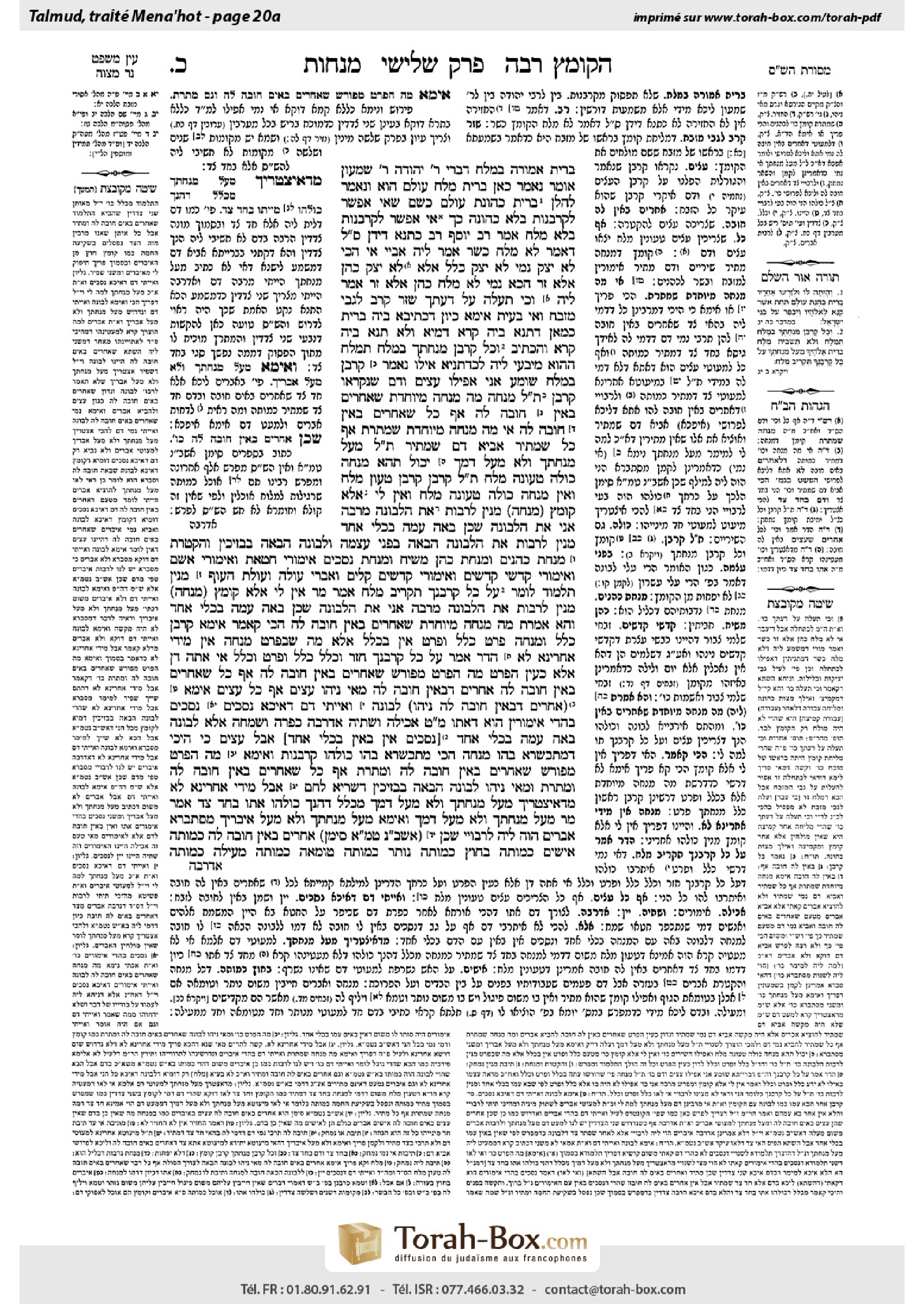
Menachot 20a: Talmud study for Daf Yomi
Daf Yomi is the daily study of one Talmud folio. Explore 37 tractates with scans, Hebrew text, Sefaria English and AI-generated French translations where annotated.
Passage selection and English or AI-generated French translation are available where the scan has annotations. Daf Study is independent of Torah-Box and Sefaria.
Browse Menachot · מנחות · All tractatesMenachot 20a text and translations
This page of Menachot includes the Aramaic text, an English translation and an AI-generated French translation, alongside the scan above.
מנחות כ׳ א · Aramaic and Hebrew text
בְּרִית אֲמוּרָה בְּמֶלַח, דִּבְרֵי רַבִּי יְהוּדָה. רַבִּי שִׁמְעוֹן אוֹמֵר: נֶאֱמַר כָּאן ״בְּרִית מֶלַח עוֹלָם הִוא״, וְנֶאֱמַר לְהַלָּן ״בְּרִית כְּהֻנַּת עוֹלָם״ – כְּשֵׁם שֶׁאִי אֶפְשָׁר לְקׇרְבָּנוֹת בְּלֹא כְּהוּנָּה, כָּךְ אִי אֶפְשָׁר לְקׇרְבָּנוֹת בְּלֹא מֶלַח.
אָמַר רַב יוֹסֵף: רַב כְּתַנָּא דִּידַן סְבִירָא לֵיהּ, דְּאָמַר: לֹא מָלַח – כָּשֵׁר. אֲמַר לֵיהּ אַבָּיֵי: אִי הָכִי, לֹא יָצַק נָמֵי – לֹא יָצַק כְּלָל? אֶלָּא: לֹא יָצַק כֹּהֵן אֶלָּא זָר, הָכָא נָמֵי: לֹא מָלַח כֹּהֵן אֶלָּא זָר.
אֲמַר לֵיהּ: וְכִי תַּעֲלֶה עַל דַּעְתְּךָ שֶׁזָּר קָרֵב לְגַבֵּי מִזְבֵּחַ?
וְאִי בָּעֵית אֵימָא, כֵּיוָן דִּכְתִיבָא בֵּיהּ ״בְּרִית״, כְּמַאן דִּתְנָא בֵּיהּ קְרָא דָּמְיָא.
וְלָא תְּנָא בֵּיהּ קְרָא? וְהָכְתִיב: ״וְכׇל קׇרְבַּן מִנְחָתְךָ בַּמֶּלַח תִּמְלָח״! הָהוּא מִיבְּעֵי לֵיהּ לְכִדְתַנְיָא: אִילּוּ נֶאֱמַר ״קׇרְבָּן בַּמֶּלַח״, שׁוֹמֵעַ אֲנִי אֲפִילּוּ עֵצִים וָדָם שֶׁנִּקְרְאוּ קׇרְבָּן.
תַּלְמוּד לוֹמַר: ״מִנְחָה״, מָה מִנְחָה מְיוּחֶדֶת שֶׁאֲחֵרִים בָּאִין חוֹבָה לָהּ, אַף כֹּל שֶׁאֲחֵרִים בָּאִין חוֹבָה לָהּ.
אִי מָה מִנְחָה מְיוּחֶדֶת שֶׁמַּתֶּרֶת, אַף כֹּל שֶׁמַּתִּיר, אָבִיא דָּם שֶׁמַּתִּיר – תַּלְמוּד לוֹמַר ״מֵעַל מִנְחָתֶךָ״, וְלֹא מֵעַל דָּמֶךָ.
יָכוֹל תְּהֵא מִנְחָה כּוּלָּהּ טְעוּנָה מֶלַח? תַּלְמוּד לוֹמַר: ״קׇרְבַּן״, קׇרְבָּן טָעוּן מֶלַח, וְאֵין מִנְחָה כּוּלָּהּ טְעוּנָה מֶלַח.
וְאֵין לִי אֶלָּא קוֹמֶץ מִנְחָה, מִנַּיִן לְרַבּוֹת אֶת הַלְּבוֹנָה? מְרַבֶּה אֲנִי אֶת הַלְּבוֹנָה, שֶׁכֵּן בָּאָה עִמָּהּ בִּכְלִי אֶחָד.
מִנַּיִן לְרַבּוֹת אֶת הַלְּבוֹנָה הַבָּאָה בִּפְנֵי עַצְמָהּ, וּלְבוֹנָה הַבָּאָה בְּבָזִיכִין, וְהַקְּטֹרֶת,
מִנְחַת כֹּהֲנִים, וּמִנְחַת כֹּהֵן מָשִׁיחַ, וּמִנְחַת נְסָכִים, אֵימוּרֵי חַטָּאת, וְאֵימוּרֵי אָשָׁם, וְאֵימוּרֵי קׇדְשֵׁי קָדָשִׁים, וְאֵימוּרֵי קָדָשִׁים קַלִּים, וְאֵבְרֵי עוֹלָה, וְעוֹלַת הָעוֹף – מִנַּיִן?
תַּלְמוּד לוֹמַר: ״עַל כׇּל קׇרְבָּנְךָ תַּקְרִיב מֶלַח״.
אָמַר מָר: אֵין לִי אֶלָּא קוֹמֶץ (מִנְחָה), מִנַּיִן לְרַבּוֹת אֶת הַלְּבוֹנָה? מְרַבֶּה אֲנִי אֶת הַלְּבוֹנָה, שֶׁכֵּן בָּאָה עִמָּהּ בִּכְלִי אֶחָד. וְהָא אָמְרַתְּ: מָה מִנְחָה מְיוּחֶדֶת שֶׁאֲחֵרִים בָּאִין חוֹבָה לָהּ?
הָכִי קָאָמַר: אֵימָא ״קׇרְבַּן״ – כָּלַל, וּ״מִנְחָה״ – פָּרַט, כְּלָל וּפְרָט – אֵין בַּכְּלָל אֶלָּא מַה שֶּׁבַּפְּרָט, מִנְחָה – אִין, מִידֵּי אַחֲרִינָא – לָא.
הֲדַר אָמַר: ״עַל כׇּל קׇרְבָּנְךָ״, חָזַר וְכָלַל, כְּלָל וּפְרָט וּכְלָל – אִי אַתָּה דָן אֶלָּא כְּעֵין הַפְּרָט, מָה הַפְּרָט מְפוֹרָשׁ שֶׁאֲחֵרִים בָּאִין חוֹבָה לָהּ, אַף כֹּל שֶׁאֲחֵרִים בָּאִין חוֹבָה לָהּ.
אֲחֵרִים דְּבָאִין חוֹבָה לָהּ, מַאי נִיהוּ – עֵצִים, אַף כֹּל עֵצִים.
אֵימָא (אֲחֵרִים דְּבָאִין חוֹבָה לָהּ נִיהוּ) – לְבוֹנָה, וְאַיְיתִי דָּם, דְּאִיכָּא נְסָכִים! נְסָכִים בַּהֲדֵי אֵימוּרִין הוּא דְּאָתוּ, מַאי טַעְמָא? אֲכִילָה וּשְׁתִיָּה. אַדְּרַבָּה – כַּפָּרָה וְשִׂמְחָה!
אֶלָּא, לְבוֹנָה בָּאָה עִמָּהּ בִּכְלִי אֶחָד, אֲבָל עֵצִים, כִּי הֵיכִי דְּמִתַּכְשְׁרָא בְּהוּ מִנְחָה, הָכִי (מִתַּכְשְׁרָא) [מִתַּכְשְׁרִי] בְּהוּ כּוּלְּהוּ קׇרְבָּנוֹת.
וְאֵימָא: מָה הַפְּרָט מְפוֹרָשׁ, שֶׁאֲחֵרִים בָּאִין חוֹבָה לָהּ וּמַתֶּרֶת – אַף כֹּל שֶׁאֲחֵרִים בָּאִין חוֹבָה לָהּ וּמַתֶּרֶת, וּמַאי נִיהוּ? לְבוֹנָה הַבָּאָה בְּבָזִיכִין, דְּשָׁרְיָא לֶחֶם, אֲבָל מִידֵּי אַחֲרִינָא – לָא.
מִדְּאִיצְטְרִיךְ ״מֵעַל מִנְחָתֶךָ״ וְלֹא מֵעַל דָּמֶךָ, מִכְּלָל דְּהָנָךְ כּוּלְּהוּ אָתוּ בְּחַד צַד.
אָמַר מָר: ״מֵעַל מִנְחָתֶךָ״ וְלֹא מֵעַל דָּמֶךָ, וְאֵימָא: ״מֵעַל מִנְחָתֶךָ״ וְלֹא מֵעַל אֵיבָרֶיךָ?
מִסְתַּבְּרָא, אֵבָרִים הֲוָה לֵיהּ לְרַבּוֹיֵי, שֶׁכֵּן (א״ש בנטמ״א סִימָן)
אֲחֵרִים בָּאִין חוֹבָה לָהּ כְּמוֹתָהּ, אִישִּׁים כְּמוֹתָהּ, בַּחוּץ כְּמוֹתָהּ, נוֹתָר כְּמוֹתָהּ,
טוּמְאָה כְּמוֹתָהּ, מְעִילָה כְּמוֹתָהּ.
Menachot 20a · English translation
a covenant stated with regard to salt, ensuring that the offerings should always be salted; this is the statement of Rabbi Yehuda. Rabbi Shimon says: It is stated here: “It is an everlasting covenant of salt” (Numbers 18:19), and it is stated there, with regard to the reward given to Pinehas: “The covenant of an everlasting priesthood” (Numbers 25:13). This teaches that just as it is impossible for the offerings to be sacrificed without the involvement of the priesthood, so too, it is impossible for the offerings to be sacrificed without salt. The baraita demonstrates that the rite of salting is an indispensable requirement, despite the fact that the rite is not repeated in the verses.
Rav Yosef said: Rav, who holds that the only sacrificial rites that are indispensable are the ones repeated in the verses, holds in accordance with the tanna of our mishna, who says: If one did not add salt, the meal offering is still fit. According to this tanna, adding salt is not indispensable. Abaye said to him: If that is so and you understand the mishna to be referring to a case where no salt is added at all, then you should also understand the mishna’s statement: If one did not pour the oil, as referring to a case where he did not pour oil at all. This cannot be, as the rite of pouring oil is repeated in the verses and is clearly indispensable. Rather, the mishna must be referring to a case where a priest did not pour oil onto the meal offering, but a non-priest did pour the oil. Here too, the tanna of the mishna means only that a priest did not add salt, but a non-priest did add salt. If no salt is added, even this tanna holds that the meal offering is unfit.
Rav Yosef said to Abaye: But could it enter your mind that a non-priest would approach the altar to salt the handful of the meal offering? A non-priest may not enter the area near the altar. Since it is not conceivable that this would take place, it must be that when ruling that the meal offering is fit, the tanna of the mishna is referring to a case where the salt was never added.
And if you wish, say instead that Rav holds that since with regard to the application of salt, the term “covenant” is written about it, it is considered as though it were repeated in another verse, as the term “covenant” teaches that it is an indispensable rite.
With regard to the question that was raised to challenge the statement of Rav, the Gemara asks: And is it correct that the application of salt is not repeated in the verse? But isn’t it written: “And every meal offering of yours you shall season with salt” (Leviticus 2:13)? The Gemara answers: That verse does not function as a repetition, since it is necessary for that which is taught in a baraita: Had the verse stated only: And every offering you shall season with salt, I would derive that this applies to even the wood and the blood, which are also termed: An offering.
To counter this, the verse states: “And every meal offering of yours,” to teach that just as the meal offering is unique in that other items come as a requirement for it, as the wood is required for the burning of the handful of the meal offering, so too any item that is unique in that other items come as a requirement for it requires the application of salt. By contrast, the wood and the blood do not require salting, as the wood itself requires no wood, and the blood is presented on the altar and does not require wood.
The baraita continues: If that logic is employed, one could say: Just as the handful of the meal offering that is burned is unique in that it permits the remainder of the meal offering to be eaten by the priests, and it requires salting, so too, any item that is unique in that it permits other items requires the application of salt. Accordingly, I will include blood in the obligation to be salted, as its presentation permits the offering to be sacrificed and eaten. To counter this, the continuation of the verse states: “Neither shall you suffer the salt of the covenant of your God to be lacking from your meal offering,” demonstrating that it cannot be lacking from the meal offering, but not from your blood.
The baraita continues: One might have thought that the entire meal offering requires salting, including the remainder of the offering that is eaten by the priests. To counter this, the verse states: “And every meal offering [korban] of yours you shall season with salt” (Leviticus 2:13), teaching that the handful, which is burned as an offering [korban] on the altar, requires salting, but the entire meal offering [minḥa] does not require salting.
And I have derived only that the handful of a meal offering requires salting. From where is it derived to include the frankincense, which is also burned on the altar, in the requirement to be salted? I include the frankincense due to the fact that it comes along with the handful in one vessel and is therefore included in the expression “offering.”
From where is it derived to include in the requirement to be salted the frankincense that comes by itself as a separate offering? One may accept the obligation to bring an offering of frankincense to be burned on the altar. From where is it derived that this frankincense requires salting? Moreover, from where is it derived to include in the requirement to be salted the frankincense that comes in bowls together with the shewbread, and the incense?
Moreover, from where is it derived in the requirement of salting in the case of the meal offerings from which a handful is not removed, i.e., the meal offering of priests, and the meal offering of the anointed priest that is brought every day by the High Priest, and the meal offering that accompanies the libations brought with burnt offerings and peace offerings? From where is it derived in the requirement of salting with regard to the sacrificial portions of the sin offering consumed on the altar, and the sacrificial portions of the guilt offering, and the sacrificial portions of the offerings of the most sacred order, and the sacrificial portions of the offerings of lesser sanctity, and the limbs of the burnt offering, and the bird burnt offering? From where is it derived that all these require salting?
The baraita continues: Therefore, the verse states: “You shall sacrifice salt with all your offerings” (Leviticus 2:13), demonstrating that everything burned on the altar requires salting. From this baraita, it is apparent that the mitzva to apply salt is necessary in order to teach about the circumstances where salt is added, and therefore it cannot be used as an instance where the mitzva is repeated in order to teach that the rite is indispensable.
§ The Gemara discusses the baraita cited above: The Master said: I have derived only that the handful of a meal offering requires salting. From where is it derived to include the frankincense, which is also burned on the altar, in the requirement to be salted? I include the frankincense, due to the fact that it comes along with the handful in one vessel and therefore is included in the expression “offering.” The Gemara asks: Why is this verse needed? But didn’t you state earlier that just as a meal offering is unique in that other items come as a requirement for it, as the wood is required for the burning of the handful of the meal offering, so too, anything that is unique in that other items come as a requirement requires the application of salt? Therefore, it is already known that the frankincense and all the other items require salting, since wood is required for their burning.
The Gemara answers: When the tanna says: I have derived only that the handful of the meal offering requires salting, this is what he is saying: One might understand the verse “And every meal offering of yours you shall season with salt” (Leviticus 2:13) differently and say the following exposition: The term “offering” that appears here is a generalization, while “meal offering” is a detail. According to the hermeneutical principles, in the case of a generalization and a detail, there is nothing in the generalization other than what is in the detail. Therefore, in the case of a meal offering, yes, it requires salting, but anything else does not require salting. From where, then, is the halakha of salting in all other cases derived?
Therefore, the verse then states: “You shall sacrifice salt with all your offerings” (Leviticus 2:13), and it then generalized again, so that the verse includes a generalization, and a detail, and a generalization, in which case according to the hermeneutical principles you may deduce that the verse is referring only to items similar to the detail. Just as the specified detail, i.e., the meal offering, is unique in that other items come as a requirement for it, so too, anything that is unique in that other items come as a requirement for it requires the application of salt. That is why the latter part of the verse is needed.
The Gemara elaborates: What are the other items that come as a requirement for the meal offering? This is referring to the wood, as the wood is required for the burning of the handful of the meal offering. So too, the expression: Anything that is unique in that other items come as a requirement for it, is referring to anything that requires wood so that it may be burned on the altar.
The Gemara asks: Why not say that the other items that come as a requirement for the meal offering is referring to the frankincense, which accompanies the meal offering, and therefore by means of the hermeneutical principle applying to a generalization, and a detail, and a generalization, include blood, which is accompanied by libations? The Gemara answers: The libations are not considered to accompany the sprinkling of the blood; rather, they accompany the sacrificial portions that are burned on the altar. What is the reason? It is because the burning of the sacrificial parts and the pouring of the libations are the eating and drinking of the altar. The Gemara counters: On the contrary, the libations are considered to accompany the blood, since the atonement that is effected by the presentation of the blood is followed by the joy that is displayed in the libation of wine.
Rather, one must say that since the frankincense comes together with the meal offering in one vessel, while the blood is not brought together with the libations in one vessel, the blood is not comparable to the meal offering. But when it is explained that the expression: The other items that come as a requirement for the meal offering, is referring to the wood, this means that just as the meal offering is rendered fit by means of the wood, so too, all offerings are rendered fit by means of the wood.
The Gemara asks: But why not say: Just as the item mentioned in the detail, i.e., the handful of the meal offering, is clearly defined as an item for which other items come as a requirement, and in addition it renders other items permitted, so too, anything that is unique in that other items come as a requirement for it and renders other items permitted requires the application of salt. And what is included due to this derivation? Frankincense that comes in the bowls that are placed upon the shewbread, as it renders the bread permitted to be eaten. But every other item should not be included.
The Gemara answers: It is apparent that all other items require only the factor of having other items come as a requirement for them to be considered similar to the meal offering. This is clear from the fact that in the case of blood, which is similar to the meal offering only in that it renders the offering permitted, it was necessary to teach that salt is not placed on blood, by means of the phrase: “Neither shall you suffer the salt of the covenant of your God to be lacking from your meal offering,” from which it is derived: But not from your blood. Had it been necessary for all items to have both aspects in common with the meal offering, there would be no need for a derivation to exclude blood. By inference, these other items derived from a meal offering are similar to it in one respect.
§ The Gemara continues its discussion of the baraita: The Master said above: The verse states: “Neither shall you suffer the salt of the covenant of your God to be lacking from your meal offering,” demonstrating that salt cannot be lacking from the meal offering, but not from your blood. The Gemara asks: But since the verse does not allude to blood explicitly, why not say that the verse teaches that salt cannot be lacking from your meal offering, but not from your limbs of the burnt offering that are sacrificed on the altar?
The Gemara answers: It stands to reason that the limbs of a burnt offering should be included in the requirement to have salt applied, since they share many characteristics with a meal offering that blood does not. The Gemara presents a mnemonic for the characteristics that they share: Alef, shin, beit, nun; tet, mem, alef. These are a reference to others [aḥerim], fire [ishim], external [baḥutz], notar; ritual impurity [tuma], and misuse of consecrated property [me’ila].
In the case of the limbs of a burnt offering, other items come as a requirement for it, as is the halakha with regard to a meal offering. The burnt offering requires wood in order to be burned on the altar, which is not the case with regard to the blood. The limbs of the burnt offering are burned in the fire of the altar, as is the halakha with regard to a meal offering, whereas the blood is presented on the corners of the altar. The burnt offering is sacrificed on the external altar, as is the halakha with regard to a meal offering, as opposed to the blood, which is presented inside the Sanctuary in the cases of the bull and goat of Yom Kippur. It is prohibited to partake of its leftover [notar] parts, as is the halakha with regard to a meal offering, which is not relevant to blood.
It is prohibited to partake of a burnt offering while in a state of ritual impurity, as is the halakha with regard to a meal offering, which is not relevant to blood. It is subject to the halakhot of misuse of consecrated property, as is the halakha with regard to a meal offering, which is not so with regard to the blood.
Menachot 20a · Traduction française (IA)
Une alliance énoncée à propos du sel, qui garantit que les offrandes soient toujours salées : telle est la position de Rabbi Yehouda. Rabbi Shimon dit : Il est écrit ici : « C’est une alliance perpétuelle de sel » (Nombres 18,19), et il est écrit là, à propos de la récompense accordée à Pinhas : « L’alliance d’une prêtrise perpétuelle » (Nombres 25,13). Cela enseigne que, de même qu’il est impossible de sacrifier les offrandes sans l’intervention de la prêtrise, de même il est impossible de les sacrifier sans sel. La baraïta démontre que le rite du salage est une exigence indispensable, bien que ce rite ne soit pas répété dans les versets.
Rav Yossef dit : Rav, qui considère que seuls les rites sacrificiels répétés dans les versets sont indispensables, suit l’avis du tanna de notre Michna, qui dit : Si l’on n’a pas ajouté de sel, l’offrande végétale reste valide. Selon ce tanna, l’ajout de sel n’est pas indispensable. Abayé lui dit : Si c’est ainsi, et que tu comprends la Michna comme traitant d’un cas où l’on n’ajoute aucun sel, tu devrais aussi comprendre sa déclaration « Si l’on n’a pas versé l’huile » comme désignant un cas où l’on n’a versé aucune huile. Cela ne peut pas être le cas, car le rite du versement de l’huile est répété dans les versets et est manifestement indispensable. La Michna doit plutôt désigner un cas où un prêtre n’a pas versé d’huile sur l’offrande végétale, mais où un non-prêtre l’a fait. Ici aussi, le tanna de la Michna veut seulement dire qu’un prêtre n’a pas ajouté de sel, mais qu’un non-prêtre en a ajouté. Si aucun sel n’est ajouté, même ce tanna considère que l’offrande végétale est invalide.
Rav Yossef dit à Abayé : Mais peux-tu concevoir qu’un non-prêtre s’approche de l’autel pour saler la poignée de l’offrande végétale ? Un non-prêtre ne peut pas pénétrer dans la zone proche de l’autel. Puisqu’on ne peut concevoir que cela se produise, il faut comprendre que, lorsqu’il statue que l’offrande végétale est valide, le tanna de la Michna parle d’un cas où le sel n’a jamais été ajouté.
Et si tu préfères, dis plutôt que Rav considère que, puisque le terme « alliance » est écrit à propos de l’application du sel, c’est comme si celle-ci était répétée dans un autre verset, car le terme « alliance » enseigne qu’il s’agit d’un rite indispensable.
À propos de la question soulevée pour réfuter la déclaration de Rav, la Guemara demande : Est-il exact que l’application du sel n’est pas répétée dans le verset ? N’est-il pas écrit : « Tu saleras toute ton offrande végétale » (Lévitique 2,13) ? La Guemara répond : Ce verset ne constitue pas une répétition, puisqu’il est nécessaire pour enseigner ce qui est exposé dans une baraïta : Si le verset avait seulement dit : « Tu saleras toute offrande », j’aurais déduit que cela s’applique même au bois et au sang, qui sont eux aussi désignés par le terme « offrande ».
Pour écarter cette possibilité, le verset dit : « Toute ton offrande végétale », afin d’enseigner que, de même que l’offrande végétale se distingue par le fait que d’autres éléments sont requis pour elle — le bois étant nécessaire pour brûler la poignée de l’offrande végétale —, de même tout élément pour lequel d’autres éléments sont requis doit recevoir du sel. En revanche, le bois et le sang ne doivent pas être salés : le bois lui-même ne nécessite pas de bois, et le sang est présenté sur l’autel sans nécessiter de bois.
La baraïta poursuit : Selon ce raisonnement, on pourrait dire : De même que la poignée de l’offrande végétale qui est brûlée se distingue par le fait qu’elle permet au reste de l’offrande végétale d’être consommé par les prêtres et qu’elle doit être salée, de même tout élément qui se distingue en permettant à d’autres éléments d’être consommés doit recevoir du sel. J’inclurais donc le sang dans l’obligation d’être salé, puisque sa présentation permet que l’offrande soit sacrifiée et consommée. Pour écarter cette possibilité, la suite du verset dit : « Tu ne laisseras pas manquer le sel de l’alliance de ton Dieu dans ton offrande végétale », ce qui montre qu’il ne peut pas manquer dans ton offrande végétale, mais non dans ton sang.
La baraïta poursuit : On aurait pu penser que toute l’offrande végétale doit être salée, y compris le reste de l’offrande consommé par les prêtres. Pour écarter cette possibilité, le verset dit : « Tu saleras toute offrande [korban] végétale » (Lévitique 2,13), enseignant que la poignée, brûlée comme offrande [korban] sur l’autel, doit être salée, mais que toute l’offrande végétale [minḥa] n’a pas à l’être.
J’ai seulement déduit que la poignée d’une offrande végétale doit être salée. D’où déduit-on que l’encens, qui est lui aussi brûlé sur l’autel, est inclus dans l’obligation d’être salé ? J’inclus l’encens parce qu’il accompagne la poignée dans un même récipient et qu’il est donc inclus dans l’expression « offrande ».
D’où déduit-on que l’encens apporté seul, comme offrande distincte, est inclus dans l’obligation d’être salé ? On peut admettre qu’il faille apporter une offrande d’encens à brûler sur l’autel. Mais d’où déduit-on que cet encens doit être salé ? De plus, d’où déduit-on que l’encens apporté dans des coupes avec les pains de proposition, ainsi que l’encens, sont inclus dans l’obligation d’être salés ?
De plus, d’où déduit-on l’obligation de saler les offrandes végétales dont on ne retire pas de poignée, c’est-à-dire l’offrande végétale des prêtres, l’offrande végétale du prêtre oint que le grand prêtre apporte chaque jour, et l’offrande végétale qui accompagne les libations apportées avec les holocaustes et les sacrifices de paix ? D’où déduit-on l’obligation de saler les portions sacrificielles du sacrifice expiatoire brûlées sur l’autel, celles du sacrifice de culpabilité, celles des offrandes de sainteté suprême, celles des offrandes de moindre sainteté, les membres de l’holocauste et l’holocauste d’oiseau ? D’où déduit-on que tous ces éléments doivent être salés ?
La baraïta poursuit : Le verset dit donc : « Tu présenteras du sel avec toutes tes offrandes » (Lévitique 2,13), ce qui démontre que tout ce qui est brûlé sur l’autel doit être salé. Cette baraïta montre que la mitsva d’appliquer du sel est nécessaire pour enseigner dans quels cas le sel est ajouté ; elle ne peut donc pas servir d’exemple où la mitsva est répétée afin d’enseigner que le rite est indispensable.
§ La Guemara examine la baraïta citée plus haut : Le Maître a dit : « J’ai seulement déduit que la poignée d’une offrande végétale doit être salée. D’où déduit-on que l’encens, qui est lui aussi brûlé sur l’autel, est inclus dans l’obligation d’être salé ? J’inclus l’encens parce qu’il accompagne la poignée dans un même récipient et qu’il est donc inclus dans l’expression “offrande”. » La Guemara demande : Pourquoi ce verset est-il nécessaire ? N’as-tu pas dit plus haut que, de même que l’offrande végétale se distingue par le fait que d’autres éléments sont requis pour elle — le bois étant nécessaire pour brûler la poignée de l’offrande végétale —, de même tout élément pour lequel d’autres éléments sont requis doit recevoir du sel ? On sait donc déjà que l’encens et tous les autres éléments doivent être salés, puisque du bois est nécessaire pour les brûler.
La Guemara répond : Lorsque le tanna dit : « J’ai seulement déduit que la poignée de l’offrande végétale doit être salée », voici ce qu’il veut dire : On pourrait comprendre autrement le verset « Tu saleras toute ton offrande végétale » (Lévitique 2,13) et exposer ainsi : Le terme « offrande » qui apparaît ici est une généralité, tandis que « offrande végétale » est une particularité. Selon les principes herméneutiques, dans le cas d’une généralité suivie d’une particularité, la généralité ne comprend rien d’autre que ce qui figure dans la particularité. Par conséquent, l’offrande végétale, oui, doit être salée, mais rien d’autre ne doit l’être. D’où déduit-on alors la halakha du salage dans tous les autres cas ?
Le verset dit donc ensuite : « Tu présenteras du sel avec toutes tes offrandes » (Lévitique 2,13) ; il énonce ainsi de nouveau une généralité, de sorte que le verset comprend une généralité, une particularité et une généralité. Selon les principes herméneutiques, on peut alors déduire que le verset ne vise que les éléments semblables à la particularité. De même que la particularité précisée, c’est-à-dire l’offrande végétale, se distingue par le fait que d’autres éléments sont requis pour elle, de même tout élément pour lequel d’autres éléments sont requis doit recevoir du sel. Voilà pourquoi la seconde partie du verset est nécessaire.
La Guemara précise : Quels sont les autres éléments requis pour l’offrande végétale ? Il s’agit du bois, car le bois est nécessaire pour brûler la poignée de l’offrande végétale. De même, l’expression « tout élément pour lequel d’autres éléments sont requis » désigne tout ce qui nécessite du bois pour pouvoir être brûlé sur l’autel.
La Guemara demande : Pourquoi ne pas dire que les autres éléments requis pour l’offrande végétale désignent l’encens qui accompagne l’offrande végétale, et inclure ainsi le sang, par le principe herméneutique de la généralité, de la particularité et de la généralité, puisque le sang est accompagné de libations ? La Guemara répond : Les libations ne sont pas considérées comme accompagnant l’aspersion du sang ; elles accompagnent plutôt les portions sacrificielles brûlées sur l’autel. Quelle en est la raison ? C’est que la combustion des portions sacrificielles et le versement des libations constituent le manger et le boire de l’autel. La Guemara objecte : Au contraire, les libations sont considérées comme accompagnant le sang, puisque l’expiation obtenue par la présentation du sang est suivie de la joie manifestée par la libation de vin.
Il faut plutôt dire que, puisque l’encens accompagne l’offrande végétale dans un même récipient, tandis que le sang n’est pas apporté dans un même récipient que les libations, le sang n’est pas comparable à l’offrande végétale. Mais lorsqu’on explique que l’expression « les autres éléments requis pour l’offrande végétale » désigne le bois, cela signifie que, de même que le bois rend l’offrande végétale valide, de même le bois rend toutes les offrandes valides.
La Guemara demande : Mais pourquoi ne pas dire que, de même que l’élément mentionné dans la particularité, c’est-à-dire la poignée de l’offrande végétale, est clairement défini comme un élément pour lequel d’autres éléments sont requis et qu’il rend en outre d’autres éléments permis, de même tout élément pour lequel d’autres éléments sont requis et qui rend d’autres éléments permis doit recevoir du sel ? Et qu’inclurait-on par cette déduction ? L’encens apporté dans les coupes placées sur les pains de proposition, puisqu’il permet de consommer le pain. Mais aucun autre élément ne devrait être inclus.
La Guemara répond : Il ressort que, pour que les autres éléments soient considérés comme semblables à l’offrande végétale, il suffit qu’ils aient d’autres éléments requis pour eux. Cela ressort clairement du fait que, dans le cas du sang, qui ressemble à l’offrande végétale uniquement en ce qu’il rend l’offrande permise, il a fallu enseigner qu’on n’applique pas de sel au sang, au moyen de l’expression : « Tu ne laisseras pas manquer le sel de l’alliance de ton Dieu dans ton offrande végétale », dont on déduit : mais pas dans ton sang. S’il avait fallu que tous les éléments aient en commun les deux caractéristiques de l’offrande végétale, il n’aurait pas été nécessaire d’apporter une déduction pour exclure le sang. Il s’ensuit que les autres éléments déduits à partir de l’offrande végétale lui ressemblent à un seul égard.
§ La Guemara poursuit son examen de la baraïta : Le Maître a dit plus haut : Le verset dit : « Tu ne laisseras pas manquer le sel de l’alliance de ton Dieu dans ton offrande végétale », ce qui démontre que le sel ne peut pas manquer dans l’offrande végétale, mais non dans ton sang. La Guemara demande : Mais puisque le verset ne fait pas explicitement allusion au sang, pourquoi ne pas dire qu’il enseigne que le sel ne peut pas manquer dans l’offrande végétale, mais qu’il peut manquer sur les membres de l’holocauste sacrifiés sur l’autel ?
La Guemara répond : Il est logique que les membres d’un holocauste soient inclus dans l’obligation d’être salés, puisqu’ils partagent avec l’offrande végétale de nombreuses caractéristiques que le sang ne partage pas. La Guemara donne un moyen mnémotechnique pour ces caractéristiques communes : alef, shin, beit, noun ; tet, mem, alef. Ces lettres renvoient aux autres [aḥerim], aux éléments brûlés au feu [ishim], à l’autel extérieur [baḥutz], au notar ; à l’impureté rituelle [tuma] et à l’usage illicite de biens consacrés [me’ila].
Dans le cas des membres d’un holocauste, d’autres éléments sont requis pour lui, comme c’est la halakha pour l’offrande végétale. L’holocauste nécessite du bois pour être brûlé sur l’autel, contrairement au sang. Les membres de l’holocauste sont brûlés dans le feu de l’autel, comme l’offrande végétale, tandis que le sang est présenté sur les angles de l’autel. L’holocauste est sacrifié sur l’autel extérieur, comme l’offrande végétale, contrairement au sang, qui est présenté à l’intérieur du Sanctuaire dans les cas du taureau et du bouc de Yom Kippour. Il est interdit de consommer ses restes [notar], comme c’est la halakha pour l’offrande végétale, ce qui ne s’applique pas au sang.
Il est interdit de consommer un holocauste en état d’impureté rituelle, comme c’est la halakha pour l’offrande végétale, ce qui ne s’applique pas au sang. Il est soumis aux lois relatives à l’usage illicite de biens consacrés, comme c’est la halakha pour l’offrande végétale, contrairement au sang.
Traduction française générée par IA à partir de l’édition anglaise de Sefaria. Vérifie toujours un passage avec le texte source.
Text from Sefaria: William Davidson Edition - Vocalized Aramaic (unknown); William Davidson Edition - English (CC BY NC).