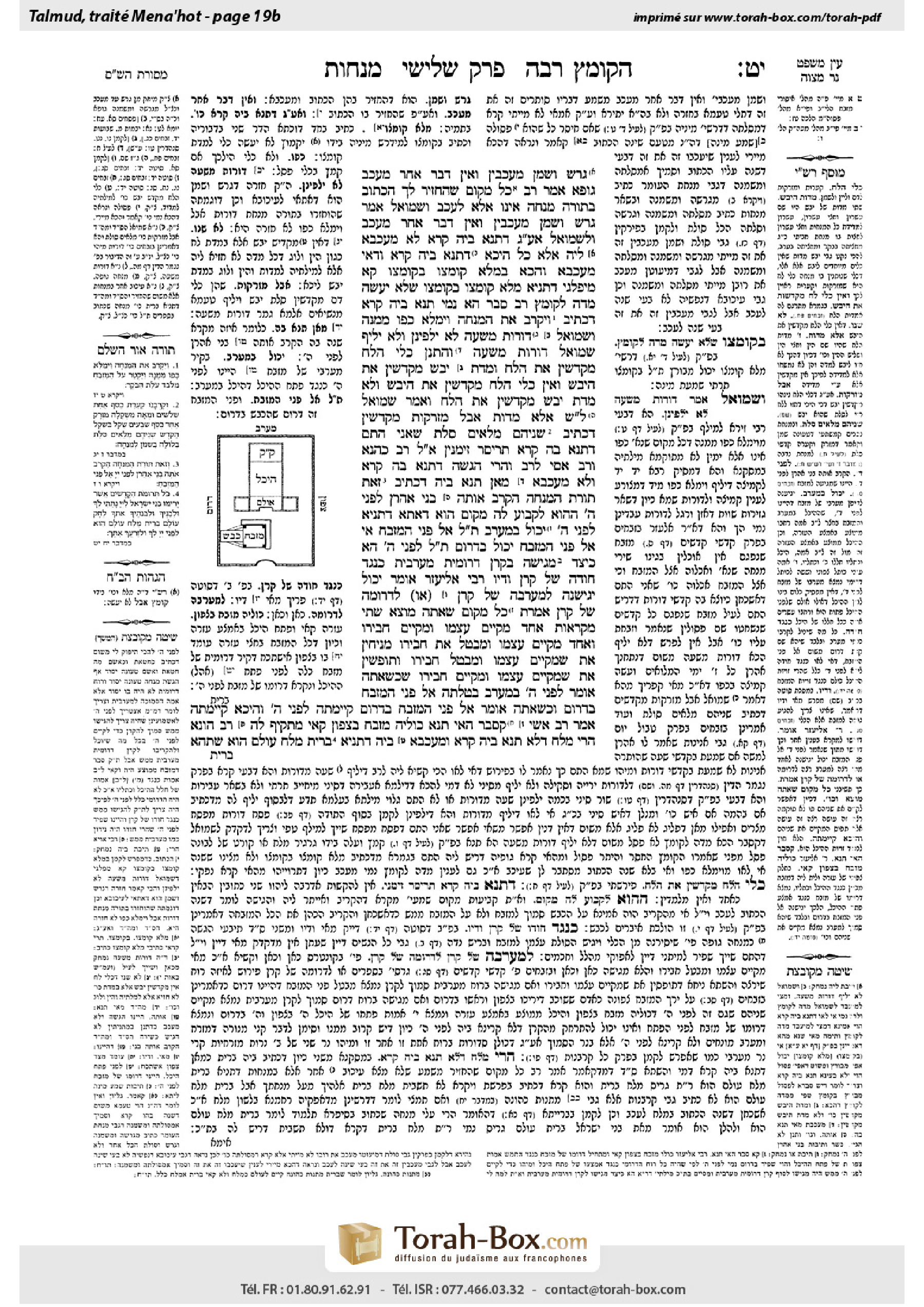
Menachot 19b: Talmud study for Daf Yomi
Daf Yomi is the daily study of one Talmud folio. Explore 37 tractates with scans, Hebrew text, Sefaria English and AI-generated French translations where annotated.
Passage selection and English or AI-generated French translation are available where the scan has annotations. Daf Study is independent of Torah-Box and Sefaria.
Browse Menachot · מנחות · All tractatesMenachot 19b text and translations
This page of Menachot includes the Aramaic text, an English translation and an AI-generated French translation, alongside the scan above.
מנחות י״ט ב · Aramaic and Hebrew text
גֶּרֶשׂ וָשֶׁמֶן מְעַכְּבִין, וְאֵין דָּבָר אַחֵר מְעַכֵּב.
גּוּפָא, אָמַר רַב: כׇּל מָקוֹם שֶׁהֶחְזִיר לְךָ הַכָּתוּב בַּתּוֹרָה מִנְחָה, אֵינוֹ אֶלָּא לְעַכֵּב. וּשְׁמוּאֵל אָמַר: גֶּרֶשׂ וָשֶׁמֶן מְעַכְּבִין, וְאֵין דָּבָר אַחֵר מְעַכֵּב. וְלִשְׁמוּאֵל, אַף עַל גַּב דִּתְנָא בֵּיהּ קְרָא לָא מְעַכְּבָא לֵיהּ?
אֶלָּא, כֹּל הֵיכָא דִּתְנָא בֵּיהּ קְרָא וַדַּאי מְעַכְּבָא, וְהָכָא בִּ״מְלֹא קוּמְצוֹ״ ״בְּקוּמְצוֹ״ קָא מִיפַּלְגִי, דְּתַנְיָא: ״מְלֹא קֻמְצוֹ״ ״בְּקֻמְצוֹ״ – שֶׁלֹּא יַעֲשֶׂה מִדָּה לַקּוֹמֶץ.
רַב סָבַר: הָא נָמֵי תְּנָא בֵּיהּ קְרָא, דִּכְתִיב: ״וַיַּקְרֵב אֶת הַמִּנְחָה וַיְמַלֵּא כַפּוֹ מִמֶּנָּה״, וּשְׁמוּאֵל: דּוֹרוֹת מִשָּׁעָה לָא יָלְפִינַן.
וְלָא יָלֵיף שְׁמוּאֵל דּוֹרוֹת מִשָּׁעָה? וְהָתְנַן: כְּלֵי הַלַּח מְקַדְּשִׁין אֶת הַלַּח, וּמִדֹּת יָבֵשׁ מְקַדְּשִׁין אֶת הַיָּבֵשׁ, וְאֵין כְּלֵי הַלַּח מְקַדְּשִׁין אֶת הַיָּבֵשׁ, וְלֹא מִדֹּת יָבֵשׁ מְקַדְּשִׁין אֶת הַלַּח.
וְאָמַר שְׁמוּאֵל: לֹא שָׁנוּ אֶלָּא מִדּוֹת, אֲבָל מִזְרָקוֹת מְקַדְּשִׁין, דִּכְתִיב ״שְׁנֵיהֶם מְלֵאִים סֹלֶת״!
שָׁאנֵי הָתָם, דִּתְנָא בָּהּ קְרָא תְּרֵיסַר זִימְנִין.
אֲמַרוּ לֵיהּ רַב כָּהֲנָא וְרַב אַסִּי לְרַב: וַהֲרֵי הַגָּשָׁה, דִּתְנָא בָּהּ קְרָא, וְלָא מְעַכְּבָא! מַאן תְּנָא בֵּיהּ? דִּכְתִיב: ״זֹאת תּוֹרַת הַמִּנְחָה הַקְרֵב אוֹתָהּ בְּנֵי אַהֲרֹן לִפְנֵי ה׳״!
הָהוּא לִקְבּוֹעַ לָהּ מָקוֹם הוּא דַּאֲתָא, דְּתַנְיָא: ״לִפְנֵי ה׳״ – יָכוֹל בַּמַּעֲרָב? תַּלְמוּד לוֹמַר: ״אֶל פְּנֵי הַמִּזְבֵּחַ״.
אִי ״אֶל פְּנֵי הַמִּזְבֵּחַ״ יָכוֹל בַּדָּרוֹם, תַּלְמוּד לוֹמַר ״לִפְנֵי ה׳״, הָא כֵּיצַד? מַגִּישָׁהּ בְּקֶרֶן דְּרוֹמִית מַעֲרָבִית כְּנֶגֶד חוּדָּהּ שֶׁל קֶרֶן וְדַיּוֹ.
רַבִּי אֱלִיעֶזֶר אוֹמֵר: יָכוֹל יַגִּישֶׁנָּה לְמַעֲרָבָהּ שֶׁל קֶרֶן אוֹ לִדְרוֹמָהּ שֶׁל קֶרֶן? אָמַרְתָּ: כׇּל מָקוֹם שֶׁאַתָּה מוֹצֵא שְׁתֵּי מִקְרָאוֹת, אֶחָד מְקַיֵּים עַצְמוֹ וּמְקַיֵּים חֲבֵירוֹ, וְאֶחָד מְקַיֵּים עַצְמוֹ וּמְבַטֵּל אֶת חֲבֵירוֹ – מַנִּיחִין אֶת שֶׁמְּקַיֵּים עַצְמוֹ וּמְבַטֵּל חֲבֵירוֹ, וְתוֹפְשִׂין אֶת שֶׁמְּקַיֵּים עַצְמוֹ וּמְקַיֵּים חֲבֵירוֹ.
שֶׁכְּשֶׁאַתָּה אוֹמֵר ״לִפְנֵי ה׳״ בַּמַּעֲרָב, בִּטַּלְתָּה ״אֶל פְּנֵי הַמִּזְבֵּחַ״ בַּדָּרוֹם, וּכְשֶׁאַתָּה אוֹמֵר ״אֶל פְּנֵי הַמִּזְבֵּחַ״ בַּדָּרוֹם, קִיַּימְתָּה ״לִפְנֵי ה׳״.
וְהֵיכָא קִיַּימְתָּה? אָמַר רַב אָשֵׁי: קָסָבַר הַאי תַּנָּא כּוּלֵּיהּ מִזְבֵּחַ בְּצָפוֹן קָאֵי.
מַתְקֵיף לַהּ רַב הוּנָא: הֲרֵי מֶלַח, דְּלָא תְּנָא בֵּיהּ קְרָא, וּמְעַכְּבָא בֵּיהּ! דְּתַנְיָא: ״בְּרִית מֶלַח עוֹלָם הִוא״ – שֶׁתְּהֵא
Menachot 19b · English translation
teaching that the groats and oil are indispensable, and nothing else is indispensable, despite the fact that the term statute appears.
§ The Gemara discusses the matter itself: Rav says: With regard to every sacrificial rite of the meal offering that the verse in the Torah repeats, it is repeated only to teach that the failure to perform that rite invalidates the offering. And Shmuel says: Only the groats and oil are indispensable, and nothing else is indispensable. The Gemara asks: And according to Shmuel, is it true that even though a rite of the meal offering is repeated in another verse he does not deem it indispensable?
Rather, Shmuel must agree that wherever the verse repeats a rite it is certainly understood to be indispensable; and here, Rav and Shmuel disagree with regard to the expressions “his handful” (Leviticus 2:2) and “with his hand” (Leviticus 6:8). As it is taught in a baraita: The verse states: “And he shall remove his handful,” and elsewhere it states: “And he shall take up from it with his hand.” The change in terminology between the two verses teaches that the priest should not use a utensil to measure an amount for the handful of a meal offering, but should use his hand.
Rav holds that this halakha of using one’s hand and not a utensil is also repeated in another verse, as it is written in the context of Aaron’s service on the eighth day of the consecration of the Tabernacle: “And he presented the meal offering; and he filled his hand from it” (Leviticus 9:17), demonstrating that the handful is removed by hand and not with a utensil. And Shmuel holds that we do not derive the halakha for all generations from a temporary situation. Therefore, using one’s hand is not indispensable, as the general requirements of the rites of the meal offering cannot be derived from a verse referring to the meal offering that was sacrificed during the consecration of the Tabernacle.
The Gemara asks: And does Shmuel not derive the halakha for all generations from a temporary situation? But didn’t we learn in a mishna (Zevaḥim 88a): Service vessels used for the liquids sanctify only the liquids placed in them, and service vessels used to measure dry substances sanctify only the dry substances that are placed in them. But service vessels used for the liquids do not sanctify the dry substances placed in them, and service vessels used to measure dry substances do not sanctify the liquids placed in them.
And Shmuel says concerning this mishna: They taught that halakha only with regard to service vessels used to measure liquids, e.g., wine or oil. But cups, which are used for collecting the blood of offerings, sanctify dry substances placed in them as well, as it is written with regard to the offerings of the princes during the inauguration of the Tabernacle: “One silver cup of seventy shekels, after the shekel of the Sanctuary; both of them full of fine flour mingled with oil for a meal offering” (Numbers 7:13), indicating that the cups were also fashioned for use with flour, a dry substance. In this case, Shmuel does derive the general halakha from a temporary situation, in this case the offerings of the princes.
The Gemara answers: There, with regard to the offering of the princes, it is different, as the verse is repeated twelve times, once with regard to each and every prince. Therefore, Shmuel derives a halakha for all generations from it. Nevertheless, generally speaking, the halakha for all generations cannot be derived from a temporary situation.
The Gemara returns to discussing Rav’s statement that a rite is deemed indispensable if it is repeated in the verses. Rav Kahana and Rav Asi said to Rav: But what of bringing the meal offering to the corner of the altar, which is repeated in the verse, as it is stated: “And he shall bring it to the altar” (Leviticus 2:8); and it is not indispensable, as stated in the mishna (18a)? The Gemara elaborates: Where is it repeated? As it is written: “And this is the law of the meal offering: The sons of Aaron shall sacrifice it before the Lord, in front of the altar” (Leviticus 6:7).
The Gemara answers: That verse is not a repetition of the mitzva for the priest to bring the meal offering to the corner of the altar; rather, it comes only to establish the place for the meal offering and describe where it should be brought. As it is taught in a baraita: The verse states: “And this is the law of the meal offering. The sons of Aaron shall sacrifice it before the Lord, in front of the altar” (Leviticus 6:7). From the phrase: “Before the Lord,” one might have thought that the meal offering must be brought on the western side of the altar, which faces the Sanctuary and is therefore “before the Lord.” Therefore, the verse states: “In front of the altar,” which is its southern side, where the priests ascend the ramp.
The baraita continues: If the verse had merely stated: In front of the altar, one might have thought that the meal offering is brought only on the southern side of the altar, as just mentioned. Therefore, the verse states: “Before the Lord,” which indicates the western side. How can these texts be reconciled? The baraita answers: The priest brings it near on the southwest corner of the altar, opposite the edge of the corner of the altar, and that will suffice for him.
The baraita continues: Rabbi Eliezer says: One might have thought that the verse presents the priest with the option that he may bring it on the western side of the corner or on the southern side of the corner. You say the following principle: Any time you find two verses, one of which fulfills itself and fulfills the other, and one of which fulfills itself and negates the other, we set aside the verse that fulfills itself and negates the other, and we seize the verse that fulfills itself and fulfills the other.
He explains: As, when you say to bring the meal offering “before the Lord,” which indicates that it shall be brought on the western side, you have nullified the other part of the verse, which states to bring it “in front of the altar,” which is on the southern side. But when you say to bring the meal offering “in front of the altar” and offer it on the southern side, you have also fulfilled the other part of the verse, which states to bring it “before the Lord.”
The Gemara asks: But if one brought the meal offering on the southern side, where have you fulfilled: “Before the Lord”? Rav Ashi said: This tanna, i.e., Rabbi Eliezer, holds that the entire altar stood in the northern part of the Temple courtyard. The southern side of the altar was aligned with the midpoint of the Temple courtyard, opposite the Holy of Holies, directly before the Lord. In any event, it can be seen in this baraita that the purpose of the verse: “The sons of Aaron shall offer it before the Lord, in front of the altar” is to establish the precise location where the meal offering is brought, and it does not serve as a repetition.
The Gemara cites another objection to Rav’s statement that a rite of the meal offering is deemed indispensable if it is repeated in the verses. Rav Huna objects to this: But what of the placement of the salt on the handful of the meal offering before it is burned, which is not repeated in the verse, and yet it is still indispensable in its sacrifice? As it is taught in a baraita: The verse states: “It is an everlasting covenant of salt” (Numbers 18:19), teaching that there will be
Menachot 19b · Traduction française (IA)
Cela enseigne que la fleur de farine et l’huile sont indispensables, et que rien d’autre ne l’est, bien que le terme « statut » apparaisse.
§ La Guemara examine le sujet lui-même. Rav dit : Chaque fois que le verset de la Torah répète un rite de l’offrande de farine, cette répétition enseigne uniquement que l’omission de ce rite invalide l’offrande. Et Chmouel dit : Seuls la fleur de farine et l’huile sont indispensables ; rien d’autre ne l’est. La Guemara demande : Selon Chmouel, est-il donc vrai que même lorsqu’un rite de l’offrande de farine est répété dans un autre verset, il ne le considère pas comme indispensable ?
Au contraire, Chmouel doit convenir que partout où le verset répète un rite, celui-ci est certainement considéré comme indispensable. Ici, Rav et Chmouel sont en désaccord au sujet des expressions « sa pleine poignée » (Lévitique 2:2) et « de sa main » (Lévitique 6:8). En effet, il est enseigné dans une baraïta : Le verset dit : « Il prélèvera sa pleine poignée », et ailleurs, il est dit : « Il en prélèvera de sa main ». La différence de formulation entre les deux versets enseigne que le prêtre ne doit pas utiliser d’ustensile pour mesurer la quantité de la poignée de l’offrande de farine, mais doit se servir de sa main.
Rav estime que cette halakha — se servir de sa main et non d’un ustensile — est également répétée dans un autre verset, comme il est écrit au sujet du service d’Aaron, le huitième jour de la consécration du Tabernacle : « Il présenta l’offrande de farine et en remplit sa main » (Lévitique 9:17). Cela démontre que la poignée est prélevée à la main et non au moyen d’un ustensile. Chmouel estime que nous ne déduisons pas la halakha applicable à toutes les générations d’une situation temporaire. Par conséquent, le fait de se servir de sa main n’est pas indispensable, car les exigences générales des rites de l’offrande de farine ne peuvent être déduites d’un verset portant sur l’offrande de farine sacrifiée lors de la consécration du Tabernacle.
La Guemara demande : Chmouel ne déduit-il pas la halakha applicable à toutes les générations d’une situation temporaire ? Pourtant, n’avons-nous pas appris dans une Michna (Zevaḥim 88a) : Les ustensiles de service destinés aux liquides sanctifient uniquement les liquides qu’on y place, et les ustensiles de service servant à mesurer des substances sèches sanctifient uniquement les substances sèches qu’on y place. Mais les ustensiles de service destinés aux liquides ne sanctifient pas les substances sèches qu’on y place, et ceux qui servent à mesurer des substances sèches ne sanctifient pas les liquides qu’on y place.
Et Chmouel dit à propos de cette Michna : Cette halakha n’a été enseignée qu’au sujet des ustensiles de service servant à mesurer les liquides, par exemple le vin ou l’huile. Mais les coupes, qui servent à recueillir le sang des offrandes, sanctifient aussi les substances sèches qu’on y place, comme il est écrit au sujet des offrandes des princes lors de la consécration du Tabernacle : « Une coupe d’argent de soixante-dix sicles, selon le sicle du Sanctuaire ; toutes deux pleines de fleur de farine mêlée d’huile, pour une offrande de farine » (Nombres 7:13). Cela indique que les coupes étaient également conçues pour être utilisées avec de la farine, une substance sèche. Dans ce cas, Chmouel déduit bien la halakha générale d’une situation temporaire, en l’occurrence les offrandes des princes.
La Guemara répond : Dans le cas des offrandes des princes, c’est différent, car le verset est répété douze fois, une fois pour chacun des princes. Chmouel en déduit donc une halakha applicable à toutes les générations. Néanmoins, de manière générale, on ne peut déduire la halakha applicable à toutes les générations d’une situation temporaire.
La Guemara revient à l’énoncé de Rav selon lequel un rite est considéré comme indispensable s’il est répété dans les versets. Rav Kahana et Rav Assi dirent à Rav : Mais qu’en est-il du fait d’apporter l’offrande de farine à l’angle de l’autel, mentionné à nouveau dans un verset, comme il est dit : « Il l’apportera à l’autel » (Lévitique 2:8), alors que cela n’est pas indispensable, comme l’enseigne la Michna (18a) ? La Guemara précise : Où ce rite est-il mentionné à nouveau ? Car il est écrit : « Voici la loi de l’offrande de farine : les fils d’Aaron la présenteront devant l’Éternel, devant l’autel » (Lévitique 6:7).
La Guemara répond : Ce verset ne répète pas la mitsva imposant au prêtre d’apporter l’offrande de farine à l’angle de l’autel ; il sert uniquement à fixer l’emplacement de l’offrande de farine et à indiquer où elle doit être apportée. En effet, il est enseigné dans une baraïta : Le verset dit : « Voici la loi de l’offrande de farine. Les fils d’Aaron la présenteront devant l’Éternel, devant l’autel » (Lévitique 6:7). De l’expression « devant l’Éternel », on aurait pu penser que l’offrande de farine doit être apportée du côté ouest de l’autel, qui fait face au Sanctuaire et se trouve donc « devant l’Éternel ». Le verset dit donc : « Devant l’autel », c’est-à-dire sur son côté sud, où les prêtres montent par la rampe.
La baraïta poursuit : Si le verset avait seulement dit « devant l’autel », on aurait pu penser que l’offrande de farine doit être apportée uniquement du côté sud de l’autel, comme indiqué précédemment. Le verset dit donc : « Devant l’Éternel », ce qui indique le côté ouest. Comment concilier ces textes ? La baraïta répond : Le prêtre l’approche à l’angle sud-ouest de l’autel, en face du bord de l’angle de l’autel ; cela lui suffit.
La baraïta poursuit : Rabbi Éliézer dit : On aurait pu penser que le verset laisse au prêtre le choix de l’apporter du côté ouest de l’angle ou du côté sud de l’angle. Voici le principe : chaque fois que l’on trouve deux versets, dont l’un remplit sa propre fonction tout en donnant aussi effet à l’autre, tandis que l’autre remplit sa propre fonction tout en contredisant le premier, on écarte celui qui remplit sa propre fonction tout en contredisant l’autre, et l’on retient celui qui remplit sa propre fonction tout en donnant aussi effet à l’autre.
Il explique : En disant d’apporter l’offrande de farine « devant l’Éternel », ce qui indique qu’elle doit être apportée du côté ouest, vous annulez l’autre partie du verset, qui dit de l’apporter « devant l’autel », c’est-à-dire du côté sud. Mais en disant d’apporter l’offrande de farine « devant l’autel » et de la présenter du côté sud, vous donnez également effet à l’autre partie du verset, qui dit de l’apporter « devant l’Éternel ».
La Guemara demande : Mais si l’on a apporté l’offrande de farine du côté sud, en quoi a-t-on accompli l’injonction « devant l’Éternel » ? Rav Achi dit : Ce tanna, c’est-à-dire Rabbi Éliézer, estime que tout l’autel se trouvait dans la partie nord du parvis du Temple. Le côté sud de l’autel était aligné sur le milieu du parvis du Temple, en face du Saint des Saints, directement devant l’Éternel. Quoi qu’il en soit, on voit dans cette baraïta que le verset « Les fils d’Aaron la présenteront devant l’Éternel, devant l’autel » sert à fixer l’emplacement précis où l’offrande de farine doit être apportée et ne constitue pas une répétition.
La Guemara cite une autre objection à l’énoncé de Rav selon lequel un rite de l’offrande de farine est considéré comme indispensable s’il est répété dans les versets. Rav Houna objecte : Mais qu’en est-il du placement du sel sur la poignée de l’offrande de farine avant qu’elle soit brûlée ? Ce geste n’est pas répété dans le verset, et pourtant il demeure indispensable pour son sacrifice. En effet, il est enseigné dans une baraïta : Le verset dit : « C’est une alliance perpétuelle de sel » (Nombres 18:19), ce qui enseigne qu’il y aura
Traduction française générée par IA à partir de l’édition anglaise de Sefaria. Vérifie toujours un passage avec le texte source.
Text from Sefaria: William Davidson Edition - Vocalized Aramaic (unknown); William Davidson Edition - English (CC BY NC).