Menachot 19a: Talmud study for Daf Yomi
Daf Yomi is the daily study of one Talmud folio. Explore 37 tractates with scans, Hebrew text, Sefaria English and AI-generated French translations where annotated.
Passage selection and English or AI-generated French translation are available where the scan has annotations. Daf Study is independent of Torah-Box and Sefaria.
Browse Menachot · מנחות · All tractatesMenachot 19a text and translations
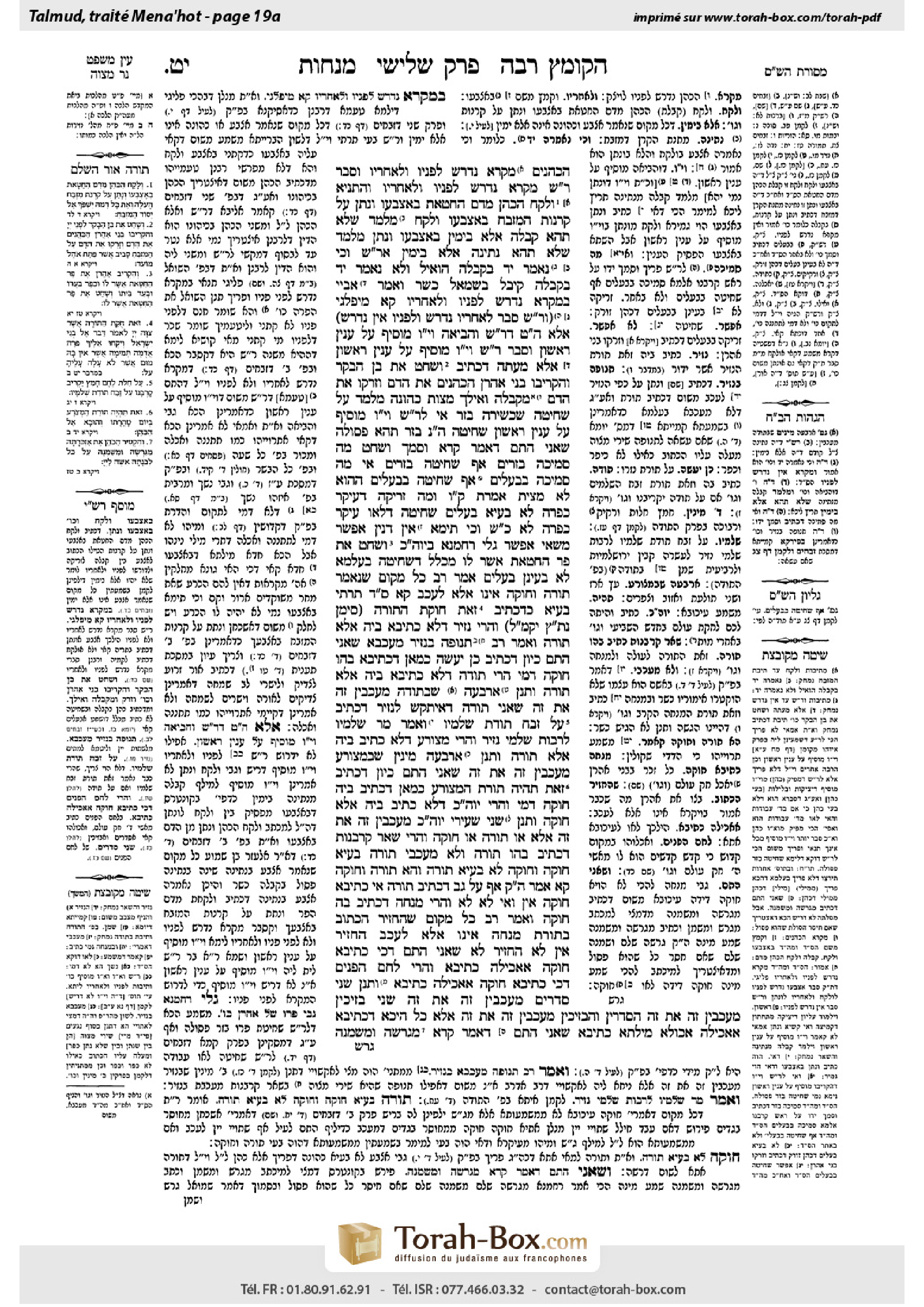
This page of Menachot includes the Aramaic text, an English translation and an AI-generated French translation, alongside the scan above.
מנחות י״ט א · Aramaic and Hebrew text
הַכֹּהֲנִים״ – מִקְרָא נִדְרָשׁ לְפָנָיו וּלְאַחֲרָיו.
וְסָבַר רַבִּי שִׁמְעוֹן מִקְרָא נִדְרָשׁ לְפָנָיו וּלְאַחֲרָיו? וְהָתַנְיָא: ״וְלָקַח הַכֹּהֵן מִדַּם הַחַטָּאת בְּאֶצְבָּעוֹ וְנָתַן עַל קַרְנֹת הַמִּזְבֵּחַ״, ״בְּאֶצְבָּעוֹ וְלָקַח״ – מְלַמֵּד שֶׁלֹּא תְּהֵא קַבָּלָה אֶלָּא בְּיָמִין, ״בְּאֶצְבָּעוֹ וְנָתַן״ – מְלַמֵּד שֶׁלֹּא תְּהֵא נְתִינָה אֶלָּא בְּיָמִין.
אָמַר רַבִּי שִׁמְעוֹן: וְכִי נֶאֱמַר ״יָד״ בְּקַבָּלָה? הוֹאִיל וְלֹא נֶאֱמַר ״יָד״ בְּקַבָּלָה, קִיבֵּל בִּשְׂמֹאל – כָּשֵׁר.
וְאָמַר אַבָּיֵי: בְּמִקְרָא נִדְרָשׁ לְפָנָיו וּלְאַחֲרָיו קָא מִיפַּלְגִי (וְרַבִּי שִׁמְעוֹן סָבַר: לְאַחֲרָיו נִדְרָשׁ, וּלְפָנָיו אֵין נִדְרָשׁ).
אֶלָּא הַיְינוּ טַעְמָא דְּרַבִּי שִׁמְעוֹן: ״וֶהֱבִיאָהּ״ – וָי״ו מוֹסִיף עַל עִנְיָן רִאשׁוֹן.
וְסָבַר רַבִּי שִׁמְעוֹן וָיו מוֹסִיף עַל עִנְיָן רִאשׁוֹן? אֶלָּא מֵעַתָּה, דִּכְתִיב: ״וְשָׁחַט אֶת בֶּן הַבָּקָר וְהִקְרִיבוּ בְּנֵי אַהֲרֹן הַכֹּהֲנִים אֶת הַדָּם וְזָרְקוּ אֶת הַדָּם״, מִקַּבָּלָה וְאֵילָךְ מִצְוַת כְּהוּנָּה, מְלַמֵּד עַל שְׁחִיטָה שֶׁכְּשֵׁירָה בְּזָר; אִי לְרַבִּי שִׁמְעוֹן וָיו מוֹסִיף עַל עִנְיָן רִאשׁוֹן, שְׁחִיטָה הָכִי נָמֵי בְּזָר תְּהֵא פְּסוּלָה!
שָׁאנֵי הָתָם, דְּאָמַר קְרָא: ״וְסָמַךְ ... וְשָׁחַט״, מָה סְמִיכָה בְּזָרִים – אַף שְׁחִיטָה בְּזָרִים.
אִי: מָה סְמִיכָה בִּבְעָלִים, אַף שְׁחִיטָה בִּבְעָלִים? הָהוּא לָא מָצֵית אָמַרְתָּ, קַל וָחוֹמֶר: וּמָה זְרִיקָה דְּעִיקַּר כַּפָּרָה – לָא בָּעֲיָא בְּעָלִים, שְׁחִיטָה דְּלָאו עִיקַּר כַּפָּרָה – לֹא כׇּל שֶׁכֵּן.
וְכִי תֵּימָא, אֵין דָּנִין אֶפְשָׁר מִשֶּׁאִי אֶפְשָׁר, גַּלִּי רַחֲמָנָא בְּיוֹם הַכִּפּוּרִים: ״וְשָׁחַט אֶת פַּר הַחַטָּאת אֲשֶׁר לוֹ״, מִכְּלָל דִּשְׁחִיטָה בְּעָלְמָא לָא בָּעֵינַן בְּעָלִים.
אָמַר רַב: כׇּל מָקוֹם שֶׁנֶּאֱמַר ״תּוֹרָה״ וְ״חוּקָּה״, אֵינוֹ אֶלָּא לְעַכֵּב. קָא סָלְקָא דַּעְתִּין תַּרְתֵּי בָּעֲיָא, כְּדִכְתִיב: ״זֹאת חֻקַּת הַתּוֹרָה״.
(סִימָן: נת״ץ יקמ״ל.)
וַהֲרֵי נָזִיר, דְּלָא כְּתִיבָא בֵּיהּ אֶלָּא תּוֹרָה, וְאָמַר רַב: תְּנוּפָה בְּנָזִיר מְעַכְּבָא! שָׁאנֵי הָתָם, כֵּיוָן דִּכְתִיב ״כֵּן יַעֲשֶׂה״, כְּמַאן דִּכְתִיבָא בְּהוּ חוּקָּה דָּמֵי.
הֲרֵי תּוֹדָה, דְּלָא כְּתִיבָא בֵּיהּ אֶלָּא תּוֹרָה, וּתְנַן: אַרְבָּעָה שֶׁבַּתּוֹדָה מְעַכְּבִין זֶה אֶת זֶה. שָׁאנֵי תּוֹדָה דְּאִיתַּקַּשׁ לְנָזִיר, דִּכְתִיב: ״עַל זֶבַח תּוֹדַת שְׁלָמָיו״, וְאָמַר מָר: ״שְׁלָמָיו״ לְרַבּוֹת שַׁלְמֵי נָזִיר.
וַהֲרֵי מְצוֹרָע, דְּלָא כְּתִיב בֵּיהּ אֶלָּא תּוֹרָה, וּתְנַן: אַרְבָּעָה מִינִין שֶׁבַּמְּצוֹרָע מְעַכְּבִין זֶה אֶת זֶה! שָׁאנֵי הָתָם, כֵּיוָן דִּכְתִיב ״זֹאת תִּהְיֶה תּוֹרַת הַמְּצֹרָע״, כְּמַאן דִּכְתִיב בֵּיהּ חוּקָּה דָּמֵי.
וַהֲרֵי יוֹם הַכִּפּוּרִים, דְּלָא כְּתִיב בֵּיהּ אֶלָּא חוּקָּה, וּתְנַן: שְׁנֵי שְׂעִירֵי יוֹם הַכִּפּוּרִים מְעַכְּבִין זֶה אֶת זֶה, אֶלָּא: אוֹ תּוֹרָה אוֹ חוּקָּה.
וַהֲרֵי שְׁאָר קׇרְבָּנוֹת, דִּכְתִיב בְּהוּ תּוֹרָה, וְלָא מְעַכְּבִי? תּוֹרָה בָּעֲיָא חוּקָּה, וְחוּקָּה לָא בָּעֲיָא תּוֹרָה.
וְהָא תּוֹרָה וְחוּקָּה קָא אָמַר, הָכִי קָאָמַר: אַף עַל גַּב דִּכְתִיב תּוֹרָה, אִי כְּתִיבָא חוּקָּה – אִין, וְאִי לָא – לָא.
וַהֲרֵי מִנְחָה, דִּכְתִיב בָּהּ חוּקָּה, וְאָמַר רַב: כׇּל מָקוֹם שֶׁהֶחְזִיר הַכָּתוּב בְּתוֹרַת מִנְחָה אֵינוֹ אֶלָּא לְעַכֵּב, הֶחְזִיר – אִין, לֹא הֶחֱזִיר – לָא.
שָׁאנֵי הָתָם, דְּכִי כְּתִיבָא חוּקָּה – אַאֲכִילָה כְּתִיבָא.
וַהֲרֵי לֶחֶם הַפָּנִים, דְּכִי כְּתִיבָא חוּקָּה אַאֲכִילָה כְּתִיבָא, וּתְנַן: שְׁנֵי סְדָרִים מְעַכְּבִין זֶה אֶת זֶה, שְׁנֵי בָּזִיכִין מְעַכְּבִין זֶה אֶת זֶה, הַסְּדָרִין וְהַבָּזִיכִין מְעַכְּבִין זֶה אֶת זֶה.
אֶלָּא, כֹּל הֵיכָא דִּכְתִיבָא אַאֲכִילָה – אַכּוֹלָּא מִילְּתָא כְּתִיבָא.
שָׁאנֵי הָתָם, דְּאָמַר קְרָא: ״מִגִּרְשָׂהּ וּמִשַּׁמְנָהּ״,
Menachot 19a · English translation
the priests,” the verse is interpreted as referring to the matter that precedes it and to the matter that succeeds it. Before mentioning the priests, the verse states the halakha of pouring the oil on the meal offering, and after mentioning the priests, it states the halakha of the removal of the handful. Therefore, a priest is required for each of these rites.
The Gemara questions this explanation: And does Rabbi Shimon hold that a verse is interpreted as referring to the matter that precedes it and to the matter that succeeds it? But isn’t it taught in a baraita: The verse states: “And the priest shall take of the blood of the sin offering with his finger and put it upon the corners of the altar” (Leviticus 4:34). The term “with his finger” is interpreted as referring to the term “and the priest shall take.” This teaches that the collection of the blood shall be performed only with the right hand, since the term “finger,” when stated in the context of the sacrificial rites, always is referring to the finger of the right hand. The term “with his finger” is also interpreted as referring to the term “and put it.” This teaches that the placing of the blood on the altar shall be performed only with the right hand.
The baraita continues: Rabbi Shimon said: But is the term hand stated with regard to the collection of the blood? Since the term hand is not stated with regard to the collection of the blood, only with regard to the placement of the blood, then even if the priest collected the blood with his left hand, the offering is fit.
And Abaye said: Rabbi Shimon and the Rabbis disagree with regard to whether a verse is interpreted as referring to the matter that precedes it and to the matter that succeeds it. The Rabbis hold that the term “with his finger” is referring to both to the term “and the priest shall take” that precedes it, and the term “and put it” that succeeds it. And Rabbi Shimon holds that a verse is interpreted as referring to the matter that succeeds it, but is not interpreted as referring to the matter that precedes it. In that case, Rabbi Shimon’s opinion that the pouring of oil must be performed by a priest can no longer be ascribed to the opinion that the phrase “Aaron’s sons, the priests” should be interpreted as referring to the description of pouring the oil that precedes it.
Rather, this is the reasoning of Rabbi Shimon: The verse states: “And he shall pour oil upon it and put frankincense upon it. And he shall bring it to Aaron’s sons, the priests” (Leviticus 2:1–2). He therefore employs the principle that the conjunction “and,” represented by the letter vav, adds to the previous matter, demonstrating that the rite of the pouring of the oil is to be performed by Aaron’s sons, the priests.
The Gemara asks: But does Rabbi Shimon hold that the letter vav adds to the previous matter? If that is so, then this would pose a problem with regard to that which is written: “And he shall slaughter the bull before the Lord, and Aaron’s sons, the priests, shall sacrifice the blood and sprinkle the blood” (Leviticus 1:5). The Sages infer from here that from the stage of the sacrificing of the blood, which begins with the collection of the blood, and onward, it is the mitzva exclusively of members of the priesthood. By inference, this teaches that the slaughter of the offering, which is performed earlier, is valid when performed by a non-priest. If according to the opinion of Rabbi Shimon the letter vav adds to the previous matter, if the slaughter of the offering is performed by a non-priest, it should also be unfit.
The Gemara answers: There, with regard to the slaughter of an offering, it is different, as earlier the verse states: “And he shall place his hands upon the head of the burnt offering; and it shall be accepted for him to make atonement for him. And he shall slaughter the bull before the Lord” (Leviticus 1:4–5), associating the placing of the hands on the head of an offering, which is performed by the owner of the animal, with the slaughter of the offering. Therefore, just as the placing of the hands on the offering is performed by non-priests, so too, the slaughter of the offering is performed by non-priests.
The Gemara asks: If there is a juxtaposition of the placing of the hands and the slaughter of the animals, why not also say that just as the placing of the hands on the offering is performed only by the owner of the animal, so too, the slaughter of the offering may be performed only by the owner of the animal? The Gemara answers: You cannot say that, due to an a fortiori inference from the halakha of the sprinkling of the blood: And just as the sprinkling of the blood, which is the essential rite that enables the one who brings the offering to achieve atonement, does not require the owner to perform it, as the priests perform this rite on his behalf, with regard to the slaughter of the offering, which is not the essential rite that enables the one who brings the offering to achieve atonement, is it not all the more so clear that it does not need to be performed by the owner?
And if you would say that one cannot derive the possible from the impossible, and the owner may not sprinkle the blood as he is not a priest, but he may still be obligated to slaughter the animal, as this rite may be performed by a non-priest, the Merciful One revealed in the Torah in the context of the Yom Kippur service with regard to the High Priest: “And he shall slaughter the bull of the sin offering which is for himself” (Leviticus 16:11). By inference, from the fact that the verse specifies that here the High Priest, who is the owner of the offering, must perform the slaughter, it is clear that usually the slaughter does not require the participation of the owner.
§ Apropos the mishna’s list of rites that are not indispensable for the meal offering, the Gemara explains that Rav says: With regard to any sacrificial rite where the term law and statute are stated, they are stated only to teach that the absence of the performance of that rite invalidates the offering. The Gemara comments: It enters our mind to say that the two terms are both required for this principle to be in effect, as it is written with regard to a red heifer: “This is the statute of the law” (Numbers 19:2).
Before continuing its discussion of this principle, the Gemara presents a mnemonic for the questions that follow: Nun, tav, tzadi; yod, kuf, mem, lamed. They represent: Nazirite; thanks offering [toda]; leper [metzora]; Yom Kippur; offerings [korbanot]; meal offering [minḥa]; shewbread [leḥem hapanim].
The Gemara asks: But what of the offering of a nazirite, about which it is written only “law,” as the verse states: “This is the law of the nazirite who vows, and of his offering to the Lord for his naziriteship, beside that for which his means suffice; according to his vow which he vows, so he must do after the law of his naziriteship” (Numbers 6:21), and yet Rav says that the lack of waving of the offering by a nazirite invalidates the offering? The Gemara answers: There it is different, since it is written in the continuation of the verse: “So he must do,” and therefore it is considered as if the term statute were written with regard to it.
The Gemara asks: But what of the thanks offering, about which it is written only “law,” as the verse states: “This is the law of the sacrifice of peace offerings” (Leviticus 7:11), and we learn in a mishna (27a) that with regard to the four types of loaves that accompany the thanks offering, failure to bring each of them prevents fulfillment of the mitzva with the others? The Gemara answers: The thanks offering is different, since it is juxtaposed in the Torah to the offering of a nazirite; as it is written in a verse describing the thanks offering: “With the sacrifice of his peace offerings for thanksgiving” (Leviticus 7:13), instead of simply stating: The sacrifice of his thanks offering. And the Master says: The term “his peace offerings” serves to include the loaves of the peace offering of the nazirite, to teach that the same halakhot apply to both.
The Gemara asks: But what of the offering of a leper, about which it is written only “law,” as the verse states: “This shall be the law of the leper” (Leviticus 14:2), and we learn in a mishna (27a) that with regard to the four species that are used in the purification process of the leper, i.e., cedar, hyssop, scarlet wool, and birds, failure to bring each of them prevents fulfillment of the mitzva with the others? The Gemara answers: There it is different, since it is written: “This shall be the law of the leper.” Due to the added emphasis of the term “shall be,” it is considered as if the term statute were written with regard to it.
The Gemara asks: But what of Yom Kippur, about which it is written only “statute,” as the verse states: “And it shall be a statute for you forever” (Leviticus 16:29), and we learn in a mishna (27a) that with regard to the two goats of Yom Kippur, the absence of each goat prevents fulfillment of the mitzva with the other? Rather, it must be that Rav meant that wherever either the term law or the term statute is employed, this signifies that the rite is an indispensable requirement.
The Gemara questions this understanding of Rav’s statement: But what of the rest of the offerings, as the term “law” is written with regard to them, and yet failure to perform all of their different rites does not invalidate those offerings? The verse states: “This is the law of the burnt offering, of the meal offering, and of the sin offering, and of the guilt offering, and of the consecration offering, and of the sacrifice of peace offerings” (Leviticus 7:37). The Gemara answers: When the term law appears, it is still necessary for the term statute to appear, in order to teach that failure to perform the rites invalidates the offering. But when the term statute appears, it is not necessary for the term law to appear as well. The term statute is sufficient.
The Gemara questions this explanation: But doesn’t Rav say: Wherever the terms law and statute appear? Apparently, both are necessary for his principle to apply. The Gemara answers: This is what Rav is saying: Even in a context where the term law is written, if the term statute is written as well, then yes, failure to perform the rites invalidates the offering; but if the term statute does not accompany the term law, then failure to perform the rites does not invalidate the offering.
The Gemara questions this explanation: But what of the meal offering, as the term “statute” is written with regard to it, as the verse states: “Every male among the children of Aaron may eat of it, as a statute forever” (Leviticus 6:11), and yet Rav says: With regard to every sacrificial rite of the law of the meal offering that the verse repeats, as the details of the meal offering are discussed in Leviticus, chapter 2, and again in Leviticus, chapter 6, it is repeated only to teach that the failure to perform that rite invalidates the offering? Doesn’t this demonstrate that where the verse repeated the command, then yes, failure to perform the rite invalidates the offering; but if the verse did not repeat it, then failure to perform the rite does not invalidate the offering, whether or not the term statute appears?
The Gemara answers: There it is different, as when the term statute is written, it is written with regard to the eating of the meal offering rather than with regard to the sacrificial rites.
The Gemara asks: But what of the shewbread, where when the term statute is written, it is written with regard to the eating of the shewbread, as the verse states: “And they shall eat it in a holy place, for it is most holy to him of the offerings of the Lord made by fire, a perpetual statute” (Leviticus 24:9), and we learn in the mishna (27a): With regard to the two arrangements of the shewbread, failure to place each of the arrangements prevents fulfillment of the mitzva with the other. With regard to the two bowls of frankincense that accompany the shewbread, failure to place each of the arrangements prevents fulfillment of the mitzva with the other. With regard to the arrangements of the shewbread and the bowls of frankincense, failure to bring each of them prevents fulfillment of the mitzva with the other.
Rather, it must be that anywhere that the term statute is written with regard to eating, it is written with regard to the entire matter, i.e., all the halakhot of the offering, and teaches that failure to perform the rites invalidates the offering.
The Gemara answers: There, with regard to the meal offering, it is different, and it is only the rites that are repeated that are indispensable, as the verse states: “Of its groats, and of its oil” (Leviticus 2:16), rather than simply: Of the groats and oil,
Menachot 19a · Traduction française (IA)
« les prêtres » : le verset est interprété comme se rapportant à ce qui le précède et à ce qui le suit. Avant de mentionner les prêtres, le verset énonce la halakha du versement de l’huile sur l’offrande végétale ; après les avoir mentionnés, il énonce la halakha du prélèvement de la poignée. Un prêtre est donc requis pour chacun de ces rites.
La Guemara conteste cette explication : Rabbi Shimon considère-t-il qu’un verset est interprété comme se rapportant à ce qui le précède et à ce qui le suit ? N’est-il pas enseigné dans une baraïta : le verset dit : « Le prêtre prendra avec son doigt du sang du sacrifice expiatoire et en mettra sur les cornes de l’autel » (Lévitique 4:34). L’expression « avec son doigt » est interprétée comme se rapportant aux mots « le prêtre prendra ». Cela enseigne que le prélèvement du sang doit être effectué uniquement de la main droite, car le terme « doigt », lorsqu’il est employé à propos des rites sacrificiels, désigne toujours le doigt de la main droite. L’expression « avec son doigt » est également interprétée comme se rapportant aux mots « en mettra ». Cela enseigne que le dépôt du sang sur l’autel doit être effectué uniquement de la main droite.
La baraïta poursuit : Rabbi Shimon dit : Mais le terme « main » est-il employé à propos du prélèvement du sang ? Puisqu’il ne l’est pas à propos du prélèvement, mais seulement à propos du dépôt du sang, l’offrande est valide même si le prêtre a prélevé le sang de la main gauche.
Abaye dit : Rabbi Shimon et les Rabbins sont en désaccord sur la question de savoir si un verset est interprété comme se rapportant à ce qui le précède et à ce qui le suit. Les Rabbins considèrent que l’expression « avec son doigt » se rapporte à la fois aux mots « le prêtre prendra », qui la précèdent, et aux mots « en mettra », qui la suivent. Rabbi Shimon, lui, considère qu’un verset est interprété comme se rapportant à ce qui le suit, mais non à ce qui le précède. Dans ce cas, on ne peut plus attribuer l’opinion de Rabbi Shimon selon laquelle le versement de l’huile doit être effectué par un prêtre à l’idée que l’expression « les fils d’Aaron, les prêtres » doit être interprétée comme se rapportant à la description du versement de l’huile qui la précède.
Il faut plutôt comprendre que voici le raisonnement de Rabbi Shimon : le verset dit : « Il versera de l’huile dessus et y déposera de l’encens. Puis il l’apportera aux fils d’Aaron, les prêtres » (Lévitique 2:1–2). Il applique donc le principe selon lequel la conjonction « et », représentée par la lettre vav, s’ajoute à l’élément précédent, ce qui montre que le rite du versement de l’huile doit être effectué par les fils d’Aaron, les prêtres.
La Guemara demande : Rabbi Shimon considère-t-il que la lettre vav s’ajoute à l’élément précédent ? Si tel est le cas, cela pose un problème concernant ce qui est écrit : « Il égorgera le taureau devant le Seigneur, et les fils d’Aaron, les prêtres, offriront le sang et aspergeront le sang » (Lévitique 1:5). Les Sages en déduisent qu’à partir de l’étape de l’offrande du sang, qui commence par son prélèvement, et pour tout ce qui suit, le rite est exclusivement une mitsva réservée aux membres de la prêtrise. Par déduction, cela enseigne que l’égorgement de l’offrande, qui a lieu auparavant, est valide même s’il est effectué par un non-prêtre. Or, si Rabbi Shimon considère que la lettre vav s’ajoute à l’élément précédent, l’égorgement de l’offrande devrait lui aussi être invalide s’il est effectué par un non-prêtre.
La Guemara répond : Dans le cas de l’égorgement d’une offrande, la situation est différente, car le verset dit auparavant : « Il posera ses mains sur la tête de l’holocauste, et celui-ci sera agréé pour lui afin de lui obtenir l’expiation. Il égorgera le taureau devant le Seigneur » (Lévitique 1:4–5), associant l’imposition des mains sur la tête d’une offrande, qui est effectuée par le propriétaire de l’animal, à l’égorgement de l’offrande. Par conséquent, de même que l’imposition des mains sur l’offrande est effectuée par des non-prêtres, l’égorgement de l’offrande est lui aussi effectué par des non-prêtres.
La Guemara demande : S’il existe une juxtaposition entre l’imposition des mains et l’égorgement des animaux, pourquoi ne pas dire également que, de même que l’imposition des mains sur l’offrande est effectuée uniquement par le propriétaire de l’animal, l’égorgement de l’offrande ne peut lui aussi être effectué que par son propriétaire ? La Guemara répond : On ne peut pas dire cela, en raison d’une déduction a fortiori à partir de la halakha de l’aspersion du sang : si l’aspersion du sang, rite essentiel qui permet à celui qui apporte l’offrande d’obtenir l’expiation, n’exige pas que le propriétaire l’effectue, puisque les prêtres accomplissent ce rite pour lui, n’est-il pas d’autant plus évident que l’égorgement de l’offrande, qui n’est pas le rite essentiel permettant à celui qui l’apporte d’obtenir l’expiation, n’a pas à être effectué par le propriétaire ?
Et si tu dis qu’on ne peut pas déduire le possible de l’impossible, que le propriétaire ne peut pas asperger le sang puisqu’il n’est pas prêtre, mais qu’il pourrait néanmoins être tenu d’égorger l’animal, puisque ce rite peut être effectué par un non-prêtre, le Miséricordieux a révélé dans la Torah, à propos du service de Yom Kippour du grand prêtre : « Il égorgera le taureau du sacrifice expiatoire qui est pour lui » (Lévitique 16:11). On en déduit que, puisque le verset précise ici que le grand prêtre, qui est le propriétaire de l’offrande, doit procéder à l’égorgement, il est clair qu’en règle générale l’égorgement n’exige pas la participation du propriétaire.
§ À propos de la liste, dans la Michna, des rites dont l’omission n’invalide pas l’offrande végétale, la Guemara explique que Rav dit : pour tout rite sacrificiel à propos duquel apparaissent les termes « loi » et « statut », ceux-ci ne sont mentionnés que pour enseigner que l’absence de ce rite invalide l’offrande. La Guemara remarque : On pourrait penser que ces deux termes sont tous deux nécessaires pour que ce principe s’applique, puisqu’il est écrit au sujet de la vache rousse : « Voici le statut de la loi » (Nombres 19:2).
Avant de poursuivre la discussion de ce principe, la Guemara donne un aide-mémoire pour les questions qui suivent : noun, tav, tsadi ; yod, kouf, mem, lamed. Ces lettres représentent : nazir ; offrande de reconnaissance [toda] ; lépreux [metzora] ; Yom Kippour ; offrandes [korbanot] ; offrande végétale [minḥa] ; pains de proposition [leḥem hapanim].
La Guemara demande : Mais qu’en est-il de l’offrande d’un nazir, à propos de laquelle seul le terme « loi » est écrit, comme le dit le verset : « Telle est la loi du nazir qui fait un vœu, et de son offrande au Seigneur pour sa naziréité, outre ce que ses moyens lui permettent ; selon le vœu qu’il fait, il agira conformément à la loi de sa naziréité » (Nombres 6:21), et pourtant Rav dit que l’absence de la présentation de l’offrande par balancement effectuée par un nazir invalide l’offrande ? La Guemara répond : Ce cas est différent, car la suite du verset dit : « il agira ainsi » ; on considère donc comme si le terme « statut » était écrit à son sujet.
La Guemara demande : Mais qu’en est-il de l’offrande de reconnaissance, à propos de laquelle seul le terme « loi » est écrit, comme le dit le verset : « Telle est la loi du sacrifice de paix » (Lévitique 7:11), et nous apprenons dans une Michna (27a) qu’en ce qui concerne les quatre sortes de pains qui accompagnent l’offrande de reconnaissance, l’absence de chacun empêche l’accomplissement de la mitsva avec les autres ? La Guemara répond : L’offrande de reconnaissance est un cas différent, car elle est juxtaposée dans la Torah à l’offrande d’un nazir ; en effet, le verset qui décrit l’offrande de reconnaissance dit : « avec le sacrifice de ses sacrifices de paix en action de grâce » (Lévitique 7:13), au lieu de dire simplement : « le sacrifice de son offrande de reconnaissance ». Et le maître dit : l’expression « ses sacrifices de paix » inclut les pains du sacrifice de paix du nazir, pour enseigner que les mêmes halakhot s’appliquent aux deux.
La Guemara demande : Mais qu’en est-il de l’offrande d’un lépreux, à propos de laquelle seul le terme « loi » est écrit, comme le dit le verset : « Telle sera la loi du lépreux » (Lévitique 14:2), et nous apprenons dans une Michna (27a) qu’en ce qui concerne les quatre espèces utilisées dans le processus de purification du lépreux, à savoir le cèdre, l’hysope, la laine écarlate et les oiseaux, l’absence de chacune empêche l’accomplissement de la mitsva avec les autres ? La Guemara répond : Ce cas est différent, car il est écrit : « Telle sera la loi du lépreux. » En raison de l’insistance supplémentaire portée par les mots « sera la », on considère comme si le terme « statut » était écrit à son sujet.
La Guemara demande : Mais qu’en est-il de Yom Kippour, à propos duquel seul le terme « statut » est écrit, comme le dit le verset : « Ce sera pour vous un statut perpétuel » (Lévitique 16:29), et nous apprenons dans une Michna (27a) qu’en ce qui concerne les deux boucs de Yom Kippour, l’absence de l’un empêche l’accomplissement de la mitsva avec l’autre ? Il faut donc plutôt dire que Rav voulait dire que, partout où apparaît le terme « loi » ou le terme « statut », cela signifie que le rite est une condition indispensable.
La Guemara met en question cette compréhension de la déclaration de Rav : Mais qu’en est-il des autres offrandes, à propos desquelles apparaît le terme « loi », alors que l’omission de leurs différents rites n’invalide pas ces offrandes ? Le verset dit : « Telle est la loi de l’holocauste, de l’offrande végétale, du sacrifice expiatoire, du sacrifice de culpabilité, du sacrifice de consécration et du sacrifice de paix » (Lévitique 7:37). La Guemara répond : Lorsque le terme « loi » apparaît, il faut encore que le terme « statut » apparaisse pour enseigner que l’omission des rites invalide l’offrande. Mais lorsque le terme « statut » apparaît, il n’est pas nécessaire que le terme « loi » apparaisse également. Le terme « statut » suffit.
La Guemara met en question cette explication : Rav ne dit-il pas : « partout où apparaissent les termes “loi” et “statut” » ? Cela indique qu’ils sont tous deux nécessaires à l’application de son principe. La Guemara répond : Voici ce que Rav veut dire : même dans un contexte où le terme « loi » est écrit, si le terme « statut » est également écrit, alors oui, l’omission des rites invalide l’offrande ; mais si le terme « statut » n’accompagne pas le terme « loi », l’omission des rites n’invalide pas l’offrande.
La Guemara met en question cette explication : Mais qu’en est-il de l’offrande végétale, à propos de laquelle le terme « statut » est écrit, comme le dit le verset : « Tout mâle parmi les fils d’Aaron pourra en manger, comme statut perpétuel » (Lévitique 6:11), et pourtant Rav dit : pour tout rite sacrificiel de la loi de l’offrande végétale que le verset répète — puisque les détails de l’offrande végétale sont exposés au Lévitique, chapitre 2, puis de nouveau au Lévitique, chapitre 6 — cette répétition n’a pour but que d’enseigner que l’omission de ce rite invalide l’offrande. Cela ne démontre-t-il pas que lorsque le verset répète le commandement, alors oui, l’omission du rite invalide l’offrande ; mais si le verset ne le répète pas, l’omission du rite n’invalide pas l’offrande, que le terme « statut » apparaisse ou non ?
La Guemara répond : Ce cas est différent, car lorsque le terme « statut » est écrit, il se rapporte à la consommation de l’offrande végétale, et non aux rites sacrificiels.
La Guemara demande : Mais qu’en est-il des pains de proposition, pour lesquels, lorsque le terme « statut » est écrit, il se rapporte à leur consommation, comme le dit le verset : « Ils les mangeront dans un lieu saint, car ils sont très saints pour lui parmi les offrandes du Seigneur consumées par le feu ; c’est un statut perpétuel » (Lévitique 24:9), et nous apprenons dans la Michna (27a) : en ce qui concerne les deux rangées de pains de proposition, l’absence de l’une empêche l’accomplissement de la mitsva avec l’autre. En ce qui concerne les deux coupes d’encens qui accompagnent les pains de proposition, l’absence de l’une empêche l’accomplissement de la mitsva avec l’autre. En ce qui concerne les rangées de pains de proposition et les coupes d’encens, l’absence de l’un de ces éléments empêche l’accomplissement de la mitsva avec les autres.
Il faut donc plutôt dire que, partout où le terme « statut » est écrit à propos de la consommation, il se rapporte à l’ensemble du sujet, c’est-à-dire à toutes les halakhot de l’offrande, et enseigne que l’omission des rites invalide l’offrande.
La Guemara répond : Dans le cas de l’offrande végétale, la situation est différente : seuls les rites qui sont répétés constituent des conditions indispensables, comme le dit le verset : « de sa fleur de farine et de son huile » (Lévitique 2:16), au lieu de dire simplement : « de la fleur de farine et de l’huile »,
Traduction française générée par IA à partir de l’édition anglaise de Sefaria. Vérifie toujours un passage avec le texte source.
Text from Sefaria: William Davidson Edition - Vocalized Aramaic (unknown); William Davidson Edition - English (CC BY NC).