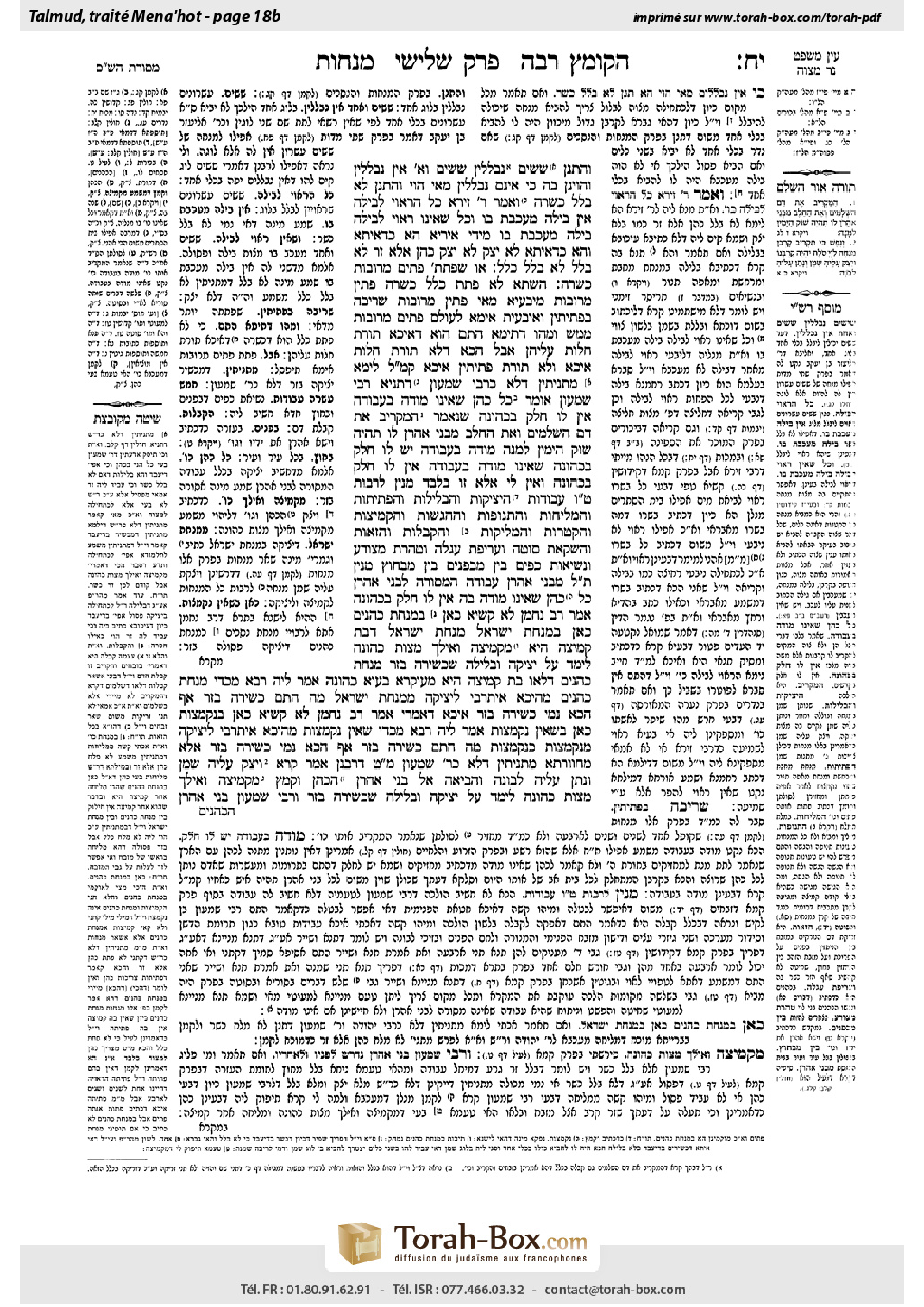
Menachot 18b: Talmud study for Daf Yomi
Daf Yomi is the daily study of one Talmud folio. Explore 37 tractates with scans, Hebrew text, Sefaria English and AI-generated French translations where annotated.
Passage selection and English or AI-generated French translation are available where the scan has annotations. Daf Study is independent of Torah-Box and Sefaria.
Browse Menachot · מנחות · All tractatesMenachot 18b text and translations
This page of Menachot includes the Aramaic text, an English translation and an AI-generated French translation, alongside the scan above.
מנחות י״ח ב · Aramaic and Hebrew text
וְהָתְנַן: שִׁשִּׁים נִבְלָלִין, שִׁשִּׁים וְאֶחָד אֵין נִבְלָלִין, וְהָוֵינַן בָּהּ: כִּי אֵינָם נִבְלָלִין מַאי הָוֵי? וְהָתְנַן: ״לֹא בָּלַל״ – כְּשֵׁרָה!
וְאָמַר רַבִּי זֵירָא: כׇּל הָרָאוּי לְבִילָּה – אֵין בִּילָּה מְעַכֶּבֶת בּוֹ, וְכֹל שֶׁאֵינוֹ רָאוּי לְבִילָּה – בִּילָּה מְעַכֶּבֶת בּוֹ.
מִידֵּי אִירְיָא? הָא כִּדְאִיתַהּ וְהָא כִּדְאִיתַהּ: ״לֹא יָצַק״ – לֹא יָצַק כֹּהֵן אֶלָּא זָר, ״לֹא בָּלַל״ – לֹא בָּלַל כְּלָל.
אוֹ שֶׁפְּתָתָן פִּתִּים מְרוּבּוֹת – כְּשֵׁרָה. הַשְׁתָּא לֹא פָּתַת כְּלָל – כְּשֵׁרָה, פִּתִּין מְרוּבּוֹת מִיבַּעְיָא? מַאי ״פִּתִּין מְרוּבּוֹת״? שֶׁרִיבָּה בִּפְתִיתִין.
וְאִיבָּעֵית אֵימָא: לְעוֹלָם פִּתִּים מְרוּבּוֹת מַמָּשׁ, וּמַהוּ דְּתֵימָא: הָתָם הוּא דְּאִיכָּא תּוֹרַת חַלּוֹת עֲלֵיהֶן, אֲבָל הָכָא, דְּלָא תּוֹרַת חַלּוֹת אִיכָּא וְלָא תּוֹרַת פְּתִיתִין אִיכָּא, קָא מַשְׁמַע לַן.
לֵימָא מַתְנִיתִין דְּלָא כְּרַבִּי שִׁמְעוֹן, דְּתַנְיָא: רַבִּי שִׁמְעוֹן אוֹמֵר: כׇּל כֹּהֵן שֶׁאֵינוֹ מוֹדֶה בָּעֲבוֹדָה אֵין לוֹ חֵלֶק בַּכְּהוּנָּה, שֶׁנֶּאֱמַר: ״הַמַּקְרִיב אֶת דַּם הַשְּׁלָמִים וְאֶת הַחֵלֶב מִבְּנֵי אַהֲרֹן לוֹ תִהְיֶה שׁוֹק הַיָּמִין לְמָנָה״ – מוֹדֶה בָּעֲבוֹדָה יֵשׁ לוֹ חֵלֶק בַּכְּהוּנָּה, שֶׁאֵינוֹ מוֹדֶה בָּעֲבוֹדָה אֵין לוֹ חֵלֶק בַּכְּהוּנָּה.
וְאֵין לִי אֶלָּא זוֹ בִּלְבַד, מִנַּיִן לְרַבּוֹת חֲמֵשׁ עֶשְׂרֵה עֲבוֹדוֹת –
הַיְּצִיקוֹת, וְהַבְּלִילוֹת, וְהַפְּתִיתוֹת, וְהַמְּלִיחוֹת, וְהַתְּנוּפוֹת, וְהַהַגָּשׁוֹת, וְהַקְּמִיצוֹת, וְהַקְטָרוֹת, וְהַמְּלִיקוֹת, וְהַקַּבָּלוֹת, וְהַזָּאוֹת, וְהַשְׁקָאַת סוֹטָה, וַעֲרִיפַת עֶגְלָה, וְטׇהֳרַת מְצוֹרָע, וּנְשִׂיאוּת כַּפַּיִם, בֵּין מִבִּפְנִים בֵּין מִבַּחוּץ, מִנַּיִן?
תַּלְמוּד לוֹמַר: ״מִבְּנֵי אַהֲרֹן״, עֲבוֹדָה הַמְּסוּרָה לִבְנֵי אַהֲרֹן, כׇּל כֹּהֵן שֶׁאֵינוֹ מוֹדֶה בָּהּ אֵין לוֹ חֵלֶק בַּכְּהוּנָּה!
אָמַר רַב נַחְמָן, לָא קַשְׁיָא: כָּאן בְּמִנְחַת כֹּהֲנִים, כָּאן בְּמִנְחַת יִשְׂרָאֵל. מִנְחַת יִשְׂרָאֵל דְּבַת קְמִיצָה הִיא, מִקְּמִיצָה וְאֵילָךְ מִצְוַת כְּהוּנָּה, לִימֵּד עַל יְצִיקָה וּבְלִילָה שֶׁכְּשֵׁירָה בְּזָר. מִנְחַת כֹּהֲנִים דְּלָאו בַּת קְמִיצָה הִיא, מֵעִיקָּרָא בָּעֲיָא כְּהוּנָּה.
אֲמַר לֵיהּ רָבָא: מִכְּדֵי מִנְחַת כֹּהֲנִים מֵהֵיכָא אִיתְרַבַּי לִיצִיקָה? מִמִּנְחַת יִשְׂרָאֵל, מָה הָתָם כְּשֵׁירָה בְּזָר – אַף הָכָא נָמֵי כְּשֵׁירָה בְּזָר!
אִיכָּא דְּאָמְרִי, אָמַר רַב נַחְמָן: לָא קַשְׁיָא, כָּאן בְּנִקְמָצוֹת, כָּאן בְּשֶׁאֵין נִקְמָצוֹת.
אֲמַר לֵיהּ רָבָא: מִכְּדֵי שֶׁאֵין נִקְמָצוֹת, מֵהֵיכָא אִיתְרַבַּי לִיצִיקָה? מִנִּקְמָצוֹת, כְּנִקְמָצוֹת – מָה הָתָם כְּשֵׁירָה בְּזָר, אַף הָכָא נָמֵי כְּשֵׁירָה בְּזָר! אֶלָּא מְחַוַּורְתָּא מַתְנִיתִין דְּלָא כְּרַבִּי שִׁמְעוֹן.
מַאי טַעְמָא דְּרַבָּנַן? אָמַר קְרָא: ״וְיָצַק עָלֶיהָ שֶׁמֶן וְנָתַן עָלֶיהָ לְבוֹנָה וֶהֱבִיאָהּ אֶל בְּנֵי אַהֲרֹן הַכֹּהֵן וְקָמַץ״, מִקְּמִיצָה וְאֵילָךְ מִצְוַת כְּהוּנָּה, לִימֵּד עַל יְצִיקָה וּבְלִילָה שֶׁכְּשֵׁירָה בְּזָר.
וְרַבִּי שִׁמְעוֹן, ״בְּנֵי אַהֲרֹן
Menachot 18b · English translation
The Gemara asks: But didn’t we learn in a mishna (103b): One who volunteers to bring a meal offering of sixty-one tenths of an ephah of flour must bring a meal offering of sixty tenths of an ephah in one vessel and a meal offering of a tenth of an ephah in a second vessel, because sixty tenths of an ephah of flour can be properly mixed with a log of oil but sixty-one tenths cannot be properly mixed with the oil. And we discussed it and asked: Even if sixty-one tenths of an ephah do not mix with one log of oil, what of it? But didn’t we learn in the mishna here that although there is a mitzva to mix the oil into the meal offering, if one did not mix the oil into it, the meal offering is still fit?
And Rabbi Zeira said the following explanation: For any measure of flour that is suitable for mixing with oil in a meal offering, the lack of mixing does not invalidate the meal offering. Even though there is a mitzva to mix the oil and the flour ab initio, the meal offering is fit for sacrifice even if the oil and the flour are not mixed. And for any measure of flour that is not suitable for mixing with oil in a meal offering, the lack of mixing invalidates the meal offering. This discussion demonstrates that when the mishna here says that the oil was not mixed into the meal offering, it means that it was not mixed at all. Therefore, the mishna’s statement that the meal offering is fit even if the oil was not poured should be understood as referring to a case where the oil was never poured, and not, as the Gemara inferred, as referring to a case where a non-priest poured it.
The Gemara refutes this proof: Are the cases comparable? This case is as it is, and that case is as it is. When the mishna states: If one did not pour the oil onto the meal offering, it is referring to a case where a priest did not pour oil onto the meal offering but a non-priest did pour it. When it states: If one did not mix the oil into the meal offering, it means he did not mix the oil at all.
§ The mishna teaches: Or if it happened that the priest broke the meal offerings that require breaking into greater pieces [pittim merubbot] than appropriate, the meal offering is fit. The Gemara asks: Now that it has already been stated in the mishna that if one did not break the loaves into pieces at all the meal offering is fit, is it necessary to state that if one broke the meal offering into greater pieces than appropriate the meal offering is fit? The Gemara answers: What does the expression pittin merubbot mean? It means that he increased [ribba] the amount of the meal offering’s pieces by breaking the loaves into many pieces that were each smaller than an olive-bulk.
And if you wish, say instead that the mishna is actually referring literally to large pieces [pittim merubbot], and it was necessary to teach this explicitly, lest you say that the meal offering is fit there, when the loaves are not broken, since they have the status of loaves, but here, when the loaves are broken into excessively large pieces and no longer have the status of loaves, as they have been broken up, but still do not have the status of pieces, as they are not the correct size, the offering is not fit. Therefore, it is necessary for the mishna to teach us this halakha explicitly.
§ Based on the Gemara’s earlier inference that when the mishna states that the meal offering is valid even if the priest did not pour the oil it is referring to a case where a non-priest did perform this action, the Gemara suggests: Let us say that the mishna is not in accordance with the opinion of Rabbi Shimon. As it is taught in a baraita that Rabbi Shimon says: Any priest who does not admit to the validity of the sacrificial rites has no portion in the gifts of the priesthood. As it is stated: “He among the sons of Aaron, that offers the blood of the peace offerings, and the fat, shall have the right thigh for a portion” (Leviticus 7:33). This teaches that one who admits to the validity of the sacrificial rites and accepts responsibility for them has a portion in the priestly gifts, but one who does not admit to the validity of the sacrificial rites does not have a portion in the priestly gifts.
The baraita continues: And I have derived only that a priest does not have a share in the priestly gifts if he does not admit to the validity of these rites of the presenting of the blood or the burning of the fats alone, which are the sacrificial rites of a slaughtered offering, as those rites are enumerated in the verse. From where is it derived that this halakha also includes one who does not admit to the validity of the fifteen sacrificial rites performed by the priests?
The baraita clarifies: These are the rites of a meal offering, i.e., the pouring of oil, the mixing, the breaking, the salting, the waving, the bringing of the offering to the altar, the removal of the handful, and the burning of the handful on the altar. And it includes other rites as well: The pinching of the nape of the neck of a bird offering, and the receiving of the blood in a vessel, and the sprinkling of the blood, and the giving of water to a woman suspected by her husband of having been unfaithful [sota], and the ritual of breaking a heifer’s neck, and the purification of a leper, and lifting of the hands for the Priestly Benediction, whether inside or outside the Temple. From where is it derived that this halakha also includes one who does not admit to the validity of these rites?
The baraita continues: The verse states: “Among the sons of Aaron,” teaching that with regard to any sacrificial rite that is entrusted to the sons of Aaron, any priest who does not admit to its validity does not have a portion in the priestly gifts. Since the pouring of the oil is included in the list of sacrificial rites entrusted to the priests, according to Rabbi Shimon the offering should not be fit if this service was performed by a non-priest.
Rav Naḥman said: This is not difficult. There, in the baraita, Rabbi Shimon is referring to the meal offering of priests, whereas here, in the mishna, the context is a meal offering of an Israelite. In the case of a meal offering of an Israelite, which is one that requires the removal of a handful to be burned on the altar, a verse teaches that from the stage of the removal of the handful onward, the rites performed with the meal offering are solely the mitzva of the members of the priesthood. Therefore, this verse also teaches that the pouring of the oil and the mixing, rites performed before the removal of the handful, are valid even if they are performed by a non-priest. By contrast, the meal offering of priests, which is one that does not require the removal of a handful, as the entire meal offering is burned on the altar, requires that from the outset the rites must be performed by a member of the priesthood; otherwise it is unfit.
Rava said to him: After all, in the case of the meal offering of priests, from where was it included that there is an obligation to pour the oil? It is derived from the halakha of the meal offering of an Israelite, where this halakha is stated explicitly. Therefore, just as there the rite is valid when performed by a non-priest, so too here, the rite is also valid when performed by a non-priest.
There are those who say the discussion took place as follows: Rav Naḥman said: This is not difficult. Here, when the mishna teaches that a meal offering is fit if the oil was poured by a non-priest, it is referring to meal offerings from which a handful is removed, whereas there, in the baraita that lists the pouring of the oil as one of the rites performed by the priests, it is referring to meal offerings from which a handful is not removed.
Rava said to him: After all, in the case of meal offerings from which a handful is not removed, from where was it included that there is also an obligation to pour the oil? It is derived from meal offerings from which a handful is removed, where this halakha is stated explicitly. Therefore, the halakha with regard to meal offerings from which a handful is not removed is like the halakha with regard to those from which a handful is removed; just as there, the rite is valid when performed by a non-priest, so too here, the rite is also valid when performed by a non-priest. Rather, since Rava deflected Rav Naḥman’s explanation of the opinion of Rabbi Shimon in the baraita, it is clear that the mishna is not in accordance with the opinion of Rabbi Shimon.
The Gemara asks: What is the reasoning of the Rabbis, who hold that the offering is fit even if the oil was poured by a non-priest? The verse states: “And he shall pour oil upon it and put frankincense upon it. And he shall bring it to Aaron’s sons, the priests; and he shall remove his handful” (Leviticus 2:1–2). From here it is derived that from the removal of the handful onward, the rites of the meal offering are solely the mitzva of the members of the priesthood. Therefore, this verse also teaches that the pouring of the oil and the mixing, rites performed before the removal of the handful, are valid even if they are performed by a non-priest.
The Gemara asks: And what would Rabbi Shimon say in response? He would say that when it states: “Aaron’s sons,
Menachot 18b · Traduction française (IA)
La Guemara demande : Mais n’avons-nous pas appris dans une Michna (103b) : Celui qui s’engage à apporter une offrande de farine de soixante et un dixièmes d’épha doit apporter une offrande de farine de soixante dixièmes d’épha dans un récipient et une offrande de farine d’un dixième d’épha dans un second récipient, car soixante dixièmes d’épha de farine peuvent être correctement mélangés à un log d’huile, tandis que soixante et un dixièmes ne le peuvent pas ? Nous en avons discuté et nous avons demandé : Même si soixante et un dixièmes d’épha ne se mélangent pas à un log d’huile, qu’importe ? N’avons-nous pas appris dans la Michna ici que, bien qu’il y ait une mitsva de mélanger l’huile à l’offrande de farine, si l’huile n’y a pas été mélangée, l’offrande reste valable ?
Rabbi Zeira a donné l’explication suivante : Pour toute mesure de farine qui peut être mélangée à l’huile dans une offrande de farine, l’absence de mélange n’invalide pas l’offrande. Bien qu’il y ait une mitsva de mélanger l’huile et la farine a priori, l’offrande peut être sacrifiée même si l’huile et la farine ne sont pas mélangées. En revanche, pour toute mesure de farine qui ne peut pas être mélangée à l’huile dans une offrande de farine, l’absence de mélange invalide l’offrande. Cette discussion montre que, lorsque la Michna dit ici que l’huile n’a pas été mélangée à l’offrande de farine, cela signifie qu’elle n’a pas été mélangée du tout. Par conséquent, l’affirmation de la Michna selon laquelle l’offrande reste valable même si l’huile n’a pas été versée doit être comprise comme se rapportant à un cas où l’huile n’a jamais été versée, et non, comme l’a déduit la Guemara, à un cas où un non-prêtre l’a versée.
La Guemara réfute cette preuve : Les cas sont-ils comparables ? Chaque cas est à considérer séparément. Lorsque la Michna dit : « Si l’on n’a pas versé l’huile sur l’offrande de farine », elle parle d’un cas où un prêtre n’a pas versé l’huile sur l’offrande, mais où un non-prêtre l’a fait. Lorsqu’elle dit : « Si l’on n’a pas mélangé l’huile à l’offrande de farine », cela signifie que l’huile n’a pas été mélangée du tout.
§ La Michna enseigne : Ou, s’il est arrivé que le prêtre brise les offrandes de farine qui doivent être brisées en morceaux [pittim merubbot] plus grands que la taille requise, l’offrande de farine reste valable. La Guemara demande : Puisqu’il a déjà été dit dans la Michna que si l’on n’a pas brisé les pains en morceaux du tout, l’offrande de farine reste valable, était-il nécessaire de préciser que si l’on a brisé l’offrande en morceaux plus grands que la taille requise, elle reste valable ? La Guemara répond : Que signifie l’expression pittim merubbot ? Elle signifie qu’il a augmenté [ribba] le nombre de morceaux de l’offrande en brisant les pains en de nombreux morceaux, chacun plus petit qu’un volume d’olive.
Ou, si tu préfères, on peut dire que la Michna parle littéralement de gros morceaux [pittim merubbot] et qu’il était nécessaire de l’enseigner explicitement, de peur que tu ne dises que l’offrande de farine reste valable dans le premier cas, lorsque les pains ne sont pas brisés, puisqu’ils ont le statut de pains, mais qu’ici, lorsque les pains sont brisés en morceaux excessivement gros, ils n’ont plus le statut de pains puisqu’ils ont été brisés, sans pour autant avoir le statut de morceaux, car ils n’ont pas la taille requise ; l’offrande ne serait alors pas valable. Il était donc nécessaire que la Michna nous enseigne explicitement cette halakha.
§ S’appuyant sur la déduction antérieure de la Guemara selon laquelle, lorsque la Michna dit que l’offrande de farine reste valable même si le prêtre n’a pas versé l’huile, elle parle d’un cas où un non-prêtre a accompli cet acte, la Guemara suggère : Disons que la Michna ne suit pas l’opinion de Rabbi Chimon. En effet, il est enseigné dans une baraïta que Rabbi Chimon dit : Tout prêtre qui ne reconnaît pas la validité des rites sacrificiels n’a aucune part dans les dons réservés aux prêtres. Comme il est dit : « Celui des fils d’Aaron qui offre le sang des sacrifices de paix et la graisse aura la cuisse droite pour part » (Lévitique 7:33). Cela enseigne que celui qui reconnaît la validité des rites sacrificiels et en assume la responsabilité a une part dans les dons sacerdotaux, tandis que celui qui ne reconnaît pas la validité de ces rites n’a aucune part dans les dons sacerdotaux.
La baraïta poursuit : J’ai seulement déduit qu’un prêtre n’a pas de part dans les dons sacerdotaux s’il ne reconnaît pas la validité des rites de présentation du sang ou de combustion des graisses, qui sont les rites sacrificiels d’un sacrifice abattu, puisque ces rites sont énumérés dans le verset. D’où déduit-on que cette halakha inclut également celui qui ne reconnaît pas la validité des quinze rites sacrificiels accomplis par les prêtres ?
La baraïta précise : Il s’agit des rites d’une offrande de farine, c’est-à-dire le versement de l’huile, le mélange, le bris, le salage, l’ondulation, la présentation de l’offrande à l’autel, le prélèvement de la poignée et la combustion de la poignée sur l’autel. Elle inclut également d’autres rites : la mélika de la nuque d’une offrande d’oiseau, la réception du sang dans un récipient, l’aspersion du sang, l’administration d’eau à une femme que son mari soupçonne d’infidélité [sota], le rite de la brisure de la nuque d’une génisse, la purification d’un lépreux et l’élévation des mains pour la bénédiction sacerdotale, que ce soit à l’intérieur ou à l’extérieur du Temple. D’où déduit-on que cette halakha inclut également celui qui ne reconnaît pas la validité de ces rites ?
La baraïta poursuit : Le verset dit : « Parmi les fils d’Aaron », ce qui enseigne que, pour tout rite sacrificiel confié aux fils d’Aaron, tout prêtre qui n’en reconnaît pas la validité n’a aucune part dans les dons sacerdotaux. Puisque le versement de l’huile figure dans la liste des rites sacrificiels confiés aux prêtres, selon Rabbi Chimon, l’offrande ne devrait pas être valable si ce rite a été accompli par un non-prêtre.
Rav Naḥman a dit : Il n’y a pas de difficulté. Là, dans la baraïta, Rabbi Chimon parle de l’offrande de farine des prêtres, tandis qu’ici, dans la Michna, il s’agit de l’offrande de farine d’un Israélite. Dans le cas de l’offrande de farine d’un Israélite, qui nécessite le prélèvement d’une poignée destinée à être brûlée sur l’autel, un verset enseigne qu’à partir du prélèvement de la poignée, les rites accomplis sur l’offrande de farine relèvent exclusivement des membres de la prêtrise. Ce verset enseigne donc également que le versement de l’huile et le mélange, rites accomplis avant le prélèvement de la poignée, sont valables même s’ils sont effectués par un non-prêtre. En revanche, l’offrande de farine des prêtres, qui ne nécessite pas le prélèvement d’une poignée puisque l’offrande entière est brûlée sur l’autel, exige que les rites soient accomplis dès le départ par un membre de la prêtrise ; sinon, elle n’est pas valable.
Rava lui dit : Après tout, dans le cas de l’offrande de farine des prêtres, d’où a-t-on déduit qu’il y a obligation de verser l’huile ? On le déduit de la halakha relative à l’offrande de farine d’un Israélite, où cette halakha est énoncée explicitement. Par conséquent, de même que là le rite reste valable lorsqu’il est accompli par un non-prêtre, de même ici, il reste valable lorsqu’il est accompli par un non-prêtre.
Selon certains, la discussion s’est déroulée ainsi : Rav Naḥman a dit : Il n’y a pas de difficulté. Ici, lorsque la Michna enseigne qu’une offrande de farine reste valable si l’huile a été versée par un non-prêtre, il s’agit d’offrandes de farine dont on prélève une poignée ; là, dans la baraïta qui énumère le versement de l’huile parmi les rites accomplis par les prêtres, il s’agit d’offrandes de farine dont on ne prélève pas de poignée.
Rava lui dit : Après tout, dans le cas des offrandes de farine dont on ne prélève pas de poignée, d’où a-t-on déduit qu’il y a également obligation de verser l’huile ? On le déduit des offrandes de farine dont on prélève une poignée, où cette halakha est énoncée explicitement. Par conséquent, la halakha relative aux offrandes de farine dont on ne prélève pas de poignée est identique à celle des offrandes dont on prélève une poignée : de même que là le rite reste valable lorsqu’il est accompli par un non-prêtre, de même ici, il reste valable lorsqu’il est accompli par un non-prêtre. Puisque Rava a écarté l’explication que Rav Naḥman donnait de l’opinion de Rabbi Chimon dans la baraïta, il est donc clair que la Michna ne suit pas l’opinion de Rabbi Chimon.
La Guemara demande : Quel est le raisonnement des Rabbins, qui considèrent que l’offrande reste valable même si l’huile a été versée par un non-prêtre ? Le verset dit : « Il versera de l’huile dessus et y mettra de l’encens. Il l’apportera ensuite aux fils d’Aaron, les prêtres ; et il prélèvera sa poignée » (Lévitique 2:1–2). On en déduit qu’à partir du prélèvement de la poignée, les rites de l’offrande de farine relèvent exclusivement des membres de la prêtrise. Ce verset enseigne donc également que le versement de l’huile et le mélange, rites accomplis avant le prélèvement de la poignée, sont valables même s’ils sont effectués par un non-prêtre.
La Guemara demande : Et que répondrait Rabbi Chimon ? Il dirait que, lorsqu’il est dit : « Les fils d’Aaron,
Traduction française générée par IA à partir de l’édition anglaise de Sefaria. Vérifie toujours un passage avec le texte source.
Text from Sefaria: William Davidson Edition - Vocalized Aramaic (unknown); William Davidson Edition - English (CC BY NC).