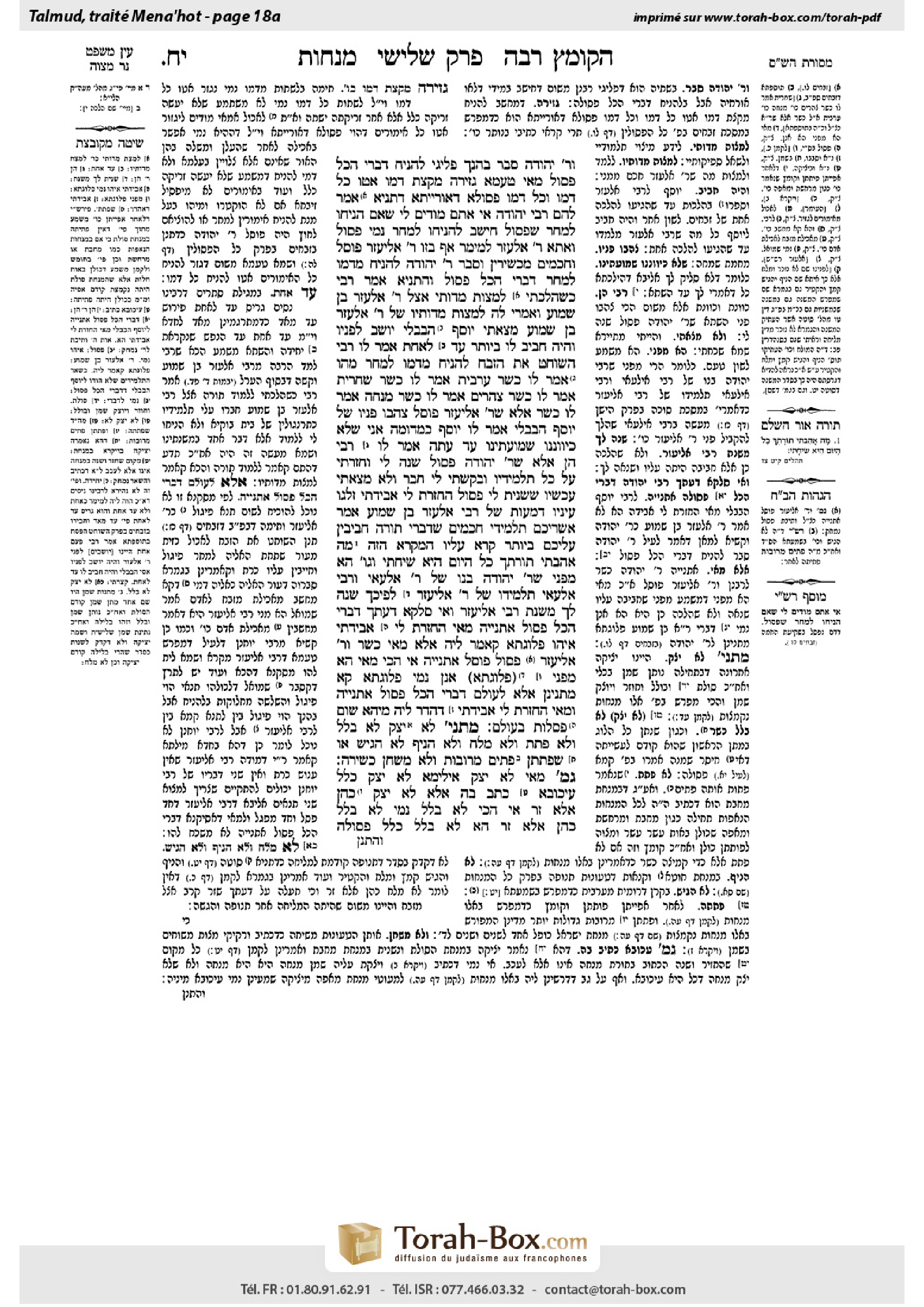
Menachot 18a: Talmud study for Daf Yomi
Daf Yomi is the daily study of one Talmud folio. Explore 37 tractates with scans, Hebrew text, Sefaria English and AI-generated French translations where annotated.
Passage selection and English or AI-generated French translation are available where the scan has annotations. Daf Study is independent of Torah-Box and Sefaria.
Browse Menachot · מנחות · All tractatesMenachot 18a text and translations
This page of Menachot includes the Aramaic text, an English translation and an AI-generated French translation, alongside the scan above.
מנחות י״ח א · Aramaic and Hebrew text
וְרַבִּי יְהוּדָה סָבַר בְּהָנָךְ פְּלִיגִי, לְהַנִּיחַ – דִּבְרֵי הַכֹּל פָּסוּל. מַאי טַעְמָא? גְּזֵירָה מִקְצָת דָּמוֹ אַטּוּ כׇּל דָּמוֹ, וְכׇל דָּמוֹ פְּסוּלָא דְאוֹרָיְיתָא.
דְּתַנְיָא, אָמַר לָהֶם רַבִּי יְהוּדָה: אִי אַתֶּם מוֹדִים לִי שֶׁאִם הִנִּיחוֹ לְמָחָר שֶׁפָּסוּל? חִישֵּׁב לְהַנִּיחוֹ לְמָחָר נָמֵי פָּסוּל.
וַאֲתָא רַבִּי אֶלְעָזָר לְמֵימֵר: אַף בְּזוֹ רַבִּי אֱלִיעֶזֶר פּוֹסֵל וַחֲכָמִים מַכְשִׁירִין.
וְסָבַר רַבִּי יְהוּדָה לְהַנִּיחַ מִדָּמוֹ לְמָחָר דִּבְרֵי הַכֹּל פָּסוּל? וְהָתַנְיָא: אָמַר רַבִּי: כְּשֶׁהָלַכְתִּי לְמַצּוֹת מִדּוֹתַי אֵצֶל רַבִּי אֶלְעָזָר בֶּן שַׁמּוּעַ, וְאָמְרִי לַהּ לְמַצּוֹת מִדּוֹתָיו שֶׁל רַבִּי אֶלְעָזָר בֶּן שַׁמּוּעַ, מָצָאתִי יוֹסֵף הַבַּבְלִי יוֹשֵׁב לְפָנָיו, וְהָיָה חָבִיב לוֹ בְּיוֹתֵר, עַד לְאַחַת אָמַר לוֹ: רַבִּי, הַשּׁוֹחֵט אֶת הַזֶּבַח לְהַנִּיחַ מִדָּמוֹ לְמָחָר מַהוּ?
אָמַר לוֹ: כָּשֵׁר. עַרְבִית אָמַר לוֹ: כָּשֵׁר. שַׁחֲרִית אָמַר לוֹ: כָּשֵׁר. צׇהֳרַיִם אָמַר לוֹ: כָּשֵׁר. מִנְחָה אָמַר לוֹ: כָּשֵׁר, אֶלָּא שֶׁרַבִּי אֱלִיעֶזֶר פּוֹסֵל. צָהֲבוּ פָּנָיו שֶׁל יוֹסֵף הַבַּבְלִי.
אָמַר לוֹ: יוֹסֵף, כִּמְדוּמֶּה אֲנִי שֶׁלֹּא כִּיוַּונְנוּ שְׁמוּעָתֵינוּ עַד עָתָּה. אָמַר לוֹ: רַבִּי, הֵן! אֶלָּא שֶׁרַבִּי יְהוּדָה פָּסוּל שָׁנָה לִי, וְחָזַרְתִּי עַל כׇּל תַּלְמִידָיו וּבִקַּשְׁתִּי לִי חָבֵר וְלֹא מָצָאתִי, עַכְשָׁיו שֶׁשָּׁנִיתָ לִי פָּסוּל – הֶחְזַרְתָּ לִי אֲבֵידָתִי.
זָלְגוּ עֵינָיו דְּמָעוֹת שֶׁל רַבִּי אֶלְעָזָר בֶּן שַׁמּוּעַ, אָמַר: אַשְׁרֵיכֶם תַּלְמִידֵי חֲכָמִים שֶׁדִּבְרֵי תוֹרָה חֲבִיבִין עֲלֵיכֶם בְּיוֹתֵר, קָרָא עָלָיו הַמִּקְרָא הַזֶּה: ״מָה אָהַבְתִּי תוֹרָתֶךָ כׇּל הַיּוֹם הִיא שִׂיחָתִי וְגוֹ׳״, הָא מִפְּנֵי שֶׁרַבִּי יְהוּדָה בְּנוֹ שֶׁל רַבִּי אִלְעַאי, וְרַבִּי אִלְעַאי תַּלְמִידוֹ שֶׁל רַבִּי אֱלִיעֶזֶר, לְפִיכָךְ שָׁנָה לְךָ מִשְׁנַת רַבִּי אֱלִיעֶזֶר.
וְאִי סָלְקָא דַעְתָּךְ דִּבְרֵי הַכֹּל פָּסוּל אַתְנְיֵיהּ, מַאי הֶחְזַרְתָּ לִי אֲבֵידָתִי? אִיהוּ פְּלוּגְתָּא קָאָמַר לֵיהּ.
אֶלָּא מַאי, כָּשֵׁר וְרַבִּי אֱלִיעֶזֶר (פָּסוּל) פּוֹסֵל אַתְנְיֵיהּ? אִי הָכִי, מַאי הָא מִפְּנֵי פְּלוּגְתָּא? אֲנַן נָמֵי פְּלוּגְתָּא קָא מַתְנִינַן!
אֶלָּא, לְעוֹלָם ״דִּבְרֵי הַכֹּל פָּסוּל״ אַתְנְיֵיהּ, וּמַאי הֶחְזַרְתָּ לִי אֲבֵידָתִי? (דהדר) [דְּאַהְדַּר] לֵיהּ מִיהָא שׁוּם פַּסְלוּת בָּעוֹלָם.
מַתְנִי׳ לֹא יָצַק, לֹא בָּלַל, וְלֹא פָּתַת, וְלֹא מֶלַח, וְלֹא הֵנִיף, לֹא הִגִּישׁ, אוֹ שֶׁפְּתָתָן פִּתִּים מְרוּבּוֹת, וְלֹא מְשָׁחָן – כְּשֵׁירָה.
גְּמָ׳ מַאי ״לֹא יָצַק״? אִילֵּימָא לֹא יָצַק כְּלָל – עִיכּוּבָא כְּתַב בָּהּ! אֶלָּא, לֹא יָצַק כֹּהֵן, אֶלָּא זָר. אִי הָכִי, ״לֹא בָּלַל״ נָמֵי – לֹא בָּלַל כֹּהֵן, אֶלָּא זָר, הָא לֹא בָּלַל כְּלָל – פְּסוּלָה.
Menachot 18a · English translation
And Rabbi Yehuda holds that the Rabbis and Rabbi Eliezer disagree only in those cases, where one’s intention is to drink the blood or burn the meat of the offering. In those cases, the Rabbis deem the offering fit, since the improper intention involves making use of the item in an unusual manner. But if one’s intention is to leave of its blood until the next day, everyone agrees that the offering is unfit. What is the reason for this? It is a rabbinic decree disqualifying the offering when some of its blood is left over until the next day due to the concern that a priest may intend to leave over all of its blood, and if one’s intention is to leave all of its blood until the next day, the offering is rendered unfit by Torah law.
As it is taught in a baraita: Rabbi Yehuda said to the Rabbis: Do you not concede to me that if he left the blood until the next day without presenting it, that the offering is unfit? Therefore, if he intended to leave the blood until the next day, it is also unfit.
And Rabbi Elazar comes to say that even in this case Rabbi Eliezer deems the offering unfit and the Rabbis deem it fit, as there is no distinction between a case where one intended to drink of the blood on the next day and where one intended to merely leave the blood until the next day.
The Gemara asks: And does Rabbi Yehuda in fact hold that if one’s intention is to leave some of the blood until the next day, everyone agrees that the offering is unfit? But isn’t it taught in a baraita: Rabbi Yehuda HaNasi said: When I went to Rabbi Elazar ben Shammua to clarify my knowledge, and some say that Rabbi Yehuda HaNasi said: When I went to clarify the knowledge of, i.e., study under, Rabbi Elazar ben Shammua, I found Yosef the Babylonian sitting before Rabbi Elazar ben Shammua. And every ruling that Rabbi Elazar ben Shammua taught was especially dear to him, until they began discussing one halakha, when Yosef the Babylonian said to him: My teacher, with regard to one who slaughters the offering with the intention to leave some of its blood for the next day, what is the halakha?
Rabbi Elazar ben Shammua said to him: The offering is fit. Yosef the Babylonian repeated this question that evening, and Rabbi Elazar ben Shammua said to him that the offering is fit. He asked again the following morning, and Rabbi Elazar ben Shammua said to him that the offering is fit. Once again, he asked this question at noon, and Rabbi Elazar ben Shammua said to him that the offering is fit. When he asked the question a further time that late afternoon, Rabbi Elazar ben Shammua said to him: I hold that the offering is fit, but Rabbi Eliezer deems it unfit. Yosef the Babylonian’s face lit up [tzahavu panav] with joy.
Rabbi Elazar ben Shammua said to him: Yosef, it seems to me that our, i.e., my, halakhot were not accurate until now, when I said that the offering is fit. Yosef the Babylonian said to him: My teacher, yes, I agree that the offering is fit, as you said. But my reluctance to accept your statement was due to the fact that Rabbi Yehuda taught me that the offering is unfit, and I went around to all of Rabbi Yehuda’s disciples, seeking another disciple who had also heard this from him, but I could not find one, and thought that I must have been mistaken. Now that you have taught me that Rabbi Eliezer deems it unfit, you have returned to me that which I had lost.
The baraita continues: Upon hearing this, Rabbi Elazar ben Shammua’s eyes streamed with tears, and he said: Happy are you, Torah scholars, for whom matters of Torah are exceedingly dear. Rabbi Elazar ben Shammua recited this verse about Yosef the Babylonian: “O how I love Your Torah; it is my meditation all the day” (Psalms 119:97). He continued: Because Rabbi Yehuda is the son of Rabbi Elai, and Rabbi Elai is the student of Rabbi Eliezer, therefore Rabbi Yehuda taught you the mishna of Rabbi Eliezer that the offering is unfit.
The Gemara explains its objection: And if it enters your mind that Rabbi Yehuda taught Yosef the Babylonian that all agree that the offering is unfit, what did Yosef the Babylonian mean when he said to Rabbi Elazar ben Shammua: You have returned to me that which I had lost? Rabbi Elazar ben Shammua had said to him only that whether the offering is rendered unfit is subject to a dispute, and Yosef the Babylonian would have been taught that all agree that it is unfit.
Rather, what is it that Rabbi Yehuda taught Yosef the Babylonian? Did he teach him that the Rabbis deem the offering fit and Rabbi Eliezer deems it unfit? If that is so, what did Rabbi Elazar ben Shammua mean when he said that it was only because Rabbi Yehuda was the son of Rabbi Elai, who was the student of Rabbi Eliezer, that Rabbi Yehuda taught this dispute? According to Rabbi Elazar ben Shammua, we too teach this dispute. The fact that Rabbi Yehuda taught both opinions in a dispute does not require justification.
Rather, it must be that actually, Rabbi Yehuda taught Yosef the Babylonian that all agree that the offering is unfit; and what did Yosef the Babylonian mean when he said: You have returned to me that which I had lost? He meant that Rabbi Elazar ben Shammua had in any event returned to him that there is some opinion in the world concerning the unfitness of the offering if one’s intention was to leave over the blood until the next day. His answer reassured Yosef the Babylonian that there is in fact such an opinion.
MISHNA: If one did not pour the oil onto the meal offering, or did not mix the oil into the meal offering, or did not break the loaves into pieces, or did not add salt, or did not wave the omer meal offering or the meal offering of a sota, or did not bring the meal offering to the altar, or if it happened that the priest broke the meal offerings that require breaking into greater pieces than appropriate, or did not smear oil on the wafers requiring this (see Leviticus 2:4), in all these cases the meal offering is fit.
GEMARA: The Gemara asks: What does the mishna mean when it states that if one did not pour the oil onto the meal offering, the meal offering is fit? If we say that it means that he did not pour oil at all, that is difficult: Doesn’t the verse write with regard to the pouring of the oil that doing so is indispensable? Rather, the mishna must be referring to a case where a priest did not pour the oil onto the meal offering, but a non-priest did pour it. The Gemara notes: If so, that the first clause of the mishna is understood in this manner, then the next halakha in the mishna: If one did not mix the oil into the meal offering, should also be understood as referring to a case where a priest did not mix the oil into the meal offering, but a non-priest did mix it, so it is fit. This would indicate that if one did not mix the oil into the meal offering at all, the meal offering is unfit.
Menachot 18a · Traduction française (IA)
Et Rabbi Yehouda considère que les Sages et Rabbi Éliézer ne sont en désaccord que dans les cas où l’on a l’intention de boire le sang ou de brûler la viande du sacrifice. Dans ces cas, les Sages déclarent le sacrifice valide, puisque l’intention fautive consiste à utiliser l’élément d’une manière inhabituelle. Mais si l’on a l’intention de laisser une partie du sang jusqu’au lendemain, tous conviennent que le sacrifice est invalide. Pour quelle raison ? Il s’agit d’un décret rabbinique qui disqualifie le sacrifice lorsqu’une partie de son sang est laissée jusqu’au lendemain, par crainte qu’un prêtre n’ait l’intention d’en laisser tout le sang ; or, si l’on a l’intention de laisser tout son sang jusqu’au lendemain, le sacrifice est disqualifié par la Torah.
Comme il est enseigné dans une baraïta : Rabbi Yehouda dit aux Sages : Ne reconnaissez-vous pas avec moi que, si l’on laisse le sang jusqu’au lendemain sans l’asperger, le sacrifice est invalide ? Par conséquent, si l’on a l’intention de laisser le sang jusqu’au lendemain, il est également invalide.
Et Rabbi Éléazar vient enseigner que, même dans ce cas, Rabbi Éliézer déclare le sacrifice invalide et les Sages le déclarent valide, car il n’y a pas de différence entre le cas où l’on a l’intention de boire le sang le lendemain et celui où l’on a simplement l’intention de laisser le sang jusqu’au lendemain.
La Guemara demande : Rabbi Yehouda considère-t-il effectivement que, si l’on a l’intention de laisser une partie du sang jusqu’au lendemain, tous conviennent que le sacrifice est invalide ? Pourtant, n’est-il pas enseigné dans une baraïta : Rabbi Yehouda HaNassi a dit : « Lorsque je suis allé auprès de Rabbi Éléazar ben Shammoua pour approfondir mes connaissances — et certains disent que Rabbi Yehouda HaNassi a dit : Lorsque je suis allé approfondir les connaissances de Rabbi Éléazar ben Shammoua, c’est-à-dire étudier auprès de lui —, j’ai trouvé Yossef le Babylonien assis devant Rabbi Éléazar ben Shammoua. Chaque enseignement de Rabbi Éléazar ben Shammoua lui était particulièrement cher, jusqu’à ce qu’ils abordent une halakha et que Yossef le Babylonien lui dise : “Mon maître, quelle est la halakha concernant celui qui égorge le sacrifice avec l’intention d’en laisser une partie du sang pour le lendemain ?” »
Rabbi Éléazar ben Shammoua lui dit : « Le sacrifice est valide. » Ce soir-là, Yossef le Babylonien posa de nouveau la question, et Rabbi Éléazar ben Shammoua lui dit que le sacrifice était valide. Il la posa encore le lendemain matin, et Rabbi Éléazar ben Shammoua lui répondit que le sacrifice était valide. Il posa de nouveau la question à midi, et Rabbi Éléazar ben Shammoua lui répondit que le sacrifice était valide. Lorsqu’il posa encore la question en fin d’après-midi, Rabbi Éléazar ben Shammoua lui dit : « Je considère que le sacrifice est valide, mais Rabbi Éliézer le déclare invalide. » Le visage de Yossef le Babylonien s’illumina de joie [tzahavu panav].
Rabbi Éléazar ben Shammoua lui dit : « Yossef, il me semble que jusqu’à présent, nos halakhot — c’est-à-dire les miennes — n’étaient pas exactes, lorsque je disais que le sacrifice était valide. » Yossef le Babylonien lui répondit : « Mon maître, oui, je suis d’accord que le sacrifice est valide, comme vous l’avez dit. Mais j’hésitais à accepter votre propos parce que Rabbi Yehouda m’avait enseigné que le sacrifice était invalide. J’ai parcouru les disciples de Rabbi Yehouda, cherchant un autre disciple qui l’ait également entendu de lui, mais je n’en ai trouvé aucun et j’ai pensé que je devais m’être trompé. Maintenant que vous m’avez enseigné que Rabbi Éliézer le déclare invalide, vous m’avez rendu ce que j’avais perdu. »
La baraïta poursuit : En entendant cela, les yeux de Rabbi Éléazar ben Shammoua se remplirent de larmes, et il dit : « Heureux êtes-vous, sages de la Torah, vous pour qui les paroles de Torah sont infiniment précieuses. » Rabbi Éléazar ben Shammoua récita à propos de Yossef le Babylonien ce verset : « Combien j’aime Ta Torah ! Elle est ma méditation tout le jour » (Psaumes 119, 97). Il poursuivit : « Puisque Rabbi Yehouda est le fils de Rabbi Ilaï, et que Rabbi Ilaï est le disciple de Rabbi Éliézer, Rabbi Yehouda t’a donc enseigné la Michna de Rabbi Éliézer, selon laquelle le sacrifice est invalide. »
La Guemara explique son objection : Et s’il te vient à l’esprit que Rabbi Yehouda a enseigné à Yossef le Babylonien que tous conviennent que le sacrifice est invalide, que voulait dire Yossef le Babylonien lorsqu’il a dit à Rabbi Éléazar ben Shammoua : « Vous m’avez rendu ce que j’avais perdu » ? Rabbi Éléazar ben Shammoua lui avait seulement dit que la question de savoir si le sacrifice est disqualifié fait l’objet d’un désaccord, alors que Yossef le Babylonien aurait appris que tous conviennent qu’il est invalide.
Mais alors, qu’est-ce que Rabbi Yehouda a enseigné à Yossef le Babylonien ? Lui a-t-il enseigné que les Sages déclarent le sacrifice valide et que Rabbi Éliézer le déclare invalide ? Si tel est le cas, que voulait dire Rabbi Éléazar ben Shammoua lorsqu’il a dit que Rabbi Yehouda avait enseigné cette controverse uniquement parce qu’il était le fils de Rabbi Ilaï, qui était le disciple de Rabbi Éliézer ? Selon Rabbi Éléazar ben Shammoua, nous enseignons nous aussi cette controverse. Le fait que Rabbi Yehouda ait enseigné les deux opinions d’une controverse n’a pas besoin d’être justifié.
Il faut plutôt dire qu’en réalité, Rabbi Yehouda a enseigné à Yossef le Babylonien que tous conviennent que le sacrifice est invalide. Et que voulait dire Yossef le Babylonien lorsqu’il a dit : « Vous m’avez rendu ce que j’avais perdu » ? Il voulait dire que Rabbi Éléazar ben Shammoua lui avait, en tout état de cause, rendu la connaissance de l’existence, dans le monde, d’une opinion selon laquelle le sacrifice est invalide si l’on a l’intention de laisser le sang jusqu’au lendemain. Sa réponse rassura Yossef le Babylonien en lui confirmant qu’une telle opinion existe effectivement.
MICHNA : Si l’on n’a pas versé l’huile sur l’offrande végétale, ou si l’on n’a pas mélangé l’huile à l’offrande végétale, ou si l’on n’a pas rompu les pains en morceaux, ou si l’on n’a pas ajouté de sel, ou si l’on n’a pas agité l’offrande végétale de l’omer ou l’offrande végétale d’une sota, ou si l’on n’a pas apporté l’offrande végétale à l’autel, ou s’il est arrivé que le prêtre rompe en morceaux plus grands qu’il ne convient les offrandes végétales qui doivent être rompues, ou s’il n’a pas enduit d’huile les galettes qui doivent l’être (voir Lévitique 2, 4), dans tous ces cas, l’offrande végétale est valide.
GUEMARA : La Guemara demande : Que signifie la Michna lorsqu’elle dit que, si l’on n’a pas versé l’huile sur l’offrande végétale, celle-ci est valide ? Si l’on dit qu’elle signifie que l’on n’a pas versé d’huile du tout, cela pose difficulté : le verset ne dit-il pas, à propos du versement de l’huile, que celui-ci est indispensable ? Il faut plutôt dire que la Michna parle du cas où un prêtre n’a pas versé l’huile sur l’offrande végétale, mais où un non-prêtre l’a versée. La Guemara remarque : Si tel est le cas, et que la première partie de la Michna s’interprète ainsi, alors la halakha suivante de la Michna — « si l’on n’a pas mélangé l’huile à l’offrande végétale » — doit elle aussi être comprise comme désignant le cas où un prêtre n’a pas mélangé l’huile à l’offrande végétale, mais où un non-prêtre l’a mélangée, de sorte que l’offrande est valide. Cela indiquerait que si l’on n’a pas du tout mélangé l’huile à l’offrande végétale, celle-ci est invalide.
Traduction française générée par IA à partir de l’édition anglaise de Sefaria. Vérifie toujours un passage avec le texte source.
Text from Sefaria: William Davidson Edition - Vocalized Aramaic (unknown); William Davidson Edition - English (CC BY NC).