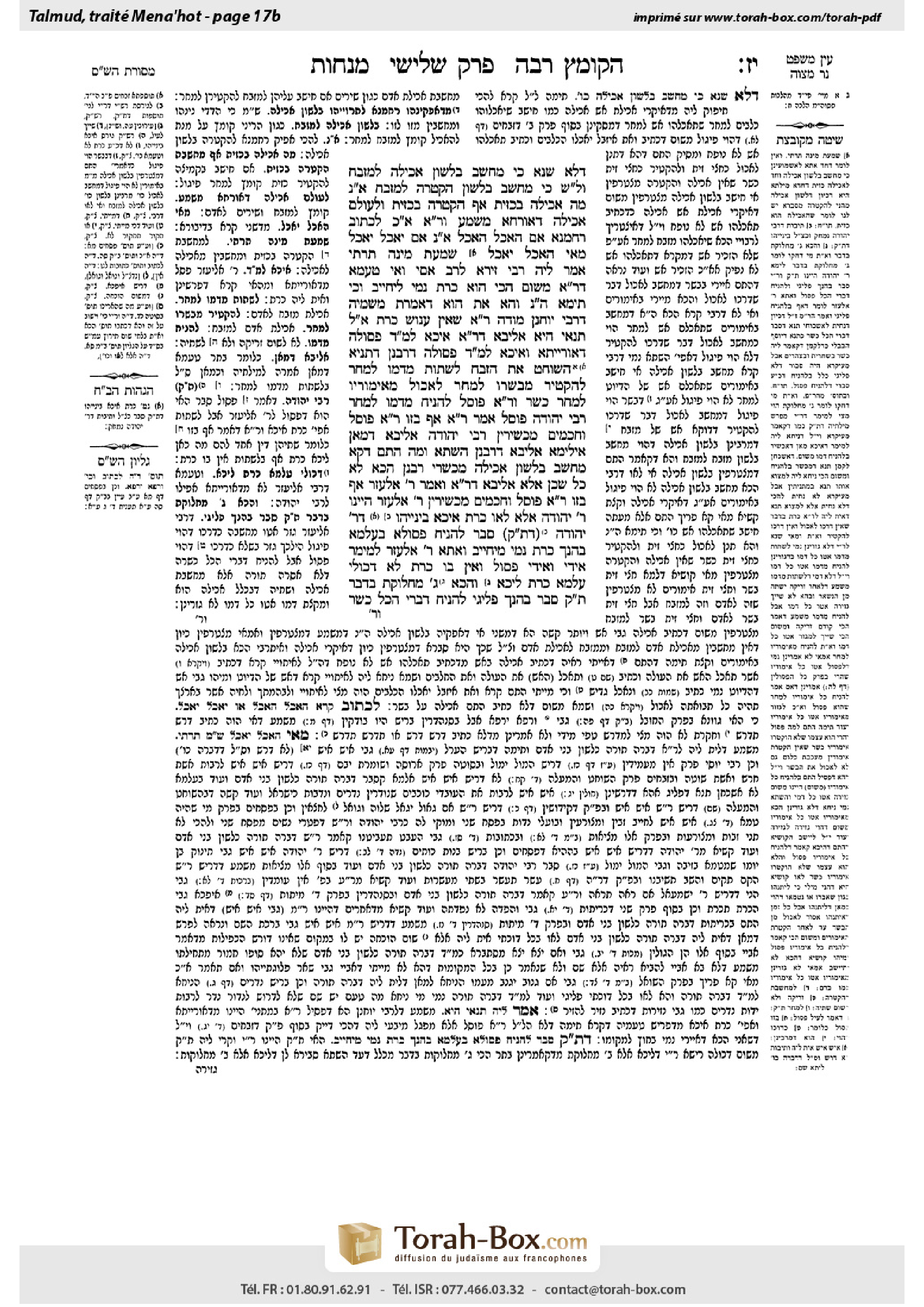
Menachot 17b: Talmud study for Daf Yomi
Daf Yomi is the daily study of one Talmud folio. Explore 37 tractates with scans, Hebrew text, Sefaria English and AI-generated French translations where annotated.
Passage selection and English or AI-generated French translation are available where the scan has annotations. Daf Study is independent of Torah-Box and Sefaria.
Browse Menachot · מנחות · All tractatesMenachot 17b text and translations
This page of Menachot includes the Aramaic text, an English translation and an AI-generated French translation, alongside the scan above.
מנחות י״ז ב · Aramaic and Hebrew text
דְּלָא שְׁנָא כִּי מְחַשֵּׁב בִּלְשׁוֹן אֲכִילָה לְמִזְבֵּחַ, וְלָא שְׁנָא כִּי מְחַשֵּׁב בִּלְשׁוֹן הַקְטָרָה לַמִּזְבֵּחַ.
אִי נָמֵי, מָה אֲכִילָה בִּכְזַיִת – אַף הַקְטָרָה בִּכְזַיִת, וּלְעוֹלָם אֲכִילָה דְּאוֹרְחָא מַשְׁמַע.
וְרַבִּי אֱלִיעֶזֶר, אִם כֵּן, לִכְתּוֹב רַחֲמָנָא ״אִם הֵאָכֹל הֵאָכֹל״, אִי נָמֵי ״אִם יֵאָכֵל יֵאָכֵל״, מַאי ״הֵאָכֹל יֵאָכֵל״? שָׁמְעַתְּ מִינַּהּ תַּרְתֵּי.
אֲמַר לֵיהּ רַבִּי זֵירָא לְרַב אַסִּי: וְאִי טַעְמָא דְּרַבִּי אֱלִיעֶזֶר מִשּׁוּם הָכִי הוּא, כָּרֵת נָמֵי לִיחַיַּיב? וְכִי תֵּימָא הָכִי נָמֵי, וְהָא אַתְּ הוּא דְּאָמְרַתְּ מִשְּׁמֵיהּ דְּרַבִּי יוֹחָנָן: מוֹדֶה רַבִּי אֱלִיעֶזֶר שֶׁאֵין עָנוּשׁ כָּרֵת!
אֲמַר לֵיהּ: תַּנָּאֵי הִיא אַלִּיבָּא דְּרַבִּי אֱלִיעֶזֶר, אִיכָּא לְמַאן דְּאָמַר: פְּסוּלָה דְּאוֹרָיְיתָא, וְאִיכָּא לְמַאן דְּאָמַר: פְּסוּלָה דְּרַבָּנַן.
דְּתַנְיָא: הַשּׁוֹחֵט אֶת הַזֶּבַח לִשְׁתּוֹת מִדָּמוֹ לְמָחָר, לְהַקְטִיר מִבְּשָׂרוֹ לְמָחָר, לֶאֱכוֹל מֵאֵימוּרָיו לְמָחָר – כָּשֵׁר, וְרַבִּי אֱלִיעֶזֶר פּוֹסֵל. לְהַנִּיחַ מִדָּמוֹ לְמָחָר – רַבִּי יְהוּדָה פּוֹסֵל. אָמַר רַבִּי אֶלְעָזָר: אַף בָּזוֹ רַבִּי אֱלִיעֶזֶר פּוֹסֵל וַחֲכָמִים מַכְשִׁירִין.
רַבִּי יְהוּדָה, אַלִּיבָּא דְּמַאן? אִילֵימָא אַלִּיבָּא דְּרַבָּנַן – הַשְׁתָּא, וּמָה הָתָם דְּקָא מְחַשֵּׁב בִּלְשׁוֹן אֲכִילָה מַכְשְׁרִי רַבָּנַן, הָכָא לֹא כׇּל שֶׁכֵּן?
אֶלָּא, אַלִּיבָּא דְּרַבִּי אֱלִיעֶזֶר, וְאָמַר רַבִּי אֶלְעָזָר: אַף בְּזוֹ רַבִּי אֱלִיעֶזֶר פּוֹסֵל וַחֲכָמִים מַכְשִׁירִין. רַבִּי אֶלְעָזָר הַיְינוּ רַבִּי יְהוּדָה!
אֶלָּא לָאו כָּרֵת אִיכָּא בֵּינַיְיהוּ, דְּרַבִּי יְהוּדָה (דְּתַנָּא קַמָּא) סָבַר: לְהַנִּיחַ – פְּסוּלָא בְּעָלְמָא, בְּהָנָךְ כָּרֵת נָמֵי מִיחַיַּיב, וַאֲתָא רַבִּי אֶלְעָזָר לְמֵימַר: אִידֵּי וְאִידֵּי פָּסוּל וְאֵין בּוֹ כָּרֵת!
לָא, דְּכוּלֵּי עָלְמָא כָּרֵת לֵיכָּא, וְהָכָא שָׁלֹשׁ מַחְלוֹקֶת בְּדָבָר: תַּנָּא קַמָּא סָבַר בְּהָנָךְ פְּלִיגִי, לְהַנִּיחַ – דִּבְרֵי הַכֹּל כָּשֵׁר,
Menachot 17b · English translation
demonstrates that there is no difference if one expresses his intention using the language of: Consumption on the altar, and there is no difference if one expresses his intention using the language of: Burning on the altar. Therefore, if the priest removed the handful from the meal offering while expressing the intention that it should be burned on the altar on the following day, whether this intention was phrased as: Consumed on the altar, or: Burned on the altar, the offering is piggul.
Alternatively, the doubled expression serves to teach that just as one renders the offering piggul only when one’s intention involves the consumption of an olive-bulk, as this is the minimal measure for an act to be considered eating, so too, one renders the offering piggul only when one’s intention involves the burning of an olive-bulk. But actually, the expression for consumption found in the verse indicates consuming it in the usual manner, and therefore an offering is rendered unfit only if one’s improper intention involved consuming an item that is usually consumed, or burning an item that is usually burned.
And what would Rabbi Eliezer respond? He would say that if that were so, that the verse intends to teach only that halakha, let the Merciful One write either: If he’akhol he’akhol, or: If ye’akhel ye’akhel, repeating the same form of the word twice. What is the reason that the verse states “he’akhol ye’akhel,” employing both repetition and variation? Learn from this formulation two halakhot. One, as the Rabbis explain, is that the offering is rendered unfit whether one uses an expression of consumption or an expression of burning, provided that one’s intention is with regard to at least an olive-bulk. The second is that the offering is rendered unfit if one intends to burn on the altar an item that is usually consumed by a person, or to consume an item that is usually burned on the altar.
Rabbi Zeira said to Rav Asi: But if the reasoning of Rabbi Eliezer is due to that derivation, and he understands that the verse equates the improper intent to consume an item that is usually consumed with the improper intent to consume an item that is usually burned, then let one also be liable to receive karet for consuming an offering brought with intention to consume, after its designated time, the part of the offering that is burned, or for intention to burn, after its designated time, an item that is usually consumed. Why does Rabbi Eliezer state only that the offering is rendered unfit? And if you would say that indeed, Rabbi Eliezer does hold that one who consumes such an offering is liable to receive karet, that is difficult: But aren’t you the one who said in the name of Rabbi Yoḥanan: Rabbi Eliezer concedes that doing so is not punishable by karet?
Rav Asi said to him: It is a dispute between tanna’im as to the opinion of Rabbi Eliezer. There is one who says that Rabbi Eliezer deems the offering to be unfit by Torah law and one is liable to receive karet. It was in accordance with this opinion that Rabbi Yoḥanan cited the proof from the verse. And there is one who says that Rabbi Eliezer deems the offering to be unfit by rabbinic law, and it was in accordance with this opinion that Rabbi Yoḥanan said that according to Rabbi Eliezer there is no punishment of karet for this transgression.
As it is taught in a baraita: In the case of one who slaughters the offering with the intention to drink some of its blood, which is designated to be presented on the altar, on the next day, or to burn some of its meat, which is meant to be eaten, on the next day, or to eat some of its sacrificial portions, which are designated to be burned on the altar, on the next day, the offering is fit, as his intention is either to eat an item that is usually sacrificed on the altar, or to burn on the altar an item that is usually eaten. But Rabbi Eliezer deems the offering unfit. If one slaughters the offering with the intention to leave some of its blood for the next day, but not to present it or consume it, Rabbi Yehuda deems the offering unfit. Rabbi Elazar said: Even in this case Rabbi Eliezer deems the offering unfit, and the Rabbis deem it fit.
The Gemara clarifies: In accordance with whose opinion is the statement of Rabbi Yehuda that the offering is unfit even if he intends only to leave the blood for the next day, but not present it or consume it? If we say it is in accordance with the opinion of the Rabbis, now consider: And if there, where the priest expresses his intention using the language of consumption, the Rabbis nevertheless deem the offering fit, despite the fact that if he had used this expression with regard to the portion burned on the altar, the offering would be piggul, is it not all the more so the case that here, when he intends only to leave the blood until the next day, the offering should be fit?
Rather, it must be that Rabbi Yehuda’s statement is in accordance with the opinion of Rabbi Eliezer. And yet the baraita continues: Rabbi Elazar said: Even in this case Rabbi Eliezer deems the offering unfit, and the Rabbis deem it fit. If Rabbi Yehuda’s statement is in accordance with the opinion of Rabbi Eliezer, then the explanation of Rabbi Elazar of Rabbi Eliezer’s opinion is identical to that of Rabbi Yehuda, and there does not appear to be any disagreement between the two.
Rather, is it not so that the difference between Rabbi Elazar and Rabbi Yehuda is with regard to liability for karet? The difference lies in that Rabbi Yehuda holds that if one’s intention is to leave the blood for the next day, then according to Rabbi Eliezer the offering is only rendered unfit, whereas in those cases listed in the mishna, such as where one’s intention is to eat the sacrificial portions on the next day, he would be liable to receive karet as well. And Rabbi Elazar comes to say that according to Rabbi Eliezer, both in this case and in that case, the offering is unfit but there is no liability to receive karet for it.
The Gemara rejects this suggestion: No, it may be that everyone agrees that according to Rabbi Eliezer in a case where one’s intention is to eat, after its designated time, an item that is usually burned, or to burn an item that is usually eaten, there is no liability to receive karet. And here there are three disputes with regard to the matter. The first tanna holds that the Rabbis and Rabbi Eliezer disagree only in those cases, with regard to whether the offering is rendered unfit due to the intention to eat an item that is usually burned or to burn an item that is usually eaten. But with regard to leaving of its blood until the next day, everyone agrees that the offering is fit.
Menachot 17b · Traduction française (IA)
Cela démontre qu’il n’y a pas de différence entre exprimer son intention en disant « être consommé sur l’autel » et l’exprimer en disant « être brûlé sur l’autel ». Par conséquent, si le prêtre a prélevé la poignée de l’offrande de farine avec l’intention qu’elle soit brûlée sur l’autel le lendemain, que cette intention soit formulée comme « être consommée sur l’autel » ou « être brûlée sur l’autel », l’offrande est piggul.
Autre explication : la répétition enseigne que, de même qu’on ne rend l’offrande piggul que si l’intention porte sur la consommation d’un volume d’olive, car c’est la mesure minimale pour qu’un acte soit considéré comme une consommation, de même on ne rend l’offrande piggul que si l’intention porte sur la combustion d’un volume d’olive. En réalité, toutefois, l’expression relative à la consommation dans le verset indique une consommation conforme à l’usage habituel ; par conséquent, une offrande n’est invalidée que si l’intention impropre porte sur la consommation d’un élément habituellement consommé ou sur la combustion d’un élément habituellement brûlé.
Et que répondrait Rabbi Eliezer ? Il dirait : s’il en était ainsi, si le verset entendait enseigner uniquement cette halakha, que le Miséricordieux écrive soit he’akhol he’akhol, soit ye’akhel ye’akhel, en répétant deux fois la même forme du mot. Pourquoi le verset dit-il « he’akhol ye’akhel », en combinant répétition et variation ? Déduis de cette formulation deux halakhot. La première, comme l’expliquent les Rabbins, est que l’offrande est invalidée, que l’on emploie une expression de consommation ou une expression de combustion, à condition que l’intention porte sur au moins un volume d’olive. La seconde est que l’offrande est invalidée si l’on a l’intention de brûler sur l’autel un élément habituellement consommé par une personne, ou de consommer un élément habituellement brûlé sur l’autel.
Rabbi Zeira dit à Rav Asi : Mais si le raisonnement de Rabbi Eliezer repose sur cette déduction, et qu’il comprend que le verset met sur le même plan l’intention impropre de consommer un élément habituellement consommé et l’intention impropre de consommer un élément habituellement brûlé, alors ne devrait-on pas également être passible de karet pour avoir consommé une offrande avec l’intention de consommer, après le délai qui lui est assigné, la partie de l’offrande qui est brûlée, ou avec l’intention de brûler, après ce délai, un élément habituellement consommé ? Pourquoi Rabbi Eliezer dit-il seulement que l’offrande est invalidée ? Et si tu dis qu’en effet, Rabbi Eliezer estime que celui qui consomme une telle offrande est passible de karet, cela pose une difficulté : n’est-ce pas toi qui as dit au nom de Rabbi Yoḥanan que Rabbi Eliezer reconnaît qu’un tel acte n’est pas passible de karet ?
Rav Asi lui répondit : il existe une controverse entre les tannaïm quant à l’opinion de Rabbi Eliezer. Selon l’un, Rabbi Eliezer considère que l’offrande est invalidée par la Torah et que l’on est passible de karet. C’est conformément à cette opinion que Rabbi Yoḥanan a cité la preuve tirée du verset. Selon l’autre, Rabbi Eliezer considère que l’offrande est invalidée par décret rabbinique ; c’est conformément à cette opinion que Rabbi Yoḥanan a dit que, selon Rabbi Eliezer, cette transgression n’est pas passible de karet.
Comme il est enseigné dans une baraïta : dans le cas de celui qui égorge l’offrande avec l’intention de boire le lendemain une partie de son sang, destiné à être présenté sur l’autel, ou de brûler le lendemain une partie de sa viande, destinée à être consommée, ou de manger le lendemain une partie de ses portions sacrificielles, destinées à être brûlées sur l’autel, l’offrande est valide, car son intention porte soit sur la consommation d’un élément habituellement offert sur l’autel, soit sur la combustion sur l’autel d’un élément habituellement consommé. Mais Rabbi Eliezer invalide l’offrande. Si l’on égorge l’offrande avec l’intention de laisser une partie de son sang jusqu’au lendemain, sans le présenter ni le consommer, Rabbi Yehuda invalide l’offrande. Rabbi Elazar dit : même dans ce cas, Rabbi Eliezer invalide l’offrande, tandis que les Rabbins la considèrent valide.
La Guemara précise : conformément à l’opinion de qui Rabbi Yehuda affirme-t-il que l’offrande est invalide même si l’on a seulement l’intention de laisser le sang jusqu’au lendemain, sans le présenter ni le consommer ? Si l’on dit que c’est conformément à l’opinion des Rabbins, considérons ceci : là, lorsque le prêtre exprime son intention au moyen d’une expression de consommation, les Rabbins déclarent pourtant l’offrande valide, bien que s’il avait employé cette expression à propos de la partie brûlée sur l’autel, l’offrande aurait été piggul. À plus forte raison, ici, lorsqu’il a seulement l’intention de laisser le sang jusqu’au lendemain, l’offrande devrait-elle être valide.
Il faut plutôt dire que la déclaration de Rabbi Yehuda est conforme à l’opinion de Rabbi Eliezer. Or la baraïta poursuit : Rabbi Elazar dit : même dans ce cas, Rabbi Eliezer invalide l’offrande, tandis que les Rabbins la considèrent valide. Si la déclaration de Rabbi Yehuda est conforme à l’opinion de Rabbi Eliezer, alors l’explication que Rabbi Elazar donne de l’opinion de Rabbi Eliezer est identique à celle de Rabbi Yehuda, et il ne semble donc y avoir aucun désaccord entre eux.
Ne faut-il pas plutôt dire que la différence entre Rabbi Elazar et Rabbi Yehuda porte sur la responsabilité de karet ? La différence est que Rabbi Yehuda estime que si l’on a l’intention de laisser le sang jusqu’au lendemain, alors, selon Rabbi Eliezer, l’offrande est seulement invalidée, tandis que dans les cas énumérés dans la Michna, par exemple lorsque l’on a l’intention de manger les portions sacrificielles le lendemain, on serait également passible de karet. Rabbi Elazar vient enseigner que, selon Rabbi Eliezer, dans les deux cas, l’offrande est invalide, mais qu’il n’y a pas de responsabilité de karet.
La Guemara rejette cette proposition : non, il se peut que tous conviennent que, selon Rabbi Eliezer, lorsqu’on a l’intention de manger, après le délai qui lui est assigné, un élément habituellement brûlé, ou de brûler un élément habituellement consommé, on n’est pas passible de karet. Et, sur ce point, il existe trois controverses. Selon le premier tanna, les Rabbins et Rabbi Eliezer ne sont en désaccord que dans ces cas, sur la question de savoir si l’offrande est invalidée du fait de l’intention de manger un élément habituellement brûlé ou de brûler un élément habituellement consommé. Mais quant au fait de laisser son sang jusqu’au lendemain, tous conviennent que l’offrande est valide.
Traduction française générée par IA à partir de l’édition anglaise de Sefaria. Vérifie toujours un passage avec le texte source.
Text from Sefaria: William Davidson Edition - Vocalized Aramaic (unknown); William Davidson Edition - English (CC BY NC).