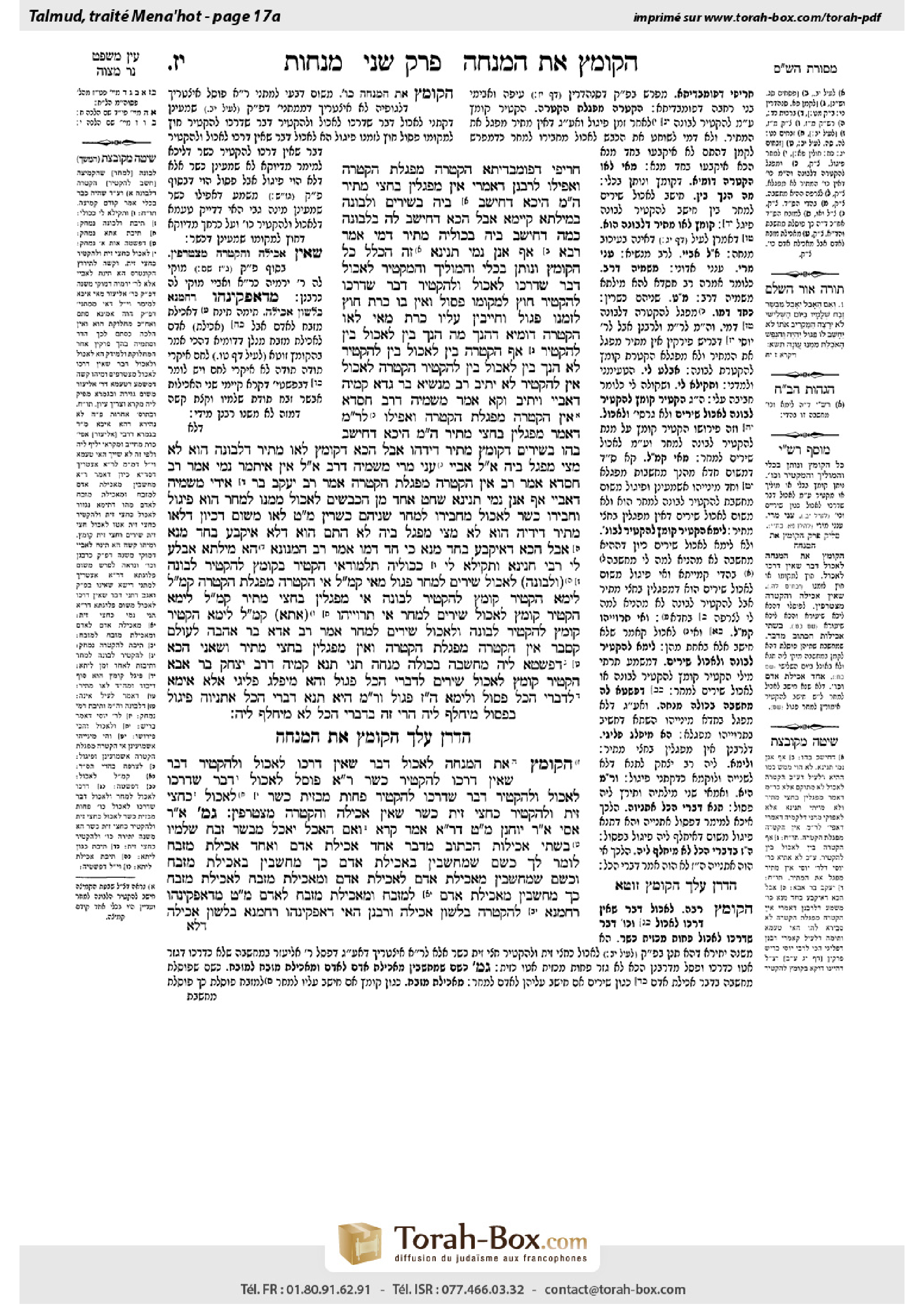
Menachot 17a: Talmud study for Daf Yomi
Daf Yomi is the daily study of one Talmud folio. Explore 37 tractates with scans, Hebrew text, Sefaria English and AI-generated French translations where annotated.
Passage selection and English or AI-generated French translation are available where the scan has annotations. Daf Study is independent of Torah-Box and Sefaria.
Browse Menachot · מנחות · All tractatesMenachot 17a text and translations
This page of Menachot includes the Aramaic text, an English translation and an AI-generated French translation, alongside the scan above.
מנחות י״ז א · Aramaic and Hebrew text
חֲרִיפֵי דְּפוּמְבְּדִיתָא: הַקְטָרָה מְפַגֶּלֶת הַקְטָרָה, וַאֲפִילּוּ לְרַבָּנַן דְּאָמְרִי אֵין מְפַגְּלִין בַּחֲצִי מַתִּיר – הָנֵי מִילֵּי הֵיכָא דְּחַשֵּׁב בֵּיהּ בְּשִׁירַיִם וּלְבוֹנָה בְּמִילְּתָא קָיְימָא, אֲבָל הָכָא דְּחַשֵּׁב לַהּ בִּלְבוֹנָה – כְּמָה דְּחַשֵּׁב בֵּיהּ בְּכוּלֵּיהּ מַתִּיר דָּמֵי.
אָמַר רָבָא: אַף אֲנַן נָמֵי תְּנֵינָא, זֶה הַכְּלָל: כׇּל הַקּוֹמֵץ וְנוֹתֵן בִּכְלִי, וְהַמּוֹלִיךְ וְהַמַּקְטִיר, לֶאֱכוֹל דָּבָר שֶׁדַּרְכּוֹ לֶאֱכוֹל וּלְהַקְטִיר דָּבָר שֶׁדַּרְכּוֹ לְהַקְטִיר, חוּץ לִמְקוֹמוֹ – פָּסוּל וְאֵין בּוֹ כָּרֵת, חוּץ לִזְמַנּוֹ – פִּגּוּל וְחַיָּיבִין עָלָיו כָּרֵת.
מַאי לָאו הַקְטָרָה דּוּמְיָא דְּהָנָךְ, מָה הָנָךְ – בֵּין לֶאֱכוֹל בֵּין לְהַקְטִיר, אַף הַקְטָרָה – בֵּין לֶאֱכוֹל בֵּין לְהַקְטִיר?
לָא, הָנָךְ – בֵּין לֶאֱכוֹל בֵּין לְהַקְטִיר; הַקְטָרָה – לֶאֱכוֹל אִין, לְהַקְטִיר לָא.
יָתֵיב רַב מְנַשְּׁיָא בַּר גַּדָּא קַמֵּיהּ דְּאַבָּיֵי, וְיָתֵיב וְקָא אָמַר מִשְּׁמֵיהּ דְּרַב חִסְדָּא: אֵין הַקְטָרָה מְפַגֶּלֶת הַקְטָרָה, וַאֲפִילּוּ לְרַבִּי מֵאִיר, דְּאָמַר: ״מְפַגְּלִין בַּחֲצִי מַתִּיר״ –
הָנֵי מִילֵּי הֵיכָא דְּחַשֵּׁב בְּהוּ בְּשִׁירַיִם, דְּקוֹמֶץ מַתִּיר דִּידְהוּ, אֲבָל הָכָא דְּקוֹמֶץ לָאו מַתִּיר דִּלְבוֹנָה הוּא – לָא מָצֵי מְפַגֵּל בֵּיהּ.
אֲמַר לֵיהּ אַבָּיֵי: עֲנִי מָרִי מִשְּׁמֵיהּ דְּרַב? אֲמַר לֵיהּ: אִין. אִיתְּמַר נָמֵי, אָמַר רַב חִסְדָּא אָמַר רַב: אֵין הַקְטָרָה מְפַגֶּלֶת הַקְטָרָה.
אָמַר רַב יַעֲקֹב בַּר אִידִי מִשְּׁמֵיהּ דְּאַבָּיֵי: אַף אֲנַן נָמֵי תְּנֵינָא, שָׁחַט אֶחָד מִן הַכְּבָשִׂים לֶאֱכוֹל מִמֶּנּוּ לְמָחָר – הוּא פִּיגּוּל וַחֲבֵירוֹ כָּשֵׁר, לֶאֱכוֹל מֵחֲבֵירוֹ לְמָחָר – שְׁנֵיהֶם כְּשֵׁרִין. מַאי טַעְמָא? לָאו מִשּׁוּם דְּכֵיוָן דְּלָאו מַתִּיר דִּידֵיהּ הוּא, לָא מָצֵי מְפַגֵּל בֵּיהּ.
לָא, הָתָם הוּא דְּלָא אִיקְּבַע בְּחַד מָנָא, אֲבָל הָכָא דְּאִיקְּבַע בְּחַד מָנָא – כִּי חַד דָּמוּ.
אָמַר רַב הַמְנוּנָא: הָא מִילְּתָא אַבְלַע לִי רַבִּי חֲנִינָא, וּתְקִילָא לִי כְּכוּלֵּיהּ תַּלְמוּדַאי – הִקְטִיר קוֹמֶץ לְהַקְטִיר לְבוֹנָה, וּלְבוֹנָה לֶאֱכוֹל שִׁירַיִם לְמָחָר – פִּגּוּל.
מַאי קָא מַשְׁמַע לַן? אִי הַקְטָרָה מְפַגֶּלֶת הַקְטָרָה קָא מַשְׁמַע לַן – לֵימָא: ״הִקְטִיר קוֹמֶץ לְהַקְטִיר לְבוֹנָה״! אִי מְפַגְּלִין בַּחֲצִי מַתִּיר קָא מַשְׁמַע לַן – לֵימָא: ״הִקְטִיר קוֹמֶץ לֶאֱכוֹל שִׁירַיִם לְמָחָר״! אִי תַּרְוַיְיהוּ אֲתָא קָא מַשְׁמַע לַן – לֵימָא: ״הִקְטִיר קוֹמֶץ לְהַקְטִיר לְבוֹנָה וְלֶאֱכוֹל שִׁירַיִם לְמָחָר״!
אָמַר רַב אַדָּא בַּר אַהֲבָה: לְעוֹלָם קָסָבַר אֵין הַקְטָרָה מְפַגֶּלֶת הַקְטָרָה, וְאֵין מְפַגְּלִין בַּחֲצִי מַתִּיר, וְשָׁאנֵי הָכָא דְּפָשְׁטָא לַיהּ מַחְשָׁבָה בְּכוּלַּהּ מִנְחָה.
תָּנֵי תַּנָּא קַמֵּיהּ דְּרַב יִצְחָק בַּר אַבָּא: הִקְטִיר קוֹמֶץ לֶאֱכוֹל שִׁירַיִם – לְדִבְרֵי הַכֹּל פִּגּוּל. וְהָא מִיפְלָג פְּלִיגִי? אֶלָּא אֵימָא: לְדִבְרֵי הַכֹּל פָּסוּל.
וְלֵימָא: הֲרֵי זֶה פִּגּוּל, וְרַבִּי מֵאִיר הִיא! תַּנָּא ״דִּבְרֵי הַכֹּל״ אַתְנְיוּהּ, ״פִּיגּוּל״ בְּ״פָסוּל״ מִיחַלַּף לֵיהּ, ״הֲרֵי זֶה״ בְּ״דִבְרֵי הַכֹּל״ לָא מִיחַלַּף לֵיהּ.
הֲדַרַן עֲלָךְ הַקּוֹמֵץ אֶת הַמִּנְחָה.
מַתְנִי׳ הַקּוֹמֵץ אֶת הַמִּנְחָה לֶאֱכוֹל דָּבָר שֶׁאֵין דַּרְכּוֹ לֶאֱכוֹל, וּלְהַקְטִיר דָּבָר שֶׁאֵין דַּרְכּוֹ לְהַקְטִיר – כָּשֵׁר, רַבִּי אֱלִיעֶזֶר פּוֹסֵל.
לֶאֱכוֹל דָּבָר שֶׁדַּרְכּוֹ לֶאֱכוֹל, וּלְהַקְטִיר דָּבָר שֶׁדַּרְכּוֹ לְהַקְטִיר פָּחוֹת מִכְּזַיִת – כָּשֵׁר. לֶאֱכוֹל כַּחֲצִי זַיִת וּלְהַקְטִיר כַּחֲצִי זַיִת – כָּשֵׁר, שֶׁאֵין אֲכִילָה וְהַקְטָרָה מִצְטָרְפִין.
גְּמָ׳ אָמַר רַבִּי אַסִּי אָמַר רַבִּי יוֹחָנָן: מַאי טַעְמָא דְּרַבִּי אֱלִיעֶזֶר? אָמַר קְרָא ״וְאִם הֵאָכֹל יֵאָכֵל מִבְּשַׂר זֶבַח שְׁלָמָיו״ – בִּשְׁתֵּי אֲכִילוֹת הַכָּתוּב מְדַבֵּר, אֶחָד אֲכִילַת אָדָם וְאֶחָד אֲכִילַת מִזְבֵּחַ, לוֹמַר לָךְ: כְּשֵׁם שֶׁמְּחַשְּׁבִין בַּאֲכִילַת אָדָם, כָּךְ מְחַשְּׁבִין בַּאֲכִילַת מִזְבֵּחַ.
וּכְשֵׁם שֶׁמְּחַשְּׁבִין מֵאֲכִילַת אָדָם לַאֲכִילַת אָדָם, וּמֵאֲכִילַת מִזְבֵּחַ לַאֲכִילַת מִזְבֵּחַ, כָּךְ מְחַשְּׁבִין מֵאֲכִילַת אָדָם לַמִּזְבֵּחַ, וּמֵאֲכִילַת מִזְבֵּחַ לָאָדָם.
מַאי טַעְמָא? מִדְּאַפְּקִינְהוּ רַחֲמָנָא לְהַקְטָרָה בִּלְשׁוֹן אֲכִילָה.
וְרַבָּנַן, הַאי דְּאַפְּקִינְהוּ רַחֲמָנָא בִּלְשׁוֹן אֲכִילָה,
Menachot 17a · English translation
the sharp people in the city of Pumbedita: Burning renders burning piggul, e.g., burning the handful with the intent to burn the frankincense the next day renders the meal offering piggul. And this is the halakha even according to the Rabbis, who say that one does not render an offering piggul with intent occurring during the sacrifice of half of a permitting factor, e.g., when sacrificing the handful alone with intent of piggul. The reason is that this statement applies only where he had intent during the sacrifice of the handful to consume the remainder the next day, and the frankincense stands intact, i.e., he had no intent with regard to it. But here, when he had intent with regard to the frankincense while burning the handful, it is considered as though he had intent with regard to the entire permitting factor.
Rava said: We learn this halakha in a mishna, as well (12a): This is the principle: In the case of anyone who removes the handful, or places the handful in the vessel, or who conveys the vessel with the handful to the altar, or who burns the handful on the altar, with the intent to partake of an item whose typical manner is such that one partakes of it, or to burn an item whose typical manner is such that one burns it on the altar, outside its designated area, the meal offering is unfit but there is no liability for karet. If his intent was to do so beyond its designated time, the offering is piggul and one is liable to receive karet on account of it.
Rava explains: What, is it not correct to say that the halakha with regard to burning is similar to these, i.e., the removal of the handful, its placement in a vessel, and the conveying? Accordingly, just as with regard to these, whether one’s intent was to partake of the remainder the next day or to burn the frankincense the next day, the halakha is that the offering is piggul, so too with regard to burning, whether one’s intent was to partake of the remainder or to burn the frankincense the next day, the offering is piggul.
The Gemara rejects this comparison: No, with regard to these, whether one’s intent was to partake of the remainder or to burn the frankincense the next day, the offering is in fact piggul. But with regard to burning, if one’s intent was to partake of the remainder the next day, yes, it is piggul, but if one’s intent was to burn the frankincense the next day, it is not piggul.
The Gemara relates that Rav Menashya bar Gadda sat before Abaye, and while he was sitting he said in the name of Rav Ḥisda: Burning does not render burning piggul, e.g., burning the handful with the intent to burn the frankincense the next day does not render the offering piggul. And this is the halakha even according to the opinion of Rabbi Meir, who says in the mishna that one renders an offering piggul through intent during the sacrifice of half of a permitting factor, e.g., when sacrificing the handful but not the frankincense with intent of piggul.
Rav Menashya bar Gadda explains that the reason is that this statement of Rabbi Meir applies only where he had intent during the sacrifice of the handful to consume the remainder the next day, as the handful is their permitting factor. But here, as the handful is not a permitting factor of the frankincense, the offering cannot be rendered piggul through it.
Abaye said to Rav Menashya: Answer me, my Master, did Rav Ḥisda state this halakha in the name of Rav? Rav Menashya said to Abaye: Yes. The Gemara notes that it was also stated explicitly that Rav Ḥisda says that Rav says: Burning does not render burning piggul.
Rav Ya’akov bar Idi said in the name of Abaye: We learn in the mishna as well that the halakha is in accordance with the opinion of Rav: If one slaughtered one of the lambs with the intent to partake of it the next day, that lamb is piggul and the other lamb is fit. If he slaughtered one lamb with the intent to partake of the other the next day, both lambs are fit. What is the reason? Is it not due to the fact that since the first lamb is not a permitting factor of the second lamb, it cannot render the second lamb piggul? The same reasoning should apply to the case of the handful and frankincense.
The Gemara rejects this suggestion: No; there is a difference between these cases. It is only there, in the mishna, that one lamb cannot render the other piggul, as it was not fixed in one vessel with the other lamb, and therefore each animal stands independent of the other. But here, as the handful and frankincense were fixed in one vessel for the purpose of offering them, they are considered like one item and one of them therefore renders the other piggul.
§ Rav Hamnuna said: Rabbi Ḥanina helped me internalize this following matter, and to me it is equivalent to all the rest of my learning, as it contains a significant novelty: If one burned the handful with the intent to burn the frankincense the next day, and burned the frankincense with the intent to partake of the remainder the next day, the meal offering is piggul.
The Gemara asks: What is Rabbi Ḥanina teaching us? If he is teaching us that burning renders burning piggul, then let him simply say: If one burned the handful with the intent to burn the frankincense, the offering is piggul. If he is teaching us that one renders an offering piggul through intent during the sacrifice of half of a permitting factor, then let him say: If one burned the handful with the intent to partake of the remainder the next day, the offering is piggul. If he is coming to teach us both of these halakhot, let him say: If one burned the handful with the intent to burn the frankincense or to partake of the remainder the next day, the offering is piggul.
Rav Adda bar Ahava said: Actually, Rabbi Ḥanina holds that burning does not render burning piggul, and therefore if one burned only the handful with the intent to burn the frankincense the next day, the offering is not piggul. And he also holds that one does not render an offering piggul through intent during the sacrifice of half of a permitting factor, and consequently if one burned only the handful with the intent to partake of the remainder the next day, the offering is not piggul either. But it is different here, as intent of piggul has extended over the entire meal offering, as he had intent of piggul during the burning of the handful with regard to the frankincense and during the burning of the frankincense with regard to the remainder.
The Gemara relates that a tanna taught a baraita before Rav Yitzḥak bar Abba: If one burned the handful with the intent to partake of the remainder the next day, everyone agrees that the meal offering is piggul. The Gemara raises a difficulty: But don’t Rabbi Meir and the Rabbis disagree in the mishna with regard to this very case? Rather, say that the baraita states: Everyone agrees that the offering is disqualified, as although the Rabbis hold that such intent does not render an offering piggul, they concede that it disqualifies the offering.
The Gemara challenges: But if one must emend the baraita, let him say that the baraita states: It is piggul, and that it is in accordance with the opinion of Rabbi Meir. The Gemara responds: It is reasonable that the tanna taught that everyone agrees, and that he accidentally exchanged the word piggul for disqualified. But he would not confuse the phrase: This is the opinion of Rabbi Meir, with the phrase: Everyone agrees.
MISHNA: In the case of one who removes a handful from the meal offering with the intent to consume, beyond its designated time, an item whose typical manner is such that one does not consume it, i.e., the handful, or to burn, beyond its designated time, an item whose typical manner is such that one does not burn it on the altar, i.e., the remainder of the meal offering, the meal offering is fit. Rabbi Eliezer deems it unfit, although it is not piggul, and consuming it is therefore not punishable by excision from the World-to-Come [karet].
In the case of one who removes a handful from the meal offering with the intent to consume, beyond its designated time, an item whose typical manner is such that one does consume it, or to burn, beyond its designated time, an item whose typical manner is such that one does burn it on the altar, but his intent was to consume or burn improperly less than an olive-bulk, the offering is fit. If his intent was both to consume half an olive-bulk and to burn half an olive-bulk beyond its designated time, the meal offering is nevertheless fit, because eating and burning do not join together.
GEMARA: Rabbi Asi says that Rabbi Yoḥanan says: What is the reason for the ruling of Rabbi Eliezer that the intention to consume, beyond its designated time, an item that is not usually consumed renders the meal offering unfit? The verse states with regard to consuming an offering after its designated time: “And if any of the flesh of the sacrifice of his peace offerings is at all consumed [he’akhol ye’akhel]” (Leviticus 7:18), repeating for emphasis the term for consumption. He derives from the repeated term that the verse is speaking of two types of consumption: One is the consumption of the offering by a person, e.g., by the priests or the owner of the offering, and the other one is the consumption of the sacrificial portions by their being burned on the altar. This serves to tell you that just as one’s improper intention with regard to the consumption of a person renders the offering unfit, so too, one’s improper intention with regard to the consumption of the altar renders the offering unfit.
And furthermore, this serves to tell you that just as one’s improper intention that a portion of the offering designated for consumption by a person will be consumed on the following day by a person renders the offering unfit, and one’s improper intention that a portion of the offering designated for consumption of the altar will be consumed on the following day by the altar renders the offering unfit, so too, one’s improper intention that a portion of the offering designated for consumption by a person will be consumed on the altar renders the offering unfit, and one’s improper intention that a portion of the offering designated for consumption of the altar will be consumed on the following day by a person renders the offering unfit.
What is the reason for this derivation? It is derived from the fact that the Merciful One expresses the burning of the offering using the language of consumption.
And the Rabbis, who disagree with Rabbi Eliezer, maintain the following: This fact that the Merciful One expresses the burning of the offering using the language of consumption
Menachot 17a · Traduction française (IA)
Les esprits pénétrants de la ville de Poumbedita disent : La combustion rend piggoul la combustion. Par exemple, brûler la poignée avec l’intention de brûler l’encens le lendemain rend l’offrande de farine piggoul. Telle est la halakha même selon les Rabbins, qui disent qu’on ne rend pas une offrande piggoul par une intention formulée lors de l’accomplissement de la moitié d’un élément permissif, par exemple lorsqu’on brûle seulement la poignée avec une intention de piggoul. Cette règle ne s’applique que dans le cas où, en brûlant la poignée, il avait l’intention de consommer le reste le lendemain, tandis que l’encens demeurait intact, c’est-à-dire qu’il n’avait aucune intention à son sujet. Mais ici, puisqu’il avait une intention concernant l’encens au moment de brûler la poignée, c’est comme s’il avait eu une intention concernant l’ensemble de l’élément permissif.
Rava dit : Nous apprenons également cette halakha dans une Michna (12a) : Voici le principe : si quelqu’un prélève la poignée, la place dans le récipient, transporte jusqu’à l’autel le récipient contenant la poignée ou brûle la poignée sur l’autel, avec l’intention de consommer après le délai prévu un élément habituellement consommé, ou de brûler après le délai prévu un élément habituellement brûlé sur l’autel, l’offrande de farine est invalide, mais il n’encourt pas la peine de retranchement. Si son intention était de le faire après le délai prévu, l’offrande est piggoul et l’on encourt la peine de retranchement à cause d’elle.
Rava explique : Ne faut-il pas comprendre que la halakha concernant la combustion est semblable à celle de ces actes, c’est-à-dire le prélèvement de la poignée, sa mise dans un récipient et son transport ? Ainsi, de même que pour ces actes, que l’intention soit de consommer le reste le lendemain ou de brûler l’encens le lendemain, l’offrande est piggoul, de même, pour la combustion, que l’intention soit de consommer le reste ou de brûler l’encens le lendemain, l’offrande est piggoul.
La Guemara rejette cette comparaison : Non. Pour ces actes, que l’intention soit de consommer le reste ou de brûler l’encens le lendemain, l’offrande est effectivement piggoul. Mais pour la combustion, si l’intention est de consommer le reste le lendemain, alors oui, l’offrande est piggoul ; en revanche, si l’intention est de brûler l’encens le lendemain, elle n’est pas piggoul.
La Guemara rapporte que Rav Menashya bar Gadda était assis devant Abaye et dit, alors qu’il était assis, au nom de Rav Ḥisda : La combustion ne rend pas piggoul la combustion. Par exemple, brûler la poignée avec l’intention de brûler l’encens le lendemain ne rend pas l’offrande piggoul. Telle est la halakha même selon l’opinion de Rabbi Meïr, qui dit dans la Michna qu’on rend une offrande piggoul par une intention formulée lors de l’accomplissement de la moitié d’un élément permissif, par exemple lorsqu’on brûle la poignée, mais pas l’encens, avec une intention de piggoul.
Rav Menashya bar Gadda explique que la raison est que cette règle de Rabbi Meïr ne s’applique que dans le cas où, en brûlant la poignée, il avait l’intention de consommer le reste le lendemain, car la poignée est l’élément permissif de ce reste. Mais ici, puisque la poignée n’est pas l’élément permissif de l’encens, l’offrande ne peut pas être rendue piggoul par son intermédiaire.
Abaye dit à Rav Menashya : « Réponds-moi, mon maître : Rav Ḥisda a-t-il énoncé cette halakha au nom de Rav ? » Rav Menashya répondit à Abaye : « Oui. » La Guemara note que cela a également été rapporté explicitement : Rav Ḥisda dit que Rav dit : « La combustion ne rend pas piggoul la combustion. »
Rav Ya’akov bar Idi dit au nom d’Abaye : Nous apprenons également dans la Michna que la halakha est conforme à l’opinion de Rav : si quelqu’un égorge l’un des agneaux avec l’intention de le consommer le lendemain, cet agneau est piggoul et l’autre est valide. S’il égorge un agneau avec l’intention de consommer l’autre le lendemain, les deux agneaux sont valides. Pour quelle raison ? N’est-ce pas parce que le premier agneau n’étant pas l’élément permissif du second, il ne peut pas rendre le second piggoul ? Le même raisonnement devrait s’appliquer au cas de la poignée et de l’encens.
La Guemara rejette cette suggestion : Non, ces cas sont différents. C’est seulement dans le cas de la Michna qu’un agneau ne peut pas rendre l’autre piggoul, car il n’a pas été fixé dans un même récipient avec l’autre agneau ; chacun est donc indépendant de l’autre. Mais ici, puisque la poignée et l’encens ont été placés dans un même récipient en vue de leur offrande, ils sont considérés comme un seul élément ; l’un peut donc rendre l’autre piggoul.
§ Rav Hamnouna dit : Rabbi Ḥanina m’a aidé à assimiler le point suivant, qui, à mes yeux, vaut à lui seul tout le reste de mon enseignement, car il comporte une nouveauté importante : si quelqu’un brûle la poignée avec l’intention de brûler l’encens le lendemain, puis brûle l’encens avec l’intention de consommer le reste le lendemain, l’offrande de farine est piggoul.
La Guemara demande : Qu’est-ce que Rabbi Ḥanina nous enseigne ? S’il nous enseigne que la combustion rend piggoul la combustion, qu’il dise simplement : « Si quelqu’un brûle la poignée avec l’intention de brûler l’encens, l’offrande est piggoul. » S’il nous enseigne qu’on rend une offrande piggoul par une intention formulée lors de l’accomplissement de la moitié d’un élément permissif, qu’il dise : « Si quelqu’un brûle la poignée avec l’intention de consommer le reste le lendemain, l’offrande est piggoul. » S’il veut nous enseigner ces deux halakhot, qu’il dise : « Si quelqu’un brûle la poignée avec l’intention de brûler l’encens ou de consommer le reste le lendemain, l’offrande est piggoul. »
Rav Adda bar Ahava dit : En réalité, Rabbi Ḥanina soutient que la combustion ne rend pas piggoul la combustion. Par conséquent, si quelqu’un brûle uniquement la poignée avec l’intention de brûler l’encens le lendemain, l’offrande n’est pas piggoul. Il soutient également qu’on ne rend pas une offrande piggoul par une intention formulée lors de l’accomplissement de la moitié d’un élément permissif ; par conséquent, si quelqu’un brûle uniquement la poignée avec l’intention de consommer le reste le lendemain, l’offrande n’est pas non plus piggoul. Mais ici, le cas est différent, car l’intention de piggoul porte sur l’ensemble de l’offrande de farine : il avait une intention de piggoul concernant l’encens en brûlant la poignée, puis concernant le reste en brûlant l’encens.
La Guemara rapporte qu’un tanna enseigna une baraïta devant Rav Yitzḥak bar Abba : si quelqu’un brûle la poignée avec l’intention de consommer le reste le lendemain, tous conviennent que l’offrande de farine est piggoul. La Guemara soulève une difficulté : Rabbi Meïr et les Rabbins ne sont-ils pas en désaccord dans la Michna précisément sur ce cas ? Il faut plutôt dire que la baraïta enseigne : tous conviennent que l’offrande est invalide. En effet, bien que les Rabbins soutiennent qu’une telle intention ne rend pas l’offrande piggoul, ils reconnaissent qu’elle l’invalide.
La Guemara objecte : Mais s’il faut corriger la baraïta, qu’on dise qu’elle enseigne : « Elle est piggoul », et qu’elle suit l’opinion de Rabbi Meïr. La Guemara répond : Il est vraisemblable que le tanna ait enseigné que tous conviennent et qu’il ait substitué par inadvertance le mot « piggoul » à « invalide ». Mais il ne confondrait pas la formule « C’est l’opinion de Rabbi Meïr » avec la formule « Tous conviennent ».
MICHNA : Si quelqu’un prélève une poignée de l’offrande de farine avec l’intention de consommer après le délai prévu un élément qu’on n’a pas coutume de consommer, c’est-à-dire la poignée, ou de brûler après le délai prévu un élément qu’on n’a pas coutume de brûler sur l’autel, c’est-à-dire le reste de l’offrande de farine, l’offrande de farine est valide. Rabbi Éliézer la déclare invalide, bien qu’elle ne soit pas piggoul ; sa consommation n’est donc pas passible de retranchement du monde à venir [karet].
Si quelqu’un prélève une poignée de l’offrande de farine avec l’intention de consommer après le délai prévu un élément habituellement consommé, ou de brûler après le délai prévu un élément habituellement brûlé sur l’autel, mais qu’il ait l’intention d’en consommer ou d’en brûler de manière irrégulière une quantité inférieure au volume d’une olive, l’offrande est valide. Si son intention est à la fois de consommer une quantité équivalant à la moitié du volume d’une olive et d’en brûler une autre équivalant à la moitié du volume d’une olive après le délai prévu, l’offrande de farine demeure valide, car la consommation et la combustion ne s’additionnent pas.
GUEMARA : Rabbi Assi dit que Rabbi Yoḥanan dit : Quelle est la raison de la décision de Rabbi Éliézer selon laquelle l’intention de consommer après le délai prévu un élément qui n’est pas habituellement consommé rend l’offrande de farine invalide ? Le verset dit, à propos de la consommation d’une offrande après le délai qui lui est destiné : « Et si l’on mange de la chair de son sacrifice de paix, qu’elle soit mangée [he’akhol ye’akhel] » (Lévitique 7:18). Le terme désignant la consommation est répété pour insister. Il déduit de cette répétition que le verset parle de deux formes de consommation : l’une est la consommation de l’offrande par une personne, par exemple par les prêtres ou par le propriétaire de l’offrande ; l’autre est la consommation des portions sacrificielles, qui sont brûlées sur l’autel. Cela vient t’enseigner que, de même qu’une intention irrégulière concernant la consommation par une personne rend l’offrande invalide, une intention irrégulière concernant la consommation par l’autel la rend également invalide.
De plus, cela vient t’enseigner que, de même qu’une intention irrégulière selon laquelle une partie de l’offrande destinée à être consommée par une personne sera consommée le lendemain par une personne rend l’offrande invalide, et qu’une intention irrégulière selon laquelle une partie de l’offrande destinée à être consommée par l’autel sera consommée le lendemain par l’autel rend l’offrande invalide, de même, une intention irrégulière selon laquelle une partie de l’offrande destinée à être consommée par une personne sera consommée sur l’autel rend l’offrande invalide, et une intention irrégulière selon laquelle une partie de l’offrande destinée à être consommée par l’autel sera consommée le lendemain par une personne rend l’offrande invalide.
Quelle est la raison de cette déduction ? Elle découle du fait que le Miséricordieux désigne la combustion de l’offrande au moyen du terme « consommation ».
Et les Rabbins, qui sont en désaccord avec Rabbi Éliézer, soutiennent ce qui suit : le fait que le Miséricordieux désigne la combustion de l’offrande au moyen du terme « consommation »
Traduction française générée par IA à partir de l’édition anglaise de Sefaria. Vérifie toujours un passage avec le texte source.
Text from Sefaria: William Davidson Edition - Vocalized Aramaic (unknown); William Davidson Edition - English (CC BY NC).