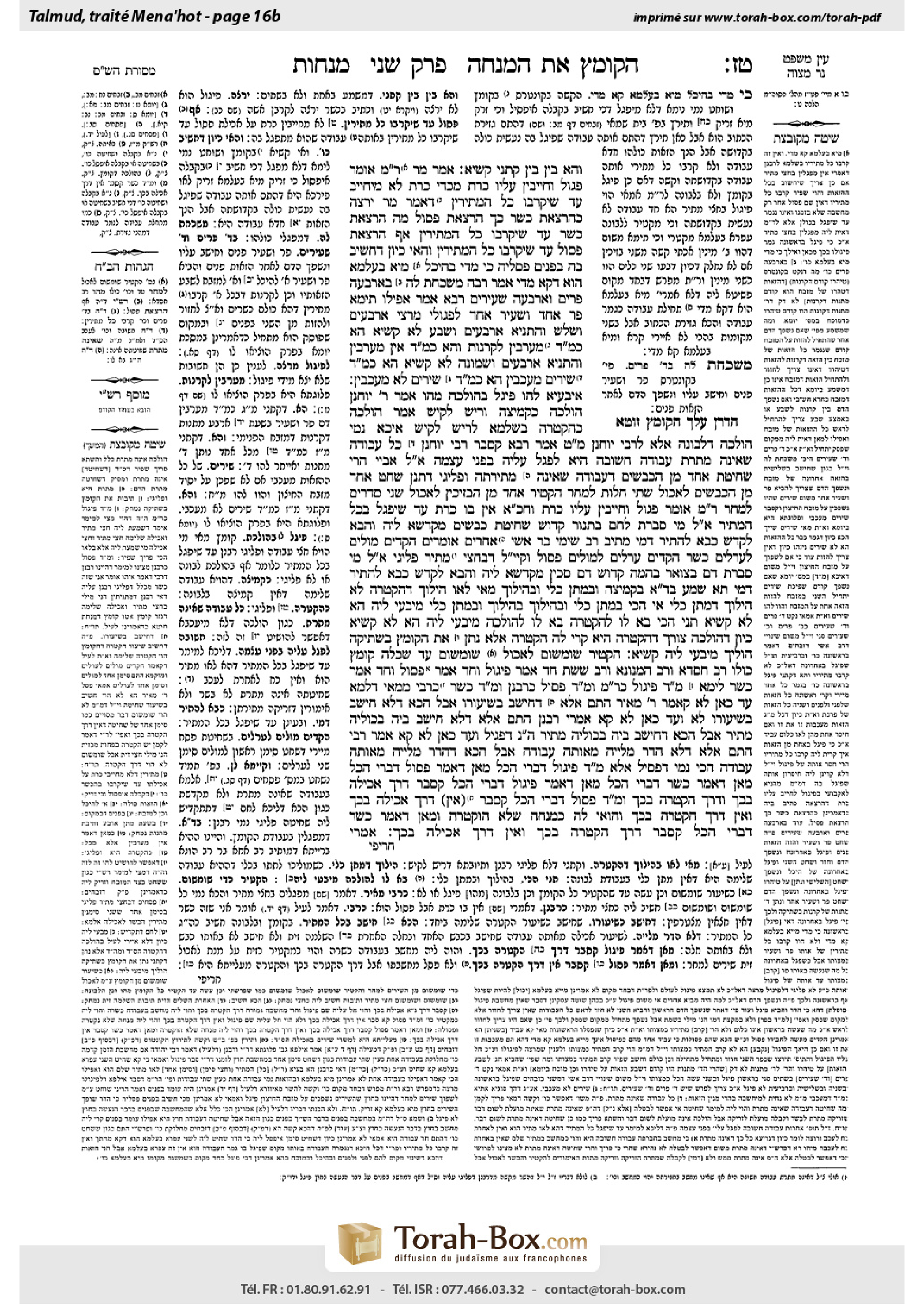
Menachot 16b: Talmud study for Daf Yomi
Daf Yomi is the daily study of one Talmud folio. Explore 37 tractates with scans, Hebrew text, Sefaria English and AI-generated French translations where annotated.
Passage selection and English or AI-generated French translation are available where the scan has annotations. Daf Study is independent of Torah-Box and Sefaria.
Browse Menachot · מנחות · All tractatesMenachot 16b text and translations
This page of Menachot includes the Aramaic text, an English translation and an AI-generated French translation, alongside the scan above.
מנחות י״ו ב · Aramaic and Hebrew text
וְהָא ״בֵּין בֵּין״ קָתָנֵי! קַשְׁיָא.
אָמַר מָר: רַבִּי מֵאִיר אוֹמֵר פִּגּוּל, וְחַיָּיבִין עָלָיו כָּרֵת. מִכְּדֵי, כָּרֵת לָא מִיחַיַּיב עַד שֶׁיִּקְרְבוּ כׇּל הַמַּתִּירִין.
דְּאָמַר מָר: ״יֵרָצֶה״ – כְּהַרְצָאַת כָּשֵׁר, כָּךְ הַרְצָאַת פָּסוּל; מָה הַרְצָאַת כָּשֵׁר עַד שֶׁיִּקְרְבוּ כׇּל הַמַּתִּירִין, אַף הַרְצָאַת פָּסוּל עַד שֶׁיִּקְרְבוּ כׇּל הַמַּתִּירִין.
וְהַאי, כֵּיוָן דְּחַשֵּׁיב בֵּהּ בִּפְנִים – פַּסְלֵיהּ, כִּי מַדֵּי בְּהֵיכַל – מַיָּא בְּעָלְמָא הוּא דְּקָא מַדֵּי.
אָמַר רַבָּה: מַשְׁכַּחַתְּ לַהּ בְּאַרְבָּעָה פָּרִים וְאַרְבָּעָה שְׂעִירִים.
רָבָא אָמַר: אֲפִילּוּ תֵּימָא פַּר אֶחָד וְשָׂעִיר אֶחָד, לְפַגּוֹלֵי מְרַצֵּי.
אַרְבָּעִים וְשָׁלֹשׁ, וְהָתַנְיָא: אַרְבָּעִים וָשֶׁבַע! לָא קַשְׁיָא, הָא כְּמַאן דְּאָמַר: מְעָרְבִין לִקְרָנוֹת, וְהָא כְּמַאן דְּאָמַר: אֵין מְעָרְבִין.
וְהָתַנְיָא: אַרְבָּעִים וּשְׁמוֹנָה! לָא קַשְׁיָא, הָא כְּמַאן דְּאָמַר: שִׁירַיִם מְעַכְּבִין, הָא כְּמַאן דְּאָמַר: שִׁירַיִם לֹא מְעַכְּבִין.
אִיבַּעְיָא לְהוּ: פִּיגֵּל בְּהוֹלָכָה, מַהוּ?
אָמַר רַבִּי יוֹחָנָן: הוֹלָכָה כִּקְמִיצָה, וְרֵישׁ לָקִישׁ אָמַר: הוֹלָכָה כְּהַקְטָרָה.
בִּשְׁלָמָא לְרֵישׁ לָקִישׁ, אִיכָּא נָמֵי הוֹלָכָה דִּלְבוֹנָה, אֶלָּא לְרַבִּי יוֹחָנָן מַאי טַעְמָא?
אָמַר רָבָא, קָסָבַר רַבִּי יוֹחָנָן: כׇּל עֲבוֹדָה שֶׁאֵינָהּ מַתֶּרֶת, עֲבוֹדָה חֲשׁוּבָה הִיא לְפַגֵּל עָלֶיהָ בִּפְנֵי עַצְמָהּ.
אֲמַר לֵיהּ אַבָּיֵי: הֲרֵי שְׁחִיטַת אֶחָד מִן הַכְּבָשִׂים, דַּעֲבוֹדָה שֶׁאֵינָהּ מַתִּירָתָהּ, וּפְלִיגִי.
דִּתְנַן: שָׁחַט אֶחָד מִן הַכְּבָשִׂים לֶאֱכוֹל שְׁתֵּי חַלּוֹת לְמָחָר, הִקְטִיר אֶחָד מִן הַבָּזִיכִין לֶאֱכוֹל שְׁנֵי סְדָרִים לְמָחָר, רַבִּי מֵאִיר אוֹמֵר: פִּגּוּל וְחַיָּיבִין עָלָיו כָּרֵת, וַחֲכָמִים אוֹמְרִים: אֵין בּוֹ כָּרֵת עַד שֶׁיְּפַגֵּל בְּכׇל הַמַּתִּיר.
אֲמַר לֵיהּ: מִי סָבְרַתְּ לֶחֶם בְּתַנּוּר קָדוֹשׁ? שְׁחִיטַת כְּבָשִׂים מְקַדְּשָׁא לֵיהּ, וְהַבָּא לְקַדֵּשׁ כְּבָא לְהַתִּיר דָּמֵי.
מֵתִיב רַב שִׁימִי בַּר אָשֵׁי: אֲחֵרִים אוֹמְרִים: הִקְדִּים מוּלִים לַעֲרֵלִים – כָּשֵׁר, הִקְדִּים עֲרֵלִים לְמוּלִים – פָּסוּל.
וְקַיְימָא לַן, דְּבַחֲצִי מַתִּיר פְּלִיגִי. אֲמַר לֵיהּ: מִי סָבְרַתְּ דָּם בְּצַוַּאר בְּהֵמָה קָדוֹשׁ? דַּם – סַכִּין מְקַדְּשָׁא לֵיהּ, וְהַבָּא לְקַדֵּשׁ כְּבָא לְהַתִּיר דָּמֵי.
תָּא שְׁמַע: בַּמֶּה דְּבָרִים אֲמוּרִים – בִּקְמִיצָה, וּבְמַתַּן כְּלִי, וּבְהִילּוּךְ.
מַאי לָאו הִילּוּךְ דְּהַקְטָרָה? לָא, הִילּוּךְ דְּמַתַּן כְּלִי.
אִי הָכִי, בְּמַתַּן כְּלִי וּבְהִילּוּךְ? בְּהִילּוּךְ וּבְמַתַּן כְּלִי מִיבְּעֵי לֵיהּ! הָא לָא קַשְׁיָא, תָּנֵי הָכִי.
בָּא לוֹ לְהַקְטָרָה? בָּא לוֹ לְהוֹלָכָה מִיבְּעֵי לֵיהּ! הָא לָא קַשְׁיָא, כֵּיוָן דְּהוֹלָכָה צוֹרֶךְ דְּהַקְטָרָה הִיא, קָרֵי לַהּ הַקְטָרָה.
אֶלָּא, נָתַן אֶת הַקּוֹמֶץ בִּשְׁתִיקָה – הוֹלִיךְ מִיבְּעֵי לֵיהּ! קַשְׁיָא.
הִקְטִיר שׁוּמְשׁוּם לֶאֱכוֹל שׁוּמְשׁוּם, עַד שֶׁכָּלָה קוֹמֶץ כּוּלּוֹ – רַב חִסְדָּא וְרַב הַמְנוּנָא וְרַב שֵׁשֶׁת: חַד אָמַר: פִּיגּוּל, וְחַד אָמַר: פָּסוּל, וְחַד אָמַר: כָּשֵׁר.
לֵימָא: מַאן דְּאָמַר פִּיגּוּל – כְּרַבִּי מֵאִיר, וּמַאן דְּאָמַר פָּסוּל – כְּרַבָּנַן, וּמַאן דְּאָמַר כָּשֵׁר – כְּרַבִּי.
מִמַּאי? דִּלְמָא עַד כָּאן לָא קָאָמַר רַבִּי מֵאִיר הָתָם, אֶלָּא דְּחִישֵּׁב בְּשִׁיעוּרוֹ, אֲבָל הָכָא דְּלֹא חִישֵּׁב בְּשִׁיעוּרוֹ – לָא.
וְעַד כָּאן לָא קָא אָמְרִי רַבָּנַן הָתָם, אֶלָּא דְּלָא חַשֵּׁב בֵּיהּ בְּכוּלֵּיהּ מַתִּיר, אֲבָל הָכָא דְּחַשֵּׁב בֵּיהּ בְּכוּלֵּיהּ מַתִּיר – הָכִי נָמֵי דְּפַגֵּיל.
וְעַד כָּאן לָא קָא אָמַר רַבִּי הָתָם, אֶלָּא דְּלָא הֲדַר מַלְּיֵיהּ מֵאוֹתָהּ עֲבוֹדָה, אֲבָל הָכָא דַּהֲדַר מַלְּיֵיהּ מֵאוֹתָהּ עֲבוֹדָה – הָכִי נָמֵי דְּפָסֵיל.
אֶלָּא, מַאן דְּאָמַר פִּיגּוּל – דִּבְרֵי הַכֹּל, מַאן דְּאָמַר פָּסוּל – דִּבְרֵי הַכֹּל, מַאן דְּאָמַר כָּשֵׁר – דִּבְרֵי הַכֹּל.
מַאן דְּאָמַר פִּיגּוּל דִּבְרֵי הַכֹּל, קָסָבַר: דֶּרֶךְ אֲכִילָה בְּכָךְ, וְדֶרֶךְ הַקְטָרָה בְּכָךְ. וּמַאן דְּאָמַר פָּסוּל דִּבְרֵי הַכֹּל, קָסָבַר: אֵין דֶּרֶךְ אֲכִילָה בְּכָךְ, וְאֵין דֶּרֶךְ הַקְטָרָה בְּכָךְ, וְהָוְיָא לָהּ כְּמִנְחָה שֶׁלֹּא הוּקְטְרָה. וּמַאן דְּאָמַר כָּשֵׁר דִּבְרֵי הַכֹּל, קָסָבַר: דֶּרֶךְ הַקְטָרָה בְּכָךְ, וְאֵין דֶּרֶךְ אֲכִילָה בְּכָךְ.
אָמְרִי
Menachot 16b · English translation
The Gemara raises a difficulty against Rav Ashi’s interpretation: But the baraita teaches: Whether during the first presentation or whether during the second, which indicates that the Rabbis disagree with Rabbi Meir even with regard to a case where the priest had intent of piggul during any one of the presentations. The Gemara notes: Indeed, this poses a difficulty.
§ The Gemara returns to the discussion of the baraita itself. The Master said above: If the priest had intent of piggul, whether in the first set of presentations, whether in the second set, or whether in the third set, Rabbi Meir says: The offering is piggul and one is liable to receive karet for its consumption, despite the fact that he performed the rest of the rite silently. The Gemara asks: Now consider, one is not liable to receive karet unless all the permitting factors of the offering have been sacrificed, i.e., if the whole service is completed, including the presentation of the blood.
The Gemara provides the source for this claim. As the Master said that the verse states with regard to piggul: “It shall not be accepted” (Leviticus 7:18), which indicates that the acceptance of a disqualified offering is like the acceptance of a valid offering, of which the verse states: “It shall be accepted” (Leviticus 22:27), and just as there is no acceptance of a valid offering unless all its permitting factors have been sacrificed, so too there is no lack of acceptance of a disqualified offering, i.e., it is not rendered piggul, unless all its permitting factors have been sacrificed. That is to say, in the absence of one of its permitting factors it does not become piggul.
Accordingly, the Gemara challenges: And with regard to this case, of the blood of the bull and goat brought on Yom Kippur, since he had intent of piggul with regard to it when he was presenting the blood inside the Holy of Holies, he has disqualified it. If so, when he sprinkles the blood again later in the Sanctuary, on the Curtain and the inner altar, it is as though he is merely sprinkling water, and not the blood of the offering. Consequently, the permitting factors of the offering have not been sacrificed, and therefore the offering should not be rendered piggul.
Rabba said: You find it possible in a case where there were four bulls and four goats, i.e., in a case where after the High Priest presented the blood inside the Holy of Holies with piggul intent, the remaining blood spilled. Consequently, he was required to bring another bull and goat in order to present their blood on the Curtain separating the Sanctuary and Holy of Holies. During that presentation he had intent of piggul, after which the remaining blood spilled, requiring him to bring another bull and goat in order to present their blood on the corners of the golden altar. He again had intent of piggul during that presentation, and then the blood spilled, which meant he had to bring yet another bull and goat in order to present their blood upon the golden altar itself.
Rava said: You may even say that the baraita is referring to a case of only one bull and one goat, and the remaining blood was in fact disqualified. Nevertheless, with regard to rendering an offering piggul, the presentations performed with the disqualified blood effect acceptance, as though the entire permitting factor was performed in its proper manner. In other words, even though the High Priest sprinkled the blood inside the Holy of Holies with improper intent, and thereby disqualified the offering, nevertheless, since he completed the service he is considered as having sacrificed all the permitting factors with regard to piggul.
§ The baraita mentioned that there are forty-three presentations of the blood of the bull and the goat sacrificed on Yom Kippur. The Gemara asks: But isn’t it taught otherwise in a different baraita, which states that there are forty-seven presentations of that blood? The Gemara answers: This is not difficult. This statement, that there are forty-three presentations, is in accordance with the opinion of the one who says that the High Priest mixes the blood of the bull and the goat before placing it on the corners of the inner altar, rather than placing the blood of each one separately. And that statement, that there are forty-seven presentations, is in accordance with the opinion of the one who says that the High Priest does not mix the two types of blood before placing them on the corners, but sprinkles four times from the blood of the bull and another four times from the blood of the goat, and only afterward mixes the blood of the two animals for placement on the top of the altar.
The Gemara raises another difficulty: But isn’t it taught in yet another baraita that there are forty-eight presentations? The Gemara answers: This is not difficult. This statement, that there are forty-eight presentations, is in accordance with the opinion of the one who says that the pouring of the remainder of the blood on the base of the external altar is indispensable, and therefore this act is added to the total. That statement, that there are only forty-seven presentations, is in accordance with the opinion of the one who says that the pouring of the remainder of the blood is not indispensable.
§ The mishna teaches: If one had intent of piggul during the sacrifice of only part of the permitting factors, e.g., during the burning of the handful but not during the burning of the frankincense, the Rabbis rule that the offering is not piggul. Concerning this, a dilemma was raised before the Sages: If one had intent of piggul during the conveying of the handful to the altar but not during the conveying of the frankincense, what is the halakha?
Rabbi Yoḥanan says: The halakha with regard to conveying the handful is like that of the removing of the handful. Just as intent of piggul with regard to removing only the handful renders the offering piggul, as it is the sole permitting factor with which the rite of removal is performed, the same applies to conveying the handful. And Reish Lakish says: The conveying of the handful is like its burning. Just as intent of piggul is required during the burning of both the handful and the frankincense for the offering to be rendered piggul, as both of them are burned on the altar, the same halakha applies to conveying.
The Gemara asks: Granted, one can understand the ruling of Reish Lakish, as the conveying of the handful is only part of the permitting factors, since there is also the conveying of the frankincense. But as for the ruling of Rabbi Yoḥanan, what is the reason that intent of piggul during the conveying of only the handful renders the offering piggul? After all, he has not had intent of piggul during the conveying of all of the permitting factors.
Rava said: Rabbi Yoḥanan holds that if one performed any sacrificial rite that does not permit the offering, e.g., conveying, even if he performed it with only one of the permitting factors, such as with the handful and not with the frankincense, it is considered a significant rite with regard to rendering the offering piggul on account of it, by itself. It is not comparable to a case of intent of piggul during the sacrifice of only part of the permitting factors, as this rite of conveying does not render the offering permitted.
Abaye said to Rava: But what about the slaughter of one of the lambs brought with the two loaves on Shavuot, which is a rite that does not permit the offering, as neither the sacrifice of its portions designated for burning upon the altar nor the consumption of the meat of the offering and the two loaves is permitted by this slaughter, and yet the Rabbis disagree with Rabbi Meir in this case?
As we learned in the mishna: If one slaughtered one of the two lambs with the intent to partake of two loaves the next day, or if one burned one of the bowls of frankincense with the intent to partake of two arrangements of shewbread the next day, Rabbi Meir says: The meal offering is piggul and one is liable to receive karet for its consumption, and the Rabbis say: There is no liability to receive karet unless he has intent of piggul during the sacrifice of the entire permitting factor. Although the slaughter of one of the lambs is a rite that does not render an offering permitted, nevertheless the Rabbis maintain that it is not considered a significant rite with regard to rendering the offering piggul by itself.
Rava said to Abaye: Do you maintain that the two loaves of bread are already sanctified from when they are in the oven, and require only the sprinkling of the blood to render them permitted for consumption? In fact, the slaughter of the lambs sanctifies the loaves, and an act that comes to sanctify is considered like that which comes to permit. Since the slaughter of the two lambs sanctifies the loaves, the slaughter of each lamb is considered half a permitting factor; the slaughter of each lamb independently cannot render the loaves piggul.
Rav Shimi bar Ashi raises an objection from a baraita that discusses the slaughter of the Paschal offering. The first tanna rules that if one slaughtering the Paschal offering intended for it to be consumed by both disqualified individuals, e.g., uncircumcised males, and fit individuals, e.g., circumcised males, the offering is not disqualified. Aḥerim say: In a case where one slaughtered a Paschal offering and severed one of the two organs of ritual slaughter with a disqualifying intention, and severed the other organ with a valid intention, then if one’s intent with regard to circumcised males preceded the intent with regard to the uncircumcised males, the offering is valid. But if the intent with regard to the uncircumcised males preceded the intent with regard to the circumcised males, it is disqualified.
Rav Shimi bar Ashi continues: And we maintain that the first tanna and Aḥerim disagree with regard to whether the sacrifice of half a permitting factor with disqualifying intent disqualifies the entire offering. In this case, although this slaughter does not sanctify anything, the severing of one of the organs is considered half of a permitting factor. Rava said to Rav Shimi bar Ashi: Do you maintain that the blood is already sanctified while inside the neck of the animal? In fact, the knife sanctifies the blood, and that which comes to sanctify is considered like that which comes to permit. Consequently, the slaughter of the animal is a permitting factor, and the severing of one of its organs is half a permitting factor.
The Gemara suggests: Come and hear a proof from a baraita: In what case is this statement, that intent of piggul with regard to only the handful renders the meal offering piggul, said? It is said in a case where one had such intent during the removal of the handful, or during the placement of the handful in a service vessel, or during the conveying.
The Gemara clarifies the proof: What, is it not correct to say that the baraita is referring to the conveying of the handful for burning upon the altar, in which case it is teaching that intent of piggul with regard to the handful during its conveying renders the offering piggul? The Gemara responds: No; the baraita is referring to the conveying of the handful before its placement into the service vessel that sanctifies it. Since the frankincense is not placed into a vessel, in this case the conveying of the handful alone is considered the performance of the entire rite.
The Gemara asks: If so, why does the baraita state: During the placement of the handful in a vessel or during the conveying? This indicates that it is referring to an act of conveying that occurs after the placement. It should have stated: During the conveying or during the placement of the handful in a vessel. The Gemara responds: This is not difficult, as one should emend the baraita and teach it in that order, i.e., with the conveying before the placement.
The Gemara raises another objection from the next clause of the same baraita: Once he comes to perform the burning of the handful, there is no liability to receive karet unless he has intent of piggul during the sacrifice of the frankincense as well. The Gemara asks: According to Reish Lakish, the baraita should have stated: Once he comes to perform the conveying and to perform the burning. Reish Lakish maintains that the conveying mentioned previously in the baraita occurs earlier, before its placement into a service vessel, which means that there is another act of conveying. The Gemara responds: This is not difficult; since this conveying is for the purpose of burning, it is called burning in the baraita.
The Gemara further challenges: But the baraita also states: If he placed the handful on the altar in silence, and he placed the frankincense with intent of piggul. According to Reish Lakish, it should have also stated: If he carried the handful in silence, and the frankincense with intent of piggul, as according to Reish Lakish it is the act of conveying that he is performing at this stage. The Gemara responds: Indeed, this is a difficulty.
§ The Gemara continues its discussion of piggul intent that occurred during the sacrifice of part of a permitting factor. If one burned an amount the size of a sesame seed of the handful and frankincense with the intent to consume an amount the size of a sesame seed from the remainder the next day, and he repeated the same action with the accompanying intent until he burned the entire measure of the handful and frankincense, the halakha in this case is a matter of dispute between Rav Ḥisda, Rav Hamnuna, and Rav Sheshet. One says that the entire meal offering is piggul, and one says that the offering is disqualified but is not piggul, and one says that the offering remains fit.
The Gemara suggests: Let us say that the one who says that the meal offering is piggul holds in accordance with the opinion of Rabbi Meir, who says that one renders an offering piggul on account of piggul intent during the sacrifice of even part of its permitting factors. And the one who says that the offering is disqualified holds in accordance with the opinion of the Rabbis, who say that such intent disqualifies an offering but does not render it piggul. And finally, the one who says that the offering is fit holds in accordance with the opinion of Rabbi Yehuda HaNasi, who says (14a) that if one slaughters each of the two lambs brought on Shavuot with the two loaves, each time intending to consume half an olive-bulk from a different loaf the next day, the offering is fit, as the halves do not combine to render the offering piggul.
The Gemara rejects this suggestion: From where is this conclusion drawn? Perhaps Rabbi Meir states that one renders an offering piggul on account of piggul intent during the sacrifice of part of the permitting factors only there, where he had intent with regard to its entire measure. But here, where he did not have intent with regard to its entire measure, but instead had a series of intentions with regard to a measure equivalent to a sesame seed, it is possible that Rabbi Meir does not render the offering piggul.
And furthermore, perhaps the Rabbis state that one does not render an offering piggul unless he has piggul intent during the sacrifice of the entire permitting factor only there, where he did not have intent concerning it during the entire permitting factor, but only during the burning of the handful. But here, where he had intent during the entire permitting factor, i.e., during the burning of both the handful and the frankincense, he has indeed rendered the offering piggul, despite the fact that each intention referred only to a small portion of the entire measure.
And perhaps Rabbi Yehuda HaNasi states that the offering is valid if one had intent of piggul with regard to half an olive-bulk from each loaf only there, where he did not subsequently complete his intention with regard to a full measure from the same sacrificial rite, as he had piggul intent with regard to half an olive-bulk during the slaughter of each lamb independently. But here, where he subsequently completed his intention with regard to a full measure from the same rite, perhaps he has indeed disqualified the offering.
Rather, the one who says that an offering is piggul when one repeatedly burns an amount the size of a sesame seed from the handful and frankincense with the intent to consume an amount the size of a sesame seed from the remainder the next day, would claim that all of the tanna’im agree that it is piggul. Similarly, the one who says that it is disqualified would contend that all agree that it is disqualified, and the one who says that it is fit would maintain that all agree that it is fit.
The Gemara elaborates: The one who says that all agree it is piggul maintains that the manner of its consumption is in such a manner, i.e., in small portions, and likewise the manner of its burning is also in such a manner. And the one who says that all agree it is disqualified holds that the manner of its consumption is not in such a manner. Accordingly, this type of piggul intent does not render the offering piggul. And the manner of its burning is also not in such a manner, and consequently it is like a meal offering whose handful was not burned properly, and is therefore disqualified. And finally, the one who says that all agree it is fit holds that the manner of its burning is in such a manner, and therefore the burning was performed properly, but the manner of its consumption is not in such a manner, which means that the piggul intent is inconsequential.
§ So say
Menachot 16b · Traduction française (IA)
La Guemara soulève une difficulté contre l’interprétation de Rav Ashi : Mais la baraïta enseigne : « Que ce soit lors de la première présentation ou lors de la deuxième », ce qui indique que les Rabbins sont en désaccord avec Rabbi Meïr même dans le cas où le prêtre a eu une intention de piggoul lors de l’une des présentations. La Guemara relève : En effet, cela pose une difficulté.
§ La Guemara revient à la discussion de la baraïta elle-même. Le Maître a dit plus haut : Si le prêtre a eu une intention de piggoul, que ce soit lors de la première série de présentations, de la deuxième ou de la troisième, Rabbi Meïr dit : L’offrande est piggoul et l’on est passible de karet pour sa consommation, bien qu’il ait accompli le reste du rite sans intention particulière. La Guemara demande : Or, on n’est passible de karet que si tous les éléments qui rendent l’offrande apte ont été sacrifiés, c’est-à-dire si tout le service est achevé, y compris la présentation du sang.
La Guemara donne la source de cette affirmation. Car le Maître a dit que le verset déclare au sujet du piggoul : « Il ne sera pas agréé » (Lévitique 7,18), ce qui indique que l’absence d’agrément d’une offrande disqualifiée est comparable à l’agrément d’une offrande valide, dont le verset déclare : « Il sera agréé » (Lévitique 22,27). De même qu’une offrande valide n’est agréée que si tous les éléments qui la rendent apte ont été sacrifiés, de même une offrande disqualifiée ne cesse d’être agréée, c’est-à-dire ne devient piggoul, que si tous les éléments qui la rendent apte ont été sacrifiés. Autrement dit, en l’absence de l’un de ces éléments, elle ne devient pas piggoul.
Dès lors, la Guemara objecte : Dans le cas du sang du taureau et du bouc offerts à Yom Kippour, puisqu’il a eu une intention de piggoul à son sujet lorsqu’il présentait le sang à l’intérieur du Saint des Saints, il l’a disqualifié. Si tel est le cas, lorsqu’il asperge ensuite le sang dans le Sanctuaire, sur le rideau et l’autel intérieur, c’est comme s’il aspergeait simplement de l’eau, et non le sang de l’offrande. Par conséquent, les éléments qui rendent l’offrande apte n’ont pas été sacrifiés, et l’offrande ne devrait donc pas devenir piggoul.
Rabba dit : Cela peut se produire dans le cas de quatre taureaux et de quatre boucs, c’est-à-dire lorsque, après que le Grand Prêtre a présenté le sang à l’intérieur du Saint des Saints avec une intention de piggoul, le reste du sang s’est répandu. Il a donc dû apporter un autre taureau et un autre bouc pour présenter leur sang sur le rideau qui sépare le Sanctuaire du Saint des Saints. Lors de cette présentation, il a eu une intention de piggoul, puis le reste du sang s’est répandu, ce qui l’a obligé à apporter un autre taureau et un autre bouc afin de présenter leur sang aux cornes de l’autel d’or. Il a de nouveau eu une intention de piggoul lors de cette présentation, puis le sang s’est répandu, de sorte qu’il a dû apporter encore un autre taureau et un autre bouc pour présenter leur sang sur l’autel d’or lui-même.
Rava dit : On peut même dire que la baraïta parle du cas d’un seul taureau et d’un seul bouc, et que le reste du sang a effectivement été disqualifié. Néanmoins, pour qu’une offrande devienne piggoul, les présentations effectuées avec le sang disqualifié produisent l’agrément, comme si l’élément qui rend l’offrande apte avait été accompli entièrement comme il convient. Autrement dit, bien que le Grand Prêtre ait aspergé le sang à l’intérieur du Saint des Saints avec une intention inadéquate et ait ainsi disqualifié l’offrande, puisqu’il a néanmoins achevé le service, on considère qu’il a sacrifié tous les éléments qui rendent l’offrande apte, en ce qui concerne le piggoul.
§ La baraïta mentionnait qu’il y a quarante-trois présentations du sang du taureau et du bouc sacrifiés à Yom Kippour. La Guemara demande : Mais une autre baraïta n’enseigne-t-elle pas qu’il y a quarante-sept présentations de ce sang ? La Guemara répond : Il n’y a pas de contradiction. Cette affirmation, selon laquelle il y a quarante-trois présentations, suit l’opinion de celui qui dit que le Grand Prêtre mélange le sang du taureau et celui du bouc avant de le placer sur les cornes de l’autel intérieur, au lieu de placer séparément le sang de chacun. L’autre affirmation, selon laquelle il y a quarante-sept présentations, suit l’opinion de celui qui dit que le Grand Prêtre ne mélange pas les deux sortes de sang avant de les placer sur les cornes, mais asperge quatre fois avec le sang du taureau, puis quatre autres fois avec celui du bouc, et ne mélange le sang des deux animaux qu’ensuite, pour le placer sur le dessus de l’autel.
La Guemara soulève une autre difficulté : Mais une autre baraïta n’enseigne-t-elle pas qu’il y a quarante-huit présentations ? La Guemara répond : Il n’y a pas de contradiction. Cette affirmation, selon laquelle il y a quarante-huit présentations, suit l’opinion de celui qui dit que le versement du reste du sang sur la base de l’autel extérieur est indispensable, et que cet acte est donc ajouté au total. L’autre affirmation, selon laquelle il n’y a que quarante-sept présentations, suit l’opinion de celui qui dit que le versement du reste du sang n’est pas indispensable.
§ La Michna enseigne : Si quelqu’un a eu une intention de piggoul pendant le sacrifice d’une partie seulement des éléments qui rendent l’offrande apte, par exemple pendant la combustion de la poignée, mais pas pendant celle de l’encens, les Rabbins statuent que l’offrande n’est pas piggoul. À ce sujet, les Sages ont soulevé un dilemme : Si quelqu’un a eu une intention de piggoul en transportant la poignée vers l’autel, mais pas en transportant l’encens, quelle est la halakha ?
Rabbi Yoḥanan dit : La halakha concernant le transport de la poignée est la même que celle concernant son prélèvement. De même qu’une intention de piggoul lors du prélèvement de la poignée seule rend l’offrande piggoul, puisque ce prélèvement constitue le seul élément qui rend l’offrande apte auquel s’applique ce rite, il en va de même pour le transport de la poignée. Et Reish Lakish dit : Le transport de la poignée est comparable à sa combustion. De même qu’une intention de piggoul pendant la combustion de la poignée et de l’encens est nécessaire pour que l’offrande devienne piggoul, puisqu’ils sont tous deux brûlés sur l’autel, la même halakha s’applique au transport.
La Guemara demande : On comprend la décision de Reish Lakish, puisque le transport de la poignée ne constitue qu’une partie des éléments qui rendent l’offrande apte, car il y a aussi le transport de l’encens. Mais, selon la décision de Rabbi Yoḥanan, quelle est la raison pour laquelle une intention de piggoul pendant le transport de la poignée seule rend l’offrande piggoul ? Après tout, il n’a pas eu d’intention de piggoul pendant le transport de tous les éléments qui rendent l’offrande apte.
Rava dit : Rabbi Yoḥanan estime que si quelqu’un accomplit un rite sacrificiel qui ne rend pas l’offrande apte, par exemple le transport, même s’il l’accomplit avec un seul des éléments qui rendent l’offrande apte, comme la poignée mais pas l’encens, ce rite est considéré à lui seul comme suffisamment significatif pour rendre l’offrande piggoul. Ce cas n’est pas comparable à celui d’une intention de piggoul pendant le sacrifice d’une partie seulement des éléments qui rendent l’offrande apte, car le rite du transport ne rend pas l’offrande apte.
Abaye dit à Rava : Mais qu’en est-il de l’abattage de l’un des agneaux offerts avec les deux pains à Chavouot ? C’est un rite qui ne rend pas l’offrande apte, puisque ni le sacrifice des parties destinées à être brûlées sur l’autel ni la consommation de la viande de l’offrande et des deux pains ne sont permis par cet abattage ; pourtant, les Rabbins sont en désaccord avec Rabbi Meïr dans ce cas.
Comme nous l’avons appris dans la Michna : Si quelqu’un a abattu l’un des deux agneaux avec l’intention de consommer les deux pains le lendemain, ou s’il a brûlé l’un des bols d’encens avec l’intention de consommer les deux rangées de pains de proposition le lendemain, Rabbi Meïr dit : L’offrande de farine est piggoul et l’on est passible de karet pour sa consommation. Les Rabbins disent : On n’est passible de karet que s’il a eu une intention de piggoul pendant le sacrifice de l’élément qui rend l’offrande apte dans son intégralité. Bien que l’abattage de l’un des agneaux soit un rite qui ne rend pas l’offrande apte, les Rabbins considèrent néanmoins qu’il ne constitue pas, à lui seul, un rite suffisamment significatif pour rendre l’offrande piggoul.
Rava dit à Abaye : Penses-tu que les deux pains sont déjà sanctifiés lorsqu’ils sont dans le four et qu’il ne leur faut que l’aspersion du sang pour que leur consommation soit permise ? En réalité, l’abattage des agneaux sanctifie les pains, et un acte qui vient sanctifier est considéré comme un acte qui vient rendre permis. Puisque l’abattage des deux agneaux sanctifie les pains, l’abattage de chaque agneau constitue la moitié d’un élément qui rend l’offrande apte ; l’abattage de chacun des agneaux pris séparément ne peut pas rendre les pains piggoul.
Rav Shimi bar Ashi soulève une objection à partir d’une baraïta qui traite de l’abattage du sacrifice pascal. Le premier tanna statue que si celui qui abat le sacrifice pascal a l’intention qu’il soit consommé à la fois par des personnes inaptes, comme des hommes non circoncis, et par des personnes aptes, comme des hommes circoncis, l’offrande n’est pas disqualifiée. Aḥerim disent : Dans le cas où quelqu’un a abattu un sacrifice pascal et sectionné l’un des deux organes de l’abattage rituel avec une intention disqualifiante, puis l’autre organe avec une intention valide, si son intention concernant les hommes circoncis a précédé celle concernant les hommes non circoncis, l’offrande est valide. Mais si son intention concernant les hommes non circoncis a précédé celle concernant les hommes circoncis, elle est disqualifiée.
Rav Shimi bar Ashi poursuit : Et nous soutenons que le premier tanna et Aḥerim sont en désaccord sur la question de savoir si le sacrifice de la moitié d’un élément qui rend l’offrande apte avec une intention disqualifiante disqualifie l’offrande entière. Dans ce cas, bien que cet abattage ne sanctifie rien, le sectionnement de l’un des organes est considéré comme la moitié d’un élément qui rend l’offrande apte. Rava dit à Rav Shimi bar Ashi : Penses-tu que le sang est déjà sanctifié alors qu’il se trouve dans le cou de l’animal ? En réalité, le couteau sanctifie le sang, et ce qui vient sanctifier est considéré comme ce qui vient rendre permis. Par conséquent, l’abattage de l’animal constitue un élément qui rend l’offrande apte, et le sectionnement de l’un de ses organes en constitue la moitié.
La Guemara propose : Viens et écoute une preuve tirée d’une baraïta : Dans quel cas a-t-on dit qu’une intention de piggoul concernant la poignée seule rend l’offrande de farine piggoul ? C’est dans le cas où l’on a eu une telle intention lors du prélèvement de la poignée, lors de son placement dans un récipient de service ou lors de son transport.
La Guemara précise la preuve : N’est-il pas juste de dire que la baraïta parle du transport de la poignée destinée à être brûlée sur l’autel, enseignant ainsi qu’une intention de piggoul concernant la poignée pendant son transport rend l’offrande piggoul ? La Guemara répond : Non ; la baraïta parle du transport de la poignée avant son placement dans le récipient de service qui la sanctifie. Comme l’encens n’est pas placé dans un récipient, dans ce cas le transport de la poignée seule est considéré comme l’accomplissement du rite dans son intégralité.
La Guemara demande : Si tel est le cas, pourquoi la baraïta dit-elle : « Lors du placement de la poignée dans un récipient ou lors du transport » ? Cela indique qu’elle parle d’un transport qui a lieu après le placement. Elle aurait dû dire : « Lors du transport ou lors du placement de la poignée dans un récipient. » La Guemara répond : Il n’y a pas de difficulté, car il faut corriger l’ordre de la baraïta et l’enseigner ainsi, c’est-à-dire en plaçant le transport avant le placement.
La Guemara soulève une autre objection à partir de la clause suivante de la même baraïta : Dès qu’il entreprend la combustion de la poignée, on n’est passible de karet que s’il a également eu une intention de piggoul pendant le sacrifice de l’encens. La Guemara demande : Selon Reish Lakish, la baraïta aurait dû dire : « Dès qu’il entreprend le transport et la combustion. » Reish Lakish estime que le transport mentionné précédemment dans la baraïta a lieu plus tôt, avant le placement de la poignée dans un récipient de service, ce qui signifie qu’il y a un autre acte de transport. La Guemara répond : Il n’y a pas de difficulté ; puisque ce transport a pour but la combustion, la baraïta le désigne comme une combustion.
La Guemara soulève encore une objection : Mais la baraïta dit aussi : « S’il a placé la poignée sur l’autel sans intention particulière et qu’il a placé l’encens avec une intention de piggoul. » Selon Reish Lakish, elle aurait également dû dire : « S’il a transporté la poignée sans intention particulière et l’encens avec une intention de piggoul », car, selon Reish Lakish, à ce stade, c’est le transport qu’il accomplit. La Guemara répond : En effet, cela pose une difficulté.
§ La Guemara poursuit la discussion sur une intention de piggoul survenue pendant le sacrifice d’une partie d’un élément qui rend l’offrande apte. Si quelqu’un a brûlé une quantité de la taille d’un grain de sésame de la poignée et de l’encens avec l’intention de consommer le lendemain une quantité de la taille d’un grain de sésame du reste, et qu’il a répété le même acte avec l’intention correspondante jusqu’à brûler toute la mesure de la poignée et de l’encens, la halakha dans ce cas fait l’objet d’un désaccord entre Rav Ḥisda, Rav Hamnuna et Rav Sheshet. Selon l’un, toute l’offrande de farine est piggoul ; selon un autre, l’offrande est disqualifiée mais n’est pas piggoul ; et selon le troisième, l’offrande reste valide.
La Guemara propose : Peut-on dire que celui qui affirme que l’offrande de farine est piggoul suit l’opinion de Rabbi Meïr, qui dit qu’une intention de piggoul pendant le sacrifice d’une partie seulement des éléments qui rendent l’offrande apte suffit à la rendre piggoul ? Celui qui affirme que l’offrande est disqualifiée suit l’opinion des Rabbins, qui disent qu’une telle intention disqualifie une offrande sans la rendre piggoul. Enfin, celui qui affirme que l’offrande est valide suit l’opinion de Rabbi Yehouda HaNassi, qui dit (14a) que si quelqu’un abat chacun des deux agneaux offerts à Chavouot avec les deux pains, en ayant à chaque fois l’intention de consommer le lendemain un demi-volume d’olive provenant d’un pain différent, l’offrande est valide, car les deux moitiés ne s’additionnent pas pour rendre l’offrande piggoul.
La Guemara rejette cette proposition : D’où tire-t-on cette conclusion ? Peut-être Rabbi Meïr dit-il qu’une intention de piggoul pendant le sacrifice d’une partie des éléments qui rendent l’offrande apte suffit à la rendre piggoul uniquement dans ce cas, où il a eu une intention portant sur la mesure entière. Mais ici, où il n’a pas eu d’intention portant sur la mesure entière, mais a plutôt eu une série d’intentions portant chacune sur une quantité équivalente à un grain de sésame, il est possible que Rabbi Meïr ne rende pas l’offrande piggoul.
En outre, peut-être les Rabbins disent-ils qu’une offrande ne devient piggoul que si l’on a eu une intention de piggoul pendant le sacrifice de l’élément qui la rend apte dans son intégralité uniquement dans le cas où l’on n’a pas eu cette intention pendant l’ensemble de cet élément, mais seulement pendant la combustion de la poignée. Mais ici, où il a eu une intention pendant l’élément qui rend l’offrande apte dans son intégralité, c’est-à-dire pendant la combustion de la poignée et de l’encens, il a effectivement rendu l’offrande piggoul, bien que chacune de ses intentions n’ait porté que sur une petite partie de la mesure entière.
Et peut-être Rabbi Yehouda HaNassi dit-il que l’offrande est valide si l’on a eu une intention de piggoul concernant un demi-volume d’olive de chaque pain uniquement dans le cas où l’on n’a pas ensuite complété son intention en visant une mesure entière lors du même rite sacrificiel, puisqu’il a eu une intention de piggoul concernant un demi-volume d’olive pendant l’abattage de chacun des agneaux pris séparément. Mais ici, où il a ensuite complété son intention en visant une mesure entière lors du même rite, peut-être a-t-il effectivement disqualifié l’offrande.
Au contraire, celui qui affirme qu’une offrande est piggoul lorsqu’on brûle à plusieurs reprises une quantité de la taille d’un grain de sésame de la poignée et de l’encens, avec l’intention de consommer le lendemain une quantité de la taille d’un grain de sésame du reste, soutiendrait que tous les tannaïm sont d’accord pour dire qu’elle est piggoul. De même, celui qui affirme qu’elle est disqualifiée soutiendrait que tous sont d’accord pour dire qu’elle est disqualifiée, et celui qui affirme qu’elle est valide soutiendrait que tous sont d’accord pour dire qu’elle est valide.
La Guemara développe : Celui qui affirme que tous sont d’accord pour dire qu’elle est piggoul estime que la manière de la consommer est précisément ainsi, c’est-à-dire par petites quantités, et que la manière de la brûler est également ainsi. Celui qui affirme que tous sont d’accord pour dire qu’elle est disqualifiée estime que la manière de la consommer n’est pas ainsi. Par conséquent, ce type d’intention de piggoul ne rend pas l’offrande piggoul. La manière de la brûler n’est pas non plus ainsi ; elle est donc comparable à une offrande de farine dont la poignée n’a pas été brûlée correctement et qui est, par conséquent, disqualifiée. Enfin, celui qui affirme que tous sont d’accord pour dire qu’elle est valide estime que la manière de la brûler est ainsi, de sorte que la combustion a été accomplie correctement ; mais la manière de la consommer n’est pas ainsi, ce qui signifie que l’intention de piggoul est sans effet.
§ Ainsi faut-il dire.
Traduction française générée par IA à partir de l’édition anglaise de Sefaria. Vérifie toujours un passage avec le texte source.
Text from Sefaria: William Davidson Edition - Vocalized Aramaic (unknown); William Davidson Edition - English (CC BY NC).