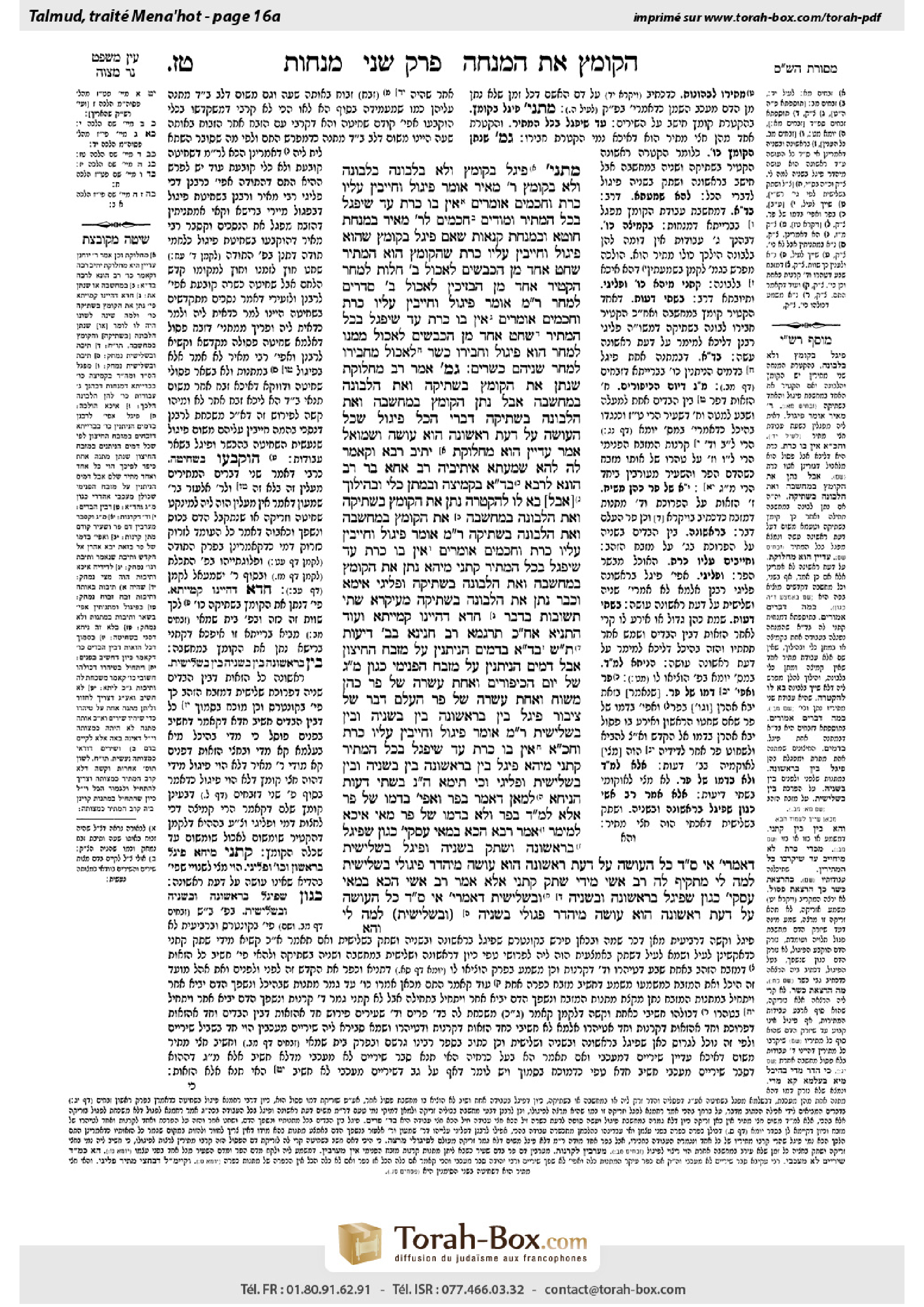
Menachot 16a: Talmud study for Daf Yomi
Daf Yomi is the daily study of one Talmud folio. Explore 37 tractates with scans, Hebrew text, Sefaria English and AI-generated French translations where annotated.
Passage selection and English or AI-generated French translation are available where the scan has annotations. Daf Study is independent of Torah-Box and Sefaria.
Browse Menachot · מנחות · All tractatesMenachot 16a text and translations
This page of Menachot includes the Aramaic text, an English translation and an AI-generated French translation, alongside the scan above.
מנחות י״ו א · Aramaic and Hebrew text
מַתְנִי׳ פִּיגֵּל בַּקּוֹמֶץ וְלֹא בַּלְּבוֹנָה, בַּלְּבוֹנָה וְלֹא בַּקּוֹמֶץ – רַבִּי מֵאִיר אוֹמֵר: פִּיגּוּל וְחַיָּיבִין עָלָיו כָּרֵת, וַחֲכָמִים אוֹמְרִים: אֵין בּוֹ כָּרֵת עַד שֶׁיְּפַגֵּל בְּכׇל הַמַּתִּיר.
וּמוֹדִים חֲכָמִים לְרַבִּי מֵאִיר בְּמִנְחַת חוֹטֵא וּבְמִנְחַת קְנָאוֹת, שֶׁאִם פִּיגֵּל בַּקּוֹמֶץ, שֶׁהוּא פִּיגּוּל וְחַיָּיבִין עָלָיו כָּרֵת, שֶׁהַקּוֹמֶץ הוּא הַמַּתִּיר.
שָׁחַט אֶחָד מִן הַכְּבָשִׂים לֶאֱכוֹל שְׁתֵּי חַלּוֹת לְמָחָר, הִקְטִיר אֶחָד מִן הַבָּזִיכִין לֶאֱכוֹל שְׁנֵי סְדָרִים לְמָחָר – רַבִּי מֵאִיר אוֹמֵר: פִּיגּוּל וְחַיָּיבִין עָלָיו כָּרֵת, וַחֲכָמִים אוֹמְרִים: אֵין בּוֹ כָּרֵת עַד שֶׁיְּפַגֵּל בְּכׇל הַמַּתִּיר.
שָׁחַט אֶחָד מִן הַכְּבָשִׂים לֶאֱכוֹל מִמֶּנּוּ לְמָחָר – הוּא פִּיגּוּל, וַחֲבֵירוֹ כָּשֵׁר; לֶאֱכוֹל מֵחֲבֵירוֹ לְמָחָר – שְׁנֵיהֶם כְּשֵׁרִים.
גְּמָ׳ אָמַר רַב: מַחְלוֹקֶת שֶׁנָּתַן אֶת הַקּוֹמֶץ בִּשְׁתִיקָה, וְאֶת הַלְּבוֹנָה בְּמַחְשָׁבָה.
אֲבָל נָתַן הַקּוֹמֶץ בְּמַחְשָׁבָה, וְאֶת הַלְּבוֹנָה בִּשְׁתִיקָה – דִּבְרֵי הַכֹּל פִּיגּוּל, שֶׁכׇּל הָעוֹשֶׂה עַל דַּעַת רִאשׁוֹנָה הוּא עוֹשֶׂה. וּשְׁמוּאֵל אָמַר: עֲדַיִין הִוא מַחְלוֹקֶת.
יָתֵיב רָבָא וְקָאָמַר לַהּ לְהָא שְׁמַעְתָּא, אֵיתִיבֵיהּ רַב אַחָא בַּר רַב הוּנָא לְרָבָא: בַּמֶּה דְּבָרִים אֲמוּרִים – בִּקְמִיצָה, וּבְמַתַּן כְּלִי, וּבְהִילּוּךְ.
בָּא לוֹ לְהַקְטָרָה, נָתַן אֶת הַקּוֹמֶץ בִּשְׁתִיקָה וְאֶת הַלְּבוֹנָה בְּמַחְשָׁבָה, אֶת הַקּוֹמֶץ בְּמַחְשָׁבָה וְאֶת הַלְּבוֹנָה בִּשְׁתִיקָה – רַבִּי מֵאִיר אוֹמֵר: פִּיגּוּל וְחַיָּיבִין עָלָיו כָּרֵת, וַחֲכָמִים אוֹמְרִים: אֵין בּוֹ כָּרֵת עַד שֶׁיְּפַגֵּל בְּכׇל הַמַּתִּיר.
קָתָנֵי מִיהָא: נָתַן אֶת הַקּוֹמֶץ בְּמַחְשָׁבָה וְאֶת הַלְּבוֹנָה בִּשְׁתִיקָה, וּפְלִיגִי.
אֵימָא: וּכְבָר נָתַן אֶת הַלְּבוֹנָה בִּשְׁתִיקָה מֵעִיקָּרָא. שְׁתֵּי תְּשׁוּבוֹת בַּדָּבָר: חֲדָא, דְּהַיְינוּ קַמַּיְיתָא, וְעוֹד, הָתַנְיָא: אַחַר כָּךְ.
תַּרְגְּמַהּ רַב חֲנִינָא בִּשְׁתֵּי דֵּיעוֹת.
תָּא שְׁמַע: בַּמֶּה דְּבָרִים אֲמוּרִים? בְּדָמִים הַנִּיתָּנִין עַל מִזְבֵּחַ הַחִיצוֹן.
אֲבָל דָּמִים הַנִּיתָּנִין עַל מִזְבֵּחַ הַפְּנִימִי, כְּגוֹן אַרְבָּעִים וְשָׁלֹשׁ שֶׁל יוֹם הַכִּיפּוּרִים, וְאַחַת עֶשְׂרֵה שֶׁל פַּר כֹּהֵן מָשׁוּחַ, וְאַחַת עֶשְׂרֵה שֶׁל פַּר הֶעְלֵם דָּבָר שֶׁל צִיבּוּר, פִּיגֵּל בֵּין בָּרִאשׁוֹנָה בֵּין בַּשְּׁנִיָּה וּבֵין בַּשְּׁלִישִׁית, רַבִּי מֵאִיר אוֹמֵר: פִּיגּוּל וְחַיָּיבִין עָלָיו כָּרֵת, וַחֲכָמִים אוֹמְרִים: אֵין בּוֹ כָּרֵת עַד שֶׁיְּפַגֵּל בְּכׇל הַמַּתִּיר.
קָתָנֵי מִיהָא: פִּיגֵּל בֵּין בָּרִאשׁוֹנָה, בֵּין בַּשְּׁנִיָּה, וּבֵין בַּשְּׁלִישִׁית, וּפְלִיגִי.
וְכִי תֵּימָא, הָכָא נָמֵי בִּשְׁתֵּי דֵּעוֹת – הָנִיחָא לְמַאן דְּאָמַר ״בְּפַר״ וַאֲפִילּוּ בְּדָמוֹ שֶׁל פַּר, אֶלָּא לְמַאן דְּאָמַר ״בְּפַר״ וְלֹא בְּדָמוֹ שֶׁל פַּר, מַאי אִיכָּא לְמֵימַר?
אָמַר רָבָא: הָכָא בְּמַאי עָסְקִינַן? כְּגוֹן שֶׁפִּיגֵּל בָּרִאשׁוֹנָה, וְשָׁתַק בַּשְּׁנִיָּה, וּפִיגֵּל בַּשְּׁלִישִׁית, דְּאָמְרִינַן: אִי סָלְקָא דַּעְתָּךְ כׇּל הָעוֹשֶׂה עַל דַּעַת רִאשׁוֹנָה הוּא עוֹשֶׂה, מִיהְדָּר פַּיגּוֹלֵי בַּשְּׁלִישִׁית לְמָה לִי?
מַתְקֵיף לַהּ רַב אָשֵׁי: מִידֵּי שָׁתַק קָתָנֵי? אֶלָּא אָמַר רַב אָשֵׁי: הָכָא בְּמַאי עָסְקִינַן – כְּגוֹן שֶׁפִּיגֵּל בָּרִאשׁוֹנָה וּבַשְּׁנִיָּה וּבַשְּׁלִישִׁית, דְּאָמְרִינַן: אִי סָלְקָא דַּעְתָּךְ כׇּל הָעוֹשֶׂה עַל דַּעַת רִאשׁוֹנָה הוּא עוֹשֶׂה, מִיהְדָּר פַּגּוֹלֵי בַּשְּׁנִיָּה וּבַשְּׁלִישִׁית לְמָה לִי?
Menachot 16a · English translation
MISHNA: With regard to the burning of the handful of a meal offering and the frankincense, both of which render the meal offering permitted for consumption: If the priest had an intention that can render the offering piggul during the burning of the handful but not during the burning of the frankincense, or during the burning of the frankincense but not during the burning of the handful, i.e., he burned one of them with the intention to eat the remainder of the offering beyond its designated time, Rabbi Meir says: The offering is piggul and one who eats it is liable to receive karet for its consumption. And the Rabbis say: There is no liability to receive karet in this case unless he renders the offering piggul during the sacrifice of the entire permitting factor, i.e., the burning of both the handful and the frankincense.
And the Rabbis concede to Rabbi Meir in the case of a meal offering of a sinner and in the case of a meal offering of jealousy of a sota that if one had intent of piggul during the burning of the handful, that the meal offering is piggul and one is liable to receive karet for its consumption, as here the handful is the sole permitting factor.
If one slaughtered one of the two lambs sacrificed with the two loaves on Shavuot with the intent to partake of the two loaves the next day, or if one burned one of the bowls of frankincense with the intent to partake of two arrangements of shewbread the next day, Rabbi Meir says: The meal offering is piggul and one is liable to receive karet for its consumption, and the Rabbis say: There is no liability to receive karet unless he has intent of piggul during the sacrifice of the entire permitting factor.
If one slaughtered one of the lambs with the intent to partake of it the next day, that lamb is piggul and the other is a fit offering. If he slaughtered one lamb with the intent to partake of the other the next day, both lambs are fit offerings, as one permitting factor does not render another permitting factor piggul.
GEMARA: Rav says: The dispute between Rabbi Meir and the Rabbis with regard to a case where one has intent of piggul by either the handful or the frankincense applies only, for instance, when he placed the handful upon the altar in silence, i.e., without specific intent, and thereafter placed the frankincense with intent to partake of the remainder the next day. In such a case, it is evident that his intent relates only to the frankincense.
But if he placed the handful with the intent to partake of the remainder the next day and then placed the frankincense in silence, all agree that the meal offering is piggul, as anyone who performs the rites in such a manner performs them in accordance with his initial intent. And Shmuel says: Even in such a case, there is still a dispute between the Rabbis and Rabbi Meir.
Rava sat and stated this halakha in accordance with the opinion of Rav. Rav Aḥa bar Rav Huna raised an objection to Rava from a baraita: In what case is this statement, that intent of piggul concerning only the handful renders the meal offering piggul, said? It is stated in a case where one had such intent during the removal of the handful, or during the placement of the handful in a service vessel, or during the conveying of the vessel to the altar. Since these rites are not performed with the frankincense, during these stages the handful is the only relevant permitting factor.
The baraita continues: But once the priest comes to perform the burning of the handful, then if he placed the handful on the fire of the altar in silence and he placed the frankincense with intent of piggul, or if he placed the handful with intent and the frankincense in silence, Rabbi Meir says: It is piggul and one is liable to receive karet for its consumption, and the Rabbis say: There is no liability to receive karet unless he has intent of piggul during the sacrifice of the entire permitting factor.
Rav Aḥa bar Rav Huna explains his objection: In any event, the baraita teaches a case where he placed the handful with intent and the frankincense in silence, and yet the Rabbis disagree with Rabbi Meir and they do not say that one performs the rite of the frankincense with one’s initial intent.
Rava answered: Say that this is what the baraita means: If he placed the handful with intent, and he had already placed the frankincense in silence from the outset, then Rabbi Meir and the Rabbis disagree. The Gemara rejects this statement: There are two possible refutations of this statement. One is that if Rava’s answer is accepted, then this case is identical to the first case of the baraita, which already taught that there is a dispute if the initial permitting factor was sacrificed in silence. And furthermore, isn’t it taught explicitly in another baraita: After placing the handful he burned the frankincense.
Rabbi Ḥanina interpreted this baraita in accordance with the opinion of Rav: This baraita is referring to a case of two intentions, i.e., there were two priests, the first one of whom burned the handful with intent of piggul, and the second burned the frankincense in silence. Since the intent of one priest is entirely independent of the other, it cannot be said that the second priest burns the frankincense in accordance with the intent of the first priest.
The Gemara continues: Come and hear a proof for the opinion of Shmuel from a baraita that addresses piggul during the sprinkling of the blood. In what case is this statement, that the offering is rendered piggul even when he intends only while performing the first placement to eat it beyond its designated time, said? It is rendered piggul in the case of blood that is placed on the external altar, where one placement renders the offering permitted.
But with regard to the blood placed inside, in the Holy of Holies, on the Curtain, and on the inner altar, for example, the forty-three presentations of the blood of the bull and goat of Yom Kippur, and the eleven presentations of the blood of the bull for an unwitting sin of the anointed priest, and the eleven presentations of the blood of the bull for an unwitting communal sin, if the priest had an intention that can render the offering piggul, whether in the first set of presentations, whether in the second set, or whether in the third set, i.e., in any of the requisite sets of presentations, e.g., in the case of the Yom Kippur bull in the Holy of Holies, on the Curtain, and on the inner altar, Rabbi Meir says: The offering is piggul and one is liable to receive karet for its consumption. And the Rabbis say: There is no liability to receive karet unless he had an intention that can render the offering piggul during the performance of the entire permitting factor.
The Gemara explains the proof: In any event, this baraita teaches: If the priest had an intention that can render the offering piggul, whether in the first set of presentations, whether in the second set, or whether in the third set; and Rabbi Meir and the Rabbis disagree in this case as well. Evidently, the Rabbis are not of the opinion that anyone who performs a rite performs it in accordance with his initial intent.
And if you would say that here too, the baraita is referring to a case of two intentions, e.g., one High Priest performed the initial presentation and was thereafter disqualified from performing the other presentations, and a second priest replaced him and performed the remaining presentations, there is still a difficulty: This works out well according to the one who says that the verse: “With this shall Aaron come into the sacred place: With a young bull” (Leviticus 16:3), indicates that a High Priest may enter the Sanctuary even with the blood of a bull, i.e., he may continue the presentations with the blood of the offerings slaughtered by another High Priest. But according to the one who says that the verse indicates that a High Priest may enter “with a young bull,” but not with the blood of a bull, i.e., a replacement High Priest must slaughter another bull and begin the presentations again, what can be said? If so, it is impossible for these presentations to be performed by two priests.
Rava said: According to Rav, here, in the baraita, we are dealing with a case where the High Priest had intent of piggul during the first set of presentations and was silent during the second set, and again had intent of piggul during the third set. In such a case, we say: If it enters your mind to say that anyone who performs a rite performs it in accordance with his initial intention, then why do I need the High Priest to repeat his intent of piggul during the third set? The fact that he repeats his intention during the third set indicates that he did not perform the second set in accordance with his initial intent. Accordingly, the Rabbis hold that the offering is not piggul, as he did not have intent of piggul during the presentation of the entire permitting factor.
Rav Ashi objects to this explanation: Does the baraita teach that the High Priest was silent? Rather, Rav Ashi said: Here we are dealing with a case where he had explicit intent of piggul during the first, second, and third presentations, and was silent during the subsequent presentations. In such a case, we say: If it enters your mind to say that anyone who performs a rite performs it in accordance with his initial intention, why do I need the High Priest to repeat his intent of piggul during the second and third presentations?
Menachot 16a · Traduction française (IA)
MICHNA : Concernant la combustion de la poignée et de l’encens d’une offrande de farine, qui rendent tous deux cette offrande propre à la consommation : si le prêtre a eu, pendant la combustion de la poignée mais pas pendant celle de l’encens, ou pendant la combustion de l’encens mais pas pendant celle de la poignée, une intention susceptible de rendre l’offrande piggoul — c’est-à-dire s’il a brûlé l’un des deux avec l’intention de manger le reste de l’offrande après le délai prescrit —, Rabbi Meïr dit : l’offrande est piggoul, et celui qui en mange est passible de karet. Les Sages disent : on n’est passible de karet dans ce cas que s’il a rendu l’offrande piggoul lors de l’accomplissement de la totalité de l’élément qui la rend permise, c’est-à-dire lors de la combustion de la poignée et de l’encens.
Les Sages reconnaissent toutefois l’avis de Rabbi Meïr dans le cas de l’offrande de farine d’un pécheur et de l’offrande de farine de jalousie d’une sota : si l’on a eu l’intention de rendre l’offrande piggoul pendant la combustion de la poignée, l’offrande de farine est piggoul et l’on est passible de karet pour en avoir mangé, car la poignée est ici le seul élément qui la rend permise.
Si l’on a égorgé l’un des deux agneaux offerts avec les deux pains à Chavouot avec l’intention de consommer les deux pains le lendemain, ou si l’on a brûlé l’une des coupes d’encens avec l’intention de consommer deux rangées de pains de proposition le lendemain, Rabbi Meïr dit : l’offrande de farine est piggoul, et l’on est passible de karet pour en avoir mangé. Les Sages disent : on n’est passible de karet que si l’on a eu l’intention de rendre l’offrande piggoul lors de l’accomplissement de la totalité de l’élément qui la rend permise.
Si l’on a égorgé l’un des agneaux avec l’intention de le consommer le lendemain, cet agneau est piggoul et l’autre est une offrande valide. Si l’on a égorgé un agneau avec l’intention de consommer l’autre le lendemain, les deux agneaux sont des offrandes valides, car un élément qui rend une offrande permise ne rend pas piggoul un autre élément qui en rend une autre permise.
GUEMARA : Rav dit : Le désaccord entre Rabbi Meïr et les Sages au sujet du cas où l’on a eu l’intention de rendre l’offrande piggoul lors de la combustion de la poignée ou de l’encens ne concerne qu’un cas comme celui-ci : le prêtre a déposé la poignée sur l’autel sans intention particulière, puis a déposé l’encens avec l’intention de consommer le reste le lendemain. Dans un tel cas, il est évident que son intention ne concerne que l’encens.
Mais s’il a déposé la poignée avec l’intention de consommer le reste le lendemain, puis a déposé l’encens sans intention particulière, tous reconnaissent que l’offrande de farine est piggoul, car quiconque accomplit les rites de cette manière les accomplit conformément à son intention initiale. Chmouel dit : même dans un tel cas, les Sages et Rabbi Meïr sont encore en désaccord.
Rava était assis et énonçait cette halakha conformément à l’avis de Rav. Rav Aḥa bar Rav Houna objecta à Rava en citant une baraïta : Dans quel cas cette affirmation, selon laquelle une intention de rendre l’offrande piggoul portant uniquement sur la poignée rend l’offrande de farine piggoul, est-elle énoncée ? Elle concerne le cas où l’on a eu une telle intention lors du prélèvement de la poignée, de son dépôt dans un ustensile de service ou du transport de cet ustensile jusqu’à l’autel. Puisque ces rites ne sont pas accomplis avec l’encens, à ces étapes la poignée est le seul élément pertinent qui rend l’offrande permise.
La baraïta poursuit : Mais lorsque le prêtre entreprend de brûler la poignée, s’il a déposé la poignée sur le feu de l’autel sans intention particulière et a déposé l’encens avec l’intention de rendre l’offrande piggoul, ou s’il a déposé la poignée avec cette intention et l’encens sans intention particulière, Rabbi Meïr dit : l’offrande est piggoul et l’on est passible de karet pour en avoir mangé. Les Sages disent : on n’est passible de karet que si l’on a eu l’intention de rendre l’offrande piggoul lors de l’accomplissement de la totalité de l’élément qui la rend permise.
Rav Aḥa bar Rav Houna explique son objection : Quoi qu’il en soit, la baraïta enseigne le cas où il a déposé la poignée avec cette intention et l’encens sans intention particulière ; pourtant, les Sages sont en désaccord avec Rabbi Meïr et ne disent pas que l’on accomplit le rite de l’encens conformément à son intention initiale.
Rava répondit : Comprends la baraïta ainsi : s’il a déposé la poignée avec cette intention et qu’il avait déjà déposé l’encens sans intention particulière dès le début, Rabbi Meïr et les Sages sont en désaccord. La Guemara rejette cette explication : elle peut être réfutée de deux façons. Premièrement, si l’on accepte la réponse de Rava, ce cas est identique au premier cas de la baraïta, qui enseigne déjà qu’il y a désaccord lorsque le premier élément qui rend l’offrande permise a été accompli sans intention particulière. En outre, n’est-il pas explicitement enseigné dans une autre baraïta : après avoir déposé la poignée, il brûla l’encens ?
Rabbi Ḥanina interpréta cette baraïta conformément à l’avis de Rav : elle traite d’un cas où il y a deux intentions, c’est-à-dire qu’il y avait deux prêtres ; le premier brûla la poignée avec l’intention de rendre l’offrande piggoul, et le second brûla l’encens sans intention particulière. Puisque l’intention d’un prêtre est entièrement indépendante de celle de l’autre, on ne peut pas dire que le second prêtre brûle l’encens conformément à l’intention du premier.
La Guemara poursuit : Viens et écoute une preuve en faveur de l’avis de Chmouel, tirée d’une baraïta qui traite du piggoul lors de l’aspersion du sang. Dans quel cas cette affirmation, selon laquelle l’offrande devient piggoul même si le prêtre n’a eu l’intention de la consommer après le délai prescrit que lors de la première aspersion, est-elle énoncée ? Elle concerne le sang déposé sur l’autel extérieur, où une seule aspersion rend l’offrande permise.
Mais concernant le sang déposé à l’intérieur — dans le Saint des Saints, sur le rideau et sur l’autel intérieur —, par exemple les quarante-trois présentations du sang du taureau et du bouc de Yom Kippour, les onze présentations du sang du taureau offert pour une faute involontaire du prêtre oint et les onze présentations du sang du taureau offert pour une faute involontaire de la communauté, si le prêtre a eu une intention susceptible de rendre l’offrande piggoul, que ce soit lors de la première série de présentations, de la deuxième ou de la troisième, c’est-à-dire lors de n’importe quelle série requise — par exemple, dans le cas du taureau de Yom Kippour, dans le Saint des Saints, sur le rideau et sur l’autel intérieur —, Rabbi Meïr dit : l’offrande est piggoul et l’on est passible de karet pour en avoir mangé. Les Sages disent : on n’est passible de karet que si l’on a eu une intention susceptible de rendre l’offrande piggoul lors de l’accomplissement de la totalité de l’élément qui la rend permise.
La Guemara explique la preuve : Quoi qu’il en soit, cette baraïta enseigne que si le prêtre a eu une intention susceptible de rendre l’offrande piggoul, que ce soit lors de la première série de présentations, de la deuxième ou de la troisième, Rabbi Meïr et les Sages sont également en désaccord. Il apparaît donc que les Sages ne pensent pas que quiconque accomplit un rite l’accomplit conformément à son intention initiale.
Et si tu dis qu’ici aussi, la baraïta traite d’un cas où il y a deux intentions — par exemple, un grand prêtre a effectué la première présentation, puis a été déclaré inapte à effectuer les autres, et un second prêtre l’a remplacé pour accomplir les présentations restantes —, une difficulté subsiste : cela s’accorde bien avec l’avis de celui qui dit que le verset « C’est avec ceci qu’Aaron entrera dans le sanctuaire : avec un jeune taureau » (Lévitique 16, 3) indique qu’un grand prêtre peut entrer dans le sanctuaire même avec le sang d’un taureau, c’est-à-dire qu’il peut poursuivre les présentations avec le sang des offrandes égorgées par un autre grand prêtre. Mais, selon celui qui dit que le verset indique qu’un grand prêtre peut entrer « avec un jeune taureau », mais pas avec le sang d’un taureau — c’est-à-dire que le grand prêtre qui le remplace doit égorger un autre taureau et recommencer les présentations —, que peut-on répondre ? Dans ce cas, il est impossible que ces présentations soient effectuées par deux prêtres.
Rava dit : Selon Rav, la baraïta traite ici d’un cas où le grand prêtre a eu l’intention de rendre l’offrande piggoul lors de la première série de présentations, est resté silencieux lors de la deuxième série, puis a de nouveau eu cette intention lors de la troisième. Dans un tel cas, on dit : si l’on pouvait penser que quiconque accomplit un rite l’accomplit conformément à son intention initiale, pourquoi le grand prêtre aurait-il besoin de réitérer son intention de rendre l’offrande piggoul lors de la troisième série ? Le fait qu’il réitère son intention lors de cette troisième série indique qu’il n’a pas accompli la deuxième conformément à son intention initiale. Par conséquent, selon les Sages, l’offrande n’est pas piggoul, car il n’a pas eu l’intention de rendre l’offrande piggoul lors de l’accomplissement de la totalité de l’élément qui la rend permise.
Rav Achi objecte à cette explication : La baraïta enseigne-t-elle que le grand prêtre est resté silencieux ? Rav Achi dit plutôt : nous traitons ici d’un cas où il a explicitement eu l’intention de rendre l’offrande piggoul lors des première, deuxième et troisième présentations, puis est resté silencieux lors des présentations suivantes. Dans un tel cas, on dit : si l’on pouvait penser que quiconque accomplit un rite l’accomplit conformément à son intention initiale, pourquoi le grand prêtre aurait-il besoin de réitérer son intention de rendre l’offrande piggoul lors des deuxième et troisième présentations ?
Traduction française générée par IA à partir de l’édition anglaise de Sefaria. Vérifie toujours un passage avec le texte source.
Text from Sefaria: William Davidson Edition - Vocalized Aramaic (unknown); William Davidson Edition - English (CC BY NC).