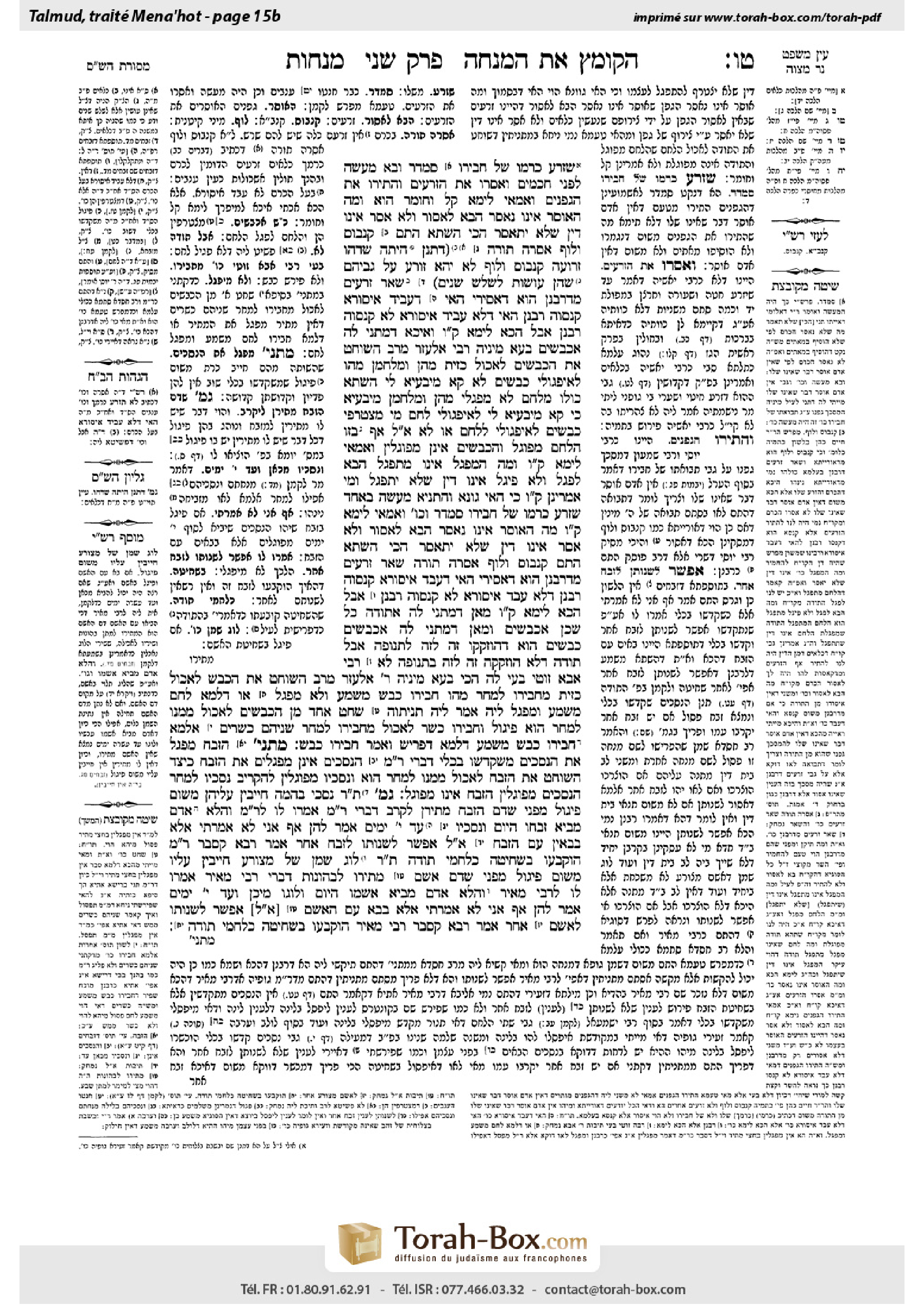
Menachot 15b: Talmud study for Daf Yomi
Daf Yomi is the daily study of one Talmud folio. Explore 37 tractates with scans, Hebrew text, Sefaria English and AI-generated French translations where annotated.
Passage selection and English or AI-generated French translation are available where the scan has annotations. Daf Study is independent of Torah-Box and Sefaria.
Browse Menachot · מנחות · All tractatesMenachot 15b text and translations
This page of Menachot includes the Aramaic text, an English translation and an AI-generated French translation, alongside the scan above.
מנחות י״ה ב · Aramaic and Hebrew text
שֶׁזָּרַע כַּרְמוֹ שֶׁל חֲבֵירוֹ סְמָדַר, וּבָא מַעֲשֶׂה לִפְנֵי חֲכָמִים, וְאָסְרוּ אֶת הַזְּרָעִים וְהִתִּירוּ אֶת הַגְּפָנִים. וְאַמַּאי? לֵימָא קַל וָחוֹמֶר הוּא: וּמָה הָאוֹסֵר אֵינוֹ נֶאֱסָר, הַבָּא לֶאֱסוֹר וְלֹא אָסַר – אֵינוֹ דִּין שֶׁלֹּא יִתְאַסֵּר?
הָכִי הַשְׁתָּא? הָתָם קַנְבּוֹס וְלוּף אָסְרָה תּוֹרָה, דִּתְנַן: הָיְתָה שָׂדֵהוּ זְרוּעָה קַנְבּוֹס וְלוֹף לֹא יְהֵא זוֹרֵעַ עַל גַּבֵּיהֶם, שֶׁהֵן עוֹשׂוֹת לְשָׁלֹשׁ שָׁנִים – שְׁאָר זְרָעִים מִדְּרַבָּנַן הוּא דַּאֲסִירִי. הַאי דְּעָבֵיד אִיסּוּרָא – קַנְסוּהּ רַבָּנַן, הַאי דְּלָא עָבֵיד אִיסּוּרָא – לָא קַנְסוּהּ רַבָּנַן. אֲבָל הָכָא, לֵימָא קַל וָחוֹמֶר!
וְאִיכָּא דְּמַתְנֵי לַהּ אַכְּבָשִׂים, בְּעָא מִינֵּיהּ רַבִּי אֶלְעָזָר מֵרַב: הַשּׁוֹחֵט אֶת הַכְּבָשִׂים לֶאֱכוֹל כְּזַיִת מֵהֶן וּמִלַּחְמָן, מַהוּ?
לְאִיפַּגּוֹלֵי כְּבָשִׂים לָא קָא מִיבַּעְיָא לִי, הַשְׁתָּא כּוּלּוֹ מִלֶּחֶם לָא מִפַּגְּלִי, מֵהֶן וּמִלַּחְמָן מִיבַּעְיָא? כִּי קָא מִיבַּעְיָא לִי לְאִיפַּגּוֹלֵי לֶחֶם, מִי מִצְטָרְפִי כְּבָשִׂים לְאִיפַּגּוֹלֵי לְלֶחֶם אוֹ לָא?
אֲמַר לֵיהּ: אַף בְּזוֹ, הַלֶּחֶם מְפוּגָּל וְהַכְּבָשִׂים אֵינָן מְפוּגָּלִין. וְאַמַּאי? לֵימָא קַל וָחוֹמֶר: וּמָה הַמְפַגֵּל אֵינוֹ מִתְפַּגֵּל, הַבָּא לְפַגֵּל וְלֹא פִּיגֵּל – אֵינוֹ דִּין שֶׁלֹּא יִתְפַּגֵּל?
וּמִי אָמְרִינַן קַל וָחוֹמֶר כִּי הַאי גַּוְנָא? וְהָתַנְיָא: מַעֲשֶׂה בְּאֶחָד שֶׁזָּרַע כַּרְמוֹ שֶׁל חֲבֵירוֹ סְמָדַר וְכוּ׳. וְאַמַּאי? לֵימָא קַל וָחוֹמֶר: מָה הָאוֹסֵר אֵינוֹ נֶאֱסָר, הַבָּא לֶאֱסוֹר וְלָא אָסַר – אֵינוֹ דִּין שֶׁלֹּא יִתְאַסֵּר?
הָכִי הַשְׁתָּא? הָתָם קַנְבּוֹס וָלוּף אָסְרָה תּוֹרָה, שְׁאָר זְרָעִים מִדְּרַבָּנַן הוּא דַּאֲסִירִי, הַאי דְּעָבֵד אִיסּוּרָא – קַנְסוּהּ רַבָּנַן, דְּלָא עָבֵד אִיסּוּרָא – לָא קַנְסוּהּ רַבָּנַן, אֲבָל הָכָא לֵימָא קַל וָחוֹמֶר!
מַאן דְּמַתְנֵי לַהּ אַתּוֹדָה – כׇּל שֶׁכֵּן אַכְּבָשִׂים, וּמַאן דְּמַתְנֵי לַהּ אַכְּבָשִׂים – כְּבָשִׂים הוּא דְּהוּזְקְקוּ זֶה לָזֶה לִתְנוּפָה, אֲבָל תּוֹדָה דְּלֹא הוּזְקְקָה זֶה לָזֶה בִּתְנוּפָה – לָא.
רַבִּי אַבָּא זוּטֵי בָּעֵי לַהּ הָכִי, בְּעָא מִינֵּיהּ רַבִּי אֶלְעָזָר מֵרַב: הַשּׁוֹחֵט אֶת הַכֶּבֶשׂ לֶאֱכוֹל כְּזַיִת מֵחֲבֵירוֹ לְמָחָר, מַהוּ? ״חֲבֵירוֹ״ כֶּבֶשׂ מַשְׁמַע, וְלָא מְפַגֵּל, אוֹ דִלְמָא ״לֶחֶם״ מַשְׁמַע, וּמְפַגֵּל לֵיהּ.
אֲמַר לֵיהּ: תְּנֵיתוּהָ, שָׁחַט אֶחָד מִן הַכְּבָשִׂים לֶאֱכוֹל מִמֶּנּוּ לְמָחָר – הוּא פִּיגּוּל וַחֲבֵירוֹ כָּשֵׁר, לֶאֱכוֹל מֵחֲבֵירוֹ לְמָחָר – שְׁנֵיהֶם כְּשֵׁרִים, אַלְמָא ״חֲבֵירוֹ״ כֶּבֶשׂ מַשְׁמַע! דִּלְמָא דְּפָרֵישׁ וְאָמַר ״חֲבֵירוֹ כֶּבֶשׂ״.
מַתְנִי׳ הַזֶּבַח מְפַגֵּל אֶת הַנְּסָכִים, מִשֶּׁקָּדְשׁוּ בִּכְלִי, דִּבְרֵי רַבִּי מֵאִיר. הַנְּסָכִים אֵינָן מְפַגְּלִים אֶת הַזֶּבַח. כֵּיצַד? הַשּׁוֹחֵט אֶת הַזֶּבַח לֶאֱכוֹל מִמֶּנּוּ לְמָחָר – הוּא וּנְסָכָיו מְפוּגָּלִין, לְהַקְרִיב נְסָכָיו לְמָחָר – הַנְּסָכִים מְפוּגָּלִין, הַזֶּבַח אֵינוֹ מְפוּגָּל.
גְּמָ׳ תָּנוּ רַבָּנַן: נִסְכֵי בְּהֵמָה חַיָּיבִין עֲלֵיהֶן מִשּׁוּם פִּיגּוּל, מִפְּנֵי שֶׁדַּם הַזֶּבַח מַתִּירָן לִקְרַב, דִּבְרֵי רַבִּי מֵאִיר.
אָמְרוּ לוֹ לְרַבִּי מֵאִיר: וַהֲלֹא אָדָם מֵבִיא זִבְחוֹ הַיּוֹם וּנְסָכָיו עַד עֲשָׂרָה יָמִים! אָמַר לָהֶן: אַף אֲנִי לֹא אָמַרְתִּי אֶלָּא בְּבָאִין עִם הַזֶּבַח. אָמְרוּ לוֹ: אֶפְשָׁר לְשַׁנּוֹתוֹ לְזֶבַח אַחֵר!
אָמַר רָבָא: קָסָבַר רַבִּי מֵאִיר, הוּקְבְּעוּ בִּשְׁחִיטָה, כְּלַחְמֵי תוֹדָה.
תָּנוּ רַבָּנַן: לוֹג שֶׁמֶן שֶׁל מְצוֹרָע חַיָּיבִין עָלָיו מִשּׁוּם פִּיגּוּל, מִפְּנֵי שֶׁדַּם אָשָׁם מַתִּירוֹ לַבְּהוֹנוֹת, דִּבְרֵי רַבִּי מֵאִיר. אָמְרוּ לוֹ לְרַבִּי מֵאִיר: וַהֲלֹא אָדָם מֵבִיא אֲשָׁמוֹ הַיּוֹם, וְלוּגּוֹ מִיכָּן וְעַד עֲשָׂרָה יָמִים.
אָמַר לָהֶן: אַף אֲנִי לֹא אָמַרְתִּי אֶלָּא בְּבָא עִם הָאָשָׁם. אֶפְשָׁר לְשַׁנּוֹתוֹ לְאָשָׁם אַחֵר. אָמַר רָבָא: קָסָבַר רַבִּי מֵאִיר הוּקְבְּעוּ בִּשְׁחִיטָה, כְּלַחְמֵי תוֹדָה.
Menachot 15b · English translation
who planted seeds in the vineyard of an another when the grapes on the vines were budding, and the incident came before the Sages and they deemed the seeds prohibited due to the prohibition against planting diverse kinds in a vineyard, but they deemed the vines permitted. The Gemara continues: But why did they deem the seeds prohibited? Let the Sages say through an analogous a fortiori inference that the seeds should be permitted: And if that which renders an item prohibited, i.e., the vine, which causes the seeds to be prohibited, is itself not prohibited, then with regard to the seeds, which come to render the vines prohibited but did not render the vines prohibited, is it not logical that they should not be rendered prohibited?
The Gemara rejects the comparison: How can these cases be compared? There, in the baraita, only hemp and arum are prohibited by Torah law to be sown in a vineyard, as we learned in a mishna (Kilayim 2:5): If one’s field was sown with hemp and arum, he should not sow above them, as they produce a yield only once every three years. Other seeds are prohibited by rabbinic law. Therefore, with regard to this person who committed a transgression by planting the seeds in the vineyard of another, the Sages penalized him and deemed his seeds prohibited, but as for that person who did not commit a transgression, i.e., the owner of the vineyard, the Sages did not penalize him. But here, in the case of piggul, which is a biblical prohibition, let us say such an a fortiori inference.
And there are those who teach the dilemma of Rabbi Elazar with regard to the lambs brought with the two loaves, and not with regard to a thanks offering. Rabbi Elazar raised a dilemma before Rav: In a case where one slaughters the lambs with the intent to consume an olive-bulk from them and from their loaves the next day, what is the halakha?
Rabbi Elazar elaborated: I do not raise the dilemma with regard to rendering the lambs piggul for the following reason: Now that in a case where his intent was to consume an entire olive-bulk from the loaves alone, the lambs are not rendered piggul, as the mishna teaches that piggul intent with regard to the loaves does not render the lambs piggul, then in a case where his intent is to consume half an olive-bulk from them and half an olive-bulk from their loaves, is it necessary to teach that the lambs are not piggul? Rather, when I raised the dilemma, it was with regard to rendering the loaves piggul. Does his intention with regard to the lambs combine with his intention with regard to the loaves to render the loaves piggul or not?
Rav said to Rabbi Elazar: Even in this case, the loaves are rendered piggul and the lambs are not rendered piggul. The Gemara asks: But why should the loaves be rendered piggul? Let us say the following a fortiori inference: And if that which renders an item piggul, i.e., the lambs, since it is maintained that intent to consume half an olive-bulk from the lambs assists to render the loaves piggul, is itself not rendered piggul, then with regard to the loaves, which come to render the lambs piggul, but do not render them piggul, as the intent to consume half an olive-bulk from the loaves does not combine with the intent to consume half an olive-bulk from the lambs to render them piggul, is it not logical that the loaves themselves should not be rendered piggul?
The Gemara asks: And do we say an a fortiori inference of this kind? But isn’t it taught in a baraita that there was an incident involving one who planted seeds in the vineyard of his friend when the grapes on the vines were budding, and the incident came before the Sages and they deemed the seeds prohibited due to the prohibition against planting diverse kinds in a vineyard, but they deemed the vines permitted. The Gemara continues: But why did they deem the seeds prohibited? Let the Sages say through an analogous a fortiori inference that the seeds should be permitted: And if that which renders an item prohibited, i.e., the vine, which causes the seeds to be prohibited, is itself not prohibited, then with regard to the seeds, which come to render the vines prohibited but did not render the vines prohibited, is it not logical that they should not be rendered prohibited?
The Gemara rejects the comparison: How can these cases be compared? There, in the baraita, only hemp and arum are prohibited by Torah law to be sown in a vineyard. Other seeds are prohibited by rabbinic law. Therefore, with regard to this person who committed a transgression by planting the seeds in the vineyard of another, the Sages penalized him and deemed his seeds prohibited, but as for this person who did not commit a transgression, i.e., the owner of the vineyard, the Sages did not penalize him. But here, in the case of piggul, which is a biblical prohibition, let us say such an a fortiori inference.
The Gemara notes: The one who teaches that the dilemma of Rabbi Elazar was raised with regard to the thanks offering and the accompanying loaves, all the more so will hold that the dilemma may be raised with regard to the case of the lambs brought with the two loaves on Shavuot. But the one who teaches that Rabbi Elazar’s dilemma was raised with regard to the lambs and the two loaves, it is possible that he holds that the dilemma was raised only with regard to the lambs and the two loaves, as they were bound to one another by waving, since the priest waves the lambs and loaves together (see Leviticus 23:20). But with regard to a thanks offering and its loaves, as they were not bound to one another by waving, the dilemma was not raised, since it is obvious in this case that his intentions do not combine.
Rabbi Abba the small taught that Rabbi Elazar raises the dilemma in this manner: Rabbi Elazar raised a dilemma before Rav: If one slaughters one of the lambs brought on Shavuot with the two loaves intending to consume an olive-bulk from the other the next day, what is the halakha? When this individual thinks of the other, does he mean the other lamb, and if so, the lamb is not rendered piggul, as one permitting factor does not render another permitting factor piggul? Or perhaps when this individual thinks of the other he means the other part of the offering, i.e., the two loaves, and if so his intention renders it piggul, as taught in the mishna.
Rav said to Rabbi Elazar: You learned in a mishna (16a): If one slaughtered one of the lambs with the intent to partake of it the next day, that lamb is piggul and the other is fit. If he slaughtered one lamb with the intent to partake of the other the next day, both lambs are fit, as one permitting factor does not render another permitting factor piggul. Rav concludes: Evidently, in this context the term: The other, means the other lamb. The Gemara rejects this proof: Perhaps the mishna is discussing a case where he clarifies and says: The other lamb, but the mishna is not referring to a case where he merely thought: The other.
MISHNA: The animal offering renders the accompanying libations and meal offerings piggul from the moment that they were consecrated in the vessel, but not before; this is the statement of Rabbi Meir. The libations do not render the animal offering piggul. How so? In the case of one who slaughters the offering with the intent to partake of it the next day, the offering and its libations are rendered piggul. But if one slaughters the offering with the intent to sacrifice its libations the next day, the libations are rendered piggul, while the offering is not piggul.
GEMARA: The Sages taught in a baraita: With regard to the libations of an animal offering, one is liable for eating them due to violation of the prohibition of piggul, as the blood of the offering permits them to be offered on the altar, and any item that becomes permitted for consumption or for sacrifice through a permitting factor can be rendered piggul, and one who partakes of such an item after its permitting factors were sacrificed is liable to receive karet. This is the statement of Rabbi Meir.
The Rabbis said to Rabbi Meir: But a person may bring his offering today and the accompanying libations from now until even ten days later. Evidently, then, the blood of the offering does render the libations permitted. Rabbi Meir said to them: I, too, spoke only about libations that come to be sacrificed together with the offering and were already sanctified in a service vessel for that purpose. The Rabbis said to him: But it is possible to switch the libations for use with another offering. Clearly, then, they are not considered an indispensable part of that offering.
Rava said: Rabbi Meir holds that the libations are fixed to this particular offering at the time of its slaughter, and one may not use them with another offering. Accordingly, these libations are rendered piggul on account of intent during the slaughter of the offering, just like the loaves of a thanks offering, which are fixed to a particular thanks offering upon its slaughter and become piggul on account of intent during the slaughter of that particular thanks offering.
In a similar vein, the Sages taught: With regard to the log of oil of the leper (see Leviticus 14:10–20), one is liable for eating it due to violation of the prohibition of piggul if the guilt offering that this oil accompanied became piggul, as the blood of the offering permits it to be placed on the right thumb and big toe of the leper. This is the statement of Rabbi Meir. The Rabbis said to Rabbi Meir: But a person may bring his guilt offering today and the accompanying log of oil from now until even ten days later. Evidently, the log of oil is not considered part of the guilt offering, and therefore it should not be rendered piggul on account of it.
Rabbi Meir said to them: I, too, spoke only about a log of oil that comes with the guilt offering. The Rabbis said to him: But even in this case, the oil should not be considered part of the offering, as it is possible to switch the oil for use with another guilt offering. Rava said: Rabbi Meir holds that the log of oil is fixed to this particular guilt offering at the time of its slaughter and is therefore rendered piggul on account of it, just like the loaves of a thanks offering, as the slaughter of the thanks offering fixes the accompanying loaves to that particular offering.
Menachot 15b · Traduction française (IA)
qui avait semé des graines dans la vigne d’autrui alors que les raisins des ceps étaient en train de bourgeonner. L’affaire fut portée devant les Sages, qui déclarèrent les graines interdites en raison de l’interdiction de semer des espèces différentes dans une vigne, mais déclarèrent les ceps permis. La Guemara poursuit : Mais pourquoi déclarèrent-ils les graines interdites ? Que les Sages disent, par une déduction a fortiori analogue, que les graines devraient être permises : si ce qui rend un élément interdit, c’est-à-dire le cep, qui entraîne l’interdiction des graines, n’est pas lui-même interdit, alors, s’agissant des graines, qui tendent à rendre les ceps interdits, mais ne les ont pas rendus interdits, n’est-il pas logique qu’elles ne soient pas déclarées interdites ?
La Guemara rejette la comparaison : Comment peut-on comparer ces cas ? Là, dans la baraïta, seuls le chanvre et l’arum sont interdits par la Torah à la culture dans une vigne, comme nous l’avons appris dans une Michna (Kilayim 2:5) : si le champ de quelqu’un a été semé de chanvre et d’arum, il ne doit pas semer par-dessus, car ces plantes ne produisent une récolte qu’une fois tous les trois ans. Les autres graines sont interdites par décret rabbinique. Par conséquent, les Sages ont sanctionné cet homme, qui a commis une transgression en semant les graines dans la vigne d’autrui, en déclarant ses graines interdites ; mais ils n’ont pas sanctionné cet autre homme, qui n’a commis aucune transgression, c’est-à-dire le propriétaire de la vigne. Mais ici, dans le cas du piggul, qui relève d’une interdiction de la Torah, disons une telle déduction a fortiori.
Certains transmettent le dilemme de Rabbi Elazar au sujet des agneaux apportés avec les deux pains, et non au sujet d’un sacrifice de remerciement. Rabbi Elazar posa un dilemme devant Rav : dans le cas où l’on égorge les agneaux avec l’intention d’en consommer, le lendemain, un volume d’olive provenant d’eux et de leurs pains, quelle est la halakha ?
Rabbi Elazar précisa : Je ne soulève pas le dilemme concernant le fait de rendre les agneaux piggul, pour la raison suivante : puisque, dans le cas où l’intention était de consommer un volume d’olive entier provenant uniquement des pains, les agneaux ne sont pas rendus piggul — comme l’enseigne la Michna, une intention de piggul concernant les pains ne rend pas les agneaux piggul —, est-il nécessaire d’enseigner que, si l’intention est de consommer un demi-volume d’olive provenant des agneaux et un demi-volume d’olive provenant de leurs pains, les agneaux ne sont pas piggul ? Lorsque j’ai soulevé le dilemme, c’était plutôt pour savoir si les pains sont rendus piggul. L’intention relative aux agneaux se joint-elle à celle relative aux pains pour rendre ces derniers piggul, ou non ?
Rav dit à Rabbi Elazar : même dans ce cas, les pains sont rendus piggul, tandis que les agneaux ne sont pas rendus piggul. La Guemara demande : Mais pourquoi les pains seraient-ils rendus piggul ? Faisons la déduction a fortiori suivante : si ce qui rend un élément piggul, c’est-à-dire les agneaux — puisque l’on considère que l’intention de consommer un demi-volume d’olive provenant des agneaux contribue à rendre les pains piggul —, n’est pas lui-même rendu piggul, alors, s’agissant des pains, qui tendent à rendre les agneaux piggul mais ne les rendent pas piggul, puisque l’intention de consommer un demi-volume d’olive provenant des pains ne se joint pas à l’intention de consommer un demi-volume d’olive provenant des agneaux pour rendre ces derniers piggul, n’est-il pas logique que les pains eux-mêmes ne soient pas rendus piggul ?
La Guemara demande : Fait-on donc une déduction a fortiori de ce genre ? N’enseigne-t-on pas dans une baraïta qu’un homme a semé des graines dans la vigne de son ami alors que les raisins des ceps étaient en train de bourgeonner ? L’affaire fut portée devant les Sages, qui déclarèrent les graines interdites en raison de l’interdiction de semer des espèces différentes dans une vigne, mais déclarèrent les ceps permis. La Guemara poursuit : Mais pourquoi déclarèrent-ils les graines interdites ? Que les Sages disent, par une déduction a fortiori analogue, que les graines devraient être permises : si ce qui rend un élément interdit, c’est-à-dire le cep, qui entraîne l’interdiction des graines, n’est pas lui-même interdit, alors, s’agissant des graines, qui tendent à rendre les ceps interdits, mais ne les ont pas rendus interdits, n’est-il pas logique qu’elles ne soient pas déclarées interdites ?
La Guemara rejette la comparaison : Comment peut-on comparer ces cas ? Là, dans la baraïta, seuls le chanvre et l’arum sont interdits par la Torah à la culture dans une vigne. Les autres graines sont interdites par décret rabbinique. Par conséquent, les Sages ont sanctionné cet homme, qui a commis une transgression en semant les graines dans la vigne d’autrui, en déclarant ses graines interdites ; mais ils n’ont pas sanctionné cet autre homme, qui n’a commis aucune transgression, c’est-à-dire le propriétaire de la vigne. Mais ici, dans le cas du piggul, qui relève d’une interdiction de la Torah, disons une telle déduction a fortiori.
La Guemara note : Celui qui enseigne que le dilemme de Rabbi Elazar a été soulevé au sujet du sacrifice de remerciement et des pains qui l’accompagnent admettra à plus forte raison qu’on peut le soulever au sujet des agneaux apportés avec les deux pains à Chavouot. Mais celui qui enseigne que le dilemme de Rabbi Elazar a été soulevé au sujet des agneaux et des deux pains peut soutenir qu’il a été soulevé uniquement à leur sujet, car ils étaient liés l’un à l’autre par le balancement, le prêtre balançant ensemble les agneaux et les pains (voir Lévitique 23:20). En revanche, le dilemme n’a pas été soulevé au sujet d’un sacrifice de remerciement et de ses pains, puisqu’ils n’étaient pas liés l’un à l’autre par le balancement, car il est évident, dans ce cas, que les intentions ne se combinent pas.
Rabbi Abba le Petit enseignait que Rabbi Elazar soulevait le dilemme de la manière suivante : Rabbi Elazar posa un dilemme devant Rav : si l’on égorge l’un des agneaux apportés à Chavouot avec les deux pains, avec l’intention de consommer, le lendemain, un volume d’olive provenant de l’autre, quelle est la halakha ? Quand cet homme pense à l’autre, entend-il par là l’autre agneau ? Si oui, l’agneau n’est pas rendu piggul, car un élément qui permet l’offrande ne rend pas piggul un autre élément qui la permet. Ou bien, quand cet homme pense à l’autre, entend-il par là l’autre partie de l’offrande, c’est-à-dire les deux pains ? Si oui, son intention les rend piggul, comme l’enseigne la Michna.
Rav dit à Rabbi Elazar : tu as appris dans une Michna (16a) : si l’on égorge l’un des agneaux avec l’intention d’en consommer le lendemain, cet agneau est piggul et l’autre est apte. Si l’on égorge un agneau avec l’intention de consommer l’autre le lendemain, les deux agneaux sont aptes, car un élément qui permet l’offrande ne rend pas piggul un autre élément qui la permet. Rav conclut : il ressort clairement que, dans ce contexte, l’expression « l’autre » désigne l’autre agneau. La Guemara rejette cette preuve : peut-être la Michna traite-t-elle d’un cas où il précise et dit « l’autre agneau », mais non d’un cas où il a simplement pensé : « l’autre ».
MICHNA : Le sacrifice animal rend piggul les libations et les offrandes de farine qui l’accompagnent dès qu’elles sont consacrées dans le récipient, mais pas avant ; telle est la déclaration de Rabbi Meïr. Les libations ne rendent pas piggul le sacrifice animal. Comment cela ? Si quelqu’un égorge le sacrifice avec l’intention d’en consommer le lendemain, le sacrifice et ses libations sont rendus piggul. Mais si quelqu’un égorge le sacrifice avec l’intention d’offrir ses libations le lendemain, les libations sont rendues piggul, tandis que le sacrifice ne l’est pas.
GUEMARA : Les Sages ont enseigné dans une baraïta : concernant les libations d’un sacrifice animal, on est passible pour leur consommation de l’interdiction de piggul, car le sang du sacrifice permet qu’elles soient offertes sur l’autel. Tout élément dont la consommation ou l’offrande est rendue permise par un facteur qui l’autorise peut devenir piggul, et celui qui consomme un tel élément après que les facteurs qui le permettent ont été accomplis est passible de karet. Telle est la déclaration de Rabbi Meïr.
Les Sages dirent à Rabbi Meïr : Mais on peut apporter son sacrifice aujourd’hui et ses libations à n’importe quel moment à partir de maintenant, même dix jours plus tard. Il apparaît donc que le sang du sacrifice rend bien les libations permises. Rabbi Meïr leur dit : Moi aussi, je n’ai parlé que des libations destinées à être offertes avec le sacrifice et déjà consacrées à cette fin dans un récipient de service. Les Sages lui dirent : Mais il est possible de remplacer ces libations par d’autres et de les utiliser avec un autre sacrifice. Il est donc clair qu’elles ne sont pas considérées comme une partie indispensable de ce sacrifice.
Rava dit : Rabbi Meïr considère que les libations sont rattachées à ce sacrifice particulier au moment de son égorgement et qu’on ne peut pas les utiliser avec un autre sacrifice. Par conséquent, ces libations sont rendues piggul en raison de l’intention formulée pendant l’égorgement du sacrifice, tout comme les pains d’un sacrifice de remerciement, qui sont rattachés à un sacrifice de remerciement particulier au moment de son égorgement et deviennent piggul en raison de l’intention formulée pendant l’égorgement de ce sacrifice particulier.
Dans le même ordre d’idées, les Sages ont enseigné : concernant le log d’huile du lépreux (voir Lévitique 14:10–20), on est passible pour sa consommation de l’interdiction de piggul si le sacrifice de culpabilité qu’accompagnait cette huile est devenu piggul, car le sang du sacrifice permet d’appliquer l’huile sur le pouce et le gros orteil droits du lépreux. Telle est la déclaration de Rabbi Meïr. Les Sages dirent à Rabbi Meïr : Mais on peut apporter son sacrifice de culpabilité aujourd’hui et le log d’huile qui l’accompagne à n’importe quel moment à partir de maintenant, même dix jours plus tard. Il apparaît donc que le log d’huile n’est pas considéré comme faisant partie du sacrifice de culpabilité ; il ne devrait donc pas devenir piggul à cause de lui.
Rabbi Meïr leur dit : Moi aussi, je n’ai parlé que d’un log d’huile qui accompagne le sacrifice de culpabilité. Les Sages lui dirent : Mais même dans ce cas, l’huile ne devrait pas être considérée comme faisant partie du sacrifice, puisqu’il est possible de la remplacer par une autre huile et de l’utiliser avec un autre sacrifice de culpabilité. Rava dit : Rabbi Meïr considère que le log d’huile est rattaché à ce sacrifice de culpabilité particulier au moment de son égorgement et qu’il est donc rendu piggul à cause de lui, tout comme les pains d’un sacrifice de remerciement, car l’égorgement de ce sacrifice de remerciement rattache les pains qui l’accompagnent à ce sacrifice particulier.
Traduction française générée par IA à partir de l’édition anglaise de Sefaria. Vérifie toujours un passage avec le texte source.
Text from Sefaria: William Davidson Edition - Vocalized Aramaic (unknown); William Davidson Edition - English (CC BY NC).