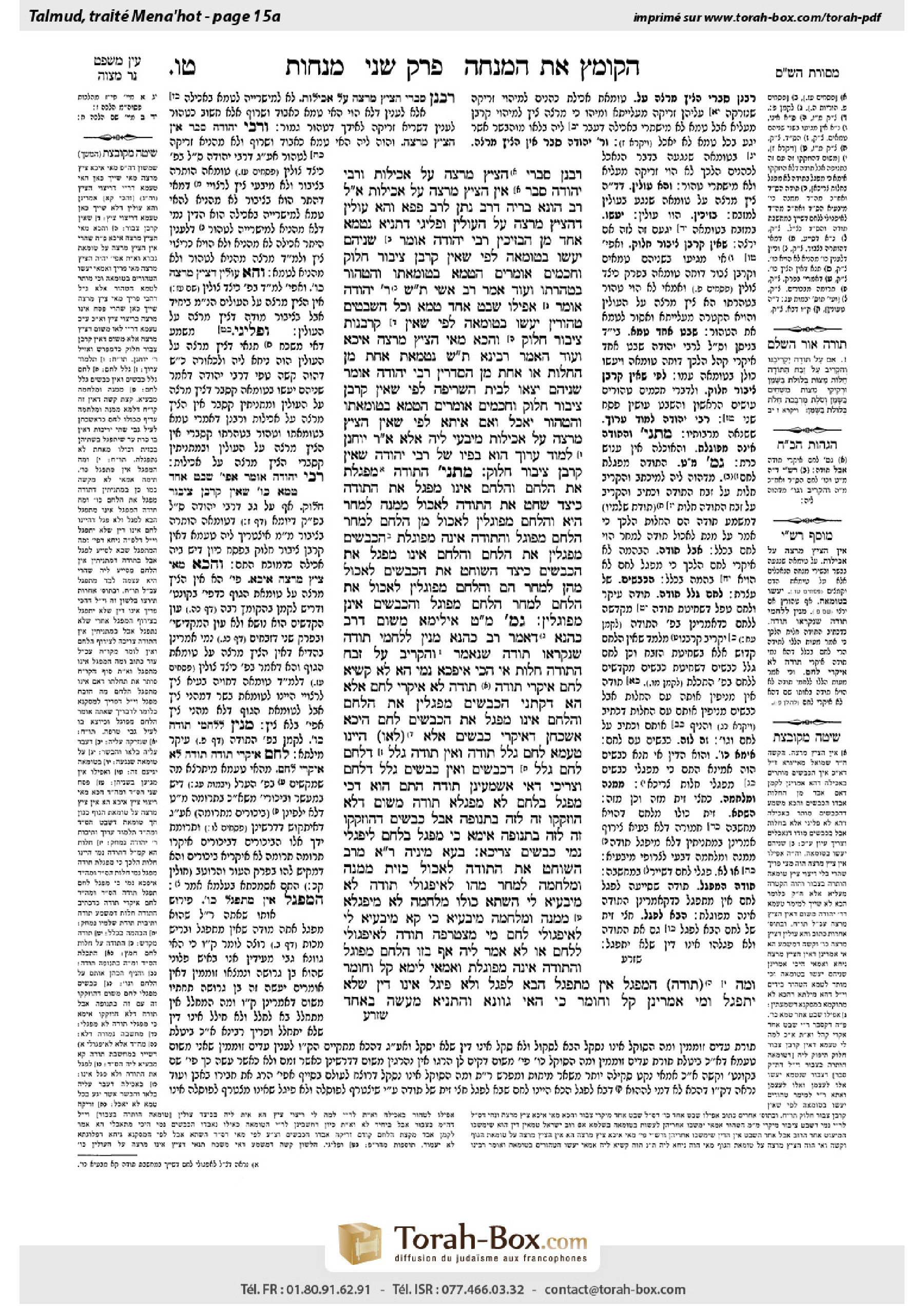
Menachot 15a: Talmud study for Daf Yomi
Daf Yomi is the daily study of one Talmud folio. Explore 37 tractates with scans, Hebrew text, Sefaria English and AI-generated French translations where annotated.
Passage selection and English or AI-generated French translation are available where the scan has annotations. Daf Study is independent of Torah-Box and Sefaria.
Browse Menachot · מנחות · All tractatesMenachot 15a text and translations
This page of Menachot includes the Aramaic text, an English translation and an AI-generated French translation, alongside the scan above.
מנחות י״ה א · Aramaic and Hebrew text
רַבָּנַן סָבְרִי: הַצִּיץ מְרַצֶּה עַל אֲכִילוֹת, וְרַבִּי יְהוּדָה סָבַר: אֵין הַצִּיץ מְרַצֶּה עַל אֲכִילוֹת.
אֲמַר לֵיהּ רַב הוּנָא בְּרֵיהּ דְּרַב נָתָן לְרַב פָּפָּא: וְהָא עוֹלִין, דְּהַצִּיץ מְרַצֶּה עַל הָעוֹלִין, וּפְלִיגִי!
דְּתַנְיָא: נִטְמָא אֶחָד מִן הַבָּזִיכִין, רַבִּי יְהוּדָה אוֹמֵר: שְׁנֵיהֶם יֵעָשׂוּ בְּטוּמְאָה, לְפִי שֶׁאֵין קׇרְבַּן צִיבּוּר חָלוּק, וַחֲכָמִים אוֹמְרִים: הַטָּמֵא בְּטוּמְאָתוֹ וְהַטָּהוֹר בְּטׇהֳרָתוֹ.
וְעוֹד, אָמַר רַב אָשֵׁי: תָּא שְׁמַע, רַבִּי יְהוּדָה אוֹמֵר: אֲפִילּוּ שֵׁבֶט אֶחָד טָמֵא וְכׇל הַשְּׁבָטִים טְהוֹרִין – יַעֲשׂוּ בְּטוּמְאָה, לְפִי שֶׁאֵין (קׇרְבְּנוֹת) [קׇרְבַּן] צִיבּוּר חָלוּק, וְהָכָא מַאי הַצִּיץ מְרַצֶּה אִיכָּא?
וְעוֹד, הָאָמַר רָבִינָא: תָּא שְׁמַע, נִטְמֵאת אַחַת מִן הַחַלּוֹת אוֹ (אַחַת) [אֶחָד] מִן הַסְּדָרִין, רַבִּי יְהוּדָה אוֹמֵר: שְׁנֵיהֶם יֵצְאוּ לְבֵית הַשְּׂרֵיפָה, לְפִי שֶׁאֵין קׇרְבַּן צִיבּוּר חָלוּק, וַחֲכָמִים אוֹמְרִים: הַטָּמֵא בְּטוּמְאָתוֹ וְהַטָּהוֹר יֵאָכֵל.
וְאִם אִיתָא, לְפִי שֶׁאֵין הַצִּיץ מְרַצֶּה עַל אֲכִילוֹת מִיבְּעֵי לֵיהּ! אֶלָּא אָמַר רַבִּי יוֹחָנָן: תַּלְמוּד עָרוּךְ הוּא בְּפִיו שֶׁל רַבִּי יְהוּדָה, שֶׁאֵין קׇרְבַּן צִיבּוּר חָלוּק.
מַתְנִי׳ הַתּוֹדָה מְפַגֶּלֶת אֶת הַלֶּחֶם, וְהַלֶּחֶם אֵינוֹ מְפַגֵּל אֶת הַתּוֹדָה. כֵּיצַד? שָׁחַט אֶת הַתּוֹדָה לֶאֱכוֹל מִמֶּנָּה לְמָחָר – הִיא וְהַלֶּחֶם מְפוּגָּלִין, לֶאֱכוֹל מִן הַלֶּחֶם לְמָחָר – הַלֶּחֶם מְפוּגָּל וְהַתּוֹדָה אֵינָהּ מְפוּגֶּלֶת.
הַכְּבָשִׂים מְפַגְּלִין אֶת הַלֶּחֶם, וְהַלֶּחֶם אֵינוֹ מְפַגֵּל אֶת הַכְּבָשִׂים. כֵּיצַד? הַשּׁוֹחֵט אֶת הַכְּבָשִׂים לֶאֱכוֹל מֵהֶן לְמָחָר – הֵם וְהַלֶּחֶם מְפוּגָּלִין, לֶאֱכוֹל אֶת הַלֶּחֶם לְמָחָר – הַלֶּחֶם מְפוּגָּל וְהַכְּבָשִׂים אֵינָן מְפוּגָּלִין.
גְּמָ׳ מַאי טַעְמָא? אִילֵּימָא מִשּׁוּם דְּרַב כָּהֲנָא, דְּאָמַר רַב כָּהֲנָא: מִנַּיִן לְלַחְמֵי תוֹדָה שֶׁנִּקְרְאוּ תּוֹדָה? שֶׁנֶּאֱמַר: ״וְהִקְרִיב עַל זֶבַח הַתּוֹדָה חַלּוֹת״.
אִי הָכִי אִיפְּכָא נָמֵי, הָא לָא קַשְׁיָא: לֶחֶם אִיקְּרִי תּוֹדָה, תּוֹדָה לָא אִיקְּרִי לֶחֶם.
אֶלָּא הָא דְּקָתָנֵי: הַכְּבָשִׂים מְפַגְּלִין אֶת הַלֶּחֶם וְהַלֶּחֶם אֵינוֹ מְפַגֵּל אֶת הַכְּבָשִׂים, לֶחֶם הֵיכָא אַשְׁכְּחַן דְּאִיקְּרִי כְּבָשִׂים? אֶלָּא לָאו הַיְינוּ טַעְמָא: לֶחֶם גְּלַל תּוֹדָה, וְאֵין תּוֹדָה גְּלַל (דלחם) [לֶחֶם], לֶחֶם גְּלַל (דכבשים) [כְבָשִׂים], וְאֵין כְּבָשִׂים גְּלַל (דלחם) [לֶחֶם].
וּצְרִיכִי, דְּאִי אַשְׁמְעִינַן תּוֹדָה – הָתָם הוּא דְּכִי מְפַגֵּל בְּלֶחֶם לָא מִפַּגְּלָא תּוֹדָה, מִשּׁוּם דְּלָא הוּזְקְקוּ זֶה לָזֶה בִּתְנוּפָה, אֲבָל כְּבָשִׂים דְּהוּזְקְקוּ זֶה לָזֶה בִּתְנוּפָה – אֵימָא כִּי מְפַגֵּל בְּלֶחֶם לִיפַּגְּלִי נָמֵי כְּבָשִׂים, צְרִיכָא.
בְּעָא מִינֵּיהּ רַבִּי אֶלְעָזָר מֵרַב: הַשּׁוֹחֵט אֶת הַתּוֹדָה לֶאֱכוֹל כְּזַיִת מִמֶּנָּה וּמִלַּחְמָהּ לְמָחָר, מַהוּ לְאִיפַּגּוֹלֵי? תּוֹדָה לָא מִיבַּעְיָא לִי, הַשְׁתָּא כּוּלּוֹ מִלַּחְמָהּ לָא מִיפַּגְּלָא, מִמֶּנָּה וּמִלַּחְמָהּ מִיבַּעְיָא?
כִּי קָא מִיבַּעְיָא לִי לְאִיפַּגּוֹלֵי לֶחֶם, מִי מִצְטָרְפָה תּוֹדָה לְאִיפַּגּוֹלֵי לְלֶחֶם אוֹ לָא?
אֲמַר לֵיהּ: אַף בְּזוֹ, הַלֶּחֶם מְפוּגָּל וְהַתּוֹדָה אֵינָהּ מְפוּגֶּלֶת. וְאַמַּאי? לֵימָא קַל וָחוֹמֶר: וּמָה תּוֹדָה הַמְפַגֵּל אֵין מִתְפַּגֵּל, הַבָּא לְפַגֵּל וְלֹא פִּיגֵּל – אֵינוֹ דִּין שֶׁלֹּא יִתְפַּגֵּל?
וּמִי אָמְרִינַן קַל וָחוֹמֶר כִּי הַאי גַוְונָא? וְהָתַנְיָא: מַעֲשֶׂה בְּאֶחָד
Menachot 15a · English translation
The Rabbis hold that the frontplate effects acceptance for items that are normally consumed by the priests but have become ritually impure. Consequently, the sprinkling of the blood in this case is an entirely valid act that is capable of rendering the remaining pure loaf permitted for consumption. And Rabbi Yehuda holds that the frontplate does not effect acceptance for items that are consumed by the priests and have become impure. Accordingly, the sprinkling of the blood is ineffective in rendering the remaining pure loaf permitted for consumption.
Rav Huna, son of Rav Natan, said to Rav Pappa: Can this be the dispute between Rabbi Yehuda and the Rabbis? But what about items that normally ascend upon the altar? Even Rabbi Yehuda concedes that the frontplate effects acceptance for impure items that normally ascend the altar, and Rabbi Yehuda and the Rabbis nevertheless disagree with regard to the remaining item in a case of this kind.
The Gemara provides the source for this claim. As it is taught in a baraita: If one of the bowls of frankincense accompanying the shewbread, which are meant to be burned upon the altar, became impure, Rabbi Yehuda says that the rites of both of them may be performed in impurity, i.e., the priest may even render the second bowl impure and burn both of them together, as no communal offering is divided, and the mitzva to sacrifice communal offerings overrides the prohibition against rendering them impure. And the Rabbis say: The impure one remains in its state of impurity and the pure one remains in its state of purity. Evidently, their dispute does not depend on whether the frontplate effects acceptance.
And furthermore, Rav Ashi said: Come and hear an additional proof that the dispute between Rabbi Yehuda and the Rabbis does not concern the frontplate, as we learn in a mishna (Pesaḥim 80a) with regard to the consumption of the Paschal offering in a state of impurity, that Rabbi Yehuda says: Even if one tribe is ritually impure and all the rest of the tribes are pure, all the tribes may perform the rite of the Paschal offering in a state of impurity, as no communal offerings are divided. Rav Ashi explains: But here, what relevance is there to the question of whether the frontplate effects acceptance? The frontplate effects acceptance for offerings that have become impure; but it does not render it permitted for one who is ritually impure to sacrifice an offering.
And furthermore, doesn’t Ravina say: Come and hear a proof that the matter of the frontplate cannot be the subject of the dispute between Rabbi Yehuda and the Rabbis, as the mishna teaches: If one of the two loaves brought on Shavuot or one of the two arrangements of shewbread became ritually impure, Rabbi Yehuda says: Both must be taken to the place of burning, as no communal offering is divided. And the Rabbis say: The impure one remains in its impurity and the pure one may be eaten.
The Gemara explains the difficulty: And if it is so, i.e., that the dispute between them concerns the frontplate, then Rabbi Yehuda should have said: They are both burned, because the frontplate does not effect acceptance for impure items that are consumed by the priests. Rather, Rabbi Yoḥanan says: It is a settled tradition in the mouth of Rabbi Yehuda that no communal offering is divided, and if one part of an offering becomes impure, the entire offering is disqualified.
MISHNA: The thanks offering renders the accompanying loaves piggul but the loaves do not render the thanks offering piggul. How so? If one slaughtered the thanks offering, which may be consumed only during the day it is slaughtered and the night thereafter, with the intent to partake of it the next day, the offering and the accompanying loaves are rendered piggul. If he slaughtered it with the intent to partake of the loaves the next day, the loaves are rendered piggul and the thanks offering is not piggul.
Likewise, the lambs sacrificed with the two loaves meal offering on Shavuot render the accompanying loaves piggul, but the loaves do not render the lambs piggul. How so? If one slaughtered the lambs, which may be consumed only during the day they are slaughtered and the night thereafter, with the intent to partake of them the next day, the lambs and the accompanying loaves are rendered piggul. If he did so with the intent to partake of the loaves the next day, the loaves are rendered piggul and the lambs are not piggul.
GEMARA: The Gemara asks: What is the reason that a thanks offering renders its accompanying loaves piggul? If we say that it is due to that which Rav Kahana says, this is problematic. As Rav Kahana says: From where is it derived that the loaves of a thanks offering are themselves called a thanks offering? It is derived from that which is stated in the verse: “Then he shall offer with the sacrifice of thanks offering loaves” (Leviticus 7:12). The juxtaposition of the words “thanks offering” and “loaves” indicates that the loaves are themselves called a thanks offering.
The Gemara explains why the halakha of the mishna cannot be derived from Rav Kahana’s exposition. If so, then the opposite should be the halakha as well, that intent of piggul with regard to the loaves should likewise render the thanks offering piggul. The Gemara rejects this suggestion: This is not difficult, as the loaves are called a thanks offering, but a thanks offering is not called loaves.
The Gemara asks: But with regard to that which the mishna teaches: The lambs sacrificed with the two loaves meal offering on Shavuot render the accompanying loaves piggul but the loaves do not render the lambs piggul, where do we find that the two loaves are called lambs? Rather, is it not correct that this is the reason why the thanks offering renders the loaves piggul but not vice versa: The bread is brought on account of [gelal] the thanks offering, but the thanks offering is not brought on account of the bread, i.e., the thanks offering is the primary element of the sacrifice. Similarly, the two loaves of bread are brought on account of the lambs, and the lambs are not brought on account of the bread.
The Gemara notes: And both of these halakhot are necessary, as, had the mishna taught us the halakha only in the case of a thanks offering, then one might say: It is only there, with regard to a thanks offering, that when one renders the loaves piggul the thanks offering is not rendered piggul, because they were not bound to one another by waving, i.e., the mitzva of waving the thanks offering may be fulfilled without the bread. But with regard to the lambs, in which the two items were bound to one another by waving, as the two loaves are waved together with the lambs, one might say that when he renders the bread piggul, the lambs should be rendered piggul as well. Therefore, it was necessary for the mishna to teach this halakha also with regard to the case of the lambs.
§ Rabbi Elazar raised a dilemma before Rav: If one slaughters the thanks offering with the intent to consume an olive-bulk from it and from its loaves the next day, what is the halakha? Rabbi Elazar elaborates: I do not raise the dilemma with regard to rendering the thanks offering piggul, for the following reason: Now that in a case where his intent was to consume the entire olive-bulk from its loaves alone, the thanks offering is not rendered piggul, in accordance with the mishna’s ruling that piggul intent with regard to the loaves does not render the thanks offering piggul, then in a case where his intent is to consume half an olive-bulk from the thanks offering and half an olive-bulk from its loaves, in which case the offering is rendered piggul only if the two intentions of less than a full measure are combined, is it necessary to teach that the thanks offering is not piggul?
Rather, when I raise the dilemma, it is with regard to rendering the loaves piggul, which can be rendered piggul via intent concerning the loaves alone. In this case, does the intention of the priest with regard to the thanks offering combine with his intention concerning the loaves to render the loaves piggul, or not?
Rav said to Rabbi Elazar: Even in this case, the loaves are rendered piggul and the thanks offering is not rendered piggul. The Gemara asks: But why should the loaves be rendered piggul? Let us say the following a fortiori inference: And if the thanks offering, which in this case serves to render the loaves piggul, is itself not rendered piggul, then the loaves, which come to render the thanks offering piggul, but do not render it piggul, as the intent to consume half an olive-bulk from the loaves does not combine with the intent to consume half an olive-bulk from the thanks offering to render the thanks offering piggul, is it not logical that the loaves themselves should not be rendered piggul?
The Gemara asks: And do we say an a fortiori inference in this way? But isn’t it taught in a baraita: There was an incident involving one
Menachot 15a · Traduction française (IA)
Les Sages considèrent que le diadème expiatoire rend recevables les éléments habituellement consommés par les prêtres qui sont devenus rituellement impurs. Par conséquent, l’aspersion du sang constitue ici un acte pleinement valide, capable de rendre la miche pure restante propre à la consommation. Rabbi Yehouda, lui, considère que le diadème expiatoire ne rend pas recevables les éléments consommés par les prêtres qui sont devenus impurs. Dès lors, l’aspersion du sang ne permet pas de rendre la miche pure restante propre à la consommation.
Rav Houna, fils de Rav Natan, dit à Rav Pappa : Est-ce là le désaccord entre Rabbi Yehouda et les Sages ? Mais qu’en est-il des éléments qui sont normalement portés sur l’autel ? Même Rabbi Yehouda reconnaît que le diadème expiatoire rend recevables les éléments impurs qui sont normalement portés sur l’autel, et pourtant Rabbi Yehouda et les Sages sont en désaccord au sujet de l’élément restant dans un cas de ce genre.
La Guemara apporte la source de cette affirmation. En effet, il est enseigné dans une baraïta : si l’une des coupes d’encens accompagnant le pain de proposition, destinées à être brûlées sur l’autel, devient impure, Rabbi Yehouda dit que les rites des deux peuvent être accomplis en état d’impureté, c’est-à-dire que le prêtre peut même rendre impure la seconde coupe et brûler les deux ensemble, car aucune offrande communautaire n’est divisée et la mitsva d’offrir les sacrifices communautaires l’emporte sur l’interdiction de les rendre impurs. Les Sages disent : celle qui est impure reste dans son état d’impureté et celle qui est pure reste dans son état de pureté. Il apparaît donc que leur désaccord ne dépend pas de la question de savoir si le diadème expiatoire rend les éléments recevables.
De plus, Rav Achi dit : Viens et entends une preuve supplémentaire que le désaccord entre Rabbi Yehouda et les Sages ne porte pas sur le diadème expiatoire. En effet, nous apprenons dans une Michna (Pessa’him 80a), à propos de la consommation du sacrifice pascal en état d’impureté, que Rabbi Yehouda dit : même si une tribu est rituellement impure et que toutes les autres tribus sont pures, toutes les tribus peuvent accomplir le rite du sacrifice pascal en état d’impureté, car aucune offrande communautaire n’est divisée. Rav Achi explique : Mais ici, en quoi la question de savoir si le diadème expiatoire rend les éléments recevables est-elle pertinente ? Le diadème expiatoire rend recevables les sacrifices qui sont devenus impurs, mais il ne permet pas à une personne rituellement impure d’offrir un sacrifice.
De plus, Ravina ne dit-il pas : Viens et entends une preuve que la question du diadème expiatoire ne peut pas être l’objet du désaccord entre Rabbi Yehouda et les Sages ? La Michna enseigne en effet : si l’une des deux miches apportées à Chavouot ou l’un des deux rangements du pain de proposition devient rituellement impur, Rabbi Yehouda dit : les deux doivent être emportés au lieu de l’incinération, car aucune offrande communautaire n’est divisée. Les Sages disent : celle qui est impure reste dans son état d’impureté, et celle qui est pure peut être consommée.
La Guemara explique la difficulté : si tel était le cas, c’est-à-dire si leur désaccord portait sur le diadème expiatoire, Rabbi Yehouda aurait dû dire : « Les deux sont brûlés », car le diadème expiatoire ne rend pas recevables les éléments impurs consommés par les prêtres. Rav Yo’hanan dit plutôt : Rabbi Yehouda tient pour une tradition établie qu’aucune offrande communautaire n’est divisée et que, si une partie d’une offrande devient impure, l’offrande entière est invalidée.
MICHNA : Le sacrifice de remerciement rend ses miches associées piggoul, mais les miches ne rendent pas le sacrifice de remerciement piggoul. Comment cela ? Si quelqu’un égorge le sacrifice de remerciement, qui ne peut être consommé que le jour de son égorgement et la nuit qui suit, avec l’intention d’en consommer le lendemain, le sacrifice et les miches associées deviennent piggoul. S’il l’égorge avec l’intention de consommer les miches le lendemain, les miches deviennent piggoul, mais le sacrifice de remerciement ne devient pas piggoul.
De même, les agneaux sacrifiés avec l’offrande de farine des deux miches à Chavouot rendent les miches associées piggoul, mais les miches ne rendent pas les agneaux piggoul. Comment cela ? Si quelqu’un égorge les agneaux, qui ne peuvent être consommés que le jour de leur égorgement et la nuit qui suit, avec l’intention d’en consommer le lendemain, les agneaux et les miches associées deviennent piggoul. S’il le fait avec l’intention de consommer les miches le lendemain, les miches deviennent piggoul, mais les agneaux ne deviennent pas piggoul.
GUEMARA : La Guemara demande : Pour quelle raison le sacrifice de remerciement rend-il ses miches associées piggoul ? Si l’on dit que cela découle de ce que dit Rav Kahana, cela pose problème. Rav Kahana dit en effet : D’où apprend-on que les miches d’un sacrifice de remerciement sont elles-mêmes appelées « sacrifice de remerciement » ? On l’apprend de ce qui est dit dans le verset : « Il présentera, avec le sacrifice de remerciement, des miches » (Lévitique 7:12). La juxtaposition des termes « sacrifice de remerciement » et « miches » indique que les miches sont elles-mêmes appelées « sacrifice de remerciement ».
La Guemara explique pourquoi la halakha de la Michna ne peut pas être déduite de l’interprétation de Rav Kahana. Si tel était le cas, la halakha inverse devrait également s’appliquer : une intention de piggoul concernant les miches devrait elle aussi rendre le sacrifice de remerciement piggoul. La Guemara rejette cette proposition : cela ne pose pas de difficulté, car les miches sont appelées « sacrifice de remerciement », mais le sacrifice de remerciement n’est pas appelé « miches ».
La Guemara demande : Mais, concernant ce qu’enseigne la Michna, à savoir que les agneaux sacrifiés avec l’offrande de farine des deux miches à Chavouot rendent les miches associées piggoul, mais que les miches ne rendent pas les agneaux piggoul, où trouve-t-on que les deux miches sont appelées « agneaux » ? Ne convient-il pas plutôt de dire que c’est pour cette raison que le sacrifice de remerciement rend les miches piggoul, mais pas l’inverse : le pain est apporté en raison de [gelal] du sacrifice de remerciement, mais le sacrifice de remerciement n’est pas apporté en raison du pain, c’est-à-dire que le sacrifice de remerciement est l’élément principal de l’offrande. De même, les deux miches de pain sont apportées en raison des agneaux, et les agneaux ne sont pas apportés en raison du pain.
La Guemara fait remarquer que ces deux halakhot sont nécessaires. En effet, si la Michna ne nous avait enseigné la halakha que dans le cas du sacrifice de remerciement, on aurait pu dire : c’est seulement dans ce cas que, lorsqu’on rend les miches piggoul, le sacrifice de remerciement ne devient pas piggoul, parce qu’ils ne sont pas liés l’un à l’autre par le balancement ; autrement dit, la mitsva de balancer le sacrifice de remerciement peut être accomplie sans le pain. Mais, dans le cas des agneaux, les deux éléments étant liés l’un à l’autre par le balancement, puisque les deux miches sont balancées avec les agneaux, on aurait pu dire que, lorsqu’on rend le pain piggoul, les agneaux devraient eux aussi devenir piggoul. C’est pourquoi la Michna devait enseigner cette halakha également dans le cas des agneaux.
§ Rabbi Elazar souleva une question devant Rav : si quelqu’un égorge le sacrifice de remerciement avec l’intention de consommer le lendemain un volume d’olive provenant à la fois du sacrifice et de ses miches, quelle est la halakha ? Rabbi Elazar précise : je ne soulève pas la question de savoir si le sacrifice de remerciement devient piggoul, pour la raison suivante : puisque, dans un cas où son intention était de consommer un volume d’olive entier provenant uniquement de ses miches, le sacrifice de remerciement ne devient pas piggoul, conformément à la décision de la Michna selon laquelle une intention de piggoul concernant les miches ne rend pas le sacrifice de remerciement piggoul, alors, dans un cas où son intention est de consommer un demi-volume d’olive provenant du sacrifice de remerciement et un demi-volume d’olive provenant de ses miches, cas où l’offrande ne devient piggoul que si les deux intentions, chacune portant sur une quantité inférieure à la mesure requise, sont combinées, est-il nécessaire d’enseigner que le sacrifice de remerciement ne devient pas piggoul ?
Je soulève plutôt la question de savoir si les miches deviennent piggoul, ce qui peut se produire par une intention concernant les miches seules. Dans ce cas, l’intention du prêtre concernant le sacrifice de remerciement s’ajoute-t-elle à son intention concernant les miches pour rendre celles-ci piggoul, ou non ?
Rav dit à Rabbi Elazar : même dans ce cas, les miches deviennent piggoul et le sacrifice de remerciement ne devient pas piggoul. La Guemara demande : Mais pourquoi les miches deviendraient-elles piggoul ? Faisons le raisonnement a fortiori suivant : si le sacrifice de remerciement, qui sert ici à rendre les miches piggoul, ne devient pas lui-même piggoul, alors les miches, qui visent à rendre le sacrifice de remerciement piggoul mais ne le rendent pas piggoul — puisque l’intention de consommer un demi-volume d’olive provenant des miches ne s’ajoute pas à l’intention de consommer un demi-volume d’olive provenant du sacrifice de remerciement pour rendre celui-ci piggoul —, n’est-il pas logique que les miches elles-mêmes ne deviennent pas piggoul ?
La Guemara demande : Peut-on faire un raisonnement a fortiori de cette manière ? N’est-il pas enseigné dans une baraïta : Il y eut un incident concernant un
Traduction française générée par IA à partir de l’édition anglaise de Sefaria. Vérifie toujours un passage avec le texte source.
Text from Sefaria: William Davidson Edition - Vocalized Aramaic (unknown); William Davidson Edition - English (CC BY NC).