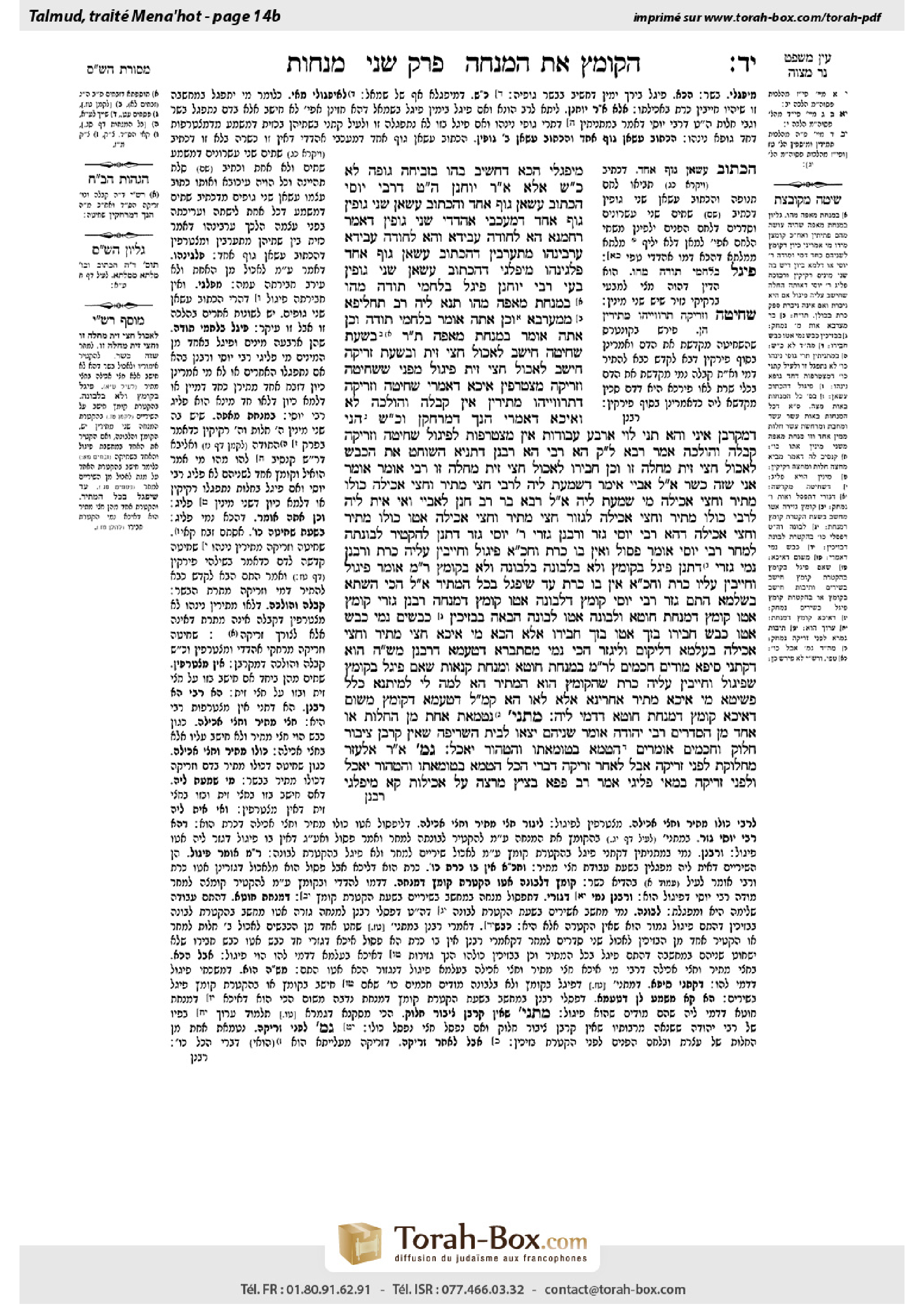
Menachot 14b: Talmud study for Daf Yomi
Daf Yomi is the daily study of one Talmud folio. Explore 37 tractates with scans, Hebrew text, Sefaria English and AI-generated French translations where annotated.
Passage selection and English or AI-generated French translation are available where the scan has annotations. Daf Study is independent of Torah-Box and Sefaria.
Browse Menachot · מנחות · All tractatesMenachot 14b text and translations
This page of Menachot includes the Aramaic text, an English translation and an AI-generated French translation, alongside the scan above.
מנחות י״ד ב · Aramaic and Hebrew text
מִיפַּגְּלִי – הָכָא דְּחַשֵּׁיב בְּהוּ בִּזְבִיחָה גּוּפַהּ, לֹא כׇּל שֶׁכֵּן?
אֶלָּא אָמַר רַבִּי יוֹחָנָן: הַיְינוּ טַעְמָא דְּרַבִּי יוֹסֵי – הַכָּתוּב עֲשָׂאָן גּוּף אֶחָד, וְהַכָּתוּב עֲשָׂאָן שְׁנֵי גּוּפִין; גּוּף אֶחָד – דִּמְעַכְּבִי אַהֲדָדֵי, שְׁנֵי גּוּפִין – דְּאָמַר רַחֲמָנָא: הָא לְחוֹדַהּ עֲבִידָא וְהָא לְחוֹדַהּ עֲבִידָא.
עָרְבִינְהוּ – מִתְעָרְבִין, דְּהַכָּתוּב עֲשָׂאָן גּוּף אֶחָד; פַּלְגִינְהוּ מִיפַּלְגִי, דְּהַכָּתוּב עֲשָׂאָן שְׁנֵי גּוּפִין.
בָּעֵי רַבִּי יוֹחָנָן: פִּיגֵּל בְּלַחְמֵי תוֹדָה מַהוּ, בְּמִנְחַת מַאֲפֶה מַהוּ? תְּנָא לֵיהּ רַב תַּחְלִיפָא מִמַּעְרְבָא: וְכֵן אַתָּה אוֹמֵר בְּלַחְמֵי תוֹדָה, וְכֵן אַתָּה אוֹמֵר בְּמִנְחַת מַאֲפֶה.
תָּנוּ רַבָּנַן: בִּשְׁעַת שְׁחִיטָה חִישֵּׁב לֶאֱכוֹל חֲצִי זַיִת, וּבִשְׁעַת זְרִיקָה חִישֵּׁב לֶאֱכוֹל חֲצִי זַיִת – פִּיגּוּל, מִפְּנֵי שֶׁשְּׁחִיטָה וּזְרִיקָה מִצְטָרְפִין.
אִיכָּא דְּאָמְרִי: שְׁחִיטָה וּזְרִיקָה, דְּתַרְוַויְיהוּ מַתִּירִין – אִין, קַבָּלָה וְהוֹלָכָה – לָא. וְאִיכָּא דְּאָמְרִי: הָנָךְ דִּמְרַחֲקָן, וְכׇל שֶׁכֵּן הָנֵי דִּמְקָרְבָן.
אִינִי? וְהָא תָּנֵי לֵוִי: אַרְבַּע עֲבוֹדוֹת אֵין מִצְטָרְפוֹת לְפִיגּוּל, שְׁחִיטָה וּזְרִיקָה, קַבָּלָה וְהוֹלָכָה! אָמַר רָבָא, לָא קַשְׁיָא: הָא רַבִּי, הָא רַבָּנַן.
דְּתַנְיָא: הַשּׁוֹחֵט אֶת הַכֶּבֶשׂ לֶאֱכוֹל חֲצִי זַיִת מֵחַלָּה זוֹ, וְכֵן חֲבֵירוֹ לֶאֱכוֹל חֲצִי זַיִת מֵחַלָּה זוֹ, רַבִּי אוֹמֵר: אוֹמֵר אֲנִי שֶׁזֶּה כָּשֵׁר.
אֲמַר לֵיהּ אַבָּיֵי: אֵימַר דְּשָׁמְעַתְּ לֵיהּ לְרַבִּי – חֲצִי מַתִּיר וַחֲצִי אֲכִילָה, כּוּלּוֹ מַתִּיר וַחֲצִי אֲכִילָה מִי שָׁמְעַתְּ לֵיהּ?
אֲמַר לֵיהּ רָבָא בַּר רַב חָנָן לְאַבָּיֵי: וְאִי אִית לֵיהּ לְרַבִּי כּוּלּוֹ מַתִּיר וַחֲצִי אֲכִילָה, לִגְזוֹר חֲצִי מַתִּיר וַחֲצִי אֲכִילָה אַטּוּ כּוּלּוֹ מַתִּיר וַחֲצִי אֲכִילָה, דְּהָא רַבִּי יוֹסֵי גָּזַר וְרַבָּנַן גָּזְרִי!
רַבִּי יוֹסֵי גָּזַר, דִּתְנַן: לְהַקְטִיר לְבוֹנָתָהּ לְמָחָר, רַבִּי יוֹסֵי אוֹמֵר: פָּסוּל וְאֵין בּוֹ כָּרֵת, וַחֲכָמִים אוֹמְרִים: פִּיגּוּל וְחַיָּיבִין עָלֶיהָ כָּרֵת.
וְרַבָּנַן נָמֵי גָּזְרִי, דִּתְנַן: פִּיגֵּל בַּקּוֹמֶץ וְלֹא בַּלְּבוֹנָה, בַּלְּבוֹנָה וְלֹא בַּקּוֹמֶץ – רַבִּי מֵאִיר אוֹמֵר: פִּיגּוּל וְחַיָּיבִין עָלָיו כָּרֵת, וַחֲכָמִים אוֹמְרִים: אֵין בּוֹ כָּרֵת עַד שֶׁיְּפַגֵּל בְּכׇל הַמַּתִּיר.
אֲמַר לֵיהּ: הָכִי הַשְׁתָּא? בִּשְׁלָמָא הָתָם, גָּזַר רַבִּי יוֹסֵי קוֹמֶץ דִּלְבוֹנָה אַטּוּ קוֹמֶץ דְּמִנְחָה.
רַבָּנַן גָּזְרִי קוֹמֶץ אַטּוּ קוֹמֶץ דְּמִנְחַת חוֹטֵא, וּלְבוֹנָה אַטּוּ לְבוֹנָה הַבָּאָה בְּבָזִיכִין.
כְּבָשִׂים נָמֵי, כֶּבֶשׂ אַטּוּ כֶּבֶשׂ חֲבֵירוֹ.
בָּזֵךְ, אַטּוּ בָּזֵךְ חֲבֵירוֹ.
אֶלָּא הָכָא, מִי אִיכָּא חֲצִי מַתִּיר וַחֲצִי אֲכִילָה בְּעָלְמָא, דְּלֵיקוּם וְלִיגְזַר?
הָכִי נָמֵי מִסְתַּבְּרָא, דְּטַעְמָא דְּרַבָּנַן מִשּׁוּם הָכִי הוּא, דְּקָתָנֵי סֵיפָא: מוֹדִים חֲכָמִים לְרַבִּי מֵאִיר בְּמִנְחַת חוֹטֵא וּמִנְחַת קְנָאוֹת שֶׁאִם פִּיגֵּל בַּקּוֹמֶץ שֶׁפִּיגּוּל, וְחַיָּיבִין עָלֶיהָ כָּרֵת, שֶׁהַקּוֹמֶץ הוּא הַמַּתִּיר.
הָא לְמָה לִי לְמִיתְנָא כְּלָל? פְּשִׁיטָא, מִי אִיכָּא מַתִּיר אַחֲרִינָא? אֶלָּא לָאו הָא קָא מַשְׁמַע לַן, דְּטַעְמָא דְּקוֹמֶץ מִשּׁוּם דְּאִיכָּא קוֹמֶץ דְּמִנְחַת חוֹטֵא דְּדָמֵי לֵיהּ.
מַתְנִי׳ נִטְמֵאת אַחַת מִן הַחַלּוֹת, אוֹ אֶחָד מִן הַסְּדָרִים – רַבִּי יְהוּדָה אוֹמֵר: שְׁנֵיהֶם יֵצְאוּ לְבֵית הַשְּׂרֵיפָה, שֶׁאֵין קׇרְבַּן צִיבּוּר חָלוּק. וַחֲכָמִים אוֹמְרִים: הַטָּמֵא בְּטוּמְאָתוֹ וְהַטָּהוֹר יֵאָכֵל.
גְּמָ׳ אָמַר רַבִּי אֶלְעָזָר: מַחְלוֹקֶת לִפְנֵי זְרִיקָה, אֲבָל לְאַחַר זְרִיקָה – דִּבְרֵי הַכֹּל הַטָּמֵא בְּטוּמְאָתוֹ וְהַטָּהוֹר יֵאָכֵל.
וְלִפְנֵי זְרִיקָה, בְּמַאי פְּלִיגִי? אָמַר רַב פָּפָּא: בְּצִיץ מְרַצֶּה עַל אֲכִילוֹת קָא מִיפַּלְגִי,
Menachot 14b · English translation
and yet Rabbi Yosei said that the remainder is rendered piggul; then here, where he has intent to partake of the right thigh the next day, which is part of the offering itself, is it not all the more so that both thighs should become piggul?
Rather, Rabbi Yoḥanan said: Rabbi Yosei holds that intent of piggul with regard to one thigh renders the other thigh piggul as well, as they are of one body. Similarly, with regard to two loaves, Rabbi Yosei is of the opinion that if one intends to consume an amount equal to an olive-bulk from both loaves, both loaves are rendered piggul. And as for his statement that intent of piggul with regard to one loaf does not render the other loaf piggul, this is the reasoning of Rabbi Yosei: The verse renders the two loaves one body, and the verse also renders them two bodies. The verse renders them one body in the sense that they preclude one another, i.e., neither loaf is valid without the other. The verse also renders them two bodies, as the Merciful One states: This loaf is prepared alone and that is prepared alone, i.e., the kneading and arrangement of each loaf must be performed separately.
Therefore, if the priest mixed them together by intending to consume an olive-bulk from both of them, then they are mixed and they are both piggul, as the verse renders them one body. But if he separated them by having intent with regard to only one loaf, in that case they are separated and only that loaf is piggul, as the verse renders them two bodies.
Rabbi Yoḥanan raises a dilemma: If one had intent of piggul with regard to one type of loaf from the loaves of a thanks offering, what is the halakha concerning the remaining types of loaves, i.e., are they rendered piggul as well? Similarly, if one had intent of piggul with regard to either the loaves or the wafers of baked meal offerings, what is the halakha with regard to the remaining type? Rav Taḥlifa from the West, i.e., Eretz Yisrael, taught him a baraita that states: And likewise you say with regard to the bread of a thanks offering, and likewise you say with regard to a baked meal offering, that the halakha is a matter of dispute between Rabbi Yosei and the Rabbis.
§ The Sages taught in a baraita: If at the time of the slaughter of an offering one had intent to consume half an olive-bulk of its meat the next day, and at the time of the sprinkling of the blood he had intent to consume half of another olive-bulk of meat the next day, the offering is piggul, as intentions that occur during the slaughter and sprinkling combine to render an offering piggul.
There is a dispute between amora’im with regard to the halakha of this baraita: Some say that in the case of intentions that occur specifically during the slaughter and sprinkling, as both of them are permitting factors of the offering, yes, the intentions combine. But intentions that occur during the collection of the blood in a service vessel and the conveying of the blood to the altar do not combine, as neither rite is a permitting factor. And some say that if intentions during those rites that are distant from one another, i.e., the slaughter and sprinkling, combine, all the more so intentions during these rites that are close to one another, i.e., collection and conveying, certainly combine.
The Gemara asks: Is that so, i.e., that intentions during the slaughter and sprinkling combine? But Levi teaches in a baraita: Intentions that occur during the four sacrificial rites do not combine to render an offering piggul, and those rites are: Slaughter and sprinkling, collection and conveying. Rava said: It is not difficult; this statement of Levi is in accordance with the opinion of Rabbi Yehuda HaNasi, whereas that baraita is in accordance with the opinion of the Rabbis.
As it is taught in a baraita with regard to the two loaves and two lambs sacrificed on Shavuot: With regard to one who slaughters one of the lambs brought as peace offerings on Shavuot with the intent to consume half an olive-bulk from this loaf the next day, and similarly, he slaughtered the other lamb with the intent to consume half an olive-bulk from that second loaf the next day, Rabbi Yehuda HaNasi says: I say that this offering is valid. Clearly, Rabbi Yehuda HaNasi holds that intentions that occur during the performance of two permitting factors do not combine to render an offering piggul.
Abaye said to Rava: You can say that you have heard that Rabbi Yehuda HaNasi holds that intentions do not combine to render an offering piggul when each intention is concerning half a permitting factor and half a measure of consumption, i.e., one lamb and half an olive-bulk. But in a case where one had intentions during the performance of an entire permitting factor, i.e., during the slaughter and sprinkling, and concerning half a measure of consumption, did you hear him say that such intentions do not combine?
Rava bar Rav Ḥanan said to Abaye: But if Rabbi Yehuda HaNasi is of the opinion that intentions during the performance of an entire permitting factor and concerning half a measure of consumption combine to render an offering piggul, why does he rule that when one slaughters each lamb with the intent to consume half an olive-bulk from one loaf the next day the offering is entirely valid? Let him decree that intentions during half a permitting factor and concerning half a measure of consumption disqualify an offering, due to the fact that intentions during an entire permitting factor and concerning half a measure of consumption render the offering piggul, as one finds in similar instances that Rabbi Yosei decreed and the Rabbis decreed in this manner.
Rava bar Rav Ḥanan elaborates: Rabbi Yosei decreed in such a case, as we learned in a mishna (13a): With regard to one who removes a handful from the meal offering with the intent to burn its handful on the next day, everyone agrees that the meal offering is piggul. But if his intent was to burn its frankincense on the next day, Rabbi Yosei says: The meal offering is unfit, but partaking of it does not include liability to receive karet. And the Rabbis say: It is a case of piggul and one is liable to receive karet for partaking of the meal offering. Since one is not liable to receive karet, Rabbi Yosei evidently disqualifies the meal offering as a rabbinic decree due to concern over a case where his intention was to burn the handful the next day.
And the Rabbis decreed as well, as we learned in a mishna (16a): If one had intent of piggul during the burning of the handful but not during the burning of the frankincense, or if he had such intent during the burning of the frankincense but not during the burning of the handful, Rabbi Meir says: The meal offering is piggul and one is liable to receive karet for its consumption, and the Rabbis say: There is no liability to receive karet for its consumption unless he has intent of piggul during the burning of the entire permitting factor, i.e., both the handful and the frankincense. Since the Rabbis state that there is no liability to receive karet, but they do not rule that the offering is valid, evidently they maintain that the offering is disqualified by rabbinic law, due to concern over a case of piggul intent during the burning of the entire permitting factor.
Abaye said to Rava bar Rav Ḥanan: How can these cases be compared? Granted there, Rabbi Yosei decreed that the offering is disqualified in a case of intent involving the handful of frankincense due to the concern of intent involving the handful of the meal offering, as the two cases are similar.
Similarly, the Rabbis decreed that the offering is disqualified in a case of intent involving the handful due to a similar case of intent concerning the handful of the meal offering of a sinner. There is no frankincense in the case of a meal offering of a sinner, and consequently the priest’s intent with regard to the handful alone renders the offering piggul, as it is the sole permitting factor. And the Rabbis also decreed in a case of intent with regard to the frankincense due to a similar case of intent concerning the frankincense that comes in the bowls that accompany the shewbread. Here there is no handful, and consequently intent with regard to the frankincense alone renders the shewbread piggul.
In the case of the two lambs that accompany the two loaves brought on Shavuot as well (16a), the Rabbis rule that if one slaughters one of the lambs with the intent to consume both loaves the next day the offering is disqualified, but one is not liable to receive karet for partaking of it. This is a rabbinic decree in a case of intent during the slaughter of one lamb due to the other lamb, as were one to slaughter both lambs with intent of piggul, the loaves would be rendered piggul, since his intent occurred during the slaughter of the entire permitting factor.
Similarly, when one burns a single bowl of frankincense from those that accompany the shewbread with the intent to consume both arrangements of shewbread the next day, the Rabbis disqualify the shewbread by rabbinic decree due to the other bowl, i.e., due to the concern over piggul intent during the burning of both bowls, as this intent involves the burning of the entire permitting factor.
Abaye concludes: But here, in the case of the baraita where one slaughtered each of the two lambs with the intent to consume half an olive-bulk from a different loaf, is there another instance in general where intent during the performance of a rite concerning half a permitting factor and with regard to half a measure of consumption renders an offering piggul, that Rabbi Yehuda HaNasi will arise and decree that the lambs in this instance are disqualified?
The Gemara notes: So too, it is reasonable that the reasoning of the Rabbis is due to that explanation, i.e., they disqualified the offerings in the aforementioned cases due to the fact that in similar instances the offering is piggul. This is evident from the fact that it is taught in the latter clause of the mishna (16a): The Rabbis concede to Rabbi Meir in the case of the meal offering of a sinner and the meal offering of jealousy that if one had intent of piggul during the burning of the handful, the meal offering is piggul and one is liable to receive karet for its consumption, as the handful is the sole permitting factor.
The Gemara explains this proof: Why do I need the mishna to teach this last statement at all? Isn’t it obvious that these meal offerings are piggul, as is there another permitting factor aside from the handful? Rather, is it not correct to say that this is what the mishna teaches us, that the reason that the Rabbis disqualified a standard meal offering when only the handful was removed with the intent of piggul is because there is the case of the handful of the meal offering of a sinner, which is similar to it and is rendered piggul due to intent involving the handful alone?
MISHNA: If one of the two loaves of Shavuot or one of the two arrangements of the shewbread became ritually impure, Rabbi Yehuda says: Both must be taken to the place of burning like any other disqualified offering, as no communal offering is divided. That is, it is either fit in its entirety or unfit in its entirety. And the Rabbis say: The impure one remains in its state of impurity and the pure one shall be eaten.
GEMARA: Rabbi Elazar says: The dispute between Rabbi Yehuda and the Rabbis applies only to a case where one loaf became ritually impure before the sprinkling of the blood of the lambs, as this is the act that renders the loaves permitted for consumption. Accordingly, they disagree whether the sprinkling is effective in permitting the remaining pure loaf for consumption. But in a case where one loaf was rendered impure after the sprinkling, meaning that both loaves were initially permitted for consumption, everyone agrees that the impure one remains in its state of impurity and the pure one shall be eaten.
The Gemara asks: And in the case where the loaves become impure before the sprinkling of the blood, with regard to what principle do they disagree? Rav Pappa said: They disagree with regard to the frontplate of the High Priest, i.e., whether it effects acceptance only for the impurity of items sacrificed on the altar, or even for the impurity of items that would normally be consumed by the priests.
Menachot 14b · Traduction française (IA)
Et pourtant, Rabbi Yosei a dit que le reste devient piggul. Alors ici, puisqu’il a l’intention de consommer la cuisse droite le lendemain, laquelle fait partie de l’offrande elle-même, n’est-il pas d’autant plus évident que les deux cuisses devraient devenir piggul ?
Rabbi Yoḥanan a plutôt dit : Rabbi Yosei soutient qu’une intention de piggul concernant une cuisse rend également l’autre cuisse piggul, puisqu’elles appartiennent au même corps. De même, concernant les deux pains, Rabbi Yosei estime que si l’on a l’intention de consommer une quantité équivalant à un volume d’olive provenant des deux pains, les deux deviennent piggul. Quant à son affirmation selon laquelle une intention de piggul concernant un pain ne rend pas l’autre pain piggul, voici le raisonnement de Rabbi Yosei : le verset fait des deux pains un seul corps, mais aussi deux corps. Il en fait un seul corps en ce sens qu’ils se conditionnent mutuellement, c’est-à-dire qu’aucun pain n’est valide sans l’autre. Le verset en fait également deux corps, car le Miséricordieux dit : « Ce pain est préparé séparément, et celui-là est préparé séparément », c’est-à-dire que le pétrissage et la disposition de chaque pain doivent être effectués séparément.
Par conséquent, si le prêtre les a réunis en ayant l’intention de consommer un volume d’olive provenant des deux pains, ils sont réunis et deviennent tous deux piggul, puisque le verset en fait un seul corps. Mais s’il les a distingués en ayant une intention concernant un seul pain, alors ils sont séparés et seul ce pain devient piggul, puisque le verset en fait deux corps.
Rabbi Yoḥanan soulève une question : si quelqu’un a eu une intention de piggul concernant l’une des catégories de pains de l’offrande de remerciement, quelle est la halakha concernant les autres catégories de pains ? Deviennent-elles également piggul ? De même, si quelqu’un a eu une intention de piggul concernant soit les pains, soit les galettes des offrandes de céréales cuites au four, quelle est la halakha concernant l’autre catégorie ? Rav Taḥlifa de l’Ouest, c’est-à-dire d’Eretz Israël, lui enseigna une baraïta qui dit : Il en va de même pour le pain de l’offrande de remerciement et pour l’offrande de céréales cuite au four : la halakha fait l’objet d’une controverse entre Rabbi Yosei et les Rabbins.
§ Les Sages ont enseigné dans une baraïta : si, au moment de l’abattage d’une offrande, quelqu’un a eu l’intention d’en consommer un demi-volume d’olive de viande le lendemain, puis qu’au moment de l’aspersion du sang il a eu l’intention d’en consommer un autre demi-volume d’olive de viande le lendemain, l’offrande est piggul, car les intentions formulées au moment de l’abattage et de l’aspersion se combinent pour rendre une offrande piggul.
Les amoraïm sont en désaccord au sujet de la halakha de cette baraïta. Certains disent que les intentions formulées précisément au moment de l’abattage et de l’aspersion se combinent, puisque ces deux rites rendent l’offrande apte à la consommation. En revanche, les intentions formulées lors du recueil du sang dans un ustensile de service et de son transport jusqu’à l’autel ne se combinent pas, car aucun de ces rites ne rend l’offrande apte à la consommation. D’autres disent que si les intentions formulées lors de ces rites éloignés l’un de l’autre, c’est-à-dire l’abattage et l’aspersion, se combinent, à plus forte raison celles formulées lors de ces rites proches l’un de l’autre, c’est-à-dire le recueil et le transport, se combinent-elles.
La Guemara demande : Est-ce donc le cas, c’est-à-dire les intentions formulées au moment de l’abattage et de l’aspersion se combinent-elles ? Pourtant, Levi enseigne dans une baraïta : les intentions formulées pendant les quatre rites sacrificiels ne se combinent pas pour rendre une offrande piggul. Ces rites sont l’abattage et l’aspersion, le recueil et le transport. Rava a dit : Il n’y a pas de difficulté ; cette déclaration de Levi est conforme à l’opinion de Rabbi Yehuda HaNasi, tandis que cette baraïta est conforme à l’opinion des Rabbins.
Comme il est enseigné dans une baraïta au sujet des deux pains et des deux agneaux offerts à Chavouot : si quelqu’un abat l’un des agneaux apportés comme offrandes de paix à Chavouot avec l’intention de consommer le lendemain un demi-volume d’olive de ce pain, puis abat l’autre agneau avec l’intention de consommer le lendemain un demi-volume d’olive de l’autre pain, Rabbi Yehuda HaNasi dit : « Je dis que cette offrande est valide. » Il est clair que Rabbi Yehuda HaNasi soutient que les intentions formulées pendant l’accomplissement de deux rites qui rendent l’offrande apte à la consommation ne se combinent pas pour la rendre piggul.
Abaye dit à Rava : Tu peux dire que tu as entendu que Rabbi Yehuda HaNasi soutient que les intentions ne se combinent pas pour rendre une offrande piggul lorsque chacune porte sur la moitié d’un rite qui rend l’offrande apte à la consommation et sur la moitié d’une mesure de consommation, c’est-à-dire un agneau et un demi-volume d’olive. Mais dans le cas où quelqu’un a formulé ses intentions pendant l’accomplissement d’un rite complet qui rend l’offrande apte à la consommation, c’est-à-dire pendant l’abattage et l’aspersion, et concernant une demi-mesure de consommation, l’as-tu entendu dire que de telles intentions ne se combinent pas ?
Rava bar Rav Ḥanan dit à Abaye : Mais si Rabbi Yehuda HaNasi estime que les intentions formulées pendant l’accomplissement d’un rite complet qui rend l’offrande apte à la consommation et portant sur une demi-mesure de consommation se combinent pour rendre l’offrande piggul, pourquoi décide-t-il que, lorsqu’on abat chaque agneau avec l’intention de consommer le lendemain un demi-volume d’olive provenant d’un pain, l’offrande est entièrement valide ? Qu’il décrète que les intentions formulées pendant la moitié d’un rite qui rend l’offrande apte à la consommation et portant sur une demi-mesure de consommation invalident l’offrande, puisque les intentions formulées pendant un rite complet qui rend l’offrande apte à la consommation et portant sur une demi-mesure de consommation rendent l’offrande piggul, comme on le constate dans des cas similaires où Rabbi Yosei a pris une telle mesure, et où les Rabbins ont eux aussi pris une telle mesure.
Rava bar Rav Ḥanan développe : Rabbi Yosei a pris une telle mesure dans un cas similaire, comme nous l’avons appris dans une Michna (13a) : concernant celui qui prélève une poignée de l’offrande de céréales avec l’intention de brûler cette poignée le lendemain, tous conviennent que l’offrande de céréales est piggul. Mais si son intention était de brûler l’encens le lendemain, Rabbi Yosei dit : l’offrande de céréales est invalide, mais celui qui en consomme n’est pas passible de karet. Les Rabbins disent : c’est un cas de piggul, et celui qui consomme l’offrande de céréales est passible de karet. Puisqu’on n’est pas passible de karet, Rabbi Yosei invalide manifestement l’offrande de céréales par décret rabbinique, par crainte d’un cas où l’intention aurait porté sur le fait de brûler la poignée le lendemain.
Les Rabbins ont eux aussi pris une telle mesure, comme nous l’avons appris dans une Michna (16a) : si quelqu’un a eu une intention de piggul pendant la combustion de la poignée, mais pas pendant celle de l’encens, ou s’il a eu une telle intention pendant la combustion de l’encens, mais pas pendant celle de la poignée, Rabbi Meir dit : l’offrande de céréales est piggul et celui qui en consomme est passible de karet. Les Rabbins disent : il n’y a pas de peine de karet pour sa consommation, à moins que l’intention de piggul ait porté sur la combustion de l’ensemble du rite qui rend l’offrande apte à la consommation, c’est-à-dire la poignée et l’encens. Puisque les Rabbins disent qu’il n’y a pas de peine de karet sans toutefois déclarer l’offrande valide, ils estiment manifestement que celle-ci est invalidée par la loi rabbinique, par crainte d’un cas d’intention de piggul pendant la combustion de l’ensemble du rite qui rend l’offrande apte à la consommation.
Abaye dit à Rava bar Rav Ḥanan : Comment peut-on comparer ces cas ? Certes, dans le premier cas, Rabbi Yosei a décrété que l’offrande était invalide lorsque l’intention concernait la poignée d’encens, par crainte d’un cas où l’intention concernerait la poignée de l’offrande de céréales, puisque les deux cas sont similaires.
De même, les Rabbins ont décrété que l’offrande était invalide lorsque l’intention concernait la poignée, en raison d’un cas similaire où l’intention porte sur la poignée de l’offrande de céréales d’un pécheur. L’offrande de céréales d’un pécheur ne comporte pas d’encens ; par conséquent, l’intention du prêtre concernant la seule poignée rend l’offrande piggul, puisque celle-ci est l’unique élément qui la rend apte à la consommation. Les Rabbins ont également décrété qu’en cas d’intention concernant l’encens, on devait tenir compte d’un cas similaire portant sur l’encens placé dans les bols qui accompagnent le pain de proposition. Dans ce cas, il n’y a pas de poignée ; par conséquent, l’intention concernant le seul encens rend le pain de proposition piggul.
Dans le cas également des deux agneaux qui accompagnent les deux pains apportés à Chavouot (16a), les Rabbins statuent que si l’on abat l’un des agneaux avec l’intention de consommer les deux pains le lendemain, l’offrande est invalide, mais que celui qui en consomme n’est pas passible de karet. Il s’agit d’un décret rabbinique appliqué à une intention formulée pendant l’abattage d’un seul agneau, par crainte d’un cas impliquant l’autre agneau : si l’on abattait les deux agneaux avec une intention de piggul, les pains deviendraient piggul, puisque l’intention aurait été formulée pendant l’abattage de l’ensemble du rite qui rend l’offrande apte à la consommation.
De même, lorsque quelqu’un brûle un seul des bols d’encens qui accompagnent le pain de proposition, avec l’intention de consommer le lendemain les deux rangées de pains de proposition, les Rabbins invalident ces pains par décret rabbinique, par crainte d’un cas impliquant l’autre bol, c’est-à-dire par crainte d’une intention de piggul pendant la combustion des deux bols, puisque cette intention porterait sur la combustion de l’ensemble du rite qui rend l’offrande apte à la consommation.
Abaye conclut : Mais ici, dans le cas de la baraïta où l’on a abattu chacun des deux agneaux avec l’intention de consommer un demi-volume d’olive provenant d’un pain différent, existe-t-il un autre cas où une intention formulée pendant l’accomplissement d’un rite portant sur la moitié d’un rite qui rend l’offrande apte à la consommation et concernant une demi-mesure de consommation rend une offrande piggul, au point que Rabbi Yehuda HaNasi décréterait que les agneaux, dans ce cas, sont invalides ?
La Guemara note : De même, il est raisonnable que les Rabbins aient agi ainsi pour cette raison, c’est-à-dire qu’ils ont invalidé les offrandes dans les cas mentionnés parce que, dans des cas similaires, l’offrande est piggul. Cela ressort du fait qu’il est enseigné dans la dernière partie de la Michna (16a) : les Rabbins reconnaissent à Rabbi Meir que, dans le cas de l’offrande de céréales d’un pécheur et de l’offrande de céréales de jalousie, si quelqu’un a eu une intention de piggul pendant la combustion de la poignée, l’offrande de céréales est piggul et celui qui en consomme est passible de karet, puisque la poignée est l’unique élément qui rend l’offrande apte à la consommation.
La Guemara explique cette preuve : Pourquoi la Michna aurait-elle besoin d’enseigner cette dernière affirmation ? N’est-il pas évident que ces offrandes de céréales sont piggul, puisqu’il n’existe aucun autre élément qui les rende aptes à la consommation en dehors de la poignée ? Il faut plutôt dire que voici ce que la Michna nous enseigne : les Rabbins ont invalidé une offrande de céréales ordinaire lorsque seule la poignée avait été prélevée avec une intention de piggul, par crainte du cas de la poignée de l’offrande de céréales d’un pécheur, qui lui est similaire et devient piggul à la suite d’une intention portant uniquement sur la poignée.
MICHNA : Si l’un des deux pains de Chavouot ou l’une des deux rangées de pains de proposition devient rituellement impur, Rabbi Yehuda dit : il faut porter les deux au lieu de combustion, comme toute autre offrande invalidée, car une offrande communautaire n’est pas divisée. Autrement dit, elle est soit entièrement valide, soit entièrement invalide. Les Rabbins disent : celui qui est impur reste dans son état d’impureté, et celui qui est pur sera consommé.
GUEMARA : Rabbi Elazar dit : la controverse entre Rabbi Yehuda et les Rabbins ne concerne que le cas où un pain est devenu rituellement impur avant l’aspersion du sang des agneaux, car c’est cet acte qui rend les pains aptes à la consommation. Ils sont donc en désaccord sur la question de savoir si l’aspersion permet la consommation du pain restant qui est pur. Mais si un pain est devenu impur après l’aspersion, c’est-à-dire alors que les deux pains étaient initialement aptes à la consommation, tous conviennent que celui qui est impur reste dans son état d’impureté et que celui qui est pur sera consommé.
La Guemara demande : Et si les pains deviennent impurs avant l’aspersion du sang, sur quel principe porte leur désaccord ? Rav Pappa dit : ils sont en désaccord au sujet du fronton du Grand Prêtre, c’est-à-dire sur la question de savoir s’il produit un effet d’agrément uniquement pour l’impureté des éléments sacrifiés sur l’autel, ou également pour l’impureté des éléments qui seraient normalement consommés par les prêtres.
Traduction française générée par IA à partir de l’édition anglaise de Sefaria. Vérifie toujours un passage avec le texte source.
Text from Sefaria: William Davidson Edition - Vocalized Aramaic (unknown); William Davidson Edition - English (CC BY NC).