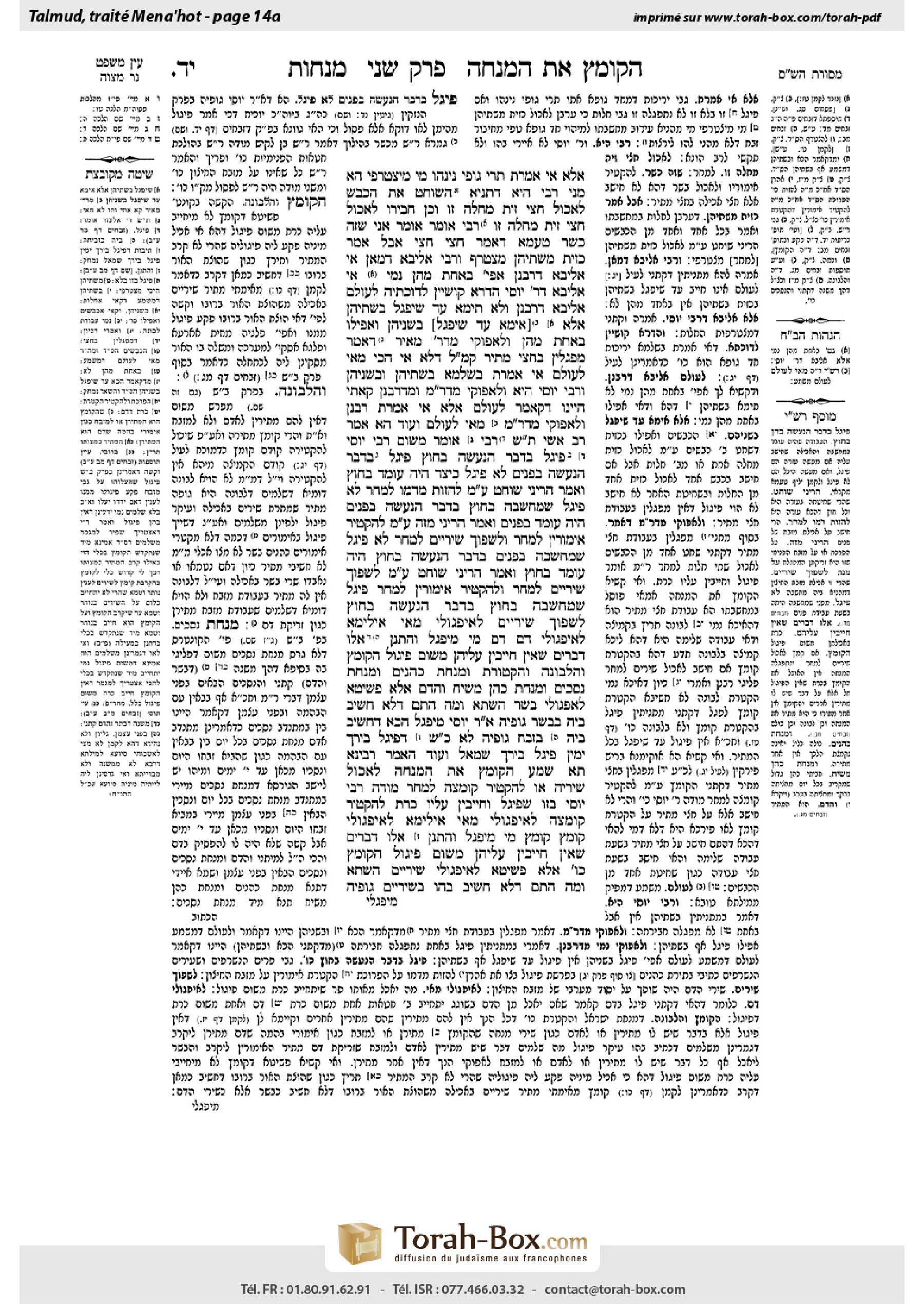
Menachot 14a: Talmud study for Daf Yomi
Daf Yomi is the daily study of one Talmud folio. Explore 37 tractates with scans, Hebrew text, Sefaria English and AI-generated French translations where annotated.
Passage selection and English or AI-generated French translation are available where the scan has annotations. Daf Study is independent of Torah-Box and Sefaria.
Browse Menachot · מנחות · All tractatesMenachot 14a text and translations
This page of Menachot includes the Aramaic text, an English translation and an AI-generated French translation, alongside the scan above.
מנחות י״ד א · Aramaic and Hebrew text
אֶלָּא אִי אָמְרַתְּ תְּרֵי גּוּפֵי נִינְהוּ – מִי מִיצְטָרְפִי?
הָא מַנִּי? רַבִּי הִיא, דְּתַנְיָא: הַשּׁוֹחֵט אֶת הַכֶּבֶשׂ לֶאֱכוֹל חֲצִי זַיִת מֵחַלָּה זוֹ, וְכֵן חֲבֵירוֹ לֶאֱכוֹל חֲצִי זַיִת מֵחַלָּה זוֹ, רַבִּי אוֹמֵר: אוֹמֵר אֲנִי שֶׁזֶּה כָּשֵׁר.
טַעְמָא דְּאָמַר ״חֲצִי חֲצִי״, אֲבָל אָמַר ״כְּזַיִת מִשְּׁתֵּיהֶן״ – מִצְטָרֵף.
וְרַבִּי, אַלִּיבָּא דְּמַאן? אִי אַלִּיבָּא דְּרַבָּנַן – אֲפִילּוּ בְּאַחַת מֵהֶן נָמֵי! אִי אַלִּיבָּא דְּרַבִּי יוֹסֵי – הָדַר קוּשְׁיַין לְדוּכְתֵּיהּ.
לְעוֹלָם אַלִּיבָּא דְּרַבָּנַן, וְלָא תֵּימָא ״עַד שֶׁיְּפַגֵּל בִּשְׁתֵּיהֶן״, אֶלָּא [אֵימָא] ״עַד שֶׁיְּפַגֵּל בִּשְׁנֵיהֶן״, וַאֲפִילּוּ בְּאַחַת מֵהֶן.
וּלְאַפּוֹקֵי מִדְּרַבִּי מֵאִיר, דְּאָמַר: מְפַגְּלִין בַּחֲצִי מַתִּיר, קָא מַשְׁמַע לַן דְּלָא.
אִי הָכִי, מַאי ״לְעוֹלָם״? אִי אָמְרַתְּ בִּשְׁלָמָא בִּשְׁתֵּיהֶן וּבִשְׁנֵיהֶן, וְרַבִּי יוֹסֵי הִיא, וּלְאַפּוֹקֵי מִדְּרַבִּי מֵאִיר וּמִדְּרַבָּנַן קָאָתֵי – הַיְינוּ דְּקָאָמַר ״לְעוֹלָם״.
אֶלָּא אִי אָמְרַתְּ רַבָּנַן, וּלְאַפּוֹקֵי מִדְּרַבִּי מֵאִיר, מַאי ״לְעוֹלָם״?
וְעוֹד, הָא אָמַר רַב אָשֵׁי: תָּא שְׁמַע, רַבִּי אוֹמֵר מִשּׁוּם רַבִּי יוֹסֵי: פִּיגֵּל בְּדָבָר הַנַּעֲשֶׂה בַּחוּץ – פִּיגֵּל, בְּדָבָר הַנַּעֲשֶׂה בִּפְנִים – לֹא פִּיגֵּל.
כֵּיצַד? הָיָה עוֹמֵד בַּחוּץ וְאָמַר: ״הֲרֵינִי שׁוֹחֵט עַל מְנָת לְהַזּוֹת מִדָּמוֹ לְמָחָר״ – לֹא פִּיגֵּל, שֶׁמַּחְשָׁבָה בַּחוּץ בְּדָבָר הַנַּעֲשֶׂה בְּפָנִים. הָיָה עוֹמֵד בִּפְנִים וְאָמַר: ״הֲרֵינִי מַזֶּה עַל מְנָת לְהַקְטִיר אֵימוּרִין לְמָחָר וְלִשְׁפּוֹךְ שִׁירַיִים לְמָחָר״ – לֹא פִּיגֵּל, שֶׁמַּחְשָׁבָה בִּפְנִים בְּדָבָר הַנַּעֲשֶׂה בַּחוּץ.
הָיָה עוֹמֵד בַּחוּץ, וְאָמַר: ״הֲרֵינִי שׁוֹחֵט עַל מְנָת לִשְׁפּוֹךְ שִׁירַיִים לְמָחָר וּלְהַקְטִיר אֵימוּרִין לְמָחָר״ – פִּיגֵּל, שֶׁמַּחְשָׁבָה בַּחוּץ בְּדָבָר הַנַּעֲשֶׂה בַּחוּץ.
לִשְׁפּוֹךְ שִׁירַיִים, לְאִיפַּגּוֹלֵי מַאי? אִילֵימָא לְאִיפַּגּוֹלֵי דָּם – דָּם מִי מִיפַּגַּל? וְהָתְנַן: אֵלּוּ דְּבָרִים שֶׁאֵין חַיָּיבִין עֲלֵיהֶן מִשּׁוּם פִּיגּוּל: הַקּוֹמֶץ, וְהַלְּבוֹנָה, וְהַקְּטוֹרֶת, וּמִנְחַת כֹּהֲנִים, וּמִנְחַת נְסָכִים, וּמִנְחַת כֹּהֵן מָשִׁיחַ, וְהַדָּם!
אֶלָּא פְּשִׁיטָא לְאִפַּגּוֹלֵי בָּשָׂר, הַשְׁתָּא וּמָה הָתָם דְּלָא חַשֵּׁיב בֵּיהּ בְּבָשָׂר גּוּפֵיהּ, אָמַר רַבִּי יוֹסֵי מִיפַּגַּל, הָכָא דְּחַשֵּׁיב בֵּיהּ בְּזֶבַח גּוּפֵיהּ, לֹא כׇּל שֶׁכֵּן דְּפִיגֵּל בְּיֶרֶךְ יָמִין פִּיגֵּל בְּיֶרֶךְ שְׂמֹאל?
וְעוֹד, הָאָמַר רָבִינָא: תָּא שְׁמַע, הַקּוֹמֵץ אֶת הַמִּנְחָה לֶאֱכוֹל שְׁיָרֶיהָ אוֹ לְהַקְטִיר קוּמְצָהּ לְמָחָר, מוֹדֶה רַבִּי יוֹסֵי בָּזוֹ שֶׁפִּיגֵּל וְחַיָּיבִין עָלָיו כָּרֵת.
לְהַקְטִיר קוּמְצָהּ, לְאִיפַּגּוֹלֵי מַאי? אִילֵימָא לְאִיפַּגּוֹלֵי קוֹמֶץ, קוֹמֶץ מִי מִיפַּגַּל? וְהָתְנַן: אֵלּוּ דְּבָרִים שֶׁאֵין חַיָּיבִין עֲלֵיהֶן מִשּׁוּם פִּיגּוּל: הַקּוֹמֶץ כּוּ׳! אֶלָּא פְּשִׁיטָא לְאִיפַּגּוֹלֵי שִׁירַיִים. הַשְׁתָּא וּמָה הָתָם, דְּלָא חַשֵּׁיב בְּהוּ בְּשִׁירַיִים גּוּפֵיהּ,
Menachot 14a · English translation
But if you say that Rabbi Yosei holds that the right and left thighs of an offering are considered two distinct bodies, and therefore piggul intent with regard to one does not render the other piggul, then in the case of the two loaves, would the intentions concerning both loaves combine to render them both piggul?
Rav Huna responds: One cannot infer anything from this baraita with regard to the opinion of Rabbi Yosei, as in accordance with whose opinion is this baraita? It is in accordance with the opinion of Rabbi Yehuda HaNasi, as it is taught in another baraita: With regard to one who slaughters one of the lambs brought as peace offerings on Shavuot with the intent to consume half an olive-bulk from this loaf the next day, and similarly, he slaughtered the other lamb with the intent to consume half an olive-bulk from that second loaf the next day, Rabbi Yehuda HaNasi says: I say that this offering is valid, as his intentions do not combine.
Rav Huna continues: It may be inferred that the reason why the priest’s intentions do not combine is that his intent was said with regard to a half and a half, i.e., he slaughtered each lamb with the intent to consume half an olive-bulk from one loaf the next day. But if he said during the slaughter of each of the lambs that he is slaughtering it with the intent to consume an olive-bulk from both of them, then the halves combine to render the offering piggul.
The Gemara asks: And as for Rabbi Yehuda HaNasi, who says that the two loaves are piggul only if he has intent with regard to an amount equal to an olive-bulk from both of them combined, in accordance with whose opinion is his statement? If it is in accordance with the opinion of the Rabbis of the mishna, who hold that piggul intent with regard to one loaf renders both loaves piggul, then even if his intent was with regard to only one of them, both loaves should be piggul. And if it is in accordance with the opinion of Rabbi Yosei, who holds that piggul intent with regard to one loaf does not render the second loaf piggul, then our difficulty returns to its place: If Rabbi Yosei holds that the right and left thighs are considered two distinct bodies, how can intentions with regard to two halves of an olive-bulk combine to render both loaves piggul?
The Gemara responds: Actually, Rabbi Yehuda HaNasi’s statement is in accordance with the opinion of the Rabbis. And do not say that the baraita states: It is not piggul unless one has the intent of piggul with regard to both of them [bishteihen], in the feminine form, whereby the baraita would be referring to the loaves. Rather, the baraita states: With regard to both of them [bishneihen], in the masculine form, i.e., unless he slaughters both lambs with piggul intent, and in such a case, even if his intent was with regard to only one of the loaves, the offering is piggul.
The Gemara adds: And this baraita serves to exclude the opinion of Rabbi Meir, who says in the mishna on 16a: One renders an offering piggul by means of intent during the sacrifice of half a permitting factor, e.g., if one slaughtered one of the lambs with the intent to consume the two loaves the next day, the loaves are piggul. This baraita teaches us that this is not the halakha.
The Gemara asks: If so, then what is the meaning of the emphasis in the baraita: There is never liability? Granted, this phrase is understandable if you say that the baraita means that the loaves are not piggul unless he has intent with regard to both of the loaves and both of the lambs, i.e., they are piggul only if he slaughters both lambs with the intention to partake of both loaves the next day. In that case the baraita is in accordance with the opinion of Rabbi Yosei, and it comes to exclude the statements of both Rabbi Meir and the Rabbis, and this is the reason that the baraita states: There is never liability, to emphasize that Rabbi Yosei disagrees with both of these opinions.
But if you say that the baraita is in accordance with the opinion of the Rabbis and that it serves to exclude only the opinion of Rabbi Meir, for what reason does the baraita stress: There is never liability? The tanna would not use such a word to exclude merely one opinion. Rather, it must be that the baraita is in accordance with the opinion of Rabbi Yosei. If so, then the difficulty raised against Rav Huna, who says that piggul intent concerning the right thigh does not render the left one piggul, remains unresolved.
And furthermore, didn’t Rav Ashi say: Come and hear a refutation of the opinion of Rav Huna from a baraita: Rabbi Yehuda HaNasi says in the name of Rabbi Yosei that if, while performing the sacrificial rites for the bulls or goats which are burned as an offering, the priest had an intention that can render the offering piggul with regard to a matter that is performed outside the Sanctuary, i.e., in the Temple courtyard, he has rendered the offering piggul. If his intention was with regard to a matter that is performed inside the Sanctuary or the Holy of Holies, he has not rendered the offering piggul.
The baraita elaborates: How so? If he was standing outside when slaughtering the animal and said: I hereby slaughter the animal with the intention of sprinkling its blood tomorrow inside the Sanctuary, he has not rendered the offering piggul. The reason is that when one has an intention outside with regard to a matter that is performed inside, he has not rendered the offering piggul. Likewise, if he was standing inside when sprinkling, and said: I hereby sprinkle the blood of the sin offering in order to burn its sacrificial portions on the external altar tomorrow and to pour out its remainder on the base of the altar tomorrow, he has not rendered the offering piggul, as he had an intention inside with regard to a matter that is performed outside.
But if he was standing outside and said: I hereby slaughter the animal with the intention to pour out the remainder of its blood tomorrow, or to burn its sacrificial portions tomorrow, he has rendered the offering piggul, as he had an intention outside with regard to a matter that is performed outside.
The Gemara analyzes this baraita: With regard to the case where one slaughtered the offering with the intent to pour the remaining blood the next day, what could be rendered piggul? If we say the blood could be rendered piggul, one can ask: Does blood become piggul? But didn’t we learn in a mishna (Zevaḥim 42b): These are the items for which one is not liable to receive karet due to the prohibition of piggul: The handful; the frankincense; the incense; the meal offering of priests; the meal offering accompanying the libations brought with an animal offering; the meal offering of the anointed priest; and the blood?
Rather, it is obvious that the baraita means that it is the meat of the offering that could be rendered piggul. Now consider: And if there, in the baraita, where he did not have intent with regard to the meat itself, as his intention was not to partake of the meat the next day but to pour the remaining blood the next day, and yet Rabbi Yosei said that the meat is rendered piggul; then here, where he has intent to partake of the right thigh the next day, which is part of the offering itself, is it not all the more so that if he had intent of piggul with regard to the right thigh, he has rendered the left thigh piggul as well?
And furthermore, doesn’t Ravina say: Come and hear a refutation of the statement of Rav Huna from the mishna (13a): In the case of one who removes a handful from the meal offering with the intent to partake of its remainder or to burn its handful on the next day, Rabbi Yosei concedes in this instance that he has rendered the offering piggul and he is liable to receive karet for partaking of it.
Ravina continues: When one removes the handful with the intent to burn its handful, what could be rendered piggul? If we say that the handful could be rendered piggul, does the handful become piggul? But didn’t we learn in a mishna (Zevaḥim 42b): These are the items for which one is not liable to receive karet due to the prohibition of piggul: The handful, etc. Rather, it is obvious that the remainder could be rendered piggul. Now consider: And if there, in the mishna, where he did not have intent with regard to the remainder itself, i.e., to partake of the remainder the next day,
Menachot 14a · Traduction française (IA)
Mais si tu dis que Rabbi Yosei considère que les cuisses droite et gauche d’une offrande constituent deux entités distinctes et que, par conséquent, une intention de piggul concernant l’une ne rend pas l’autre piggul, alors, dans le cas des deux pains, les intentions concernant chacun des deux pains se combineraient-elles pour les rendre tous deux piggul ?
Rav Houna répond : On ne peut rien déduire de cette baraïta quant à l’opinion de Rabbi Yosei, car de l’opinion de qui cette baraïta relève-t-elle ? Elle relève de celle de Rabbi Yehouda HaNassi, comme l’enseigne une autre baraïta : Celui qui égorge l’un des agneaux offerts en sacrifice de paix à Chavouot avec l’intention de consommer, le lendemain, un demi-volume d’olive de ce pain, puis égorge de même l’autre agneau avec l’intention de consommer, le lendemain, un demi-volume d’olive de ce second pain, Rabbi Yehouda HaNassi dit : « Je considère que cette offrande est valide, car ses intentions ne se combinent pas. »
Rav Houna poursuit : On peut en déduire que si les intentions du prêtre ne se combinent pas, c’est parce que son intention portait sur un demi-volume et un demi-volume, c’est-à-dire qu’il a égorgé chaque agneau avec l’intention de consommer, le lendemain, un demi-volume d’olive de l’un des pains. Mais s’il a dit, lors de l’égorgement de chacun des agneaux, qu’il l’égorgeait avec l’intention de consommer, le lendemain, un volume d’olive des deux pains, alors les deux moitiés se combinent pour rendre l’offrande piggul.
La Guemara demande : Et quant à Rabbi Yehouda HaNassi, qui dit que les deux pains ne sont piggul que s’il a eu l’intention de consommer une quantité équivalant à un volume d’olive des deux réunis, de l’opinion de qui relève son propos ? S’il relève de l’opinion des Sages de la Michna, qui considèrent qu’une intention de piggul concernant un pain rend les deux pains piggul, alors les deux pains devraient être piggul même si son intention ne concernait qu’un seul d’entre eux. Et s’il relève de l’opinion de Rabbi Yosei, qui considère qu’une intention de piggul concernant un pain ne rend pas le second pain piggul, alors notre difficulté se pose de nouveau : si Rabbi Yosei considère que les cuisses droite et gauche constituent deux entités distinctes, comment des intentions portant sur deux demi-volumes d’olive peuvent-elles se combiner pour rendre les deux pains piggul ?
La Guemara répond : En réalité, le propos de Rabbi Yehouda HaNassi relève de l’opinion des Sages. Et ne dis pas que la baraïta dit : « Ce n’est piggul que s’il a eu une intention de piggul concernant les deux [bishteihen] », au féminin, auquel cas la baraïta parlerait des pains. La baraïta dit plutôt : « concernant les deux [bishneihen] », au masculin, c’est-à-dire qu’il faut qu’il égorge les deux agneaux avec une intention de piggul ; dans ce cas, même si son intention ne concernait qu’un seul des pains, l’offrande est piggul.
La Guemara ajoute : Cette baraïta vient écarter l’opinion de Rabbi Meïr, qui dit dans la Michna, en 16a : On rend une offrande piggul par une intention portant sur la moitié d’un facteur qui permet la consommation. Par exemple, si l’on a égorgé l’un des agneaux avec l’intention de consommer les deux pains le lendemain, les pains sont piggul. Cette baraïta nous apprend que telle n’est pas la halakha.
La Guemara demande : Si tel est le cas, que signifie l’insistance de la baraïta : « Il n’y a jamais de responsabilité » ? Cette formule se comprend si l’on dit que la baraïta signifie que les pains ne sont piggul que s’il a eu une intention concernant les deux pains et les deux agneaux, c’est-à-dire qu’ils ne sont piggul que s’il égorge les deux agneaux avec l’intention de consommer les deux pains le lendemain. Dans ce cas, la baraïta relève de l’opinion de Rabbi Yosei et vient écarter les propos de Rabbi Meïr comme ceux des Sages ; c’est pourquoi elle dit : « Il n’y a jamais de responsabilité », pour souligner que Rabbi Yosei est en désaccord avec ces deux opinions.
Mais si tu dis que la baraïta relève de l’opinion des Sages et qu’elle vient écarter uniquement celle de Rabbi Meïr, pourquoi insiste-t-elle en disant : « Il n’y a jamais de responsabilité » ? Le tanna n’emploierait pas une telle expression pour écarter une seule opinion. Il faut plutôt en conclure que la baraïta relève de l’opinion de Rabbi Yosei. Dans ce cas, la difficulté soulevée contre Rav Houna, qui dit qu’une intention de piggul concernant la cuisse droite ne rend pas la cuisse gauche piggul, demeure sans réponse.
Et de plus, Rav Ashi n’a-t-il pas dit : Viens et écoute une réfutation de l’opinion de Rav Houna à partir d’une baraïta : Rabbi Yehouda HaNassi dit au nom de Rabbi Yosei que si, pendant l’accomplissement des rites sacrificiels des taureaux ou des boucs offerts en holocauste, le prêtre a eu une intention susceptible de rendre l’offrande piggul concernant un acte accompli à l’extérieur du Sanctuaire, c’est-à-dire dans la cour du Temple, il a rendu l’offrande piggul. Si son intention concernait un acte accompli à l’intérieur du Sanctuaire ou du Saint des Saints, il n’a pas rendu l’offrande piggul.
La baraïta précise : Comment cela ? S’il se tenait à l’extérieur lorsqu’il a égorgé l’animal et a dit : « J’égorge cet animal avec l’intention d’asperger son sang demain à l’intérieur du Sanctuaire », il n’a pas rendu l’offrande piggul. En effet, lorsqu’on a une intention à l’extérieur concernant un acte accompli à l’intérieur, on ne rend pas l’offrande piggul. De même, s’il se tenait à l’intérieur au moment de l’aspersion et a dit : « J’asperge le sang du sacrifice expiatoire afin d’en brûler les portions sacrificielles demain sur l’autel extérieur et d’en verser le reste demain au pied de l’autel », il n’a pas rendu l’offrande piggul, car son intention, formulée à l’intérieur, concernait un acte accompli à l’extérieur.
Mais s’il se tenait à l’extérieur et a dit : « J’égorge cet animal avec l’intention d’en verser le reste du sang demain », ou « d’en brûler les portions sacrificielles demain », il a rendu l’offrande piggul, car son intention, formulée à l’extérieur, concernait un acte accompli à l’extérieur.
La Guemara analyse cette baraïta : Dans le cas où quelqu’un a égorgé l’offrande avec l’intention d’en verser le reste du sang le lendemain, qu’est-ce qui pourrait être rendu piggul ? Si l’on dit que le sang pourrait être rendu piggul, on peut demander : Le sang peut-il devenir piggul ? N’avons-nous pas appris dans une Michna (Zéva’him 42b) : Voici les éléments pour lesquels on n’encourt pas la peine de retranchement en raison de l’interdit de piggul : la poignée, l’encens, l’encens composé, l’offrande végétale des prêtres, l’offrande végétale accompagnant les libations offertes avec un sacrifice animal, l’offrande végétale du prêtre oint et le sang ?
Il est donc évident que la baraïta veut dire que c’est la viande de l’offrande qui pourrait être rendue piggul. Or, considère ceci : dans ce cas de la baraïta, il n’avait pas eu d’intention concernant la viande elle-même, puisque son intention n’était pas de consommer la viande le lendemain, mais de verser le reste du sang le lendemain ; pourtant, Rabbi Yosei a dit que la viande devient piggul. Alors ici, où il a l’intention de consommer la cuisse droite le lendemain, qui fait partie de l’offrande elle-même, n’est-il pas d’autant plus évident que s’il a eu une intention de piggul concernant la cuisse droite, il a également rendu la cuisse gauche piggul ?
Et de plus, Ravina ne dit-il pas : Viens et écoute une réfutation de l’affirmation de Rav Houna à partir de la Michna (13a) : Dans le cas de celui qui prélève une poignée de l’offrande végétale avec l’intention de consommer le reste ou de brûler la poignée le lendemain, Rabbi Yosei reconnaît dans ce cas qu’il a rendu l’offrande piggul et qu’il encourt la peine de retranchement s’il en consomme.
Ravina poursuit : Lorsqu’on prélève la poignée avec l’intention de brûler cette poignée, qu’est-ce qui pourrait être rendu piggul ? Si l’on dit que la poignée pourrait être rendue piggul, la poignée devient-elle piggul ? N’avons-nous pas appris dans une Michna (Zéva’him 42b) : Voici les éléments pour lesquels on n’encourt pas la peine de retranchement en raison de l’interdit de piggul : la poignée, etc. Il est donc évident que c’est le reste qui pourrait être rendu piggul. Or, considère ceci : dans ce cas de la Michna, il n’avait pas eu d’intention concernant le reste lui-même, c’est-à-dire de consommer le reste le lendemain,
Traduction française générée par IA à partir de l’édition anglaise de Sefaria. Vérifie toujours un passage avec le texte source.
Text from Sefaria: William Davidson Edition - Vocalized Aramaic (unknown); William Davidson Edition - English (CC BY NC).