Menachot 13b: Talmud study for Daf Yomi
Daf Yomi is the daily study of one Talmud folio. Explore 37 tractates with scans, Hebrew text, Sefaria English and AI-generated French translations where annotated.
Passage selection and English or AI-generated French translation are available where the scan has annotations. Daf Study is independent of Torah-Box and Sefaria.
Browse Menachot · מנחות · All tractatesMenachot 13b text and translations
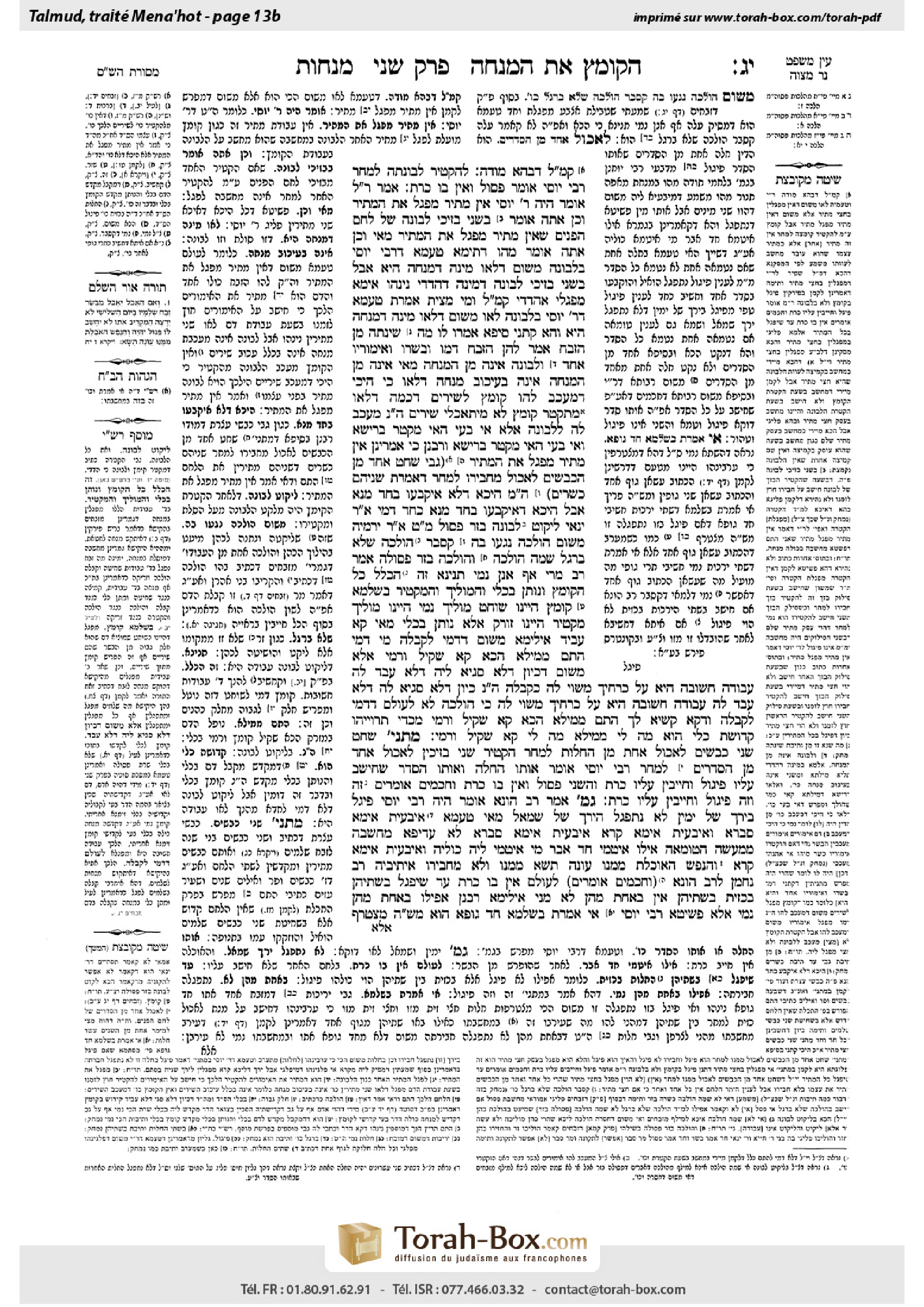
This page of Menachot includes the Aramaic text, an English translation and an AI-generated French translation, alongside the scan above.
מנחות י״ג ב · Aramaic and Hebrew text
קָא מַשְׁמַע לַן דִּבְהָא מוֹדֵי.
לְהַקְטִיר לְבוֹנָתָהּ לְמָחָר, רַבִּי יוֹסֵי אוֹמֵר: פָּסוּל וְאֵין בּוֹ כָּרֵת. אָמַר רֵישׁ לָקִישׁ: אוֹמֵר הָיָה רַבִּי יוֹסֵי, אֵין מַתִּיר מְפַגֵּל אֶת הַמַּתִּיר.
וְכֵן אַתָּה אוֹמֵר בִּשְׁנֵי בְּזִיכֵי לְבוֹנָה שֶׁל לֶחֶם הַפָּנִים, שֶׁאֵין מַתִּיר מְפַגֵּל אֶת הַמַּתִּיר.
מַאי ״וְכֵן אַתָּה אוֹמֵר״? מַהוּ דְּתֵימָא טַעְמָא דְּרַבִּי יוֹסֵי בִּלְבוֹנָה – מִשּׁוּם דְּלָאו מִינַהּ דְּמִנְחָה הִיא, אֲבָל בִּשְׁנֵי בְּזִיכֵי לְבוֹנָה, דְּמִינַהּ דַּהֲדָדֵי נִינְהוּ – אֵימָא מְפַגְּלִי אַהֲדָדֵי, קָא מַשְׁמַע לַן.
וּמִי מָצֵית אָמְרַתְּ טַעְמָא דְּרַבִּי יוֹסֵי בִּלְבוֹנָה לָאו מִשּׁוּם דְּלָאו מִינַהּ דְּמִנְחָה הִיא? וְהָא קָתָנֵי סֵיפָא: אָמְרוּ לוֹ: מָה שִׁינְּתָה מִן הַזֶּבַח? אָמַר לָהֶן: הַזֶּבַח דָּמוֹ וּבְשָׂרוֹ וְאֵימוּרָיו אֶחָד, וּלְבוֹנָה אֵינָהּ מִן הַמִּנְחָה.
מַאי ״אֵינָהּ מִן הַמִּנְחָה״? אֵינָהּ בְּעִיכּוּב מִנְחָה, דְּלָאו כִּי הֵיכִי דִּמְעַכֵּב לְהוּ קוֹמֶץ לְשִׁירַיִם, דְּכַמָּה דְּלָאו מִתְקַטַּר קוֹמֶץ לָא מִיתְאַכְלִי שִׁירַיִם, הָכִי נָמֵי מְעַכֵּב לַהּ לִלְבוֹנָה, אֶלָּא אִי בָּעֵי הַאי מַקְטַר בְּרֵישָׁא וְאִי בָּעֵי הַאי מַקְטַר בְּרֵישָׁא.
וְרַבָּנַן, כִּי אָמְרִינַן ״אֵין מַתִּיר מְפַגֵּל אֶת הַמַּתִּיר״ (גַּבֵּי שָׁחַט אֶחָד מִן הַכְּבָשִׂים לֶאֱכוֹל מֵחֲבֵירוֹ לְמָחָר, דְּאָמְרַתְּ שְׁנֵיהֶם כְּשֵׁרִים), הָנֵי מִילֵּי הֵיכָא דְּלָא אִיקְּבַעוּ בְּחַד מָנָא, אֲבָל הֵיכָא דְּאִיקְּבַעוּ בְּחַד מָנָא – כְּחַד דָּמֵי.
אָמַר רַבִּי יַנַּאי: לִיקּוּט לְבוֹנָה בְּזָר – פָּסוּל. מַאי טַעְמָא? אָמַר רַבִּי יִרְמְיָה: מִשּׁוּם הוֹלָכָה נָגְעוּ בָּהּ, קָסָבַר הוֹלָכָה שֶׁלֹּא בָּרֶגֶל שְׁמָהּ הוֹלָכָה, וְהוֹלָכָה בְּזָר – פְּסוּלָה.
אָמַר רַב מָרִי: אַף אֲנַן נָמֵי תְּנֵינָא, זֶה הַכְּלָל: כׇּל הַקּוֹמֵץ, וְנוֹתֵן בִּכְלִי, וְהַמּוֹלִיךְ, וְהַמַּקְטִיר.
בִּשְׁלָמָא קוֹמֵץ הַיְינוּ שׁוֹחֵט, מוֹלִיךְ נָמֵי הַיְינוּ מוֹלִיךְ, מַקְטִיר הַיְינוּ זוֹרֵק, אֶלָּא נוֹתֵן בִּכְלִי מַאי קָא עָבֵיד?
אִילֵּימָא מִשּׁוּם דְּדָמֵי לְקַבָּלָה, מִי דָּמֵי? הָתָם מִמֵּילָא, הָכָא קָא שָׁקֵיל וְרָמֵי.
אֶלָּא מִשּׁוּם דְּכֵיוָן דְּלָא סַגִּיא לֵיהּ דְּלָא עָבֵד לַהּ, עֲבוֹדָה חֲשׁוּבָה הִיא, עַל כֻּרְחָיךְ מְשַׁוֵּי לַהּ כְּקַבָּלָה. הָכָא נָמֵי, כֵּיוָן דְּלָא סַגִּיא לֵהּ דְּלָא עָבֵד לַהּ, עֲבוֹדָה חֲשׁוּבָה הִיא, עַל כֻּרְחָיךְ מְשַׁוֵּי לַהּ כִּי הוֹלָכָה.
לָא, לְעוֹלָם דְּדָמֵי לְקַבָּלָה, וּדְקָא קַשְׁיָא לָךְ: הָתָם מִמֵּילָא, הָכָא קָא שָׁקֵיל וְרָמֵי –
מִכְּדֵי תַּרְוַיְיהוּ קְדוּשַּׁת כְּלִי הוּא, מָה לִי מִמֵּילָא, מָה לִי קָא שָׁקֵיל וְרָמֵי.
מַתְנִי׳ שָׁחַט שְׁנֵי כְּבָשִׂים לֶאֱכוֹל אַחַת מִן הַחַלּוֹת לְמָחָר, הִקְטִיר שְׁנֵי בָּזִיכִין לֶאֱכוֹל אֶחָד מִן הַסְּדָרִים לְמָחָר, רַבִּי יוֹסֵי אוֹמֵר: אוֹתָהּ הַחַלָּה וְאוֹתוֹ הַסֵּדֶר שֶׁחִישֵּׁב עָלָיו – פִּיגּוּל וְחַיָּיבִין עָלָיו כָּרֵת, וְהַשֵּׁנִי פָּסוּל וְאֵין בּוֹ כָּרֵת. וַחֲכָמִים אוֹמְרִים: זֶה וָזֶה פִּיגּוּל וְחַיָּיבִין עָלָיו כָּרֵת.
גְּמָ׳ אָמַר רַב הוּנָא: אוֹמֵר הָיָה רַבִּי יוֹסֵי, פִּיגֵּל בַּיָּרֵךְ שֶׁל יָמִין – לֹא נִתְפַּגֵּל הַיָּרֵךְ שֶׁל שְׂמֹאל. מַאי טַעְמָא? אִיבָּעֵית אֵימָא סְבָרָא, וְאִיבָּעֵית אֵימָא קְרָא.
אִיבָּעֵית אֵימָא סְבָרָא: לָא עֲדִיפָא מַחְשָׁבָה מִמַּעֲשֵׂה הַטּוּמְאָה, אִילּוּ אִיטַּמִּי חַד אֵבֶר מִי אִיטַּמִּי לֵיהּ כּוּלֵּיהּ? וְאִיבָּעֵית אֵימָא קְרָא: ״וְהַנֶּפֶשׁ הָאֹכֶלֶת מִמֶּנּוּ עֲוֹנָהּ תִּשָּׂא״ – מִמֶּנּוּ וְלֹא מֵחֲבֵירוֹ.
אֵיתִיבֵיהּ רַב נַחְמָן לְרַב הוּנָא: וַחֲכָמִים אוֹמְרִים, לְעוֹלָם אֵין בּוֹ כָּרֵת עַד שֶׁיְּפַגֵּל בִּשְׁתֵּיהֶן בִּכְזַיִת. בִּשְׁתֵּיהֶן – אִין, בְּאַחַת מֵהֶן – לָא.
מַנִּי? אִילֵּימָא רַבָּנַן – אֲפִילּוּ בְּאַחַת מֵהֶן נָמֵי! אֶלָּא פְּשִׁיטָא רַבִּי יוֹסֵי. אִי אָמְרַתְּ בִּשְׁלָמָא חַד גּוּפָא הוּא – מִשּׁוּם הָכִי מִצְטָרֵף,
Menachot 13b · English translation
Therefore, the tanna teaches us that in this case Rabbi Yosei concedes that if the handful is removed with the intent to burn only the handful on the next day, the offering is rendered piggul. Accordingly, Rabbi Yosei holds that one renders an offering piggul with intent that concerns only half of its permitting factors, and the offering is not rendered piggul in the case of the latter clause for a different reason, as the Gemara will discuss later.
§ The mishna teaches that if one removed the handful from a meal offering with the intent to burn its frankincense on the next day, Rabbi Yosei says that the meal offering is unfit but partaking of it does not include liability to receive karet. Concerning this, Reish Lakish says: Rabbi Yosei would say, i.e., this is Rabbi Yosei’s reasoning: A permitting factor does not render another permitting factor piggul. In other words, if, while performing the rites of a permitting factor, one had intent to perform the rites of a different permitting factor outside its designated time, the offering is not rendered piggul on account of this intent.
Reish Lakish adds: And you would say the same with regard to the two bowls of frankincense of the shewbread, that a permitting factor does not render another permitting factor piggul, and therefore if the priest burned one of the bowls with the intent to burn the other bowl the next day, the shewbread is not rendered piggul.
The Gemara asks: What is the purpose of the apparently superfluous statement: And you would say the same with regard to the two bowls of frankincense? Is there reason to assume that Rabbi Yosei would hold that the shewbread is rendered piggul in such a case? The Gemara responds that it is necessary, lest you say that the reason that Rabbi Yosei holds that there is no piggul in the case of the frankincense is because it is not of the same type as a meal offering. But with regard to the two bowls of frankincense, which are of the same type as each other, one might say that they do render one another piggul. Therefore, Reish Lakish teaches us that in both instances one permitting factor does not render another permitting factor piggul.
The Gemara asks: And can you say that the reason for the opinion of Rabbi Yosei in the case of the frankincense in the mishna is not due to the fact that the frankincense is not of the same type as a meal offering? But isn’t it taught in the latter clause of the mishna that the Rabbis said to Rabbi Yosei: In what manner does the frankincense differ from an animal offering, where if one slaughtered it with the intent to sacrifice the portions consumed on the altar the next day it is piggul; and Rabbi Yosei said to the Rabbis: There is a difference, as in the case of an animal offering, its blood, and its flesh, and its portions consumed on the altar are all one entity, but the frankincense is not part of the meal offering? The mishna indicates that according to Rabbi Yosei the reason the meal offering is not piggul is because the frankincense is not of the same type as the meal offering.
The Gemara explains: What does Rabbi Yosei mean when he says that the frankincense is not part of the meal offering? He means that it is not part of the preclusion of the meal offering. The Gemara elaborates: This means that the halakha is not that just as the handful precludes the remainder, i.e., that as long as the handful is not burned the remainder may not be consumed, so too the handful precludes the frankincense from being burned upon the altar. Rather, if the priest wants, he burns this first, and if he wants, he burns that first, i.e., he may burn the frankincense before or after the burning of the handful. Accordingly, the frankincense is an independent permitting factor. For this reason, intent with regard to the frankincense that occurred during the removal of the handful does not render a meal offering piggul.
The Gemara asks: And the Rabbis, who say that the meal offering is rendered piggul in such a case, what is their opinion? The Gemara responds: They hold that when we say that a permitting factor does not render another permitting factor piggul, this is with regard to the case taught in a mishna (16a) concerning one who slaughtered one of the lambs whose sacrifice permits the consumption of the two loaves meal offering brought on Shavuot, with the intent to partake of the other lamb the next day. The Gemara elaborates: When you said in the mishna that both permitting factors are fit, this statement applies only where they were not fixed in one vessel. But in a situation where they were fixed in one vessel, as is the case with regard to the handful and the frankincense, they are considered like one unit, and therefore they render one another piggul.
§ With regard to the frankincense, Rabbi Yannai says: The collection of the frankincense from a meal offering, when performed by a non-priest, is not valid and disqualifies the meal offering. The Gemara asks: What is the reason? Rabbi Yirmeya said: It is because the rite of conveying has touched it, i.e., the collection of the frankincense is considered part of the rite of the conveying of the frankincense to the altar for the purpose of burning. Even if the non-priest simply collected the frankincense and thereafter transferred it to a priest, Rabbi Yannai holds that conveying even without moving one’s leg is called conveying, and the halakha is that the performance of the rite of conveying by a non-priest is not valid.
Rav Mari said: We learn this halakha in the mishna on 12a, which discusses those sacrificial rites of a meal offering during which improper intent renders an offering piggul, as well. The mishna teaches: This is the principle: In the case of anyone who removes the handful, or places the handful in the vessel, or who conveys the vessel with the handful to the altar, or who burns the handful on the altar, with the intent to partake of an item whose typical manner is such that one partakes of it, or to burn an item whose typical manner is such that one burns it on the altar, outside its designated area, the meal offering is unfit but there is no liability for karet. If his intent was to perform any of these actions beyond their designated time, the offering is piggul and one is liable to receive karet on account of it, provided that the permitting factor, i.e., the handful, was sacrificed in accordance with its mitzva.
Rav Mari analyzes the first part of this mishna: Granted, the removal of the handful from a meal offering is the same as, i.e., equivalent to, the slaughter of animal offerings. The conveying of the handful to the altar in order to burn it is also the same as the conveying of the blood of a slaughtered offering to the altar in order to sprinkle it. Similarly, the burning of the handful and frankincense of a meal offering is comparable to the sprinkling of the blood of a slaughtered offering upon the altar. But as for placing the handful in the service vessel, what rite is he performing that is comparable to a rite of slaughtered offerings?
If we say that the meal offering is piggul because the placing of the handful into a vessel is comparable to the collection of the blood of a slaughtered offering into a service vessel, one can ask: Are these rites in fact comparable? There, in the case of animal offerings, the blood enters the vessel by itself, whereas here, the priest takes the handful from the meal offering and casts it into the vessel.
Rather, it must be due to the following reason: Since it is not possible to sacrifice the handful without first performing the act of placing it in a vessel, the placement of the handful in a vessel is considered a significant rite, and perforce this factor causes it to be considered like the collection of the blood. Here too, with regard to the collection of the frankincense, since it is not possible to sacrifice the frankincense without first performing the act of collecting it from the vessel, the collection of the frankincense is a significant rite that perforce causes it to be considered like the rite of conveying.
The Gemara rejects this suggestion: No, this is not the reason, and one cannot prove from the mishna that the collection of the frankincense from a meal offering performed by a non-priest is not valid. Actually, the reason why intent during the placement of the handful renders the offering piggul is in fact because it is comparable to the collection of the blood of a slaughtered offering. And as for the difficulty you raised, that there the blood enters the vessel by itself, whereas here he takes the handful from the meal offering and casts it into the vessel, this is not a true difficulty.
The Gemara explains: Now consider, both of them, i.e., the collection of the blood and the placing of the handful, involve the sanctity of a vessel, in which a service vessel sanctifies a permitting factor to the altar, either the handful or the blood. What difference is it to me if the permitting factor enters the vessel by itself or whether one takes the item and casts it into the vessel?
MISHNA: If one slaughtered the two lambs that accompany the two meal offering loaves sacrificed on Shavuot with the intent to partake of one of the two loaves the next day, or if one burned the two bowls of frankincense accompanying the shewbread with the intent to partake of one of the arrangements of the shewbread the next day, Rabbi Yosei says: That loaf and that arrangement of which he intended to partake the next day are piggul and one is liable to receive karet for their consumption, and the second loaf and arrangement are unfit, but there is no liability to receive karet for their consumption. And the Rabbis say: This loaf and arrangement and that loaf and arrangement are both piggul and one is liable to receive karet for their consumption.
GEMARA: Rav Huna says: Rabbi Yosei would say, in accordance with his opinion that intent of piggul with regard to one loaf or one arrangement does not render the second loaf or arrangement piggul, that if one had intent of piggul with regard to the right thigh, i.e., he slaughtered an offering with the intent to partake of the right thigh the next day, then the left thigh has not become piggul and one is not liable to receive karet for its consumption. What is the reason for this? If you wish, propose a logical argument, and if you wish, cite a verse.
Rav Huna elaborates: If you wish, propose a logical argument: Disqualifying intent is no stronger than an incident of ritual impurity, and if one limb of an offering became impure, did the entire offering then become impure? Accordingly, one limb can be rendered piggul without the other. And if you wish, cite a verse that addresses piggul: “And the soul that eats of it shall bear his iniquity” (Leviticus 7:18). The verse indicates that one who eats specifically “of it,” i.e., from one part, shall bear his iniquity, and not one who eats from the other part of the offering.
Rav Naḥman raised an objection to Rav Huna from a baraita: And the Rabbis say that there is never liability to receive karet for partaking of the two loaves unless one has intent of piggul with regard to an olive-bulk of both of them, i.e., one’s intent renders both loaves piggul only if he slaughters the lambs with the intent to consume an amount equal to an olive-bulk from both loaves combined outside their proper time. One can infer from this that if he had intent with regard to both of them, yes, both loaves are piggul. But if his intent was with regard to only one of them, no, the other loaf is not piggul.
Rav Naḥman continues: In accordance with whose opinion is the baraita? If we say that it is in accordance with the opinion of the Rabbis of the mishna, then even if his intent was with regard to only one of them, both loaves are rendered piggul. Rather, it is obvious that the baraita is in accordance with the opinion of Rabbi Yosei. Now, granted, if you say that according to Rabbi Yosei the left and right thighs of an offering are considered one body, and consequently piggul intent with regard to one thigh renders the other thigh piggul as well, then due to that reason it is understandable that if the piggul intent was for an amount equal to one total olive-bulk from both of the loaves, then the intent with regard to each loaf is combined with the other.
Menachot 13b · Traduction française (IA)
Par conséquent, le tanna nous enseigne qu’en l’occurrence Rabbi Yosei admet que si la poignée est prélevée avec l’intention de ne brûler que la poignée le lendemain, l’offrande devient piggul. Rabbi Yosei considère donc qu’une offrande devient piggul à la suite d’une intention qui ne concerne que la moitié de ses facteurs de validation. Si l’offrande ne devient pas piggul dans le cas de la dernière clause, c’est pour une autre raison, comme la Guemara l’expliquera plus loin.
§ La Michna enseigne que si l’on a prélevé la poignée d’une offrande de farine avec l’intention de brûler son encens le lendemain, Rabbi Yosei dit que l’offrande de farine est impropre, mais que sa consommation n’entraîne pas la peine de karet. À ce sujet, Reish Lakish dit : Voici ce que dirait Rabbi Yosei, c’est-à-dire son raisonnement : un facteur de validation ne rend pas un autre facteur de validation piggul. Autrement dit, si, en accomplissant le rite d’un facteur de validation, on a l’intention d’accomplir le rite d’un autre facteur de validation en dehors du temps qui lui est prescrit, l’offrande ne devient pas piggul à cause de cette intention.
Reish Lakish ajoute : On dirait la même chose des deux coupes d’encens des pains de proposition : un facteur de validation ne rend pas un autre facteur de validation piggul. Par conséquent, si le prêtre a brûlé l’une des coupes avec l’intention de brûler l’autre le lendemain, les pains de proposition ne deviennent pas piggul.
La Guemara demande : À quoi sert cette affirmation apparemment superflue selon laquelle on dirait la même chose des deux coupes d’encens ? Y a-t-il une raison de supposer que Rabbi Yosei considérerait que les pains de proposition deviennent piggul dans un tel cas ? La Guemara répond que cette précision est nécessaire, car on pourrait dire que si, selon Rabbi Yosei, l’encens ne rend pas l’offrande piggul, c’est parce qu’il n’est pas de même nature qu’une offrande de farine. Mais pour les deux coupes d’encens, qui sont de même nature l’une que l’autre, on pourrait dire qu’elles se rendent mutuellement piggul. Reish Lakish nous enseigne donc que, dans les deux cas, un facteur de validation ne rend pas un autre facteur de validation piggul.
La Guemara demande : Peut-on vraiment dire que, dans le cas de l’encens mentionné dans la Michna, la position de Rabbi Yosei ne tient pas au fait que l’encens n’est pas de même nature qu’une offrande de farine ? La dernière clause de la Michna n’enseigne-t-elle pas que les Sages dirent à Rabbi Yosei : En quoi l’encens diffère-t-il d’une offrande animale, pour laquelle, si on l’a égorgée avec l’intention de sacrifier les parties consumées sur l’autel le lendemain, elle devient piggul ? Et Rabbi Yosei répondit aux Sages : Il y a une différence, car dans le cas d’une offrande animale, son sang, sa chair et ses parties consumées sur l’autel constituent une seule entité, tandis que l’encens ne fait pas partie de l’offrande de farine. La Michna indique que, selon Rabbi Yosei, si l’offrande de farine ne devient pas piggul, c’est parce que l’encens n’est pas de même nature qu’elle.
La Guemara explique : Que veut dire Rabbi Yosei lorsqu’il dit que l’encens ne fait pas partie de l’offrande de farine ? Il veut dire qu’il ne participe pas à ce qui interdit le reste de l’offrande de farine à la consommation. La Guemara précise : Cela signifie que la halakha n’est pas que, de même que la poignée rend le reste interdit — c’est-à-dire que tant que la poignée n’a pas été brûlée, le reste ne peut pas être consommé —, de même la poignée empêche que l’encens soit brûlé sur l’autel. Au contraire, si le prêtre le souhaite, il brûle d’abord l’un, et s’il le souhaite, il brûle d’abord l’autre ; autrement dit, il peut brûler l’encens avant ou après la poignée. L’encens est donc un facteur de validation indépendant. C’est pourquoi l’intention concernant l’encens, formulée lors du prélèvement de la poignée, ne rend pas l’offrande de farine piggul.
La Guemara demande : Et quelle est l’opinion des Sages, qui disent que l’offrande de farine devient piggul dans un tel cas ? La Guemara répond : Selon eux, lorsque nous disons qu’un facteur de validation ne rend pas un autre facteur de validation piggul, nous parlons du cas enseigné dans une Michna (16a) à propos de celui qui a égorgé l’un des agneaux dont le sacrifice autorise la consommation de l’offrande de farine constituée des deux pains présentés à Chavouot, avec l’intention de consommer l’autre agneau le lendemain. La Guemara précise : Lorsque la Michna dit que les deux facteurs de validation sont aptes, cela ne s’applique que s’ils n’ont pas été réunis dans un même récipient. Mais lorsqu’ils ont été réunis dans un même récipient, comme c’est le cas de la poignée et de l’encens, ils sont considérés comme une seule unité et se rendent donc mutuellement piggul.
§ Au sujet de l’encens, Rabbi Yannai dit : Le prélèvement de l’encens d’une offrande de farine par un non-prêtre est invalide et rend l’offrande de farine impropre. La Guemara demande : Pour quelle raison ? Rabbi Yirmeya dit : Parce que le rite du transport est intervenu, c’est-à-dire que le prélèvement de l’encens est considéré comme faisant partie du transport de l’encens vers l’autel en vue de le brûler. Même si le non-prêtre s’est contenté de prélever l’encens puis de le remettre à un prêtre, Rabbi Yannai considère que le transport, même sans déplacer les jambes, est appelé transport. Or, la halakha est que l’accomplissement du rite du transport par un non-prêtre est invalide.
Rav Mari dit : Nous apprenons aussi cette halakha de la Michna en 12a, qui traite des rites de l’offrande de farine au cours desquels une intention incorrecte rend une offrande piggul. La Michna enseigne : Voici le principe : quiconque prélève la poignée, place la poignée dans le récipient, transporte jusqu’à l’autel le récipient contenant la poignée ou brûle la poignée sur l’autel, avec l’intention de consommer en dehors du lieu prescrit un élément qui est normalement destiné à être consommé, ou de brûler en dehors du lieu prescrit un élément qui est normalement destiné à être brûlé sur l’autel, rend l’offrande de farine impropre, mais n’encourt pas la peine de karet. Si son intention était d’accomplir l’une de ces actions au-delà du temps prescrit, l’offrande devient piggul et l’on encourt la peine de karet à cause d’elle, à condition que le facteur de validation, c’est-à-dire la poignée, ait été offert conformément à sa mitsva.
Rav Mari analyse la première partie de cette Michna : Il est évident que le prélèvement de la poignée d’une offrande de farine équivaut à l’égorgement des offrandes animales. Le transport de la poignée jusqu’à l’autel en vue de la brûler équivaut également au transport du sang d’une offrande égorgée jusqu’à l’autel en vue de l’asperger. De même, la combustion de la poignée et de l’encens d’une offrande de farine correspond à l’aspersion sur l’autel du sang d’une offrande égorgée. Mais en plaçant la poignée dans le récipient de service, quel rite accomplit-on qui soit comparable à un rite des offrandes égorgées ?
Si nous disons que l’offrande de farine devient piggul parce que le placement de la poignée dans un récipient équivaut au recueillement du sang d’une offrande égorgée dans un récipient de service, on peut demander : ces rites sont-ils vraiment comparables ? Dans le cas des offrandes animales, le sang entre de lui-même dans le récipient, tandis qu’ici, le prêtre prend la poignée de l’offrande de farine et la jette dans le récipient.
Il faut plutôt en conclure que la raison est la suivante : puisqu’il est impossible d’offrir la poignée sans avoir d’abord procédé à sa mise dans un récipient, ce placement est considéré comme un rite important ; cela le fait nécessairement considérer comme équivalent au recueillement du sang. De même, pour le prélèvement de l’encens, puisqu’il est impossible d’offrir l’encens sans l’avoir d’abord prélevé du récipient, ce prélèvement constitue un rite important et le fait nécessairement considérer comme équivalent au rite du transport.
La Guemara rejette cette proposition : Non, telle n’est pas la raison, et l’on ne peut pas déduire de la Michna que le prélèvement de l’encens d’une offrande de farine par un non-prêtre est invalide. En réalité, si l’intention formulée au moment du placement de la poignée rend l’offrande piggul, c’est bien parce que ce rite équivaut au recueillement du sang d’une offrande égorgée. Quant à la difficulté soulevée — là, le sang entre de lui-même dans le récipient, tandis qu’ici, le prêtre prend la poignée de l’offrande de farine et la jette dans le récipient —, ce n’est pas une véritable difficulté.
La Guemara explique : Considère ces deux rites : le recueillement du sang et le placement de la poignée impliquent tous deux la sainteté d’un récipient, par lequel un récipient de service sanctifie un facteur de validation destiné à l’autel, qu’il s’agisse de la poignée ou du sang. Quelle différence cela fait-il que le facteur de validation entre de lui-même dans le récipient ou que quelqu’un le prenne et le jette dans le récipient ?
MICHNA : Si l’on a égorgé les deux agneaux qui accompagnent les deux pains de l’offrande de farine présentée à Chavouot avec l’intention de consommer l’un des deux pains le lendemain, ou si l’on a brûlé les deux coupes d’encens qui accompagnent les pains de proposition avec l’intention de consommer l’une des rangées de pains de proposition le lendemain, Rabbi Yosei dit : Ce pain et cette rangée que l’on avait l’intention de consommer le lendemain sont piggul, et leur consommation entraîne la peine de karet ; l’autre pain et l’autre rangée sont impropres, mais leur consommation n’entraîne pas la peine de karet. Les Sages disent : Ce pain et cette rangée, ainsi que l’autre pain et l’autre rangée, sont tous deux piggul, et leur consommation entraîne la peine de karet.
GUEMARA : Rav Huna dit : Selon son opinion, d’après laquelle l’intention de piggul concernant l’un des pains ou l’une des rangées ne rend pas l’autre pain ou l’autre rangée piggul, Rabbi Yosei dirait que si l’on a eu une intention de piggul concernant la cuisse droite — c’est-à-dire si l’on a égorgé une offrande avec l’intention de consommer la cuisse droite le lendemain —, la cuisse gauche n’est pas devenue piggul et sa consommation n’entraîne pas la peine de karet. Pour quelle raison ? Si tu le souhaites, avance un raisonnement logique ; si tu le souhaites, cite un verset.
Rav Huna développe : Si tu le souhaites, avance un raisonnement logique : une intention disqualifiante n’est pas plus grave qu’un cas d’impureté rituelle. Si un membre d’une offrande devenait impur, l’offrande entière deviendrait-elle pour autant impure ? Une partie peut donc être rendue piggul sans que l’autre le soit. Et si tu le souhaites, cite un verset qui traite du piggul : « La personne qui en mangera portera la faute » (Lévitique 7:18). Le verset indique que celui qui mange précisément « de cela », c’est-à-dire d’une partie, portera sa faute, mais non celui qui mange de l’autre partie de l’offrande.
Rav Naḥman objecta à Rav Huna en citant une baraïta : Les Sages disent que l’on n’encourt jamais la peine de karet pour avoir consommé les deux pains, à moins d’avoir eu une intention de piggul concernant le volume d’une olive des deux pains, c’est-à-dire que l’intention ne rend les deux pains piggul que si l’on a égorgé les agneaux avec l’intention de consommer, en dehors du temps prescrit, un volume égal à celui d’une olive provenant des deux pains réunis. On peut en déduire que si l’intention concernait les deux, oui, les deux pains sont piggul ; mais si elle ne concernait qu’un seul, non, l’autre pain n’est pas piggul.
Rav Naḥman poursuit : De qui la baraïta suit-elle l’opinion ? Si l’on dit qu’elle suit celle des Sages de la Michna, alors, même si son intention ne concernait qu’un seul des deux pains, les deux deviennent piggul. Il est donc évident que la baraïta suit l’opinion de Rabbi Yosei. Or, on comprend que, selon Rabbi Yosei, les cuisses gauche et droite d’une offrande sont considérées comme un seul corps et que, par conséquent, une intention de piggul concernant une cuisse rend aussi l’autre cuisse piggul. Dans ce cas, on comprend que si l’intention de piggul portait sur un volume total égal à celui d’une olive provenant des deux pains, l’intention concernant chaque pain s’ajoute à celle concernant l’autre.
Traduction française générée par IA à partir de l’édition anglaise de Sefaria. Vérifie toujours un passage avec le texte source.
Text from Sefaria: William Davidson Edition - Vocalized Aramaic (unknown); William Davidson Edition - English (CC BY NC).