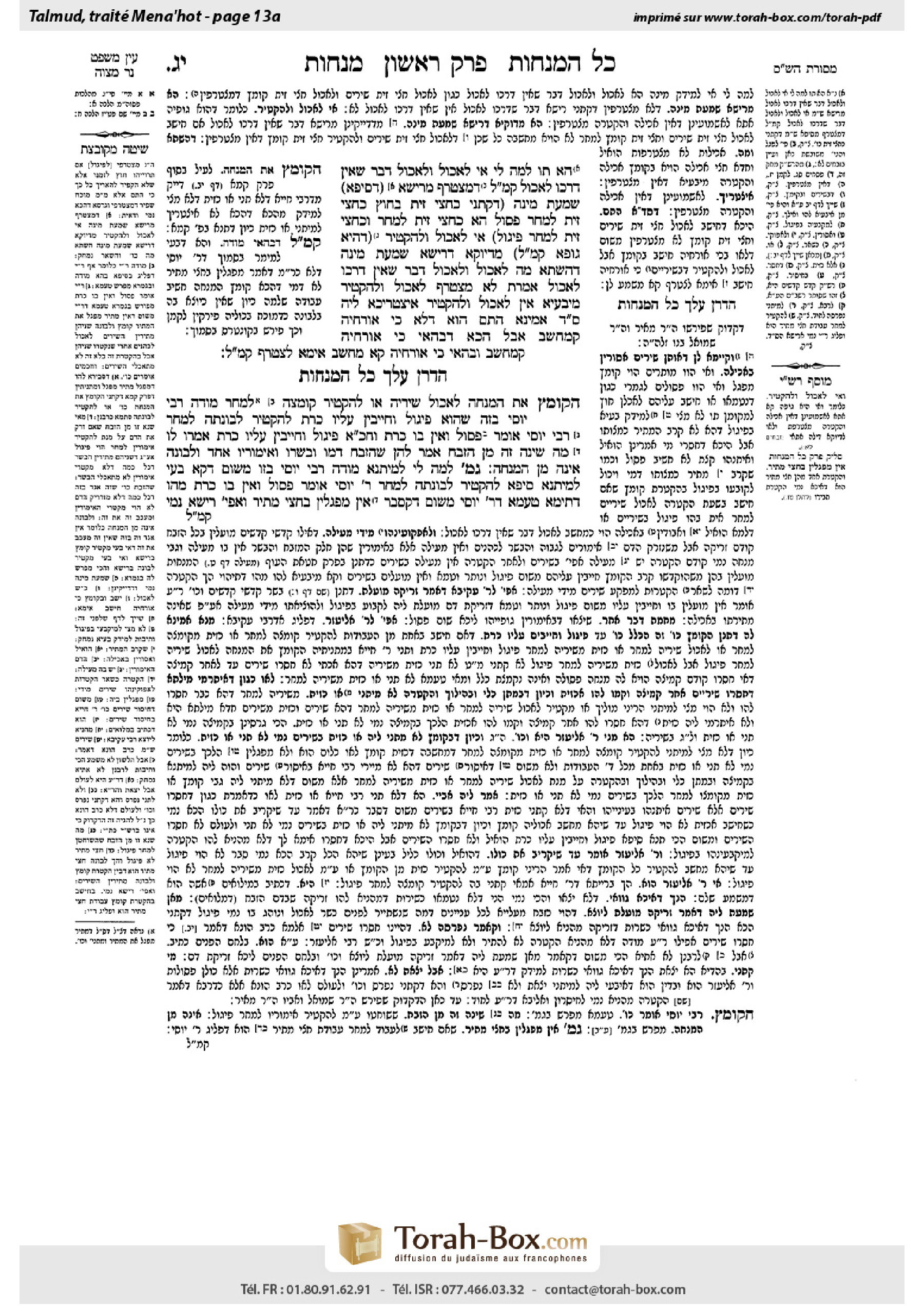
Menachot 13a: Talmud study for Daf Yomi
Daf Yomi is the daily study of one Talmud folio. Explore 37 tractates with scans, Hebrew text, Sefaria English and AI-generated French translations where annotated.
Passage selection and English or AI-generated French translation are available where the scan has annotations. Daf Study is independent of Torah-Box and Sefaria.
Browse Menachot · מנחות · All tractatesMenachot 13a text and translations
This page of Menachot includes the Aramaic text, an English translation and an AI-generated French translation, alongside the scan above.
מנחות י״ג א · Aramaic and Hebrew text
הָא תּוּ לְמָה לִי? אִי לֶאֱכוֹל וְלֶאֱכוֹל דָּבָר (שאין) [שֶׁ]דַּרְכּוֹ לֶאֱכוֹל קָא מַשְׁמַע לַן דְּמִצְטָרֵף, מֵרֵישָׁא דְּסֵיפָא שָׁמְעַתְּ מִינַּהּ, דְּקָתָנֵי: כַּחֲצִי זַיִת בַּחוּץ כַּחֲצִי זַיִת לְמָחָר פָּסוּל, הָא כַּחֲצִי זַיִת לְמָחָר וְכַחֲצִי זַיִת לְמָחָר – פִּיגּוּל.
אִי לֶאֱכוֹל וּלְהַקְטִיר (דְּהִיא גּוּפַהּ קָא מַשְׁמַע לַן), מִדִּיּוּקָא דְּרֵישָׁא שָׁמְעַתְּ מִינַּהּ.
דְּהַשְׁתָּא, מָה לֶאֱכוֹל וְלֶאֱכוֹל דָּבָר שֶׁאֵין דַּרְכּוֹ לֶאֱכוֹל – אָמְרַתְּ לָא מִצְטָרֵף, לֶאֱכוֹל וּלְהַקְטִיר מִיבַּעְיָא?
אִין, לֶאֱכוֹל וּלְהַקְטִיר אִיצְטְרִיכָא לֵיהּ, סָלְקָא דַּעְתָּךְ אָמֵינָא: הָתָם הוּא דְּלָא כִּי אוֹרְחֵיהּ קָמְחַשֵּׁב.
אֲבָל הָכָא, דִּבְהַאי כִּי אוֹרְחֵיהּ קָמְחַשֵּׁב, וּבְהַאי כִּי אוֹרְחֵיהּ קָא מְחַשֵּׁב, אֵימָא לִצְטָרֵף, קָא מַשְׁמַע לַן.
הֲדַרַן עֲלָךְ כׇּל הַמְּנָחוֹת.
מַתְנִי׳ הַקּוֹמֵץ אֶת הַמִּנְחָה לֶאֱכוֹל שְׁיָרֶיהָ אוֹ לְהַקְטִיר קוּמְצָהּ לְמָחָר – מוֹדֶה רַבִּי יוֹסֵי בָּזֶה שֶׁהוּא פִּיגּוּל וְחַיָּיבִין עָלָיו כָּרֵת. לְהַקְטִיר לְבוֹנָתָהּ לְמָחָר, רַבִּי יוֹסֵי אוֹמֵר: פָּסוּל וְאֵין בּוֹ כָּרֵת, וַחֲכָמִים אוֹמְרִים: פִּיגּוּל וְחַיָּיבִין עָלָיו כָּרֵת.
אָמְרוּ לוֹ: מָה (שִׁינָּה) [שָׁנַת] זוֹ מִן הַזֶּבַח? אָמַר לָהֶן: שֶׁהַזֶּבַח דָּמוֹ וּבְשָׂרוֹ וְאֵימוּרָיו אֶחָד, וּלְבוֹנָה אֵינָהּ מִן הַמִּנְחָה.
גְּמָ׳ לְמָה לִי לְמִיתְנֵא ״מוֹדֶה רַבִּי יוֹסֵי בָּזוֹ״?
מִשּׁוּם דְּקָא בָּעֵי לְמִיתְנֵא סֵיפָא, לְהַקְטִיר לְבוֹנָתָהּ לְמָחָר, רַבִּי יוֹסֵי אוֹמֵר: פָּסוּל וְאֵין בּוֹ כָּרֵת.
מַהוּ דְּתֵימָא: טַעְמָא דְּרַבִּי יוֹסֵי מִשּׁוּם דְּקָסָבַר אֵין מְפַגְּלִין בַּחֲצִי מַתִּיר, וַאֲפִילּוּ רֵישָׁא נָמֵי,
Menachot 13a · English translation
According to Abaye, why do I also need this mishna here? If you will suggest that this mishna is necessary, as one can infer from it that if one intended to partake of half an olive-bulk the next day and then intended to partake of another half an olive-bulk the next day, both from an item whose typical manner is such that one partakes of it, the mishna teaches us that they join together in order to render the offering piggul, this suggestion can be rejected: But you already learn the halakha in this case from the first clause of the latter clause of the previous mishna, as it teaches: Half an olive-bulk outside and half an olive-bulk the next day, the offering is unfit. One can infer from this that if his intent was to consume half an olive-bulk the next day and half an olive-bulk the next day, it is piggul.
If you suggest that the mishna is necessary for a case where one intended to consume and to burn, i.e., that the mishna teaches us the matter itself, that intent to consume does not join together with intent to burn, this too cannot be. The reason is that from the inference of the first clause of the mishna you can already learn the halakha in this case, as it teaches: If one intended to partake of an item whose typical manner is such that one partakes of it, the offering is rendered piggul. This indicates that if his intent was to consume an item whose typical manner is such that one does not consume it, the offering is not rendered piggul.
The Gemara explains how the halakha that intent to consume and burn do not combine can be inferred from the mishna: Now consider, if when one intended to partake of an item whose typical manner is such that one partakes of it and to partake of an item whose typical manner is such that one does not partake of it, you say that his intentions do not join together, despite the fact that both of his intentions referred to consumption, is it necessary for the mishna to teach that intentions to consume and to burn do not join together?
The Gemara responds: Yes; although the mishna teaches the halakha of a case where one intended to consume an item typically consumed and to consume an item typically not consumed, it was necessary for the mishna to teach the halakha of a case where one intended to eat and to burn. As it might enter your mind to say that there, where one’s intentions referred solely to consumption, the halakha is that his intentions do not join together, as he intended to act not in accordance with its typical manner, since he intended to consume that which is not meant to be consumed.
The Gemara continues: But here, where his intent was to consume half an olive-bulk and to burn half an olive-bulk, where with regard to this half he intends in accordance with its typical manner, and with regard to this half he intends in accordance with its typical manner, one might say that they should join together, despite the fact that each intention concerns only half an olive-bulk. Therefore, the mishna teaches us that such intentions do not join together, and the mishna can be explained even in accordance with the opinion of the Rabbis.
MISHNA: In the case of a priest who removes a handful from the meal offering with the intent to partake of its remainder or to burn its handful on the next day, Rabbi Yosei concedes in this instance that it is a case of piggul and he is liable to receive karet for partaking of it. But if the priest’s intent was to burn its frankincense the next day, Rabbi Yosei says: The meal offering is unfit but partaking of it does not include liability to receive karet. And the Rabbis say: It is a case of piggul and he is liable to receive karet for partaking of the meal offering.
The Rabbis said to Rabbi Yosei: In what manner does this differ from an animal offering, where if one slaughtered it with the intent to sacrifice the portions consumed on the altar the next day, it is piggul? Rabbi Yosei said to the Rabbis: There is a difference, as in the case of an animal offering, its blood, and its flesh, and its portions consumed on the altar are all one entity. Consequently, intent with regard to any one of them renders the entire offering piggul. But the frankincense is not part of the meal offering.
GEMARA: The Gemara questions the terminology of the mishna: Why do I need the tanna to teach that Rabbi Yosei concedes in this instance? Let the tanna simply state: If one removes the handful from a meal offering with the intent to partake of its remainder or to burn the handful on the next day, Rabbi Yosei says that the offering is piggul and one is liable to receive karet for partaking of the remainder.
The Gemara responds: It was necessary for the tanna to teach that Rabbi Yosei concedes, because he wants to teach the latter clause of the mishna, that if his intent was to burn its frankincense the next day, Rabbi Yosei says that the meal offering is unfit, but partaking of it does not include liability to receive karet.
The Gemara elaborates: The reason the tanna links the two cases of the mishna is lest you say that the reason that Rabbi Yosei does not render the meal offering piggul is because he holds that one cannot render an offering piggul with intent that concerns only half of its permitting factors. And consequently, since the burning of the handful and the frankincense render the remainder of a meal offering permitted for consumption, then even in the first clause of the mishna, where one intends to burn the handful the next day, Rabbi Yosei should hold that the offering is not rendered piggul, as the intent does not refer to the frankincense as well.
Menachot 13a · Traduction française (IA)
Selon Abayé, pourquoi ai-je aussi besoin de cette Michna ici ? Si l’on suggère que cette Michna est nécessaire, car on pourrait en déduire que si quelqu’un a l’intention de consommer un demi-volume d’olive le lendemain, puis un autre demi-volume d’olive le lendemain, dans les deux cas à partir d’un élément qu’il est habituel de consommer, la Michna nous enseigne que ces intentions s’additionnent pour rendre l’offrande piggoul, on peut rejeter cette suggestion : cette halakha ne s’apprend-elle pas déjà de la première clause de la seconde partie de la Michna précédente ? En effet, elle enseigne : un demi-volume d’olive à l’extérieur et un demi-volume d’olive le lendemain : l’offrande est invalide. On peut en déduire que si son intention était de consommer un demi-volume d’olive le lendemain et un autre demi-volume d’olive le lendemain, l’offrande est piggoul.
Si l’on suggère que la Michna est nécessaire pour le cas où quelqu’un a l’intention de consommer et de brûler, c’est-à-dire qu’elle nous enseigne que l’intention de consommer ne s’additionne pas à l’intention de brûler, cela ne convient pas non plus. En effet, on peut déjà apprendre cette halakha de l’inférence tirée de la première clause de la Michna, qui enseigne que si quelqu’un a l’intention de consommer un élément qu’il est habituel de consommer, l’offrande devient piggoul. Cela indique que si son intention est de consommer un élément qu’il n’est pas habituel de consommer, l’offrande ne devient pas piggoul.
La Guemara explique comment déduire de la Michna que les intentions de consommer et de brûler ne s’additionnent pas : réfléchissons. Si, lorsque quelqu’un a l’intention de consommer un élément qu’il est habituel de consommer et un élément qu’il n’est pas habituel de consommer, on considère que ses intentions ne s’additionnent pas, alors que toutes deux portent sur la consommation, est-il nécessaire que la Michna enseigne que les intentions de consommer et de brûler ne s’additionnent pas ?
La Guemara répond : oui. Bien que la Michna enseigne la halakha du cas où quelqu’un a l’intention de consommer un élément habituellement consommé et un élément qui ne l’est pas, il était nécessaire qu’elle enseigne également la halakha du cas où quelqu’un a l’intention de consommer et de brûler. En effet, on aurait pu penser que, dans le premier cas, où ses intentions portent uniquement sur la consommation, elles ne s’additionnent pas, puisqu’il a l’intention d’agir contrairement à l’usage en consommant ce qui n’est pas destiné à être consommé.
La Guemara poursuit : mais ici, où son intention est de consommer un demi-volume d’olive et d’en brûler un demi-volume d’olive, et où, pour chacune de ces moitiés, il a l’intention d’agir conformément à l’usage, on aurait pu dire que les intentions s’additionnent, bien que chacune ne porte que sur un demi-volume d’olive. La Michna nous enseigne donc que de telles intentions ne s’additionnent pas, et elle peut ainsi s’expliquer même selon l’opinion des Rabbins.
MICHNA : Dans le cas d’un prêtre qui prélève une poignée de l’offrande de farine avec l’intention de consommer le reste ou de brûler la poignée le lendemain, Rabbi Yosse reconnaît ici qu’il s’agit d’un cas de piggoul et que celui qui en consomme est passible de retranchement. Mais si le prêtre a l’intention de brûler son encens le lendemain, Rabbi Yosse dit : l’offrande de farine est invalide, mais celui qui en consomme n’est pas passible de retranchement. Les Rabbins disent : il s’agit d’un cas de piggoul et celui qui consomme l’offrande de farine est passible de retranchement.
Les Rabbins dirent à Rabbi Yosse : en quoi cela diffère-t-il d’une offrande animale, pour laquelle, si quelqu’un l’égorge avec l’intention d’offrir le lendemain les parties destinées à être consumées sur l’autel, elle est piggoul ? Rabbi Yosse leur répondit : il y a une différence, car, dans le cas d’une offrande animale, le sang, la chair et les parties destinées à être consumées sur l’autel constituent une seule et même entité. Par conséquent, une intention portant sur n’importe laquelle de ces parties rend l’offrande entière piggoul. Mais l’encens ne fait pas partie de l’offrande de farine.
GUEMARA : La Guemara s’interroge sur la formulation de la Michna : pourquoi le tanna doit-il enseigner que Rabbi Yosse reconnaît ce cas ? Que le tanna dise simplement : si quelqu’un prélève la poignée d’une offrande de farine avec l’intention de consommer le reste ou de brûler la poignée le lendemain, Rabbi Yosse dit que l’offrande est piggoul et que celui qui consomme le reste est passible de retranchement.
La Guemara répond : il était nécessaire que le tanna enseigne que Rabbi Yosse reconnaît ce cas, car il veut enseigner la seconde partie de la Michna : si son intention est de brûler son encens le lendemain, Rabbi Yosse dit que l’offrande de farine est invalide, mais que celui qui en consomme n’est pas passible de retranchement.
La Guemara développe : le tanna relie les deux cas de la Michna de peur que l’on dise que si Rabbi Yosse ne rend pas l’offrande de farine piggoul, c’est parce qu’il estime qu’on ne peut pas rendre une offrande piggoul par une intention qui ne porte que sur la moitié des éléments qui la rendent permise. Par conséquent, puisque la combustion de la poignée et celle de l’encens rendent le reste de l’offrande de farine propre à la consommation, même dans la première partie de la Michna, où quelqu’un a l’intention de brûler la poignée le lendemain, Rabbi Yosse devrait estimer que l’offrande ne devient pas piggoul, puisque l’intention ne porte pas également sur l’encens.
Traduction française générée par IA à partir de l’édition anglaise de Sefaria. Vérifie toujours un passage avec le texte source.
Text from Sefaria: William Davidson Edition - Vocalized Aramaic (unknown); William Davidson Edition - English (CC BY NC).