Menachot 12b: Talmud study for Daf Yomi
Daf Yomi is the daily study of one Talmud folio. Explore 37 tractates with scans, Hebrew text, Sefaria English and AI-generated French translations where annotated.
Passage selection and English or AI-generated French translation are available where the scan has annotations. Daf Study is independent of Torah-Box and Sefaria.
Browse Menachot · מנחות · All tractatesMenachot 12b text and translations
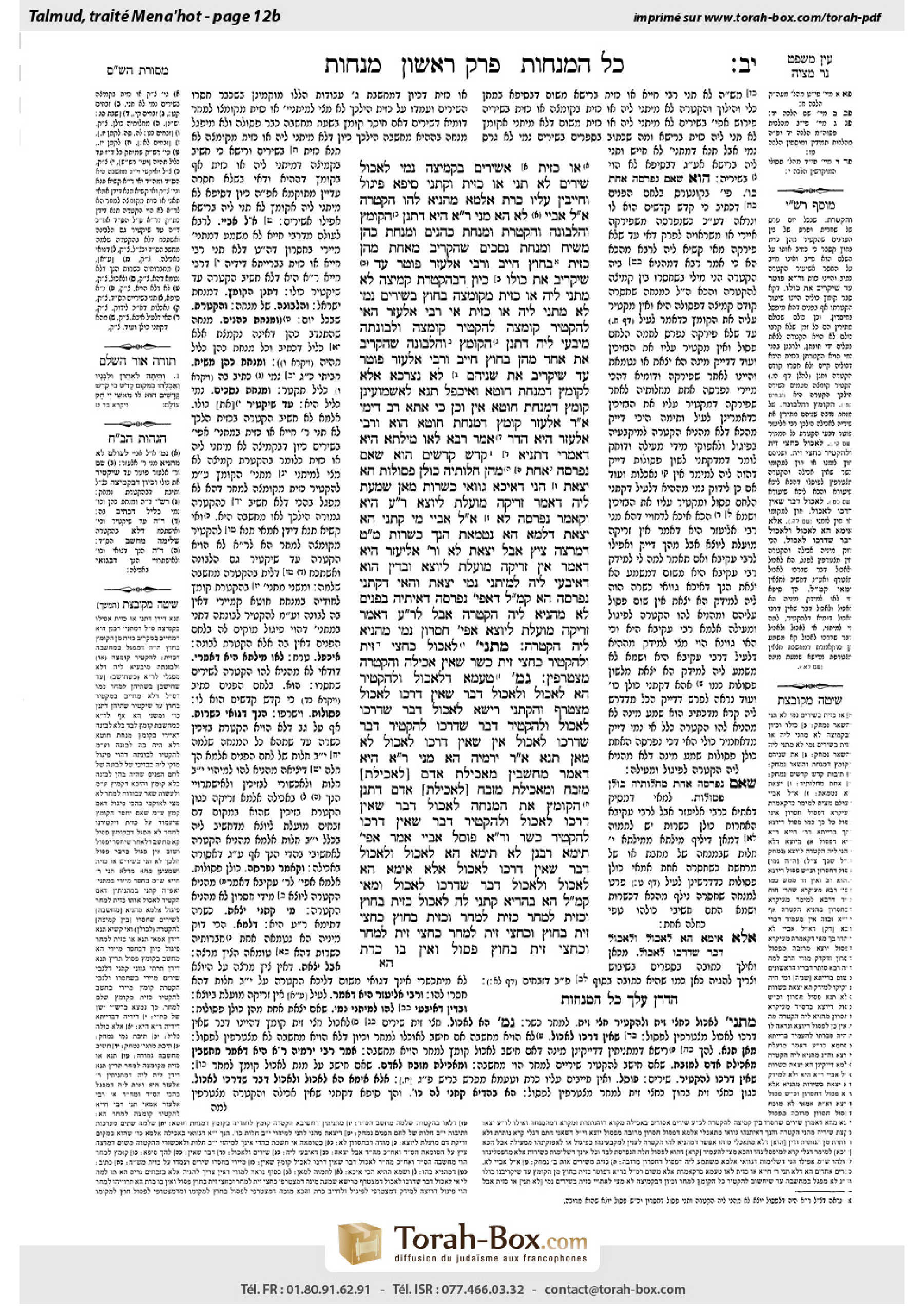
This page of Menachot includes the Aramaic text, an English translation and an AI-generated French translation, alongside the scan above.
מנחות י״ב ב · Aramaic and Hebrew text
״אוֹ כְּזַיִת״ אַשִּׁירַיִם, בִּקְמִיצָה נָמֵי לֶאֱכוֹל שִׁירַיִם לָא תָּנֵי ״אוֹ כְּזַיִת״, וְקָתָנֵי סֵיפָא: פִּיגּוּל וְחַיָּיבִין עָלָיו כָּרֵת, אַלְמָא מַהְנְיָא לְהוּ הַקְטָרָה.
אֲמַר לֵיהּ אַבָּיֵי: לָא, הָא מַנִּי? רַבִּי אֶלְעָזָר הִיא, דִּתְנַן: הַקּוֹמֶץ, וְהַלְּבוֹנָה, וְהַקְּטֹרֶת, וּמִנְחַת כֹּהֲנִים, וּמִנְחַת כֹּהֵן מָשִׁיחַ, וּמִנְחַת נְסָכִים, שֶׁהִקְרִיב מֵאַחַת מֵהֶן כְּזַיִת בַּחוּץ – חַיָּיב, וְרַבִּי אֶלְעָזָר פּוֹטֵר עַד שֶׁיַּקְרִיב אֶת כּוּלּוֹ.
כֵּיוָן דִּבְהַקְטָרַת קְמִיצָה לָא מִתְּנֵי לֵיהּ ״אוֹ כְּזַיִת מִקּוּמְצָהּ בַּחוּץ״, בְּשִׁירַיִם נָמֵי לָא מִתְּנֵי לֵיהּ ״אוֹ כְּזַיִת״.
אִי רַבִּי אֶלְעָזָר, הַאי ״לְהַקְטִיר קוּמְצָהּ״, ״לְהַקְטִיר קוּמְצָהּ וּלְבוֹנָתָהּ״ מִיבְּעֵי לֵיהּ! דִּתְנַן: הַקּוֹמֶץ וְהַלְּבוֹנָה שֶׁהִקְרִיב אֶת אֶחָד מֵהֶן בַּחוּץ – חַיָּיב, וְרַבִּי אֶלְעָזָר פּוֹטֵר עַד שֶׁיַּקְרִיב אֶת שְׁנֵיהֶם.
לֹא נִצְרְכָא אֶלָּא לְקוֹמֶץ דְּמִנְחַת חוֹטֵא.
וְאִיכְּפֵל תַּנָּא לְאַשְׁמוֹעִינַן קוֹמֶץ דְּמִנְחַת חוֹטֵא? אִין. וְכֵן כִּי אֲתָא רַב דִּימִי אָמַר רַבִּי אֶלְעָזָר: קוֹמֶץ דְּמִנְחַת חוֹטֵא הוּא, וְרַבִּי אֶלְעָזָר הִיא.
הֲדַר אָמַר רָבָא: לָאו מִילְּתָא הִיא דַּאֲמַרִי, דְּתַנְיָא: ״קֹדֶשׁ קָדָשִׁים הוּא״, שֶׁאִם נִפְרְסָה אַחַת מֵהֶן – חַלּוֹתֶיהָ כּוּלָּן פְּסוּלוֹת.
הָא יָצָאת – הָנֵי דְּאִיכָּא גַּוַּואי כְּשֵׁרוֹת, מַאן שָׁמְעַתְּ לֵיהּ דְּאָמַר: זְרִיקָה מוֹעֶלֶת לַיּוֹצֵא? רַבִּי עֲקִיבָא הִיא, וְקָאָמַר: נִפְרְסָה – לָא.
אֲמַר לֵיהּ אַבָּיֵי: מִי קָתָנֵי הָא יָצָאת? דִּלְמָא הָא נִטְמֵאת – הָנָךְ כְּשֵׁרוֹת.
מַאי טַעְמָא? דִּמְרַצֵּה צִיץ, אֲבָל יָצָאת – לָא, וְרַבִּי אֱלִיעֶזֶר הִיא, דְּאָמַר: אֵין זְרִיקָה מוֹעֶלֶת לַיּוֹצֵא.
וּבְדִין הוּא דְּאִיבְּעִי לֵיהּ לְמִיתְנֵי נָמֵי יָצָאת, וְהַאי דְּקָתָנֵי נִפְרְסָה – הָא קָא מַשְׁמַע לַן, דַּאֲפִילּוּ נִפְרְסָה, דְּאִיתֵיהּ בִּפְנִים – לָא מַהְנְיָא לֵיהּ הַקְטָרָה. אֲבָל לְרַבִּי עֲקִיבָא דְּאָמַר: זְרִיקָה מוֹעֶלֶת לַיּוֹצֵא – אֲפִילּוּ חֶסְרוֹן נָמֵי מַהְנְיָא לֵיהּ הַקְטָרָה.
מַתְנִי׳ לֶאֱכוֹל כַּחֲצִי זַיִת וּלְהַקְטִיר כַּחֲצִי זַיִת – כָּשֵׁר, שֶׁאֵין אֲכִילָה וְהַקְטָרָה מִצְטָרְפִין.
גְּמָ׳ טַעְמָא דְּלֶאֱכוֹל וּלְהַקְטִיר, הָא לֶאֱכוֹל וְלֶאֱכוֹל דָּבָר שֶׁאֵין דַּרְכּוֹ לֶאֱכוֹל – מִצְטָרֵף.
וְהָקָתָנֵי רֵישָׁא: לֶאֱכוֹל דָּבָר שֶׁדַּרְכּוֹ לֶאֱכוֹל, וּלְהַקְטִיר דָּבָר שֶׁדַּרְכּוֹ לְהַקְטִיר – דָּבָר שֶׁדַּרְכּוֹ לֶאֱכוֹל, אִין; שֶׁאֵין דַּרְכּוֹ לֶאֱכוֹל, לָא. מַאן תַּנָּא?
אָמַר רַבִּי יִרְמְיָה: הָא מַנִּי? רַבִּי אֱלִיעֶזֶר הִיא, דְּאָמַר: מְחַשְּׁבִין מֵאֲכִילַת אָדָם לַמִּזְבֵּחַ, וּמֵאֲכִילַת מִזְבֵּחַ לָאָדָם.
דִּתְנַן: הַקּוֹמֵץ אֶת הַמִּנְחָה לֶאֱכוֹל דָּבָר שֶׁאֵין דַּרְכּוֹ לֶאֱכוֹל, וּלְהַקְטִיר דָּבָר שֶׁאֵין דַּרְכּוֹ לְהַקְטִיר – כָּשֵׁר, וְרַבִּי אֱלִיעֶזֶר פּוֹסֵל.
אַבָּיֵי אָמַר: אֲפִילּוּ תֵּימָא רַבָּנַן, לָא תֵּימָא הָא לֶאֱכוֹל וְלֶאֱכוֹל דָּבָר שֶׁאֵין דַּרְכּוֹ לֶאֱכוֹל, אֶלָּא אֵימָא הָא לֶאֱכוֹל וְלֶאֱכוֹל דָּבָר שֶׁדַּרְכּוֹ לֶאֱכוֹל.
וּמַאי קָא מַשְׁמַע לַן? הָא בְּהֶדְיָא קָתָנֵי לַהּ: לֶאֱכוֹל כְּזַיִת בַּחוּץ וּכְזַיִת לְמָחָר, כְּזַיִת לְמָחָר וּכְזַיִת בַּחוּץ, כַּחֲצִי זַיִת בַּחוּץ וְכַחֲצִי זַיִת לְמָחָר, כַּחֲצִי זַיִת לְמָחָר וְכַחֲצִי זַיִת בַּחוּץ – פָּסוּל וְאֵין בּוֹ כָּרֵת.
Menachot 12b · English translation
Or an olive-bulk, in the case of one’s intent with regard to the consumption of the remainder, because the remainder is already the size of an olive-bulk. Therefore, in the case of the removal of the handful as well, i.e., when he teaches: One who removes a handful to partake of its remainder, Rabbi Ḥiyya did not teach: Or to consume an olive-bulk of its remainder, despite the fact that he could have done so in that clause. Rava concludes his proof: And yet the latter clause teaches that if one burned the handful with the intent to consume the remainder after its designated time, the offering is piggul and one is liable to receive karet on account of it. Evidently, burning is effective in rendering a lacking remainder as piggul.
Abaye said to Rava: No, one cannot prove from here that the mishna is discussing the case of a remainder that became lacking. The reason for this is: In accordance with whose opinion is this mishna of Rabbi Ḥiyya? It is in accordance with the opinion of Rabbi Elazar, as we learned in a mishna (Zevaḥim 109b): With regard to the handful of flour, and the frankincense, and the incense, and the meal offering of priests (see Leviticus 6:16), and the meal offering of the anointed priest (see Leviticus 6:12–15), and the meal offering that accompanies the libations brought with animal offerings (see Numbers 15:1–16), where one sacrificed an olive-bulk from one of them outside the Temple courtyard, he is liable for sacrificing outside the courtyard. And Rabbi Elazar exempts one from liability until he sacrifices them in their entirety rather than just an olive-bulk from them.
Abaye concludes: Since with regard to the burning of the handful he could not teach: Or burn an olive-bulk of its handful outside the Temple, as according to Rabbi Elazar one is not liable for burning anything less than the full handful and therefore intent to burn only an olive-bulk does not render the offering piggul, with regard to the remainder as well, he did not teach: Or an olive-bulk.
The Gemara asks: If the mishna of Rabbi Ḥiyya is really in accordance with the opinion of Rabbi Elazar, then this statement: To burn its handful outside the Temple courtyard, should have been phrased: To burn its handful and its frankincense outside the Temple courtyard, as we learned in a mishna (Zevaḥim 110a): With regard to the handful and the frankincense, in a case where one sacrificed only one of them outside the Temple courtyard, he is liable. Rabbi Elazar exempts from liability one who burns only one of them until he sacrifices both of them together.
The Gemara responds: The mishna of Rabbi Ḥiyya is necessary only for the handful of the meal offering of a sinner, which has no frankincense. Since only the burning of the handful permits the remainder of the sinner’s meal offering for consumption, one’s intent to burn it the next day renders the offering piggul. With regard to this meal offering, one is not liable for burning anything less than the full handful, according to Rabbi Elazar, and therefore it does not teach: Or an olive-bulk.
The Gemara asks: And did the tanna go to all that trouble [ve’ikhpal] just to teach us a halakha that is applicable only in the case of the handful of the meal offering of a sinner? The Gemara responds: Yes, he did. And similarly, when Rav Dimi came to Babylonia from Eretz Yisrael, he said that Rabbi Elazar ben Pedat said: When the mishna discusses an instance where one has intent to sacrifice the handful of a meal offering outside, it is referring to the handful of the meal offering of a sinner, and it is in accordance with the opinion of Rabbi Elazar.
Rava then said: That which I said, that the burning of the handful with the intent to consume the remainder the next day is effective in rendering even a remainder that became lacking in measure as piggul and to remove it from being subject to misuse of consecrated property is nothing, as it is taught in a baraita: The verse states with regard to the shewbread: “It is most holy” (Leviticus 24:9). The restrictive term “it” teaches that the shewbread must remain whole, so that if one of the loaves of the shewbread broke and consequently became lacking in measure, then all of its loaves are disqualified, and the burning of the bowls of frankincense does not render them permitted for consumption.
Rava continues: It can be inferred from the baraita that if the loaves remained whole but one of them left the Temple, those that are inside the Temple are still fit. And whom have you heard who says: The sprinkling of the blood is effective in rendering piggul an item that left the Temple? It is Rabbi Akiva. And yet he says in this baraita that if one of the loaves broke, the burning of the frankincense is not effective for them. Similarly, with regard to the remainder of a meal offering that became lacking in measure, even Rabbi Akiva agrees that the burning of the handful is ineffective in rendering it piggul.
Abaye said to Rava: How can you cite a proof from this baraita? Is it taught in this baraita: But if a loaf of shewbread left, those loaves that remain inside are fit? Perhaps all of the loaves are disqualified if even one of them left, and one should infer a different halakha from the baraita, that if one of the loaves became ritually impure, these that remain pure are fit.
Abaye explains: What is the reason for such a distinction? The reason is that the frontplate of the High Priest effects acceptance for ritually impure offerings. But in a case where a loaf of shewbread left, the frontplate does not effect acceptance, and therefore all of the loaves are disqualified, as in a case where one loaf breaks. And if so, the baraita is in accordance with the opinion of Rabbi Eliezer, who says that sprinkling is not effective with regard to an item that left the Temple courtyard.
Abaye continues: And by right the baraita should have also taught that if one of the loaves of shewbread left, all the loaves are disqualified. And as for the fact that it teaches the halakha specifically with regard to a loaf that broke, this is what the baraita teaches us: That even if the loaf broke, in which case the loaf is still inside the Temple, burning is not effective with regard to it. But according to Rabbi Akiva, who says that sprinkling is effective with regard to an item that left the Temple, even in the case of a lacking measure, burning is effective with regard to it.
MISHNA: If one’s intent was to partake of half an olive-bulk of the remainder and to burn half an olive-bulk of it not at the appropriate time or not in the appropriate area, the offering is fit, because eating and burning do not join together.
GEMARA: The Gemara infers from the mishna: The reason that the two halves of an olive-bulk do not join together is because his intent was to partake of half an olive-bulk and to burn half an olive-bulk, which indicates that if his intent was to partake of half an olive-bulk of the remainder and to partake of half an olive-bulk of an item whose typical manner is such that one does not consume it, i.e., the handful, then the halves do join together to the amount of an olive-bulk and disqualify the offering.
The Gemara notes an apparent contradiction: But the first clause teaches, in the earlier mishna: If one’s intent was to partake of an item whose typical manner is such that one partakes of it, or to burn an item whose typical manner is such that one burns it on the altar, beyond its designated time, the offering is piggul. One can infer from this mishna that if his intent was to partake of an item whose typical manner is such that one partakes of it, yes, such intent disqualifies an offering. But if his intent was to partake of an item whose typical manner is such that one does not partake of it, this intent does not disqualify the offering, and likewise such intent does not join together with another to this end. If so, who is the tanna who taught the latter clause?
Rabbi Yirmeya said: In accordance with whose opinion is this mishna? It is in accordance with the opinion of Rabbi Eliezer, who says that one can have improper intent from the consumption performed by a person to the consumption performed by the altar, and from the consumption performed by the altar to the consumption performed by a person. In other words, if one’s intent was to burn the remainder the next day or to consume the handful the next day, such intent disqualifies an offering even though the remainder is intended for consumption by the priests and the handful is intended for burning upon the altar.
The Gemara cites the relevant ruling of Rabbi Eliezer. As we learned in a mishna (17a): In the case of one who removes a handful from the meal offering with the intent to consume after its designated time an item whose typical manner is such that one does not consume it, i.e., the handful, or to burn beyond its designated time an item whose typical manner is such that one does not burn it on the altar, i.e., the remainder of the meal offering, the meal offering is fit. And Rabbi Eliezer deems it unfit, although it is not piggul and consuming it is not punishable by karet.
Abaye said: You may even say that the mishna here is in accordance with the opinion of the Rabbis. And do not say that one should infer from the mishna that if his intent was to partake of half an olive-bulk of an item whose typical manner is such that one consumes it and to partake of half an olive-bulk of an item whose typical manner is such that one does not partake of it, the offering is disqualified. Rather, say that if his intent was to partake of half an olive-bulk on the next day and to partake of half an olive-bulk outside the Temple, and each of these halves is from an item whose typical manner is such that one partakes of it, then the halves are joined together and disqualify the offering.
The Gemara asks: And what is this teaching us? The previous mishna already teaches that principle explicitly: If one performed one of these rites with the intent to partake of an olive-bulk outside its designated area and an olive-bulk the next day, or an olive-bulk the next day and an olive-bulk outside its designated area, or half an olive-bulk outside its designated area and half an olive-bulk the next day, or half an olive-bulk the next day and half an olive-bulk outside its designated area, the offering is unfit but there is no liability for karet.
Menachot 12b · Traduction française (IA)
Ou un volume d’olive, lorsqu’il s’agit de l’intention de consommer le reste, puisque celui-ci a déjà le volume d’une olive. Par conséquent, dans le cas du prélèvement de la poignée également, c’est-à-dire lorsqu’il enseigne : « Celui qui prélève une poignée dans l’intention de consommer le reste », Rabbi Ḥiyya n’a pas enseigné : « Ou de consommer un volume d’olive de son reste », bien qu’il aurait pu le faire dans cette clause. Rava conclut sa preuve : Pourtant, la clause suivante enseigne que si l’on a brûlé la poignée avec l’intention de consommer le reste après le délai prévu, l’offrande est piggul et l’on est passible de karet à cause d’elle. Il ressort donc de là que la combustion peut rendre piggul un reste dont la quantité est insuffisante.
Abaye dit à Rava : Non, on ne peut pas prouver de là que la Michna traite du cas d’un reste dont la quantité est devenue insuffisante. En effet, selon l’opinion de qui cette Michna de Rabbi Ḥiyya a-t-elle été enseignée ? Selon celle de Rabbi Elazar, comme nous l’avons appris dans une Michna (Zevaḥim 109b) : Si l’on a offert à l’extérieur du parvis du Temple un volume d’olive prélevé sur la poignée de farine, l’encens, l’encens aromatique, l’offrande de farine des prêtres (voir Lévitique 6:16), l’offrande de farine du prêtre oint (voir Lévitique 6:12–15) ou l’offrande de farine accompagnant les libations apportées avec des sacrifices animaux (voir Nombres 15:1–16), on est passible pour l’avoir offert à l’extérieur du parvis. Rabbi Elazar, quant à lui, exempte de toute responsabilité jusqu’à ce qu’on offre ces éléments dans leur intégralité, et non seulement un volume d’olive prélevé sur eux.
Abaye conclut : Puisqu’au sujet de la combustion de la poignée, il ne pouvait pas enseigner : « Ou brûler un volume d’olive de sa poignée à l’extérieur du Temple », car selon Rabbi Elazar, on n’est pas passible pour la combustion d’une quantité inférieure à la poignée entière et l’intention de ne brûler qu’un volume d’olive ne rend donc pas l’offrande piggul, il n’a pas non plus enseigné : « Ou un volume d’olive », au sujet du reste.
La Guemara demande : Si la Michna de Rabbi Ḥiyya est réellement conforme à l’opinion de Rabbi Elazar, la formule « brûler sa poignée à l’extérieur du parvis du Temple » aurait dû être : « brûler sa poignée et son encens à l’extérieur du parvis du Temple », comme nous l’avons appris dans une Michna (Zevaḥim 110a) : Si l’on offre à l’extérieur du parvis du Temple soit la poignée, soit l’encens, on est passible. Rabbi Elazar exempte de toute responsabilité celui qui n’en brûle qu’un seul, jusqu’à ce qu’il les offre tous deux ensemble.
La Guemara répond : La Michna de Rabbi Ḥiyya n’est nécessaire que pour la poignée de l’offrande de farine du pécheur, qui ne comporte pas d’encens. Puisque seule la combustion de la poignée permet de consommer le reste de l’offrande de farine du pécheur, l’intention de la brûler le lendemain rend l’offrande piggul. Pour cette offrande, selon Rabbi Elazar, on n’est pas passible pour la combustion d’une quantité inférieure à la poignée entière ; c’est pourquoi la Michna n’enseigne pas : « Ou un volume d’olive ».
La Guemara demande : Le tanna s’est-il donné tant de peine [ve’ikhpal] uniquement pour nous enseigner une halakha qui ne s’applique que dans le cas de la poignée de l’offrande de farine du pécheur ? La Guemara répond : Oui. De même, lorsque Rav Dimi arriva en Babylonie depuis la Terre d’Israël, il rapporta que Rabbi Elazar ben Pedat avait dit : Lorsque la Michna traite du cas où l’on a l’intention d’offrir à l’extérieur la poignée d’une offrande de farine, elle fait référence à la poignée de l’offrande de farine du pécheur et suit l’opinion de Rabbi Elazar.
Rava dit alors : Ce que j’ai dit, à savoir que la combustion de la poignée, avec l’intention de consommer le reste le lendemain, peut rendre piggul même un reste dont la quantité est devenue insuffisante et le soustraire à l’interdiction de l’usage abusif des biens consacrés, est sans fondement, car une baraïta enseigne : Au sujet des pains de proposition, le verset dit : « Il est très saint » (Lévitique 24:9). Le terme restrictif « il » enseigne que les pains de proposition doivent rester entiers. Ainsi, si l’un des pains se brise et que la quantité devient par conséquent insuffisante, tous les pains sont invalidés, et la combustion des coupes d’encens ne les rend pas permis à la consommation.
Rava poursuit : On peut déduire de la baraïta que si les pains sont restés entiers, mais que l’un d’eux a quitté le Temple, ceux qui s’y trouvent encore restent aptes. Or, qui a-t-on entendu dire que l’aspersion du sang peut rendre piggul un élément qui a quitté le Temple ? Rabbi Akiva. Pourtant, il dit dans cette baraïta que si l’un des pains s’est brisé, la combustion de l’encens n’a aucun effet à leur égard. De même, concernant le reste d’une offrande de farine dont la quantité est devenue insuffisante, même Rabbi Akiva reconnaît que la combustion de la poignée ne peut le rendre piggul.
Abaye dit à Rava : Comment peux-tu tirer une preuve de cette baraïta ? Y est-il enseigné : « Mais si un pain de proposition a quitté le Temple, les pains restés à l’intérieur sont aptes » ? Peut-être tous les pains sont-ils invalidés si l’un d’eux a quitté le Temple, et faut-il déduire de la baraïta une autre halakha : si l’un des pains est devenu rituellement impur, ceux qui sont restés purs sont aptes.
Abaye explique : Quelle est la raison de cette distinction ? C’est que le tsits, la plaque frontale du grand prêtre, obtient l’acceptation pour les offrandes rituellement impures. Mais lorsqu’un pain de proposition a quitté le Temple, le tsits n’obtient pas l’acceptation ; tous les pains sont donc invalidés, comme dans le cas où un pain se brise. Si tel est le cas, la baraïta suit l’opinion de Rabbi Eliezer, qui dit que l’aspersion n’a aucun effet sur un élément qui a quitté le parvis du Temple.
Abaye poursuit : En toute logique, la baraïta aurait également dû enseigner que si l’un des pains de proposition a quitté le Temple, tous les pains sont invalidés. Si elle enseigne précisément la halakha au sujet d’un pain qui s’est brisé, c’est pour nous apprendre que même si le pain s’est brisé, auquel cas il se trouve toujours dans le Temple, la combustion n’a aucun effet à son égard. Mais selon Rabbi Akiva, qui dit que l’aspersion a un effet sur un élément qui a quitté le Temple, la combustion a également un effet sur lui lorsque sa quantité est insuffisante.
MICHNA : Si l’on avait l’intention de consommer un demi-volume d’olive du reste et d’en brûler un demi-volume d’olive au-delà du délai prévu ou hors de l’endroit prévu, l’offrande reste apte, car la consommation et la combustion ne s’additionnent pas.
GUEMARA : La Guemara déduit de la Michna que si les deux moitiés d’un volume d’olive ne s’additionnent pas, c’est parce que l’intention était de consommer un demi-volume d’olive et d’en brûler un demi-volume d’olive. Cela indique que si l’intention était de consommer un demi-volume d’olive du reste et un demi-volume d’olive d’un élément que l’on n’a pas coutume de consommer, à savoir la poignée, les deux moitiés s’additionnent pour atteindre le volume d’une olive et invalident l’offrande.
La Guemara relève une contradiction apparente : Or, la première clause de la Michna précédente enseigne que si l’intention était de consommer, au-delà du délai prévu, un élément que l’on a coutume de consommer, ou de brûler, au-delà du délai prévu, un élément que l’on a coutume de brûler sur l’autel, l’offrande est piggul. On peut en déduire que si l’intention était de consommer un élément que l’on a coutume de consommer, une telle intention invalide l’offrande. Mais si l’intention était de consommer un élément que l’on n’a pas coutume de consommer, cette intention n’invalide pas l’offrande et ne s’additionne pas non plus à une autre intention à cette fin. Si tel est le cas, quel tanna a enseigné la dernière clause ?
Rabbi Yirmeya dit : Selon l’opinion de qui cette Michna a-t-elle été enseignée ? Selon celle de Rabbi Eliezer, qui dit qu’on peut avoir une intention impropre en passant de la consommation par l’homme à la consommation par l’autel, et de la consommation par l’autel à la consommation par l’homme. Autrement dit, si l’intention était de brûler le reste le lendemain ou de consommer la poignée le lendemain, cette intention invalide l’offrande, bien que le reste soit destiné à être consommé par les prêtres et la poignée à être brûlée sur l’autel.
La Guemara cite la décision pertinente de Rabbi Eliezer. En effet, nous avons appris dans une Michna (17a) : Si quelqu’un prélève une poignée de l’offrande de farine avec l’intention de consommer, après le délai prévu, un élément que l’on n’a pas coutume de consommer, à savoir la poignée, ou de brûler, au-delà du délai prévu, un élément que l’on n’a pas coutume de brûler sur l’autel, à savoir le reste de l’offrande de farine, l’offrande de farine reste apte. Rabbi Eliezer la déclare toutefois inapte, bien qu’elle ne soit pas piggul et que sa consommation ne soit pas passible de karet.
Abaye dit : On peut même dire que la Michna ici suit l’opinion des Rabbins. Il ne faut pas déduire de la Michna que si l’intention était de consommer un demi-volume d’olive d’un élément que l’on a coutume de consommer et un demi-volume d’olive d’un élément que l’on n’a pas coutume de consommer, l’offrande est invalidée. Il faut plutôt dire que si l’intention était de consommer un demi-volume d’olive le lendemain et un demi-volume d’olive à l’extérieur du Temple, et que chacune de ces moitiés provient d’un élément que l’on a coutume de consommer, les deux moitiés s’additionnent et invalident l’offrande.
La Guemara demande : Et que nous apprend-on ainsi ? La Michna précédente enseigne déjà explicitement ce principe : Si l’on a accompli l’un de ces rites avec l’intention de consommer un volume d’olive hors de l’endroit prévu et un volume d’olive le lendemain, ou un volume d’olive le lendemain et un volume d’olive hors de l’endroit prévu, ou un demi-volume d’olive hors de l’endroit prévu et un demi-volume d’olive le lendemain, ou un demi-volume d’olive le lendemain et un demi-volume d’olive hors de l’endroit prévu, l’offrande est inapte, mais l’on n’est pas passible de karet.
Traduction française générée par IA à partir de l’édition anglaise de Sefaria. Vérifie toujours un passage avec le texte source.
Text from Sefaria: William Davidson Edition - Vocalized Aramaic (unknown); William Davidson Edition - English (CC BY NC).