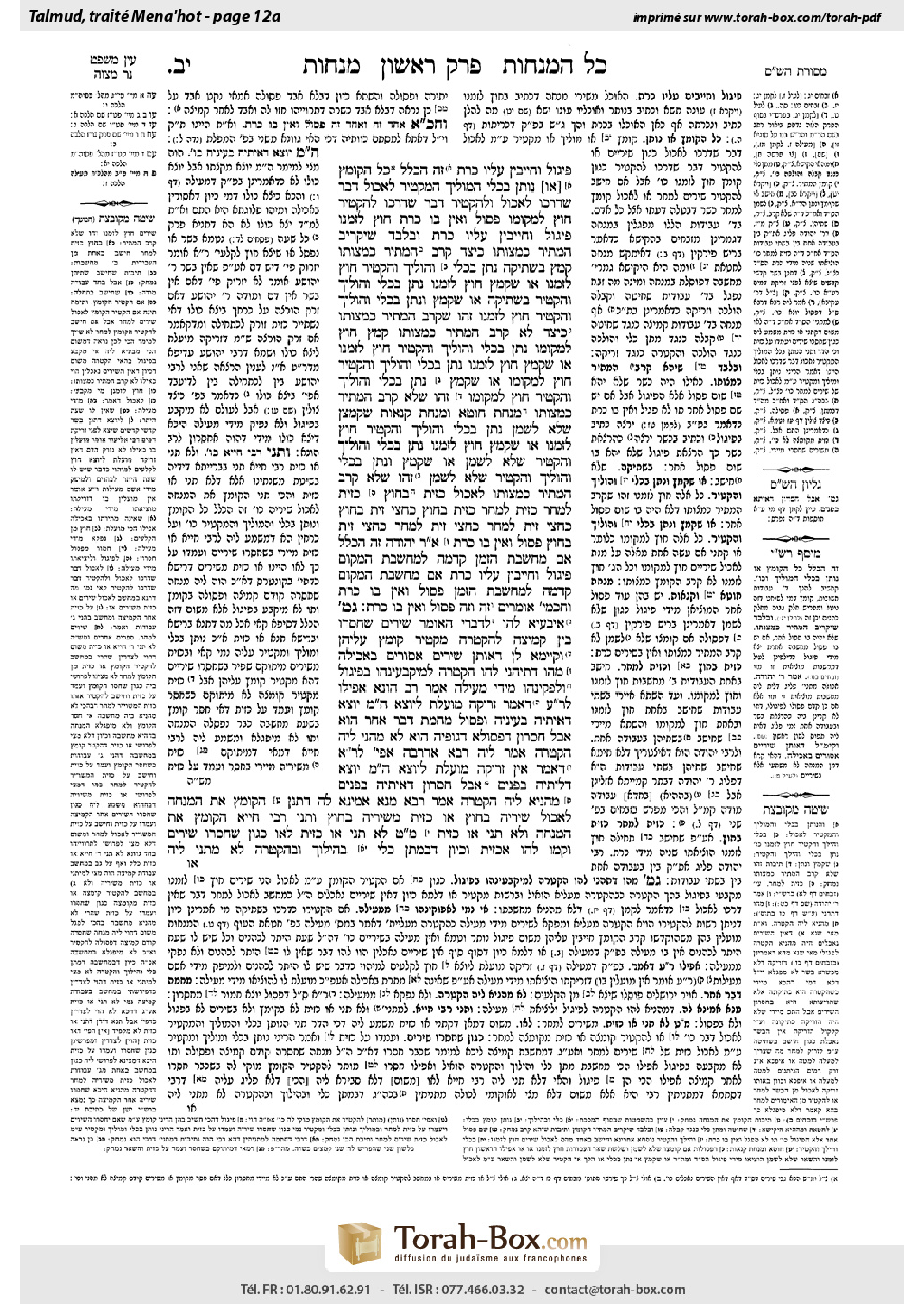
Menachot 12a: Talmud study for Daf Yomi
Daf Yomi is the daily study of one Talmud folio. Explore 37 tractates with scans, Hebrew text, Sefaria English and AI-generated French translations where annotated.
Passage selection and English or AI-generated French translation are available where the scan has annotations. Daf Study is independent of Torah-Box and Sefaria.
Browse Menachot · מנחות · All tractatesMenachot 12a text and translations
This page of Menachot includes the Aramaic text, an English translation and an AI-generated French translation, alongside the scan above.
מנחות י״ב א · Aramaic and Hebrew text
פִּיגּוּל, וְחַיָּיבִין עָלָיו כָּרֵת.
זֶה הַכְּלָל: כׇּל הַקּוֹמֵץ [אוֹ] נוֹתֵן בִּכְלִי, הַמּוֹלִיךְ, הַמַּקְטִיר, לֶאֱכוֹל דָּבָר שֶׁדַּרְכּוֹ לֶאֱכוֹל, וּלְהַקְטִיר דָּבָר שֶׁדַּרְכּוֹ לְהַקְטִיר, חוּץ לִמְקוֹמוֹ – פָּסוּל וְאֵין בּוֹ כָּרֵת, חוּץ לִזְמַנּוֹ – פִּיגּוּל וְחַיָּיבִין עָלָיו כָּרֵת, וּבִלְבַד שֶׁיַּקְרִיב הַמַּתִּיר כְּמִצְוָתוֹ.
כֵּיצַד קָרֵב הַמַּתִּיר כְּמִצְוָתוֹ? קָמַץ בִּשְׁתִיקָה, נָתַן בִּכְלִי וְהוֹלִיךְ וְהִקְטִיר חוּץ לִזְמַנּוֹ; אוֹ שֶׁקָּמַץ חוּץ לִזְמַנּוֹ, נָתַן בִּכְלִי וְהוֹלִיךְ וְהִקְטִיר בִּשְׁתִיקָה; אוֹ שֶׁקָּמַץ וְנָתַן בִּכְלִי וְהוֹלִיךְ וְהִקְטִיר חוּץ לִזְמַנּוֹ – זֶהוּ שֶׁקָּרֵב הַמַּתִּיר כְּמִצְוָתוֹ.
כֵּיצַד לֹא קָרַב הַמַּתִּיר כְּמִצְוָתוֹ? קָמַץ חוּץ לִמְקוֹמוֹ, נָתַן בִּכְלִי וְהוֹלִיךְ וְהִקְטִיר חוּץ לִזְמַנּוֹ, אוֹ שֶׁקָּמַץ חוּץ לִזְמַנּוֹ, נָתַן בִּכְלִי וְהוֹלִיךְ וְהִקְטִיר חוּץ לִמְקוֹמוֹ, אוֹ שֶׁקָּמַץ, נָתַן בִּכְלִי וְהוֹלִיךְ וְהִקְטִיר חוּץ לִמְקוֹמוֹ – זֶהוּ שֶׁלֹּא קָרַב הַמַּתִּיר כְּמִצְוָתוֹ.
מִנְחַת חוֹטֵא וּמִנְחַת קְנָאוֹת שֶׁקְּמָצָן שֶׁלֹּא לִשְׁמָן, נָתַן בִּכְלִי וְהוֹלִיךְ וְהִקְטִיר חוּץ לִזְמַנּוֹ; אוֹ שֶׁקָּמַץ חוּץ לִזְמַנּוֹ, נָתַן בִּכְלִי וְהוֹלִיךְ וְהִקְטִיר שֶׁלֹּא לִשְׁמָן; אוֹ שֶׁקָּמַץ וְנָתַן בִּכְלִי וְהוֹלִיךְ וְהִקְטִיר שֶׁלֹּא לִשְׁמָן – זֶהוּ שֶׁלֹּא קָרַב הַמַּתִּיר כְּמִצְוָתוֹ.
לֶאֱכוֹל כְּזַיִת בַּחוּץ כְּזַיִת לְמָחָר, כְּזַיִת לְמָחָר כְּזַיִת בַּחוּץ, כַּחֲצִי זַיִת בַּחוּץ כַּחֲצִי זַיִת לְמָחָר, כַּחֲצִי זַיִת לְמָחָר כַּחֲצִי זַיִת בַּחוּץ – פָּסוּל וְאֵין בּוֹ כָּרֵת.
אָמַר רַבִּי יְהוּדָה, זֶה הַכְּלָל: אִם מַחְשֶׁבֶת הַזְּמַן קָדְמָה לְמַחְשֶׁבֶת הַמָּקוֹם – פִּיגּוּל, וְחַיָּיבִין עָלָיו כָּרֵת. אִם מַחְשֶׁבֶת הַמָּקוֹם קָדְמָה לְמַחְשֶׁבֶת הַזְּמַן – פָּסוּל, וְאֵין בּוֹ כָּרֵת. וַחֲכָמִים אוֹמְרִים: זֶה וָזֶה פָּסוּל וְאֵין בּוֹ כָּרֵת.
גְּמָ׳ אִיבַּעְיָא לְהוּ, לְדִבְרֵי הָאוֹמֵר: שִׁירַיִם שֶׁחָסְרוּ בֵּין קְמִיצָה לְהַקְטָרָה מַקְטִיר קוֹמֶץ עֲלֵיהֶן, וְקַיְימָא לַן דְּאוֹתָן שִׁירַיִם אֲסוּרִים בַּאֲכִילָה, מַהוּ דְּתִיהַנֵּי לְהוּ הַקְטָרָה לְמִיקְבְּעִינְהוּ בְּפִיגּוּל?
(ולפקינהו) [וּלְאַפֹּקִינְהוּ] מִידֵי מְעִילָה?
אָמַר רַב הוּנָא: אֲפִילּוּ לְרַבִּי עֲקִיבָא דְּאָמַר ״זְרִיקָה מוֹעֶלֶת לַיּוֹצֵא״, הָנֵי מִילֵּי יוֹצֵא,
דְּאִיתֵיהּ בְּעֵינֵיהּ, וּפָסוּל מֵחֲמַת דָּבָר אַחֵר הוּא, אֲבָל חֶסְרוֹן, דִּפְסוּלָא דְּגוּפֵיהּ הוּא – לָא מַהְנְיָא לֵיהּ הַקְטָרָה.
אֲמַר לֵיהּ רָבָא: אַדְּרַבָּה, אֲפִילּוּ לְרַבִּי אֱלִיעֶזֶר דְּאָמַר ״אֵין זְרִיקָה מוֹעֶלֶת לַיּוֹצֵא״ – הָנֵי מִילֵּי יוֹצֵא, דְּלֵיתֵיהּ בִּפְנִים, אֲבָל חֶסְרוֹן דְּאִיתֵיהּ בִּפְנִים – מַהְנְיָא לֵיהּ הַקְטָרָה.
אָמַר רָבָא: מְנָא אָמֵינָא לַהּ, דִּתְנַן: הַקּוֹמֵץ אֶת הַמִּנְחָה לֶאֱכוֹל שְׁיָרֶיהָ בַּחוּץ אוֹ כְּזַיִת מִשְּׁיָרֶיהָ בַּחוּץ, וְתָנֵי רַבִּי חִיָּיא: הַקּוֹמֵץ אֶת הַמִּנְחָה, וְלָא תָּנֵי ״אוֹ כְּזַיִת״.
מַאי טַעְמָא לָא תָּנֵי ״אוֹ כְּזַיִת״? לָאו כְּגוֹן שֶׁחָסְרוּ שִׁירַיִם וְקָמוּ לְהוּ אַכְּזַיִת, וְכֵיוָן דִּבְמַתַּן כְּלִי, בְּהִילּוּךְ, וּבְהַקְטָרָה לָא מִתְּנֵי לֵיהּ
Menachot 12a · English translation
the offering is piggul, and one is liable to receive karet for partaking of the remainder of that meal offering.
This is the principle: In the case of anyone who removes the handful, or places the handful in the vessel, or who conveys the vessel with the handful to the altar, or who burns the handful on the altar, with the intent to partake of an item whose typical manner is such that one partakes of it, e.g., the remainder, or to burn an item whose typical manner is such that one burns it on the altar, e.g., the handful or the frankincense, outside its designated area, the meal offering is unfit but there is no liability for karet. If his intent was to do so beyond its designated time, the offering is piggul and one is liable to receive karet on account of it, provided that the permitting factor, i.e., the handful, was sacrificed in accordance with its mitzva. If the permitting factor was not sacrificed in accordance with its mitzva, although the meal offering is unfit, the prohibition of piggul does not apply to it.
How is the permitting factor considered to have been sacrificed in accordance with its mitzva? If one removed the handful in silence, i.e., with no specific intent, and placed it in the vessel, conveyed it, and burned the handful on the altar, with the intent to partake of the remainder beyond its designated time; or if one removed the handful with the intent to partake of the remainder or burn the handful or frankincense beyond its designated time, and placed it in the vessel, and conveyed it, and burned the handful on the altar in silence, with no specific intent; or if one removed the handful and placed it in the vessel, conveyed it, and burned the handful on the altar, with the intent to partake of the remainder beyond its designated time, that is the case of an offering whose permitting factor was sacrificed in accordance with its mitzva, and one is liable to receive karet for partaking of it due to piggul.
How is the permitting factor not sacrificed in accordance with its mitzva? If one removed the handful with the intent to partake of the remainder or burn the handful or frankincense outside its designated area, or placed it in the vessel, conveyed it, and burned the handful on the altar, with the intent to partake of the remainder beyond its designated time; or if one removed the handful with the intent to partake of the remainder or burn the handful or frankincense beyond its designated time, and placed it in the vessel, conveyed it, and burned the handful on the altar, with the intent to partake of the remainder outside its designated area; or if one removed the handful and placed it in the vessel, and conveyed it, and burned the handful on the altar, with the intent to partake of the remainder outside its designated area, that is the case of an offering whose permitting factor was not sacrificed in accordance with its mitzva.
The meal offering of a sinner and the meal offering of jealousy brought by a sota that one removed their handful not for their sake and placed it in the vessel, conveyed it, and burned the handful on the altar, with the intent to partake of the remainder or burn the handful beyond its designated time; or that one removed the handful with the intent to partake of the remainder or burn the handful beyond its designated time or placed it in the vessel, conveyed it, and burned the handful on the altar, not for their sake; or that one removed the handful, and placed it in the vessel, and conveyed it, and burned the handful on the altar, not for their sake, that is the case of an offering whose permitting factor was not sacrificed in accordance with its mitzva.
If one performed one of these rites with the intent to partake of an olive-bulk outside its designated area and an olive-bulk the next day, or an olive-bulk the next day and an olive-bulk outside its designated area, or half an olive-bulk outside its designated area and half an olive-bulk the next day, or half an olive-bulk the next day and half an olive-bulk outside its designated area, the offering is unfit but there is no liability for karet.
Rabbi Yehuda says that this is the principle: If the intent with regard to the time preceded the intent with regard to the area, the offering is piggul and one is liable to receive karet on account of it. If the intent with regard to the area preceded the intent with regard to the time, the offering is unfit but there is no liability for karet. And the Rabbis say: In both this case, where the intent with regard to time was first, and that case, where the intent with regard to area came first, the offering is unfit but there is no liability for karet.
GEMARA: A dilemma was raised before the Sages: According to the statement of the one who says that if the remainder of a meal offering became lacking between the removal of the handful and the burning of the handful on the altar the priest nevertheless burns the handful on account of such a meal offering, and as we maintain that despite the fact that the handful is burned on account of it that remainder is prohibited for consumption, what is the halakha with regard to piggul? Should the burning of the handful be effective in establishing such a remainder as piggul when the handful was burned with the intent to partake of the remainder the next day?
And similarly, is the burning of the handful effective in removing such a remainder from being subject to misuse of consecrated property, just as a complete remainder is removed from being subject to this prohibition after the burning of the handful, when it becomes permitted to the priests for consumption?
Rav Huna said: Even according to the opinion of Rabbi Akiva, who says that the sprinkling of the blood of an offering, which renders its meat permitted for consumption and removes it from being subject to misuse of consecrated property, is effective in removing the meat of an offering that left the Temple courtyard from being subject to misuse of consecrated property despite the fact that such meat is prohibited for consumption, that statement applies only when the meat was disqualified by means of leaving.
Rav Huna explains: The reason is that the meat remains as is, and the disqualification of the meat by means of leaving is on account of something else, i.e., a factor external to the meat itself. But in the case of a lack in the measure of the remainder of a meal offering, which is a disqualification on account of itself, the burning of the handful is not effective in removing the remainder from being subject to misuse of consecrated property, nor to establish it as piggul.
Rava said to Rav Huna: On the contrary; even according to the opinion of Rabbi Eliezer, who says that sprinkling is not effective in removing the meat that left the Temple courtyard from being subject to misuse of consecrated property, that statement applies only when the meat was disqualified by means of leaving, as the meat is not inside the Temple courtyard where the sprinkling could be effective for it. But with regard to a lack in the measure of the remainder of a meal offering that is inside the Temple courtyard, the burning of the handful is effective in removing the remainder from being subject to misuse of consecrated property as well as in establishing it as piggul.
Rava said: From where do I say that even remainders that lack a full measure can be rendered piggul? This can be inferred from that which we learned in the mishna: With regard to one who removes a handful from the meal offering with the intent to partake of its remainder outside the Temple courtyard or to partake of an olive-bulk of its remainder outside the Temple courtyard, the meal offering is unfit but there is no liability for karet, and if he removes a handful from the meal offering with the intent to partake of its remainder beyond the designated time or to partake of an olive-bulk of its remainder beyond the designated time the offering is piggul and one is liable to receive karet for partaking of the remainder of that meal offering. And Rabbi Ḥiyya teaches in his version of the mishna: One who removes a handful from the meal offering with the intent to partake of its remainder, and he does not teach: Or an olive-bulk of its remainder.
Rava continues: What is the reason that Rabbi Ḥiyya diverged from the standard text of the mishna and did not teach: Or an olive-bulk? Is it not because his mishna is discussing a case where the remainder later became lacking and its measure stood at an olive-bulk? And therefore Rabbi Ḥiyya did not include the clause: Or an olive-bulk, since later in the mishna, with regard to the placement of the handful in a vessel, and with regard to the conveyance of the vessel to the altar, and with regard to the burning of the handful, he could not teach the phrase:
Menachot 12a · Traduction française (IA)
L’offrande est piggul, et l’on encourt la peine de retranchement pour avoir consommé le reste de cette offrande végétale.
Voici le principe : si quelqu’un prélève la poignée, la dépose dans le récipient, transporte jusqu’à l’autel le récipient contenant la poignée ou brûle la poignée sur l’autel, avec l’intention de consommer hors du lieu qui lui est assigné un élément qui, par nature, est destiné à être consommé, par exemple le reste, ou de brûler hors du lieu qui lui est assigné un élément qui, par nature, est destiné à être brûlé sur l’autel, par exemple la poignée ou l’encens, l’offrande végétale est invalide, mais il n’encourt pas la peine de retranchement. Si son intention était d’agir ainsi après le délai qui lui est assigné, l’offrande est piggul et l’on encourt la peine de retranchement à cause d’elle, à condition que l’élément qui autorise la consommation, c’est-à-dire la poignée, ait été offert conformément à sa mitsva. Si cet élément n’a pas été offert conformément à sa mitsva, l’offrande végétale est invalide, mais l’interdiction liée au piggul ne s’applique pas.
Comment l’élément qui autorise la consommation est-il considéré comme ayant été offert conformément à sa mitsva ? Si l’on a prélevé la poignée sans intention particulière, puis qu’on l’a déposée dans le récipient, transportée et brûlée sur l’autel avec l’intention de consommer le reste après le délai qui lui est assigné ; ou si l’on a prélevé la poignée avec l’intention de consommer le reste, ou de brûler la poignée ou l’encens, après le délai qui leur est assigné, puis qu’on l’a déposée dans le récipient, transportée et brûlée sur l’autel sans intention particulière ; ou si l’on a prélevé la poignée, l’a déposée dans le récipient, l’a transportée et l’a brûlée sur l’autel avec l’intention de consommer le reste après le délai qui lui est assigné, c’est le cas d’une offrande dont l’élément qui autorise la consommation a été offert conformément à sa mitsva, et l’on encourt la peine de retranchement pour l’avoir consommée en raison du piggul.
Comment l’élément qui autorise la consommation n’a-t-il pas été offert conformément à sa mitsva ? Si l’on a prélevé la poignée avec l’intention de consommer le reste, ou de brûler la poignée ou l’encens, hors du lieu qui leur est assigné, puis qu’on l’a déposée dans le récipient, transportée et brûlée sur l’autel avec l’intention de consommer le reste après le délai qui lui est assigné ; ou si l’on a prélevé la poignée avec l’intention de consommer le reste, ou de brûler la poignée ou l’encens, après le délai qui leur est assigné, puis qu’on l’a déposée dans le récipient, transportée et brûlée sur l’autel avec l’intention de consommer le reste hors du lieu qui lui est assigné ; ou si l’on a prélevé la poignée, l’a déposée dans le récipient, l’a transportée et l’a brûlée sur l’autel avec l’intention de consommer le reste hors du lieu qui lui est assigné, c’est le cas d’une offrande dont l’élément qui autorise la consommation n’a pas été offert conformément à sa mitsva.
Dans le cas de l’offrande végétale du pécheur et de l’offrande végétale de jalousie apportée par une sota, si l’on en a prélevé la poignée sans les avoir en vue, puis qu’on l’a déposée dans le récipient, transportée et brûlée sur l’autel avec l’intention de consommer le reste ou de brûler la poignée après le délai qui leur est assigné ; ou si l’on a prélevé la poignée avec l’intention de consommer le reste ou de brûler la poignée après le délai qui leur est assigné, puis qu’on l’a déposée dans le récipient, transportée et brûlée sur l’autel sans les avoir en vue ; ou si l’on a prélevé la poignée, l’a déposée dans le récipient, l’a transportée et l’a brûlée sur l’autel sans les avoir en vue, c’est le cas d’une offrande dont l’élément qui autorise la consommation n’a pas été offert conformément à sa mitsva.
Si l’on a accompli l’un de ces rites avec l’intention de consommer un volume d’olive hors du lieu qui lui est assigné et un volume d’olive le lendemain, ou un volume d’olive le lendemain et un volume d’olive hors du lieu qui lui est assigné, ou un demi-volume d’olive hors du lieu qui lui est assigné et un demi-volume d’olive le lendemain, ou un demi-volume d’olive le lendemain et un demi-volume d’olive hors du lieu qui lui est assigné, l’offrande est invalide, mais il n’y a pas de peine de retranchement.
Rabbi Yehuda dit : Voici le principe : si l’intention concernant le délai a précédé celle concernant le lieu, l’offrande est piggul et l’on encourt la peine de retranchement à cause d’elle. Si l’intention concernant le lieu a précédé celle concernant le délai, l’offrande est invalide, mais il n’y a pas de peine de retranchement. Les Sages disent : dans les deux cas, que l’intention concernant le délai soit venue en premier ou que l’intention concernant le lieu soit venue en premier, l’offrande est invalide, mais il n’y a pas de peine de retranchement.
GUEMARA : Une question fut posée aux Sages : selon l’opinion de celui qui dit que, si le reste d’une offrande végétale a diminué entre le prélèvement de la poignée et sa combustion sur l’autel, le prêtre brûle néanmoins la poignée pour cette offrande, et puisque nous soutenons que, même si la poignée est brûlée pour cette offrande, il est interdit de consommer ce reste, quelle est la halakha concernant le piggul ? La combustion de la poignée peut-elle conférer le statut de piggul à un tel reste, lorsque la poignée a été brûlée avec l’intention de consommer le reste le lendemain ?
De même, la combustion de la poignée peut-elle soustraire un tel reste à l’interdiction de tirer profit des biens consacrés, tout comme un reste intact cesse d’être soumis à cette interdiction après la combustion de la poignée, lorsqu’il devient permis aux prêtres de le consommer ?
Rav Huna dit : même selon l’opinion de Rabbi Akiva, qui affirme que l’aspersion du sang d’une offrande — laquelle rend sa viande propre à la consommation et la soustrait à l’interdiction de tirer profit des biens consacrés — soustrait à cette interdiction la viande d’une offrande qui a quitté le parvis du Temple, bien que cette viande demeure interdite à la consommation, cette règle ne s’applique que lorsque la viande a été disqualifiée parce qu’elle a quitté le parvis.
Rav Huna explique : la raison en est que la viande demeure telle quelle et que sa disqualification due à sa sortie du parvis résulte d’un autre facteur, c’est-à-dire d’un élément extérieur à la viande elle-même. Mais lorsqu’il manque une quantité requise au reste d’une offrande végétale, ce qui constitue une disqualification intrinsèque, la combustion de la poignée ne soustrait pas le reste à l’interdiction de tirer profit des biens consacrés et ne lui confère pas non plus le statut de piggul.
Rava dit à Rav Huna : c’est le contraire. Même selon l’opinion de Rabbi Eliezer, qui affirme que l’aspersion ne soustrait pas à l’interdiction de tirer profit des biens consacrés la viande qui a quitté le parvis du Temple, cette règle ne s’applique que lorsque la viande a été disqualifiée parce qu’elle a quitté le parvis, puisqu’elle ne se trouve pas à l’intérieur du parvis du Temple, où l’aspersion pourrait produire son effet sur elle. En revanche, si une quantité requise manque au reste d’une offrande végétale qui se trouve à l’intérieur du parvis du Temple, la combustion de la poignée soustrait le reste à l’interdiction de tirer profit des biens consacrés et lui confère également le statut de piggul.
Rava dit : d’où est-ce que je déduis que même des restes auxquels il manque la mesure requise peuvent être rendus piggul ? On peut le déduire de ce que nous avons appris dans la Michna : si quelqu’un prélève une poignée de l’offrande végétale avec l’intention de consommer son reste hors du parvis du Temple ou d’en consommer un volume d’olive hors du parvis du Temple, l’offrande végétale est invalide, mais il n’y a pas de peine de retranchement ; et s’il prélève une poignée de l’offrande végétale avec l’intention de consommer son reste après le délai qui lui est assigné ou d’en consommer un volume d’olive après ce délai, l’offrande est piggul et l’on encourt la peine de retranchement pour avoir consommé le reste de cette offrande végétale. Or Rabbi Ḥiyya enseigne dans sa version de la Michna : « Celui qui prélève une poignée de l’offrande végétale avec l’intention de consommer son reste », sans ajouter : « ou un volume d’olive de son reste ».
Rava poursuit : pourquoi Rabbi Ḥiyya s’est-il écarté du texte courant de la Michna et n’a-t-il pas enseigné : « ou un volume d’olive » ? N’est-ce pas parce que sa Michna traite d’un cas où le reste a ensuite diminué, de sorte que sa quantité était d’un volume d’olive ? Rabbi Ḥiyya n’a donc pas inclus la clause « ou un volume d’olive », car plus loin dans la Michna, au sujet du dépôt de la poignée dans un récipient, du transport du récipient jusqu’à l’autel et de la combustion de la poignée, il n’aurait pas pu enseigner l’expression :
Traduction française générée par IA à partir de l’édition anglaise de Sefaria. Vérifie toujours un passage avec le texte source.
Text from Sefaria: William Davidson Edition - Vocalized Aramaic (unknown); William Davidson Edition - English (CC BY NC).