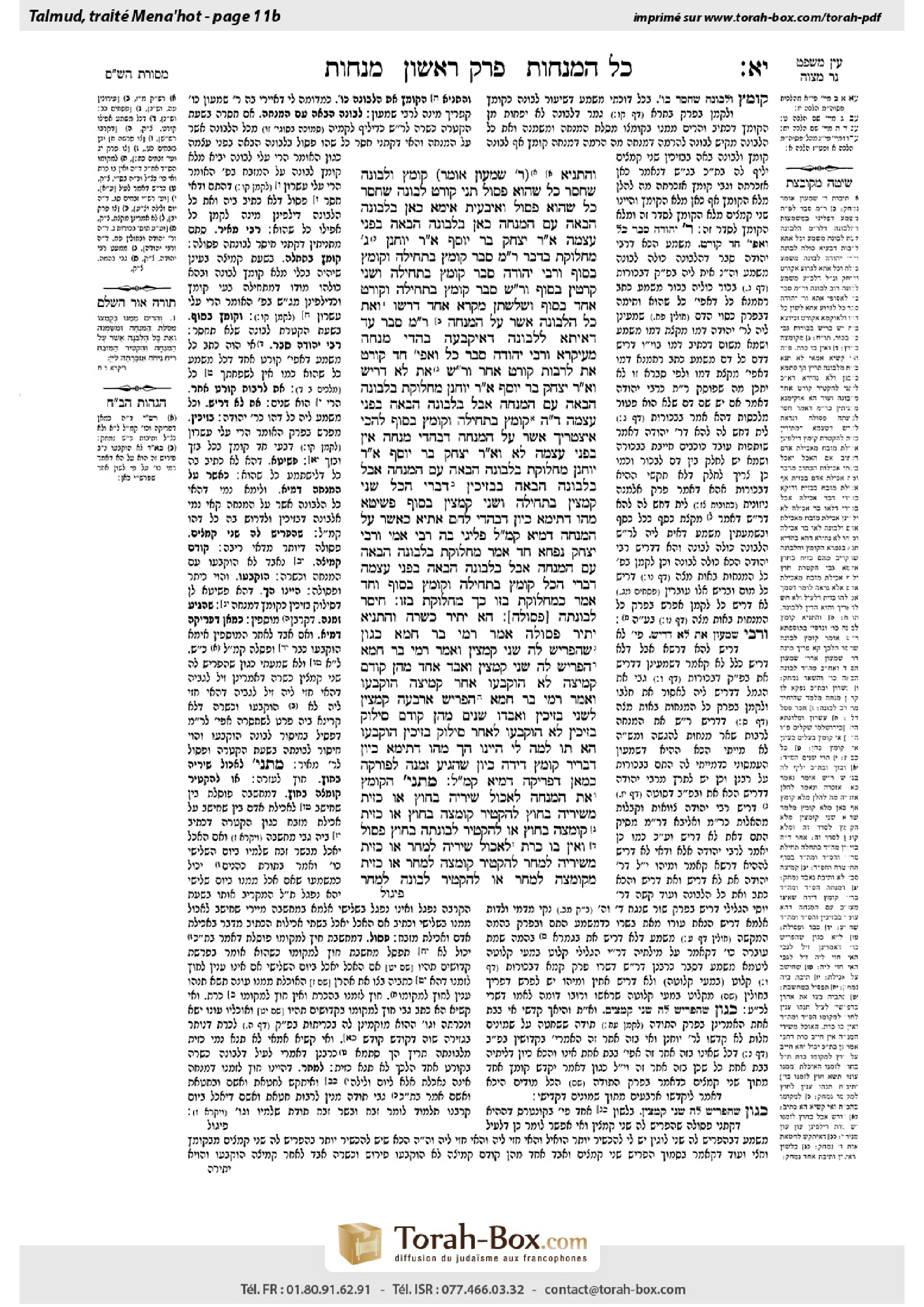
Menachot 11b: Talmud study for Daf Yomi
Daf Yomi is the daily study of one Talmud folio. Explore 37 tractates with scans, Hebrew text, Sefaria English and AI-generated French translations where annotated.
Passage selection and English or AI-generated French translation are available where the scan has annotations. Daf Study is independent of Torah-Box and Sefaria.
Browse Menachot · מנחות · All tractatesMenachot 11b text and translations
This page of Menachot includes the Aramaic text, an English translation and an AI-generated French translation, alongside the scan above.
מנחות י״א ב · Aramaic and Hebrew text
וְהָתַנְיָא (רַבִּי שִׁמְעוֹן אוֹמֵר): קוֹמֶץ לְבוֹנָה שֶׁחָסַר כׇּל שֶׁהוּא – פָּסוּל. תְּנִי: קוֹרֶט לְבוֹנָה שֶׁחָסַר כׇּל שֶׁהוּא – פָּסוּל. וְאִיבָּעֵית אֵימָא: כָּאן בִּלְבוֹנָה הַבָּאָה עִם הַמִּנְחָה, כָּאן בִּלְבוֹנָה הַבָּאָה בִּפְנֵי עַצְמָהּ.
אָמַר רַבִּי יִצְחָק בַּר יוֹסֵף, אָמַר רַבִּי יוֹחָנָן: שָׁלֹשׁ מַחְלוֹקֹת בַּדָּבָר, רַבִּי מֵאִיר סָבַר: קוֹמֵץ בַּתְּחִילָּה וְקוֹמֵץ בַּסּוֹף, וְרַבִּי יְהוּדָה סָבַר: קוֹמֶץ בַּתְּחִילָּה וּשְׁנֵי קְרָטִין בַּסּוֹף, וְרַבִּי שִׁמְעוֹן סָבַר: קוֹמֶץ בַּתְּחִילָּה וְקוֹרֶט אֶחָד בַּסּוֹף.
וּשְׁלׇשְׁתָּן מִקְרָא אֶחָד דָּרְשׁוּ, ״וְאֵת כׇּל הַלְּבוֹנָה אֲשֶׁר עַל הַמִּנְחָה״. רַבִּי מֵאִיר סָבַר: עַד דְּאִיתָא לִלְבוֹנָה דְּאִיקְּבַעָה בַּהֲדֵי מִנְחָה מֵעִיקָּרָא, וְרַבִּי יְהוּדָה סָבַר: ״כׇּל״ – וַאֲפִילּוּ חַד קוֹרֶט, ״אֶת״ – לְרַבּוֹת קוֹרֶט אַחֵר, וְרַבִּי שִׁמְעוֹן ״אֶת״ לָא דָּרֵישׁ.
וְאָמַר רַבִּי יִצְחָק בַּר יוֹסֵף, אָמַר רַבִּי יוֹחָנָן: מַחְלוֹקֶת בִּלְבוֹנָה הַבָּאָה עִם הַמִּנְחָה, אֲבָל בִּלְבוֹנָה הַבָּאָה בִּפְנֵי עַצְמָהּ – דִּבְרֵי הַכֹּל קוֹמֶץ בַּתְּחִילָּה וְקוֹמֶץ בַּסּוֹף. לְהָכִי אִיצְטְרִיךְ ״אֲשֶׁר עַל הַמִּנְחָה״, דְּבַהֲדֵי מִנְחָה – אִין, בִּפְנֵי עַצְמָהּ – לָא.
וְאָמַר רַבִּי יִצְחָק בַּר יוֹסֵף, אָמַר רַבִּי יוֹחָנָן: מַחְלוֹקֶת בִּלְבוֹנָה הַבָּאָה עִם הַמִּנְחָה, אֲבָל בִּלְבוֹנָה הַבָּאָה בְּבָזִיכִין – דִּבְרֵי הַכֹּל שְׁנֵי קְמָצִין בַּתְּחִילָּה, וּשְׁנֵי קְמָצִין בַּסּוֹף.
פְּשִׁיטָא, מַהוּ דְּתֵימָא: כֵּיוָן דְּבַהֲדֵי לֶחֶם אָתְיָא, כַּ״אֲשֶׁר עַל הַמִּנְחָה״ דָּמְיָא, קָא מַשְׁמַע לַן.
פְּלִיגִי בַּהּ רַבִּי אַמֵּי וְרַבִּי יִצְחָק נַפָּחָא, חַד אָמַר: מַחְלוֹקֶת בִּלְבוֹנָה הַבָּאָה עִם הַמִּנְחָה, אֲבָל בִּלְבוֹנָה הַבָּאָה בִּפְנֵי עַצְמָהּ – דִּבְרֵי הַכֹּל קוֹמֶץ בַּתְּחִילָּה וְקוֹמֶץ בַּסּוֹף, וְחַד אָמַר: כְּמַחְלוֹקֶת בָּזוֹ כָּךְ מַחְלוֹקֶת בָּזוֹ.
חִיסֵּר לְבוֹנָתָהּ – הָא יָתֵיר כְּשֵׁרָה, וְהָתַנְיָא: יָתֵיר פְּסוּלָה! אָמַר רָמֵי בַּר חָמָא: כְּגוֹן שֶׁהִפְרִישׁ לָהּ שְׁנֵי קְמָצִין.
וְאָמַר רָמֵי בַּר חָמָא: הִפְרִישׁ לָהּ שְׁנֵי קְמָצִין, וְאָבַד אֶחָד מֵהֶן קוֹדֶם קְמִיצָה – לֹא הוּקְבְּעוּ, אַחַר קְמִיצָה – הוּקְבְּעוּ.
וְאָמַר רָמֵי בַּר חָמָא: הִפְרִישׁ אַרְבָּעָה קְמָצִין לִשְׁנֵי בָּזִיכִין, וְאָבְדוּ שְׁנַיִם מֵהֶן קוֹדֶם סִילּוּק בָּזִיכִין – לָא הוּקְבְּעוּ, לְאַחַר סִילּוּק בָּזִיכִין – הוּקְבְּעוּ.
הָא תּוּ לְמָה לִי? הַיְינוּ הָךְ!
מַהוּ דְּתֵימָא: כֵּיוָן דִּבְרִיר קוֹמֶץ דִּידַהּ, כֵּיוָן שֶׁהִגִּיעַ זְמַנָּהּ לְפוֹרְקָהּ – כְּמַאן דִּפְרִיקָה דָּמְיָא, קָא מַשְׁמַע לַן.
מַתְנִי׳ הַקּוֹמֵץ אֶת הַמִּנְחָה לֶאֱכוֹל שְׁיָרֶיהָ בַּחוּץ, אוֹ כְּזַיִת מִשְּׁיָרֶיהָ בַּחוּץ, לְהַקְטִיר קוּמְצָהּ בַּחוּץ, אוֹ כְּזַיִת קוּמְצָהּ בַּחוּץ, אוֹ לְהַקְטִיר לְבוֹנָתָהּ בַּחוּץ – פָּסוּל, וְאֵין בּוֹ כָּרֵת. לֶאֱכוֹל שְׁיָרֶיהָ לְמָחָר, אוֹ כְּזַיִת מִשְּׁיָרֶיהָ לְמָחָר, לְהַקְטִיר קוּמְצָהּ לְמָחָר, אוֹ כְּזַיִת מִקּוּמְצָהּ לְמָחָר, אוֹ לְהַקְטִיר לְבוֹנָה לְמָחָר –
Menachot 11b · English translation
The Gemara asks: But isn’t it taught in a baraita that Rabbi Shimon says: A handful of flour or frankincense that was decreased by any amount from its full measure is disqualified? The Gemara answers that one should teach the baraita as follows: A pinch of frankincense that was decreased by any amount is disqualified. And if you wish, say instead that here, the first cited statement of Rabbi Shimon, is referring to the case of frankincense that comes with a meal offering, and this frankincense is disqualified only when there is less than a pinch, whereas there, the second statement of Rabbi Shimon, is referring to the case of frankincense that comes by itself. Such frankincense is disqualified if it comprises any less than its full measure.
Rabbi Yitzḥak bar Yosef says that Rabbi Yoḥanan says: There are three disputes of tanna’im with regard to the matter. Rabbi Meir holds that the priest must remove a handful at the beginning, and ultimately the entire handful must be burned upon the altar. And Rabbi Yehuda holds that the priest must remove a handful at the beginning, and ultimately at least two pinches from it must be burned upon the altar. And Rabbi Shimon holds that the priest must remove a handful at the beginning and ultimately at least one pinch from it must be burned upon the altar.
And all three of them interpret a single verse differently. The verse states: “And he shall take up from there his handful, of the fine flour of the meal offering, and of the oil of it, and [ve’et] all the frankincense that is upon the meal offering, and shall make it smoke upon the altar” (Leviticus 6:8). Rabbi Meir holds that one may not make the offering smoke upon the altar unless there remains the entire measure of frankincense that was initially fixed together with the meal offering. And Rabbi Yehuda holds that when the verse states: “All [kol],” it is referring to any part of the frankincense, even a single pinch, as kol can mean any amount (see II Kings 2:4). And when the verse states: “Et,” this serves to include another pinch. Accordingly, at least two pinches must remain to be burned upon the altar. And Rabbi Shimon interprets the word “all” in the same manner as does Rabbi Yehuda, but he does not interpret and derive a halakha from the term “et,” and he therefore holds that only one pinch must remain to be burned.
And Rabbi Yitzḥak bar Yosef further says that Rabbi Yoḥanan says: The dispute between these tanna’im is with regard to frankincense that comes with a meal offering. But with regard to frankincense that comes by itself, everyone, even Rabbi Yehuda and Rabbi Shimon, agrees that the priest must bring a handful at the beginning, and ultimately the entire handful must be burned upon the altar. For this reason it was necessary for the verse to state: “That is upon the meal offering,” as this indicates that together with a meal offering, yes, one may burn the frankincense even if there remains only a pinch or two, but with regard to frankincense that comes by itself, one may not burn it if it is in that state.
And Rabbi Yitzḥak bar Yosef says that Rabbi Yoḥanan says: The dispute between these tanna’im is with regard to frankincense that comes with a meal offering. But with regard to frankincense that comes in bowls together with the shewbread, everyone, even Rabbi Yehuda and Rabbi Shimon, agrees that there must be two handfuls in the beginning, one handful for each bowl, and ultimately there must also be two handfuls.
The Gemara asks: Isn’t it obvious that this is the case, as with regard to this halakha the verse does not state the term: All, from which one might derive that it is referring to any part of the frankincense? The Gemara explains: This ruling is necessary, lest you say that since the frankincense in the bowls comes together with bread, i.e., the shewbread, it should be considered as: “Frankincense that is upon the meal offering” (Leviticus 6:8), and therefore Rabbi Yehuda and Rabbi Shimon claim that one may sacrifice it even if less than two handfuls remain. Rabbi Yitzḥak bar Yosef teaches us that this is not the case.
The Gemara notes: Rabbi Ami and Rabbi Yitzḥak Nappaḥa disagree with regard to the case of frankincense that comes by itself. One says that the dispute between the tanna’im with regard to whether or not a handful of frankincense that became lacking may be sacrificed upon the altar applies only with regard to frankincense that comes with a meal offering, but with regard to frankincense that comes by itself, everyone agrees that the priest must remove a handful at the beginning and ultimately the entire handful must be burned upon the altar. And one says: Just as there is a dispute in this case, so too, there is a dispute in that case.
§ The mishna teaches that if the priest decreased its frankincense beyond its appropriate measure, the meal offering is unfit. The Gemara infers from this statement that if he increased its frankincense, it is fit. The Gemara asks: But isn’t it taught in a baraita that if he increased its frankincense the meal offering is disqualified? Rami bar Ḥama said: The baraita rules that the meal offering is disqualified in a case where he separated two handfuls of frankincense for the meal offering and placed both of them onto the meal offering.
And Rami bar Ḥama says: In a case where one separated two handfuls of frankincense for the meal offering and subsequently lost one of them, if it was lost before the removal of the handful of the meal offering, the additional frankincense was not fixed with the meal offering, and therefore it does not disqualify the meal offering. But if this occurred after the removal of the handful of the meal offering, since both handfuls were already fixed with the meal offering, it is disqualified, as he increased its frankincense by a large amount.
And Rami bar Ḥama says: In a case where one separated four handfuls of frankincense for placement in the two bowls that accompany the shewbread, and two of them were subsequently lost, the halakha depends on when they were lost. If they were lost before the removal of the bowls from the Table of the shewbread, then the additional frankincense was not yet fixed with the shewbread, and the frankincense remains fit for sacrifice. But if they were lost after the removal of the bowls, then all four handfuls were already fixed with the shewbread, and therefore the frankincense is disqualified.
The Gemara asks: Why do I also need this? This statement of Rami bar Ḥama is identical to that previous statement, as the burning of the frankincense permits the shewbread for consumption just as the frankincense permits the meal offering for consumption. Consequently, the removal of the bowls of frankincense is comparable to the removal of the handful from a meal offering.
The Gemara explains: The last statement of Rami bar Ḥama is necessary, lest you say that since the handful of frankincense of the shewbread is already considered designated for burning, as it is placed in a separate bowl and burned in its entirety, then once the time arrives for removing the bowls from upon the Table of the shewbread, it is considered as though the bowls were already removed, and the shewbread should therefore be disqualified on account of the additional frankincense. Therefore, Rami bar Ḥama teaches us that the additional handfuls disqualify the shewbread only if they were inside the bowls at the time of their actual removal from the Table.
MISHNA: With regard to one who removes a handful from the meal offering with the intent to partake of its remainder outside the Temple courtyard or to partake of an olive-bulk of its remainder outside the Temple courtyard, to burn its handful outside the Temple courtyard or to burn an olive-bulk of its handful outside the Temple courtyard, or to burn its frankincense outside the Temple courtyard, in all these cases the offering is unfit, but there is no liability for karet for one who partakes of it. If one had the intent to partake of its remainder on the next day or to partake of an olive-bulk of its remainder on the next day, to burn its handful on the next day or to burn an olive-bulk of its handful on the next day, or to burn its frankincense on the next day,
Menachot 11b · Traduction française (IA)
La Guemara demande : Mais n’est-il pas enseigné dans une baraïta que Rabbi Shimon dit : « Une poignée de farine ou d’encens qui a diminué, même d’une quantité infime, par rapport à sa mesure complète est disqualifiée » ? La Guemara répond qu’il faut enseigner la baraïta ainsi : « Une pincée d’encens qui a diminué, même d’une quantité infime, est disqualifiée. » Ou bien, si tu préfères, dis plutôt qu’ici, la première déclaration citée de Rabbi Shimon concerne l’encens qui accompagne une offrande de farine, et que cet encens n’est disqualifié que s’il en reste moins d’une pincée ; tandis que là, la seconde déclaration de Rabbi Shimon concerne l’encens qui est offert seul. Un tel encens est disqualifié s’il en reste moins que la mesure complète.
Rabbi Yitzḥak bar Yosef dit au nom de Rabbi Yoḥanan : Il y a trois divergences entre les tannaïm à ce sujet. Rabbi Meir estime que le prêtre doit prélever une poignée au départ et qu’en fin de compte, la poignée entière doit être brûlée sur l’autel. Rabbi Yehouda estime que le prêtre doit prélever une poignée au départ et qu’en fin de compte, au moins deux pincées doivent en être brûlées sur l’autel. Rabbi Shimon estime que le prêtre doit prélever une poignée au départ et qu’en fin de compte, au moins une pincée doit en être brûlée sur l’autel.
Tous trois interprètent différemment un même verset. Le verset dit : « Il en prélèvera sa poignée, de la fleur de farine de l’offrande de farine, de son huile et [ve’et] de tout l’encens qui se trouve sur l’offrande de farine, et il le fera brûler sur l’autel » (Lévitique 6:8). Rabbi Meir estime qu’on ne peut faire brûler l’offrande sur l’autel que s’il reste toute la mesure d’encens initialement fixée avec l’offrande de farine. Rabbi Yehouda estime que lorsque le verset dit « tout [kol] », il désigne n’importe quelle quantité d’encens, même une seule pincée, car kol peut signifier n’importe quelle quantité (voir II Rois 2:4). Le terme « et [et] » sert à inclure une pincée supplémentaire. Ainsi, il doit en rester au moins deux à brûler sur l’autel. Rabbi Shimon interprète le mot « tout » comme Rabbi Yehouda, mais il ne donne pas d’interprétation au terme « et » et n’en déduit aucune halakha ; il estime donc qu’il doit en rester une seule pincée à brûler.
Rabbi Yitzḥak bar Yosef dit encore au nom de Rabbi Yoḥanan : La divergence entre ces tannaïm concerne l’encens qui accompagne une offrande de farine. Mais, pour l’encens offert seul, tous, y compris Rabbi Yehouda et Rabbi Shimon, conviennent que le prêtre doit en apporter une poignée au départ et qu’en fin de compte, la poignée entière doit être brûlée sur l’autel. C’est pourquoi le verset devait préciser : « qui se trouve sur l’offrande de farine » ; cela indique que, lorsqu’il accompagne une offrande de farine, oui, on peut brûler l’encens même s’il n’en reste qu’une ou deux pincées, mais que l’encens offert seul ne peut pas être brûlé dans cet état.
Rabbi Yitzḥak bar Yosef dit au nom de Rabbi Yoḥanan : La divergence entre ces tannaïm concerne l’encens qui accompagne une offrande de farine. Mais, pour l’encens placé dans des coupes avec les pains de proposition, tous, y compris Rabbi Yehouda et Rabbi Shimon, conviennent qu’il faut deux poignées au départ, une poignée pour chaque coupe, et qu’en fin de compte, il doit aussi en rester deux poignées.
La Guemara demande : N’est-ce pas évident, puisque, dans le cas de cette halakha, le verset n’emploie pas le terme « tout », dont on aurait pu déduire qu’il vise n’importe quelle quantité d’encens ? La Guemara explique : Cette décision est nécessaire, de peur que tu ne dises que, puisque l’encens dans les coupes accompagne du pain, c’est-à-dire les pains de proposition, il doit être considéré comme « l’encens qui se trouve sur l’offrande de farine » (Lévitique 6:8) et que, par conséquent, Rabbi Yehouda et Rabbi Shimon soutiennent qu’on peut le sacrifier même s’il en reste moins de deux poignées. Rabbi Yitzḥak bar Yosef nous enseigne que ce n’est pas le cas.
La Guemara relève : Rabbi Ami et Rabbi Yitzḥak Nappaḥa sont en désaccord au sujet de l’encens offert seul. Selon l’un, la divergence entre les tannaïm sur la question de savoir si une poignée d’encens dont la quantité a diminué peut être sacrifiée sur l’autel ne concerne que l’encens qui accompagne une offrande de farine ; pour l’encens offert seul, tous conviennent que le prêtre doit prélever une poignée au départ et qu’en fin de compte, la poignée entière doit être brûlée sur l’autel. Selon l’autre, de même qu’il y a une divergence dans ce cas, il y en a aussi dans l’autre cas.
§ La Michna enseigne que si le prêtre a diminué la quantité d’encens au-dessous de la mesure requise, l’offrande de farine est impropre. La Guemara déduit de cette affirmation que s’il a augmenté la quantité d’encens, l’offrande est valide. La Guemara demande : Mais n’est-il pas enseigné dans une baraïta que s’il a augmenté la quantité d’encens, l’offrande de farine est disqualifiée ? Rami bar Ḥama dit : La baraïta statue que l’offrande de farine est disqualifiée dans le cas où le prêtre a mis à part deux poignées d’encens pour cette offrande et les a toutes deux déposées dessus.
Rami bar Ḥama dit : Dans le cas où quelqu’un a mis à part deux poignées d’encens pour l’offrande de farine et en a ensuite perdu une, si celle-ci a été perdue avant le prélèvement de la poignée de l’offrande de farine, l’encens supplémentaire n’avait pas été fixé avec l’offrande et ne la disqualifie donc pas. Mais si cela s’est produit après le prélèvement de la poignée de l’offrande de farine, les deux poignées ayant déjà été fixées avec l’offrande, celle-ci est disqualifiée, car la quantité d’encens a été augmentée dans une grande mesure.
Rami bar Ḥama dit : Dans le cas où quelqu’un a mis à part quatre poignées d’encens à placer dans les deux coupes qui accompagnent les pains de proposition, et que deux d’entre elles ont ensuite été perdues, la halakha dépend du moment où elles ont été perdues. Si elles l’ont été avant que les coupes ne soient retirées de la Table des pains de proposition, l’encens supplémentaire n’avait pas encore été fixé avec les pains de proposition, et l’encens reste apte au sacrifice. Mais si elles ont été perdues après le retrait des coupes, les quatre poignées avaient déjà été fixées avec les pains de proposition ; l’encens est donc disqualifié.
La Guemara demande : Pourquoi ai-je aussi besoin de cette déclaration ? Cette dernière déclaration de Rami bar Ḥama est identique à la précédente, puisque la combustion de l’encens rend les pains de proposition permis à la consommation, tout comme l’encens rend l’offrande de farine permise à la consommation. Par conséquent, le retrait des coupes d’encens est comparable au prélèvement de la poignée d’une offrande de farine.
La Guemara explique : La dernière déclaration de Rami bar Ḥama est nécessaire, de peur que tu ne dises que, puisque la poignée d’encens des pains de proposition est déjà considérée comme destinée à être brûlée — car elle est placée dans une coupe séparée et brûlée en entier —, dès que vient le moment de retirer les coupes de la Table des pains de proposition, c’est comme si elles avaient déjà été retirées ; les pains de proposition devraient donc être disqualifiés à cause de l’encens supplémentaire. Rami bar Ḥama nous enseigne donc que les poignées supplémentaires ne disqualifient les pains de proposition que si elles se trouvaient dans les coupes au moment où celles-ci ont effectivement été retirées de la Table.
MICHNA : Celui qui prélève une poignée de l’offrande de farine avec l’intention de consommer le reste hors du parvis du Temple, ou d’en consommer un volume d’olive hors du parvis du Temple, de brûler sa poignée hors du parvis du Temple ou d’en brûler un volume d’olive hors du parvis du Temple, ou de brûler son encens hors du parvis du Temple : dans tous ces cas, l’offrande est impropre, mais celui qui en consomme n’encourt pas la peine de retranchement. Si son intention était de consommer le reste le lendemain, ou d’en consommer un volume d’olive le lendemain, de brûler sa poignée le lendemain ou d’en brûler un volume d’olive le lendemain, ou de brûler son encens le lendemain,
Traduction française générée par IA à partir de l’édition anglaise de Sefaria. Vérifie toujours un passage avec le texte source.
Text from Sefaria: William Davidson Edition - Vocalized Aramaic (unknown); William Davidson Edition - English (CC BY NC).