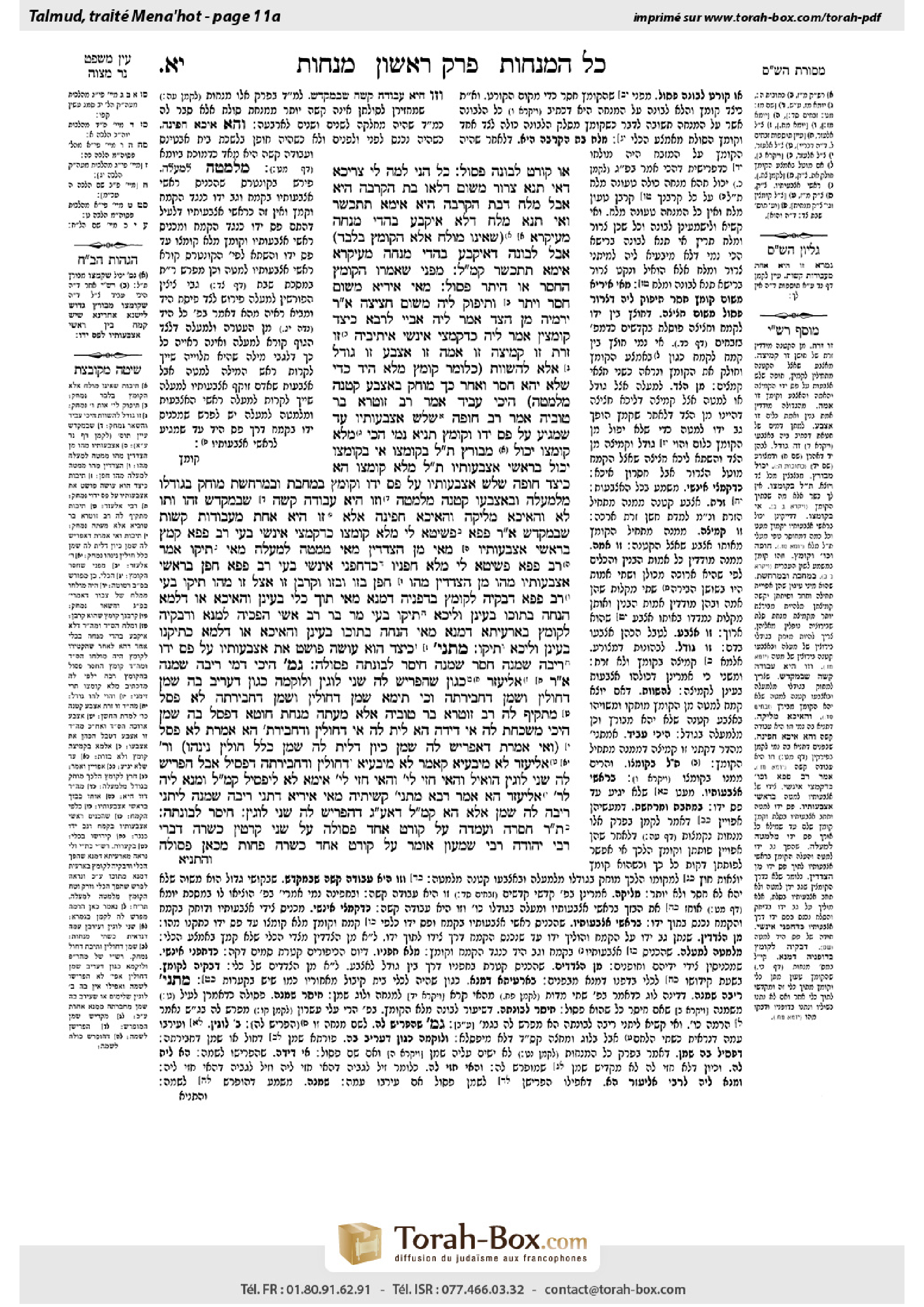
Menachot 11a: Talmud study for Daf Yomi
Daf Yomi is the daily study of one Talmud folio. Explore 37 tractates with scans, Hebrew text, Sefaria English and AI-generated French translations where annotated.
Passage selection and English or AI-generated French translation are available where the scan has annotations. Daf Study is independent of Torah-Box and Sefaria.
Browse Menachot · מנחות · All tractatesMenachot 11a text and translations
This page of Menachot includes the Aramaic text, an English translation and an AI-generated French translation, alongside the scan above.
מנחות י״א א · Aramaic and Hebrew text
אוֹ קוֹרֶט לְבוֹנָה – פָּסוּל. כֹּל הָנֵי לְמָה לִי?
צְרִיכָא, דְּאִי תְּנָא צְרוֹר – מִשּׁוּם דְּלָאו בַּת הַקְרָבָה הִיא, אֲבָל מֶלַח דְּבַת הַקְרָבָה הִיא – אֵימָא תִּתַּכְשַׁר.
וְאִי תְּנָא מֶלַח, דְּלָא אִיקְּבַע בַּהֲדֵי מִנְחָה מֵעִיקָּרָא (שֶׁאֵינוֹ מוֹלֵחַ אֶלָּא הַקּוֹמֶץ בִּלְבַד), אֲבָל לְבוֹנָה דְּאִיקְּבַע בַּהֲדֵי מִנְחָה מֵעִיקָּרָא – אֵימָא תִּתַּכְשַׁר, קָא מַשְׁמַע לַן.
מִפְּנֵי שֶׁאָמְרוּ: הַקּוֹמֶץ הֶחָסֵר אוֹ הַיָּתֵר פָּסוּל. מַאי אִירְיָא מִשּׁוּם חָסֵר וְיָתֵר? וְתִיפּוֹק לֵיהּ מִשּׁוּם חֲצִיצָה! אָמַר רַבִּי יִרְמְיָה: מִן הַצַּד.
אֲמַר לֵיהּ אַבָּיֵי לְרָבָא: כֵּיצַד קוֹמְצִין? אֲמַר לֵיהּ: כִּדְקָמְצִי אִינָשֵׁי. אֵיתִיבֵיהּ: זוֹ זֶרֶת, זוֹ קְמִיצָה.
זוֹ אַמָּה, זוֹ אֶצְבַּע, זוֹ גּוּדָל.
אֶלָּא לְהַשְׁווֹת, (כְּלוֹמַר, קוֹמֵץ מְלֹא הַיָּד כְּדֵי שֶׁלֹּא יְהֵא חָסֵר, וְאַחַר כָּךְ מוֹחֵק בְּאֶצְבַּע קְטַנָּה מִלְּמַטָּה).
הֵיכִי עָבֵיד? אָמַר רַב זוּטְרָא בַּר טוֹבִיָּה, אָמַר רַב: חוֹפֶה שְׁלֹשׁ אֶצְבְּעוֹתָיו, עַד שֶׁמַּגִּיעַ עַל פַּס יָדוֹ, וְקוֹמֵץ.
תַּנְיָא נָמֵי הָכִי: ״מְלֹא קֻמְצוֹ״ – יָכוֹל מְבוֹרָץ? תַּלְמוּד לוֹמַר ״בְּקֻמְצוֹ״.
אִי בְּקֻמְצוֹ, יָכוֹל בְּרָאשֵׁי אֶצְבְּעוֹתָיו? תַּלְמוּד לוֹמַר: ״מְלֹא קֻמְצוֹ״, הָא כֵּיצַד? חוֹפֶה שְׁלֹשׁ אֶצְבְּעוֹתָיו עַל פַּס יָדוֹ וְקוֹמֵץ.
בְּמַחֲבַת וּבְמַרְחֶשֶׁת, מוֹחֵק בְּגוּדָלוֹ מִלְּמַעְלָה וּבְאֶצְבָּעוֹ קְטַנָּה מִלְּמַטָּה, וְזוֹ הִיא עֲבוֹדָה קָשָׁה שֶׁבַּמִּקְדָּשׁ.
זֶהוּ וְתוּ לָא? וְהָאִיכָּא מְלִיקָה, וְהָאִיכָּא חֲפִינָה! אֶלָּא זוֹ הִיא אַחַת מֵעֲבוֹדוֹת קָשׁוֹת שֶׁבַּמִּקְדָּשׁ.
אָמַר רַב פָּפָּא: פְּשִׁיטָא לִי, ״מְלֹא קֻמְצוֹ״ כִּדְקָמְצִי אִינָשֵׁי. בָּעֵי רַב פָּפָּא: קָמַץ בְּרָאשֵׁי אֶצְבְּעוֹתָיו, מַאי?
מִן הַצְּדָדִין, מַאי? מִמַּטָּה לְמַעְלָה, מַאי? תֵּיקוּ.
אָמַר רַב פָּפָּא: פְּשִׁיטָא לִי, ״מְלֹא חׇפְנָיו״ כִּדְחָפְנִי אִינָשֵׁי. בָּעֵי רַב פָּפָּא: חָפַן בְּרָאשֵׁי אֶצְבְּעוֹתָיו מַהוּ? מִן הַצְּדָדִין מַהוּ? חָפַן בְּזוֹ וּבָזוֹ וְקֵרְבָן זוֹ אֵצֶל זוֹ מַהוּ? תֵּיקוּ.
בָּעֵי רַב פָּפָּא: דַּבְּקֵיהּ לְקוֹמֶץ בְּדַפְנֵיהּ דְּמָנָא, מַאי? תּוֹךְ כְּלִי בָּעֵינַן, וְהָאִיכָּא, אוֹ דִלְמָא הַנָּחָה בְּתוֹכוֹ בָּעֵינַן, וְלֵיכָּא? תֵּיקוּ.
בָּעֵי מָר בַּר רַב אָשֵׁי: הַפְכֵיהּ לְמָנָא, וְדַבְּקֵיהּ לְקוֹמֶץ בְּאַרְעִיתָא דְּמָנָא, מַאי? הַנָּחָה בְּתוֹכוֹ בָּעֵינַן, וְהָאִיכָּא, אוֹ דִלְמָא כְּתִיקְנוֹ בָּעִינַן, וְלֵיכָּא? תֵּיקוּ.
מַתְנִי׳ כֵּיצַד הוּא עוֹשֶׂה? פּוֹשֵׁט אֶת אֶצְבְּעוֹתָיו עַל פַּס יָדוֹ. רִיבָּה שַׁמְנָהּ, חִסֵּר שַׁמְנָהּ, חִיסֵּר לְבוֹנָתָהּ – פְּסוּלָה.
גְּמָ׳ הֵיכִי דָמֵי רִיבָּה שַׁמְנָהּ? אָמַר רַבִּי אֱלִיעֶזֶר: כְּגוֹן שֶׁהִפְרִישׁ לָהּ שְׁנֵי לוּגִּין. וְלוֹקְמַהּ כְּגוֹן דְּעָרֵיב בָּהּ שֶׁמֶן דְּחוּלִּין וָשֶׁמֶן דַּחֲבֶירְתַּהּ!
וְכִי תֵּימָא, שֶׁמֶן דְּחוּלִּין וָשֶׁמֶן דַּחֲבֶירְתַּהּ לָא פָּסֵל, מַתְקֵיף לַהּ רַב זוּטְרָא בַּר טוֹבִיָּה: אֶלָּא מֵעַתָּה, מִנְחַת חוֹטֵא דְּפָסֵל בָּהּ שֶׁמֶן, הֵיכִי מַשְׁכַּחַתְּ לַהּ?
אִי דִּידַהּ – הָא לֵית לַהּ, אִי דְּחוּלִּין וְדַחֲבֶירְתַּהּ – הָא אָמְרַתְּ לָא פָּסֵל, (וְאִי אָמְרַתְּ דְּאַפְרֵישׁ לֵהּ שֶׁמֶן – כֵּיוָן דְּלֵית לֵהּ שֶׁמֶן כְּלָל, חוּלִּין נִינְהוּ).
וְרַבִּי אֱלִיעֶזֶר לָא מִיבַּעְיָא קָאָמַר: לָא מִיבַּעְיָא דְּחוּלִּין וְדַחֲבֶירְתַּהּ דְּפָסֵיל, אֲבָל הִפְרִישׁ לָהּ שְׁנֵי לוּגִּין, הוֹאִיל וְהַאי חֲזֵי לֵיהּ וְהַאי חֲזֵי לֵיהּ, אֵימָא לָא לִיפְּסִיל – קָא מַשְׁמַע לַן.
וּמְנָא לֵיהּ לְרַבִּי אֱלִיעֶזֶר הָא? אָמַר רָבָא: מַתְנִיתִין קְשִׁיתֵיהּ, מַאי אִירְיָא דְּתָנֵי ״רִיבָּה שַׁמְנָהּ״? לִיתְנֵי ״רִיבָּה לָהּ שֶׁמֶן״! אֶלָּא הָא קָא מַשְׁמַע לַן, דְּאַף עַל גַּב דְּהִפְרִישׁ לָהּ שְׁנֵי לוּגִּין.
חִיסֵּר לְבוֹנָתָהּ. תָּנוּ רַבָּנַן: חָסְרָה וְעָמְדָה עַל קוֹרֶט אֶחָד – פְּסוּלָה, עַל שְׁנֵי קְרָטִין – כְּשֵׁרָה, דִּבְרֵי רַבִּי יְהוּדָה. רַבִּי שִׁמְעוֹן אוֹמֵר: עַל קוֹרֶט אֶחָד – כְּשֵׁרָה, פָּחוֹת מִכָּאן – פְּסוּלָה.
Menachot 11a · English translation
or a pinch of frankincense emerged in his hand, the meal offering is unfit, as the handful lacks a full measure on account of these items. The Gemara asks: Why do I need all these examples? Any one of them would convey the fact that the handful must contain a full measure.
The Gemara explains: All of the cases are necessary. Because if the mishna had taught only the example of a stone, it might have been thought that only a stone diminishes the measure of the handful, because it is not fit for sacrifice. But with regard to salt, which is fit for sacrifice, as the priest places salt on the handful before burning it upon the altar, one might say that the handful should be fit, as the salt should not subtract from the handful’s measure.
And if the mishna had taught only the example of salt, it might have been thought that the salt diminishes the handful’s measure as it was not initially fixed together with the entire meal offering. The reason is that the priest salts the handful alone. But with regard to the frankincense, which was initially fixed together with the entire meal offering, i.e., it is placed upon the meal offering before the priest removes a handful from it, one might say that the handful should be fit and the frankincense should not diminish from the handful’s measure. Therefore, the mishna teaches us that in any of these instances the meal offering is unfit.
§ The mishna teaches that if a stone, or a grain of salt, or a pinch of frankincense emerged in the priest’s hand together with the handful, the meal offering is unfit due to the fact that the Sages said: The handful that is lacking or that is outsized is unfit. The Gemara asks: Why does the tanna explain that the offering is not valid specifically because it is lacking or outsized? But let the tanna derive that such a handful is not valid due to the fact that there is an interposition between the priest’s hand and the handful. Rabbi Yirmeya says: Since there are certain instances where these items do not interpose between one’s hand and the handful, e.g., when they are located on the side of the handful, the mishna teaches that they disqualify the handful due to the fact that they reduce its measure.
§ Abaye said to Rava: How do the priests properly remove the handful from a meal offering? Rava said to him: They remove it as people normally remove handfuls, by folding all of their fingers over the palm of the hand. Abaye raised an objection to Rava from a baraita discussing the mitzva function of each of the fingers: This small finger is for measuring a span (see Exodus 28:16), i.e., the distance between the thumb and the little finger. This fourth finger is used for removal of a handful from the meal offering, i.e., the measurement of a handful begins from this finger, as the priest removes a handful by folding the middle three fingers over his palm.
Furthermore, this middle finger is used for measuring a cubit, the distance from the elbow to the tip of the middle finger. This forefinger, next to the thumb, is the finger used to sprinkle the blood of offerings on the altar. And finally, this thumb is the one on which the blood and oil is placed during the purification ritual of a leper (see Leviticus 14:17). Evidently, the little finger is not used in the removal of a handful.
The Gemara responds: The little finger is used only for the purposes of leveling the handful, that is to say, the priest first removes a handful with a full hand, i.e., all of his fingers, so that it should not be lacking in measure, and then he wipes away the protruding flour with his little finger from the bottom, and with his thumb from the top.
The Gemara asks: How is the removal of the handful performed? Rav Zutra bar Toviyya says that Rav says: When the priest places his hand in the meal offering, he bends his middle three fingers until the tips of his fingers reach over the palm of his hand, and he then removes the handful.
The Gemara notes that this is also taught in a baraita. From the verse that states: “And he shall remove from there his handful” (Leviticus 2:2), one might have thought that the handful should be overflowing. Therefore, another verse states: “And he shall take up from it with his handful [bekumtzo]” (Leviticus 6:8). The prefix that means “with” can also mean: In, indicating that the proper measure of a handful is that which is contained within one’s fingers alone.
The baraita continues: If the measurement of a handful is determined by the term “with his handful,” one might have thought that the priest removes a handful with his fingertips, i.e., that a handful consists of that which the priest removes by folding his fingers onto themselves. Therefore, the verse states: “His handful,” indicating that the handful must be full and not merely that which is contained within his fingers. How so? He scoops by closing his three fingers over the palm of his hand, and in this way takes a handful from the flour of the meal offering.
The baraita continues: In the case of a pan meal offering and that of a deep-pan meal offering, when the flour was fried before being scooped and was therefore hard, the priest wipes away with his thumb any flour that was overflowing above his handful, and with his little finger he wipes away the flour that was pushing out below. And this precise taking of the handful of a meal offering is the most difficult sacrificial rite in the Temple, as the priest must wipe away any protruding elements without removing any flour from the handful itself.
The Gemara asks: This one is the hardest sacrificial rite, and no other? But isn’t there pinching the nape of the neck of a bird offering, which is also considered extremely difficult to perform, and isn’t there the scooping of the handful of incense by the High Priest on Yom Kippur, another rite that is extremely difficult to perform? Rather, the baraita means that this taking of the handful of a meal offering is one of the most difficult sacrificial rites in the Temple.
Rav Pappa said: It is obvious to me that the term “his handful” means that the removal of the handful from a meal offering should be performed ab initio in the manner that people usually remove a handful, with their fingertips angled to the side. Rav Pappa raises a dilemma: What is the halakha if the priest removed a handful with his fingertips, i.e., if he placed his hand horizontally over the meal offering and filled his palm with flour by closing his fingers to his palm? Does this disqualify the taking of the handful or not?
Similarly, if the priest took a handful from the sides, by passing the back of his hand back and forth over the flour in the vessel so that the flour collected in his palm by way of the side of his palm, what is the halakha? Furthermore, if he took the handful with the back of his hand placed downward in the vessel, and with his fingers he collected the flour upward into his palm, what is the halakha? Are the handfuls removed in this manner fit for sacrifice? The Gemara states: These dilemmas shall stand unresolved.
Rav Pappa said: It is obvious to me that when the Torah states: “His handful” (Leviticus 16:12), in the context of the scooping of handfuls of incense by the High Priest on Yom Kippur, it means in the manner that people usually scoop a handful, by placing the backs of their hands into the vessel and bringing their hands together. Rav Pappa raises a dilemma: What is the halakha if the High Priest scooped a handful with his fingertips? What is the halakha if he took a handful from the sides? What is the halakha if he scooped a handful with this hand and with that hand separately and then brought them together? The Gemara states: These dilemmas shall stand unresolved.
Rav Pappa raises yet another dilemma: If the priest took the handful from the vessel containing the meal offering and stuck the handful onto the side of the second vessel in order to sanctify it, i.e., the handful was not placed directly into the vessel, what is the halakha? Do we require that the handful be inside the vessel, and that is the case here? Or perhaps we require that the handful be placed properly inside the vessel, and that is not the case in this instance. No answer is found, and the Gemara concludes: The dilemma shall stand unresolved.
Mar bar Rav Ashi raises a similar dilemma: If the priest overturned the vessel and stuck the handful to the underside of the vessel, in a case where there was an indentation on the underside, what is the halakha? Do we require that the handful be placed inside the vessel, and that requirement is fulfilled here, as the handful is within the indentation? Or perhaps we require that it be placed properly in the vessel, and that is not the case here. The Gemara states: The dilemma shall stand unresolved.
MISHNA: How does the priest perform the removal of a handful? He extends his fingers onto the palm of his hand. If one increased its oil, decreased its oil, or decreased its frankincense, beyond the appropriate measures, the meal offering is unfit.
GEMARA: What are the circumstances of a case where the meal offering is disqualified due to the fact that one increased its oil? Rabbi Eliezer says: The circumstances are a case where he separated two log of oil for the meal offering instead of one log, and mixed them into a tenth of an ephah of flour. The Gemara raises a difficulty: And let Rabbi Eliezer interpret the mishna as referring to a case where he mixed non-sacred oil or the oil of another meal offering into the meal offering.
And if you would say that non-sacred oil and the oil of another meal offering do not disqualify a meal offering, Rav Zutra bar Toviyya objects to this claim: If that is so, then with regard to the meal offering of a sinner, of which it is stated (59b) that oil disqualifies it, how can you find the circumstances where it is in fact disqualified?
Rav Zutra bar Toviyya elaborates: If you suggest that he mixed its own oil into the flour, such a case does not exist, as the meal offering of a sinner does not have any oil. If he mixed non-sacred oil or that of another meal offering into the flour, the meal offering should not be disqualified, as you said that such oil does not disqualify a meal offering. And if you would say that he designated oil for his meal offering and mixed it into the flour despite the Torah prohibition against mixing oil into it, I say that since the meal offering of a sinner does not have oil at all, any oil that he separates and mixes into it is considered non-sacred, and you have already said that non-sacred oil does not disqualify a meal offering.
The Gemara responds: In fact, non-sacred oil and the oil of another meal offering do disqualify a meal offering, and Rabbi Eliezer is speaking utilizing the style of: It is not necessary, as follows: It is not necessary to say that non-sacred oil and the oil of another meal offering disqualify a meal offering. But in a case where one separated two log for his meal offering, since this first log is fit for the meal offering, and that second log is also fit for it, one might say that even when he mixes both log into the meal offering, it should not disqualify the meal offering. Therefore, Rabbi Eliezer teaches us that the meal offering is disqualified in this case as well.
The Gemara asks: And from where does Rabbi Eliezer derive this conclusion? Rava said: The terminology of the mishna posed a difficulty for him, as one can ask: Why does the tanna specifically teach that the meal offering is disqualified if he increased its oil, which indicates that he increased it with oil belonging to the offering itself? Let the mishna teach simply: He increased the oil. Rather, this is what the mishna teaches us: That even though he initially separated two log of oil for the meal offering, its own oil disqualifies the offering when there is too much.
§ The mishna teaches that if one decreased its frankincense beyond its appropriate measure, the meal offering is unfit. Concerning this, the Sages taught in a baraita: If one decreased its frankincense to the point that the amount stood at only one pinch, it is disqualified, but if the decreased amount stood at two pinches, it is fit; this is the statement of Rabbi Yehuda. Rabbi Shimon says: If the decreased amount stood at one pinch, it is fit; less than that, it is disqualified.
Menachot 11a · Traduction française (IA)
ou une pincée d’encens apparut dans sa main, l’offrande de farine est invalide, car la poignée n’atteint pas la mesure requise à cause de ces éléments. La Guemara demande : Pourquoi tous ces exemples sont-ils nécessaires ? Un seul aurait suffi à établir que la poignée doit contenir une mesure complète.
La Guemara explique : Tous ces cas sont nécessaires. En effet, si la Michna avait enseigné seulement l’exemple d’une pierre, on aurait pu penser que seule une pierre diminue la mesure de la poignée, parce qu’elle n’est pas propre à être offerte. Mais pour le sel, qui peut être offert, puisque le prêtre en met sur la poignée avant de la brûler sur l’autel, on aurait pu dire que la poignée est valide, car le sel ne devrait pas en diminuer la mesure.
Et si la Michna avait enseigné seulement l’exemple du sel, on aurait pu penser qu’il diminue la mesure de la poignée parce qu’il n’avait pas été associé dès le départ à l’ensemble de l’offrande de farine. En effet, le prêtre sale uniquement la poignée. Mais pour l’encens, qui avait été associé dès le départ à l’ensemble de l’offrande de farine, c’est-à-dire qu’il est placé sur celle-ci avant que le prêtre n’en prélève une poignée, on aurait pu dire que la poignée est valide et que l’encens ne devrait pas en diminuer la mesure. La Michna nous enseigne donc que, dans chacun de ces cas, l’offrande de farine est invalide.
§ La Michna enseigne que si une pierre, un grain de sel ou une pincée d’encens apparut dans la main du prêtre avec la poignée, l’offrande de farine est invalide, car les Sages ont dit : Une poignée dont la mesure est insuffisante ou excessive est invalide. La Guemara demande : Pourquoi le tanna explique-t-il que l’offrande est invalide précisément parce que la mesure est insuffisante ou excessive ? Le tanna ne pourrait-il pas déduire qu’une telle poignée est invalide parce qu’il y a interposition entre la main du prêtre et la poignée ? Rabbi Yirmeya dit : Puisqu’il existe des cas où ces éléments ne s’interposent pas entre la main et la poignée, par exemple lorsqu’ils se trouvent sur le côté de la poignée, la Michna enseigne qu’ils invalident la poignée parce qu’ils en réduisent la mesure.
§ Abaye dit à Rava : Comment les prêtres prélèvent-ils correctement une poignée d’une offrande de farine ? Rava lui répond : Ils la prélèvent comme on le fait habituellement, en repliant tous les doigts sur la paume. Abaye objecte à Rava en citant une baraïta qui traite de la fonction de chaque doigt dans le service des mitsvot : Le petit doigt sert à mesurer un empan (voir Exode 28:16), c’est-à-dire la distance entre le pouce et le petit doigt. Le quatrième doigt sert à prélever une poignée de l’offrande de farine ; autrement dit, la mesure de la poignée commence à partir de ce doigt, car le prêtre la prélève en repliant ses trois doigts du milieu sur la paume.
En outre, le majeur sert à mesurer une coudée, distance entre le coude et l’extrémité du majeur. L’index, à côté du pouce, est le doigt qui sert à asperger le sang des sacrifices sur l’autel. Enfin, c’est sur le pouce que l’on place le sang et l’huile lors du rituel de purification d’un lépreux (voir Lévitique 14:17). Il ressort de là que le petit doigt ne sert pas à prélever une poignée.
La Guemara répond : Le petit doigt sert uniquement à égaliser la poignée. Autrement dit, le prêtre prélève d’abord une poignée avec toute sa main, c’est-à-dire avec tous ses doigts, afin que la mesure ne soit pas insuffisante, puis il enlève la farine qui dépasse par le bas avec son petit doigt et celle qui dépasse par le haut avec son pouce.
La Guemara demande : Comment procède-t-on au prélèvement de la poignée ? Rav Zutra bar Toviyya dit au nom de Rav : Lorsque le prêtre plonge la main dans l’offrande de farine, il replie ses trois doigts du milieu jusqu’à ce que leur extrémité atteigne la paume, puis il prélève la poignée.
La Guemara note que cela est également enseigné dans une baraïta. À partir du verset qui dit : « Il en prélèvera une poignée » (Lévitique 2:2), on aurait pu penser que la poignée doit déborder. C’est pourquoi un autre verset dit : « Il en prélèvera une poignée [bekumtzo] » (Lévitique 6:8). Le préfixe qui signifie « avec » peut aussi signifier « dans », ce qui indique que la mesure convenable d’une poignée est celle qui tient uniquement entre les doigts.
La baraïta poursuit : Si l’expression « avec sa poignée » détermine la mesure de la poignée, on aurait pu penser que le prêtre la prélève du bout des doigts, c’est-à-dire qu’elle se limite à ce qu’il recueille en repliant ses doigts sur eux-mêmes. C’est pourquoi le verset dit : « Sa poignée », ce qui indique que la poignée doit être pleine et ne se limite pas à ce qui est contenu entre ses doigts. Comment procède-t-il ? Il prélève la farine en repliant ses trois doigts sur la paume, et prend ainsi une poignée de l’offrande de farine.
La baraïta poursuit : Dans le cas d’une offrande de farine cuite à la poêle ou dans un plat profond, lorsque la farine avait été frite avant d’être prélevée et était donc dure, le prêtre enlève avec son pouce la farine qui déborde au-dessus de sa poignée et, avec son petit doigt, celle qui dépasse par le bas. Le prélèvement précis de la poignée d’une offrande de farine est le rite sacrificiel le plus difficile à accomplir dans le Temple, car le prêtre doit enlever tout ce qui dépasse sans retirer de farine de la poignée elle-même.
La Guemara demande : Est-ce le seul rite sacrificiel le plus difficile ? Mais il y a aussi l’égorgement à la nuque d’un oiseau offert en sacrifice, qui est également considéré comme extrêmement difficile à accomplir, ainsi que le prélèvement d’une poignée d’encens par le Grand Prêtre à Yom Kippour, un autre rite extrêmement difficile. La baraïta veut plutôt dire que le prélèvement de la poignée d’une offrande de farine compte parmi les rites sacrificiels les plus difficiles du Temple.
Rav Pappa dit : Il m’est évident que l’expression « sa poignée » signifie qu’a priori, le prélèvement d’une poignée d’une offrande de farine doit se faire de la manière habituelle, les doigts inclinés sur le côté. Rav Pappa soulève un dilemme : Quelle est la halakha si le prêtre prélève une poignée du bout des doigts, c’est-à-dire s’il place sa main à l’horizontale au-dessus de l’offrande de farine et remplit sa paume de farine en repliant ses doigts vers celle-ci ? Le prélèvement de la poignée est-il invalide ou non ?
De même, quelle est la halakha s’il prend une poignée sur les côtés, en faisant passer le dos de sa main d’avant en arrière sur la farine dans le récipient, de sorte que la farine s’accumule dans sa paume par le côté de celle-ci ? En outre, quelle est la halakha s’il prend la poignée en plaçant le dos de sa main vers le bas dans le récipient, puis recueille la farine avec ses doigts en la ramenant vers le haut dans sa paume ? Les poignées prélevées de ces manières sont-elles aptes au sacrifice ? La Guemara dit : Ces dilemmes restent sans réponse.
Rav Pappa dit : Il m’est évident que lorsque la Torah dit : « Sa poignée » (Lévitique 16:12), à propos du prélèvement de poignées d’encens par le Grand Prêtre à Yom Kippour, cela signifie que la poignée doit être prélevée de la manière habituelle, en plaçant le dos des mains dans le récipient et en rapprochant celles-ci. Rav Pappa soulève un dilemme : Quelle est la halakha si le Grand Prêtre prélève une poignée du bout des doigts ? Quelle est la halakha s’il en prend une sur les côtés ? Quelle est la halakha s’il prélève une poignée avec chaque main séparément, puis les réunit ? La Guemara dit : Ces dilemmes restent sans réponse.
Rav Pappa soulève un autre dilemme : Si le prêtre prélève la poignée dans le récipient contenant l’offrande de farine et la colle sur le côté d’un second récipient afin de la sanctifier, c’est-à-dire sans la déposer directement dans le récipient, quelle est la halakha ? Faut-il que la poignée se trouve à l’intérieur du récipient, condition remplie ici ? Ou faut-il qu’elle soit déposée correctement à l’intérieur du récipient, ce qui n’est pas le cas ici ? Aucune réponse n’est trouvée, et la Guemara conclut : Le dilemme reste sans réponse.
Mar bar Rav Ashi soulève un dilemme semblable : Si le prêtre retourne le récipient et colle la poignée sur sa face inférieure, dans un cas où celle-ci comporte un creux, quelle est la halakha ? Faut-il que la poignée soit placée à l’intérieur du récipient, condition remplie ici puisque la poignée se trouve dans le creux ? Ou faut-il qu’elle soit placée correctement dans le récipient, ce qui n’est pas le cas ici ? La Guemara dit : Le dilemme reste sans réponse.
MICHNA : Comment le prêtre prélève-t-il une poignée ? Il replie ses doigts sur la paume de sa main. Si l’on a augmenté ou diminué la quantité d’huile, ou diminué la quantité d’encens, au-delà des mesures prescrites, l’offrande de farine est invalide.
GUEMARA : Dans quelles circonstances une offrande de farine est-elle invalidée parce qu’on y a ajouté trop d’huile ? Rabbi Eliezer dit : Il s’agit du cas où l’on a mis de côté deux log d’huile pour l’offrande de farine au lieu d’un log, et où on les a mélangés à un dixième d’épha de farine. La Guemara soulève une difficulté : Rabbi Eliezer ne pourrait-il pas interpréter la Michna comme parlant du cas où l’on a mélangé à l’offrande de farine de l’huile profane ou l’huile d’une autre offrande de farine ?
Et si tu dis que l’huile profane et l’huile d’une autre offrande de farine n’invalident pas une offrande de farine, Rav Zutra bar Toviyya objecte à cette affirmation : S’il en est ainsi, dans le cas de l’offrande de farine du pécheur, dont il est dit (59b) que l’huile l’invalide, comment peut-on trouver des circonstances où elle est effectivement invalidée ?
Rav Zutra bar Toviyya développe : Si tu suggères qu’il a mélangé à la farine l’huile qui lui était destinée, un tel cas n’existe pas, car l’offrande de farine du pécheur ne contient pas d’huile. S’il a mélangé à la farine de l’huile profane ou celle d’une autre offrande de farine, l’offrande ne devrait pas être invalidée, puisque tu as dit que cette huile n’invalide pas une offrande de farine. Et si tu dis qu’il a réservé de l’huile pour son offrande de farine et l’a mélangée à la farine, malgré l’interdiction de la Torah d’y mélanger de l’huile, je réponds que, puisque l’offrande de farine du pécheur ne contient aucune huile, toute huile qu’il met de côté et mélange à celle-ci est considérée comme profane ; or tu as déjà dit que l’huile profane n’invalide pas une offrande de farine.
La Guemara répond : En réalité, l’huile profane et l’huile d’une autre offrande de farine invalident une offrande de farine, et Rabbi Eliezer s’exprime selon le raisonnement du « ce n’est pas nécessaire », comme suit : Il n’est pas nécessaire de dire que l’huile profane et l’huile d’une autre offrande de farine invalident une offrande de farine. Mais dans le cas où l’on a mis de côté deux log pour son offrande de farine, puisque ce premier log lui convient et que le second lui convient également, on aurait pu dire que même mélangés à l’offrande de farine, les deux log ne l’invalident pas. Rabbi Eliezer nous enseigne donc que, dans ce cas aussi, l’offrande de farine est invalidée.
La Guemara demande : Et de quoi Rabbi Eliezer déduit-il cette conclusion ? Rava dit : La formulation de la Michna lui posait problème, car on peut demander : Pourquoi le tanna enseigne-t-il précisément que l’offrande de farine est invalidée si l’on a augmenté sa quantité d’huile, ce qui indique qu’on l’a augmentée avec l’huile propre à l’offrande ? Que la Michna dise simplement : « Il a augmenté la quantité d’huile. » La Michna nous enseigne plutôt ceci : même si l’on a mis de côté dès le départ deux log d’huile pour l’offrande de farine, l’excès de sa propre huile invalide l’offrande.
§ La Michna enseigne que si l’on a diminué la quantité d’encens au-delà de la mesure prescrite, l’offrande de farine est invalide. À ce propos, les Sages enseignent dans une baraïta : Si l’on a réduit l’encens au point qu’il ne reste qu’une pincée, l’offrande est invalide ; mais si la quantité réduite est de deux pincées, elle est valide. Telle est la déclaration de Rabbi Yehuda. Rabbi Shimon dit : Si la quantité réduite est d’une pincée, elle est valide ; en dessous de cette quantité, elle est invalide.
Traduction française générée par IA à partir de l’édition anglaise de Sefaria. Vérifie toujours un passage avec le texte source.
Text from Sefaria: William Davidson Edition - Vocalized Aramaic (unknown); William Davidson Edition - English (CC BY NC).