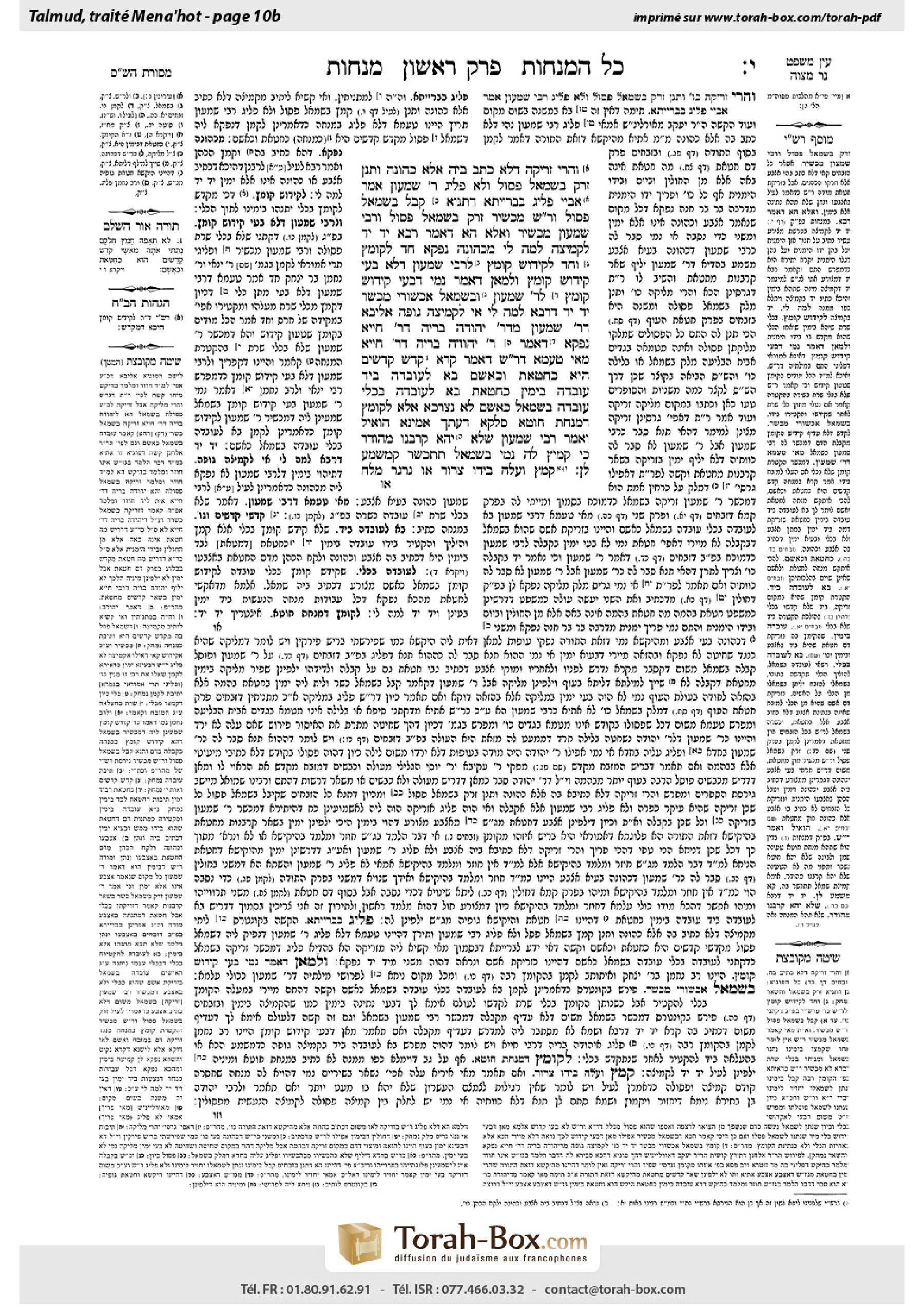
Menachot 10b: Talmud study for Daf Yomi
Daf Yomi is the daily study of one Talmud folio. Explore 37 tractates with scans, Hebrew text, Sefaria English and AI-generated French translations where annotated.
Passage selection and English or AI-generated French translation are available where the scan has annotations. Daf Study is independent of Torah-Box and Sefaria.
Browse Menachot · מנחות · All tractatesMenachot 10b text and translations
This page of Menachot includes the Aramaic text, an English translation and an AI-generated French translation, alongside the scan above.
מנחות י׳ ב · Aramaic and Hebrew text
וַהֲרֵי זְרִיקָה דְּלָא כְּתִיב בַּיהּ אֶלָּא כְּהוּנָּה, וּתְנַן: זָרַק בִּשְׂמֹאל פָּסוּל, וְלָא פְּלִיג רַבִּי שִׁמְעוֹן? אָמַר אַבָּיֵי: פְּלִיג בְּבָרַיְיתָא, דְּתַנְיָא: קִבֵּל בִּשְׂמֹאל פָּסוּל, וְרַבִּי שִׁמְעוֹן מַכְשִׁיר; זָרַק בִּשְׂמֹאל פָּסוּל, וְרַבִּי שִׁמְעוֹן מַכְשִׁיר.
וְאֶלָּא, הָא דְּאָמַר רָבָא: ״יָד״ ״יָד״ לִקְמִיצָה, לְמָה לִי? מִכְּהוּנָּה נָפְקָא!
חַד לְקוֹמֶץ, וְחַד לְקִידּוּשׁ קוֹמֶץ.
לְרַבִּי שִׁמְעוֹן דְּלָא בָּעֵי קִידּוּשׁ קוֹמֶץ, וּלְמַאן דְּאָמַר נָמֵי דְּבָעֵי קִידּוּשׁ קוֹמֶץ לְרַבִּי שִׁמְעוֹן, וּבִשְׂמֹאל אַכְשׁוֹרֵי מַכְשַׁר – ״יָד״ ״יָד״ דְּרָבָא לְמָה לִי?
אִי לִקְמִיצָה גּוּפַהּ, אַלִּיבָּא דְּרַבִּי שִׁמְעוֹן, מִדְּרַבִּי יְהוּדָה בְּרֵיהּ דְּרַבִּי חִיָּיא נָפְקָא, דְּאָמַר רַבִּי יְהוּדָה בְּרֵיהּ דְּרַבִּי חִיָּיא: מַאי טַעְמָא דְּרַבִּי שִׁמְעוֹן? דְּאָמַר קְרָא: ״קֹדֶשׁ קָדָשִׁים הִיא כַּחַטָּאת וְכָאָשָׁם״.
בָּא לְעוֹבְדָהּ בַּיָּד – עוֹבְדָהּ בְּיָמִין, כְּחַטָּאת; בָּא לְעוֹבְדָהּ בִּכְלִי – עוֹבְדָהּ בִּשְׂמֹאל, כְּאָשָׁם.
לֹא נִצְרְכָא אֶלָּא לְקוֹמֶץ דְּמִנְחַת חוֹטֵא, סָלְקָא דַּעְתָּךְ אָמֵינָא: הוֹאִיל וְאָמַר רַבִּי שִׁמְעוֹן שֶׁלֹּא יְהֵא קׇרְבָּנוֹ מְהוּדָּר, כִּי קָמֵיץ לַהּ נָמֵי בִּשְׂמֹאל תִּתַּכְשַׁר, קָמַשְׁמַע לַן.
קָמַץ וְעָלָה בְּיָדוֹ צְרוֹר, אוֹ גַרְגֵּר מֶלַח,
Menachot 10b · English translation
The Gemara asks: But isn’t there the sprinkling of the blood, concerning which only the priesthood is written in the verse, and we learned: If one sprinkled the blood with his left hand it is disqualified; and Rabbi Shimon does not disagree with this ruling, indicating that Rabbi Shimon holds that a mention of the priesthood does not require a mention of the word finger? Abaye says: He disagrees with this ruling in a baraita, as it is taught in a baraita: If one collected the blood with his left hand it is disqualified, and Rabbi Shimon deems it fit. Additionally, if one sprinkled the blood with his left hand it is disqualified, and Rabbi Shimon deems it fit.
The Gemara asks: But that which Rava says with regard to the superfluous terms in the passage discussing a leper: One derives a verbal analogy between the word “hand” written in that passage and the word “hand” written with regard to the removal of a handful from a meal offering, to indicate that the latter must also be performed with the right hand, why do I need this verbal analogy? One can derive that the handful must be removed with the right hand from the verse’s mention of the priesthood, as it is stated: “And the priest shall remove his handful” (Leviticus 5:12).
The Gemara responds: Both derivations are necessary, one for the removal of the handful from a meal offering, and one for the sanctification of the handful, i.e., placing it into a second service vessel. Both must be performed with the right hand.
The Gemara asks: And according to Rabbi Shimon, who does not require sanctification of the handful, or according to the one who says that Rabbi Shimon also requires the sanctification of the handful but that he deems the sanctification fit when performed with the left hand (see 26a), why do I need the verbal analogy of Rava between “hand” and “hand”?
If one suggests that it is necessary to indicate that the removal of the handful itself must be performed with the right hand, this cannot be, since this is derived from the verse cited by Rabbi Yehuda, son of Rabbi Ḥiyya. As Rabbi Yehuda, son of Rabbi Ḥiyya, says: What is the reason that Rabbi Shimon does not require that the handful be sanctified in a service vessel? As the verse states with regard to the meal offering: “It is most holy, as the sin offering, and as the guilt offering” (Leviticus 6:10).
Rabbi Yehuda, son of Rabbi Ḥiyya, elaborates: The verse compares the meal offering to a sin offering and a guilt offering. Therefore, if the priest comes to perform the burning of the handful with his hand, he performs it with his right hand, like in the case of a sin offering, whose blood is sprinkled with the hand. And if he comes to perform it with a vessel, i.e., if he first sanctifies the handful in a service vessel, then he may perform it with his left hand, like in the case of a guilt offering, whose blood is sprinkled from a vessel. Since the removal of the handful is performed with the hand, the verse indicates that it must be performed with the right hand, and the verbal analogy is unnecessary.
The Gemara responds: The verbal analogy is necessary only for the handful of the meal offering of a sinner, to teach that it must be removed with the right hand. It might enter your mind to say: Since Rabbi Shimon says that this offering does not require oil and frankincense so that a sinner’s offering will not be of superior quality, perhaps when the priest removed the handful with his left hand, which is a manner of inferior quality, it should be fit as well. The verbal analogy therefore teaches us that the handful must always be removed with the right hand, even in the case of the meal offering of a sinner.
§ The mishna teaches: If a priest removed the handful of flour, and a stone or a grain of salt emerged in his hand,
Menachot 10b · Traduction française (IA)
La Guemara demande : Mais n’y a-t-il pas l’aspersion du sang, à propos de laquelle seul le sacerdoce est mentionné dans le verset ? Or, nous avons appris que si quelqu’un asperge le sang de la main gauche, le sacrifice est invalide. Rabbi Shimon ne conteste pas cette règle, ce qui indique qu’à ses yeux, la mention du sacerdoce n’implique pas que le mot « doigt » soit mentionné. Abaye dit : Il conteste cette règle dans une baraïta, car il est enseigné dans une baraïta : si quelqu’un recueille le sang de la main gauche, le sacrifice est invalide, mais Rabbi Shimon le juge valide. De plus, si quelqu’un asperge le sang de la main gauche, le sacrifice est invalide, mais Rabbi Shimon le juge valide.
La Guemara demande : Mais pourquoi Rava a-t-il besoin de l’analogie verbale qu’il établit à partir des termes superflus du passage consacré au lépreux, entre le mot « main » qui y figure et le mot « main » employé à propos du prélèvement d’une poignée d’une offrande végétale, pour enseigner que ce prélèvement doit lui aussi être effectué de la main droite ? Ne peut-on pas déduire du verset que la poignée doit être prélevée de la main droite, puisqu’il est dit : « Et le prêtre prélèvera sa poignée » (Lévitique 5, 12) ?
La Guemara répond : Les deux déductions sont nécessaires, l’une pour le prélèvement de la poignée d’une offrande végétale, et l’autre pour la sanctification de la poignée, c’est-à-dire son placement dans un second ustensile de service. Ces deux opérations doivent être effectuées de la main droite.
La Guemara demande : Et selon Rabbi Shimon, qui n’exige pas la sanctification de la poignée, ou selon celui qui dit que Rabbi Shimon l’exige également, mais juge valide une sanctification effectuée de la main gauche (voir 26a), pourquoi l’analogie verbale de Rava entre « main » et « main » est-elle nécessaire ?
Si l’on suggère qu’elle est nécessaire pour enseigner que le prélèvement de la poignée lui-même doit être effectué de la main droite, cela ne peut être le cas, puisque cette règle se déduit du verset cité par Rabbi Yehuda, fils de Rabbi Ḥiyya. En effet, Rabbi Yehuda, fils de Rabbi Ḥiyya, dit : Pour quelle raison Rabbi Shimon n’exige-t-il pas que la poignée soit sanctifiée dans un ustensile de service ? Car le verset dit au sujet de l’offrande végétale : « Elle est très sainte, comme le sacrifice expiatoire et comme le sacrifice de culpabilité » (Lévitique 6, 10).
Rabbi Yehuda, fils de Rabbi Ḥiyya, développe : Le verset compare l’offrande végétale au sacrifice expiatoire et au sacrifice de culpabilité. Par conséquent, si le prêtre brûle la poignée à la main, il le fait de la main droite, comme dans le cas du sacrifice expiatoire, dont le sang est aspergé à la main. S’il effectue cette opération avec un ustensile, c’est-à-dire s’il sanctifie d’abord la poignée dans un ustensile de service, il peut alors le faire de la main gauche, comme dans le cas du sacrifice de culpabilité, dont le sang est aspergé à l’aide d’un ustensile. Puisque le prélèvement de la poignée s’effectue à la main, le verset indique qu’il doit être fait de la main droite ; l’analogie verbale est donc superflue.
La Guemara répond : L’analogie verbale n’est nécessaire que pour la poignée de l’offrande végétale d’un pécheur, afin d’enseigner qu’elle doit être prélevée de la main droite. On pourrait penser : puisque Rabbi Shimon dit que cette offrande ne requiert ni huile ni encens, afin que l’offrande d’un pécheur ne soit pas de qualité supérieure, peut-être serait-elle également valide si le prêtre prélevait la poignée de la main gauche, ce qui constitue une manière moins soignée de procéder. L’analogie verbale nous enseigne donc que la poignée doit toujours être prélevée de la main droite, même dans le cas de l’offrande végétale d’un pécheur.
§ La Michna enseigne : si un prêtre a prélevé la poignée de farine et qu’une pierre ou un grain de sel est apparu dans sa main,
Traduction française générée par IA à partir de l’édition anglaise de Sefaria. Vérifie toujours un passage avec le texte source.
Text from Sefaria: William Davidson Edition - Vocalized Aramaic (unknown); William Davidson Edition - English (CC BY NC).