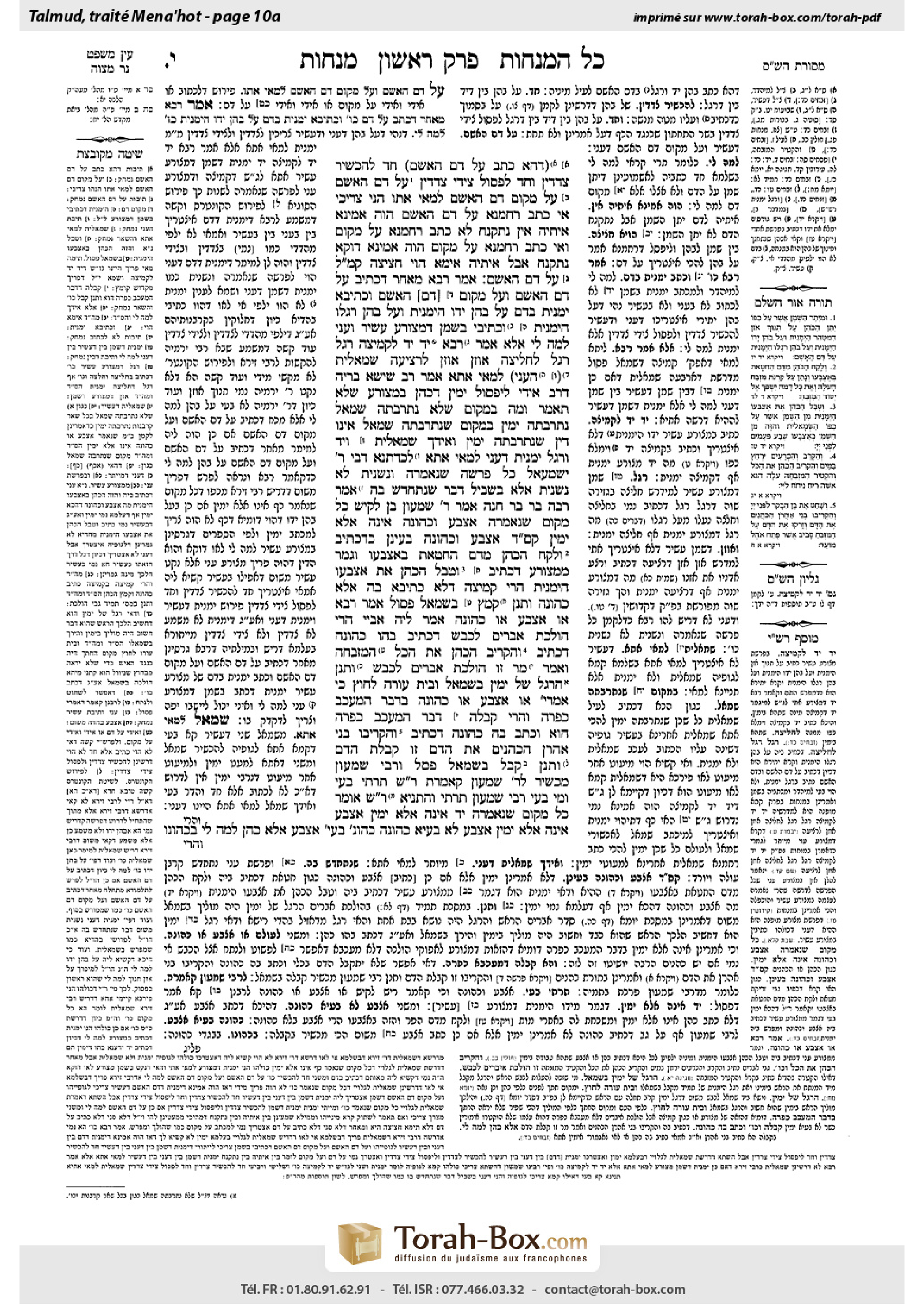
Menachot 10a: Talmud study for Daf Yomi
Daf Yomi is the daily study of one Talmud folio. Explore 37 tractates with scans, Hebrew text, Sefaria English and AI-generated French translations where annotated.
Passage selection and English or AI-generated French translation are available where the scan has annotations. Daf Study is independent of Torah-Box and Sefaria.
Browse Menachot · מנחות · All tractatesMenachot 10a text and translations
This page of Menachot includes the Aramaic text, an English translation and an AI-generated French translation, alongside the scan above.
מנחות י׳ א · Aramaic and Hebrew text
(דְּהָא כְּתִב ״עַל דַּם הָאָשָׁם״!), חַד לְהַכְשִׁיר צְדָדִין, וְחַד לִפְסוֹל צִידֵּי צְדָדִין.
״עַל דַּם הָאָשָׁם״, (על) [וְ״עַל] מְקוֹם דַּם הָאָשָׁם״ – לְמַאי אָתוּ?
הָנֵי צְרִיכִי, אִי כְּתַב רַחֲמָנָא ״עַל דַּם הָאָשָׁם״, הֲוָה אָמֵינָא: אִיתֵיהּ – אִין, נִתְקַנֵּחַ – לָא, כְּתַב רַחֲמָנָא ״עַל מְקוֹם״.
וְאִי כְּתַב רַחֲמָנָא ״עַל מְקוֹם״, הֲוָה אָמֵינָא: דַּוְקָא נִתְקַנֵּחַ, אֲבָל אִיתֵיהּ – אֵימָא הָוֵי חֲצִיצָה, קָא מַשְׁמַע לַן ״עַל דַּם הָאָשָׁם״.
אָמַר רָבָא: מֵאַחַר דִּכְתִיב ״עַל דַּם הָאָשָׁם״ וְ״עַל מְקוֹם [דַּם] הָאָשָׁם״, וּכְתִיבָא יְמָנִית בְּדָם ״עַל בֹּהֶן יָדוֹ הַיְמָנִית וְעַל בֹּהֶן רַגְלוֹ הַיְמָנִית״, וּכְתִיבִי בְּשֶׁמֶן דִּמְצוֹרָע עָשִׁיר וְעָנִי, לְמָה לִי?
אֶלָּא אָמַר רָבָא: ״יָד״ ״יָד״ לִקְמִיצָה.
״רֶגֶל״ ״רֶגֶל״ לַחֲלִיצָה.
״אוֹזֶן״ ״אוֹזֶן״ לִרְצִיעָה.
״שְׂמָאלִית״ (הֶעָנִי) לְמַאי אֲתָא? אָמַר רַב שִׁישָׁא בְּרֵיהּ דְּרַב אִידִי: לִיפְסוֹל יָמִין דְּכֹהֵן בִּמְצוֹרָע, שֶׁלֹּא תֹּאמַר: וּמָה בִּמְקוֹם שֶׁלֹּא נִתְרַבְּתָה שְׂמֹאל נִתְרַבְּתָה יָמִין, בְּמָקוֹם שֶׁנִּתְרַבְּתָה שְׂמֹאל אֵינוֹ דִּין שֶׁנִּתְרַבְּתָה יָמִין?
וְאִידָּךְ ״שְׂמָאלִית״ (וְיָד וָרֶגֶל יְמָנִית דְּעָנִי), לְמַאי אֲתָא? לְכִדְתָנָא דְּבֵי רַבִּי יִשְׁמָעֵאל: כׇּל פָּרָשָׁה שֶׁנֶּאֶמְרָה וְנִשְׁנֵית, לֹא נִשְׁנֵית אֶלָּא בִּשְׁבִיל דָּבָר שֶׁנִּתְחַדֵּשׁ בָּהּ.
אָמַר רַבָּה בַּר בַּר חָנָה, אָמַר רַבִּי שִׁמְעוֹן בֶּן לָקִישׁ: כׇּל מָקוֹם שֶׁנֶּאֶמְרָה אֶצְבַּע וּכְהוּנָּה, אֵינָהּ אֶלָּא יָמִין.
קָא סָלְקָא דַּעְתִּין, אֶצְבַּע וּכְהוּנָּה בָּעֵינַן, כְּדִכְתִיב: ״וְלָקַח הַכֹּהֵן מִדַּם הַחַטָּאת בְּאֶצְבָּעוֹ״, וְגָמַר מִמְּצוֹרָע, דִּכְתִיב: ״וְטָבַל הַכֹּהֵן אֶת אֶצְבָּעוֹ הַיְמָנִית״. הֲרֵי קְמִיצָה דְּלָא כְּתִיבָא בָּהּ אֶלָּא כְּהוּנָּה, וּתְנַן: קָמַץ בִּשְׂמֹאל פָּסוּל!
אָמַר רָבָא: אוֹ ״אֶצְבַּע״ אוֹ ״כְּהוּנָּה״.
אֲמַר לֵיהּ אַבָּיֵי: הֲרֵי הוֹלָכַת אֵבָרִים לַכֶּבֶשׁ, דִּכְתִיב בְּהוּ כְּהוּנָּה, דִּכְתִיב: ״וְהִקְרִיב הַכֹּהֵן אֶת הַכֹּל הַמִּזְבֵּחָה״, וְאָמַר מָר: זוֹ הוֹלָכַת אֵבָרִים לַכֶּבֶשׁ, וּתְנַן: הָרֶגֶל שֶׁל יָמִין בִּשְׂמֹאל וּבֵית עוֹרָהּ לַחוּץ.
כִּי אָמְרִינַן ״אוֹ אֶצְבַּע אוֹ כְּהוּנָּה״ – בְּדָבָר הַמְעַכֵּב כַּפָּרָה.
וַהֲרֵי קַבָּלָה (דבר) [דְּדָבָר] הַמְעַכֵּב כַּפָּרָה הוּא, וּכְתִב בָּהּ כְּהוּנָּה, דִּכְתִיב: ״וְהִקְרִיבוּ בְּנֵי אַהֲרֹן הַכֹּהֲנִים אֶת הַדָּם״ – זוֹ קַבָּלַת הַדָּם, וּתְנַן: קִבֵּל בִּשְׂמֹאל פָּסַל, וְרַבִּי שִׁמְעוֹן מַכְשִׁיר.
לְרַבִּי שִׁמְעוֹן קָאָמְרַתְּ? רַבִּי שִׁמְעוֹן תַּרְתֵּי בָּעֵי.
וּמִי בָּעֵי רַבִּי שִׁמְעוֹן תַּרְתֵּי? וְהָתַנְיָא: רַבִּי שִׁמְעוֹן אוֹמֵר: כׇּל מָקוֹם שֶׁנֶּאֶמְרָה ״יָד״ – אֵינָהּ אֶלָּא יָמִין, ״אֶצְבַּע״ – אֵינָהּ אֶלָּא יָמִין! אֶצְבַּע לָא בָּעֲיָא כְּהוּנָּה, כְּהוּנָּה בָּעֲיָא אֶצְבַּע.
אֶלָּא כֹּהֵן לְמָה לִּי? בְּכִהוּנוֹ.
Menachot 10a · English translation
After all, a verse already indicates that the oil must be placed on the right thumb and big toe, as it is written: “Upon the blood of the guilt offering” (Leviticus 14:17). Since the Torah has already specified that the blood is placed upon the right thumb and big toe (Leviticus 14:14), it is clear that the oil is placed there as well. Similarly, why must the verse specify with regard to a poor leper that the oil is placed on the right thumb and big toe? Isn’t it already clear from the verse where the oil must be placed, as it states: “Upon the place of the blood of the guilt offering” (Leviticus 14:28)? The Gemara responds: One specification, stated with regard to a wealthy leper, serves to permit the placement of the oil on the sides of the thumb and sides of the big toe in addition to the nail side of the thumb and big toe, and one, stated with regard to a poor leper, serves to disqualify the sides of sides, i.e., their undersides.
The Gemara inquires with regard to the verse: “Upon the blood of the guilt offering” (Leviticus 14:17), stated with regard to the purification of a wealthy leper, and the verse: “Upon the place of the blood of the guilt offering” (Leviticus 14:28), stated with regard to the purification of a poor leper. For what purpose do they come, i.e., why are both verses necessary?
The Gemara responds: These verses are necessary, because if the Merciful One had written only: “Upon the blood of the guilt offering,” I would say: If the blood is still on the right thumb and big toe of the leper, yes, the priest places the oil upon the blood. But if it was wiped from there, he does not place the oil. Therefore, the Merciful One writes: “Upon the place of the blood of the guilt offering,” indicating that the oil is placed upon the location of the blood, not necessarily upon the blood itself.
And conversely, if the Merciful One had written only: “Upon the place of the blood of the guilt offering,” I would say: The oil is placed on his right thumb and big toe specifically when the blood was wiped from there. But if the blood is still there, I will say that the blood is an interposition between the oil and the thumb or toe. Therefore, the verse teaches us that the oil is placed “upon the blood of the guilt offering,” and the blood is not considered an interposition.
Rava said: Since it is written that the priest places the oil “upon the blood of the guilt offering,” and: “Upon the place of the blood of the guilt offering,” and it is also written with regard to a wealthy leper (see Leviticus 14:14) and a poor one (see Leviticus 14:25) that the right hand and foot are required for the placement of the blood, as the verses state: “Upon the thumb of his right hand, and upon the big toe of his right foot,” and this is also written with regard to the oil of a wealthy leper (see Leviticus 14:17) and a poor one (see Leviticus 14:28), one can ask: Why do I need all of these verses?
Rather, Rava said: The verses that specify that the oil must be placed on the right thumb and big toe do not teach a halakha with regard to a leper, as it is clear that the oil must be placed on the right thumb and big toe, as it states: “Upon the place of the blood of the guilt offering.” Rather, these verses are the source of verbal analogies for other halakhot. When the verse states with regard to a wealthy leper: “Of his right hand” (Leviticus 14:17), this teaches a verbal analogy between the term “hand” written here and “hand” written with regard to the removal of a handful, as the verse states about the removal of a handful: “And he filled his hand from it” (Leviticus 9:17). The verbal analogy teaches that the removal of the handful must also be performed with the right hand.
Similarly, when the verse states: “Of his right foot” (Leviticus 14:17), with regard to a wealthy leper, this teaches a verbal analogy between the term “foot” written here and “foot” written with regard to the ritual through which the yavam, a man whose married brother died childless, frees his brother’s widow, the yevama, of her levirate bonds [ḥalitza], as the verse states with regard to ḥalitza: “And remove his shoe from upon his foot” (Deuteronomy 25:9). The verbal analogy teaches that the shoe is removed from his right foot.
Additionally, when the verse states: “Upon the tip of the right ear of him that is to be cleansed” (Leviticus 14:17), with regard to a wealthy leper, this teaches a verbal analogy between the term “ear” written here and “ear” written with regard to the piercing of a Hebrew slave’s ear with an awl, as the verse states: “And his master shall bore his ear through with an awl” (Exodus 21:6). The verbal analogy teaches that the slave’s right ear is pierced.
The Gemara asks: With regard to the additional mention of the left hand in the verse dealing with the poor leper, for what purpose does it come? Rav Sheisha, son of Rav Idi, said: It comes to disqualify the right hand of a priest for the purification of a leper. This teaches that you should not say: And if in a place where the left side is not included, as sacrificial rites in general are disqualified when performed with the left hand, the right hand is included, i.e., those rites must be performed with the right hand, then in a place where the left hand is included, in the case of a leper, isn’t it logical that the right hand should also be included? Therefore, the verse repeats that the oil is poured into the priest’s left hand, in order to disqualify the right hand.
The Gemara asks: And concerning the other verses that specify the left hand of a poor leper (Leviticus 14:26–27) as well as the right hand and foot of a poor leper (Leviticus 14:25–28), for what purpose do they come? The Gemara responds: These verses come for that which the school of Rabbi Yishmael taught: Any passage that was stated in the Torah and was then repeated, was repeated only for the sake of a matter that was introduced for the first time in the repeated passage. That is, sometimes the Torah repeats an entire passage just to teach a single new detail. In this case, the verses that discuss the purification of a poor leper were repeated only for the sake of the differences in the offerings between a wealthy leper and a poor one. No additional halakha should be derived from them.
§ Rabba bar bar Ḥana says that Rabbi Shimon ben Lakish says: Any place in the Torah in which it is stated that an action is performed with a finger or by the priesthood, i.e., that one uses his finger to perform the action or that a priest performs it, this teaches that it is performed only with the right hand.
The Gemara comments: It might enter our mind to say that this means that we require both a finger and the priesthood to be stated together in the verse in order to mandate use of the right hand, e.g., as it is written: “And the priest shall take of the blood of the sin offering with his finger” (Leviticus 4:25). And the fact that this verse is referring to a finger from his right hand is derived from a leper, as it is written: “And the priest shall dip his right finger” (Leviticus 14:16). This cannot be correct, as there is the verse that addresses the removal of a handful from a meal offering, in which only the priesthood is written, and yet we learned in a mishna (6a): If the priest removed the handful with his left hand the meal offering is unfit.
Therefore, Rava said: This statement means that if the verse mentions either a finger or the priesthood, only the right hand may be used.
Abaye said to Rava: But this is contradicted by the verse discussing the conveyance of the limbs of the daily burnt offering to the ramp of the altar, as priesthood is written with regard to it, as it is written: “And the priest shall sacrifice the whole and make it smoke upon the altar” (Leviticus 1:13), and the Master said that this verse is referring to the conveyance of the limbs to the ramp. And yet we learned in a mishna (Tamid 31b): When the priest conveys the limbs to the ramp, the foot of the right side of the offering is carried in the left hand of the priest, and the place of its skin, i.e., the side of the limb covered in skin, is held facing outward. Clearly, use of the left hand does not disqualify the conveyance of the limbs.
The Gemara responds: When we say that if the verse states either finger or priesthood then the left hand is disqualified, this is only with regard to a matter that precludes atonement, i.e., a rite whose performance is indispensable to the atonement, similar to the sprinkling of the oil on the leper (see Leviticus 14:16). The conveyance of the limbs, by contrast, is not indispensable to atonement.
The Gemara asks: But isn’t there the collection of the blood in a service vessel, which is a matter indispensable to atonement, and about which priesthood is written? As it is written: “And Aaron’s sons, the priests, shall present the blood” (Leviticus 1:5), and this is referring to the collection of the blood. And yet we learned in a mishna (Zevaḥim 15b): If one collected the blood with his left hand, the blood is disqualified for offering, and Rabbi Shimon deems it fit, despite the fact that priesthood is mentioned in the verse.
The Gemara responds: You are saying that there is a difficulty according to the opinion of Rabbi Shimon? Rabbi Shimon requires that both matters appear in the verse, i.e., both finger and priesthood.
The Gemara asks: And does Rabbi Shimon really require both? But isn’t it taught in a baraita: Rabbi Shimon says: In any place in the Torah in which the word hand is stated, the verse is referring only to the right hand, and whenever a verse mentions the word finger, it is referring only to a finger of the right hand? The Gemara responds: According to Rabbi Shimon, if the verse mentions only the word finger, it does not require a mention of the priesthood as well for the limitation to apply. But if the verse mentions only the priesthood, it requires mention of the term finger for the limitation to apply.
The Gemara asks: But according to Rabbi Shimon, if the mention of the priesthood alone does not suffice to disqualify the right hand, then why do I need the superfluous reference to a priest with regard to the collection of the blood? After all, the verse already states that the collection must be performed by the sons of Aaron. The Gemara responds: The additional mention of the priesthood indicates that a priest must perform the collection of the blood in his priestly state, i.e., while wearing the priestly vestments.
Menachot 10a · Traduction française (IA)
Après tout, un verset indique déjà que l’huile doit être appliquée sur le pouce et le gros orteil droits, comme il est écrit : « Sur le sang du sacrifice de culpabilité » (Lévitique 14:17). Puisque la Torah a déjà précisé que le sang est appliqué sur le pouce et le gros orteil droits (Lévitique 14:14), il est clair que l’huile y est appliquée également. De même, pourquoi le verset doit-il préciser, au sujet d’un lépreux pauvre, que l’huile est appliquée sur le pouce et le gros orteil droits ? N’est-il pas déjà clair où l’huile doit être appliquée, comme il est dit : « À l’endroit du sang du sacrifice de culpabilité » (Lévitique 14:28) ? La Guemara répond : L’une des précisions, formulée au sujet d’un lépreux aisé, sert à autoriser l’application de l’huile sur les côtés du pouce et du gros orteil, en plus de leurs faces portant l’ongle ; l’autre, formulée au sujet d’un lépreux pauvre, sert à exclure les côtés des côtés, c’est-à-dire leurs faces inférieures.
La Guemara s’interroge au sujet du verset : « Sur le sang du sacrifice de culpabilité » (Lévitique 14:17), énoncé à propos de la purification d’un lépreux aisé, et du verset : « À l’endroit du sang du sacrifice de culpabilité » (Lévitique 14:28), énoncé à propos de la purification d’un lépreux pauvre. À quoi servent-ils, c’est-à-dire pourquoi ces deux versets sont-ils nécessaires ?
La Guemara répond : Ces versets sont nécessaires, car si le Miséricordieux n’avait écrit que : « Sur le sang du sacrifice de culpabilité », j’aurais dit : Si le sang se trouve encore sur le pouce et le gros orteil droits du lépreux, alors le prêtre applique l’huile sur le sang. Mais si le sang a été essuyé, il n’applique pas l’huile. C’est pourquoi le Miséricordieux écrit : « À l’endroit du sang du sacrifice de culpabilité », indiquant que l’huile est appliquée à l’endroit où se trouvait le sang, pas nécessairement sur le sang lui-même.
Inversement, si le Miséricordieux n’avait écrit que : « À l’endroit du sang du sacrifice de culpabilité », j’aurais dit : L’huile est appliquée sur son pouce et son gros orteil droits uniquement lorsque le sang en a été essuyé. Mais si le sang s’y trouve encore, je dirais qu’il fait écran entre l’huile et le pouce ou l’orteil. Le verset nous enseigne donc que l’huile est appliquée « sur le sang du sacrifice de culpabilité » et que le sang n’est pas considéré comme faisant écran.
Rava dit : Puisqu’il est écrit que le prêtre applique l’huile « sur le sang du sacrifice de culpabilité » et « à l’endroit du sang du sacrifice de culpabilité », et qu’il est également écrit, au sujet d’un lépreux aisé (voir Lévitique 14:14) et d’un lépreux pauvre (voir Lévitique 14:25), que la main droite et le pied droit sont requis pour l’application du sang, comme le disent les versets : « Sur le pouce de sa main droite et sur le gros orteil de son pied droit », et que la même chose est également écrite au sujet de l’huile d’un lépreux aisé (voir Lévitique 14:17) et d’un lépreux pauvre (voir Lévitique 14:28), on peut demander : Pourquoi tous ces versets sont-ils nécessaires ?
Rava dit plutôt : Les versets qui précisent que l’huile doit être appliquée sur le pouce et le gros orteil droits n’enseignent pas de halakha concernant le lépreux, car il est clair que l’huile doit être appliquée sur le pouce et le gros orteil droits, comme il est dit : « À l’endroit du sang du sacrifice de culpabilité ». Ces versets sont plutôt la source d’analogies verbales concernant d’autres halakhot. Lorsque le verset dit, à propos d’un lépreux aisé : « De sa main droite » (Lévitique 14:17), cela établit une analogie verbale entre le terme « main » écrit ici et le terme « main » écrit au sujet du prélèvement d’une poignée, comme il est dit à propos de ce prélèvement : « Il en prit une pleine poignée » (Lévitique 9:17). Cette analogie verbale enseigne que le prélèvement de la poignée doit lui aussi être effectué de la main droite.
De même, lorsque le verset dit : « De son pied droit » (Lévitique 14:17), à propos d’un lépreux aisé, cela établit une analogie verbale entre le terme « pied » écrit ici et le terme « pied » écrit au sujet du rite par lequel le yavam, un homme dont le frère marié est mort sans enfant, libère sa belle-sœur, la yevama, des liens du lévirat [ḥalitza], comme il est dit au sujet de la ḥalitza : « Il lui ôtera sa chaussure du pied » (Deutéronome 25:9). Cette analogie verbale enseigne que la chaussure est retirée de son pied droit.
De plus, lorsque le verset dit : « Sur le bout de l’oreille droite de celui qui doit être purifié » (Lévitique 14:17), à propos d’un lépreux aisé, cela établit une analogie verbale entre le terme « oreille » écrit ici et le terme « oreille » écrit au sujet du percement de l’oreille d’un esclave hébreu avec un poinçon, comme il est dit : « Son maître lui percera l’oreille avec un poinçon » (Exode 21:6). Cette analogie verbale enseigne que c’est l’oreille droite de l’esclave qui est percée.
La Guemara demande : À quoi sert la mention supplémentaire de la main gauche dans le verset concernant le lépreux pauvre ? Rav Sheisha, fils de Rav Idi, dit : Elle sert à exclure la main droite du prêtre pour la purification d’un lépreux. Cela enseigne qu’il ne faut pas dire : Si, dans un cas où le côté gauche n’est pas inclus, les rites sacrificiels étant généralement invalides lorsqu’ils sont accomplis de la main gauche, le côté droit est inclus, c’est-à-dire que ces rites doivent être accomplis de la main droite, alors, dans un cas où la main gauche est incluse, celui du lépreux, n’est-il pas logique que la main droite le soit aussi ? Le verset répète donc que l’huile est versée dans la main gauche du prêtre afin d’exclure la main droite.
La Guemara demande : À quoi servent les autres versets qui précisent la main gauche du lépreux pauvre (Lévitique 14:26-27), ainsi que sa main droite et son pied droit (Lévitique 14:25-28) ? La Guemara répond : Ces versets servent à enseigner ce que la maison d’étude de Rabbi Yishmael a enseigné : Tout passage énoncé dans la Torah puis répété ne l’a été qu’en vue d’un élément introduit pour la première fois dans le passage répété. Autrement dit, la Torah répète parfois un passage entier uniquement pour enseigner un seul détail nouveau. Dans ce cas, les versets qui traitent de la purification d’un lépreux pauvre ont été répétés uniquement en raison des différences entre les offrandes d’un lépreux aisé et celles d’un lépreux pauvre. On ne doit en tirer aucune halakha supplémentaire.
§ Rabba bar bar Ḥana rapporte au nom de Rabbi Shimon ben Lakish : Partout dans la Torah où il est dit qu’une action est accomplie avec un doigt ou par la prêtrise, c’est-à-dire que l’action est accomplie au moyen du doigt ou par un prêtre, cela enseigne qu’elle ne peut être accomplie qu’avec la main droite.
La Guemara fait remarquer : On pourrait penser que cela signifie que le verset doit mentionner à la fois un doigt et la prêtrise pour imposer l’usage de la main droite, par exemple comme il est écrit : « Le prêtre prendra du sang du sacrifice expiatoire avec son doigt » (Lévitique 4:25). Le fait que ce verset parle d’un doigt de sa main droite se déduit du cas du lépreux, comme il est écrit : « Le prêtre trempera son doigt droit » (Lévitique 14:16). Cela ne peut pas être juste, car il y a le verset qui traite du prélèvement d’une poignée d’une offrande végétale, où seule la prêtrise est mentionnée ; pourtant, nous avons appris dans une Michna (6a) : Si le prêtre a prélevé la poignée de sa main gauche, l’offrande végétale est invalide.
Rava dit donc : Cette déclaration signifie que si le verset mentionne soit un doigt, soit la prêtrise, seule la main droite peut être utilisée.
Abaye dit à Rava : Mais cela est contredit par le verset qui traite du transport des membres de l’holocauste quotidien jusqu’à la rampe de l’autel, car la prêtrise y est mentionnée, comme il est écrit : « Le prêtre présentera le tout et le fera fumer sur l’autel » (Lévitique 1:13), et le Maître a dit que ce verset parle du transport des membres jusqu’à la rampe. Pourtant, nous avons appris dans une Michna (Tamid 31b) : Lorsque le prêtre transporte les membres jusqu’à la rampe, le pied droit de l’offrande est porté dans la main gauche du prêtre, et la partie où se trouve sa peau, c’est-à-dire le côté du membre recouvert de peau, est tournée vers l’extérieur. Il est donc clair que l’usage de la main gauche n’invalide pas le transport des membres.
La Guemara répond : Lorsque nous disons que si le verset mentionne soit un doigt, soit la prêtrise, la main gauche est exclue, cela ne concerne qu’un rite qui conditionne l’expiation, c’est-à-dire un rite dont l’accomplissement est indispensable à l’expiation, comme l’aspersion de l’huile sur le lépreux (voir Lévitique 14:16). En revanche, le transport des membres n’est pas indispensable à l’expiation.
La Guemara demande : Mais qu’en est-il du recueil du sang dans un récipient de service, un acte indispensable à l’expiation au sujet duquel la prêtrise est mentionnée ? En effet, il est écrit : « Les fils d’Aaron, les prêtres, présenteront le sang » (Lévitique 1:5), ce qui fait référence au recueil du sang. Pourtant, nous avons appris dans une Michna (Zevaḥim 15b) : Si quelqu’un a recueilli le sang de sa main gauche, le sang est disqualifié pour l’offrande, mais Rabbi Shimon le déclare apte, bien que le verset mentionne la prêtrise.
La Guemara répond : Dis-tu qu’il y a une difficulté selon l’opinion de Rabbi Shimon ? Rabbi Shimon exige que les deux éléments figurent dans le verset, c’est-à-dire le doigt et la prêtrise.
La Guemara demande : Rabbi Shimon exige-t-il vraiment les deux ? N’enseigne-t-on pas dans une baraïta : Rabbi Shimon dit : Partout dans la Torah où le mot « main » est employé, le verset ne parle que de la main droite ; et chaque fois qu’un verset mentionne le mot « doigt », il ne parle que d’un doigt de la main droite. La Guemara répond : Selon Rabbi Shimon, si le verset ne mentionne que le mot « doigt », il n’est pas nécessaire qu’il mentionne aussi la prêtrise pour que cette restriction s’applique. Mais si le verset ne mentionne que la prêtrise, le terme « doigt » doit également être mentionné pour que la restriction s’applique.
La Guemara demande : Mais selon Rabbi Shimon, si la seule mention de la prêtrise ne suffit pas à exclure la main gauche, pourquoi la mention d’un prêtre à propos du recueil du sang est-elle nécessaire ? Après tout, le verset dit déjà que le recueil doit être effectué par les fils d’Aaron. La Guemara répond : La mention supplémentaire de la prêtrise indique qu’un prêtre doit recueillir le sang dans l’exercice de ses fonctions sacerdotales, c’est-à-dire vêtu des vêtements sacerdotaux.
Traduction française générée par IA à partir de l’édition anglaise de Sefaria. Vérifie toujours un passage avec le texte source.
Text from Sefaria: William Davidson Edition - Vocalized Aramaic (unknown); William Davidson Edition - English (CC BY NC).