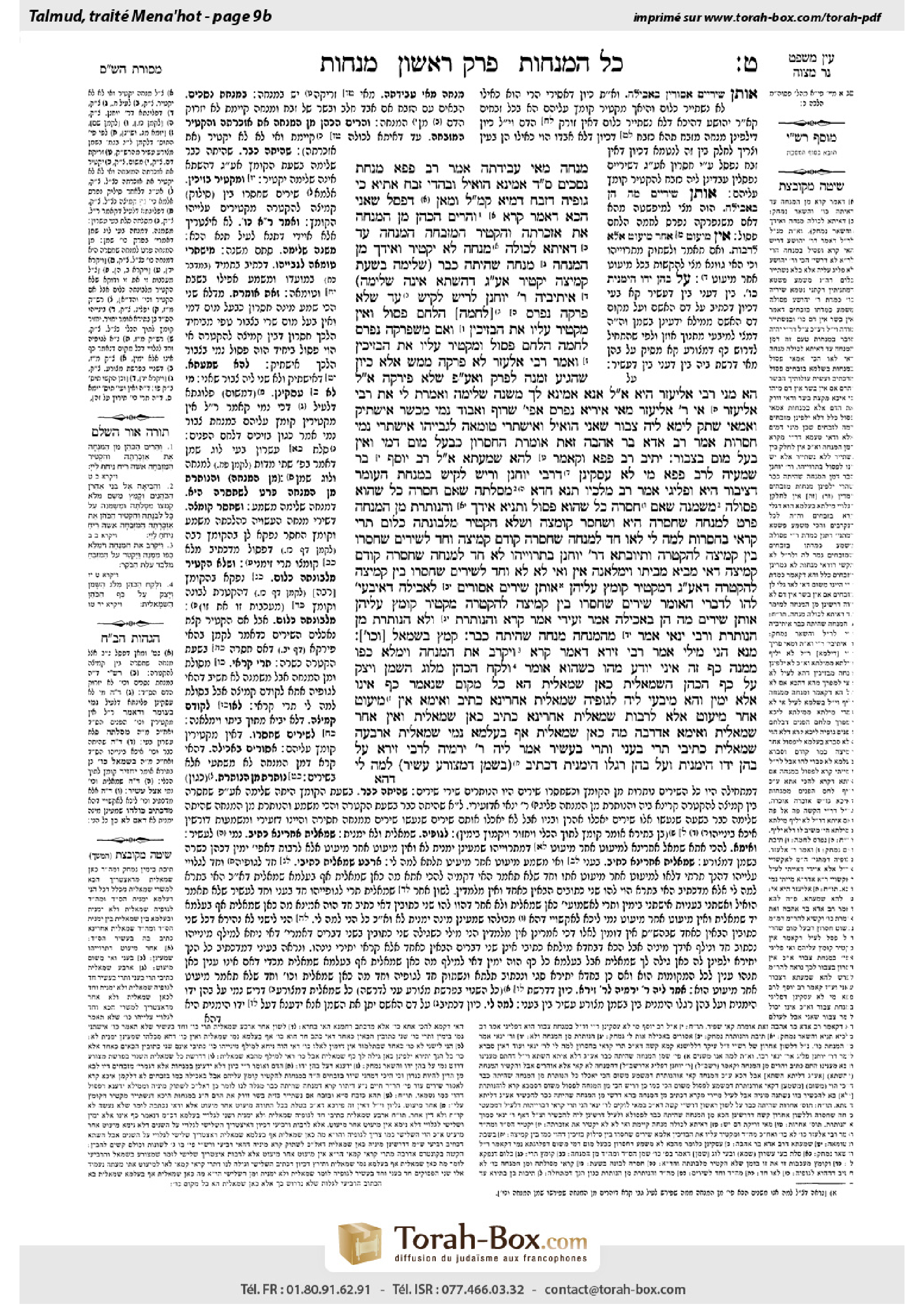
Menachot 9b: Talmud study for Daf Yomi
Daf Yomi is the daily study of one Talmud folio. Explore 37 tractates with scans, Hebrew text, Sefaria English and AI-generated French translations where annotated.
Passage selection and English or AI-generated French translation are available where the scan has annotations. Daf Study is independent of Torah-Box and Sefaria.
Browse Menachot · מנחות · All tractatesMenachot 9b text and translations
This page of Menachot includes the Aramaic text, an English translation and an AI-generated French translation, alongside the scan above.
מנחות ט׳ ב · Aramaic and Hebrew text
מִנְחָה מַאי עֲבִידְתֵּהּ? אָמַר רַב פָּפָּא: מִנְחַת נְסָכִים.
סָלְקָא דַּעְתָּךְ אָמֵינָא: הוֹאִיל וּבַהֲדֵי זֶבַח אָתְיָא – כִּי גּוּפֵיהּ דְּזֶבַח דָּמְיָא, קָא מַשְׁמַע לַן.
וּמַאן דְּפָסֵל – שָׁאנֵי הָכָא, דְּאָמַר קְרָא: ״וְהֵרִים הַכֹּהֵן מִן הַמִּנְחָה אֶת אַזְכָּרָתָהּ וְהִקְטִיר הַמִּזְבֵּחָה״, ״הַמִּנְחָה״ – עַד דְּאִיתַהּ לְכוּלַּהּ מִנְחָה לֹא יַקְטִיר.
וְאִידָּךְ, ״מִן הַמִּנְחָה״ – מִנְחָה שֶׁהָיְתָה כְּבָר שְׁלֵימָה בִּשְׁעַת קְמִיצָה יַקְטִיר, אַף עַל גַּב דְּהַשְׁתָּא אֵינָהּ שְׁלֵימָה.
אֵיתִיבֵיהּ רַבִּי יוֹחָנָן לְרֵישׁ לָקִישׁ: עַד שֶׁלֹּא פֵּרְקָהּ נִפְרַס הַלֶּחֶם – פָּסוּל, וְאֵין מַקְטִיר עָלָיו אֶת הַבָּזִיכִין, וְאִם מִשֶּׁפֵּרְקָהּ נִפְרַס לַחְמָהּ – הַלֶּחֶם פָּסוּל, וּמַקְטִיר עָלָיו אֶת הַבָּזִיכִין. וְאָמַר רַבִּי אֶלְעָזָר: לֹא פֵּרְקָהּ מַמָּשׁ, אֶלָּא כֵּיוָן שֶׁהִגִּיעַ זְמַנָּהּ לְפָרֵק, וְאַף עַל פִּי שֶׁלֹּא פִּירְקָהּ.
אֲמַר לֵיהּ: הָא מַנִּי? רַבִּי אֱלִיעֶזֶר הִיא. אֲמַר לֵיהּ: אֲנָא אָמֵינָא לָךְ מִשְׁנָה שְׁלֵימָה, וְאָמְרַתְּ לִי אַתְּ רַבִּי אֱלִיעֶזֶר?
אִי רַבִּי אֱלִיעֶזֶר, מַאי אִירְיָא נִפְרַס? אֲפִילּוּ שָׂרוּף וְאָבוּד נָמֵי מַכְשַׁר! אִישְׁתִּיק.
וְאַמַּאי שְׁתֵק? לֵימָא לֵיהּ: צִבּוּר שָׁאנֵי, הוֹאִיל וְאִישְׁתְּרַי טוּמְאָה לְגַבַּיְיהוּ – אִישְׁתְּרַי נָמֵי חֲסֵרוֹת! אָמַר רַב אַדָּא בַּר אַהֲבָה: זֹאת אוֹמֶרֶת, הַחֶסְרוֹן כְּבַעַל מוּם דָּמֵי, וְאֵין בַּעַל מוּם בַּצִּבּוּר.
יָתֵיב רַב פָּפָּא וְקָאָמַר לְהָא שְׁמַעְתָּא, אֲמַר לֵיהּ רַב יוֹסֵף בַּר שְׁמַעְיָה לְרַב פָּפָּא: מִי לָא עָסְקִינַן דְּרַבִּי יוֹחָנָן וְרֵישׁ לָקִישׁ בְּמִנְחַת הָעוֹמֶר דְּצִיבּוּר הִיא, וּפְלִיגִי?
אָמַר רַב מַלְכִּיּוֹ, תָּנָא חֲדָא: ״מִסׇּלְתָּהּ״ – שֶׁאִם חָסְרָה כׇּל שֶׁהוּא פְּסוּלָה, ״מִשַּׁמְנָהּ״ – שֶׁאִם חָסְרָה כׇּל שֶׁהוּא פָּסוּל.
וְתַנְיָא אִידַּךְ: ״וְהַנּוֹתֶרֶת מִן הַמִּנְחָה״ – פְּרָט לַמִּנְחָה שֶׁחָסְרָה הִיא, וְשֶׁחָסַר קוּמְצָהּ, וְשֶׁלֹּא הִקְטִיר מִלְּבוֹנָתָהּ כְּלוּם.
תְּרֵי קְרָאֵי בַּחֲסֵרוֹת לְמָה לִי? לָאו חַד לְמִנְחָה שֶׁחָסְרָה קוֹדֶם קְמִיצָה, וְחַד לְשִׁירַיִם שֶׁחָסְרוּ בֵּין קְמִיצָה לְהַקְטָרָה,
וּתְיוּבְתָּא דְּרַבִּי יוֹחָנָן בְּתַרְוַיְיהוּ?
לָא, חַד לְמִנְחָה שֶׁחָסְרָה קוֹדֶם קְמִיצָה, דְּאִי מֵבִיא מִבֵּיתוֹ וִימַלְּאֶנָּה – אִין, וְאִי לָא – לָא, וְחַד לְשִׁירַיִם שֶׁחָסְרוּ בֵּין קְמִיצָה לְהַקְטָרָה, דְּאַף עַל גַּב דְּמַקְטִיר קוֹמֶץ עֲלֵיהֶן – אוֹתָן שִׁירַיִם אֲסוּרִים לַאֲכִילָה.
דְּאִיבַּעְיָא לְהוּ: לְדִבְרֵי הָאוֹמֵר שִׁירַיִם שֶׁחָסְרוּ בֵּין קְמִיצָה לְהַקְטָרָה מַקְטִיר קוֹמֶץ עֲלֵיהֶן, אוֹתָן שִׁירַיִם מָה הֵן בַּאֲכִילָה?
אָמַר זְעֵירִי, אָמַר קְרָא: ״וְהַנּוֹתֶרֶת״, וְלֹא הַנּוֹתֶרֶת מִן הַנּוֹתֶרֶת. וְרַבִּי יַנַּאי אָמַר: ״מֵהַמִּנְחָה״ – מִנְחָה שֶׁהָיְתָה כְּבָר.
קָמַץ בִּשְׂמֹאל – מְנָא הָנֵי מִילֵּי? אָמַר רַבִּי זֵירָא, דְּאָמַר קְרָא: ״וַיַּקְרֵב אֶת הַמִּנְחָה וַיְמַלֵּא כַפּוֹ מִמֶּנָּה״ – כַּף זֶה אֵינִי יוֹדֵעַ מַהוּ, כְּשֶׁהוּא אוֹמֵר: ״וְלָקַח הַכֹּהֵן מִלּוֹג הַשָּׁמֶן וְיָצַק עַל כַּף הַכֹּהֵן הַשְּׂמָאלִית״ – כָּאן שְׂמָאלִית, הָא כׇּל מָקוֹם שֶׁנֶּאֱמַר ״כַּף״ אֵינוֹ אֶלָּא יָמִין.
וְהָא מִיבְּעֵי לֵיהּ לְגוּפֵיהּ? ״שְׂמָאלִית״ אַחֲרִינָא כְּתִיב.
וְאֵימָא: אֵין מִיעוּט אַחַר מִיעוּט אֶלָּא לְרַבּוֹת? ״שְׂמָאלִית״ אַחֲרִינָא כְּתִיב. כָּאן שְׂמָאלִית, וְאֵין אַחֵר שְׂמָאלִית.
וְאֵימָא: אַדְּרַבָּה, מָה כָּאן שְׂמָאלִית – אַף בְּעָלְמָא נָמֵי שְׂמָאלִית! אַרְבָּעָה ״שְׂמָאלִית״ כְּתִיבִי: תְּרֵי בְּעָנִי, וּתְרֵי בְּעָשִׁיר.
אֲמַר לֵיהּ רַבִּי יִרְמְיָה לְרַבִּי זֵירָא: ״עַל בֹּהֶן יָדוֹ הַיְמָנִית וְעַל בֹּהֶן רַגְלוֹ הַיְמָנִית״ דִּכְתִיב בְּשֶׁמֶן דִּמְצוֹרָע עָשִׁיר לְמָה לִּי?
Menachot 9b · English translation
Parenthetically, the Gemara asks: What is the mention of a meal offering doing here, in a baraita that discusses slaughtered offerings? There is no sprinkling in the case of a meal offering. Rav Pappa said: The baraita is referring to a meal offering that accompanies the libations brought with a slaughtered offering.
Rav Pappa elaborates: It might enter your mind to say that since such a meal offering comes with a slaughtered offering, it is considered like the offering itself. Accordingly, if the only part remaining from an offering is the meal offering that is brought with it, perhaps it is considered as though part of the offering itself remains, and therefore the priest may sprinkle the offering’s blood on account of it. Therefore, the baraita teaches us that this is not the halakha. In any event, Rabbi Yehoshua states in this baraita that the blood of an offering is sprinkled if a minimum amount remains from it. The same should apply to the remainder of a regular meal offering.
Rabbi Yoḥanan cited this baraita as proof that even according to Rabbi Yehoshua, if a portion of the remainder of a meal offering remains intact then the handful may be burned on account of it. The Gemara asks: And concerning the one who disqualifies the handful when the remainder is lacking, i.e., Reish Lakish, how does he explain the opinion of Rabbi Yehoshua? The Gemara responds: Reish Lakish would claim that it is different here, in the case of a meal offering, as the verse states: “And the priest shall remove from the meal offering its memorial part, and shall make it smoke upon the altar” (Leviticus 2:9). Since it is clear that the verse is discussing a meal offering, the apparently superfluous mention of “the meal offering” teaches that unless the entire meal offering is intact, the priest shall not burn the handful.
The Gemara continues: And the other amora, Rabbi Yoḥanan, how does he interpret that verse? Rabbi Yoḥanan claims that the phrase “from the meal offering” is referring to a meal offering that was already whole at the time of the removal of its handful, and the verse teaches that he shall burn its handful even though it is currently not whole.
Rabbi Yoḥanan raised an objection to Reish Lakish from a baraita: If before the priest detached the arrangement of shewbread and the bowls of frankincense from upon the Table, the bread broke into pieces, the bread is unfit for consumption and the priest does not burn the frankincense contained in the bowls on account of it. And if the bread broke after the priest detached it, the bread is unfit but the priest burns the frankincense contained in the bowls on account of it. And Rabbi Elazar says: The baraita does not mean that the priest actually detached the shewbread. Rather, it means that once the time to detach it has arrived the frankincense contained in the bowls may be burned, even though he has not yet detached it. Just as the frankincense contained in the bowls is burned despite the broken shewbread, likewise, the handful of a meal offering should be burned even when the remainder is lacking.
Reish Lakish said to Rabbi Yoḥanan in response: In accordance with whose opinion is this? It is in accordance with the opinion of Rabbi Eliezer, who permits the burning of a handful even when the remainder has been entirely destroyed. And I hold in accordance with the opinion of Rabbi Yehoshua. Rabbi Yoḥanan said to him: I am stating a complete halakha to you, i.e., a baraita of an unspecified opinion, and you say to me that this baraita is in accordance with the opinion of Rabbi Eliezer alone?
Rabbi Yoḥanan added: And furthermore, if the baraita is in accordance with the opinion of only Rabbi Eliezer, then why does the baraita mention specifically an instance where the bread broke? According to Rabbi Eliezer, even if the bread was burned or lost entirely, he deems the frankincense contained in the bowls fit for burning as well. The Gemara notes: Reish Lakish was silent and did not respond to the objections of Rabbi Yoḥanan.
The Gemara asks: But why was Reish Lakish silent? Let him say to Rabbi Yoḥanan that one cannot cite a proof from a baraita that discusses the shewbread, a communal offering, because offerings of the community are different, since ritual impurity was permitted for them, i.e., communal offerings may be sacrificed even in a state of ritual impurity. Therefore, it was also permitted to sacrifice them when they are lacking. Rav Adda bar Ahava said: The fact that Reish Lakish did not respond in this manner is to say that a meal offering that is lacking in measure is considered like a blemished animal, not merely like an impure offering, and there is no instance of a blemished animal being permitted for use as an offering, even in the case of a communal offering.
The Gemara relates that Rav Pappa was once sitting and saying this halakha, and he noted that Reish Lakish was silent and did not respond to Rabbi Yoḥanan’s objections by differentiating between a communal offering and that of an individual, and that Rav Adda bar Ahava derived from Reish Lakish’s silence that a lack in the measure of a meal offering is tantamount to a blemish. Rav Yosef bar Shemaya said to Rav Pappa: Are we not dealing with a disagreement that exists between Rabbi Yoḥanan and Reish Lakish even in the case of the omer meal offering, which is a communal offering? And even so, they disagree. Accordingly, Reish Lakish could not have responded to the objections of Rabbi Yoḥanan by distinguishing between a communal and an individual offering, and therefore one cannot derive from his silence that a meal offering lacking in its measure is like a blemished animal.
The Gemara further discusses the disagreement between Rabbi Yoḥanan and Reish Lakish. Rav Malkiyu says that one baraita taught: The verse states: “And he shall remove…of its fine flour” (Leviticus 2:2). This indicates that if the meal offering lacks any amount of its flour, it is disqualified and the priest may not remove a handful from it. Similarly, the term: “Of its oil” (Leviticus 2:2), teaches that if the meal offering lacks any amount of its oil, it is disqualified.
And it is taught in another baraita that the verse that states: “But that which is left of the meal offering shall be Aaron’s and his sons’” (Leviticus 2:3), teaches that the remainder of the meal offering is given to the priests only if there was initially a whole meal offering, to the exclusion of a meal offering that was lacking, or whose handful was lacking, or from which the priest did not burn any frankincense. In such cases, the meal offering is disqualified and its remainder may not be consumed by the priests.
Rav Malkiyu asks: Why do I need two verses to disqualify meal offerings that are lacking? Is it not correct to say that one verse is referring to a meal offering that became lacking before the removal of the handful, i.e., that one may not refill it, and one verse is referring to the remainder of a meal offering that became lacking between the removal of the handful and its burning upon the altar, and it teaches that one may not burn a handful on account of such a remainder?
Rav Malkiyu concludes: And if so, then this is a conclusive refutation of the opinion of Rabbi Yoḥanan in both instances where he disagrees with Reish Lakish, i.e., in the case of a meal offering that became lacking before the removal of the handful, as Rabbi Yoḥanan holds that one may refill it, and in the case of the remainder that became lacking between the removal of the handful and its burning, as he holds that the handful may be burned.
The Gemara rejects this suggestion: No; one verse is indeed referring to a meal offering that became lacking before the removal of the handful, but it is not teaching that this meal offering is disqualified. Rather, this verse indicates that if he brings flour from his home and fills it so that the meal offering is no longer lacking, then yes, it is fit, but if he does not bring more flour, it is not fit. And one verse is indeed referring to the remainder of a meal offering that became lacking between the removal of the handful and its burning upon the altar; nevertheless, it does not indicate that the handful may not be burned. Rather, it teaches that even though the priest burns the handful on account of such a remainder, that remainder is prohibited for consumption.
The Gemara continues: This is indeed the appropriate explanation of the verses, as a dilemma was raised before the Sages: According to the statement of the one who says that in a case where the remainder of a meal offering became lacking between the removal of the handful and its burning upon the altar, the priest burns the handful on account of this remainder, concerning the remainder itself, what is its status with regard to consumption, i.e., may the remainder be eaten?
Ze’eiri said that the verse states: “But that which is left of the meal offering shall be Aaron’s and his sons’,” which teaches that the priests may consume the remainder of a meal offering, but not the remainder of the remainder, i.e., if the remainder became lacking before the handful was burned, the remaining part of the remainder may not be consumed. Alternatively, Rabbi Yannai says that “of the meal offering shall be Aaron’s and his sons’” indicates that the priests may consume only the remainder of a meal offering that was previously whole when the handful was burned, not the remainder of the remainder.
§ The mishna teaches: If the priest removed the handful with his left hand the meal offering is unfit. The Gemara asks: From where are these matters derived? Rabbi Zeira said that it is derived from that which the verse states: “And the meal offering was presented; and he filled his hand from it” (Leviticus 9:17). Rabbi Zeira explains: This hand, I do not know what it is, i.e., the left hand or the right. When the verse states with regard to the atonement of a leper: “And the priest shall take of the log of oil, and pour it into the palm of his own left hand” (Leviticus 14:15), it mentions the left hand. One can therefore derive that here, where the verse specifies, the priest must use his left hand, whereas in any place where it is stated in a verse “hand” without specification, it is referring only to the right hand.
The Gemara asks: But how can this conclusion be derived from the verse discussing the atonement of a leper? This verse is necessary for itself, i.e., to teach that the oil must be poured on the priest’s left hand, not his right. The Gemara answers that another mention of the left hand is written in the same passage (see Leviticus 14:16). From this additional mention of the left hand it may be derived that any unspecified reference to a hand is referring to the right hand.
The Gemara challenges: But say that according to the hermeneutical principle that one restriction after another restriction serves only to amplify, it should be inferred from the additional specification of the left hand that the oil may be poured onto the priest’s right hand. The Gemara responds: Yet another specification of the left hand is written in that passage (see Leviticus 14:26). Accordingly, the hermeneutical principle that one restriction after another serves only to amplify does not apply. Instead, the verse indicates that here the left hand is required, and there is no other instance where the Torah requires the left hand.
The Gemara challenges: But one can say that on the contrary, just as here the left hand is required, so too generally, the left hand is required as well. The Gemara responds: Four mentions of the left hand are written in the passage, two with regard to a poor leper (Leviticus 14:26–27), and two with regard to a wealthy one (Leviticus 14:15–16). Accordingly, three of the specifications serve to indicate that the oil may be poured only onto the left hand, while the additional mention serves to restrict the use of the left hand to the case of a leper alone.
Rabbi Yirmeya said to Rabbi Zeira: According to your opinion, one interprets homiletically the additional specifications in the passage discussing the purification of a leper. If so, there is another apparently superfluous verse: “Upon the thumb of his right hand, and upon the big toe of his right foot” (Leviticus 14:17), which is written with regard to the placement of the oil upon the right thumb and big toe of a wealthy leper. Why do I need the verse to specify that the oil is placed on the leper’s right thumb and big toe?
Menachot 9b · Traduction française (IA)
Incidemment, la Guemara demande : Que vient faire ici la mention d’une offrande de farine, dans une baraïta qui traite de sacrifices abattus ? Dans le cas d’une offrande de farine, il n’y a pas d’aspersion. Rav Pappa dit : La baraïta parle d’une offrande de farine qui accompagne les libations apportées avec un sacrifice abattu.
Rav Pappa précise : On aurait pu penser que, puisqu’une telle offrande de farine accompagne un sacrifice abattu, elle est considérée comme le sacrifice lui-même. Par conséquent, si la seule partie restante d’un sacrifice est l’offrande de farine qui l’accompagne, on aurait pu penser qu’une partie du sacrifice lui-même subsiste et que le prêtre peut donc asperger le sang du sacrifice à cause d’elle. La baraïta nous enseigne donc que telle n’est pas la halakha. Quoi qu’il en soit, Rabbi Yehoshua affirme dans cette baraïta que le sang d’un sacrifice est aspergé s’il en reste une quantité minimale. Il devrait en aller de même pour le reste d’une offrande de farine ordinaire.
Rabbi Yoḥanan a cité cette baraïta comme preuve que, même selon Rabbi Yehoshua, si une partie du reste d’une offrande de farine demeure intacte, la poignée peut être brûlée à cause d’elle. La Guemara demande : Et celui qui invalide la poignée lorsque le reste est incomplet, c’est-à-dire Reish Lakish, comment explique-t-il l’opinion de Rabbi Yehoshua ? La Guemara répond : Reish Lakish soutiendrait que le cas d’une offrande de farine est différent, car il est écrit : « Le prêtre en prélèvera une partie commémorative de l’offrande de farine et la fera fumer sur l’autel » (Lévitique 2:9). Puisqu’il est clair que le verset parle d’une offrande de farine, la mention apparemment superflue de « l’offrande de farine » enseigne que, si l’offrande de farine entière n’est pas intacte, le prêtre ne doit pas brûler la poignée.
La Guemara poursuit : Et l’autre amora, Rabbi Yoḥanan, comment interprète-t-il ce verset ? Rabbi Yoḥanan soutient que l’expression « de l’offrande de farine » désigne une offrande de farine qui était entière au moment du prélèvement de sa poignée, et que le verset enseigne que le prêtre doit brûler sa poignée même si elle n’est plus entière à présent.
Rabbi Yoḥanan a soulevé une objection contre Reish Lakish à partir d’une baraïta : Si, avant que le prêtre ne retire de la Table le dispositif de pains du Pain de proposition et les coupes d’encens, le pain se brise en morceaux, il est impropre à la consommation et le prêtre ne brûle pas à cause de lui l’encens contenu dans les coupes. Mais si le pain se brise après que le prêtre l’a retiré, il est impropre à la consommation, mais le prêtre brûle à cause de lui l’encens contenu dans les coupes. Rabbi Elazar dit : La baraïta ne signifie pas que le prêtre a effectivement retiré le Pain de proposition. Elle signifie plutôt qu’une fois arrivé le moment de le retirer, l’encens contenu dans les coupes peut être brûlé, même si le prêtre ne l’a pas encore retiré. De même que l’encens contenu dans les coupes est brûlé malgré le Pain de proposition brisé, de même la poignée d’une offrande de farine devrait être brûlée même lorsque le reste est incomplet.
Reish Lakish répondit à Rabbi Yoḥanan : De qui cette baraïta suit-elle l’opinion ? De Rabbi Eliezer, qui permet de brûler une poignée même lorsque le reste a été entièrement détruit. Quant à moi, je suis l’opinion de Rabbi Yehoshua. Rabbi Yoḥanan lui dit : Je t’énonce une halakha complète, c’est-à-dire une baraïta dont l’opinion n’est pas précisée, et tu me réponds que cette baraïta suit uniquement l’opinion de Rabbi Eliezer ?
Rabbi Yoḥanan ajouta : De plus, si la baraïta suit uniquement l’opinion de Rabbi Eliezer, pourquoi mentionne-t-elle précisément un cas où le pain s’est brisé ? Selon Rabbi Eliezer, même si le pain a entièrement brûlé ou a été entièrement perdu, il considère également que l’encens contenu dans les coupes peut être brûlé. La Guemara note : Reish Lakish garda le silence et ne répondit pas aux objections de Rabbi Yoḥanan.
La Guemara demande : Mais pourquoi Reish Lakish garda-t-il le silence ? Qu’il dise à Rabbi Yoḥanan qu’on ne peut pas tirer de preuve d’une baraïta qui traite du Pain de proposition, une offrande communautaire, car les offrandes communautaires sont différentes : l’impureté rituelle leur était permise, c’est-à-dire que les sacrifices communautaires peuvent être offerts même en état d’impureté rituelle. Il était donc également permis de les offrir lorsqu’ils étaient incomplets. Rav Adda bar Ahava dit : Si Reish Lakish n’a pas répondu ainsi, c’est pour indiquer qu’une offrande de farine dont la mesure est incomplète est considérée comme un animal présentant un défaut, et non simplement comme une offrande impure ; or, il n’existe aucun cas où un animal présentant un défaut soit autorisé comme offrande, même s’il s’agit d’une offrande communautaire.
La Guemara rapporte que Rav Pappa était un jour assis et enseignait cette halakha. Il remarqua que Reish Lakish avait gardé le silence et n’avait pas répondu aux objections de Rabbi Yoḥanan en établissant une distinction entre une offrande communautaire et une offrande individuelle, et que Rav Adda bar Ahava avait déduit de ce silence qu’une mesure incomplète d’une offrande de farine équivaut à un défaut. Rav Yosef bar Shemaya dit à Rav Pappa : Ne sommes-nous pas en présence d’un désaccord qui existe entre Rabbi Yoḥanan et Reish Lakish même dans le cas de l’offrande de farine de l’omer, qui est une offrande communautaire ? Pourtant, ils sont en désaccord. Reish Lakish ne pouvait donc pas répondre aux objections de Rabbi Yoḥanan en distinguant une offrande communautaire d’une offrande individuelle ; on ne peut donc pas déduire de son silence qu’une offrande de farine dont la mesure est incomplète est semblable à un animal présentant un défaut.
La Guemara poursuit l’examen du désaccord entre Rabbi Yoḥanan et Reish Lakish. Rav Malkiyu dit qu’une baraïta enseigne : Le verset dit : « Il en prélèvera… de sa fleur de farine » (Lévitique 2:2). Cela indique que si l’offrande de farine a perdu ne serait-ce qu’une partie de sa farine, elle est invalidée et le prêtre ne peut pas en prélever une poignée. De même, l’expression « de son huile » (Lévitique 2:2) enseigne que si l’offrande de farine a perdu ne serait-ce qu’une partie de son huile, elle est invalidée.
Une autre baraïta enseigne que le verset qui dit : « Ce qui restera de l’offrande de farine appartiendra à Aaron et à ses fils » (Lévitique 2:3), enseigne que le reste de l’offrande de farine n’est donné aux prêtres que si l’offrande était entière au départ, à l’exclusion d’une offrande de farine incomplète, d’une offrande dont la poignée était incomplète ou d’une offrande dont le prêtre n’a brûlé aucun encens. Dans ces cas, l’offrande de farine est invalidée et les prêtres ne peuvent pas consommer ce qui en reste.
Rav Malkiyu demande : Pourquoi ai-je besoin de deux versets pour invalider les offrandes de farine incomplètes ? Ne peut-on pas dire que l’un des versets parle d’une offrande de farine devenue incomplète avant le prélèvement de la poignée, c’est-à-dire qu’on ne peut pas la compléter, et que l’autre parle du reste d’une offrande de farine devenu incomplet entre le prélèvement de la poignée et sa combustion sur l’autel, et enseigne qu’on ne peut pas brûler une poignée à cause d’un tel reste ?
Rav Malkiyu conclut : Si tel est le cas, cela réfute définitivement l’opinion de Rabbi Yoḥanan dans les deux cas où il est en désaccord avec Reish Lakish : celui d’une offrande de farine devenue incomplète avant le prélèvement de la poignée, car Rabbi Yoḥanan soutient qu’on peut la compléter, et celui du reste devenu incomplet entre le prélèvement de la poignée et sa combustion, car il soutient que la poignée peut être brûlée.
La Guemara rejette cette proposition : Non ; l’un des versets parle bien d’une offrande de farine devenue incomplète avant le prélèvement de la poignée, mais il n’enseigne pas que cette offrande est invalidée. Ce verset indique plutôt que, s’il apporte de la farine de chez lui et en ajoute pour que l’offrande de farine ne soit plus incomplète, alors elle est valide ; mais s’il n’apporte pas de farine supplémentaire, elle n’est pas valide. L’un des versets parle bien du reste d’une offrande de farine devenu incomplet entre le prélèvement de la poignée et sa combustion sur l’autel ; néanmoins, il n’indique pas que la poignée ne peut pas être brûlée. Il enseigne plutôt que, même si le prêtre brûle la poignée à cause d’un tel reste, ce reste est interdit à la consommation.
La Guemara poursuit : Telle est bien l’explication appropriée des versets, car les Sages ont soulevé la question suivante : Selon l’avis de celui qui dit que, lorsque le reste d’une offrande de farine devient incomplet entre le prélèvement de la poignée et sa combustion sur l’autel, le prêtre brûle la poignée à cause de ce reste, quel est le statut du reste lui-même du point de vue de la consommation ? Autrement dit, peut-on consommer ce reste ?
Ze’eiri dit que le verset affirme : « Ce qui restera de l’offrande de farine appartiendra à Aaron et à ses fils », ce qui enseigne que les prêtres peuvent consommer le reste d’une offrande de farine, mais pas le reste du reste ; autrement dit, si le reste devient incomplet avant que la poignée ne soit brûlée, la partie restante de ce reste ne peut pas être consommée. Rabbi Yannai dit, quant à lui, que les mots « de l’offrande de farine appartiendra à Aaron et à ses fils » indiquent que les prêtres ne peuvent consommer que le reste d’une offrande de farine qui était encore entière au moment où la poignée a été brûlée, et non le reste du reste.
§ La Michna enseigne : Si le prêtre a prélevé la poignée de sa main gauche, l’offrande de farine est impropre. La Guemara demande : D’où déduit-on cela ? Rabbi Zeira dit que cela se déduit de ce que dit le verset : « L’offrande de farine fut présentée, et il en remplit sa main » (Lévitique 9:17). Rabbi Zeira explique : Je ne sais pas de quelle main il s’agit, c’est-à-dire de la gauche ou de la droite. Lorsque le verset mentionne, à propos de la purification d’un lépreux : « Le prêtre prendra de la mesure d’huile d’un log et en versera dans la paume de sa main gauche » (Lévitique 14:15), il précise qu’il s’agit de la main gauche. On peut donc déduire que, dans ce passage où le verset le précise, le prêtre doit utiliser sa main gauche, tandis que partout où un verset dit simplement « main », sans précision, il s’agit uniquement de la main droite.
La Guemara demande : Mais comment cette conclusion peut-elle être déduite du verset qui traite de la purification d’un lépreux ? Ce verset est nécessaire pour lui-même, c’est-à-dire pour enseigner que l’huile doit être versée sur la main gauche du prêtre, et non sur sa main droite. La Guemara répond qu’une autre mention de la main gauche figure dans le même passage (voir Lévitique 14:16). On peut déduire de cette mention supplémentaire de la main gauche que toute référence non précisée à une main désigne la main droite.
La Guemara objecte : Mais disons que, selon le principe herméneutique voulant qu’une restriction qui suit une autre restriction ne serve qu’à élargir, il faudrait déduire de la précision supplémentaire concernant la main gauche que l’huile peut être versée sur la main droite du prêtre. La Guemara répond : Une autre précision concernant la main gauche figure encore dans ce passage (voir Lévitique 14:26). Par conséquent, le principe herméneutique selon lequel une restriction qui en suit une autre ne sert qu’à élargir ne s’applique pas. Le verset indique plutôt qu’ici, la main gauche est requise, et qu’il n’existe aucun autre cas où la Torah exige la main gauche.
La Guemara objecte : Mais on pourrait dire qu’au contraire, de même que la main gauche est requise ici, elle est également requise de manière générale. La Guemara répond : Le passage mentionne quatre fois la main gauche, deux fois à propos d’un lépreux pauvre (Lévitique 14:26–27) et deux fois à propos d’un lépreux aisé (Lévitique 14:15–16). Par conséquent, trois de ces précisions indiquent que l’huile ne peut être versée que sur la main gauche, tandis que la mention supplémentaire limite l’usage de la main gauche au seul cas d’un lépreux.
Rabbi Yirmeya dit à Rabbi Zeira : Selon toi, on interprète par homilétique les précisions supplémentaires dans le passage traitant de la purification d’un lépreux. Si tel est le cas, il y a un autre verset apparemment superflu : « Sur le pouce de sa main droite et sur le gros orteil de son pied droit » (Lévitique 14:17), écrit à propos de l’application de l’huile sur le pouce et le gros orteil droits d’un lépreux aisé. Pourquoi le verset doit-il préciser que l’huile est appliquée sur le pouce et le gros orteil droits du lépreux ?
Traduction française générée par IA à partir de l’édition anglaise de Sefaria. Vérifie toujours un passage avec le texte source.
Text from Sefaria: William Davidson Edition - Vocalized Aramaic (unknown); William Davidson Edition - English (CC BY NC).