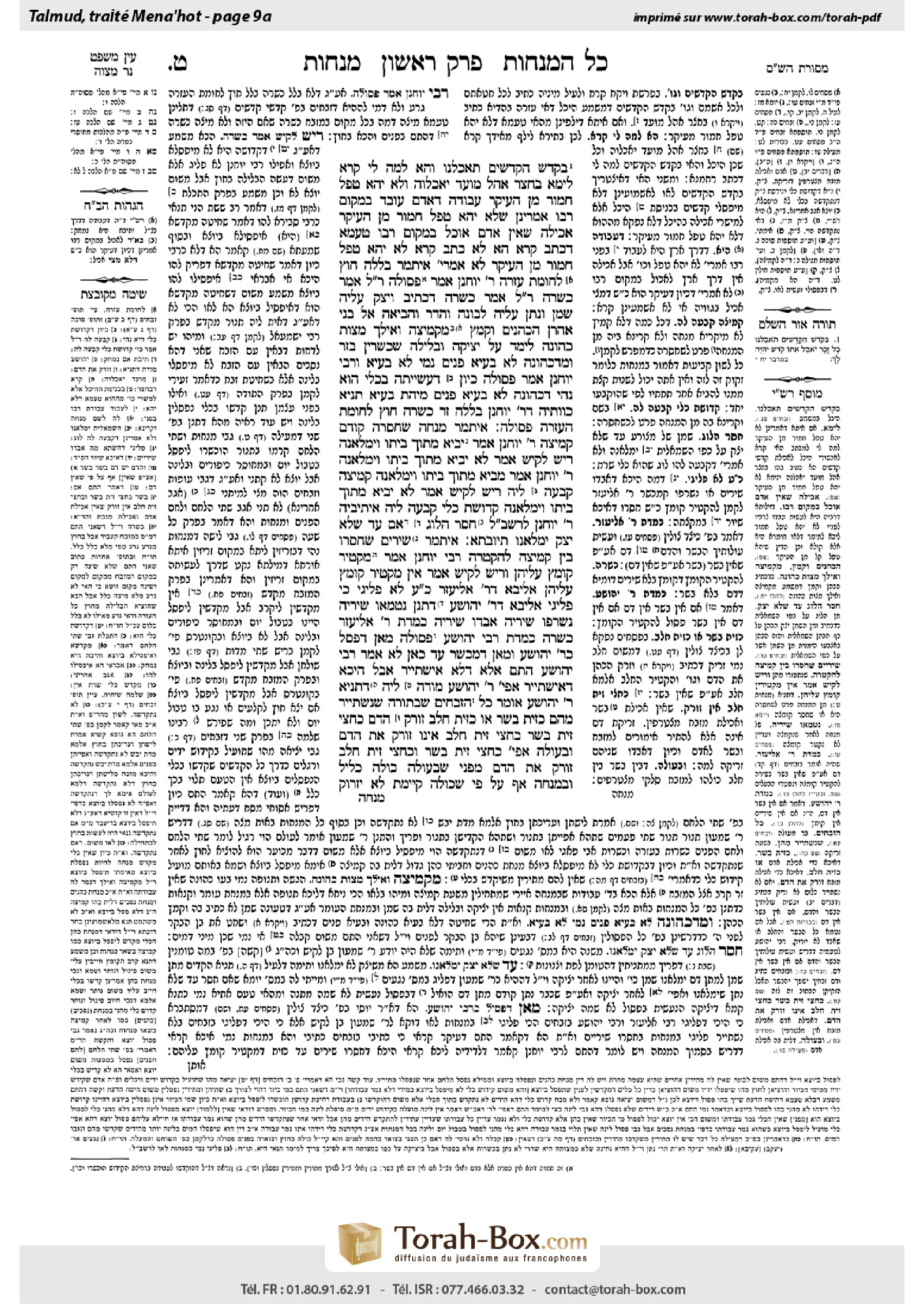
Menachot 9a: Talmud study for Daf Yomi
Daf Yomi is the daily study of one Talmud folio. Explore 37 tractates with scans, Hebrew text, Sefaria English and AI-generated French translations where annotated.
Passage selection and English or AI-generated French translation are available where the scan has annotations. Daf Study is independent of Torah-Box and Sefaria.
Browse Menachot · מנחות · All tractatesMenachot 9a text and translations
This page of Menachot includes the Aramaic text, an English translation and an AI-generated French translation, alongside the scan above.
מנחות ט׳ א · Aramaic and Hebrew text
״בְּקֹדֶשׁ הַקֳּדָשִׁים תֹּאכְלֶנּוּ״.
וְהָא לְמָה לִי קְרָא? לֵימָא: ״בַּחֲצַר אֹהֶל מוֹעֵד יֹאכְלוּהָ״, וְלֹא יְהֵא טָפֵל חָמוּר מִן הָעִיקָּר.
עֲבוֹדָה, דְּאָדָם עוֹבֵד בִּמְקוֹם רַבּוֹ, אָמְרִינַן שֶׁלֹּא יְהֵא טָפֵל חָמוּר מִן הָעִיקָּר. אֲכִילָה, שֶׁאֵין אָדָם אוֹכֵל בִּמְקוֹם רַבּוֹ, טַעְמָא דִּכְתַב קְרָא, הָא לָא כְּתַב קְרָא – לֹא יְהֵא טָפֵל חָמוּר מִן הָעִיקָּר לָא אָמְרִינַן.
אִיתְּמַר: בְּלָלָהּ חוּץ לְחוֹמַת עֲזָרָה, רַבִּי יוֹחָנָן אָמַר: פְּסוּלָה, רֵישׁ לָקִישׁ אָמַר: כְּשֵׁרָה. רֵישׁ לָקִישׁ אָמַר כְּשֵׁרָה, דִּכְתִיב: ״וְיָצַק עָלֶיהָ שֶׁמֶן וְנָתַן עָלֶיהָ לְבוֹנָה״, וַהֲדַר ״וֶהֱבִיאָהּ אֶל בְּנֵי אַהֲרֹן הַכֹּהֲנִים וְקָמַץ״.
מִקְּמִיצָה וְאֵילָךְ מִצְוַת כְּהוּנָּה, לִימֵּד עַל יְצִיקָה וּבְלִילָה שֶׁכְּשֵׁרִין בְּזָר, וּמִדִּכְהוּנָּה לָא בָּעֲיָא, פְּנִים נָמֵי לָא בָּעֲיָא.
וְרַבִּי יוֹחָנָן אָמַר: פְּסוּלָה, כֵּיוָן דַּעֲשִׂיָּיתָהּ בִּכְלִי הוּא, נְהִי דִּכְהוּנָּה לָא בָּעֲיָא, פְּנִים מִיהַת בָּעֲיָא. תַּנְיָא כְּוָותֵיהּ דְּרַבִּי יוֹחָנָן: בְּלָלָהּ זָר – כְּשֵׁרָה, חוּץ לְחוֹמַת הָעֲזָרָה – פְּסוּלָה.
אִיתְּמַר: מִנְחָה שֶׁחָסְרָה קוֹדֶם קְמִיצָה, רַבִּי יוֹחָנָן אָמַר: יָבִיא מִתּוֹךְ בֵּיתוֹ וִימַלְּאֶנָּה, רֵישׁ לָקִישׁ אָמַר: לָא יָבִיא מִתּוֹךְ בֵּיתוֹ וִימַלְּאֶנָּה.
רַבִּי יוֹחָנָן אָמַר: מֵבִיא מִתּוֹךְ בֵּיתוֹ וִימַלְּאֶנָּה, קְמִיצָה קָבְעָה לֵיהּ. רֵישׁ לָקִישׁ אָמַר: לָא יָבִיא מִתּוֹךְ בֵּיתוֹ וִימַלְּאֶנָּה, קְדוּשַּׁת כְּלִי קָבְעָה לֵיהּ.
אֵיתִיבֵיהּ רַבִּי יוֹחָנָן לְרַבִּי שִׁמְעוֹן בֶּן לָקִישׁ: חָסֵר הַלּוֹג, אִם עַד שֶׁלֹּא יָצַק – יְמַלְּאֶנּוּ, תְּיוּבְתָּא.
אִיתְּמַר: שִׁירַיִם שֶׁחָסְרוּ בֵּין קְמִיצָה לְהַקְטָרָה, רַבִּי יוֹחָנָן אָמַר: מַקְטִיר קוֹמֶץ עֲלֵיהֶן, וְרֵישׁ לָקִישׁ אָמַר: אֵין מַקְטִיר קוֹמֶץ עֲלֵיהֶן. אַלִּיבָּא דְּרַבִּי אֱלִיעֶזֶר כּוּלֵּי עָלְמָא לָא פְּלִיגִי, כִּי פְּלִיגִי אַלִּיבָּא דְּרַבִּי יְהוֹשֻׁעַ.
דִּתְנַן: נִטְמְאוּ שְׁיָרֶיהָ, נִשְׂרְפוּ שְׁיָרֶיהָ, אָבְדוּ שְׁיָרֶיהָ – כְּמִדַּת רַבִּי אֱלִיעֶזֶר כְּשֵׁרָה, כְּמִדַּת רַבִּי יְהוֹשֻׁעַ פְּסוּלָה.
מַאן דְּפָסֵל – כְּרַבִּי יְהוֹשֻׁעַ, וּמַאן דְּמַכְשַׁר – עַד כָּאן לֹא אָמַר רַבִּי יְהוֹשֻׁעַ הָתָם אֶלָּא דְּלָא אִישְׁתְּיַיר, אֲבָל הֵיכָא דְּאִישְׁתְּיַיר – אֲפִילּוּ רַבִּי יְהוֹשֻׁעַ מוֹדֶה לֵיהּ.
דְּתַנְיָא: רַבִּי יְהוֹשֻׁעַ אוֹמֵר: כׇּל הַזְּבָחִים שֶׁבַּתּוֹרָה שֶׁנִּשְׁתַּיֵּיר מֵהֶם כְּזַיִת בָּשָׂר אוֹ כְּזַיִת חֵלֶב – זוֹרֵק הַדָּם, כַּחֲצִי זַיִת בָּשָׂר כַּחֲצִי זַיִת חֵלֶב – אֵינוֹ זוֹרֵק אֶת הַדָּם.
וּבָעוֹלָה, אֲפִילּוּ כַּחֲצִי זַיִת בָּשָׂר וְכַחֲצִי זַיִת חֵלֶב – זוֹרֵק אֶת הַדָּם, מִפְּנֵי שֶׁבָּעוֹלָה כּוּלָּהּ כָּלִיל, וּבַמִּנְחָה, אַף עַל פִּי שֶׁכּוּלָּהּ קַיֶּימֶת – לֹא יִזְרוֹק.
Menachot 9a · English translation
“Every meal offering of theirs, and every sin offering of theirs, and every guilt offering of theirs, which they may render unto Me, shall be most holy for you and for your sons. In the Sanctuary you shall eat them” (Numbers 18:9–10). This indicates that although the mitzva is to consume offerings of the most sacred order in the courtyard, in certain instances the priests may consume these offerings inside the Sanctuary, the most holy place.
The Gemara explains its objection: But according to the opinion of Rabbi Yoḥanan, why do I need this verse? Let him say here as well that as the verse states: “In the court of the Tent of Meeting they shall eat it” (Leviticus 6:9), i.e., in the Temple courtyard, it is logical that the halakha with regard to the minor area should not be more stringent than the halakha with regard to the major one, i.e., if one may consume a peace offering in the Temple courtyard then all the more so may he consume it in the Sanctuary.
The Gemara explains: Consuming an offering is not the same as slaughtering it. The slaughter of an offering is part of the sacrificial service, and it is not considered disrespectful for a person to serve his master in the place of his master, i.e., within the Sanctuary as well as in the courtyard. Therefore, we say that the halakha with regard to the minor area should not be more stringent than the halakha with regard to the major one. By contrast, with regard to the consumption of an offering, since a person may not eat in the place of his master, the only reason that it is permitted to consume an offering inside the Sanctuary is that it is written in the verse: “In a most holy place you shall eat them.” Had this not been written in the verse explicitly, we would not say that the halakha with regard to the minor area should not be more stringent than the halakha with regard to the major one.
§ It was stated: If one mixed the oil of a meal offering into it outside the wall of the Temple courtyard, Rabbi Yoḥanan says that it is disqualified, and Reish Lakish says that it is valid. Reish Lakish says: It is valid, as it is written: “And he shall pour oil upon it, and put frankincense upon it” (Leviticus 2:1), and then it is written: “And he shall bring it to Aaron’s sons the priests; and he shall remove” (Leviticus 2:2).
Reish Lakish explains: The Sages derived from here that from the removal of the handful onward the rites performed with the meal offering are solely a mitzva of the priesthood. Accordingly, the verse taught about pouring and mixing that they are valid when performed by a non-priest. And from the fact that the priesthood is not required for the mixing, it may be derived that it is also not required that its performance be inside the walls of the Temple courtyard.
And Rabbi Yoḥanan says: This meal offering is disqualified, since a meal offering’s performance is in a service vessel. Therefore, granted that the priesthood is not required, yet in any event its performance inside the Temple courtyard is required. The Gemara notes that it is taught in a baraita in accordance with the opinion of Rabbi Yoḥanan: If a meal offering was mixed by a non-priest it is valid. But if it was mixed outside the wall of the Temple courtyard it is disqualified.
§ It was stated: With regard to a meal offering that became lacking in its full measure before the removal of the handful, Rabbi Yoḥanan says that the owner shall bring additional flour from within his home and shall fill the missing part of the measure of the meal offering. Reish Lakish says: He shall not bring flour from within his home and fill it. Instead, he must bring a new meal offering.
The Gemara explains: Rabbi Yoḥanan says that he brings flour from within his home and he fills it, as the removal of the handful establishes it as a meal offering to the extent that it may become disqualified. Before the removal, one may always add flour to the meal offering. Reish Lakish says: He shall not bring flour from within his home and fill it, as the sanctity of the service vessel establishes it as a meal offering. Therefore, once the meal offering was placed in a service vessel and sanctified, it is disqualified if it becomes lacking.
Rabbi Yoḥanan raised an objection to Rabbi Shimon ben Lakish, Reish Lakish, from a mishna (Nega’im 14:10) discussing the log of oil brought by a leper: In a case where the log lacked a full measure, if it became lacking before the priest poured from it into his palm in order to place it on the right thumb and big toe of the leper, he shall fill it. Clearly the service vessel containing the log does not sanctify the oil to the extent that it can become disqualified. The Gemara notes: Indeed, this is a conclusive refutation of the opinion of Reish Lakish.
§ It was stated: With regard to the remainder of a meal offering that became lacking between the removal of the handful and its burning upon the altar, Rabbi Yoḥanan says that one burns the handful on account of such a remainder, and that the remainder is then permitted for consumption. And Reish Lakish says that one does not burn the handful on account of the remainder. The Gemara notes: According to the opinion of Rabbi Eliezer, everyone agrees that the handful is burned on account of the remainder. In other words, both amora’im, Rabbi Yoḥanan and Reish Lakish, concur that this is the halakha according to the tanna Rabbi Eliezer. When they disagree, it is concerning the halakha according to the opinion of Rabbi Yehoshua.
The Gemara cites the dispute in question. As we learned in a mishna (26a): If, after the handful was removed, the remainder of the meal offering became ritually impure, or if the remainder of the meal offering was burned, or if the remainder of the meal offering was lost, according to the principle of Rabbi Eliezer, who says that with regard to an animal offering the blood is fit for sprinkling even if there is no meat that can be eaten, the meal offering is fit, and the priest burns the handful. But according to the principle of Rabbi Yehoshua, who says that with regard to an animal offering the blood is fit for sprinkling only if there is meat that can be eaten, it is unfit and the priest does not burn the handful, as the handful serves to render the remainder permitted.
The one who disqualifies the remainder of a meal offering that became lacking between the removal of the handful and its burning upon the altar, i.e., Reish Lakish, holds in accordance with the plain meaning of the opinion of Rabbi Yehoshua. And the one who deems that remainder fit, i.e., Rabbi Yoḥanan, maintains that when Rabbi Yehoshua says that the remainder is unfit, he says so only there, in a case where nothing remained from the meal offering other than the remainder. Since the handful is intended to render permitted for consumption the remainder of the meal offering, if there is no remainder at all then the handful is not burned. But in a case where there remained a portion of the remainder, Rabbi Yoḥanan maintains that even Rabbi Yehoshua concedes to Rabbi Eliezer that the handful is fit to be burned.
The Gemara cites a proof for Rabbi Yoḥanan: It is clear that this is Rabbi Yehoshua’s opinion, as it is taught in a baraita that Rabbi Yehoshua says: With regard to any of the offerings that are mentioned in the Torah from which there remains either an olive-bulk of meat or an olive-bulk of fat, the halakha is that the priest sprinkles the blood of that offering and thereby permits either the remaining meat for consumption or the remaining fat for sacrifice upon the altar. But if there remains only half an olive-bulk of meat and half an olive-bulk of fat, he does not sprinkle the blood, as the consumption or burning of anything less than an olive-bulk is not significant enough to warrant the sprinkling of the blood. The volumes of the meat and the fat do not combine to form a whole olive-bulk.
The baraita continues: And in the case of a burnt offering, even if there remains only half an olive-bulk of flesh and half an olive-bulk of fat, he sprinkles the blood, because in the case of a burnt offering it is entirely consumed, i.e., as the flesh and fat are both burned upon the altar, there is in fact an olive-bulk of the offering that is designated for burning upon the altar. And with regard to a meal offering, even though it remains entirely intact, he shall not sprinkle.
Menachot 9a · Traduction française (IA)
« Toute leur offrande végétale, tout leur sacrifice expiatoire et tout leur sacrifice de culpabilité, qu’ils peuvent Me présenter, seront très saints pour vous et pour vos fils. Vous les mangerez dans le Sanctuaire » (Nombres 18, 9-10). Cela indique que, bien que la mitsva soit de consommer les offrandes de sainteté supérieure dans la cour, dans certains cas les prêtres peuvent les consommer à l’intérieur du Sanctuaire, le lieu très saint.
La Guemara explique son objection : mais, selon l’opinion de Rabbi Yoḥanan, pourquoi ce verset est-il nécessaire ? Qu’il dise ici aussi que, puisque le verset énonce : « Dans la cour de la Tente d’assignation, ils la mangeront » (Lévitique 6, 9), c’est-à-dire dans la cour du Temple, il est logique que la halakha relative au domaine mineur ne soit pas plus stricte que celle relative au domaine majeur. Autrement dit, si l’on peut consommer une offrande de paix dans la cour du Temple, on peut à plus forte raison la consommer dans le Sanctuaire.
La Guemara explique : consommer une offrande n’est pas la même chose que l’abattre. L’abattage d’une offrande fait partie du service sacrificiel, et il n’est pas irrespectueux pour un homme de servir son maître dans le lieu où celui-ci se trouve, c’est-à-dire dans le Sanctuaire comme dans la cour. Par conséquent, on dit que la halakha relative au domaine mineur ne doit pas être plus stricte que celle relative au domaine majeur. En revanche, s’agissant de la consommation d’une offrande, puisqu’un homme ne peut pas manger dans le lieu où se trouve son maître, la seule raison pour laquelle il est permis de consommer une offrande dans le Sanctuaire est que le verset dit : « Vous les mangerez dans un lieu très saint. » Si cela n’avait pas été explicitement écrit dans le verset, nous n’aurions pas dit que la halakha relative au domaine mineur ne doit pas être plus stricte que celle relative au domaine majeur.
§ Il a été dit : si quelqu’un a mêlé l’huile à une offrande végétale à l’extérieur de l’enceinte de la cour du Temple, Rabbi Yoḥanan dit qu’elle est invalide, tandis que Reish Lakish dit qu’elle est valide. Reish Lakish dit qu’elle est valide, car il est écrit : « Il versera de l’huile dessus et y mettra de l’encens » (Lévitique 2, 1), puis : « Il l’apportera aux fils d’Aaron, les prêtres, et celui-ci en prélèvera » (Lévitique 2, 2).
Reish Lakish explique : les Sages ont déduit de là qu’à partir du prélèvement de la poignée, les rites accomplis sur l’offrande végétale relèvent exclusivement du service sacerdotal. Par conséquent, le verset enseigne que le versement de l’huile et son mélange sont valides même s’ils sont accomplis par un non-prêtre. Et du fait qu’un prêtre n’est pas requis pour le mélange, on peut déduire qu’il n’est pas non plus nécessaire que celui-ci soit effectué à l’intérieur de l’enceinte de la cour du Temple.
Et Rabbi Yoḥanan dit : cette offrande végétale est invalide, car son rite doit être accompli dans un ustensile de service. Ainsi, même si un prêtre n’est pas requis, il reste néanmoins nécessaire que le rite soit accompli à l’intérieur de la cour du Temple. La Guemara relève qu’une baraïta enseigne conformément à l’opinion de Rabbi Yoḥanan : si une offrande végétale a été mélangée par un non-prêtre, elle est valide. Mais si elle a été mélangée à l’extérieur de l’enceinte de la cour du Temple, elle est invalide.
§ Il a été dit : au sujet d’une offrande végétale dont la mesure complète s’est trouvée diminuée avant le prélèvement de la poignée, Rabbi Yoḥanan dit que son propriétaire doit apporter de la farine de chez lui et compléter la mesure manquante. Reish Lakish dit : il ne doit pas apporter de farine de chez lui pour la compléter ; il doit plutôt apporter une nouvelle offrande végétale.
La Guemara explique : Rabbi Yoḥanan dit qu’il apporte de la farine de chez lui et complète la mesure, car c’est le prélèvement de la poignée qui lui confère le statut d’offrande végétale au point qu’elle puisse devenir invalide. Avant le prélèvement, on peut toujours ajouter de la farine à l’offrande végétale. Reish Lakish dit : il ne doit pas apporter de farine de chez lui pour la compléter, car c’est la consécration dans l’ustensile de service qui lui confère le statut d’offrande végétale. Par conséquent, dès que l’offrande végétale a été placée dans un ustensile de service et consacrée, elle est invalide si une partie vient à manquer.
Rabbi Yoḥanan souleva une objection contre Rabbi Shimon ben Lakish, Reish Lakish, à partir d’une Michna (Negaïm 14, 10) traitant du log d’huile apporté par un lépreux : si le log n’avait pas la mesure complète et qu’il en manquait une partie avant que le prêtre en verse dans sa paume pour l’appliquer sur le pouce et le gros orteil droits du lépreux, il doit le compléter. Il est clair que l’ustensile de service contenant le log ne consacre pas l’huile au point qu’elle puisse devenir invalide. La Guemara relève : en effet, c’est une réfutation décisive de l’opinion de Reish Lakish.
§ Il a été dit : au sujet du reste d’une offrande végétale dont une partie est venue à manquer entre le prélèvement de la poignée et sa combustion sur l’autel, Rabbi Yoḥanan dit qu’on brûle la poignée en raison de ce reste, qui devient alors permis à la consommation. Reish Lakish dit qu’on ne brûle pas la poignée en raison du reste. La Guemara relève : selon l’opinion de Rabbi Eliezer, tous sont d’accord pour dire que la poignée est brûlée en raison du reste. Autrement dit, les deux amoraïm, Rabbi Yoḥanan et Reish Lakish, conviennent que telle est la halakha selon le tanna Rabbi Eliezer. Leur désaccord porte sur la halakha selon l’opinion de Rabbi Yehoshua.
La Guemara cite le désaccord en question. Comme nous l’avons appris dans une Michna (26a) : si, après le prélèvement de la poignée, le reste de l’offrande végétale est devenu rituellement impur, a été brûlé ou a été perdu, alors, selon le principe de Rabbi Eliezer, qui dit que, pour une offrande animale, le sang peut être aspergé même s’il n’y a pas de viande consommable, l’offrande végétale est apte et le prêtre brûle la poignée. Mais selon le principe de Rabbi Yehoshua, qui dit que, pour une offrande animale, le sang ne peut être aspergé que s’il y a de la viande consommable, l’offrande est inapte et le prêtre ne brûle pas la poignée, car celle-ci sert à rendre le reste permis à la consommation.
Celui qui invalide le reste d’une offrande végétale dont une partie est venue à manquer entre le prélèvement de la poignée et sa combustion sur l’autel, c’est-à-dire Reish Lakish, s’en tient au sens apparent de l’opinion de Rabbi Yehoshua. Celui qui considère ce reste comme apte, c’est-à-dire Rabbi Yoḥanan, soutient que lorsque Rabbi Yehoshua dit que le reste est inapte, il ne le dit que dans le cas où rien ne reste de l’offrande végétale hormis ce reste. Puisque la poignée est destinée à rendre le reste de l’offrande végétale permis à la consommation, si rien ne reste du tout, la poignée n’est pas brûlée. Mais lorsqu’une partie du reste subsiste, Rabbi Yoḥanan soutient que même Rabbi Yehoshua concède à Rabbi Eliezer que la poignée peut être brûlée.
La Guemara cite une preuve en faveur de Rabbi Yoḥanan : il est clair qu’il s’agit là de l’opinion de Rabbi Yehoshua, car une baraïta enseigne que Rabbi Yehoshua dit : pour toute offrande mentionnée dans la Torah dont il reste soit un volume d’une olive de viande, soit un volume d’une olive de graisse, la halakha est que le prêtre asperge le sang de cette offrande, permettant ainsi la consommation de la viande restante ou la combustion sur l’autel de la graisse restante. Mais s’il ne reste qu’un demi-volume d’olive de viande et un demi-volume d’olive de graisse, il n’asperge pas le sang, car la consommation ou la combustion d’une quantité inférieure au volume d’une olive n’est pas suffisamment significative pour justifier l’aspersion du sang. Les volumes de viande et de graisse ne s’additionnent pas pour former un volume entier d’olive.
La baraïta poursuit : dans le cas d’un holocauste, même s’il ne reste qu’un demi-volume d’olive de chair et un demi-volume d’olive de graisse, le prêtre asperge le sang, car l’holocauste est entièrement consumé, autrement dit, puisque la chair et la graisse sont toutes deux brûlées sur l’autel, il y a en réalité un volume d’olive de l’offrande destiné à être brûlé sur l’autel. Et, s’agissant d’une offrande végétale, même si elle demeure entièrement intacte, le prêtre ne doit pas asperger le sang.
Traduction française générée par IA à partir de l’édition anglaise de Sefaria. Vérifie toujours un passage avec le texte source.
Text from Sefaria: William Davidson Edition - Vocalized Aramaic (unknown); William Davidson Edition - English (CC BY NC).