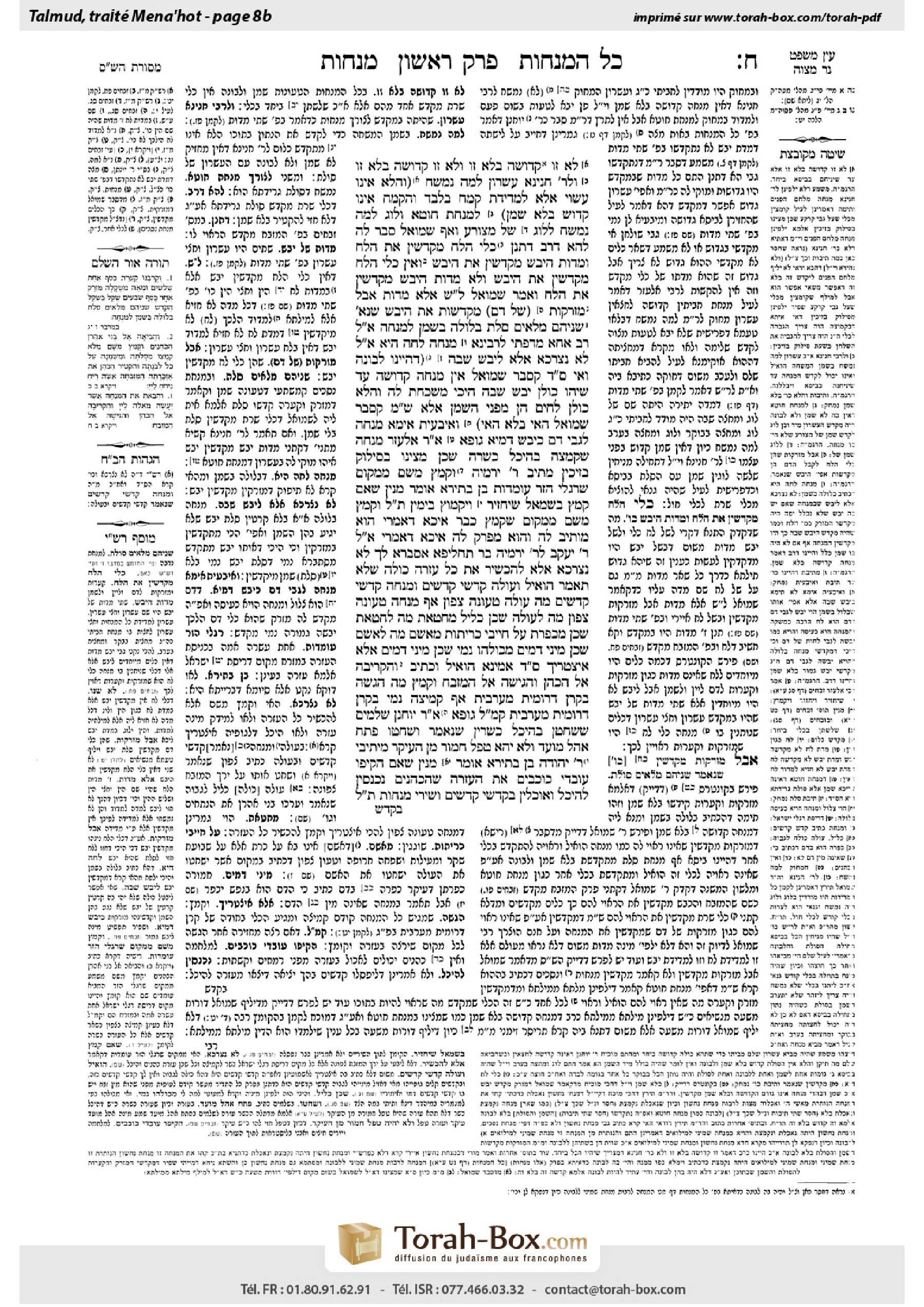
Menachot 8b: Talmud study for Daf Yomi
Daf Yomi is the daily study of one Talmud folio. Explore 37 tractates with scans, Hebrew text, Sefaria English and AI-generated French translations where annotated.
Passage selection and English or AI-generated French translation are available where the scan has annotations. Daf Study is independent of Torah-Box and Sefaria.
Browse Menachot · מנחות · All tractatesMenachot 8b text and translations
This page of Menachot includes the Aramaic text, an English translation and an AI-generated French translation, alongside the scan above.
מנחות ח׳ ב · Aramaic and Hebrew text
לֹא זוֹ קְדוֹשָׁה בְּלֹא זוֹ וְלֹא זוֹ קְדוֹשָׁה בְּלֹא זוֹ.
וּלְרַבִּי חֲנִינָא, עִשָּׂרוֹן לָמָּה נִמְשַׁח? (וַהֲלֹא אֵינוֹ עָשׂוּי אֶלָּא לִמְדִידַת קֶמַח בִּלְבַד, וְהַקֶּמַח אֵינוֹ קָדוֹשׁ בְּלֹא שֶׁמֶן!) לְמִנְחַת חוֹטֵא.
וְלוֹג, לָמָּה נִמְשַׁח? לְלוֹג שֶׁל מְצוֹרָע.
וְאַף שְׁמוּאֵל סָבַר לַהּ לְהָא דְּרַב, דִּתְנַן: כְּלֵי הַלַּח מְקַדְּשִׁין אֶת הַלַּח, וּמִדּוֹת הַיָּבֵשׁ מְקַדְּשִׁין אֶת הַיָּבֵשׁ, וְאֵין כְּלֵי הַלַּח מְקַדְּשִׁין אֶת הַיָּבֵשׁ, וְלֹא מִדּוֹת הַיָּבֵשׁ מְקַדְּשִׁין אֶת הַלַּח.
וְאָמַר שְׁמוּאֵל: לֹא שָׁנוּ אֶלָּא מִדּוֹת, אֲבָל מִזְרָקוֹת (שֶׁל דָּם) מְקַדְּשׁוֹת אֶת הַיָּבֵשׁ, שֶׁנֶּאֱמַר: ״שְׁנֵיהֶם מְלֵאִים סֹלֶת בְּלוּלָה בַשֶּׁמֶן לְמִנְחָה״.
אֲמַר לֵיהּ רַב אַחָא מִדִּפְתִּי לְרָבִינָא: מִנְחָה לַחָה הִיא! אֲמַר לֵיהּ: לֹא נִצְרְכָא אֶלָּא לַיָּבֵשׁ שֶׁבָּהּ, (דְּהַיְינוּ לְבוֹנָה.
וְאִי סָלְקָא דַעְתָּךְ קָסָבַר שְׁמוּאֵל: אֵין מִנְחָה קְדוֹשָׁה עַד שֶׁיְּהוּ כּוּלָּן, יָבֵשׁ שֶׁבָּהּ הֵיכִי מַשְׁכַּחַתְּ לַהּ? וַהֲלֹא כּוּלָּן לַחִים הֵן מִפְּנֵי הַשֶּׁמֶן! אֶלָּא שְׁמַע מִינַּהּ קָסָבַר שְׁמוּאֵל: הַאי בְּלֹא הַאי.)
וְאִיבָּעֵית אֵימָא: מִנְחָה, לְגַבֵּי דָּם – כְּיָבֵשׁ דָּמְיָא.
גּוּפָא, אָמַר רַבִּי אֶלְעָזָר: מִנְחָה שֶׁקְּמָצָהּ בַּהֵיכָל – כְּשֵׁרָה, שֶׁכֵּן מָצִינוּ בְּסִילּוּק בָּזִיכִין.
מֵתִיב רַבִּי יִרְמְיָה: ״וְקָמַץ מִשָּׁם״ – מִמָּקוֹם שֶׁרַגְלֵי הַזָּר עוֹמְדוֹת.
בֶּן בְּתִירָא אוֹמֵר: מִנַּיִן שֶׁאִם קָמַץ בִּשְׂמֹאל, שֶׁיַּחֲזִיר וְיִקְמוֹץ בְּיָמִין? תַּלְמוּד לוֹמַר: ״וְקָמַץ מִשָּׁם״ – מִמָּקוֹם שֶׁקָּמַץ כְּבָר.
אִיכָּא דְּאָמְרִי: הוּא מוֹתֵיב לַהּ וְהוּא מְפָרֵק לַהּ. אִיכָּא דְאָמְרִי: אֲמַר לֵיהּ רַבִּי יַעֲקֹב לְרַבִּי יִרְמְיָה בַּר תַּחְלִיפָא, אַסְבְּרַהּ לָךְ – לֹא נִצְרְכָא אֶלָּא לְהַכְשִׁיר אֶת כׇּל עֲזָרָה כּוּלָּהּ, שֶׁלֹּא תֹּאמַר: הוֹאִיל וְעוֹלָה קׇדְשֵׁי קָדָשִׁים, וּמִנְחָה קׇדְשֵׁי קָדָשִׁים, מָה עוֹלָה טְעוּנָה צָפוֹן – אַף מִנְחָה טְעוּנָה צָפוֹן.
מָה לְעוֹלָה, שֶׁכֵּן כָּלִיל, מֵחַטָּאת.
מָה לְחַטָּאת, שֶׁכֵּן מְכַפֶּרֶת עַל חַיָּיבֵי כָרֵיתוֹת, מֵאָשָׁם.
מָה לְאָשָׁם, שֶׁכֵּן מִינֵי דָמִים! מִכּוּלְּהוּ נָמֵי, שֶׁכֵּן מִינֵי דָמִים!
אֶלָּא אִיצְטְרִיךְ, סָלְקָא דַּעְתָּךְ אָמֵינָא, הוֹאִיל וּכְתִיב: ״וְהִקְרִיבָהּ אֶל הַכֹּהֵן וְהִגִּישָׁהּ אֶל הַמִּזְבֵּחַ וְקָמַץ״, מָה הַגָּשָׁה בְּקֶרֶן דְּרוֹמִית מַעֲרָבִית, אַף קְמִיצָה נָמֵי בְּקֶרֶן דְּרוֹמִית מַעֲרָבִית, קָא מַשְׁמַע לַן.
גּוּפָא, אָמַר רַבִּי יוֹחָנָן: שְׁלָמִים שֶׁשְּׁחָטָן בַּהֵיכָל – כְּשֵׁרִין, שֶׁנֶּאֱמַר: ״וּשְׁחָטוֹ פֶּתַח אֹהֶל מוֹעֵד״, וְלֹא יְהֵא טָפֵל חָמוּר מִן הָעִיקָּר.
מֵיתִיבִי: רַבִּי יְהוּדָה בֶּן בְּתִירָא אוֹמֵר, מִנַּיִן שֶׁאִם הִקִּיפוּ גּוֹיִם אֶת הָעֲזָרָה, שֶׁהַכֹּהֲנִים נִכְנָסִין לַהֵיכָל וְאוֹכְלִין בְּקׇדְשֵׁי קָדָשִׁים וּשְׁיָרֵי מְנָחוֹת? תַּלְמוּד לוֹמַר:
Menachot 8b · English translation
Neither is this substance sanctified without that, nor is that sanctified without this. Rather, any meal offering that requires oil and frankincense is sanctified by a service vessel only when the flour, oil, and frankincense are all placed in the same vessel at the same time.
The Gemara asks: And according to the opinion of Rabbi Ḥanina, for what purpose was the vessel that measured a tenth of an ephah anointed, making it possible for it to sanctify items placed inside it? This vessel was fashioned only for measuring flour, and according to Rabbi Ḥanina the flour is not sanctified without oil. What then does this vessel sanctify? The Gemara answers: The vessel was anointed for the purpose of sanctifying the meal offering of a sinner, which contains neither oil nor frankincense.
The Gemara further asks: And for what purpose was the vessel that measured one log of oil anointed? After all, according to Rabbi Ḥanina oil for a meal offering cannot be sanctified by itself. The Gemara explains: It was anointed for the purpose of sanctifying the log of oil of a leper, which is not brought as part of a meal offering. This oil is sanctified without flour or frankincense.
The Gemara notes: And Shmuel also holds in accordance with this statement of Rav, that a service vessel sanctifies the flour of a meal offering even without its oil, as we learned in a mishna (Zevaḥim 88a): The vessels used for liquids sanctify only the liquids, and the vessels that serve as dry measures sanctify only the dry goods. But the vessels used for liquids do not sanctify the dry goods, and the vessels that serve as dry measures do not sanctify the liquids.
And Shmuel says with regard to this mishna: They taught that vessels used for liquids do not sanctify dry goods only with regard to vessels used as measures. But bowls that are used for collecting and tossing the blood of offerings sanctify the dry goods as well, as it is stated with regard to the offerings of the princes brought during the inauguration of the Tabernacle: “Both of them full of fine flour mixed with oil for a meal offering” (Numbers 7:13), which indicates that the bowl sanctifies meal offerings, which are dry.
The Gemara continues its proof: And Rav Aḥa of Difti said to Ravina, with regard to this derivation of Shmuel: But the meal offering of the verse is also considered a liquid, as it is mingled with oil. How then can one derive from it the halakha with regard to items that are entirely dry? Ravina said to him: The verse cited by Shmuel is necessary only to teach that the dry part of a meal offering, that is, the frankincense, which invariably does not come into contact with the oil, is sanctified by the bowls as well.
The Gemara concludes its proof with regard to Shmuel’s opinion: And if it enters your mind that Shmuel holds that a meal offering is not sanctified by a service vessel until all of its components are together in the vessel, then how can you find a case where the dry parts of a meal offering are by themselves? Is it not correct that when meal offerings are sanctified, all of them are liquids, due to the oil that is mixed with them? Rather, conclude from here that Shmuel holds that this substance may be sanctified without that one.
And if you wish, say instead in answer to Rav Aḥa of Difti’s question: A meal offering, even when it is mixed with oil, is, relative to blood, considered as a dry item. Accordingly, one may derive from the verse that the bowls sanctify dry items, and just as a bowl sanctifies a meal offering that contains oil, as it is considered dry in comparison to blood, so too, it sanctifies a meal offering that is entirely dry, i.e., that contains no oil, as claimed by Rav.
§ The Gemara discusses the matter itself. Rabbi Elazar says: A meal offering from which the priest removed a handful while inside the Sanctuary is valid, despite the fact that the handful should be removed in the Temple courtyard; the reason is that we find a similar case in the Sanctuary, with regard to the removal of the bowls of frankincense from the Table of the shewbread. Just as the bowls permit the shewbread for consumption, so too, the handful permits the remainder of the meal offering for consumption.
Rabbi Yirmeya raises an objection to this opinion from a baraita discussing the verse: “And he shall bring it to Aaron’s sons the priests; and he shall remove from there his handful” (Leviticus 2:2). The verse indicates that the removal of a handful from a meal offering may be performed from the place where the feet of the non-priest may stand, i.e., anywhere within the Temple courtyard.
The baraita continues: Ben Beteira, who holds that a handful is not disqualified when removed with the left hand, says that the verse should be interpreted as follows: From where is it derived that if one removed a handful with his left hand, that he must return the handful to the vessel that contains the meal offering and again remove the handful with his right hand? The verse states: “And he shall remove from there.” This indicates that the handful is removed from the place where he already removed it, i.e., the handful is returned to the meal offering and thereupon removed from the same meal offering, this time with his right hand. It is clear from the statement of the first tanna that the handful of a meal offering may be removed only in the place where the feet of a non-priest may stand, but not in the Sanctuary.
Some say that Rabbi Yirmeya raises the objection and he resolves it as well. And some say that Rabbi Ya’akov said to Rabbi Yirmeya bar Taḥlifa: I will explain to you the resolution of this objection: The verse is necessary only to permit the entire Temple courtyard for removing the handful there, not to prohibit the removal of a handful inside the Sanctuary. The reason is that you should not say: Since a burnt offering is an offering of the most sacred order, and a meal offering is likewise an offering of the most sacred order, then just as a burnt offering requires that its slaughter be performed in the northern part of the Temple courtyard, so too, a meal offering requires that the removal of its handful be in the northern part.
The Gemara raises a difficulty with regard to this comparison: What is notable about a burnt offering? It is notable in that it is more sacred, as it is consumed in its entirety upon the altar. The Gemara responds: The same comparison may be drawn from a sin offering, which is also an offering of the most sacred order and is not sacrificed in its entirety upon the altar, and yet it must be slaughtered in the northern part of the Temple courtyard.
The Gemara raises a difficulty with regard to this comparison as well: What is notable about a sin offering? It is notable in that the halakhot of a sin offering are more stringent, as its sacrifice atones for those sins whose transgression causes one to be liable to receive karet. The Gemara responds: The comparison may be drawn from a guilt offering, as it too is an offering of the most sacred order, it is not sacrificed in its entirety upon the altar, it does not atone for such sins, and yet it must be slaughtered in the northern part of the Temple courtyard.
The Gemara rejects this suggestion as well: What is notable about a guilt offering? It is notable in that a guilt offering has a loftier status, as it is one of the types of offerings whose atonement is achieved through their blood, i.e., it is an animal offering. The Gemara adds: Once this claim has been accepted, from all of them as well, i.e., from a burnt offering and sin offering, one cannot draw a comparison to a meal offering either, as they are all of the types of offerings whose atonement is achieved through their blood.
Rather, the verse was necessary in order to permit the removal of a handful anywhere in the Temple courtyard because it might enter your mind to say that since it is written: “And it shall be presented to the priest, and he shall bring it to the altar” (Leviticus 2:8), and it states: “And he shall remove from there his handful” (Leviticus 2:2), one could claim: Just as the bringing of the meal offering is in the southwestern corner of the altar, so too, the removal of the handful must also be performed in the southwestern corner. Therefore, the verse teaches us that the removal of the handful may be performed anywhere in the Temple courtyard, but this does not serve to exclude the Sanctuary.
§ The Gemara discusses the matter itself. Rabbi Yoḥanan says: Peace offerings that were slaughtered in the Sanctuary are valid, as it is stated: “And slaughter it at the entrance of the Tent of Meeting” (Leviticus 3:2), i.e., in the courtyard. And it is logical that the halakha with regard to the minor area, i.e., the courtyard, should not be more stringent than the halakha with regard to the major one, the Tent of Meeting or the Sanctuary.
The Gemara raises an objection to the opinion of Rabbi Yoḥanan from a baraita. Rabbi Yehuda ben Beteira says: From where is it derived that if gentiles surrounded the Temple courtyard and were firing projectiles inside to the point that it became impossible to remain in the courtyard on account of the threat, that the priests enter the Sanctuary and partake of the offerings of the most sacred order and the remainders of the meal offerings while inside the Sanctuary? The verse states:
Menachot 8b · Traduction française (IA)
Ni cette substance n’est sanctifiée sans celle-là, ni celle-là sans celle-ci. Au contraire, toute offrande végétale qui requiert de l’huile et de l’encens n’est sanctifiée par un ustensile de service que si la farine, l’huile et l’encens sont tous placés simultanément dans le même ustensile.
La Guemara demande : et selon l’avis de Rabbi Ḥanina, dans quel but le récipient qui mesurait un dixième d’épha a-t-il été oint, afin qu’il puisse sanctifier ce qu’on y plaçait ? Ce récipient était conçu uniquement pour mesurer la farine et, selon Rabbi Ḥanina, la farine n’est pas sanctifiée sans huile. Que sanctifie donc ce récipient ? La Guemara répond : il a été oint afin de sanctifier l’offrande végétale du pécheur, qui ne contient ni huile ni encens.
La Guemara demande encore : dans quel but le récipient qui mesurait un log d’huile a-t-il été oint ? Après tout, selon Rabbi Ḥanina, l’huile destinée à une offrande végétale ne peut pas être sanctifiée à elle seule. La Guemara explique : il a été oint afin de sanctifier le log d’huile du lépreux, qui n’est pas apporté dans le cadre d’une offrande végétale. Cette huile est sanctifiée sans farine ni encens.
La Guemara relève que Chmouel aussi est d’accord avec cette déclaration de Rav, selon laquelle un ustensile de service sanctifie la farine d’une offrande végétale même sans son huile, comme nous l’avons appris dans une Michna (Zévaḥim 88a) : les ustensiles destinés aux liquides ne sanctifient que les liquides, et les ustensiles servant de mesures pour les produits secs ne sanctifient que les produits secs. Mais les ustensiles destinés aux liquides ne sanctifient pas les produits secs, et ceux servant de mesures pour les produits secs ne sanctifient pas les liquides.
Et Chmouel dit au sujet de cette Michna : l’enseignement selon lequel les ustensiles destinés aux liquides ne sanctifient pas les produits secs ne concerne que les ustensiles servant de mesures. Mais les bols qui servent à recueillir le sang des sacrifices et à le projeter sanctifient également les produits secs, comme il est dit au sujet des offrandes des princes apportées lors de l’inauguration du Tabernacle : « Tous deux remplis de fleur de farine mêlée d’huile, pour une offrande végétale » (Nombres 7:13). Cela indique que le bol sanctifie les offrandes végétales, qui sont sèches.
La Guemara poursuit sa démonstration : Rav Aḥa de Difti dit à Ravina, au sujet de cette déduction de Chmouel : mais l’offrande végétale mentionnée dans le verset est elle aussi considérée comme un liquide, puisqu’elle est mélangée à de l’huile. Comment peut-on alors en déduire la halakha concernant des éléments entièrement secs ? Ravina lui dit : le verset cité par Chmouel est nécessaire uniquement pour enseigner que la partie sèche d’une offrande végétale, c’est-à-dire l’encens, qui n’entre jamais en contact avec l’huile, est elle aussi sanctifiée par les bols.
La Guemara achève sa démonstration concernant l’avis de Chmouel : si tu penses que, selon Chmouel, une offrande végétale n’est sanctifiée par un ustensile de service que lorsque tous ses éléments se trouvent ensemble dans l’ustensile, alors comment peut-on trouver un cas où les éléments secs d’une offrande végétale sont seuls ? N’est-il pas vrai qu’au moment où les offrandes végétales sont sanctifiées, elles sont toutes des liquides, en raison de l’huile qui y est mélangée ? Il faut donc en conclure que, selon Chmouel, cette substance peut être sanctifiée sans l’autre.
Et, si tu le souhaites, on peut répondre autrement à la question de Rav Aḥa de Difti : une offrande végétale, même lorsqu’elle est mélangée à de l’huile, est considérée comme un produit sec par rapport au sang. On peut donc déduire du verset que les bols sanctifient les produits secs ; de même qu’un bol sanctifie une offrande végétale qui contient de l’huile, puisqu’elle est considérée comme sèche par comparaison avec le sang, de même sanctifie-t-il une offrande végétale entièrement sèche, c’est-à-dire qui ne contient pas d’huile, comme l’affirme Rav.
§ La Guemara revient à la question elle-même. Rabbi Elazar dit : une offrande végétale dont le prêtre a prélevé une poignée à l’intérieur du Sanctuaire est valide, bien que la poignée doive être prélevée dans la cour du Temple. En effet, nous trouvons un cas semblable dans le Sanctuaire, à propos du retrait des bols d’encens de la Table des pains de proposition. De même que les bols rendent les pains de proposition permis à la consommation, la poignée rend le reste de l’offrande végétale permis à la consommation.
Rabbi Yirmeya soulève une objection contre cet avis à partir d’une baraïta qui traite du verset : « Il l’apportera aux fils d’Aaron, les prêtres, et il en prélèvera une poignée » (Lévitique 2:2). Le verset indique que la poignée d’une offrande végétale peut être prélevée depuis l’endroit où un non-prêtre peut se tenir, c’est-à-dire n’importe où dans la cour du Temple.
La baraïta poursuit : Ben Beteira, qui estime qu’une poignée n’est pas disqualifiée lorsqu’elle est prélevée de la main gauche, dit qu’il faut interpréter le verset ainsi : d’où apprend-on que si quelqu’un a prélevé une poignée de la main gauche, il doit la remettre dans le récipient contenant l’offrande végétale, puis la prélever de nouveau de la main droite ? Le verset dit : « Il en prélèvera ». Cela indique que la poignée est prélevée à l’endroit où elle avait déjà été prélevée, c’est-à-dire qu’elle est remise dans l’offrande végétale, puis prélevée de nouveau de cette même offrande, cette fois de la main droite. La déclaration du premier tanna montre clairement que la poignée d’une offrande végétale ne peut être prélevée que dans le lieu où un non-prêtre peut se tenir, mais pas dans le Sanctuaire.
Selon certains, Rabbi Yirmeya soulève l’objection et la résout également. Selon d’autres, Rabbi Ya’akov dit à Rabbi Yirmeya bar Taḥlifa : je vais t’expliquer la résolution de cette objection. Le verset est nécessaire uniquement pour permettre de prélever la poignée partout dans la cour du Temple, et non pour interdire de la prélever à l’intérieur du Sanctuaire. En effet, on pourrait dire : puisque l’holocauste est un sacrifice de sainteté supérieure et que l’offrande végétale est également un sacrifice de sainteté supérieure, de même qu’un holocauste doit être égorgé dans la partie nord de la cour du Temple, l’offrande végétale doit elle aussi avoir sa poignée prélevée dans la partie nord.
La Guemara soulève une difficulté à propos de cette comparaison : qu’a-t-il de particulier, l’holocauste ? Il se distingue par sa plus grande sainteté, puisqu’il est entièrement consumé sur l’autel. La Guemara répond : on peut établir la même comparaison à partir d’un sacrifice expiatoire, qui est lui aussi un sacrifice de sainteté supérieure et qui n’est pas entièrement sacrifié sur l’autel, mais qui doit néanmoins être égorgé dans la partie nord de la cour du Temple.
La Guemara soulève également une difficulté à propos de cette comparaison : qu’a-t-il de particulier, le sacrifice expiatoire ? Ses halakhot sont plus strictes, car il expie les péchés dont la transgression rend passible de karet. La Guemara répond : on peut établir la comparaison à partir d’un sacrifice de culpabilité, car lui aussi est un sacrifice de sainteté supérieure, il n’est pas entièrement sacrifié sur l’autel, il n’expie pas de tels péchés, et il doit pourtant être égorgé dans la partie nord de la cour du Temple.
La Guemara rejette également cette proposition : qu’a-t-il de particulier, le sacrifice de culpabilité ? Il se distingue par son statut plus élevé, puisqu’il fait partie des catégories de sacrifices dont l’expiation s’accomplit par le sang, c’est-à-dire qu’il s’agit d’un sacrifice animal. La Guemara ajoute : dès lors qu’on a accepté cet argument, on ne peut pas non plus établir une comparaison à partir des autres, c’est-à-dire de l’holocauste et du sacrifice expiatoire, car eux aussi font partie des catégories de sacrifices dont l’expiation s’accomplit par le sang.
Le verset était plutôt nécessaire pour permettre de prélever une poignée n’importe où dans la cour du Temple, car on pourrait penser que, puisqu’il est écrit : « On la présentera au prêtre, et celui-ci l’apportera à l’autel » (Lévitique 2:8), et aussi : « Il en prélèvera une poignée » (Lévitique 2:2), on pourrait soutenir que, de même que l’offrande végétale est apportée dans l’angle sud-ouest de l’autel, la poignée doit elle aussi être prélevée dans l’angle sud-ouest. Le verset nous enseigne donc que la poignée peut être prélevée n’importe où dans la cour du Temple ; il ne sert toutefois pas à exclure le Sanctuaire.
§ La Guemara revient à la question elle-même. Rabbi Yoḥanan dit : les sacrifices de paix égorgés dans le Sanctuaire sont valides, comme il est dit : « Égorge-le à l’entrée de la Tente de la Rencontre » (Lévitique 3:2), c’est-à-dire dans la cour. Il est logique que la halakha concernant le domaine mineur, c’est-à-dire la cour, ne soit pas plus stricte que celle concernant le domaine majeur, la Tente de la Rencontre, c’est-à-dire le Sanctuaire.
La Guemara soulève une objection contre l’avis de Rabbi Yoḥanan à partir d’une baraïta. Rabbi Yehuda ben Beteira dit : d’où apprend-on que si des non-Juifs encerclent la cour du Temple et tirent des projectiles à l’intérieur, au point qu’il devient impossible d’y rester en raison du danger, les prêtres entrent dans le Sanctuaire et y consomment les sacrifices de sainteté supérieure ainsi que les restes des offrandes végétales ? Le verset dit :
Traduction française générée par IA à partir de l’édition anglaise de Sefaria. Vérifie toujours un passage avec le texte source.
Text from Sefaria: William Davidson Edition - Vocalized Aramaic (unknown); William Davidson Edition - English (CC BY NC).