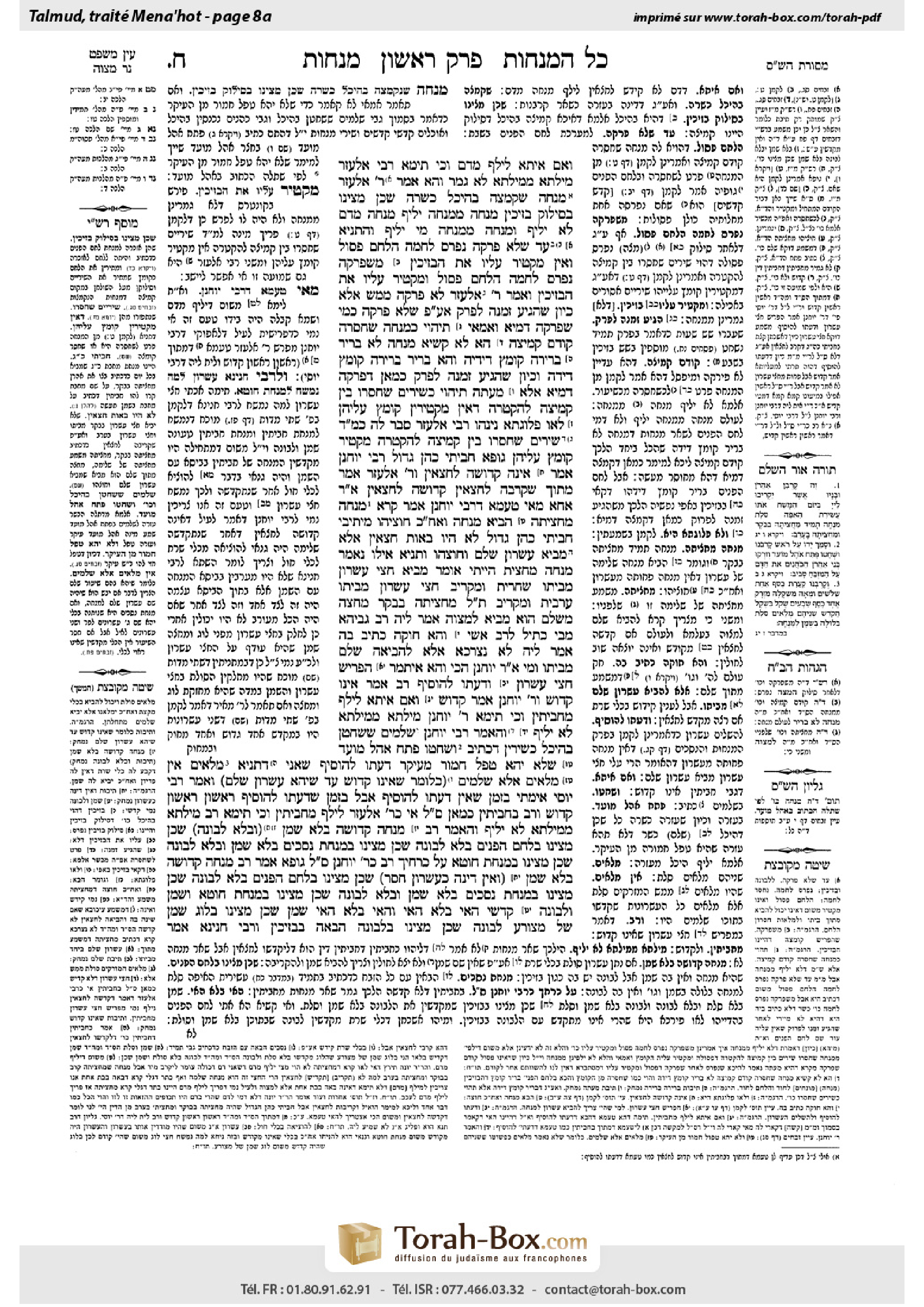
Menachot 8a: Talmud study for Daf Yomi
Daf Yomi is the daily study of one Talmud folio. Explore 37 tractates with scans, Hebrew text, Sefaria English and AI-generated French translations where annotated.
Passage selection and English or AI-generated French translation are available where the scan has annotations. Daf Study is independent of Torah-Box and Sefaria.
Browse Menachot · מנחות · All tractatesMenachot 8a text and translations
This page of Menachot includes the Aramaic text, an English translation and an AI-generated French translation, alongside the scan above.
מנחות ח׳ א · Aramaic and Hebrew text
וְאִם אִיתַהּ, לֵילַף מִדָּם? וְכִי תֵּימָא: רַבִּי אֶלְעָזָר מִילְּתָא מִמִּילְּתָא לָא גָּמַר? וְהָא אָמַר רַבִּי אֶלְעָזָר: מִנְחָה שֶׁקְּמָצָהּ בַּהֵיכָל כְּשֵׁרָה, שֶׁכֵּן מָצִינוּ בְּסִילּוּק בָּזִיכִין.
מִנְחָה מִמִּנְחָה יָלֵיף, מִנְחָה מִדָּם לָא יָלֵיף.
וּמִנְחָה מִמִּנְחָה מִי יָלֵיף? וְהָתַנְיָא: עַד שֶׁלֹּא פֵּרְקָהּ נִפְרַס לַחְמָהּ – הַלֶּחֶם פָּסוּל, וְאֵין מַקְטִיר עָלָיו אֶת הַבָּזִיכִין. מִשֶּׁפֵּרְקָהּ נִפְרַס לַחְמָהּ – הַלֶּחֶם פָּסוּל, וּמַקְטִיר עָלָיו אֶת הַבָּזִיכִין.
וְאָמַר רַבִּי אֶלְעָזָר: לֹא פֵּרְקָהּ מַמָּשׁ, אֶלָּא כֵּיוָן שֶׁהִגִּיעַ זְמַנָּהּ לְפָרֵק, אַף עַל פִּי שֶׁלֹּא פֵּרְקָהּ, כְּמִי שֶׁפֵּרְקָהּ דָּמְיָא.
וְאַמַּאי? תֶּיהְוֵי כְּמִנְחָה שֶׁחָסְרָה קוֹדֶם קְמִיצָה!
הָא לָא קַשְׁיָא, מִנְחָה לָא בְּרִיר (בְּרֵירָה) קוֹמֶץ דִּידַהּ, וְהָא בְּרִיר (בְּרֵירָה) קוֹמֶץ דִּידַהּ, וְכֵיוָן שֶׁהִגִּיעַ זְמַנָּהּ לְפָרֵק – כְּמַאן דְּפָרְקַהּ דָּמְיָא.
אֶלָּא מֵעַתָּה, תֶּיהְוֵי כְּשִׁירַיִם שֶׁחָסְרוּ בֵּין קְמִיצָה לְהַקְטָרָה, דְּאֵין מַקְטִירִין קוֹמֶץ עֲלֵיהֶן! לָאו פְּלוּגְתָּא נִינְהוּ? רַבִּי אֶלְעָזָר סָבַר לַהּ כְּמַאן דְּאָמַר: שִׁירַיִם שֶׁחָסְרוּ בֵּין קְמִיצָה לְהַקְטָרָה – מַקְטִיר קוֹמֶץ עֲלֵיהֶן.
גּוּפָא: חֲבִיתֵּי כֹּהֵן גָּדוֹל, רַבִּי יוֹחָנָן אָמַר: אֵינָהּ קְדוֹשָׁה לַחֲצָאִין, וְרַבִּי אֶלְעָזָר אָמַר: מִתּוֹךְ שֶׁקְּרֵבָה לַחֲצָאִין, קְדוֹשָׁה לַחֲצָאִין. אָמַר רַבִּי אַחָא: מַאי טַעְמָא דְּרַבִּי יוֹחָנָן? אָמַר קְרָא: ״מִנְחָה מַחֲצִיתָהּ״, הָבֵיא מִנְחָה וְאַחַר כָּךְ חֳצֵיהוּ.
מֵיתִיבִי: חֲבִיתֵּי כֹּהֵן גָּדוֹל לֹא הָיוּ בָּאוֹת חֲצָאִין, אֶלָּא מֵבִיא עִשָּׂרוֹן שָׁלֵם וְחוֹצֵהוּ; וְתַנְיָא: אִילּוּ נֶאֱמַר ״מִנְחָה מַחֲצִית״, הָיִיתִי אוֹמֵר: מֵבִיא חֲצִי עִשָּׂרוֹן מִבֵּיתוֹ שַׁחֲרִית וּמַקְרִיב, חֲצִי עִשָּׂרוֹן מִבֵּיתוֹ עַרְבִית וּמַקְרִיב; תַּלְמוּד לוֹמַר ״מַחֲצִיתָהּ בַּבֹּקֶר״ – מֶחֱצָה מִשָּׁלֵם הוּא מֵבִיא.
לְמִצְוָה. אֲמַר לֵיהּ רַב גְּבִיהָא מִבֵּי כְתִיל לְרַב אָשֵׁי: וְהָא ״חוּקָּה״ כְּתִיב בַּהּ, אֲמַר לֵיהּ: לֹא נִצְרְכָה אֶלָּא לַהֲבִיאָהּ שָׁלֵם מִבֵּיתוֹ.
וּמִי אָמַר רַבִּי יוֹחָנָן הָכִי? וְהָא אִיתְּמַר: הִפְרִישׁ חֲצִי עִשָּׂרוֹן, וְדַעְתּוֹ לְהוֹסִיף – רַב אָמַר: אֵינוֹ קָדוֹשׁ, וְרַבִּי יוֹחָנָן אָמַר: קָדוֹשׁ. וְאִם אִיתָא, לֵילַף מֵחֲבִיתִּין!
וְכִי תֵּימָא, רַבִּי יוֹחָנָן מִילְּתָא מִמִּילְּתָא לָא יָלֵיף, וְהָאָמַר רַבִּי יוֹחָנָן: שְׁלָמִים שֶׁשְּׁחָטָן בַּהֵיכָל כְּשֵׁירִין, דִּכְתִיב: ״וּשְׁחָטוֹ פֶּתַח אֹהֶל מוֹעֵד״, שֶׁלֹּא יְהֵא טָפֵל חָמוּר מֵעִיקָּר.
דַּעְתּוֹ לְהוֹסִיף שָׁאנֵי, דְּתַנְיָא: ״מְלֵאִים״ – אֵין ״מְלֵאִים״ אֶלָּא שְׁלֵמִים (כְּלוֹמַר שֶׁאֵינוֹ קָדוֹשׁ עַד שֶׁיְּהֵא עִשָּׂרוֹן שָׁלֵם), וְאָמַר רַבִּי יוֹסֵי: אֵימָתַי? בִּזְמַן שֶׁאֵין דַּעְתּוֹ לְהוֹסִיף, אֲבָל בִּזְמַן שֶׁדַּעְתּוֹ לְהוֹסִיף – רִאשׁוֹן רִאשׁוֹן קָדוֹשׁ.
וְרַב, בְּחָבִיתִין כְּמַאן סְבִירָא לֵיהּ? אִי כְּרַבִּי אֶלְעָזָר, לֵילַף מֵחֲבִיתִּין!
וְכִי תֵּימָא רַב מִילְּתָא מִמִּילְּתָא לָא יָלֵיף, וְהָאָמַר רַב: מִנְחָה קְדוֹשָׁה בְּלֹא שֶׁמֶן (וּבְלֹא לְבוֹנָה) – שֶׁכֵּן מָצִינוּ בְּלֶחֶם הַפָּנִים. בְּלֹא לְבוֹנָה – שֶׁכֵּן מָצִינוּ בְּמִנְחַת נְסָכִים.
בְּלֹא שֶׁמֶן וּבְלֹא לְבוֹנָה – שֶׁכֵּן מָצִינוּ בְּמִנְחַת חוֹטֵא, עַל כׇּרְחָיךְ רַב כְּרַבִּי יוֹחָנָן סְבִירָא לֵיהּ.
גּוּפָא, אָמַר רַב: מִנְחָה קְדוֹשָׁה בְּלֹא שֶׁמֶן, וְאֵין דִּינָה כְּעִשָּׂרוֹן חָסֵר – שֶׁכֵּן מָצִינוּ בְּלֶחֶם הַפָּנִים. בְּלֹא לְבוֹנָה – שֶׁכֵּן מָצִינוּ בְּמִנְחַת נְסָכִים. בְּלֹא שֶׁמֶן וּבְלֹא לְבוֹנָה – שֶׁכֵּן מָצִינוּ בְּמִנְחַת חוֹטֵא.
וְשֶׁמֶן וּלְבוֹנָה קׇדְשִׁי הַאי בְּלָא הַאי וְהַאי בְּלָא הַאי; שֶׁמֶן – שֶׁכֵּן מָצִינוּ בְּלוֹג שֶׁמֶן שֶׁל מְצוֹרָע, לְבוֹנָה – שֶׁכֵּן מָצִינוּ בִּלְבוֹנָה הַבָּאָה בְּבָזִיכִין, וְרַבִּי חֲנִינָא אָמַר:
Menachot 8a · English translation
And if it is so that Rabbi Elazar holds that blood may not be sanctified in halves, let him derive the halakha of the High Priest’s griddle-cake offering from that of blood. And if you would say that in this case Rabbi Elazar does not derive the halakha of the matter of a meal offering from that of another matter, that is difficult: But doesn’t Rabbi Elazar say: A meal offering from which the priest removed a handful while inside the Sanctuary is valid, despite the fact that the handful should be removed in the Temple courtyard; the reason is that we find a similar case in the Sanctuary, with regard to the removal of the bowls of frankincense from the Table of the shewbread? Just as the bowls permit the shewbread for consumption when removed in the Sanctuary, so too, the handful permits the remainder of the meal offering for consumption. This indicates that Rabbi Elazar does derive the halakha of a meal offering from that of another matter.
The Gemara responds: Rabbi Elazar does derive the halakha with regard to a meal offering from that of another meal offering; the shewbread is considered a meal offering. But he does not derive the halakha with regard to a meal offering from that of blood.
The Gemara asks: And does Rabbi Elazar derive the halakha of one meal offering from that of another meal offering? But isn’t it taught in a baraita: If before the priest detached the arrangement of shewbread and the bowls of frankincense from upon the Table, the bread broke into pieces, the bread is unfit for consumption and the priest does not burn the frankincense contained in the bowls on account of it. If the bread broke after the priest detached it, the bread is unfit but the priest burns the frankincense contained in the bowls on account of it.
The Gemara continues: And Rabbi Elazar says: When the baraita refers to the detachment of the shewbread, it does not mean that the priest actually detached it. Rather, it means that once the time to detach it has arrived, even though he has not yet detached it and has not removed the bowls, it is considered as though he has detached it. Accordingly, if the shewbread broke after that time, the frankincense is burned.
The Gemara explains its question: And if Rabbi Elazar derives the halakha of one meal offering from another, why does he say that frankincense contained in the bowls is burned in a case where the shewbread broke when the time to detach the bread had arrived? It should be like the case of a meal offering that became lacking in its measure before the removal of the handful. Such a handful is not removed and is not sacrificed upon the altar. Likewise, the frankincense was still on the Table when the shewbread broke and should therefore be disqualified.
The Gemara answers: This is not difficult, as there is a difference between these meal offerings. In the case of a meal offering that became lacking before the removal of a handful, its handful was not clearly designated. Consequently, if the meal offering became lacking before a handful was removed, one may no longer remove a handful from it. But in the case of the shewbread and the bowls of frankincense, its handful, i.e., the frankincense, was clearly designated at the time when the frankincense was placed in the bowls, since the frankincense is in a separate container from the bread. And therefore, once the time to detach the bread has arrived, it is considered as though he has detached it.
The Gemara asks: But if that is so, then even if the time to detach the shewbread arrived, why is the frankincense burned? It should be like a case where the remainder of a meal offering became lacking between the removal of the handful and the burning upon the altar; the halakha in this case is that one does not burn the handful on account of such a meal offering. The Gemara responds: Isn’t it a dispute among the amora’im (9a) whether or not the handful is burned in such a case? One can say that Rabbi Elazar holds in accordance with the opinion of the one who says that if the remainder of a meal offering became lacking between the removal of the handful and the burning, the priest burns the handful on account of such a meal offering.
§ The Gemara discusses the matter itself: With regard to the griddle-cake offering of the High Priest, Rabbi Yoḥanan says that it is not sanctified in halves, and Rabbi Elazar says: Since it is sacrificed in halves, as half of the meal offering is sacrificed in the morning and half in the afternoon, it may likewise be sanctified in halves. Rav Aḥa said: What is the reasoning of Rabbi Yoḥanan? The verse states: “A meal offering perpetually, half of it in the morning, and half of it in the evening” (Leviticus 6:13). This means: First bring a whole meal offering, and only afterward divide it into halves.
The Gemara raises an objection to the opinion of Rabbi Elazar. The mishna teaches (50b): The griddle-cake offering of the High Priest did not come in halves. Rather, the High Priest brings a full tenth of an ephah and then divides it into two. And it is taught in a baraita with regard to this mishna: If it were stated: A meal offering, half in the morning, and half in the evening, I would say: He brings half of a tenth from his home in the morning and sacrifices it, and another half of a tenth from his home in the evening and sacrifices it. Therefore, the verse states: “Half of it in the morning,” indicating that he brings a half from a whole, and he does not bring a half by itself.
The Gemara responds: Rabbi Elazar maintains that the verse requires that a whole meal offering be brought in the morning only for a mitzva, i.e., ab initio. Nevertheless, if half of a tenth was brought in the morning it is valid after the fact. Rav Geviha from Bei Katil said to Rav Ashi: But the term “statute” is written with regard to the griddle-cake offering, as the verse states: “A statute forever” (Leviticus 6:15), and there is a principle that whenever the Torah calls a mitzva a statute, the details of its performance are indispensable. Rav Ashi said to him: It was necessary for the Torah to define this mitzva as a statute only with regard to the requirement that the High Priest bring a full tenth from his home. With regard to its sanctification in a service vessel, it can be sanctified in halves.
The Gemara asks: And did Rabbi Yoḥanan really say this? But it was stated: If one set aside half a tenth of an ephah for any meal offering, and his intention was to add to the half in order to reach a full tenth, Rav says that it is not sanctified, as he did not bring a full tenth, and Rabbi Yoḥanan says that it is sanctified. And if it is so that Rabbi Yoḥanan holds that the griddle-cake offering cannot be sanctified in halves, let him derive from the griddle-cake offering that no meal offering may be sanctified in halves.
And if you would say that Rabbi Yoḥanan does not derive the halakha of one matter with regard to consecrated items from that of another matter, that is difficult: But doesn’t Rabbi Yoḥanan say: Peace offerings that were slaughtered in the Sanctuary are valid, as it is written: “And slaughter it at the entrance of the Tent of Meeting” (Leviticus 3:2), i.e., in the courtyard. Rabbi Yoḥanan explains: It is logical that the halakha with regard to the minor area, i.e., the courtyard, should not be more stringent than the halakha with regard to the major area, the Tent of Meeting. Evidently, Rabbi Yoḥanan derives a halakha with regard to the Sanctuary from the Temple courtyard.
The Gemara responds: Rabbi Yoḥanan does in fact derive the halakha of one matter from another, and therefore he learns the halakha with regard to all meal offerings from the griddle-cake offering, that in general they are not sanctified in halves. But a case where one expresses his intention to add to the half measure is different, as it is taught in a baraita with regard to the verse: “Both of them full of fine flour” (Numbers 7:13). “Full” is a reference only to full measurements; that is to say, the flour is not sanctified until there is a full tenth inside the vessel. And Rabbi Yosei said: When is it the halakha that the flour is sanctified only if a full tenth is inside the vessel? It is at a time when his intention was not initially to add to that which he placed inside the vessel. But at a time when his intention was initially to add, each initial bit of flour is sanctified by the vessel.
The Gemara asks: And Rav, who holds that standard meal offerings are not sanctified in halves even if one’s initial intention was to add to the half measure, with regard to a griddle-cake offering, in accordance with whose opinion does he hold? If he holds in accordance with the opinion of Rabbi Elazar, who says that a griddle-cake offering can be sanctified in halves, then let him derive from the halakha of griddle-cake offerings that all meal offerings may be sanctified in halves.
And if you would say that Rav does not derive the halakha of one matter from that of another matter, that is difficult: But doesn’t Rav say: A standard meal offering, which is brought with oil and frankincense, is sanctified by a service vessel even without its oil and without its frankincense. It is sanctified without its oil, as we find such a halakha with regard to the shewbread, which is sacrificed without oil and is nevertheless sanctified by a service vessel. Similarly, it is sanctified even without its frankincense, as we find such a halakha with regard to the meal offering accompanying the libations of an offering, which is sacrificed without frankincense and is nevertheless sanctified by a service vessel.
Finally, a standard meal offering is sanctified by a service vessel even without its oil and without its frankincense, as we find with regard to the meal offering of a sinner, which includes neither of these. This indicates that Rav does derive the halakha of a meal offering from other meal offerings. Rather, perforce, with regard to the griddle-cake offering, Rav holds in accordance with the opinion of Rabbi Yoḥanan, that this offering is not sanctified in halves, and it is derived from there that no meal offerings are sanctified in halves.
§ The Gemara discusses the matter itself: Rav says that a meal offering is sanctified without its oil, and its halakha is not the same as when a tenth of an ephah of flour is lacking, as we find such a halakha with regard to the shewbread, which is sacrificed without oil and is nevertheless sanctified by a service vessel. Similarly, it is sanctified even without its frankincense, as we find such a halakha with regard to the meal offering accompanying the libations of an offering, which is sacrificed without frankincense and is nevertheless sanctified. Additionally, a meal offering is sanctified even without its oil and without its frankincense, as we find such a halakha with regard to the meal offering of a sinner, which lacks both oil and frankincense and is nevertheless sanctified by a service vessel.
Rav continues: And oil and frankincense are each sanctified by service vessels, this substance without that one, and that substance without this one. Oil is sanctified on its own, as we find such a halakha with regard to the log of oil of a leper, which is sanctified on its own. Frankincense is sanctified on its own, as we find such a halakha with regard to the frankincense that comes in the bowls that are brought with the shewbread; there is no oil in that case and yet the frankincense is sanctified in the bowls. And Rabbi Ḥanina says:
Menachot 8a · Traduction française (IA)
Et s’il en est ainsi, si Rabbi Elazar estime que le sang ne peut pas être sanctifié par moitié, qu’il déduise la halakha de l’offrande de galettes à la poêle du Grand Prêtre de celle du sang. Et si tu dis que, dans ce cas, Rabbi Elazar ne déduit pas la halakha d’une offrande végétale de celle d’une autre catégorie, cela pose difficulté : Rabbi Elazar ne dit-il pas qu’une offrande végétale dont le prêtre a prélevé une poignée à l’intérieur du Sanctuaire est valide, bien que la poignée doive être prélevée dans la cour du Temple ? La raison en est que nous trouvons un cas semblable dans le Sanctuaire, concernant le retrait des coupes d’encens de la Table des pains de proposition. De même que les coupes permettent la consommation des pains de proposition lorsqu’elles sont retirées dans le Sanctuaire, de même la poignée permet la consommation du reste de l’offrande végétale. Cela indique que Rabbi Elazar déduit bien la halakha d’une offrande végétale de celle d’une autre catégorie.
La Guemara répond : Rabbi Elazar déduit bien la halakha concernant une offrande végétale de celle d’une autre offrande végétale ; les pains de proposition sont considérés comme une offrande végétale. Mais il ne déduit pas la halakha concernant une offrande végétale de celle du sang.
La Guemara demande : Rabbi Elazar déduit-il donc la halakha d’une offrande végétale de celle d’une autre offrande végétale ? N’est-il pas enseigné dans une baraïta : si, avant que le prêtre ne retire l’ensemble des pains de proposition et les coupes d’encens de la Table, le pain se brise en morceaux, il est impropre à la consommation et le prêtre ne brûle pas l’encens contenu dans les coupes à son sujet. Si le pain se brise après que le prêtre l’a retiré, il est impropre à la consommation, mais le prêtre brûle l’encens contenu dans les coupes à son sujet.
La Guemara poursuit : Rabbi Elazar dit que lorsque la baraïta parle du retrait des pains de proposition, elle ne veut pas dire que le prêtre les a effectivement retirés. Elle veut dire qu’une fois venu le moment de les retirer, même s’il ne les a pas encore retirés et n’a pas enlevé les coupes, c’est considéré comme s’il les avait retirés. Par conséquent, si les pains de proposition se brisent après ce moment, l’encens est brûlé.
La Guemara explique la question : si Rabbi Elazar déduit la halakha d’une offrande végétale de celle d’une autre, pourquoi dit-il que l’encens contenu dans les coupes est brûlé lorsque les pains de proposition se sont brisés après l’arrivée du moment où ils devaient être retirés ? Ce cas devrait être comparable à celui d’une offrande végétale qui a diminué avant le prélèvement de la poignée. Dans un tel cas, la poignée n’est pas prélevée et n’est pas offerte sur l’autel. De même, l’encens se trouvait encore sur la Table lorsque les pains de proposition se sont brisés ; il devrait donc être invalidé.
La Guemara répond : cela ne pose pas de difficulté, car ces offrandes végétales diffèrent. Dans le cas d’une offrande végétale qui a diminué avant le prélèvement d’une poignée, celle-ci n’avait pas été désignée de manière distincte. Par conséquent, si l’offrande végétale a diminué avant qu’une poignée en soit prélevée, on ne peut plus en prélever une. Mais dans le cas des pains de proposition et des coupes d’encens, la poignée, c’est-à-dire l’encens, avait été désignée de manière distincte au moment où l’encens avait été placé dans les coupes, puisque celui-ci se trouve dans un récipient séparé du pain. Par conséquent, une fois venu le moment de retirer le pain, c’est considéré comme si le prêtre l’avait retiré.
La Guemara demande : mais si c’est ainsi, même lorsque le moment de retirer les pains de proposition est arrivé, pourquoi l’encens est-il brûlé ? Cela devrait être comparable au cas où le reste d’une offrande végétale a diminué entre le prélèvement de la poignée et sa combustion sur l’autel ; dans ce cas, on ne brûle pas la poignée au titre d’une telle offrande végétale. La Guemara répond : les amoraïm ne sont-ils pas en désaccord (9a) sur le fait de savoir si la poignée est brûlée ou non dans un tel cas ? On peut dire que Rabbi Elazar suit l’opinion de celui qui dit que si le reste d’une offrande végétale a diminué entre le prélèvement de la poignée et sa combustion, le prêtre brûle la poignée au titre de cette offrande.
§ La Guemara examine le sujet lui-même : au sujet de l’offrande de galettes à la poêle du Grand Prêtre, Rabbi Yoḥanan dit qu’elle n’est pas sanctifiée par moitié, tandis que Rabbi Elazar dit : puisqu’elle est offerte par moitié — une moitié de l’offrande végétale le matin et l’autre l’après-midi —, elle peut également être sanctifiée par moitié. Rav Aḥa dit : quel est le raisonnement de Rabbi Yoḥanan ? Le verset dit : « Une offrande végétale perpétuelle, la moitié le matin et la moitié le soir » (Lévitique 6, 13). Cela signifie : apporte d’abord une offrande végétale entière, puis partage-la en deux.
La Guemara soulève une objection contre l’opinion de Rabbi Elazar. La Michna enseigne (50b) : l’offrande de galettes à la poêle du Grand Prêtre n’était pas apportée par moitié. Le Grand Prêtre apporte plutôt un dixième d’épha entier, puis le partage en deux. Et une baraïta enseigne à propos de cette Michna : si le verset avait dit « une offrande végétale, la moitié le matin et la moitié le soir », j’aurais pensé qu’il apporte de chez lui un demi-dixième le matin et l’offre, puis qu’il apporte de chez lui un autre demi-dixième le soir et l’offre. Le verset dit donc : « La moitié le matin », ce qui indique qu’il apporte une moitié provenant d’un tout, et non une moitié à part.
La Guemara répond : Rabbi Elazar estime que le verset exige, à titre de mitsva, c’est-à-dire a priori, qu’une offrande végétale entière soit apportée le matin. Néanmoins, si un demi-dixième a été apporté le matin, l’offrande est valide a posteriori. Rav Geviha de Bei Katil dit à Rav Ashi : mais le terme « statut » est écrit au sujet de l’offrande de galettes à la poêle, comme le dit le verset : « Un statut perpétuel » (Lévitique 6, 15), et il existe un principe selon lequel, chaque fois que la Torah qualifie une mitsva de statut, les modalités de son accomplissement sont indispensables. Rav Ashi lui dit : la Torah devait définir cette mitsva comme un statut uniquement pour exiger que le Grand Prêtre apporte de chez lui un dixième entier. Quant à sa sanctification dans un récipient de service, elle peut avoir lieu par moitié.
La Guemara demande : Rabbi Yoḥanan a-t-il vraiment dit cela ? Or, il a été enseigné : si quelqu’un a mis de côté un demi-dixième d’épha pour une offrande végétale quelconque, avec l’intention d’ajouter à cette moitié afin d’atteindre un dixième entier, Rav dit que ce n’est pas sanctifié, puisqu’il n’a pas apporté un dixième entier, tandis que Rabbi Yoḥanan dit que c’est sanctifié. Et s’il en est ainsi, si Rabbi Yoḥanan estime que l’offrande de galettes à la poêle ne peut pas être sanctifiée par moitié, qu’il en déduise qu’aucune offrande végétale ne peut être sanctifiée par moitié.
Et si tu dis que Rabbi Yoḥanan ne déduit pas la halakha concernant une catégorie d’éléments consacrés de celle d’une autre, cela pose difficulté : Rabbi Yoḥanan ne dit-il pas que les sacrifices de paix égorgés dans le Sanctuaire sont valides, car il est écrit : « Tu l’égorgeras à l’entrée de la Tente d’assignation » (Lévitique 3, 2), c’est-à-dire dans la cour. Rabbi Yoḥanan explique : il est logique que la halakha relative à l’espace plus restreint, c’est-à-dire la cour, ne soit pas plus stricte que celle relative à l’espace plus vaste, la Tente d’assignation. Cela montre que Rabbi Yoḥanan déduit une halakha concernant le Sanctuaire de celle concernant la cour du Temple.
La Guemara répond : Rabbi Yoḥanan déduit effectivement la halakha d’une catégorie de celle d’une autre, et il déduit donc de l’offrande de galettes à la poêle la halakha applicable à toutes les offrandes végétales : en général, elles ne sont pas sanctifiées par moitié. Mais le cas où quelqu’un exprime son intention d’ajouter à la demi-mesure est différent, comme l’enseigne une baraïta à propos du verset : « Toutes deux pleines de fleur de farine » (Nombres 7, 13). Le terme « pleines » ne désigne que des mesures complètes ; autrement dit, la farine n’est sanctifiée que lorsqu’un dixième entier se trouve dans le récipient. Rabbi Yosei dit : dans quel cas la halakha veut-elle que la farine ne soit sanctifiée que si un dixième entier se trouve dans le récipient ? Lorsque son intention initiale n’était pas d’ajouter à ce qu’il avait placé dans le récipient. Mais si son intention initiale était d’ajouter, chaque quantité de farine placée au départ est sanctifiée par le récipient.
La Guemara demande : et Rav, qui estime que les offrandes végétales ordinaires ne sont pas sanctifiées par moitié, même si l’on avait dès le départ l’intention d’ajouter à la demi-mesure, quelle opinion suit-il au sujet de l’offrande de galettes à la poêle ? S’il suit l’opinion de Rabbi Elazar, qui dit que cette offrande peut être sanctifiée par moitié, qu’il en déduise que toutes les offrandes végétales peuvent être sanctifiées par moitié.
Et si tu dis que Rav ne déduit pas la halakha d’une catégorie de celle d’une autre, cela pose difficulté : Rav ne dit-il pas qu’une offrande végétale ordinaire, apportée avec de l’huile et de l’encens, est sanctifiée par un récipient de service même sans son huile et sans son encens ? Elle est sanctifiée sans son huile, comme nous le constatons pour les pains de proposition, qui sont offerts sans huile et sont néanmoins sanctifiés par un récipient de service. De même, elle est sanctifiée sans son encens, comme nous le constatons pour l’offrande végétale accompagnant les libations d’un sacrifice, qui est offerte sans encens et est néanmoins sanctifiée par un récipient de service.
Enfin, une offrande végétale ordinaire est sanctifiée par un récipient de service même sans son huile et sans son encens, comme nous le constatons pour l’offrande végétale du pécheur, qui ne comporte ni l’un ni l’autre. Cela indique que Rav déduit bien la halakha d’une offrande végétale de celle d’autres offrandes végétales. Il faut donc nécessairement dire qu’au sujet de l’offrande de galettes à la poêle, Rav suit l’opinion de Rabbi Yoḥanan : cette offrande n’est pas sanctifiée par moitié, et l’on en déduit qu’aucune offrande végétale n’est sanctifiée par moitié.
§ La Guemara examine le sujet lui-même : Rav dit qu’une offrande végétale est sanctifiée sans son huile, et que sa halakha diffère de celle d’un dixième d’épha de farine auquel il manque une partie, comme nous le constatons pour les pains de proposition, qui sont offerts sans huile et sont néanmoins sanctifiés par un récipient de service. De même, elle est sanctifiée même sans son encens, comme nous le constatons pour l’offrande végétale accompagnant les libations d’un sacrifice, qui est offerte sans encens et est néanmoins sanctifiée. En outre, une offrande végétale est sanctifiée même sans son huile et sans son encens, comme nous le constatons pour l’offrande végétale du pécheur, qui est dépourvue à la fois d’huile et d’encens et est néanmoins sanctifiée par un récipient de service.
Rav poursuit : l’huile et l’encens sont chacun sanctifiés par des récipients de service, l’un sans l’autre et l’autre sans le premier. L’huile est sanctifiée à elle seule, comme nous le constatons pour le log d’huile du lépreux, qui est sanctifié à lui seul. L’encens est sanctifié à lui seul, comme nous le constatons pour l’encens contenu dans les coupes apportées avec les pains de proposition : il n’y a pas d’huile dans ce cas, et pourtant l’encens est sanctifié dans les coupes. Et Rabbi Ḥanina dit :
Traduction française générée par IA à partir de l’édition anglaise de Sefaria. Vérifie toujours un passage avec le texte source.
Text from Sefaria: William Davidson Edition - Vocalized Aramaic (unknown); William Davidson Edition - English (CC BY NC).