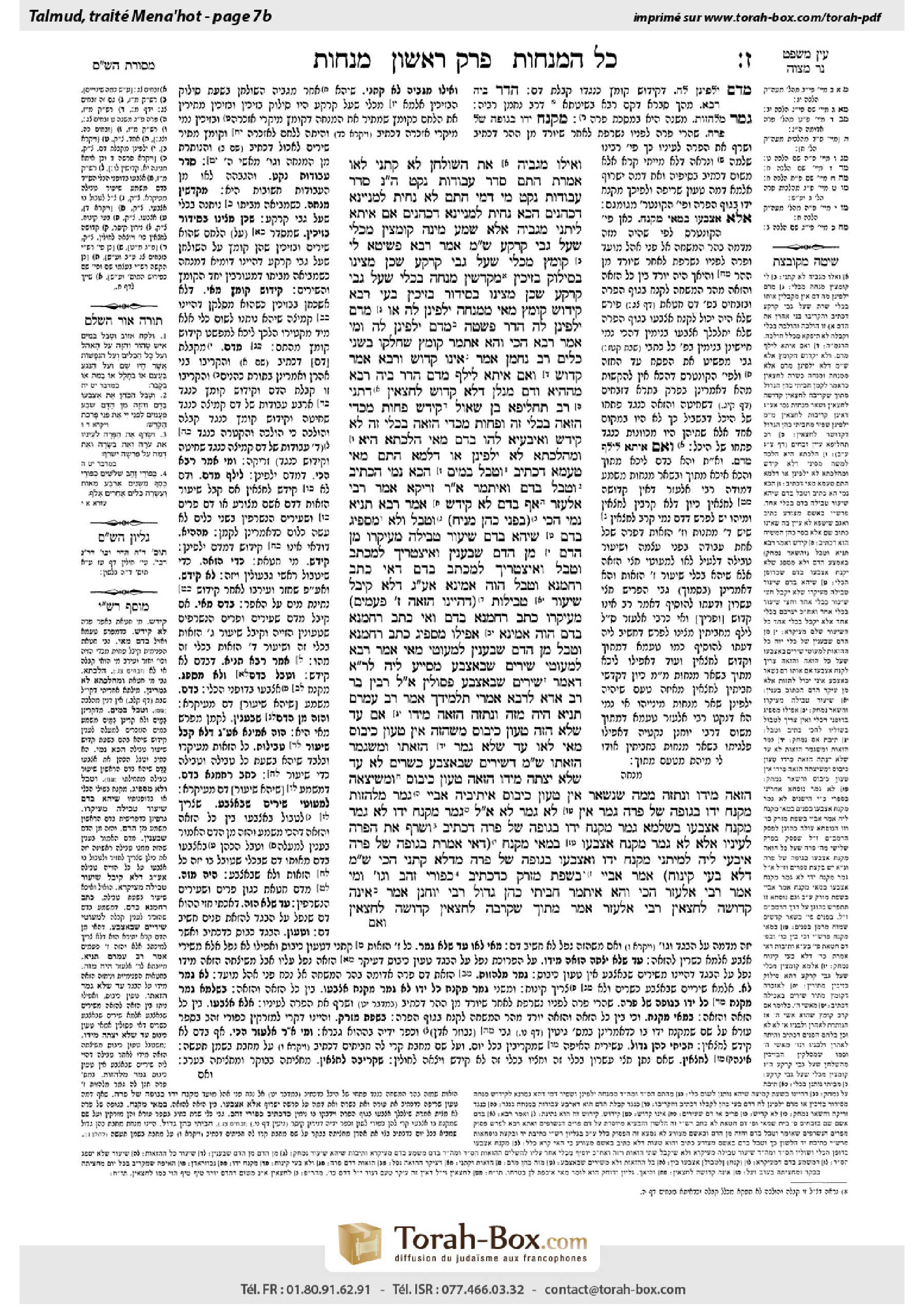
Menachot 7b: Talmud study for Daf Yomi
Daf Yomi is the daily study of one Talmud folio. Explore 37 tractates with scans, Hebrew text, Sefaria English and AI-generated French translations where annotated.
Passage selection and English or AI-generated French translation are available where the scan has annotations. Daf Study is independent of Torah-Box and Sefaria.
Browse Menachot · מנחות · All tractatesMenachot 7b text and translations
This page of Menachot includes the Aramaic text, an English translation and an AI-generated French translation, alongside the scan above.
מנחות ז׳ ב · Aramaic and Hebrew text
וְאִילּוּ מַגְבִּיהַּ אֶת הַשּׁוּלְחָן לָא קָתָנֵי.
לָאו אָמְרַתְּ הָתָם, סֵדֶר עֲבוֹדוֹת נָקֵט? הָכָא נָמֵי סֵדֶר עֲבוֹדוֹת נָקֵט.
מִי דָּמֵי? הָתָם לָא נָחֵית לְמִנְיָינָא דְּכֹהֲנִים, הָכָא נָחֵית לְמִנְיָינָא דְּכֹהֲנִים. אִם אִיתָא – לִיתְנֵי מַגְבִּיהַּ! אֶלָּא שְׁמַע מִינַּהּ: קוֹמְצִין מִכְּלִי שֶׁעַל גַּבֵּי קַרְקַע. שְׁמַע מִינַּהּ.
אָמַר רָבָא: פְּשִׁיטָא לִי, קוֹמֵץ מִכְּלִי שֶׁעַל גַּבֵּי קַרְקַע – שֶׁכֵּן מָצִינוּ בְּסִילּוּק בָּזִיכִין. מְקַדְּשִׁין מִנְחָה בִּכְלִי שֶׁעַל גַּבֵּי קַרְקַע – שֶׁכֵּן מָצִינוּ בְּסִידּוּר בָּזִיכִין.
בָּעֵי רָבָא: קִידּוּשׁ קוֹמֶץ מַאי? מִמִּנְחָה יָלְפִינַן לַהּ, אוֹ מִדָּם יָלְפִינַן לַהּ? הֲדַר פַּשְׁטַהּ: מִדָּם יָלְפִינַן לַהּ.
וּמִי אָמַר רָבָא הָכִי? וְהָא אִתְּמַר: קוֹמֶץ שֶׁחִלְּקוֹ בִּשְׁנֵי כֵּלִים, רַב נַחְמָן אָמַר: אֵינוֹ קָדוֹשׁ, וְרָבָא אָמַר: קָדוֹשׁ. וְאִם אִיתָא, לֵילַף מִדָּם! הֲדַר בֵּיהּ רָבָא מֵהַהִיא.
וָדָם מְנָלַן דְּלָא קָדוֹשׁ לַחֲצָאִין? דְּתָנֵי רַב תַּחְלִיפָא בֶּן שָׁאוּל: קִידֵּשׁ פָּחוֹת מִכְּדֵי הַזָּאָה בִּכְלִי זֶה, וּפָחוֹת מִכְּדֵי הַזָּאָה בִּכְלִי זֶה – לֹא קִידֵּשׁ.
וְאִיבַּעְיָא לְהוּ: בְּדָם מַאי? הִלְכְתָא הִיא, וּמֵהִלְכְתָא לָא יָלְפִינַן.
אוֹ דִלְמָא הָתָם מַאי טַעְמָא – דִּכְתִיב ״וְטָבַל בַּמַּיִם״, הָכָא נָמֵי הָכְתִיב ״וְטָבַל בַּדָּם״?
וְאִיתְּמַר, אָמַר רַבִּי זְרִיקָא אָמַר רַבִּי אֶלְעָזָר: אַף בְּדָם לֹא קִידֵּשׁ. אָמַר רָבָא: תַּנְיָא נָמֵי הָכִי, בִּפְנֵי כֹּהֵן מַנִּיחַ, ״וְטָבַל״ וְלֹא מְסַפֵּיג.
״בַּדָּם״ – שֶׁיְּהֵא בַּדָּם שִׁיעוּר טְבִילָה מֵעִיקָּרוֹ, ״מִן הַדָּם״ – מִן הַדָּם שֶׁבָּעִנְיָן.
וְאִיצְטְרִיךְ לְמִכְתַּב ״וְטָבַל״, וְאִיצְטְרִיךְ לְמִכְתַּב ״בַּדָּם״, דְּאִי כְּתַב רַחֲמָנָא ״וְטָבַל״ הֲוָה אָמֵינָא: אַף עַל גַּב דְּלֹא קִיבֵּל שִׁיעוּר טְבִילוֹת, דְּהַיְינוּ הַזָּאָה שֶׁבַע פְּעָמִים מֵעִיקָּרוֹ, כְּתַב רַחֲמָנָא ״בַּדָּם״.
וְאִי כְּתַב רַחֲמָנָא ״בַּדָּם״, הֲוָה אָמֵינָא אֲפִילּוּ מְסַפֵּיג, כְּתַב רַחֲמָנָא ״וְטָבַל״.
״מִן הַדָּם״ שֶׁבָּעִנְיָן, לְמַעוֹטֵי מַאי? אָמַר רָבָא: לְמַעוֹטֵי שִׁירַיִם שֶׁבָּאֶצְבַּע, מְסַיַּיע לֵיהּ לְרַבִּי אֶלְעָזָר, דְּאָמַר: שִׁירַיִם שֶׁבָּאֶצְבַּע פְּסוּלִין.
אֲמַר לֵיהּ רָבִין בַּר רַב אַדָּא לְרָבָא: אָמְרִי תַּלְמִידָךְ אָמַר רַב עַמְרָם, תַּנְיָא: הָיָה מַזֶּה וְנִתְּזָה הַזָּאָה מִיָּדוֹ, אִם עַד שֶׁלֹּא הִזָּה – טָעוּן כִּיבּוּס, מִשֶּׁהִזָּה – אֵין טָעוּן כִּיבּוּס.
מַאי לָאו עַד שֶׁלֹּא גָּמַר הַזָּאָתוֹ, וּמִשֶּׁגָּמַר הַזָּאָתוֹ? שְׁמַע מִינַּהּ דְּשִׁירַיִם שֶׁבָּאֶצְבַּע כְּשֵׁרִים.
לֹא, עַד שֶׁלֹּא יָצְתָה מִיָּדוֹ הַזָּאָה – טָעוּן כִּיבּוּס, וּמִשֶּׁיָּצְאָה הַזָּאָה מִיָּדוֹ וְנִתְּזָה מִמַּה שֶּׁנִּשְׁאַר – אֵין טָעוּן כִּיבּוּס.
אֵיתִיבֵיהּ אַבָּיֵי: גָּמַר מִלְּהַזּוֹת – מְקַנֵּחַ יָדוֹ בְּגוּפָהּ שֶׁל פָּרָה. גָּמַר – אִין, לֹא גָּמַר – לָא.
אֲמַר לֵיהּ: גָּמַר – מְקַנֵּחַ יָדוֹ, לֹא גָּמַר – מְקַנֵּחַ אֶצְבָּעוֹ.
בִּשְׁלָמָא גָּמַר מְקַנֵּחַ יָדוֹ בְּגוּפָהּ שֶׁל פָּרָה, דִּכְתִיב: ״וְשָׂרַף אֶת הַפָּרָה לְעֵינָיו״, אֶלָּא לֹא גָּמַר מְקַנֵּחַ אֶצְבָּעוֹ, בְּמַאי מְקַנֵּחַ? דְּאִי אָמְרַתְּ בְּגוּפָהּ שֶׁל פָּרָה, אִיבְּעִי לֵיהּ לְמִיתְנֵי: מְקַנֵּחַ יָדוֹ וְאֶצְבָּעוֹ בְּגוּפָהּ שֶׁל פָּרָה! מִדְּלָא קָתָנֵי הָכִי, שְׁמַע מִינַּהּ דְּלָא בָּעֵי קִינּוּחַ.
אָמַר אַבָּיֵי: בִּשְׂפַת מִזְרָק, כְּדִכְתִיב: ״כְּפוֹרֵי זָהָב וְגוֹ׳״.
וּמִי אָמַר רַבִּי אֶלְעָזָר הָכִי? וְהָא אִיתְּמַר: חֲבִיתֵּי כֹּהֵן גָּדוֹל – רַבִּי יוֹחָנָן אָמַר: אֵינָהּ קְדוֹשָׁה לַחֲצָאִין, רַבִּי אֶלְעָזָר אָמַר: מִתּוֹךְ שֶׁקְּרֵבָה לַחֲצָאִין, קְדוֹשָׁה לַחֲצָאִין.
Menachot 7b · English translation
Rav Sheshet notes: The entire process of the replacement of the shewbread is taught in the mishna, and yet the statement: A priest raises the Table above the ground so that the bowls of frankincense can be properly removed from them, is not taught. One can therefore conclude from the mishna that just as the bowls of frankincense are removed from a vessel that is resting upon the ground, i.e., the Table, so too, one may remove a handful of a meal offering from a vessel that is resting upon the ground.
The Gemara rejects this proof: Didn’t you already say there, with regard to the mishna that discusses improper intentions expressed during the service of a meal offering (12a), that the tanna cited only the order of sacrificial rites? Here too, the tanna cited only the order of sacrificial rites. Therefore, one cannot prove from here that there is no requirement to raise the Table.
The Gemara asks: Are these mishnayot comparable? There, on 12a, the tanna did not delve into the number of priests involved in the service of a meal offering. Here, on 99b, the tanna does in fact delve into the number of priests involved in the service of the shewbread. Therefore, if it is so, i.e., if the Table must be raised before the bowls of frankincense are removed, let the tanna teach that another priest raises the Table. Rather, conclude from the mishna that one may remove a handful of a meal offering from a vessel that is resting upon the ground. The Gemara affirms: Conclude from here that this is so.
§ Rava said: It is obvious to me that a priest may remove a handful from a vessel that is resting upon the ground, as we find such an instance in the case of the removal of the bowls of frankincense from the Table of the shewbread, since the Table is resting upon the ground of the Sanctuary when they are removed. Similarly, one can sanctify a meal offering in a vessel that is resting upon the ground, as we find such an instance in the case of the arrangement of the bowls of frankincense upon the Table of the shewbread.
Rava raises a dilemma: With regard to the sanctification of a handful by placing it in a vessel that is resting upon the ground, what is the halakha? Do we derive this halakha from the sanctification of a meal offering, in which case one can sanctify a handful in this manner, just as he can do so with a meal offering? Or do we derive it from the collection of the blood of an offering, in which case one cannot do so, just as the blood of an offering may not be collected in a vessel that is resting upon the ground? Rava then resolves the dilemma: We derive it from the collection of the blood.
The Gemara asks: And did Rava really say this, that the halakha with regard to the sanctification of a handful is derived from the collection of the blood? But it was stated: With regard to a full measure of a handful that a priest divided and placed in two vessels, Rav Naḥman says that it is not sanctified, and Rava says that it is sanctified. And if it is so that the halakha of the handful is derived from the collection of the blood, then let Rava derive from blood that the handful is not sanctified in this manner, just as the blood is not sanctified when divided into two. The Gemara responds: Rava retracted that statement and ruled that a handful is not sanctified when divided and placed into two vessels.
The Gemara further discusses the halakha with regard to the collection of the blood. And with regard to blood, from where do we derive that it is not sanctified in halves, i.e., when collected in two vessels? It is derived from that which Rav Taḥlifa ben Shaul teaches with regard to the water of purification: If the priest sanctified the water in two vessels in such a manner that he sanctified less than the amount of sprinkling in this vessel, i.e., there was not enough water into which he could dip a bundle of hyssop and sprinkle the water with it, and he sanctified less than the amount of sprinkling in that vessel, then he has not sanctified the water. Even if he subsequently combines the contents of both vessels into a single vessel, the water is not sanctified.
The Gemara continues: And a dilemma was raised before the Sages: With regard to the collection of blood of a sin offering for the purpose of sprinkling it upon the altar, what is the halakha? Is the ruling with regard to the water of purification a halakha transmitted to Moses from Sinai, in which case the halakha with regard to blood may not be derived from it, as we do not derive other cases from a halakha transmitted to Moses from Sinai?
The Gemara explains the other side of the dilemma: Or perhaps, there, in the case of the water of purification, what is the reason that it is not sanctified? It is possible that the reason is that it is written in a verse that is referring to the water initially placed in the vessel: “And dip it in the water” (Numbers 19:18). If this verse is the source of the halakha that the hyssop may be dipped in the water of purification only when there was initially enough water in the vessel for sprinkling, then here too, in the case of the blood of a sin offering, isn’t it written: “And the priest shall dip his finger in the blood” (Leviticus 4:6)?
The Gemara continues: And it was stated with regard to this dilemma: Rabbi Zerika says that Rabbi Elazar says: Even in the case of the blood, one has not sanctified it if he collected less than a full measure of blood in a single vessel. Rava said that this is also taught in a baraita with regard to the bull of the anointed priest. The verse states: “And the priest shall dip his finger in the blood, and sprinkle of the blood” (Leviticus 4:6). From the term “And the priest shall dip” it is derived that there must be enough blood inside the vessel in which to dip his finger, and there should not be so little blood that he must resort to wiping his finger along the walls of the vessel.
The baraita continues: Additionally, from the term “in the blood” it is derived that there should initially be in the vessel containing the blood a measure fit for dipping his finger. Furthermore, it is derived from the term “of the blood” that he must sprinkle from the blood of the matter, as will be explained.
And it was necessary for the Merciful One to write: “And the priest shall dip,” and it was necessary for the Merciful One to write: “In the blood,” despite the fact that both terms are referring to the amount of blood that must be in the vessel. Because if the Merciful One had written only: “And the priest shall dip,” I would say that it is enough if the vessel contains enough blood for even one sprinkling, even though the priest did not initially collect a measure fit for all of the sprinklings, that is, enough with which to sprinkle seven times. Therefore, the Merciful One writes: “In the blood.”
And if the Merciful One had written only: “In the blood,” I would say that if there was initially a full measure collected in the vessel then the sprinkling is valid even if now the priest must resort to wiping his finger. Therefore, the Merciful One writes: “And the priest shall dip,” indicating that the priest must be able to dip his finger into the blood and not have to wipe it on the walls of the vessel.
The Gemara returns to the last statement of the baraita, that the priest must sprinkle from the blood of the matter. This statement serves to exclude what? Rava said: It serves to exclude the remainder of blood on his finger from the previous sprinkling, i.e., the priest must dip his finger into the blood before each sprinkling; he may not sprinkle with the blood that remains on his finger from the previous sprinkling. The Gemara notes: This supports the opinion of Rabbi Elazar, who says that the remainder of blood that remained on the priest’s finger is unfit for sprinkling.
Ravin bar Rav Adda said to Rava: Your students say that Rav Amram says that it is taught in a baraita: In a case where a priest was sprinkling from the blood of a sin offering and the blood of the sprinkling sprayed from his hand onto a garment, the halakha is as follows: If the blood sprayed onto the garment before he sprinkled, the garment requires laundering, as is the halakha when the blood of a sin offering that is fit for sprinkling fell on a garment. But if the blood sprayed onto the garment after he had already sprinkled, it does not require laundering.
Ravin bar Rav Adda asks: What, is it not correct to say that this means if the blood sprayed onto the garment before he completed all of his sprinkling, then the garment requires laundering, and if the blood sprayed onto the garment after he completed his sprinkling, then the garment does not require laundering? If so, one can conclude from the baraita that the remainder of blood that remained on his finger between each sprinkling is fit for sprinkling, as otherwise, it would not result in a requirement to launder a garment upon which it sprayed.
The Gemara rejects this suggestion: No, the baraita is saying that if the blood sprayed from his hand onto the garment before any particular sprinkling left his hand, the garment requires laundering. But if the blood was sprayed after a sprinkling left his hand, in which case the blood sprayed from that which remained on his finger following that sprinkling, then the garment does not require laundering, as the blood left on his finger was already rendered unfit for sprinkling.
Abaye raised an objection to Rava from a mishna discussing the red heifer (Para 3:9): When the priest has completed sprinkling the blood of the red heifer toward the entrance to the Sanctuary, he wipes his hand from the blood on the body of the heifer. Abaye explains his objection: The mishna states that when the priest completed all the sprinklings, then yes, he wipes his hand. It may be inferred that if he did not complete the sprinklings, he does not wipe his hand, even though blood remains on his finger from each preceding sprinkling. This proves that the blood that remains on his finger is fit for sprinkling.
Rava said to Abaye: The mishna means that when the priest completed all of the sprinklings, he wipes his hand. If he has not yet completed all of them, then he does not wipe his hand but he must wipe his finger to remove the blood after each sprinkling, as that blood is no longer fit for subsequent sprinklings.
The Gemara raises a difficulty: Granted, after he completed all the sprinklings he wipes his hand on the body of the heifer, as it is written: “And the heifer shall be burned in his sight; her skin, and her flesh, and her blood” (Numbers 19:5), which indicates that the blood of the red heifer must be burned together with its flesh. But if when the priest had not yet completed the sprinklings he wipes his finger, then with what does he wipe? Because if you say that he wipes his finger on the body of the heifer, the mishna should have taught: He wipes his hand and his finger on the body of the heifer. Rather, from the fact that the mishna does not teach this, that he wipes his finger on the body of the heifer, one can conclude from this mishna that his finger does not require wiping between sprinklings.
Abaye said: He wipes his finger on the edge of the bowl containing the blood, as it is written: “Atoning bowls [keforei] of gold” (Ezra 1:10), which is referring to the bowls containing the blood. The root kafar can also mean to wipe.
§ The Gemara returns to the issue of the sanctification of blood collected in two vessels: And did Rabbi Elazar really say this, that blood is sanctified only when a full measure is initially collected in a single vessel? But it was stated with regard to the High Priest’s griddle-cake offering: Rabbi Yoḥanan says that it is not sanctified in halves, i.e., if half of a tenth of an ephah was placed in one vessel, and a second half in another vessel, neither is sanctified. Rabbi Elazar says: Since it is sacrificed in halves, as half of the meal offering is sacrificed in the morning and half in the afternoon, it may be sanctified in halves.
Menachot 7b · Traduction française (IA)
Rav Chéchet fait remarquer : Toute la procédure du remplacement des pains de proposition est enseignée dans la Michna ; pourtant, celle-ci ne mentionne pas qu’un prêtre soulève la Table au-dessus du sol afin que les coupes d’oliban puissent en être retirées correctement. On peut donc conclure de la Michna que, de même que les coupes d’oliban sont retirées d’un ustensile posé à même le sol — à savoir la Table —, on peut également prélever une pleine poignée d’une offrande de farine dans un ustensile posé à même le sol.
La Guemara réfute cette preuve : N’as-tu pas déjà dit là-bas, à propos de la Michna qui traite des intentions incorrectes exprimées pendant le service d’une offrande de farine (12a), que le tanna n’a cité que l’ordre des rites sacrificiels ? Ici aussi, le tanna n’a cité que l’ordre des rites sacrificiels. On ne peut donc pas en déduire qu’il n’est pas nécessaire de soulever la Table.
La Guemara demande : Ces Michnayot sont-elles comparables ? Là-bas, en 12a, le tanna ne s’est pas penché sur le nombre de prêtres prenant part au service d’une offrande de farine. Ici, en 99b, le tanna traite effectivement du nombre de prêtres prenant part au service des pains de proposition. Par conséquent, si la Table doit être soulevée avant que les coupes d’oliban en soient retirées, que le tanna enseigne qu’un autre prêtre la soulève ! Il faut plutôt conclure de la Michna qu’on peut prélever une pleine poignée d’une offrande de farine dans un ustensile posé à même le sol. La Guemara confirme : Conclus-en que c’est bien le cas.
§ Rava dit : Il est évident pour moi qu’un prêtre peut prélever une pleine poignée dans un ustensile posé à même le sol, comme on le voit lorsqu’on retire les coupes d’oliban de la Table des pains de proposition : au moment où on les retire, la Table repose sur le sol du Sanctuaire. De même, on peut sanctifier une offrande de farine dans un ustensile posé à même le sol, comme on le voit lorsqu’on dispose les coupes d’oliban sur la Table des pains de proposition.
Rava soulève un dilemme : Quelle est la halakha concernant la sanctification d’une pleine poignée en la plaçant dans un ustensile posé à même le sol ? Déduit-on cette halakha de la sanctification d’une offrande de farine, auquel cas on peut sanctifier une pleine poignée de cette manière, comme on peut le faire pour une offrande de farine ? Ou bien la déduit-on du recueil du sang d’un sacrifice, auquel cas on ne peut pas procéder ainsi, tout comme le sang d’un sacrifice ne peut pas être recueilli dans un ustensile posé à même le sol ? Rava résout alors le dilemme : Nous la déduisons du recueil du sang.
La Guemara demande : Rava a-t-il vraiment dit que la halakha concernant la sanctification d’une pleine poignée se déduit du recueil du sang ? Or, il a été enseigné : au sujet d’une mesure complète de pleine poignée qu’un prêtre a divisée et placée dans deux ustensiles, Rav Naḥman dit qu’elle n’est pas sanctifiée, tandis que Rava dit qu’elle est sanctifiée. Si la halakha relative à la pleine poignée se déduit du recueil du sang, que Rava déduise du sang que la pleine poignée n’est pas sanctifiée de cette manière, tout comme le sang n’est pas sanctifié lorsqu’il est divisé en deux. La Guemara répond : Rava est revenu sur cette déclaration et a statué qu’une pleine poignée n’est pas sanctifiée lorsqu’elle est divisée et placée dans deux ustensiles.
La Guemara poursuit l’examen de la halakha relative au recueil du sang. Et concernant le sang, d’où déduit-on qu’il n’est pas sanctifié par moitiés, c’est-à-dire lorsqu’il est recueilli dans deux ustensiles ? Cela se déduit de ce que Rav Taḥlifa ben Shaoul enseigne au sujet de l’eau de purification : si le prêtre a sanctifié l’eau dans deux ustensiles de telle sorte qu’il en a sanctifié une quantité inférieure à celle requise pour l’aspersion dans le premier ustensile — c’est-à-dire qu’il n’y avait pas assez d’eau pour y tremper un faisceau d’hysope et asperger avec cette eau —, et qu’il en a sanctifié une quantité inférieure à celle requise pour l’aspersion dans l’autre ustensile, alors il n’a pas sanctifié l’eau. Même s’il réunit ensuite le contenu des deux ustensiles dans un seul, l’eau n’est pas sanctifiée.
La Guemara poursuit : Les Sages ont soulevé un dilemme : concernant le recueil du sang d’un sacrifice expiatoire en vue de l’asperger sur l’autel, quelle est la halakha ? La règle relative à l’eau de purification est-elle une halakha transmise à Moïse au Sinaï, auquel cas on ne peut pas en déduire la halakha concernant le sang, puisqu’on ne déduit pas d’autres cas d’une halakha transmise à Moïse au Sinaï ?
La Guemara expose l’autre possibilité du dilemme : Ou peut-être, là-bas, dans le cas de l’eau de purification, la raison pour laquelle elle n’est pas sanctifiée est-elle la suivante : un verset, qui se rapporte à l’eau initialement placée dans l’ustensile, dit : « Et il la trempera dans l’eau » (Nombres 19:18). Si ce verset est la source de la halakha selon laquelle l’hysope ne peut être trempée dans l’eau de purification que si l’ustensile contenait dès le départ une quantité d’eau suffisante pour l’aspersion, alors ici aussi, dans le cas du sang d’un sacrifice expiatoire, n’est-il pas écrit : « Et le prêtre trempera son doigt dans le sang » (Lévitique 4:6) ?
La Guemara poursuit : Et il a été enseigné au sujet de ce dilemme : Rabbi Zérika dit au nom de Rabbi Éléazar : même dans le cas du sang, on ne l’a pas sanctifié si l’on en a recueilli moins qu’une mesure complète dans un seul ustensile. Rava dit que cela est également enseigné dans une baraïta à propos du taureau du prêtre oint. Le verset dit : « Et le prêtre trempera son doigt dans le sang, et aspergera du sang » (Lévitique 4:6). De l’expression « Et le prêtre trempera », on déduit qu’il doit y avoir dans l’ustensile assez de sang pour qu’il puisse y tremper son doigt ; il ne doit pas y en avoir si peu qu’il soit contraint de passer son doigt le long des parois de l’ustensile.
La baraïta poursuit : De l’expression « dans le sang », on déduit que l’ustensile contenant le sang doit avoir contenu dès le départ une quantité suffisante pour qu’il puisse y tremper son doigt. En outre, de l’expression « du sang », on déduit qu’il doit asperger du sang de l’offrande, comme cela sera expliqué.
Le Miséricordieux devait écrire « Et le prêtre trempera », et il devait également écrire « dans le sang », bien que ces deux expressions se rapportent à la quantité de sang qui doit se trouver dans l’ustensile. Car si le Miséricordieux avait écrit seulement « Et le prêtre trempera », j’aurais dit qu’il suffit que l’ustensile contienne assez de sang pour une seule aspersion, même si le prêtre n’a pas recueilli dès le départ une quantité suffisante pour toutes les aspersions, c’est-à-dire assez pour asperger sept fois. Le Miséricordieux a donc écrit « dans le sang ».
Et si le Miséricordieux avait écrit seulement « dans le sang », j’aurais dit que, si une quantité complète avait été recueillie au départ dans l’ustensile, l’aspersion est valide même si le prêtre est désormais contraint de passer son doigt le long des parois. Le Miséricordieux a donc écrit « Et le prêtre trempera », pour indiquer que le prêtre doit pouvoir tremper son doigt dans le sang, sans avoir à le passer contre les parois de l’ustensile.
La Guemara revient à la dernière déclaration de la baraïta, selon laquelle le prêtre doit asperger du sang de l’offrande. Qu’est-ce que cette déclaration vient exclure ? Rava dit : elle vient exclure le sang resté sur son doigt après l’aspersion précédente ; autrement dit, le prêtre doit tremper son doigt dans le sang avant chaque aspersion. Il ne peut pas asperger avec le sang qui lui reste sur le doigt depuis l’aspersion précédente. La Guemara note : Cela appuie l’opinion de Rabbi Éléazar, qui dit que le sang resté sur le doigt du prêtre ne peut pas servir à l’aspersion.
Ravin bar Rav Adda dit à Rava : Tes élèves disent que Rav Amram enseigne dans une baraïta : dans le cas où un prêtre aspergeait du sang d’un sacrifice expiatoire et que du sang destiné à l’aspersion a jailli de sa main sur un vêtement, la halakha est la suivante : si le sang a jailli sur le vêtement avant qu’il n’asperge, le vêtement doit être lavé, conformément à la halakha applicable lorsque le sang d’un sacrifice expiatoire propre à l’aspersion tombe sur un vêtement. Mais si le sang a jailli sur le vêtement après qu’il a déjà aspergé, il n’est pas nécessaire de le laver.
Ravin bar Rav Adda demande : Ne faut-il pas comprendre que, si le sang a jailli sur le vêtement avant qu’il ait terminé toutes ses aspersions, le vêtement doit être lavé, tandis que, s’il a jailli sur le vêtement après qu’il a terminé ses aspersions, il n’est pas nécessaire de le laver ? Si tel est le cas, on peut conclure de la baraïta que le sang resté sur son doigt entre chaque aspersion peut servir à l’aspersion ; autrement, le vêtement sur lequel il a jailli ne devrait pas avoir à être lavé.
La Guemara rejette cette proposition : Non, la baraïta dit que si le sang a jailli de sa main sur le vêtement avant qu’une aspersion donnée ne quitte sa main, le vêtement doit être lavé. Mais si le sang a jailli après qu’une aspersion a quitté sa main, auquel cas il s’agit du sang provenant de ce qui était resté sur son doigt après cette aspersion, le vêtement n’a pas à être lavé, car le sang resté sur son doigt était déjà devenu impropre à l’aspersion.
Abayé soulève une objection contre Rava à partir d’une Michna traitant de la vache rousse (Para 3:9) : lorsque le prêtre a terminé d’asperger le sang de la vache rousse en direction de l’entrée du Sanctuaire, il essuie sa main du sang sur le corps de la vache. Abayé explique son objection : la Michna dit que le prêtre essuie sa main une fois toutes les aspersions terminées. On peut en déduire que s’il n’a pas terminé les aspersions, il n’essuie pas sa main, alors même que du sang reste sur son doigt après chaque aspersion précédente. Cela prouve que le sang resté sur son doigt peut servir à l’aspersion.
Rava dit à Abayé : La Michna veut dire que, lorsque le prêtre a terminé toutes les aspersions, il essuie sa main. S’il ne les a pas encore toutes terminées, il n’essuie pas sa main, mais il doit essuyer son doigt pour en retirer le sang après chaque aspersion, car ce sang ne peut plus servir aux aspersions suivantes.
La Guemara soulève une difficulté : Il est compréhensible qu’après avoir terminé toutes les aspersions, il essuie sa main sur le corps de la vache, car il est écrit : « La vache sera brûlée sous ses yeux ; sa peau, sa chair et son sang » (Nombres 19:5), ce qui indique que le sang de la vache rousse doit être brûlé avec sa chair. Mais si, avant d’avoir terminé les aspersions, le prêtre essuie son doigt, avec quoi l’essuie-t-il ? Car si tu dis qu’il essuie son doigt sur le corps de la vache, la Michna aurait dû enseigner qu’il essuie sa main et son doigt sur le corps de la vache. Par conséquent, puisque la Michna n’enseigne pas qu’il essuie son doigt sur le corps de la vache, on peut conclure de cette Michna qu’il n’est pas nécessaire d’essuyer son doigt entre les aspersions.
Abayé dit : Il essuie son doigt sur le bord de la coupe contenant le sang, comme il est écrit : « Des coupes d’or [keforei] » (Esdras 1:10), ce qui désigne les coupes contenant le sang. La racine kafar peut également signifier « essuyer ».
§ La Guemara revient à la question de la sanctification du sang recueilli dans deux ustensiles : Rabbi Éléazar a-t-il vraiment dit que le sang n’est sanctifié que lorsqu’une mesure complète a été recueillie dès le départ dans un seul ustensile ? Or, il a été enseigné au sujet de l’offrande de galettes cuites à la poêle du Grand Prêtre : Rabbi Yoḥanan dit qu’elle n’est pas sanctifiée par moitiés, c’est-à-dire que si une moitié d’un dixième d’épha est placée dans un ustensile et l’autre moitié dans un second ustensile, aucune des deux n’est sanctifiée. Rabbi Éléazar dit : Puisqu’elle est offerte par moitiés — la moitié de l’offrande de farine étant offerte le matin et l’autre moitié l’après-midi —, elle peut être sanctifiée par moitiés.
Traduction française générée par IA à partir de l’édition anglaise de Sefaria. Vérifie toujours un passage avec le texte source.
Text from Sefaria: William Davidson Edition - Vocalized Aramaic (unknown); William Davidson Edition - English (CC BY NC).