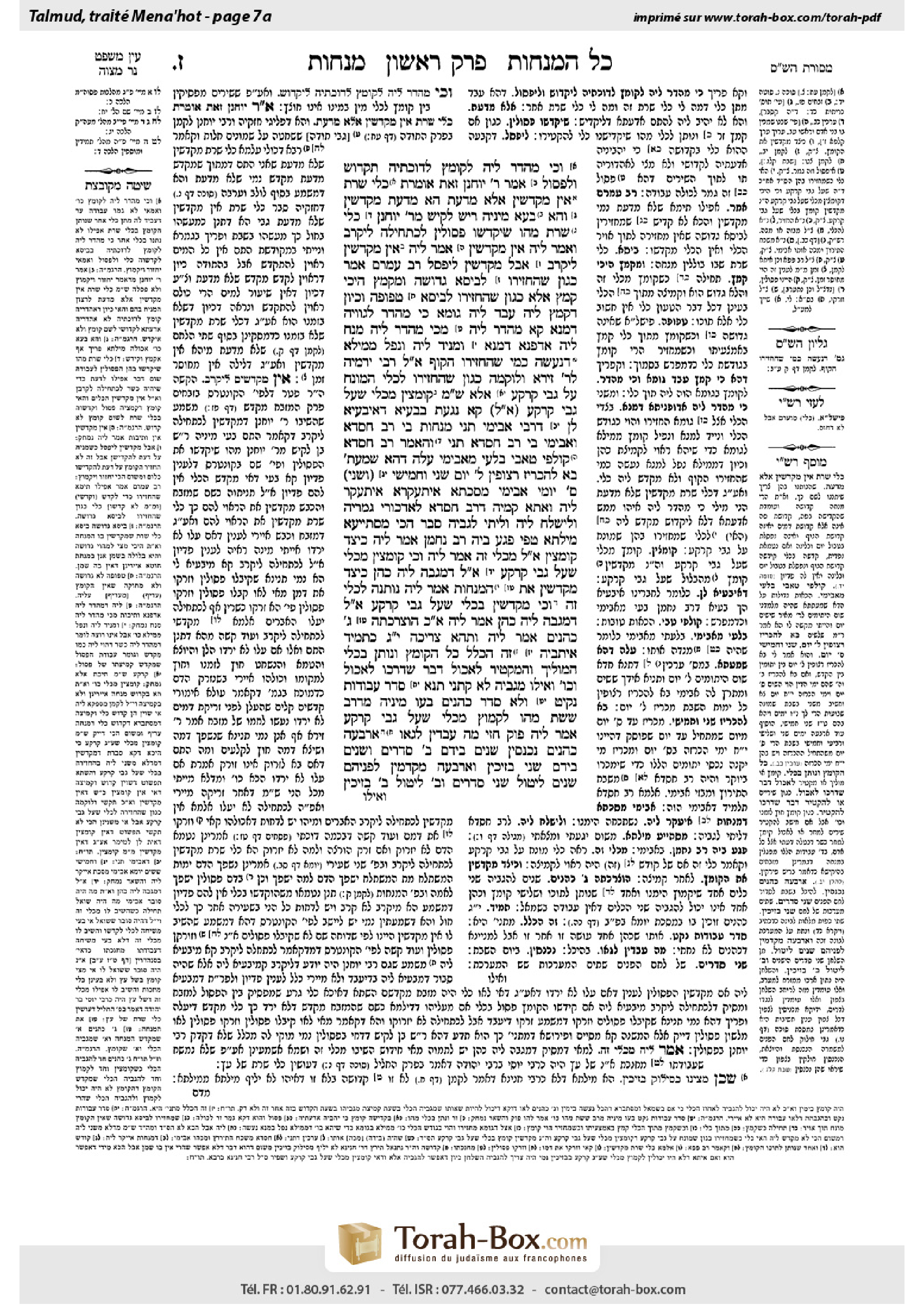
Menachot 7a: Talmud study for Daf Yomi
Daf Yomi is the daily study of one Talmud folio. Explore 37 tractates with scans, Hebrew text, Sefaria English and AI-generated French translations where annotated.
Passage selection and English or AI-generated French translation are available where the scan has annotations. Daf Study is independent of Torah-Box and Sefaria.
Browse Menachot · מנחות · All tractatesMenachot 7a text and translations
This page of Menachot includes the Aramaic text, an English translation and an AI-generated French translation, alongside the scan above.
מנחות ז׳ א · Aramaic and Hebrew text
וְכִי מַהְדַּר לֵיהּ לְקוֹמֶץ לְדוּכְתֵּיהּ, (תִּקְדּוֹשׁ) [לִקְדּוֹשׁ] וְלִפְסוֹל.
אָמַר רַבִּי יוֹחָנָן, זֹאת אוֹמֶרֶת: כְּלֵי שָׁרֵת אֵין מְקַדְּשִׁין אֶלָּא מִדַּעַת.
הָא מִדַּעַת מְקַדְּשִׁין? וְהָא בְּעָא מִינֵּיהּ רֵישׁ לָקִישׁ מֵרַבִּי יוֹחָנָן: כְּלֵי שָׁרֵת מַהוּ שֶׁיְּקַדְּשׁוּ פְּסוּלִין לְכַתְּחִילָּה לִיקְרַב? וַאֲמַר לֵיהּ: אֵין מְקַדְּשִׁין! אֲמַר לֵיהּ: אֵין מְקַדְּשִׁין לִיקְרַב, אֲבָל מִקַּדְּשִׁין לִיפָּסֵל.
רַב עַמְרָם אָמַר: כְּגוֹן שֶׁהֶחְזִירוֹ לְבִיסָא גְּדוּשָׁה.
וּמִקְמָץ הֵיכִי קְמַץ? אֶלָּא, כְּגוֹן שֶׁהֶחְזִירוֹ לְבִיסָא טְפוּפָה.
וְכֵיוָן דִּקְמַץ לֵיהּ עֲבַד לֵיהּ גּוּמָּא, כִּי מַהְדַּר לְגַוֵּויהּ דְּמָנָא קָא מַהְדַּר לֵיהּ! מִכִּי מַהְדַּר לֵיהּ, מַנַּח לֵיהּ אַדֻּפְנָא דְּמָנָא, וּמְנִיד לֵיהּ וְנָפֵל מִמֵּילָא, דְּנַעֲשָׂה כְּמִי שֶׁהֶחְזִירוֹ הַקּוֹף.
אֲמַר לֵיהּ רַבִּי יִרְמְיָה לְרַבִּי זֵירָא: וְלוֹקְמַהּ כְּגוֹן שֶׁהֶחְזִירוֹ לִכְלִי הַמּוּנָּח עַל גַּבֵּי קַרְקַע! אֶלָּא, שְׁמַע מִינַּהּ קוֹמְצִין מִכְּלִי שֶׁעַל גַּבֵּי קַרְקַע? אֲמַר לֵיהּ: קָא נָגְעַתְּ בְּבַעְיָא דְּאִיבַּעְיָא לַן, דְּרַבִּי אֲבִימִי תָּנֵי מְנָחוֹת בֵּי רַב חִסְדָּא.
וַאֲבִימִי בֵּי רַב חִסְדָּא תָּנֵי? וְהָאָמַר רַב חִסְדָּא: קוּלְפֵי טָאבֵי בְּלַעִי מֵאֲבִימִי עֲלַהּ דְּהָא שְׁמַעְתָּא, בָּא לְהַכְרִיז רְצוּפִין – שְׁלֹשִׁים יוֹם, שֵׁנִי וַחֲמִישִׁי וְשֵׁנִי – שִׁשִּׁים יוֹם.
אֲבִימִי מַסֶּכְתָּא אִיתְעֲקַרָא (אִיתְעֲקַר) לֵיהּ, וַאֲתָא קַמֵּיהּ דְּרַב חִסְדָּא לְאִדְּכוֹרֵי גְּמָרֵיהּ. וְלִישְׁלַח לֵיהּ וְלֵיתֵי לְגַבֵּיהּ? סְבַר: הָכִי מִסְתַּיְּיעָא מִילְּתָא טְפֵי.
פְּגַע בֵּיהּ רַב נַחְמָן, אֲמַר לֵיהּ: כֵּיצַד קוֹמְצִין? אֲמַר לֵיהּ: מִכְּלִי זֶה. אֲמַר לֵיהּ: וְכִי קוֹמְצִין מִכְּלִי שֶׁעַל גַּבֵּי קַרְקַע? אֲמַר לֵיהּ: דְּמַגְבַּה לֵיהּ כֹּהֵן.
כֵּיצַד מְקַדְּשִׁין אֶת הַמְּנָחוֹת? אֲמַר לֵיהּ: נוֹתְנָהּ לִכְלִי זֶה. וְכִי מְקַדְּשִׁין בִּכְלִי שֶׁעַל גַּבֵּי קַרְקַע? אֲמַר לֵיהּ: דְּמַגְבַּה לֵיהּ כֹּהֵן.
אֲמַר לֵיהּ: אִם כֵּן, הוּצְרַכְתָּה שְׁלֹשָׁה כֹּהֲנִים! אֲמַר לֵיהּ: וּתְהֵא צְרִיכָה שְׁלֹשָׁה עָשָׂר, כַּתָּמִיד.
אֵיתִיבֵיהּ: זֶה הַכְּלָל, כׇּל הַקּוֹמֵץ וְנוֹתֵן בִּכְלִי, הַמּוֹלִיךְ וְהַמַּקְטִיר, לֶאֱכוֹל דָּבָר שֶׁדַּרְכּוֹ לֶאֱכוֹל וְכוּ׳.
וְאִילּוּ מַגְבִּיהַּ לָא קָתָנֵי? תַּנָּא סֵדֶר עֲבוֹדוֹת נָקֵיט, וְלָא סֵדֶר כֹּהֲנִים.
בְּעוֹ מִינֵּיהּ מִדְּרַב שֵׁשֶׁת: מַהוּ לִקְמוֹץ מִכְּלִי שֶׁעַל גַּבֵּי קַרְקַע? אֲמַר לֵיהּ: פּוֹק חֲזִי מָה עָבְדִין לְגָאו. אַרְבָּעָה כֹּהֲנִים נִכְנָסִין, שְׁנַיִם בְּיָדָם שְׁנֵי סְדָרִים, וּשְׁנַיִם בְּיָדָם שְׁנֵי בָּזִיכִין, וְאַרְבָּעָה מְקַדְּמִין לִפְנֵיהֶם, שְׁנַיִם לִיטּוֹל שְׁנֵי סְדָרִים, וּשְׁנַיִם לִיטּוֹל שְׁנֵי בָּזִיכִין.
Menachot 7a · English translation
when he returns the handful to its former place in the service vessel that contains the meal offering it should become sanctified, as it is now placed inside a service vessel, and it should therefore become disqualified. It should not matter whether the handful was placed in the vessel designated for it, or back in the same vessel it was taken from.
Concerning this challenge, Rabbi Yoḥanan said: That is to say that service vessels sanctify items placed in them only when they are placed there with specific intent that they be sanctified by that vessel. Since the priest does not return the handful to the vessel containing the meal offering with such intent, the handful is not disqualified, because the rite was not completed.
The Gemara asks: It may be inferred from this statement that if items are placed into service vessels with intent, the service vessels sanctify them. But didn’t Reish Lakish raise a dilemma before Rabbi Yoḥanan: What is the halakha with regard to service vessels, i.e., do they sanctify disqualified items to the extent that they may be sacrificed upon the altar ab initio? And Rabbi Yoḥanan said to him that they do not sanctify the items. The Gemara responds: This is what Rabbi Yoḥanan said to him: They do not sanctify the disqualified items that are placed inside them to the extent that they may be sacrificed, but they do sanctify them to the extent that they are disqualified.
Rav Amram says: Even if service vessels sanctify items without specific intent, it is possible to return the handful to the meal offering without the vessel sanctifying the handful, such as in a case where he returned it to a heaped bowl [levisa], i.e., he placed the handful upon the heap of flour in such a manner that the handful did not enter the airspace of the vessel containing the meal offering. Consequently, the handful is not sanctified by the vessel.
The Gemara asks: But if the meal offering was heaped, how was he initially able to remove a handful from it? The handful must initially be removed from within a vessel. Rather, it is possible to return the handful without sanctifying it in a case where he returned it to a full [tefufa] bowl, i.e., it was full to the brim but not heaped. When the priest initially removes a handful from such a vessel, he removes it from inside the vessel, but when it is returned, it does not enter the airspace of the vessel.
The Gemara asks: But once he removed a handful, he formed a furrow in the surface of the meal offering, and therefore when he returns the handful to its previous place inside the vessel, he is in fact returning it to a spot within the vessel, i.e., the furrow. If so, the handful should be sanctified to the extent that the vessel disqualifies it. The Gemara responds: When he returns it to the vessel containing the meal offering, he does not place it directly in the furrow. Rather, he lays it on the wall of the vessel and moves the vessel, and the handful falls by itself into the furrow. In this manner, it is as though a monkey rather than a person returned the handful to the furrow, and the handful is therefore not sanctified.
§ The Gemara returns to its discussion of the opinion of ben Beteira. Rabbi Yirmeya said to Rabbi Zeira: And let one interpret ben Beteira’s ruling as speaking of a case in which the handful is not sanctified by the vessel containing the meal offering, such as where he returned it to a vessel that is resting upon the ground. Rather, the fact that this was not suggested indicates that service vessels sanctify items placed inside them even while resting on the ground. Is it correct to conclude from here that one may remove a handful of a meal offering from a service vessel that is resting upon the ground? Rabbi Zeira said to him: You have touched upon a dilemma that was already raised before us, when Rabbi Avimi was learning tractate Menaḥot in the study hall of Rav Ḥisda.
The Gemara interrupts this statement with a question: And did Rabbi Avimi really learn in the study hall of Rav Ḥisda? But didn’t Rav Ḥisda say: I absorbed many blows [kulfei] from Avimi as a result of that halakha, i.e., Avimi would mock me when I questioned his statements with regard to the sale of orphans’ property by the courts, which were contradictory to the ruling of a particular baraita. Avimi explained to me that if the court comes to announce such a sale on consecutive days, then it is announced for thirty days, in accordance with that baraita. But if it will be announced only on Monday, Thursday, and Monday, then it is announced over the course of sixty days. If so, Rav Ḥisda was in fact the pupil while Rabbi Avimi was his teacher.
The Gemara answers: Avimi was in fact the teacher, but tractate Menaḥot was uprooted for him, i.e., he forgot it, and Avimi came before his student Rav Ḥisda to help him recall his learning. The Gemara asks: If Rav Ḥisda was in fact Avimi’s student, let Avimi send for him and Rav Ḥisda come to Avimi. The Gemara responds: Avimi thought that this would be more helpful in this matter, i.e., that by exerting the effort to travel to his pupil in order to learn from him, he would better retain his studies.
The Gemara returns to the statement of Rabbi Zeira: Rav Naḥman encountered Avimi upon his return from the study hall of Rav Ḥisda. Rav Naḥman said to him: How does one properly remove a handful from a meal offering? Avimi pointed to a vessel that was resting on the ground and said to him: From this vessel one may properly remove a handful. Rav Naḥman said to him: But may one remove a handful from a vessel that is resting upon the ground? Avimi said to him: When I said that such a vessel may be used, I meant that one priest would first raise it from the ground and then another priest would remove a handful from it.
Rav Naḥman proceeded to ask Avimi another question: How does one properly sanctify the meal offerings? Avimi pointed to a vessel that was resting on the ground and said to him: The priest places it into this vessel. Rav Naḥman again said to him: But can one sanctify a meal offering in a vessel that is resting upon the ground? Avimi said to him: When I said that such a vessel may be used, I meant that another priest would initially raise it from the ground, and only then would the meal offering be placed inside it.
Rav Naḥman said to Avimi: If so, then you require the involvement of three priests, i.e., one to raise the vessel, one to sanctify the meal offering, and one to remove the handful from the meal offering. Avimi said to him: And let it require even thirteen priests, just as the service of the daily burnt offering required the involvement of thirteen priests. The need for several priests presents no difficulty.
Rav Naḥman raised another objection to the statement of Avimi from a mishna (12a) that discusses the halakha that improper intentions during the service of a meal offering disqualify it. This is the principle: In the case of anyone who removes the handful, or places the handful in the vessel, or who conveys the vessel with the handful to the altar, or who burns the handful on the altar, with the intent to partake of an item whose typical manner is such that one partakes of it, or to burn an item whose typical manner is such that one burns it on the altar, e.g., the handful or the frankincense, outside its designated area, the meal offering is unfit but there is no liability for excision from the World-to-Come [karet].
Rav Naḥman explained his objection: All the rites of a meal offering are taught in the mishna, and yet raising the vessel from the ground is not taught. This indicates that there is no requirement to raise a vessel from the ground in order to use it for the service of a meal offering. Avimi responded: The tanna cited the order of sacrificial rites, i.e., those rites concerning which improper intentions disqualify a meal offering, but he did not cite the order of the priests, i.e., he did not cite the total number of priests involved in the service.
On the same topic, the Sages raised a dilemma before Rav Sheshet: What is the halakha with regard to the permissibility of removing a handful from a vessel that is resting upon the ground? Is this removal valid? Rav Sheshet said to one of the Sages who raised the dilemma: Go out and see what they do within the Sanctuary when they remove the bowls containing the frankincense that were placed upon the Table of the shewbread in order to burn the frankincense upon the altar. The mishna (99b) states: When the priests would replace the shewbread every Shabbat, four priests would enter the Sanctuary, two with the two arrangements of the new shewbread in their hands and two with the two bowls of frankincense in their hands. And four priests would precede them and enter the Sanctuary before them, two to remove the two arrangements of the old shewbread and two to remove the two bowls of frankincense.
Menachot 7a · Traduction française (IA)
Lorsqu’il remet la poignée à sa place initiale, dans le récipient de service qui contient l’offrande de farine, elle devrait être sanctifiée, puisqu’elle se trouve alors dans un récipient de service, et donc être disqualifiée. Peu importe que la poignée ait été placée dans le récipient qui lui était destiné ou remise dans le même récipient d’où elle avait été prélevée.
À propos de cette objection, Rabbi Yoḥanan a dit : Cela signifie que les récipients de service ne sanctifient les éléments qu’on y place que si on les y place expressément dans l’intention qu’ils soient sanctifiés par ce récipient. Puisque le prêtre ne remet pas la poignée dans le récipient contenant l’offrande de farine avec cette intention, la poignée n’est pas disqualifiée, car le rite n’a pas été achevé.
La Guemara demande : Peut-on déduire de cette déclaration que, si des éléments sont placés dans des récipients de service avec cette intention, ces récipients les sanctifient ? Pourtant, Reish Lakish n’a-t-il pas soumis à Rabbi Yoḥanan la question suivante : Quelle est la halakha concernant les récipients de service ? Autrement dit, sanctifient-ils les éléments disqualifiés au point qu’ils puissent être offerts sur l’autel a priori ? Rabbi Yoḥanan lui répondit qu’ils ne sanctifient pas ces éléments. La Guemara répond : Voici ce que Rabbi Yoḥanan lui a dit : Ils ne sanctifient pas les éléments disqualifiés qui y sont placés au point qu’ils puissent être offerts, mais ils les sanctifient de manière à les disqualifier.
Rav Amram dit : Même si les récipients de service sanctifient les éléments sans intention explicite, il est possible de remettre la poignée dans l’offrande de farine sans que le récipient ne la sanctifie, par exemple si on la remet dans un bol où la farine est entassée [levisa], c’est-à-dire en posant la poignée sur le tas de farine de telle manière qu’elle ne pénètre pas dans l’espace intérieur du récipient contenant l’offrande de farine. La poignée n’est donc pas sanctifiée par le récipient.
La Guemara demande : Mais si l’offrande de farine était entassée, comment a-t-il pu en prélever une poignée au départ ? La poignée doit d’abord être prélevée à l’intérieur d’un récipient. Il est plutôt possible de remettre la poignée sans la sanctifier dans un cas où il la remet dans un bol plein [tefufa], c’est-à-dire rempli à ras bord, mais sans que la farine forme un tas. Lorsque le prêtre prélève d’abord une poignée dans un tel récipient, il la prend à l’intérieur de celui-ci ; mais lorsqu’il la remet, elle ne pénètre pas dans son espace intérieur.
La Guemara demande : Mais après avoir prélevé une poignée, il a formé un sillon à la surface de l’offrande de farine ; lorsqu’il remet la poignée à sa place initiale dans le récipient, il la remet donc bien à l’intérieur de celui-ci, dans le sillon. Dans ce cas, le récipient devrait sanctifier la poignée de manière à la disqualifier. La Guemara répond : Lorsqu’il la remet dans le récipient contenant l’offrande de farine, il ne la pose pas directement dans le sillon. Il la pose plutôt sur la paroi du récipient, puis déplace celui-ci, de sorte que la poignée tombe d’elle-même dans le sillon. Ainsi, c’est comme si un singe, et non une personne, avait remis la poignée dans le sillon ; elle n’est donc pas sanctifiée.
§ La Guemara revient à l’opinion de ben Beteira. Rabbi Yirmeya dit à Rabbi Zeira : Pourquoi ne pas interpréter la décision de ben Beteira comme portant sur un cas où la poignée n’est pas sanctifiée par le récipient contenant l’offrande de farine, par exemple si elle a été remise dans un récipient posé à même le sol ? Le fait que cette possibilité n’ait pas été proposée indique plutôt que les récipients de service sanctifient les éléments qui y sont placés même lorsqu’ils reposent à même le sol. Peut-on donc conclure de là qu’il est permis de prélever une poignée d’une offrande de farine dans un récipient posé à même le sol ? Rabbi Zeira lui dit : Tu viens de soulever une question qui nous avait déjà été posée, lorsque Rabbi Avimi étudiait le traité Menachot dans la maison d’étude de Rav Ḥisda.
La Guemara interrompt cette déclaration par une question : Rabbi Avimi a-t-il vraiment étudié dans la maison d’étude de Rav Ḥisda ? Pourtant, Rav Ḥisda n’a-t-il pas dit : J’ai reçu de nombreux coups [kulfei] d’Avimi à cause de cette halakha ? Autrement dit, Avimi se moquait de moi lorsque je contestais ses propos au sujet de la vente par les tribunaux des biens des orphelins, qui contredisaient la décision d’une baraïta particulière. Avimi m’expliqua que si le tribunal fait annoncer une telle vente des jours consécutifs, elle est annoncée pendant trente jours, conformément à cette baraïta. Mais si elle n’est annoncée que le lundi, le jeudi et le lundi, elle est annoncée sur une période de soixante jours. Rav Ḥisda était donc en réalité l’élève, et Rabbi Avimi son maître.
La Guemara répond : Avimi était bien le maître, mais le traité Menachot lui avait échappé, c’est-à-dire qu’il l’avait oublié ; il se rendit donc auprès de son élève Rav Ḥisda pour l’aider à se remémorer son étude. La Guemara demande : Si Rav Ḥisda était bien l’élève d’Avimi, qu’Avimi le fasse appeler et que Rav Ḥisda vienne à lui. La Guemara répond : Avimi pensait que cela serait plus utile dans cette circonstance : en faisant l’effort de se rendre chez son élève pour apprendre de lui, il retiendrait mieux son étude.
La Guemara revient à la déclaration de Rabbi Zeira : Rav Naḥman rencontra Avimi alors que celui-ci revenait de la maison d’étude de Rav Ḥisda. Rav Naḥman lui demanda : Comment prélève-t-on correctement une poignée d’une offrande de farine ? Avimi lui désigna un récipient posé à même le sol et lui dit : On peut prélever correctement une poignée dans ce récipient. Rav Naḥman lui demanda : Mais peut-on prélever une poignée dans un récipient posé à même le sol ? Avimi lui répondit : Lorsque j’ai dit qu’on pouvait utiliser un tel récipient, je voulais dire qu’un prêtre le soulèverait d’abord du sol, puis qu’un autre prêtre y prélèverait une poignée.
Rav Naḥman posa une autre question à Avimi : Comment sanctifie-t-on correctement les offrandes de farine ? Avimi lui désigna un récipient posé à même le sol et lui dit : Le prêtre la place dans ce récipient. Rav Naḥman lui demanda de nouveau : Mais peut-on sanctifier une offrande de farine dans un récipient posé à même le sol ? Avimi lui répondit : Lorsque j’ai dit qu’on pouvait utiliser un tel récipient, je voulais dire qu’un autre prêtre le soulèverait d’abord du sol, et que l’offrande de farine ne serait placée à l’intérieur qu’ensuite.
Rav Naḥman dit à Avimi : Dans ce cas, il faut donc faire intervenir trois prêtres : l’un pour soulever le récipient, l’un pour sanctifier l’offrande de farine et l’un pour en prélever une poignée. Avimi lui répondit : Et qu’il en faille même treize, tout comme le service de l’holocauste quotidien nécessitait l’intervention de treize prêtres ! La nécessité de faire intervenir plusieurs prêtres ne pose aucune difficulté.
Rav Naḥman souleva une autre objection à la déclaration d’Avimi, à partir d’une Michna (12a) qui traite de la halakha selon laquelle des intentions inappropriées pendant le service d’une offrande de farine la disqualifient. Voici le principe : dans le cas de toute personne qui prélève la poignée, la place dans le récipient, transporte jusqu’à l’autel le récipient contenant la poignée, ou brûle la poignée sur l’autel, avec l’intention de consommer un élément normalement destiné à être consommé, ou de brûler un élément normalement destiné à être brûlé sur l’autel, comme la poignée ou l’encens, hors de l’endroit qui lui est assigné, l’offrande de farine est invalide, mais cette personne n’encourt pas l’excision du monde à venir [karet].
Rav Naḥman expliqua son objection : Tous les rites d’une offrande de farine sont enseignés dans la Michna, et pourtant, le fait de soulever le récipient du sol n’y est pas mentionné. Cela indique qu’il n’est pas nécessaire de soulever un récipient du sol pour l’utiliser dans le service d’une offrande de farine. Avimi répondit : Le tanna a énuméré l’ordre des rites sacrificiels, c’est-à-dire les rites au cours desquels des intentions inappropriées disqualifient une offrande de farine ; mais il n’a pas énuméré l’ordre des prêtres, autrement dit, il n’a pas précisé le nombre total de prêtres intervenant dans le service.
Sur le même sujet, les Sages soumirent à Rav Sheshet la question suivante : Quelle est la halakha concernant la possibilité de prélever une poignée dans un récipient posé à même le sol ? Ce prélèvement est-il valide ? Rav Sheshet dit à l’un des Sages qui avaient soulevé cette question : Va voir ce que l’on fait dans le Sanctuaire lorsqu’on retire les bols contenant l’encens, placés sur la Table des pains de proposition, afin de brûler l’encens sur l’autel. La Michna (99b) enseigne : Lorsque les prêtres remplaçaient les pains de proposition chaque Chabbat, quatre prêtres entraient dans le Sanctuaire : deux portant les deux rangées des nouveaux pains de proposition, et deux portant les deux bols d’encens. Quatre prêtres les précédaient et entraient dans le Sanctuaire avant eux : deux pour retirer les deux rangées des anciens pains de proposition, et deux pour retirer les deux bols d’encens.
Traduction française générée par IA à partir de l’édition anglaise de Sefaria. Vérifie toujours un passage avec le texte source.
Text from Sefaria: William Davidson Edition - Vocalized Aramaic (unknown); William Davidson Edition - English (CC BY NC).