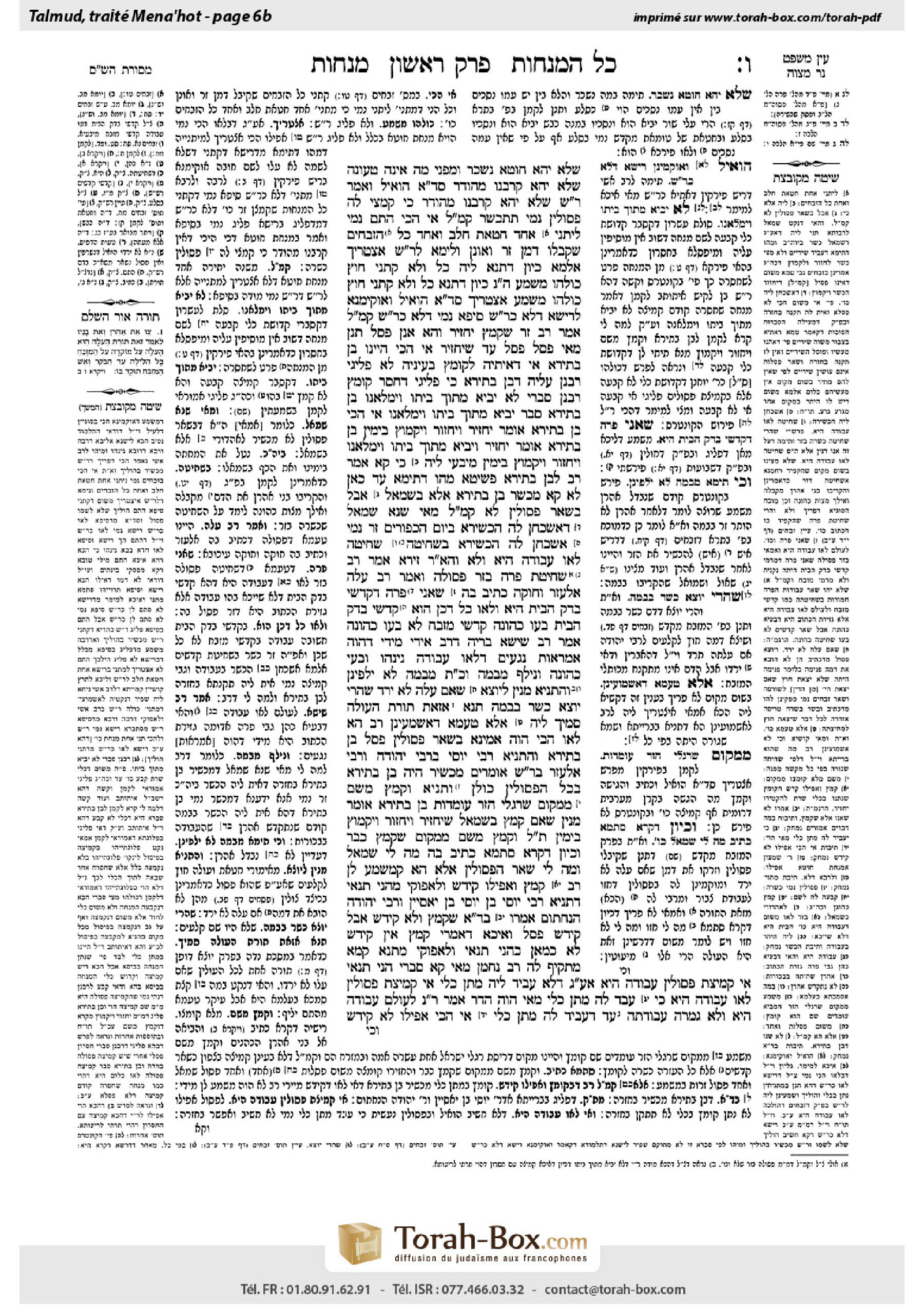
Menachot 6b: Talmud study for Daf Yomi
Daf Yomi is the daily study of one Talmud folio. Explore 37 tractates with scans, Hebrew text, Sefaria English and AI-generated French translations where annotated.
Passage selection and English or AI-generated French translation are available where the scan has annotations. Daf Study is independent of Torah-Box and Sefaria.
Browse Menachot · מנחות · All tractatesMenachot 6b text and translations
This page of Menachot includes the Aramaic text, an English translation and an AI-generated French translation, alongside the scan above.
מנחות ו׳ ב · Aramaic and Hebrew text
שֶׁלֹּא יְהֵא חוֹטֵא נִשְׂכָּר, וּמִפְּנֵי מָה אֵינָהּ טְעוּנָה? שֶׁלֹּא יְהֵא קׇרְבָּנוֹ מְהוּדָּר. סָלְקָא דַּעְתָּךְ אָמֵינָא: הוֹאִיל וְאָמַר רַבִּי שִׁמְעוֹן שֶׁלֹּא יְהֵא קׇרְבָּנוֹ מְהוּדָּר, כִּי קָמְצִי לַהּ פְּסוּלִין נָמֵי תִּתַּכְשַׁר, קָא מַשְׁמַע לַן.
אִי הָכִי, הָתָם נָמֵי לִיתְנֵי: אֶחָד חַטַּאת חֵלֶב וְאֶחָד כׇּל הַזְּבָחִים שֶׁקִּבְּלוּ דָּמָן זָר וְאוֹנֵן, וְלֵימָא: לְרַבִּי שִׁמְעוֹן אִצְטְרִיךְ.
אַלְמָא, כֵּיוָן דִּתְנָא לֵיהּ ״כׇּל״ וְלָא קָתָנֵי ״חוּץ״ – כּוּלְּהוּ מַשְׁמַע, הָכָא נָמֵי, כֵּיוָן דִּתְנָא ״כׇּל״ וְלָא קָתָנֵי ״חוּץ״ – כּוּלְּהוּ מַשְׁמַע.
אִצְטְרִיךְ, סָלְקָא דַּעְתָּךְ אָמֵינָא: הוֹאִיל וְאוֹקֵימְנָא לְרֵישָׁא דְּלָא כְּרַבִּי שִׁמְעוֹן, סֵיפָא נָמֵי דְּלָא כְּרַבִּי שִׁמְעוֹן, קָא מַשְׁמַע לַן.
אָמַר רַב: זָר שֶׁקָּמַץ – יַחְזִיר, וְהָא אֲנַן ״פָּסַל״ תְּנַן? מַאי ״פָּסַל״? פָּסַל עַד שֶׁיַּחֲזִיר.
אִי הָכִי, הַיְינוּ בֶּן בְּתִירָא? אִי דְּאִיתֵיהּ לְקוֹמֶץ בְּעֵינֵיהּ – לָא פְּלִיגִי רַבָּנַן עֲלֵיהּ דְּבֶן בְּתִירָא, כִּי פְּלִיגִי – דַּחֲסַר קוֹמֶץ. רַבָּנַן סָבְרִי: לָא יָבִיא מִתּוֹךְ בֵּיתוֹ וִימַלְּאֶנּוּ, בֶּן בְּתִירָא סָבַר: יָבִיא מִתּוֹךְ בֵּיתוֹ וִימַלְּאֶנּוּ.
אִי הָכִי, בֶּן בְּתִירָא אוֹמֵר: יַחְזִיר וְיַחֲזוֹר וְיִקְמוֹץ בְּיָמִין?! בֶּן בְּתִירָא אוֹמֵר: יַחְזִיר וְיָבִיא מִתּוֹךְ בֵּיתוֹ וִימַלְּאֶנּוּ, וְיַחֲזוֹר וְיִקְמוֹץ בְּיָמִין, מִיבְּעֵי לֵיהּ!
כִּי קָא אָמַר רַב לְבֶן בְּתִירָא, פְּשִׁיטָא! מַהוּ דְּתֵימָא: עַד כָּאן לָא קָא מַכְשַׁר בֶּן בְּתִירָא אֶלָּא בִּשְׂמֹאל, אֲבָל בִּשְׁאָר פְּסוּלִין לָא, קָא מַשְׁמַע לַן.
מַאי שְׁנָא שְׂמֹאל, דְּאַשְׁכְּחַן לֵהּ הֶכְשֵׁירָא בְּיוֹם הַכִּפּוּרִים? זָר נָמֵי אַשְׁכְּחַן לֵהּ הֶכְשֵׁירָא בִּשְׁחִיטָה!
שְׁחִיטָה לָאו עֲבוֹדָה הִיא.
וְלָא? וְהָאָמַר רַבִּי זֵירָא אָמַר רַב: שְׁחִיטַת פָּרָה בְּזָר פְּסוּלָה, וְאָמַר רַב עֲלַהּ: ״אֶלְעָזָר״ וְ״חוּקָּה״ כְּתִיב בַּהּ. שָׁאנֵי פָּרָה, דְּקׇדְשֵׁי בֶּדֶק הַבַּיִת הִיא.
וְלָאו כָּל דְּכֵן הוּא? קׇדְשֵׁי בֶּדֶק הַבַּיִת בָּעוּ כְּהוּנָּה, קׇדְשֵׁי מִזְבֵּחַ לָא בָּעוּ כְּהוּנָּה?! אָמַר רַב שִׁישָׁא בְּרֵיהּ דְּרַב אִידִי: מִידֵּי דְּהָוֵה אַמַּרְאוֹת נְגָעִים, דְּלָאו עֲבוֹדָה נִינְהוּ וּבָעֵי כְּהוּנָּה.
וְנֵילַף מִבָּמָה?
וְכִי תֵימָא, מִבָּמָה לָא יָלְפִינַן, וְהָתַנְיָא: מִנַּיִן לַיּוֹצֵא, שֶׁאִם עָלָה לֹא יֵרֵד, שֶׁהֲרֵי יוֹצֵא כָּשֵׁר בְּבָמָה!
תְּנָא אַ״זֹּאת תּוֹרַת הָעֹלָה״ סְמִיךְ לֵיהּ.
אֶלָּא טַעְמָא דְּאַשְׁמְעִינַן רַב, הָא לָאו הָכִי הֲוָה אָמֵינָא בִּשְׁאָר פְּסוּלִין פָּסַל בֶּן בְּתִירָא? וְהָתַנְיָא: רַבִּי יוֹסֵי בְּרַבִּי יְהוּדָה וְרַבִּי אֶלְעָזָר בְּרַבִּי שִׁמְעוֹן אוֹמְרִים: מַכְשִׁיר הָיָה בֶּן בְּתִירָא בְּכׇל הַפְּסוּלִין כּוּלָּן!
וְתַנְיָא: ״וְקָמַץ מִשָּׁם״ – מִמָּקוֹם שֶׁרַגְלֵי הַזָּר עוֹמְדוֹת.
בֶּן בְּתִירָא אוֹמֵר, מִנַּיִן שֶׁאִם קָמַץ בִּשְׂמֹאל שֶׁיַּחֲזִיר וְיַחֲזוֹר וְיִקְמוֹץ בְּיָמִין? תַּלְמוּד לוֹמַר: ״וְקָמַץ מִשָּׁם״, מִמָּקוֹם שֶׁקָּמַץ כְּבָר.
וְכֵיוָן דִּקְרָא סְתָמָא כְּתִיב בַּהּ, מָה לִי שְׂמֹאל, וּמָה לִי שְׁאָר הַפְּסוּלִין?
אֶלָּא, הָא קָמַשְׁמַע לַן רַב: קָמַץ וַאֲפִילּוּ קִידֵּשׁ, וּלְאַפּוֹקֵי מֵהָנֵי תַּנָּאֵי דְּתַנְיָא: רַבִּי יוֹסֵי בֶּן יוֹסֵי בֶּן יָאסְיָין וְרַבִּי יְהוּדָה הַנַּחְתּוֹם אָמְרוּ: בַּמֶּה דְּבָרִים אֲמוּרִים – שֶׁקָּמַץ וְלֹא קִידֵּשׁ, אֲבָל קִידֵּשׁ – פָּסַל.
וְאִיכָּא דְאָמְרִי: קָמַץ – אִין, קִידֵּשׁ – לָא. כְּמַאן? כְּהָנֵי תַּנָּאֵי, וּלְאַפּוֹקֵי מִתַּנָּא קַמָּא.
מַתְקֵיף לַהּ רַב נַחְמָן: מַאי קָא סָבְרִי הָנֵי תַּנָּאֵי? אִי קְמִיצַת פְּסוּלִין עֲבוֹדָה הִיא, אַף עַל גַּב דְּלָא עָבֵיד לֵיהּ מַתַּן כְּלִי! אִי קְמִיצַת פְּסוּלִין לָאו עֲבוֹדָה הִיא, כִּי עֲבַד לֵהּ מַתַּן כְּלִי מַאי הֲוָה?
הֲדַר אָמַר רַב נַחְמָן: לְעוֹלָם עֲבוֹדָה הִיא, וְלָא גָּמְרָה עֲבוֹדָתָהּ עַד דְּעָבֵיד לֵהּ מַתַּן כְּלִי.
אִי הָכִי, אֲפִילּוּ לֹא קִידֵּשׁ,
Menachot 6b · English translation
so that the sinner will not profit. And for what reason does his offering not require libations? So that his offering will not be of superior quality. Accordingly, it might enter your mind to say that since Rabbi Shimon says: In order that his offering will not be of superior quality, when the handful is removed by one of those unfit for performing the Temple service, the offering should also be valid, as it too is of inferior quality. Therefore, the mishna teaches us the halakha in a manner that emphasizes that even according to the opinion of Rabbi Shimon the meal offering of a sinner is disqualified when the handful is removed by one who is unfit.
The Gemara asks: If so, then there as well, i.e., with regard to slaughtered offerings, let the mishna (Zevaḥim 15b) teach: Both the sin offering of forbidden fat and all the slaughtered offerings with regard to which the one who collected their blood was a non-priest or a priest who is an acute mourner, are disqualified. And let us say that it was necessary to teach the mishna in this manner in accordance with the opinion of Rabbi Shimon, to emphasize that although the sin offering is not of superior quality, in that it does not require that libations be brought with it, nevertheless it is disqualified if its blood was collected by one unfit for Temple service. Why then does that mishna teach simply: All the slaughtered offerings with regard to which the one who collected their blood was a non-priest are disqualified?
The Gemara concludes its question: Apparently, since the tanna teaches that mishna with the term: All, and he does not teach: Except, all offerings are indicated by the general disqualification, and there is no need to emphasize the halakha with regard to a sin offering, even in accordance with the opinion of Rabbi Shimon. Here too, with regard to meal offerings, since the tanna teaches the mishna with the term: All, and he does not teach: Except, this means that all of them are indicated, even the meal offering of a sinner. Why then does the mishna specifically mention the meal offering of a sinner?
The Gemara explains: It was necessary to teach the mishna in this manner as it might enter your mind to say: Since I have established that the first clause, i.e., the mishna on 2a, is not in accordance with the opinion of Rabbi Shimon, with regard to the last clause as well, i.e., the mishna here, it may be concluded that it is not in accordance with the opinion of Rabbi Shimon. Therefore, the mishna teaches us the halakha in this manner, to emphasize that it is in accordance with his opinion.
§ Rav says: In the case of a non-priest who removed a handful, he should return the handful to the meal offering. The Gemara challenges: But we learned in the mishna that a non-priest disqualified the meal offering by removing a handful from it. The Gemara responds: What does the mishna mean when it says: Disqualified? It means that the non-priest has disqualified the meal offering until such time as he returns the handful to the meal offering, whereupon a priest fit for the Temple service should again remove a handful from the meal offering and sacrifice it.
The Gemara challenges: If so, then this is identical to the opinion of ben Beteira in the mishna, who says that if a priest removed a handful with his left hand it is returned to the meal offering whereupon the priest removes a handful from the offering with his right hand. What difference is there between the two opinions in the mishna? The Gemara explains: If the handful that was removed by one unfit for Temple service is in its unadulterated form, then the Rabbis do not disagree with the opinion of ben Beteira, and the handful is returned to the meal offering. They disagree when the handful is lacking. The Rabbis hold: One does not bring flour from within his house and refill the vessel containing the handful, whereas ben Beteira holds that one brings flour from within his house and refills it.
The Gemara asks: If so, i.e., if the mishna is referring to a handful that is lacking, then the statement of the mishna: Ben Beteira says he must return the handful to the vessel with the meal offering and again remove a handful with his right hand, is imprecise, as the mishna should have taught: Ben Beteira says he must return the handful to the vessel with the meal offering and bring flour from within his house and refill the missing amount, and again remove a handful with his right hand.
The Gemara therefore suggests a different answer: When Rav said that the handful is returned to the meal offering, he said this only according to the opinion of ben Beteira. The Gemara asks: But isn’t it obvious that this is the opinion of ben Beteira? The Gemara responds: Rav’s statement is necessary lest you say that ben Beteira deems the meal offering fit only when the handful was removed with one’s left hand, but with regard to other disqualifications, he does not deem it fit. Therefore, Rav teaches us that with regard to all of the disqualifications cited in the mishna, ben Beteira holds that the handful is returned to the meal offering whereupon a new handful is removed from it and sacrificed upon the altar.
The Gemara asks: What is different in the case of a handful removed with a priest’s left hand that one might have thought that ben Beteira’s opinion applies only in this case? Perhaps the reason is that we find that the Temple service performed with the priest’s left hand is fit on Yom Kippur, i.e., when the High Priest would enter the Holy of Holies holding the vessel containing the incense in his left hand. But with regard to a non-priest as well, we find that the Temple service is fit with regard to slaughter, as an offering may be slaughtered by a non-priest. Why then is it necessary for Rav to teach that the opinion of ben Beteira applies to the case of a non-priest as well?
The Gemara responds: Slaughter is not considered a sacrificial rite, and it is for that reason that a non-priest may slaughter an offering. Accordingly, without the statement of Rav one would not have concluded that ben Beteira holds that a handful removed by a non-priest may be returned, as the Temple service is never fit when performed by a non-priest.
The Gemara asks: And is slaughter really not considered a sacrificial rite? But doesn’t Rabbi Zeira say that Rav says: The slaughter of a red heifer by a non-priest is not valid? And Rav said with regard to this halakha: This is because both the term: “Elazar the priest” (Numbers 19:3), and the term: “Statute” (Numbers 19:2), are written in the Torah’s description of the slaughter of the red heifer. The term “statute” indicates that if one deviates from any of the details of the service as delineated in the verses, the service is not valid. The Gemara answers: The halakhot of the red heifer are different, as the heifer is considered sanctified for the purpose of Temple maintenance, not for sacrifice upon the altar. Accordingly, one cannot derive from the case of the red heifer that the slaughter of an offering is considered a sacrificial rite.
The Gemara asks: But is it not all the more so? If items sanctified for the purpose of Temple maintenance require that the performance of rites relevant to them be performed by a member of the priesthood, then with regard to items sanctified for sacrifice upon the altar, shouldn’t they certainly require that their rites be performed by a member of the priesthood? Rav Sheisha, son of Rav Idi, said in response: The requirement that the red heifer be slaughtered by a priest is not proof that its slaughter is a sacrificial rite. Rather, that requirement is just as it is in the case of examination of the shades of leprous marks, which is obviously not considered a sacrificial rite, and yet the Torah requires that these marks be examined by a member of the priesthood.
The Gemara asks: Nevertheless, why was it necessary for Rav to teach that the removal of a handful by a non-priest does not disqualify the meal offering according to ben Beteira? Let us derive it from the fact that there was a period of fitness for rites performed by a non-priest, as before the construction of the Temple it was permitted for non-priests to sacrifice offerings upon a private altar.
And if you would say that we do not derive halakhot of the rites performed in the Temple from those performed on a private altar, one can respond: But isn’t it taught in a baraita: From where is it derived with regard to an item, e.g., the limbs of an offering, that emerged from the Temple courtyard and was thereby rendered unfit for sacrifice upon the altar, that if it nevertheless ascended upon the altar it shall not descend? It is derived from the fact that an item that emerged is valid for sacrifice on a private altar. This indicates that one can learn the halakhot of offerings in the Temple from the halakhot of a private altar.
The Gemara rejects this: The tanna of that baraita relies on the verse: “This is the law of the burnt offering” (Leviticus 6:2), from which it is derived that any item that ascends upon the altar shall not descend from it, even if it was disqualified. In other words, the verse is the source for the halakha of the baraita, whereas the case of a private altar is cited merely as a support for this ruling.
The Gemara asks: Rather, the reason it is known that ben Beteira permits the return to the meal offering of a handful removed by a non-priest is that Rav taught us so. Were it not for this, I would say that with regard to other disqualifications, i.e., other than a handful removed with the left hand, ben Beteira invalidates the meal offering. But isn’t it taught in a baraita that Rabbi Yosei, son of Rabbi Yehuda, and Rabbi Elazar, son of Rabbi Shimon, both say: Ben Beteira would deem fit in the case of all the other disqualifications listed in the mishna?
The Gemara continues: And it is taught in a baraita with regard to the verse: “And he shall bring it to Aaron’s sons the priests; and he shall remove from there his handful” (Leviticus 2:2), that this verse indicates that the removal of a handful from a meal offering may be performed from the place where the feet of the non-priest stand, i.e., anywhere within the Temple courtyard.
The baraita continues: Ben Beteira says that the verse should be interpreted as follows: From where is it derived that if one removed a handful with his left hand, that he must return the handful to the vessel with the meal offering and again remove the handful with his right hand? It is derived from that which the verse states: “And he shall remove from there,” indicating that the handful is removed from the place where he already removed it, i.e., the handful is returned to the meal offering and thereupon removed from the same meal offering with the right hand. This concludes the baraita.
The Gemara explains the difficulty from the baraita: And since the verse is written in an unspecified manner, i.e., it does not mention which handfuls are returned, what difference is it to me if the handful was removed with the left hand, and what difference is it to me if it was removed by means of one of the other disqualifications?
The Gemara therefore suggests an alternative explanation: Rather, this is what Rav teaches us: Ben Beteira holds that if one unfit for Temple service removed a handful it may be returned to the meal offering even if he sanctified the handful by placing it in a service vessel. And the statement of Rav serves to exclude the opinion of these tanna’im: As it is taught in a baraita: Rabbi Yosei ben Yosei ben Yasiyyan and Rabbi Yehuda the baker said: In what case is this statement of ben Beteira said, i.e., in which case does he rule that the handful may be returned to the meal offering? It is in a case where the unfit individual removed a handful and did not sanctify it by placing it inside a service vessel. But if he sanctified it then he has disqualified it, even according to ben Beteira, and it may not be returned to the meal offering.
And there are those who say that Rav teaches the opposite, that if an unfit person merely removed a handful, yes, ben Beteira permits such a handful to be returned to the meal offering from which it was removed, but if he already sanctified the handful by placing it inside a service vessel, it may not be returned. In accordance with whose opinion is this explanation? It is in accordance with the opinion of these tanna’im, i.e., Rabbi Yosei ben Yosei ben Yasiyyan and Rabbi Yehuda the baker, and it is to exclude the opinion of the first tanna in that baraita, who disagrees with the ruling of Rabbi Yosei ben Yosei ben Yasiyyan and Rabbi Yehuda the baker and maintains that a handful may be returned even after it was sanctified by a service vessel.
Rav Naḥman objects to this: What do these tanna’im of the baraita hold? If they hold that the removal of a handful by one unfit for Temple service is considered the performance of a sacrificial rite to the extent that it disqualifies the offering, then the meal offering should be disqualified even though he did not perform the stage of the placement of the handful in a vessel. And if they hold that the removal of a handful by an unfit individual is not considered the performance of a rite, then when he performed the stage of its placement in a vessel, what significance was there to this action? He can still return the handful to the meal offering.
Rav Naḥman reconsidered and then said: Actually, those tanna’im hold that the removal of a handful by one unfit for Temple service is considered the performance of a sacrificial rite, but the rite of the handful is not complete until he performs the stage of its placement in a vessel. Consequently, the meal offering is disqualified only after a person unfit for Temple service places the handful inside a service vessel.
The Gemara challenges: If so, i.e., if the placement of the handful inside a service vessel completes the rite that begins with the handful’s removal, then even if the handful was removed by an unfit individual who has not yet sanctified it in the service vessel designated for the handful,
Menachot 6b · Traduction française (IA)
afin que le pécheur n’en tire pas profit. Et pour quelle raison son offrande ne requiert-elle pas de libations ? Afin que son offrande ne soit pas de meilleure qualité. On pourrait donc être tenté de dire que, puisque Rabbi Shimon dit : « Afin que son offrande ne soit pas de meilleure qualité », lorsque la poignée est prélevée par une personne inapte au service du Temple, l’offrande devrait elle aussi être valide, puisqu’elle est également de qualité inférieure. La Michna nous enseigne donc la halakha de manière à souligner que, même selon l’opinion de Rabbi Shimon, l’offrande de farine d’un pécheur est invalidée lorsque la poignée est prélevée par une personne inapte.
La Guemara demande : Dans ce cas, là aussi, c’est-à-dire à propos des sacrifices égorgés, que la Michna (Zévaḥim 15b) enseigne : « Tant le sacrifice expiatoire pour consommation de graisse interdite que tous les sacrifices égorgés dont le sang a été recueilli par un non-prêtre ou par un prêtre en état d’onen sont invalides. » Et disons qu’il était nécessaire d’enseigner la Michna sous cette forme, conformément à l’opinion de Rabbi Shimon, pour souligner que, bien que le sacrifice expiatoire ne soit pas de meilleure qualité, puisqu’il ne requiert pas de libations, il est néanmoins invalide si son sang a été recueilli par une personne inapte au service du Temple. Pourquoi donc cette Michna enseigne-t-elle simplement : « Tous les sacrifices égorgés dont le sang a été recueilli par un non-prêtre sont invalides » ?
La Guemara conclut sa question : Apparemment, puisque le tanna enseigne cette Michna avec le terme « tous », et non « sauf », cela indique que tous les sacrifices sont concernés par l’invalidation générale ; il n’est donc pas nécessaire de souligner la halakha concernant un sacrifice expiatoire, même selon l’opinion de Rabbi Shimon. Ici aussi, à propos des offrandes de farine, puisque le tanna enseigne la Michna avec le terme « toutes », et non « sauf », cela signifie qu’elles sont toutes concernées, y compris l’offrande de farine d’un pécheur. Pourquoi donc la Michna mentionne-t-elle spécifiquement l’offrande de farine d’un pécheur ?
La Guemara explique : Il était nécessaire d’enseigner la Michna sous cette forme, car on aurait pu être tenté de dire : Puisque j’ai établi que la première partie, c’est-à-dire la Michna en 2a, n’est pas conforme à l’opinion de Rabbi Shimon, on peut également conclure que la dernière partie, c’est-à-dire la Michna ici, n’est pas conforme à son opinion. La Michna nous enseigne donc la halakha sous cette forme afin de souligner qu’elle est conforme à son opinion.
§ Rav dit : Dans le cas où un non-prêtre a prélevé une poignée, il doit la remettre dans l’offrande de farine. La Guemara objecte : Pourtant, nous avons appris dans la Michna qu’un non-prêtre a invalidé l’offrande de farine en y prélevant une poignée. La Guemara répond : Que signifie le terme « invalidé » employé par la Michna ? Cela signifie que le non-prêtre a invalidé l’offrande de farine jusqu’à ce qu’il remette la poignée dans l’offrande ; alors, un prêtre apte au service du Temple doit prélever de nouveau une poignée de l’offrande et la sacrifier.
La Guemara objecte : Dans ce cas, cette opinion est identique à celle de ben Beteira dans la Michna, qui dit que, si un prêtre a prélevé une poignée de la main gauche, celle-ci est remise dans l’offrande de farine, après quoi le prêtre en prélève une de la main droite. Quelle différence y a-t-il entre les deux opinions de la Michna ? La Guemara explique : Si la poignée prélevée par une personne inapte au service du Temple est intacte, les Rabbins ne sont pas en désaccord avec ben Beteira, et la poignée est remise dans l’offrande de farine. Leur désaccord porte sur le cas où la poignée est incomplète. Les Rabbins soutiennent qu’on ne prend pas de farine chez soi pour compléter le récipient contenant la poignée, tandis que ben Beteira soutient qu’on prend de la farine chez soi pour le compléter.
La Guemara demande : Dans ce cas, c’est-à-dire si la Michna parle d’une poignée incomplète, son énoncé — « Ben Beteira dit qu’il doit remettre la poignée dans le récipient contenant l’offrande de farine, puis en prélever de nouveau une de la main droite » — est imprécis. La Michna aurait dû enseigner : « Ben Beteira dit qu’il doit remettre la poignée dans le récipient contenant l’offrande de farine, prendre de la farine chez lui pour combler ce qui manque, puis prélever de nouveau une poignée de la main droite. »
La Guemara propose donc une autre réponse : Lorsque Rav a dit que la poignée est remise dans l’offrande de farine, il l’a dit uniquement selon l’opinion de ben Beteira. La Guemara demande : Mais n’est-il pas évident que telle est l’opinion de ben Beteira ? La Guemara répond : La déclaration de Rav est nécessaire, car on pourrait croire que ben Beteira ne considère l’offrande de farine comme valide que lorsque la poignée a été prélevée de la main gauche, mais qu’il ne la considère pas comme valide en cas d’autres causes d’invalidation. Rav nous enseigne donc que, pour toutes les causes d’invalidation citées dans la Michna, ben Beteira soutient que la poignée est remise dans l’offrande de farine, après quoi une nouvelle poignée en est prélevée et sacrifiée sur l’autel.
La Guemara demande : En quoi le cas d’une poignée prélevée de la main gauche d’un prêtre diffère-t-il, de sorte qu’on aurait pu penser que l’opinion de ben Beteira ne s’applique qu’à ce cas ? Peut-être est-ce parce que le service du Temple accompli de la main gauche d’un prêtre est valide à Yom Kippour, lorsque le grand prêtre entrait dans le Saint des Saints en tenant de la main gauche le récipient contenant l’encens. Mais, concernant un non-prêtre également, nous trouvons que le service du Temple est valide pour l’égorgement, puisqu’un sacrifice peut être égorgé par un non-prêtre. Pourquoi Rav doit-il donc enseigner que l’opinion de ben Beteira s’applique également au cas d’un non-prêtre ?
La Guemara répond : L’égorgement n’est pas considéré comme un rite sacrificiel ; c’est pour cette raison qu’un non-prêtre peut égorger un sacrifice. Par conséquent, sans la déclaration de Rav, on n’aurait pas conclu que ben Beteira soutient qu’une poignée prélevée par un non-prêtre peut être remise, car le service du Temple n’est jamais valide lorsqu’il est accompli par un non-prêtre.
La Guemara demande : L’égorgement n’est-il vraiment pas considéré comme un rite sacrificiel ? Rabbi Zeira ne dit-il pas au nom de Rav : « L’égorgement d’une vache rousse par un non-prêtre n’est pas valide » ? Rav a dit à propos de cette halakha que c’est parce que les termes « Eléazar le prêtre » (Nombres 19:3) et « statut » (Nombres 19:2) figurent tous deux dans la Torah, dans la description de l’égorgement de la vache rousse. Le terme « statut » indique que si l’on s’écarte de l’un quelconque des détails du service décrits dans les versets, le service n’est pas valide. La Guemara répond : Les halakhot de la vache rousse sont différentes, car celle-ci est considérée comme consacrée à l’entretien du Temple, et non comme destinée à être sacrifiée sur l’autel. On ne peut donc pas déduire du cas de la vache rousse que l’égorgement d’un sacrifice est considéré comme un rite sacrificiel.
La Guemara demande : Mais n’est-ce pas d’autant plus évident ? Si les objets consacrés à l’entretien du Temple exigent que les rites qui les concernent soient accomplis par un membre de la prêtrise, ceux qui sont consacrés au sacrifice sur l’autel ne devraient-ils pas, à plus forte raison, exiger que leurs rites soient accomplis par un membre de la prêtrise ? Rav Sheisha, fils de Rav Idi, répondit : L’exigence qu’un prêtre égorge la vache rousse ne prouve pas que son égorgement soit un rite sacrificiel. Cette exigence est comparable à celle qui s’applique à l’examen des nuances des marques de lèpre : cet examen n’est manifestement pas un rite sacrificiel, et pourtant la Torah exige que ces marques soient examinées par un membre de la prêtrise.
La Guemara demande : Malgré tout, pourquoi Rav devait-il enseigner que, selon ben Beteira, le prélèvement d’une poignée par un non-prêtre n’invalide pas l’offrande de farine ? Déduisons-le du fait qu’il y a eu une période où les rites accomplis par un non-prêtre étaient valides : avant la construction du Temple, les non-prêtres avaient le droit de sacrifier des offrandes sur un autel privé.
Et si tu dis que nous ne déduisons pas les halakhot des rites accomplis dans le Temple de celles des rites accomplis sur un autel privé, on peut répondre : N’est-il pas enseigné dans une baraïta : « D’où déduit-on, à propos d’un élément, par exemple les membres d’un sacrifice, qui est sorti de la cour du Temple et est ainsi devenu impropre à être sacrifié sur l’autel, que, s’il y est néanmoins monté, il ne doit pas en descendre ? » On le déduit du fait qu’un élément qui est sorti peut être sacrifié sur un autel privé. Cela indique que l’on peut tirer les halakhot relatives aux sacrifices dans le Temple de celles qui concernent un autel privé.
La Guemara rejette cette réponse : Le tanna de cette baraïta s’appuie sur le verset : « Voici la loi de l’holocauste » (Lévitique 6:2), dont on déduit que tout élément qui monte sur l’autel ne doit pas en descendre, même s’il a été invalidé. Autrement dit, le verset est la source de la halakha de la baraïta, tandis que le cas de l’autel privé n’est cité qu’à l’appui de cette décision.
La Guemara demande : La raison pour laquelle on sait que ben Beteira permet de remettre dans l’offrande de farine une poignée prélevée par un non-prêtre serait donc que Rav nous l’a enseigné. Sans cela, j’aurais dit que, pour les autres causes d’invalidation, c’est-à-dire celles qui ne concernent pas une poignée prélevée de la main gauche, ben Beteira invalide l’offrande de farine. Mais n’est-il pas enseigné dans une baraïta que Rabbi Yosei, fils de Rabbi Yehuda, et Rabbi Elazar, fils de Rabbi Shimon, disent tous deux : « Ben Beteira déclarait valide le cas de toutes les autres causes d’invalidation énumérées dans la Michna » ?
La Guemara poursuit : Une baraïta enseigne à propos du verset : « Il l’apportera aux fils d’Aaron, les prêtres, et il en prélèvera sa poignée » (Lévitique 2:2), que ce verset indique qu’une poignée d’une offrande de farine peut être prélevée depuis l’endroit où se tiennent les pieds du non-prêtre, c’est-à-dire en tout lieu dans la cour du Temple.
La baraïta poursuit : Ben Beteira dit que le verset doit être interprété ainsi : D’où déduit-on que, si quelqu’un a prélevé une poignée de la main gauche, il doit la remettre dans le récipient contenant l’offrande de farine, puis la prélever de nouveau de la main droite ? On le déduit de ce que dit le verset : « Et il en prélèvera », ce qui indique que la poignée est prélevée à l’endroit où elle a déjà été prélevée ; autrement dit, la poignée est remise dans l’offrande de farine, puis prélevée de nouveau de la main droite dans cette même offrande. La baraïta s’achève ici.
La Guemara explique la difficulté que pose la baraïta : Puisque le verset est formulé sans précision, c’est-à-dire qu’il ne mentionne pas quelles poignées sont remises, quelle importance y a-t-il à ce que la poignée ait été prélevée de la main gauche ou qu’elle l’ait été à la suite de l’une des autres causes d’invalidation ?
La Guemara propose donc une autre explication : En réalité, Rav nous enseigne ceci : ben Beteira soutient que, si une personne inapte au service du Temple a prélevé une poignée, celle-ci peut être remise dans l’offrande de farine, même si elle l’a consacrée en la plaçant dans un récipient de service. La déclaration de Rav sert à écarter l’opinion de ces tannaïm, car une baraïta enseigne : « Rabbi Yosei ben Yosei ben Yasiyyan et Rabbi Yehuda le boulanger ont dit : “Dans quel cas cette déclaration de ben Beteira est-elle formulée, c’est-à-dire dans quel cas statue-t-il que la poignée peut être remise dans l’offrande de farine ? C’est lorsque la personne inapte a prélevé une poignée sans la consacrer en la plaçant dans un récipient de service. Mais si elle l’a consacrée, elle l’a alors invalidée, même selon ben Beteira, et elle ne peut pas être remise dans l’offrande de farine.” »
Certains disent que Rav enseigne le contraire : si une personne inapte s’est contentée de prélever une poignée, ben Beteira permet de remettre cette poignée dans l’offrande de farine dont elle a été prélevée ; mais si elle l’a déjà consacrée en la plaçant dans un récipient de service, elle ne peut pas être remise. Selon l’opinion de qui cette explication est-elle formulée ? Selon celle de ces tannaïm, c’est-à-dire Rabbi Yosei ben Yosei ben Yasiyyan et Rabbi Yehuda le boulanger ; elle vise à écarter l’opinion du premier tanna de cette baraïta, qui est en désaccord avec leur décision et soutient qu’une poignée peut être remise même après avoir été consacrée dans un récipient de service.
Rav Naḥman objecte : Quelle est l’opinion de ces tannaïm de la baraïta ? S’ils soutiennent que le prélèvement d’une poignée par une personne inapte au service du Temple est considéré comme l’accomplissement d’un rite sacrificiel, au point d’invalider l’offrande, l’offrande de farine devrait être invalidée même si cette personne n’a pas accompli l’étape consistant à placer la poignée dans un récipient. Et s’ils soutiennent que le prélèvement d’une poignée par une personne inapte n’est pas considéré comme l’accomplissement d’un rite, quelle importance y a-t-il à ce qu’elle ait accompli l’étape consistant à la placer dans un récipient ? Elle peut toujours remettre la poignée dans l’offrande de farine.
Rav Naḥman revint sur sa réflexion, puis dit : En réalité, ces tannaïm soutiennent que le prélèvement d’une poignée par une personne inapte au service du Temple est considéré comme l’accomplissement d’un rite sacrificiel, mais que le rite de la poignée n’est achevé que lorsqu’elle accomplit l’étape consistant à la placer dans un récipient. Par conséquent, l’offrande de farine n’est invalidée qu’après qu’une personne inapte au service du Temple a placé la poignée dans un récipient de service.
La Guemara objecte : Dans ce cas, c’est-à-dire si le placement de la poignée dans un récipient de service achève le rite qui commence avec le prélèvement de la poignée, alors même si la poignée a été prélevée par une personne inapte qui ne l’a pas encore consacrée dans le récipient de service destiné à la poignée,
Traduction française générée par IA à partir de l’édition anglaise de Sefaria. Vérifie toujours un passage avec le texte source.
Text from Sefaria: William Davidson Edition - Vocalized Aramaic (unknown); William Davidson Edition - English (CC BY NC).