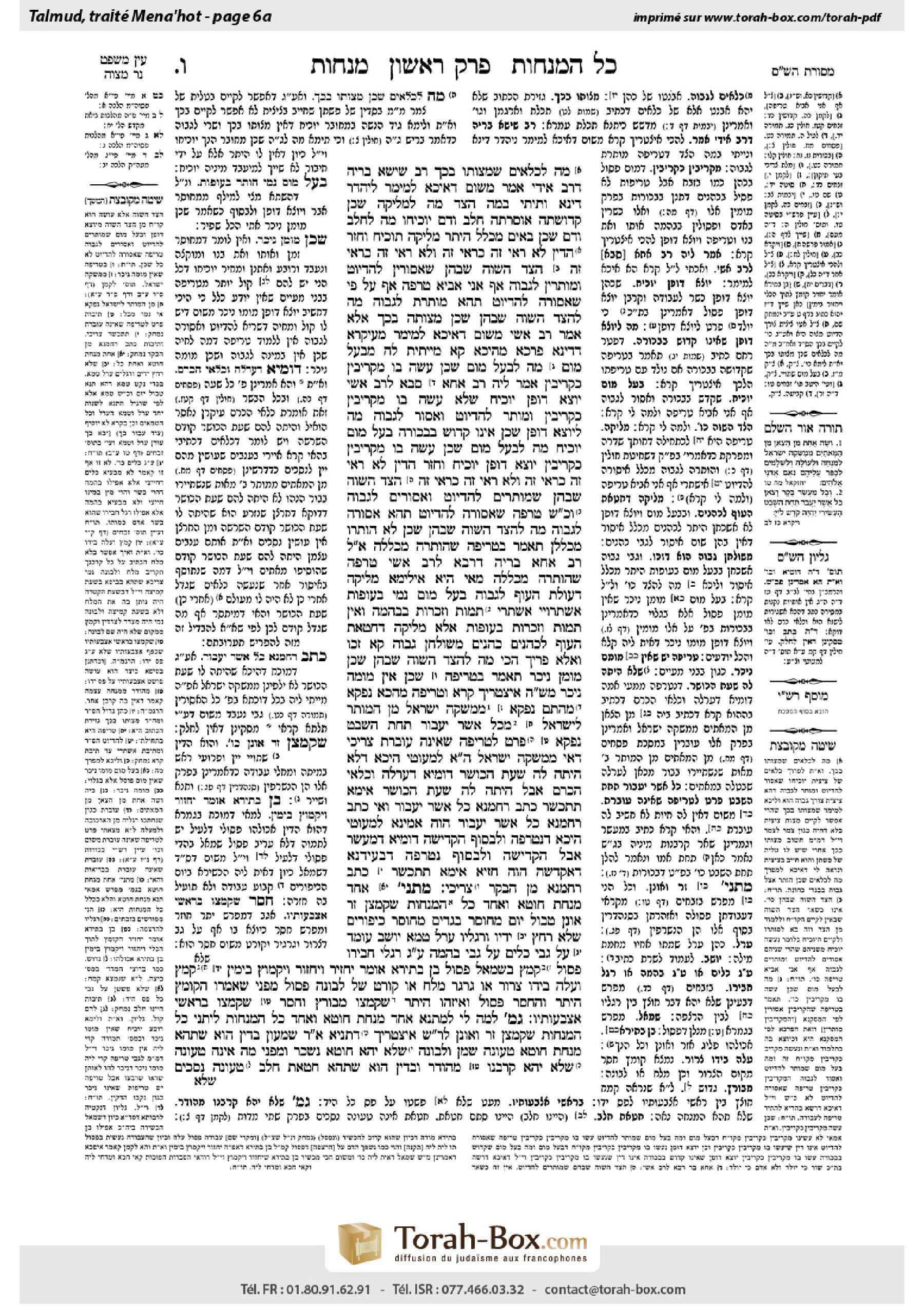
Menachot 6a: Talmud study for Daf Yomi
Daf Yomi is the daily study of one Talmud folio. Explore 37 tractates with scans, Hebrew text, Sefaria English and AI-generated French translations where annotated.
Passage selection and English or AI-generated French translation are available where the scan has annotations. Daf Study is independent of Torah-Box and Sefaria.
Browse Menachot · מנחות · All tractatesMenachot 6a text and translations
This page of Menachot includes the Aramaic text, an English translation and an AI-generated French translation, alongside the scan above.
מנחות ו׳ א · Aramaic and Hebrew text
מָה לְכִלְאַיִם שֶׁמִּצְוָתוֹ בְּכָךְ.
רַב שִׁישָׁא בְּרֵיהּ דְּרַב אִידִי אָמַר: מִשּׁוּם דְּאִיכָּא לְמֵימַר, לִיהְדַּר דִּינָא וְתֵיתֵי בַּ״מָּה הַצַּד״ – מָה לִמְלִיקָה שֶׁכֵּן קְדוּשָּׁתָהּ אוֹסַרְתָּהּ, חֵלֶב וָדָם יוֹכִיחוּ.
מָה לְחֵלֶב וָדָם, שֶׁכֵּן בָּאִים מִכְּלַל הֶיתֵּר – מְלִיקָה תּוֹכִיחַ.
וְחָזַר הַדִּין, לֹא רְאִי זֶה כִרְאִי זֶה וְלֹא רְאִי זֶה כִּרְאִי זֶה, הַצַּד הַשָּׁוֶה שֶׁבָּהֶן שֶׁאֲסוּרִין לַהֶדְיוֹט וּמוּתָּרִין לַגָּבוֹהַּ, אַף אֲנִי אָבִיא טְרֵפָה – אַף עַל פִּי שֶׁאֲסוּרָה לַהֶדְיוֹט תְּהֵא מוּתֶּרֶת לַגָּבוֹהַּ, מָה לְהַצַּד הַשָּׁוֶה שֶׁבָּהֶן שֶׁכֵּן מִצְוָתָהּ בְּכָךְ!
אֶלָּא אָמַר רַב אָשֵׁי, מִשּׁוּם דְּאִיכָּא לְמֵימַר: מֵעִיקָּרָא דְּדִינָא פִּרְכָא, מֵהֵיכָא קָא מַיְיתֵית לַהּ? מִבַּעַל מוּם –
מָה לְבַעַל מוּם, שֶׁכֵּן עָשָׂה בּוֹ מַקְרִיבִין כִּקְרֵיבִין.
אֲמַר לֵיהּ רַב אַחָא סָבָא לְרַב אָשֵׁי: יוֹצֵא דּוֹפֶן יוֹכִיחַ, שֶׁלֹּא עָשָׂה בּוֹ מַקְרִיבִין כִּקְרֵיבִין, וּמוּתָּר לַהֶדְיוֹט וְאָסוּר לַגָּבוֹהַּ.
מָה לְיוֹצֵא דּוֹפֶן, שֶׁכֵּן אֵינוֹ קָדוֹשׁ בִּבְכוֹרָה.
בַּעַל מוּם יוֹכִיחַ, מָה לְבַעַל מוּם שֶׁכֵּן עָשָׂה בּוֹ מַקְרִיבִין כִּקְרֵיבִין, יוֹצֵא דּוֹפֶן יוֹכִיחַ.
וְחָזַר הַדִּין, לֹא רְאִי זֶה כִּרְאִי זֶה וְלֹא רְאִי זֶה כִּרְאִי זֶה, הַצַּד הַשָּׁוֶה שֶׁבָּהֶן שֶׁמּוּתָּרִין לַהֶדְיוֹט וַאֲסוּרִים לַגָּבוֹהַּ, וְכׇל שֶׁכֵּן טְרֵפָה שֶׁאֲסוּרָה לַהֶדְיוֹט תְּהֵא אֲסוּרָה לַגָּבוֹהַּ.
מָה לְהַצַּד הַשָּׁוֶה שֶׁבָּהֶן, שֶׁכֵּן לֹא הוּתְּרוּ מִכְּלָלָן, תֹּאמַר בִּטְרֵיפָה שֶׁהוּתְּרָה מִכְּלָלָהּ.
אֲמַר לֵיהּ רַב אַחָא בְּרֵיהּ דְּרָבָא לְרַב אָשֵׁי: טְרֵפָה שֶׁהוּתְּרָה מִכְּלָלָהּ מַאי הִיא? אִילֵימָא מְלִיקָה דְּעוֹלַת הָעוֹף לַגָּבוֹהַּ, בַּעַל מוּם נָמֵי בְּעוֹפוֹת אִשְׁתְּרוֹיֵי אִשְׁתְּרִי, תַּמּוּת וְזַכְרוּת בַּבְּהֵמָה, וְאֵין תַּמּוּת וְזַכְרוּת בָּעוֹפוֹת!
אֶלָּא, מְלִיקָה דְּחַטַּאת הָעוֹף לַכֹּהֲנִים – כֹּהֲנִים מִשּׁוּלְחַן גָּבוֹהַּ קָא זָכוּ.
וְאֶלָּא פָּרֵיךְ הָכִי: מָה לְהַצַּד הַשָּׁוֶה שֶׁבָּהֶן שֶׁכֵּן מוּמָן נִיכָּר, תֹּאמַר בִּטְרֵיפָה שֶׁכֵּן אֵין מוּמָהּ נִיכָּר! מִשּׁוּם הָכִי אִיצְטְרִיךְ קְרָא.
וּטְרֵיפָה מֵהָכָא נָפְקָא? מֵהָתָם נָפְקָא: ״מִמַּשְׁקֵה יִשְׂרָאֵל״ – מִן הַמּוּתָּר לְיִשְׂרָאֵל!
מִ״כֹּל אֲשֶׁר יַעֲבוֹר תַּחַת הַשָּׁבֶט״ – נָפְקָא, פְּרָט לַטְּרֵיפָה שֶׁאֵינָהּ עוֹבֶרֶת.
צְרִיכִי, דְּאִי מִ״מַּשְׁקֵה יִשְׂרָאֵל״ הֲוָה אָמֵינָא לְמַעוֹטֵי הֵיכָא דְּלֹא הָיְתָה לָהּ שְׁעַת הַכּוֹשֶׁר, דֻּמְיָא דְּעׇרְלָה וְכִלְאֵי הַכֶּרֶם, אֲבָל הָיְתָה לָהּ שְׁעַת הַכּוֹשֶׁר אֵימָא תִּתַּכְשַׁר, כְּתַב רַחֲמָנָא ״כׇּל אֲשֶׁר יַעֲבוֹר״.
וְאִי כְּתַב רַחֲמָנָא ״כׇּל אֲשֶׁר יַעֲבוֹר״, הֲוָה אָמֵינָא לְמַעוֹטֵי הֵיכָא דְּנִטְרְפָה וּלְבַסּוֹף הִקְדִּישָׁהּ, דֻּמְיָא דְּמַעֲשֵׂר. אֲבָל הִקְדִּישָׁהּ וּלְבַסּוֹף נִטְרְפָה, דִּבְעִידָּנָא דְּאַקְדְּשַׁהּ הֲוָה חַזְיָא, אֵימָא תִּתַּכְשַׁר. כְּתַב רַחֲמָנָא ״מִן הַבָּקָר״, צְרִיכִי.
מַתְנִי׳ אֶחָד מִנְחַת חוֹטֵא וְאֶחָד כׇּל הַמְּנָחוֹת, שֶׁקְּמָצָן זָר, אוֹנֵן, טְבוּל יוֹם, מְחוּסַּר בְּגָדִים, מְחוּסַּר כִּיפּוּרִים, שֶׁלֹּא רָחַץ יָדָיו וְרַגְלָיו, עָרֵל, טָמֵא, יוֹשֵׁב, עוֹמֵד עַל גַּבֵּי כֵלִים, עַל גַּבֵּי בְהֵמָה, עַל גַּבֵּי רַגְלֵי חֲבֵירוֹ – פָּסוּל.
קָמַץ בִּשְׂמֹאל – פָּסוּל, בֶּן בְּתִירָא אוֹמֵר: יַחְזִיר וְיַחֲזוֹר וְיִקְמוֹץ בְּיָמִין.
קָמַץ וְעָלָה בְּיָדוֹ צְרוֹר, אוֹ גַרְגֵּר מֶלַח, אוֹ קוֹרֶט שֶׁל לְבוֹנָה – פָּסוּל, מִפְּנֵי שֶׁאָמְרוּ: הַקּוֹמֶץ הַיָּתֵר וְהֶחָסֵר – פָּסוּל. וְאֵיזֶהוּ הַיָּתֵר – שֶׁקְּמָצוֹ מְבוֹרָץ, וְחָסֵר – שֶׁקְּמָצוֹ בְּרָאשֵׁי אֶצְבְּעוֹתָיו.
גְּמָ׳ לְמָה לִי לְמִתְנָא ״אֶחָד מִנְחַת חוֹטֵא וְאֶחָד כׇּל הַמְּנָחוֹת״? לִיתְנֵי ״כׇּל הַמְּנָחוֹת שֶׁקְּמָצָן זָר וְאוֹנֵן״!
לְרַבִּי שִׁמְעוֹן אִיצְטְרִיךְ, דְּתַנְיָא: אָמַר רַבִּי שִׁמְעוֹן: בְּדִין הוּא שֶׁתְּהֵא מִנְחַת חוֹטֵא טְעוּנָה שֶׁמֶן וּלְבוֹנָה, שֶׁלֹּא יְהֵא חוֹטֵא נִשְׂכָּר, וּמִפְּנֵי מָה אֵינָהּ טְעוּנָה? שֶׁלֹּא יְהֵא קׇרְבָּנוֹ מְהוּדָּר, וּבַדִּין הוּא שֶׁתְּהֵא חַטַּאת חֵלֶב טְעוּנָה נְסָכִים,
Menachot 6a · English translation
What is notable about diverse kinds? It is notable in that its mitzva is in this manner, since the belt of the priestly vestments must be sewn from diverse kinds. By contrast, there is no mitzva to sacrifice specifically a tereifa.
Rav Sheisha, son of Rav Idi, said: The halakha that a tereifa is unfit for sacrifice must be derived from the verse, because it can be said: Let this claim be derived by analogy from the common element of two sources, as follows: With regard to the question of the baraita: What is notable about pinching? It is notable in that its sanctity prohibits it, one can respond: Fat and blood prove that this consideration is not enough to reject the a fortiori inference, as these are prohibited before they are sanctified and are nevertheless permitted for the Most High.
Similarly, with regard to the question: What is notable about fat and blood? They are notable in that they come from an item that is generally permitted, i.e., the animal from which they come is itself permitted for consumption, one can reply: Pinching proves that this consideration is insufficient for a rejection of the a fortiori inference, as a bird that was killed by pinching is entirely prohibited for eating, and yet a pinched bird is permitted to the altar.
Rav Sheisha concludes: And accordingly, the inference has reverted to its starting point. The aspect of this case is not like the aspect of that case and the aspect of that case is not like the aspect of this case; their common element is that they are prohibited for consumption to an ordinary person and are nevertheless permitted for the Most High. Therefore, I will also bring the case of a tereifa and say: Even though is it prohibited for consumption to an ordinary person, it should be permitted for the Most High. It is therefore necessary to derive from a verse that a tereifa is unfit for sacrifice. The Gemara rejects this: What is notable about their common element? It is notable in that with regard to fat and blood, and pinching, in both cases its mitzva is performed in this manner.
Rather, Rav Ashi said: It is necessary to derive the halakha of a tereifa from a verse because one can say that the refutation of the a fortiori inference is present from the outset. Rav Ashi elaborates: From where do you wish to derive the halakha that a tereifa is unfit for sacrifice? You wish to derive it from an a fortiori inference from the case of a blemished animal, as a blemished animal is permitted for consumption and prohibited for sacrifice. This is problematic.
Rav Ashi explains: What is notable about a blemished animal? It is notable in that with regard to blemishes the Torah rendered those who sacrifice like that which is sacrificed, i.e., a blemished priest may not sacrifice an offering just as a blemished animal is unfit for sacrifice (see Leviticus, chapter 22). This cannot be said with regard to a tereifa, as a priest with a wound that will cause him to die within twelve months may perform the Temple service. It is therefore necessary to derive from the verse the fact that a tereifa is unfit for sacrifice.
Rav Aḥa Sava said to Rav Ashi: But an animal born by caesarean section proves that this a fortiori inference cannot be rejected based on that consideration, as with regard to it the Torah did not render those who sacrifice like that which is sacrificed, since an animal born by caesarean section is unfit for sacrifice whereas a priest born in such a manner may perform the Temple service. And yet an animal born by caesarean section is permitted for consumption to an ordinary person and prohibited for the Most High. If so, one cannot reject the a fortiori inference because with regard to blemishes the Torah rendered those who sacrifice like that which is sacrificed. Why then is a verse necessary in order to derive that a tereifa is unfit?
Rav Ashi responds: What is notable about an animal born by caesarean section? It is notable in that such an animal is not sanctified with firstborn status, whereas a firstborn animal that was born as a tereifa is sanctified. Accordingly, without the verse one might have concluded that a tereifa may be sacrificed.
Rav Aḥa Sava answers: A blemished animal proves that this is not the decisive consideration, as it does become sanctified with the sanctity of a firstborn, and it too is permitted for consumption and prohibited for the Most High. And if you say: What is notable about a blemished animal? It is notable in that with regard to it the Torah rendered those who sacrifice like that which is sacrificed, one can respond: An animal born by caesarean section proves that this consideration is not decisive, as a priest born by caesarean section may perform the Temple service.
Rav Aḥa Sava concludes: And therefore, the inference has reverted to its starting point. The aspect of this case is not like the aspect of that case and the aspect of that case is not like the aspect of this case; their common element is that they are permitted for consumption to an ordinary person and prohibited for the Most High. And all the more so a tereifa, which is prohibited to an ordinary person, should be prohibited for the Most High. If so, the derivation from a verse is unnecessary.
Rav Ashi refutes the proof of Rav Aḥa Sava: What is notable about their common element? It is notable in that their general prohibition was not permitted, since blemished animals and those born by caesarean section are never permitted for sacrifice. Will you say that the same applies to a tereifa, whose general prohibition was permitted, as will be explained? Accordingly, it is necessary to derive from the verse that a tereifa is unfit for sacrifice.
Rav Aḥa, son of Rava, said to Rav Ashi: This tereifa whose general prohibition was permitted, what is it, i.e., to what case is this referring? If we say that it is referring to the pinching of a bird burnt offering for the Most High, whereby the bird is initially rendered a tereifa at the start of the pinching process, and nevertheless it is sacrificed upon the altar, then the same may be said of a blemished animal as well. As with regard to birds it is permitted to sacrifice a blemished bird. This is in accordance with the halakha that the requirement that an offering must be unblemished and male applies to animal offerings, but there is no requirement that an offering must be unblemished and male in the case of bird offerings.
Rather, this permitting the general prohibition found in the context of a tereifa is referring to the halakha that the pinching of a bird sin offering renders it permitted to the priests for consumption despite the fact that it was not slaughtered by cutting its neck with a knife. This claim can be refuted as well, as the priests receive their portion from the table of the Most High, i.e., they may partake of the sin offering only because it was permitted for sacrifice upon the altar. Accordingly, there is no difference between a tereifa due to pinching and a blemished bird, as both were released from their general prohibition in this regard, since both are permitted for sacrifice upon the altar and both are therefore permitted for consumption by the priests. Consequently, the a fortiori inference remains valid, and the verse is unnecessary.
Rather, refute the a fortiori inference like this: What is notable about their common element? It is notable in that with regard to both a blemished animal and one born by caesarean section their blemish is noticeable, as a blemished animal is visibly blemished and it is well known when an animal is born by caesarean section. Will you say that they can serve as the source of the halakha of a tereifa, whose blemish is not necessarily noticeable? Due to that reason, the verse: “Of the herd” (Leviticus 1:3), was necessary, to teach that a tereifa is unfit for sacrifice.
§ After trying to prove why a derivation from a verse is necessary, the Gemara questions the very source provided by the baraita on 5b for the disqualification of a tereifa, i.e., the verse: “Of the herd” (Leviticus 1:3). But is the halakha that a tereifa is unfit for sacrifice derived from here? It is derived from there, i.e., from the verse: “From the well-watered pastures of Israel” (Ezekiel 45:15), from which it is derived that an offering may be brought only from that which is permitted to the Jewish people.
Alternatively, this halakha can be derived from a verse discussing animal tithe offerings: “Whatever passes under the rod, the tenth shall be holy for the Lord” (Leviticus 27:32). This teaches that all animals may be sacrificed as the animal tithe, excluding a tereifa, as it does not pass under the rod on account of its weakness, and the Sages derived from this the halakha that a tereifa is unfit for any type of offering.
The Gemara responds: All of these verses are necessary, because if the disqualification of a tereifa was derived from the verse “the well-watered pastures of Israel,” I would say that this verse serves to exclude a tereifa only in a case where it did not have a period of fitness, e.g., if it was born a tereifa and was therefore never fit for sacrifice. This is similar to the case of the fruit of a tree during the first three years after its planting [orla] and diverse kinds planted in a vineyard, whose disqualification is derived from this verse. But with regard to a tereifa that had a period of fitness, one might say that it should be fit. Therefore, the Merciful One writes: “Whatever passes under the rod,” to teach that all animals that do not pass under the rod are unfit for sacrifice, even if they were once fit.
The Gemara continues: And if the Merciful One had written only: “Whatever passes under the rod,” I would say that this verse serves to exclude a tereifa only where it was rendered a tereifa and its owner subsequently sanctified it. This is similar to the case of animal tithes, as this verse is teaching that a tereifa cannot be subsequently sanctified as a tithe. But if the owner sanctified it and it was subsequently rendered a tereifa, which means that at the time when it was sanctified it was fit, one might say that it should be fit. Therefore, the Merciful One wrote: “Of the herd,” to teach that even an animal that became a tereifa after it was already sanctified is unfit for sacrifice. Accordingly, all three verses are necessary.
MISHNA: Both the meal offering of a sinner and all other meal offerings with regard to which the one who removed their handful was a non-priest, or a priest who was an acute mourner, i.e., whose relative died and was not yet buried, or a priest who was ritually impure who immersed that day and was waiting for nightfall for the purification process to be completed, or a priest lacking the requisite priestly vestments, or a priest who had not yet brought an atonement offering to complete the purification process, or a priest who did not wash his hands and feet from the water in the Basin prior to performing the Temple service, or an uncircumcised priest, or a ritually impure priest, or a priest who removed the handful while sitting, or while standing not on the floor of the Temple but upon vessels, or upon an animal, or upon the feet of another person; in all these cases the meal offerings are unfit for sacrifice.
If the priest removed the handful with his left hand the meal offering is unfit. Ben Beteira says: He must return the handful to the vessel that contains the meal offering and again remove the handful, this time with his right hand.
If a priest removed the handful of flour, and a stone, a grain of salt, or a pinch [koret] of frankincense emerged in his hand, the meal offering is unfit due to the fact that the Sages said: The handful that is outsized or that is lacking is unfit. The existence of one of these foreign items in the handful means that the requisite measure of flour is lacking. And which is the outsized handful? It is one where he removed the handful overflowing [mevoratz] in a manner in which his fingers do not hold the flour. And which is the lacking handful? It is one where he removed the handful with the tips of his fingers.
GEMARA: The Gemara asks: Why do I need the mishna to teach: Both the meal offering of a sinner and all other meal offerings? Let it teach: All the meal offerings with regard to which the one who removed their handful was a non-priest or an acute mourner. Why does the mishna single out the case of the meal offering of a sinner?
The Gemara responds: It was necessary for the mishna to teach this halakha in this manner in accordance with the opinion of Rabbi Shimon. As it is taught in a baraita that Rabbi Shimon says: By right the meal offering of a sinner should require oil and frankincense like other meal offerings, so that the sinner will not profit. And for what reason does it not require oil and frankincense? So that his offering will not be of superior quality. And likewise, by right the sin offering of forbidden fat, i.e., the offering brought by one who unwittingly ate the forbidden fat of a domesticated animal, should require libations
Menachot 6a · Traduction française (IA)
Qu’y a-t-il de remarquable dans les espèces mélangées ? C’est que leur mitsva s’accomplit de cette manière, puisque la ceinture des vêtements sacerdotaux doit être tissée de matières mélangées. En revanche, il n’y a pas de mitsva d’offrir précisément une tereifa.
Rav Sheisha, fils de Rav Idi, dit : La halakha selon laquelle une tereifa est impropre au sacrifice doit être déduite d’un verset, car on pourrait dire que cette affirmation se déduit par analogie de l’élément commun à deux sources, comme suit : À la question de la baraïta : « Qu’y a-t-il de remarquable dans la mélika ? », on peut répondre : elle est remarquable en ce que sa sainteté la rend interdite. La graisse et le sang montrent que cette considération ne suffit pas à réfuter l’inférence a fortiori, car ils sont interdits avant d’être sanctifiés et sont néanmoins permis pour le Très-Haut.
De même, à la question : « Qu’y a-t-il de remarquable dans la graisse et le sang ? », on peut répondre : ils sont remarquables en ce qu’ils proviennent d’un élément généralement permis, c’est-à-dire que l’animal dont ils proviennent est lui-même permis à la consommation. La mélika montre que cette considération ne suffit pas à réfuter l’inférence a fortiori, car un oiseau tué par mélika est entièrement interdit à la consommation et pourtant, après la mélika, il est permis sur l’autel.
Rav Sheisha conclut : L’inférence revient donc à son point de départ. Le cas de l’un n’est pas semblable à celui de l’autre, et le cas de l’autre n’est pas semblable à celui de l’un ; leur élément commun est qu’ils sont interdits à la consommation à une personne ordinaire et pourtant permis pour le Très-Haut. Je considérerai donc aussi le cas d’une tereifa et dirai : bien qu’elle soit interdite à la consommation à une personne ordinaire, elle devrait être permise pour le Très-Haut. Il est donc nécessaire de déduire d’un verset qu’une tereifa est impropre au sacrifice. La Guemara objecte : Qu’y a-t-il de remarquable dans leur élément commun ? C’est que, dans le cas de la graisse et du sang comme dans celui de la mélika, la mitsva s’accomplit de cette manière.
Rav Ashi dit plutôt : Il est nécessaire de déduire d’un verset la halakha concernant une tereifa, car on peut dire que la réfutation de l’inférence a fortiori s’impose d’emblée. Rav Ashi précise : De quoi souhaitez-vous déduire qu’une tereifa est impropre au sacrifice ? Vous souhaitez le déduire par une inférence a fortiori du cas d’un animal présentant un défaut, puisqu’un tel animal est permis à la consommation et interdit au sacrifice. Cela pose problème.
Rav Ashi explique : Qu’y a-t-il de remarquable dans le cas d’un animal présentant un défaut ? C’est que, pour ce qui est des défauts, la Torah a assimilé ceux qui offrent le sacrifice à ce qui est offert, c’est-à-dire qu’un prêtre présentant un défaut ne peut pas offrir un sacrifice, tout comme un animal présentant un défaut est impropre au sacrifice (voir Lévitique, chapitre 22). Cela ne peut pas être invoqué dans le cas d’une tereifa, car un prêtre atteint d’une blessure qui entraînera sa mort dans les douze mois peut accomplir le service du Temple. Il est donc nécessaire de déduire d’un verset qu’une tereifa est impropre au sacrifice.
Rav Aḥa Sava dit à Rav Ashi : Mais un animal né par césarienne prouve que cette inférence a fortiori ne peut pas être réfutée sur la base de cette considération, car, dans son cas, la Torah n’a pas assimilé ceux qui offrent le sacrifice à ce qui est offert : un animal né par césarienne est impropre au sacrifice, tandis qu’un prêtre né de cette manière peut accomplir le service du Temple. Et pourtant, un animal né par césarienne est permis à la consommation à une personne ordinaire et interdit pour le Très-Haut. On ne peut donc pas réfuter l’inférence a fortiori au motif que, pour les défauts, la Torah a assimilé ceux qui offrent le sacrifice à ce qui est offert. Pourquoi alors faut-il un verset pour déduire qu’une tereifa est impropre au sacrifice ?
Rav Ashi répond : Qu’y a-t-il de remarquable dans le cas d’un animal né par césarienne ? C’est qu’un tel animal n’est pas sanctifié en tant que premier-né, alors qu’un animal premier-né né tereifa est sanctifié. Par conséquent, sans le verset, on aurait pu conclure qu’une tereifa peut être offerte en sacrifice.
Rav Aḥa Sava répond : Un animal présentant un défaut prouve que ce n’est pas là la considération décisive, puisqu’il est bien sanctifié de la sainteté du premier-né et qu’il est lui aussi permis à la consommation et interdit pour le Très-Haut. Et si tu dis : « Qu’y a-t-il de remarquable dans le cas d’un animal présentant un défaut ? C’est que, dans son cas, la Torah a assimilé ceux qui offrent le sacrifice à ce qui est offert », on peut répondre : un animal né par césarienne prouve que cette considération n’est pas décisive, puisqu’un prêtre né par césarienne peut accomplir le service du Temple.
Rav Aḥa Sava conclut : L’inférence revient donc à son point de départ. Le cas de l’un n’est pas semblable à celui de l’autre, et le cas de l’autre n’est pas semblable à celui de l’un ; leur élément commun est qu’ils sont permis à la consommation à une personne ordinaire et interdits pour le Très-Haut. À plus forte raison, une tereifa, qui est interdite à la consommation à une personne ordinaire, devrait être interdite pour le Très-Haut. Si tel est le cas, la déduction à partir d’un verset est inutile.
Rav Ashi réfute la preuve de Rav Aḥa Sava : Qu’y a-t-il de remarquable dans leur élément commun ? C’est que, dans leur cas, l’interdiction générale n’a pas été levée, puisque les animaux présentant un défaut et ceux nés par césarienne ne sont jamais permis au sacrifice. Dirais-tu qu’il en va de même d’une tereifa, dont l’interdiction générale a été levée, comme cela sera expliqué ? Il est donc nécessaire de déduire du verset qu’une tereifa est impropre au sacrifice.
Rav Aḥa, fils de Rava, dit à Rav Ashi : De quelle tereifa dont l’interdiction générale a été levée s’agit-il, c’est-à-dire à quel cas cela fait-il référence ? Si nous disons qu’il s’agit de la mélika d’un oiseau offert en holocauste pour le Très-Haut, par laquelle l’oiseau devient d’abord une tereifa au début du processus de mélika, et qu’il est néanmoins offert sur l’autel, alors on peut en dire autant d’un animal présentant un défaut. En effet, il est permis d’offrir un oiseau présentant un défaut. Cela est conforme à la halakha selon laquelle l’exigence qu’un sacrifice soit sans défaut et mâle s’applique aux sacrifices d’animaux, mais non aux sacrifices d’oiseaux.
Il s’agit plutôt du fait que, dans le contexte d’une tereifa, l’interdiction générale est levée selon la halakha voulant que la mélika d’un oiseau offert en sacrifice expiatoire le rende permis à la consommation pour les prêtres, bien qu’il n’ait pas été abattu en lui tranchant le cou avec un couteau. Cette affirmation peut elle aussi être réfutée, car les prêtres reçoivent leur part de la table du Très-Haut, c’est-à-dire qu’ils ne peuvent consommer le sacrifice expiatoire que parce qu’il a été permis au sacrifice sur l’autel. Par conséquent, il n’y a aucune différence entre une tereifa due à la mélika et un oiseau présentant un défaut, puisque, à cet égard, l’interdiction générale a été levée pour les deux : tous deux sont permis au sacrifice sur l’autel et sont donc permis à la consommation pour les prêtres. L’inférence a fortiori reste donc valable, et le verset est inutile.
Réfutons plutôt l’inférence a fortiori de la manière suivante : Qu’y a-t-il de remarquable dans leur élément commun ? C’est que, dans le cas aussi bien d’un animal présentant un défaut que d’un animal né par césarienne, le défaut est manifeste : l’animal présentant un défaut porte une imperfection visible et l’on sait qu’un animal est né par césarienne. Dirais-tu qu’ils peuvent servir de source pour la halakha concernant une tereifa, dont le défaut n’est pas nécessairement manifeste ? C’est pour cette raison que le verset « Parmi le gros bétail » (Lévitique 1:3) était nécessaire, afin d’enseigner qu’une tereifa est impropre au sacrifice.
§ Après avoir tenté de démontrer pourquoi une déduction à partir d’un verset est nécessaire, la Guemara s’interroge sur la source même donnée par la baraïta en 5b pour exclure une tereifa, à savoir le verset « Parmi le gros bétail » (Lévitique 1:3). Mais la halakha selon laquelle une tereifa est impropre au sacrifice se déduit-elle de là ? Elle se déduit d’ailleurs, c’est-à-dire du verset « des pâturages bien arrosés d’Israël » (Ézéchiel 45:15), d’où l’on déduit qu’un sacrifice ne peut être offert qu’à partir de ce qui est permis au peuple juif.
On peut aussi déduire cette halakha d’un verset portant sur les sacrifices de dîme animale : « Tout ce qui passe sous la verge, le dixième sera consacré à l’Éternel » (Lévitique 27:32). Cela enseigne que tous les animaux peuvent être offerts comme dîme animale, à l’exception d’une tereifa, car, en raison de sa faiblesse, elle ne passe pas sous la verge. Les Sages en ont déduit la halakha selon laquelle une tereifa est impropre à tout type de sacrifice.
La Guemara répond : Tous ces versets sont nécessaires, car si l’exclusion d’une tereifa se déduisait du verset « les pâturages bien arrosés d’Israël », je dirais que ce verset exclut une tereifa seulement dans le cas où elle n’a jamais été apte, par exemple si elle est née tereifa et n’a donc jamais été apte au sacrifice. Cela ressemble au cas du fruit d’un arbre durant les trois premières années suivant sa plantation [orla] et à celui des espèces mélangées plantées dans une vigne, dont l’exclusion se déduit de ce verset. Mais concernant une tereifa qui a connu une période où elle était apte, on pourrait dire qu’elle devrait être apte. C’est pourquoi le Miséricordieux écrit : « Tout ce qui passe sous la verge », pour enseigner que tous les animaux qui ne passent pas sous la verge sont impropres au sacrifice, même s’ils ont été aptes auparavant.
La Guemara poursuit : Et si le Miséricordieux n’avait écrit que « Tout ce qui passe sous la verge », j’aurais dit que ce verset exclut une tereifa seulement lorsqu’elle est devenue tereifa et que son propriétaire l’a ensuite sanctifiée. Cela ressemble au cas de la dîme animale, car ce verset enseigne qu’une tereifa ne peut pas ensuite être sanctifiée comme dîme. Mais si le propriétaire l’a sanctifiée et qu’elle est devenue tereifa par la suite, ce qui signifie qu’elle était apte au moment de sa sanctification, on pourrait dire qu’elle devrait être apte. C’est pourquoi le Miséricordieux a écrit : « Parmi le gros bétail », pour enseigner que même un animal devenu tereifa après avoir déjà été sanctifié est impropre au sacrifice. Les trois versets sont donc nécessaires.
MICHNA : Tant l’offrande de farine d’un pécheur que toutes les autres offrandes de farine sont impropres au sacrifice si celui qui en a prélevé la poignée était un non-prêtre, un prêtre en deuil aigu, c’est-à-dire dont un proche est mort et n’a pas encore été enseveli, un prêtre rituellement impur qui s’est immergé ce jour-là et attend la tombée de la nuit pour que le processus de purification soit achevé, un prêtre dépourvu des vêtements sacerdotaux requis, un prêtre qui n’a pas encore apporté de sacrifice expiatoire pour achever le processus de purification, un prêtre qui ne s’est pas lavé les mains et les pieds avec l’eau du bassin avant d’accomplir le service du Temple, un prêtre incirconcis, un prêtre rituellement impur, ou un prêtre qui a prélevé la poignée en position assise, ou debout ailleurs que sur le sol du Temple, mais sur des récipients, sur un animal ou sur les pieds d’une autre personne.
Si le prêtre a prélevé la poignée de la main gauche, l’offrande de farine est impropre. Ben Beteira dit : Il doit remettre la poignée dans le récipient qui contient l’offrande de farine et la prélever de nouveau, cette fois de la main droite.
Si un prêtre a prélevé la poignée de farine et qu’une pierre, un grain de sel ou une pincée [koret] d’encens se trouve dans sa main, l’offrande de farine est impropre, car les Sages ont dit : une poignée trop grande ou insuffisante est impropre. La présence de l’un de ces éléments étrangers dans la poignée signifie que la mesure requise de farine n’y est pas. Et quelle est la poignée trop grande ? C’est celle qu’il a prélevée en la faisant déborder [mevoratz], de sorte que ses doigts ne retiennent pas la farine. Et quelle est la poignée insuffisante ? C’est celle qu’il a prélevée du bout des doigts.
GUEMARA : La Guemara demande : Pourquoi la Michna doit-elle enseigner : « Tant l’offrande de farine d’un pécheur que toutes les autres offrandes de farine » ? Qu’elle enseigne : « Toutes les offrandes de farine dont celui qui en a prélevé la poignée était un non-prêtre ou un prêtre en deuil aigu. » Pourquoi la Michna distingue-t-elle le cas de l’offrande de farine d’un pécheur ?
La Guemara répond : Il était nécessaire que la Michna enseigne cette halakha de cette manière, conformément à l’opinion de Rabbi Shimon. En effet, il est enseigné dans une baraïta que Rabbi Shimon dit : À juste titre, l’offrande de farine d’un pécheur devrait nécessiter de l’huile et de l’encens, comme les autres offrandes de farine, afin que le pécheur n’en tire pas avantage. Et pour quelle raison ne nécessite-t-elle pas d’huile et d’encens ? Afin que son offrande ne soit pas de qualité supérieure. De même, à juste titre, le sacrifice expiatoire pour consommation de graisse interdite, c’est-à-dire le sacrifice apporté par celui qui a consommé involontairement la graisse interdite d’un animal domestique, devrait nécessiter des libations
Traduction française générée par IA à partir de l’édition anglaise de Sefaria. Vérifie toujours un passage avec le texte source.
Text from Sefaria: William Davidson Edition - Vocalized Aramaic (unknown); William Davidson Edition - English (CC BY NC).