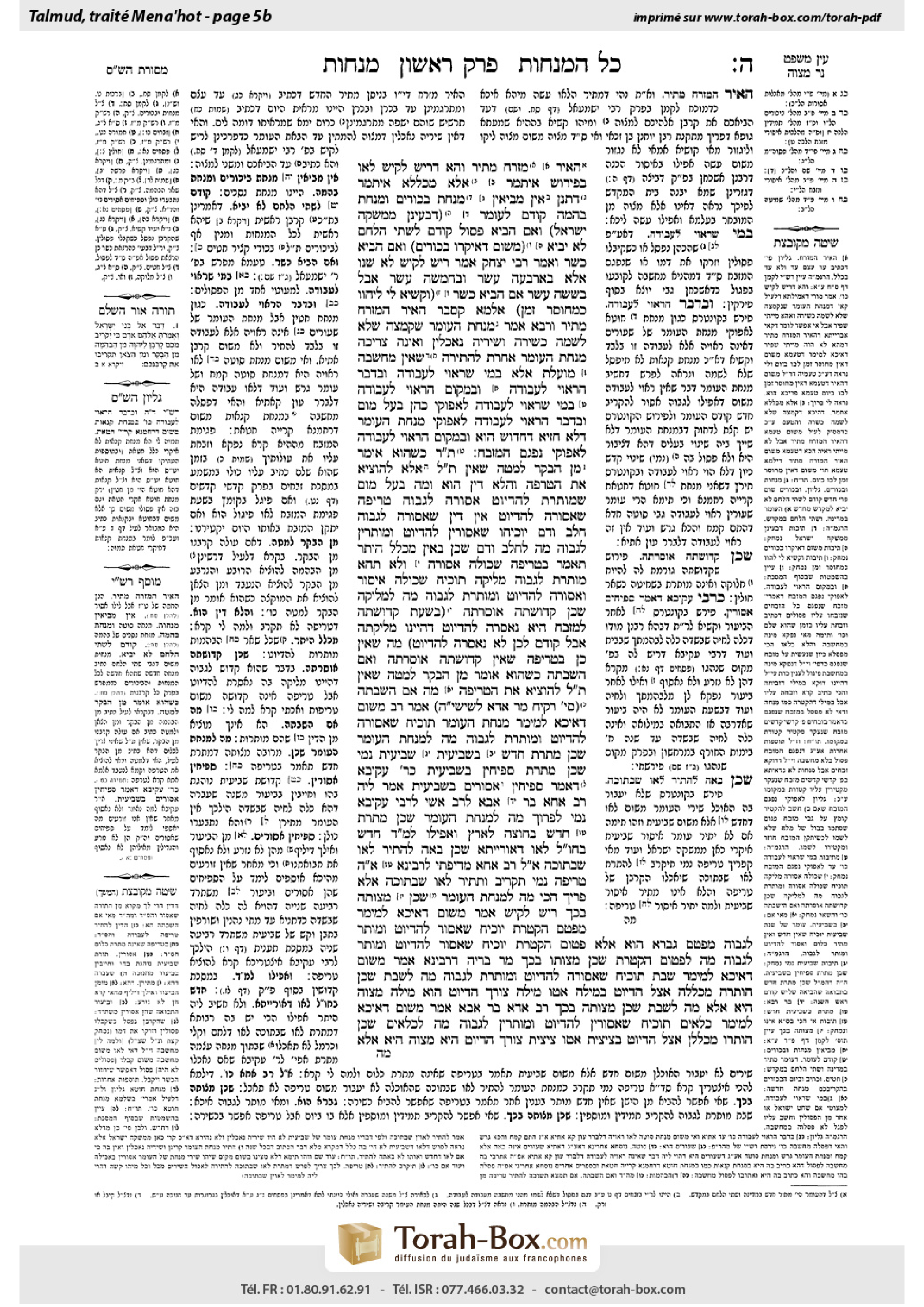
Menachot 5b: Talmud study for Daf Yomi
Daf Yomi is the daily study of one Talmud folio. Explore 37 tractates with scans, Hebrew text, Sefaria English and AI-generated French translations where annotated.
Passage selection and English or AI-generated French translation are available where the scan has annotations. Daf Study is independent of Torah-Box and Sefaria.
Browse Menachot · מנחות · All tractatesMenachot 5b text and translations
This page of Menachot includes the Aramaic text, an English translation and an AI-generated French translation, alongside the scan above.
מנחות ה׳ ב · Aramaic and Hebrew text
הֵאִיר מִזְרָח מַתִּיר.
וְהָא דְּרֵישׁ לָקִישׁ לָאו בְּפֵירוּשׁ אִיתְּמַר, אֶלָּא מִכְּלָלָא אִיתְּמַר, דִּתְנַן: אֵין מְבִיאִין מִנְחַת בִּכּוּרִים וּמִנְחַת בְּהֵמָה קוֹדֶם לָעוֹמֶר, דְּבָעֵינַן ״מִמַּשְׁקֵה יִשְׂרָאֵל״, וְאִם הֵבִיא – פָּסוּל.
קוֹדֶם לִשְׁתֵּי הַלֶּחֶם לֹא יָבִיא, מִשּׁוּם דְּאִיקְּרוּ ״בִּכּוּרִים״, וְאִם הֵבִיא – כָּשֵׁר.
וְאָמַר רַבִּי יִצְחָק אָמַר רֵישׁ לָקִישׁ: לֹא שָׁנוּ אֶלָּא בְּאַרְבָּעָה עָשָׂר וּבַחֲמִשָּׁה עָשָׂר, אֲבָל בְּשִׁשָּׁה עָשָׂר אִם הֵבִיא – כָּשֵׁר, וְקַשְׁיָא לִי: לִיהְווֹ כַּמְחוּסַּר זְמַן! אַלְמָא קָסָבַר הֵאִיר הַמִּזְרָח מַתִּיר.
וְרָבָא אָמַר: מִנְחַת הָעוֹמֶר שֶׁקְּמָצָהּ שֶׁלֹּא לִשְׁמָהּ – כְּשֵׁירָה, וּשְׁיָרֶיהָ נֶאֱכָלִין, וְאֵינָהּ צְרִיכָה מִנְחַת הָעוֹמֶר אַחֶרֶת לְהַתִּירָהּ, שֶׁאֵין מַחְשָׁבָה מוֹעֶלֶת אֶלָּא בְּמִי שֶׁרָאוּי לָעֲבוֹדָה, וּבְדָבָר הָרָאוּי לָעֲבוֹדָה, וּבִמְקוֹם הָרָאוּי לָעֲבוֹדָה.
בְּמִי שֶׁרָאוּי לָעֲבוֹדָה – לְאַפּוֹקֵי כֹּהֵן בַּעַל מוּם, וּבְדָבָר הָרָאוּי לָעֲבוֹדָה – לְאַפּוֹקֵי מִנְחַת הָעוֹמֶר דְּלָא חַזְיָא, דְּחִדּוּשׁ הוּא, וּבִמְקוֹם הָרָאוּי לָעֲבוֹדָה – לְאַפּוֹקֵי נִפְגַּם הַמִּזְבֵּחַ.
תָּנוּ רַבָּנַן: כְּשֶׁהוּא אוֹמֵר ״מִן הַבָּקָר״ לְמַטָּה, שֶׁאֵין תַּלְמוּד לוֹמַר, אֶלָּא לְהוֹצִיא אֶת הַטְּרֵפָה.
וַהֲלֹא דִּין הוּא: וּמָה בַּעַל מוּם שֶׁמּוּתֶּרֶת לַהֶדְיוֹט – אֲסוּרָה לַגָּבוֹהַּ, טְרֵיפָה שֶׁאֲסוּרָה לַהֶדְיוֹט – אֵין דִּין שֶׁאֲסוּרָה לַגָּבוֹהַּ? חֵלֶב וָדָם יוֹכִיחוּ, שֶׁאֲסוּרִין לַהֶדְיוֹט וּמוּתָּרִין לַגָּבוֹהַּ!
מָה לְחֵלֶב וָדָם, שֶׁכֵּן בָּאִין מִכְּלַל הֶיתֵּר, תֹּאמַר בִּטְרֵיפָה שֶׁכּוּלָּהּ אֲסוּרָה, וְלֹא תְּהֵא מוּתֶּרֶת לַגָּבוֹהַּ!
מְלִיקָה תּוֹכִיחַ, שֶׁכּוּלָּהּ אִיסּוּר, וַאֲסוּרָה לַהֶדְיוֹט, וּמוּתֶּרֶת לַגָּבוֹהַּ.
מָה לִמְלִיקָה, שֶׁכֵּן קְדוּשָּׁתָהּ אוֹסַרְתָּהּ, בִּשְׁעַת קְדוּשָּׁתָהּ לַמִּזְבֵּחַ הִיא נֶאֶסְרָה לַהֶדְיוֹט, דְּהַיְינוּ מְלִיקָתָהּ, אֲבָל קוֹדֶם לָכֵן לֹא נֶאֶסְרָה לַהֶדְיוֹט, מַה שֶּׁאֵין כֵּן בִּטְרֵיפָה, שֶׁאֵין קְדוּשָּׁתָהּ אוֹסַרְתָּהּ!
וְאִם הֵשַׁבְתָּה, כְּשֶׁהוּא אוֹמֵר ״מִן הַבָּקָר״ לְמַטָּה, שֶׁאֵין תַּלְמוּד לוֹמַר, לְהוֹצִיא אֶת הַטְּרֵיפָה.
מָה ״אִם הֵשַׁבְתָּה״? (סִימָן: רְקִיחַ, מָר, אַדָּא, לְשֵׁישֵׁיהּ).
אָמַר רַב, מִשּׁוּם דְּאִיכָּא לְמֵימַר: מִנְחַת הָעוֹמֶר תּוֹכִיחַ, שֶׁאֲסוּרָה לַהֶדְיוֹט וּמוּתֶּרֶת לַגָּבוֹהַּ. מָה לְמִנְחַת הָעוֹמֶר, שֶׁכֵּן מַתֶּרֶת חָדָשׁ!
בַּשְּׁבִיעִית – שְׁבִיעִית נָמֵי, שֶׁכֵּן מַתֶּרֶת סְפִיחִין בַּשְּׁבִיעִית, כְּרַבִּי עֲקִיבָא, דְּאָמַר: סְפִיחִין אֲסוּרִים בִּשְׁבִיעִית.
אֲמַר לֵיהּ רַב אַחָא בַּר אַבָּא לְרַב אָשֵׁי: לְרַבִּי עֲקִיבָא נָמֵי לִפְרוֹךְ, מָה לְמִנְחַת הָעוֹמֶר שֶׁכֵּן מַתֶּרֶת חָדָשׁ בְּחוּצָה לָאָרֶץ?
וַאֲפִילּוּ לְמַאן דְּאָמַר: חָדָשׁ בְּחוּץ לָאָרֶץ לָאו דְּאוֹרָיְיתָא, שֶׁכֵּן בָּאָה לְהַתִּיר לָאו שֶׁבְּתוֹכָהּ.
אֲמַר לֵיהּ רַב אַחָא מִדִּיפְתִּי לְרָבִינָא: אִי הָכִי, טְרֵיפָה נָמֵי תִּקְרַב וְתַתִּיר לָאו שֶׁבְּתוֹכָהּ! אֶלָּא פָּרֵיךְ הָכִי: מָה לְמִנְחַת הָעוֹמֶר, שֶׁכֵּן מִצְוָתָהּ בְּכָךְ.
רֵישׁ לָקִישׁ אָמַר: מִשּׁוּם דְּאִיכָּא לְמֵימַר מְפַטֵּם הַקְּטֹרֶת יוֹכִיחַ, שֶׁאָסוּר לַהֶדְיוֹט וּמוּתָּר לַגָּבוֹהַּ. מְפַטֵּם גַּבְרָא הוּא!
אֶלָּא, פִּטּוּם הַקְּטֹרֶת יוֹכִיחַ, שֶׁאָסוּר לַהֶדְיוֹט וּמוּתָּר לַגָּבוֹהַּ. מָה לְפִטּוּם הַקְּטֹרֶת, שֶׁכֵּן מִצְוָתוֹ בְּכָךְ.
מָר בְּרֵיהּ דְּרָבִינָא אָמַר, מִשּׁוּם דְּאִיכָּא לְמֵימַר: שַׁבָּת תּוֹכִיחַ, שֶׁאֲסוּרָה לַהֶדְיוֹט וּמוּתֶּרֶת לַגָּבוֹהַּ.
מָה לְשַׁבָּת, שֶׁכֵּן הוּתְּרָה מִכְּלָלָהּ אֵצֶל הֶדְיוֹט בְּמִילָה!
אַטּוּ מִילָה צוֹרֶךְ הֶדְיוֹט הוּא? מִילָה מִצְוָה הִיא! אֶלָּא, מָה לְשַׁבָּת שֶׁכֵּן מִצְוָתָהּ בְּכָךְ.
רַב אַדָּא בַּר אַבָּא אָמַר: מִשּׁוּם דְּאִיכָּא לְמֵימַר, כִּלְאַיִם תּוֹכִיחַ, שֶׁאֲסוּרִין לַהֶדְיוֹט וּמוּתָּרִין לַגָּבוֹהַּ.
מָה לְכִלְאַיִם, שֶׁכֵּן הוּתְּרוּ מִכְּלָלָן אֵצֶל הֶדְיוֹט בְּצִיצִית? אַטּוּ צִיצִית צוֹרֶךְ הֶדְיוֹט הִיא? מִצְוָה הִיא! אֶלָּא
Menachot 5b · English translation
the illumination of the eastern horizon permits the new crop.
The Gemara notes: And this statement of Reish Lakish was not stated explicitly; rather, it was stated by inference, i.e., it is evident from a different statement of Reish Lakish that this is his opinion. As we learned in a mishna (68b): One may not bring a meal offering, the first fruits, or the meal offering brought with the libations accompanying an animal offering, from the new crop, prior to the sacrifice of the omer. The Gemara interrupts its citation of the mishna to add that the reason is that we require that an offering be “from the well-watered pastures of Israel,” i.e., it must be brought from that which is permitted to the Jewish people, and the new crop has not yet been permitted to them. The mishna concludes: And if he brought these offerings from the new crop they are unfit.
The mishna continues: After the omer but prior to the two loaves one may not bring those offerings from the new crop. The Gemara explains that this is because the two loaves are called first fruits, and therefore they should precede all other offerings from the new crop. The mishna adds: But if he brought those offerings from the new crop, they are fit.
And Rav Yitzḥak says that Reish Lakish says: The Sages taught that a meal offering that was brought from the new crop before the omer meal offering is disqualified only if it was brought on the fourteenth or on the fifteenth of Nisan. But if it was on the sixteenth, then even if he brought it prior to the omer meal offering, it is valid. He continues: And this statement poses a difficulty for me: Why should meal offerings be valid when sacrificed on the sixteenth if they were sacrificed before the omer meal offering? Let them be considered like offerings whose time has not yet arrived. The Gemara comments: Apparently, Reish Lakish holds that the illumination of the eastern horizon permits the new crop.
§ The Gemara previously cited the opinion of Rav that an omer meal offering from which a handful was removed not for its own sake is disqualified. The Gemara also cited the opinion of Reish Lakish that this meal offering is valid but another omer meal offering is necessary to permit the new crop for consumption. And Rava says: With regard to an omer meal offering from which the priest removed a handful not for its own sake, it is valid and its remainder is consumed, and it does not require another omer meal offering to permit it for consumption. The reason is that improper intent is effective [mo’elet] to disqualify an offering only when it is expressed by one who is fit for the Temple service, and with regard to an item that is fit for the Temple service, and in a place that is fit for the Temple service.
Rava elaborates: The condition that improper intent disqualifies only when expressed by one who is fit for the Temple service serves to exclude the intent of a blemished priest, who is disqualified from performing the Temple service. The condition that it disqualifies only when expressed with regard to an item that is fit for the Temple service serves to exclude the omer meal offering, which is generally unfit for the Temple service, as it is a novelty, in that it is brought from barley whereas most meal offerings are brought from wheat. And finally, the condition that it disqualifies only when expressed in a place that is fit for the Temple service serves to exclude sacrificial rites that were performed with improper intent while the altar was damaged. At such a time improper intent does not disqualify an offering, and therefore if the altar is repaired on the same day, the offering may be sacrificed upon the altar.
§ The Gemara discusses the prohibition against sacrificing an item that is prohibited to the Jewish people. The Sages taught in a baraita: It is derived from a passage in the Torah that discusses burnt offerings: “You shall bring your offering from the cattle, even from the herd or from the flock” (Leviticus 1:2), that certain animals are prohibited for sacrifice upon the altar (see Temura 28a). When it states later, in the next verse: “If his offering is a burnt offering of the herd” (Leviticus 1:3), this is difficult, as there is no need for the verse to state this, as it was already written earlier. Rather, this serves to exclude an animal with a wound that will cause it to die within twelve months [tereifa] from being brought as an offering.
The baraita questions the need for this derivation: But could this not be derived through an a fortiori inference? And if a blemished animal, which is permitted to an ordinary person [lehedyot] for consumption, is nevertheless prohibited as an offering for the Most High (see Leviticus 22:19), then certainly with regard to a tereifa, which is forbidden to an ordinary person for consumption (see Exodus 22:30), is it not logical that it is prohibited for the Most High? The baraita responds: Fat [ḥelev] and blood prove that this a fortiori inference is not valid, as they are forbidden to an ordinary person and yet they are permitted for the Most High.
The baraita rejects this suggestion: What is notable about fat and blood? They are notable in that they come from an item that is generally permitted, i.e., the animal from which they come is itself permitted for consumption. Will you say the same with regard to a tereifa, which is entirely forbidden for eating, and therefore should not be permitted for the Most High?
The baraita responds: The pinching of bird offerings will prove that one cannot derive by means of an a fortiori inference that a tereifa is disqualified. As a bird killed by the pinching of its nape is also entirely forbidden, and yet although it is forbidden for consumption to an ordinary person, as it is rendered a carcass, it is nevertheless permitted for the Most High, as bird offerings are killed by the pinching of their napes. The verse is therefore necessary to disqualify a tereifa.
The baraita rejects this suggestion as well: What is notable about pinching? It is notable in that its sanctity prohibits it, i.e., only at the time when it becomes sanctified for the altar does it become prohibited for consumption to an ordinary person, which is at the time of its pinching. But before this time it is not yet prohibited to an ordinary person for consumption. This is not the case with regard to a tereifa, as its sanctity does not prohibit it for consumption, since it is always prohibited to eat it. Accordingly, by logical inference alone one can arrive at the conclusion that a tereifa should not be permitted for the Most High.
The baraita concludes with a statement that will soon be explained: And if you have responded, i.e., if you succeeded in rejecting the a fortiori inference, then when the verse states later: “Of the herd” (Leviticus 1:3), as there is no need for the verse to state this phrase, it serves to exclude a tereifa.
The Gemara asks: What response is alluded to by the statement: If you have responded? The conclusion of the baraita had indicated that the a fortiori inference must be accepted. The Gemara cites several suggestions, for which it provides the following mnemonic: Rekiaḥ, Mar, Adda, Leshisheih. These terms allude to the names of some of the Sages mentioned in the following discussion: Rav; Rabbi Akiva; Rav Aḥa; Mar, son of Ravina; Rav Adda; and Rav Sheisha, son of Rav Idi.
Rav said that this is the response: The halakha that a tereifa is unfit for sacrifice must be derived from a verse because it may be said that the omer meal offering proves that the halakha concerning a tereifa cannot be derived by the a fortiori inference, as the omer is prohibited for consumption to an ordinary person, since it comes from the new crop, and yet it is permitted as an offering for the Most High. The Gemara rejects this suggestion: What is notable about the omer meal offering? It is notable in that the omer renders the new crop permitted for consumption, whereas a tereifa does not render anything permitted.
The Gemara responds: Although the omer meal offering generally renders the new crop permitted, the omer brought during a Sabbatical Year does not render the crop permitted, as it is prohibited to plant during the Sabbatical Year, and consequently there is no new crop for the omer offering to permit. The Gemara counters this suggestion: The omer meal offering brought during a Sabbatical Year also renders something permitted, as it permits produce that grew without being purposely planted [sefiḥin] during the Sabbatical Year. The Gemara responds: Nevertheless, in accordance with the opinion of Rabbi Akiva, who says that sefiḥin are prohibited during the Sabbatical Year, the omer meal offering brought during a Sabbatical Year does not render the new crop permitted for consumption, and yet it is permitted for the Most High. A verse is therefore necessary to derive that a tereifa may not be sacrificed.
Rav Aḥa bar Abba said to Rav Ashi: According to the opinion of Rabbi Akiva as well, let us refute the statement of Rav, as what is notable about the omer meal offering? It is notable in that the omer permits the new crop for consumption outside of Eretz Yisrael, where the prohibitions of the Sabbatical Year do not apply.
And even according to the one who says that the consumption of produce from the new crop grown outside of Eretz Yisrael is not prohibited by Torah law, Rav’s statement can be refuted in another manner: What is notable about the omer meal offering? It is notable in that the omer comes to permit a prohibition that applies to a substance that was previously within it, i.e., the burning upon the altar of a handful from the omer meal offering renders the remainder of the meal offering permitted to the priests, whereas a tereifa is entirely forbidden.
Rav Aḥa of Difti said to Ravina: This is not a refutation, as, if that is so, then with regard to a tereifa as well, you should sacrifice it and you will thereby permit a prohibition that applies to a substance that was previously within it, and its meat will become permitted to the priests for consumption. Therefore, a verse is needed to exclude a tereifa. Rather, one can refute the statement of Rav like this: What is notable about the omer meal offering? It is notable in that its mitzva is in this manner, i.e., the Torah requires the omer meal offering to be brought from the new crop in order to permit the new crop for consumption. By contrast, there is no mitzva to sacrifice specifically a tereifa.
Reish Lakish said that this is the response alluded to at the end of the baraita: The halakha that a tereifa is unfit for sacrifice must be derived from a verse because it can be said that the one who prepares the incense proves that the halakha concerning a tereifa may not be derived by the a fortiori inference, as this is prohibited to an ordinary person, and is nevertheless permitted for the Most High. The Gemara questions the terminology of Reish Lakish: But the one who prepares the incense is a person. How can it be said that a person is prohibited to an ordinary person?
Rather, Reish Lakish meant that the preparation of the incense proves it, as it is prohibited to prepare the incense mixture for use by an ordinary person (see Exodus 30:37), and yet it is permitted to do so for the Most High. The Gemara refutes this claim: What is notable about preparation of the incense? It is notable in that its mitzva is in this manner. By contrast, there is no mitzva to sacrifice specifically a tereifa.
Mar, son of Ravina, said that this is the response of the baraita: The halakha that a tereifa is unfit for sacrifice must be derived from a verse because it can be said that Shabbat proves that the halakha concerning a tereifa cannot be derived by the a fortiori inference, as it is prohibited for an ordinary person to perform labor on Shabbat, and yet the labor involved in the Temple service is permitted on Shabbat for the Most High. Without the verse, one might similarly conclude that a tereifa is permitted for the Most High despite the fact that it is prohibited for consumption.
The Gemara rejects this: What is notable about Shabbat? It is notable in that the general prohibition against labor on Shabbat was permitted with regard to an ordinary person in the case of circumcision, as the mitzva of circumcision must be performed in its proper time, even on Shabbat, despite the fact that the act of circumcision is generally prohibited on Shabbat.
The Gemara asks: Is that to say that circumcision is considered a requirement of an ordinary person, whose performance was exempted from the general prohibition against labor on Shabbat for one’s private needs? Circumcision is a mitzva. Rather, the statement of Mar, son of Ravina, can be refuted like this: What is notable about Shabbat? It is notable in that its mitzva is in this manner, i.e., the Torah requires that offerings be brought on Shabbat. By contrast, there is no mitzva to sacrifice specifically a tereifa.
Rav Adda bar Abba said that this is the response mentioned in the baraita: The halakha that a tereifa is unfit for sacrifice must be derived from a verse because it can be said that the prohibition against diverse kinds proves that the halakha of a tereifa cannot be derived from the a fortiori inference, as it is prohibited for an ordinary person to wear garments sewn from a mixture of diverse kinds (Deuteronomy 22:11), and yet such garments are permitted for the Most High, as the belt of the priestly vestments was fashioned from a mixture of diverse kinds.
The Gemara rejects this: What is notable about the prohibition against diverse kinds? It is notable in that the general prohibition against wearing a garment sewn from diverse kinds was permitted in the case of an ordinary person with regard to ritual fringes, as a string of sky-blue wool must be placed on a four-cornered garment even if that garment is made from linen. The Gemara asks: Is that to say that ritual fringes are considered a requirement of an ordinary person, whose performance was exempted from the general prohibition concerning diverse kinds with regard to one’s private needs? Placing ritual fringes on a garment is a mitzva. Rather, the claim of Rav Adda bar Abba can be refuted like this:
Menachot 5b · Traduction française (IA)
La lueur de l’horizon oriental rend la nouvelle récolte permise.
La Guemara relève : cette déclaration de Reish Lakish n’a pas été formulée explicitement ; elle a plutôt été déduite, c’est-à-dire que l’on voit, à partir d’une autre déclaration de Reish Lakish, que telle est son opinion. En effet, nous avons appris dans une Michna (68b) : On ne peut apporter ni une offrande de farine, ni les prémices, ni l’offrande de farine apportée avec les libations accompagnant un sacrifice animal à partir de la nouvelle récolte avant le sacrifice de l’omer. La Guemara interrompt la citation de la Michna pour ajouter que la raison en est que nous exigeons qu’une offrande provienne « des pâturages bien arrosés d’Israël », c’est-à-dire qu’elle soit apportée à partir de produits permis au peuple juif ; or, la nouvelle récolte ne lui a pas encore été permise. La Michna conclut : Et s’il a apporté ces offrandes à partir de la nouvelle récolte, elles sont invalides.
La Michna poursuit : Après l’omer, mais avant les deux pains, on ne peut apporter ces offrandes à partir de la nouvelle récolte. La Guemara explique que c’est parce que les deux pains sont appelés prémices ; ils doivent donc précéder toutes les autres offrandes provenant de la nouvelle récolte. La Michna ajoute : Mais s’il a apporté ces offrandes à partir de la nouvelle récolte, elles sont valides.
Et Rav Yitzḥak dit au nom de Reish Lakish : Les Sages ont enseigné qu’une offrande de farine apportée à partir de la nouvelle récolte avant l’offrande de farine de l’omer n’est disqualifiée que si elle a été apportée le quatorze ou le quinze Nissan. Mais si elle l’a été le seize, alors, même si elle a été apportée avant l’offrande de farine de l’omer, elle est valide. Il poursuit : Cette déclaration me pose une difficulté : pourquoi les offrandes de farine seraient-elles valides lorsqu’elles sont sacrifiées le seize, si elles l’ont été avant l’offrande de farine de l’omer ? Qu’elles soient considérées comme des offrandes dont le moment n’est pas encore arrivé. La Guemara commente : Apparemment, Reish Lakish estime que la lueur de l’horizon oriental rend la nouvelle récolte permise.
§ La Guemara a précédemment cité l’opinion de Rav selon laquelle une offrande de farine de l’omer dont une poignée a été prélevée avec une intention qui n’était pas la sienne est disqualifiée. Elle a également cité l’opinion de Reish Lakish selon laquelle cette offrande de farine est valide, mais qu’une autre offrande de farine de l’omer est nécessaire pour rendre la nouvelle récolte permise à la consommation. Et Rava dit : À propos d’une offrande de farine de l’omer dont le prêtre a prélevé une poignée avec une intention qui n’était pas la sienne, elle est valide et son reste peut être consommé ; il n’est pas nécessaire d’apporter une autre offrande de farine de l’omer pour la rendre permise à la consommation. La raison en est qu’une intention inadéquate n’a d’effet [mo’elet] pour disqualifier une offrande que lorsqu’elle est exprimée par une personne apte au service du Temple, à propos d’un élément apte au service du Temple, et en un lieu apte au service du Temple.
Rava précise : La condition selon laquelle une intention inadéquate ne disqualifie que lorsqu’elle est exprimée par une personne apte au service du Temple exclut l’intention d’un prêtre atteint d’un défaut physique, qui est inapte à accomplir le service du Temple. La condition selon laquelle elle ne disqualifie que lorsqu’elle porte sur un élément apte au service du Temple exclut l’offrande de farine de l’omer, qui est généralement inapte au service du Temple, car elle constitue une exception : elle est apportée à partir de l’orge, alors que la plupart des offrandes de farine sont apportées à partir du blé. Enfin, la condition selon laquelle elle ne disqualifie que lorsqu’elle est exprimée en un lieu apte au service du Temple exclut les rites sacrificiels accomplis avec une intention inadéquate alors que l’autel était endommagé. À ce moment-là, une intention inadéquate ne disqualifie pas l’offrande ; par conséquent, si l’autel est réparé le même jour, l’offrande peut y être sacrifiée.
§ La Guemara examine l’interdiction de sacrifier un élément interdit au peuple juif. Les Sages ont enseigné dans une baraïta : On déduit d’un passage de la Torah traitant des holocaustes : « Vous apporterez votre offrande parmi le bétail, parmi les bovins ou parmi les ovins » (Lévitique 1:2), que certains animaux ne peuvent être sacrifiés sur l’autel (voir Temoura 28a). Lorsque le verset dit plus loin, au verset suivant : « Si son offrande est un holocauste du gros bétail » (Lévitique 1:3), cela pose une difficulté, car le verset n’a pas besoin de le dire, puisque cela a déjà été écrit précédemment. Cette expression sert plutôt à exclure du statut d’offrande un animal atteint d’une blessure qui entraînera sa mort dans les douze mois [tereifa].
La baraïta interroge sur la nécessité de cette déduction : Ne pourrait-on pas le déduire par un raisonnement a fortiori ? Si un animal atteint d’un défaut physique, dont la consommation est permise à une personne ordinaire [lehedyot], est néanmoins interdit comme offrande au Très-Haut (voir Lévitique 22:19), à plus forte raison une tereifa, dont la consommation est interdite à une personne ordinaire (voir Exode 22:30), ne devrait-elle pas être interdite au Très-Haut ? La baraïta répond : La graisse [ḥelev] et le sang prouvent que ce raisonnement a fortiori n’est pas valable, puisqu’ils sont interdits à une personne ordinaire et pourtant permis au Très-Haut.
La baraïta rejette cette proposition : Qu’ont de particulier la graisse et le sang ? Ils ont ceci de particulier qu’ils proviennent d’un élément généralement permis, c’est-à-dire que l’animal dont ils proviennent est lui-même permis à la consommation. Diriez-vous la même chose d’une tereifa, qui est entièrement interdite à la consommation et ne devrait donc pas être permise au Très-Haut ?
La baraïta répond : La mélika des oiseaux prouve qu’on ne peut pas déduire par un raisonnement a fortiori qu’une tereifa est disqualifiée. Un oiseau tué par la mélika, c’est-à-dire par la section de la nuque, est lui aussi entièrement interdit ; pourtant, bien qu’il soit interdit à la consommation pour une personne ordinaire, puisqu’il devient une nevela, il est permis au Très-Haut, car les offrandes d’oiseaux sont tuées par la mélika. Le verset est donc nécessaire pour disqualifier une tereifa.
La baraïta rejette également cette proposition : Qu’a de particulier la mélika ? Elle a ceci de particulier que c’est sa sainteté qui la rend interdite : elle ne devient interdite à la consommation pour une personne ordinaire qu’au moment où elle est consacrée à l’autel, c’est-à-dire au moment de sa mélika. Avant ce moment, elle n’est pas encore interdite à la consommation pour une personne ordinaire. Il n’en va pas de même d’une tereifa, car sa sainteté ne la rend pas interdite à la consommation, puisqu’elle a toujours été interdite à la consommation. Par conséquent, le seul raisonnement logique permet de conclure qu’une tereifa ne devrait pas être permise au Très-Haut.
La baraïta conclut par une déclaration qui sera bientôt expliquée : Et si tu as répondu, c’est-à-dire si tu as réussi à rejeter le raisonnement a fortiori, alors, lorsque le verset dit plus loin : « Du gros bétail » (Lévitique 1:3), cette expression, dont le verset n’a pas besoin, sert à exclure une tereifa.
La Guemara demande : À quelle réponse la déclaration « si tu as répondu » fait-elle allusion ? La conclusion de la baraïta avait indiqué que le raisonnement a fortiori devait être accepté. La Guemara cite plusieurs propositions, pour lesquelles elle donne le moyen mnémotechnique suivant : Rekiaḥ, Mar, Adda, Leshisheih. Ces termes évoquent les noms de certains Sages mentionnés dans la discussion qui suit : Rav ; Rabbi Akiva ; Rav Aḥa ; Mar, fils de Ravina ; Rav Adda ; et Rav Sheisha, fils de Rav Idi.
Rav dit que voici la réponse : Il faut déduire d’un verset la halakha selon laquelle une tereifa est inapte au sacrifice, car on pourrait dire que l’offrande de farine de l’omer prouve qu’on ne peut pas déduire par le raisonnement a fortiori la halakha concernant une tereifa : l’omer est interdit à la consommation pour une personne ordinaire, puisqu’il provient de la nouvelle récolte, et pourtant il est permis comme offrande au Très-Haut. La Guemara rejette cette proposition : Qu’a de particulier l’offrande de farine de l’omer ? Elle a ceci de particulier que l’omer rend la nouvelle récolte permise à la consommation, alors qu’une tereifa ne rend rien permis.
La Guemara répond : Bien que l’offrande de farine de l’omer rende généralement la nouvelle récolte permise, l’omer apporté pendant une année de chemita ne rend pas la récolte permise, car il est interdit de semer pendant l’année de chemita et, par conséquent, il n’y a pas de nouvelle récolte que l’offrande de l’omer puisse rendre permise. La Guemara objecte : L’offrande de farine de l’omer apportée pendant une année de chemita rend tout de même quelque chose permis, puisqu’elle permet de consommer les produits qui ont poussé sans avoir été semés intentionnellement [sefiḥin] pendant l’année de chemita. La Guemara répond : Néanmoins, selon l’opinion de Rabbi Akiva, qui dit que les sefiḥin sont interdits pendant l’année de chemita, l’offrande de farine de l’omer apportée pendant une année de chemita ne rend pas la nouvelle récolte permise à la consommation, et pourtant elle est permise au Très-Haut. Un verset est donc nécessaire pour déduire qu’une tereifa ne peut pas être sacrifiée.
Rav Aḥa bar Abba dit à Rav Ashi : Même selon l’opinion de Rabbi Akiva, réfutons la déclaration de Rav, car qu’a de particulier l’offrande de farine de l’omer ? Elle a ceci de particulier que l’omer rend la nouvelle récolte permise à la consommation hors d’Erets Israël, où les interdictions de l’année de chemita ne s’appliquent pas.
Et même selon celui qui dit que, selon la Torah, la consommation de produits de la nouvelle récolte cultivés hors d’Erets Israël n’est pas interdite, on peut réfuter autrement la déclaration de Rav : Qu’a de particulier l’offrande de farine de l’omer ? Elle a ceci de particulier que l’omer vient lever une interdiction qui s’applique à une substance qui se trouvait auparavant en son sein : la combustion sur l’autel d’une poignée prélevée sur l’offrande de farine de l’omer rend le reste de l’offrande permis aux prêtres, alors qu’une tereifa est entièrement interdite.
Rav Aḥa de Difti dit à Ravina : Ce n’est pas une réfutation, car, si tel était le cas, à propos d’une tereifa aussi, tu devrais la sacrifier ; tu lèverais ainsi une interdiction qui s’applique à une substance qui se trouvait auparavant en son sein, et sa viande deviendrait permise à la consommation pour les prêtres. Un verset est donc nécessaire pour exclure une tereifa. On peut plutôt réfuter ainsi la déclaration de Rav : Qu’a de particulier l’offrande de farine de l’omer ? Elle a ceci de particulier que sa mitsva consiste en cela, c’est-à-dire que la Torah exige que l’offrande de farine de l’omer soit apportée à partir de la nouvelle récolte afin de rendre celle-ci permise à la consommation. En revanche, il n’y a pas de mitsva de sacrifier précisément une tereifa.
Reish Lakish dit que voici la réponse à laquelle fait allusion la fin de la baraïta : Il faut déduire d’un verset la halakha selon laquelle une tereifa est inapte au sacrifice, car on pourrait dire que celui qui prépare l’encens prouve qu’on ne peut pas déduire par le raisonnement a fortiori la halakha concernant une tereifa : cette préparation est interdite à une personne ordinaire et pourtant permise au Très-Haut. La Guemara interroge sur la formulation de Reish Lakish : Mais celui qui prépare l’encens est une personne. Comment peut-on dire qu’une personne est interdite à une personne ordinaire ?
Reish Lakish voulait plutôt dire que la préparation de l’encens en apporte la preuve, car il est interdit de préparer le mélange d’encens pour l’usage d’une personne ordinaire (voir Exode 30:37), alors qu’il est permis de le faire pour le Très-Haut. La Guemara réfute cette affirmation : Qu’a de particulier la préparation de l’encens ? Elle a ceci de particulier que sa mitsva consiste en cela. En revanche, il n’y a pas de mitsva de sacrifier précisément une tereifa.
Mar, fils de Ravina, dit que voici la réponse de la baraïta : Il faut déduire d’un verset la halakha selon laquelle une tereifa est inapte au sacrifice, car on pourrait dire que Chabbat prouve qu’on ne peut pas déduire par le raisonnement a fortiori la halakha concernant une tereifa : il est interdit à une personne ordinaire d’accomplir un travail pendant Chabbat, alors que le travail lié au service du Temple est permis pendant Chabbat pour le Très-Haut. En l’absence du verset, on pourrait pareillement conclure qu’une tereifa est permise au Très-Haut, bien qu’elle soit interdite à la consommation.
La Guemara rejette cette proposition : Qu’a de particulier Chabbat ? Il a ceci de particulier que l’interdiction générale du travail pendant Chabbat a été levée pour une personne ordinaire dans le cas de la circoncision, car la mitsva de la circoncision doit être accomplie au moment prescrit, même pendant Chabbat, bien que l’acte de circoncision soit généralement interdit pendant Chabbat.
La Guemara demande : Cela signifie-t-il que la circoncision est considérée comme une nécessité d’une personne ordinaire, dont l’accomplissement a été soustrait à l’interdiction générale du travail pendant Chabbat pour les besoins privés ? La circoncision est une mitsva. On peut plutôt réfuter ainsi la déclaration de Mar, fils de Ravina : Qu’a de particulier Chabbat ? Il a ceci de particulier que sa mitsva consiste en cela, c’est-à-dire que la Torah exige que des offrandes soient apportées pendant Chabbat. En revanche, il n’y a pas de mitsva de sacrifier précisément une tereifa.
Rav Adda bar Abba dit que voici la réponse mentionnée dans la baraïta : Il faut déduire d’un verset la halakha selon laquelle une tereifa est inapte au sacrifice, car on pourrait dire que l’interdiction des mélanges d’espèces prouve qu’on ne peut pas déduire par le raisonnement a fortiori la halakha concernant une tereifa : il est interdit à une personne ordinaire de porter des vêtements cousus d’un mélange d’espèces (Deutéronome 22:11), alors que de tels vêtements sont permis au Très-Haut, puisque la ceinture des vêtements sacerdotaux était faite d’un mélange d’espèces.
La Guemara rejette cette proposition : Qu’a de particulier l’interdiction des mélanges d’espèces ? Elle a ceci de particulier que l’interdiction générale de porter un vêtement cousu d’un mélange d’espèces a été levée pour une personne ordinaire dans le cas des franges rituelles, puisqu’un fil de laine bleu ciel doit être placé sur un vêtement à quatre coins, même si ce vêtement est en lin. La Guemara demande : Cela signifie-t-il que les franges rituelles sont considérées comme une nécessité d’une personne ordinaire, dont l’accomplissement a été soustrait à l’interdiction générale des mélanges d’espèces pour les besoins privés ? Placer des franges rituelles sur un vêtement est une mitsva. On peut plutôt réfuter ainsi l’argument de Rav Adda bar Abba :
Traduction française générée par IA à partir de l’édition anglaise de Sefaria. Vérifie toujours un passage avec le texte source.
Text from Sefaria: William Davidson Edition - Vocalized Aramaic (unknown); William Davidson Edition - English (CC BY NC).