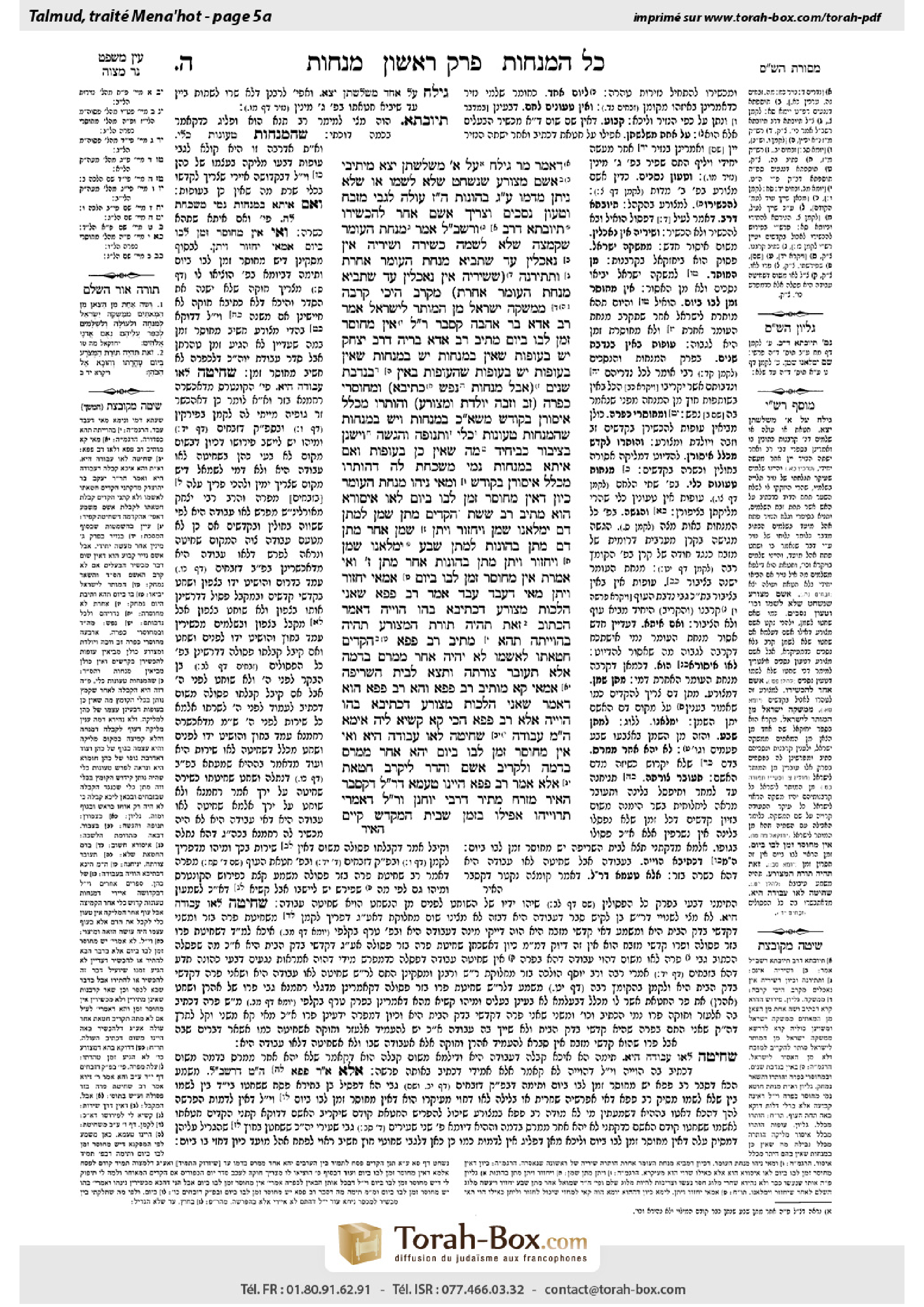
Menachot 5a: Talmud study for Daf Yomi
Daf Yomi is the daily study of one Talmud folio. Explore 37 tractates with scans, Hebrew text, Sefaria English and AI-generated French translations where annotated.
Passage selection and English or AI-generated French translation are available where the scan has annotations. Daf Study is independent of Torah-Box and Sefaria.
Browse Menachot · מנחות · All tractatesMenachot 5a text and translations
This page of Menachot includes the Aramaic text, an English translation and an AI-generated French translation, alongside the scan above.
מנחות ה׳ א · Aramaic and Hebrew text
דְּאָמַר מָר: גִּילַּח עַל אַחַת מִשְּׁלׇשְׁתָּן יָצָא.
מֵיתִיבִי: אָשָׁם מְצוֹרָע שֶׁנִּשְׁחַט שֶׁלֹּא לִשְׁמוֹ, אוֹ שֶׁלֹּא נִיתַּן מִדָּמוֹ עַל גַּבֵּי בְּהוֹנוֹת – הֲרֵי זֶה עוֹלֶה לְגַבֵּי מִזְבֵּחַ, וְטָעוּן נְסָכִים, וְצָרִיךְ אָשָׁם אַחֵר לְהַכְשִׁירוֹ. תְּיוּבְתָּא דְרַב.
וְרַבִּי שִׁמְעוֹן בֶּן לָקִישׁ אָמַר: מִנְחַת הָעוֹמֶר שֶׁקְּמָצָהּ שֶׁלֹּא לִשְׁמָהּ – כְּשֵׁירָה, וּשְׁיָרֶיהָ אֵין נֶאֱכָלִין עַד שֶׁתָּבִיא מִנְחַת הָעוֹמֶר אַחֶרֶת וְתַתִּירֶנָּה.
שֶׁשְּׁיָרֶיהָ אֵין נֶאֱכָלִין עַד שֶׁתָּבִיא מִנְחַת הָעוֹמֶר אַחֶרֶת, מִקְרָב הֵיכִי קָרְבָה? ״מִמַּשְׁקֵה יִשְׂרָאֵל״ – מִן הַמּוּתָּר לְיִשְׂרָאֵל.
אָמַר רַב אַדָּא בַּר אַהֲבָה: קָסָבַר רֵישׁ לָקִישׁ, אֵין מְחוּסָּר זְמַן לְבוֹ בַּיּוֹם.
מֵתִיב רַב אַדָּא בְּרֵיהּ דְּרַב יִצְחָק: יֵשׁ בָּעוֹפוֹת שֶׁאֵין בַּמְּנָחוֹת, יֵשׁ בַּמְּנָחוֹת שֶׁאֵין בָּעוֹפוֹת. יֵשׁ בָּעוֹפוֹת – שֶׁהָעוֹפוֹת בָּאִין בְּנִדְבַת שְׁנַיִם, אֲבָל מְנָחוֹת ״נֶפֶשׁ״ כְּתִיבָא.
וּמְחוּסְּרֵי כַפָּרָה: זָב, וְזָבָה, יוֹלֶדֶת, וּמְצוֹרָע.
וְהוּתְּרוּ מִכְּלַל אִיסּוּרָן בַּקּוֹדֶשׁ, מַה שֶּׁאֵין כֵּן בַּמְּנָחוֹת.
וְיֵשׁ בַּמְּנָחוֹת – שֶׁהַמְּנָחוֹת טְעוּנוֹת כְּלִי, וּתְנוּפָה וְהַגָּשָׁה, וְיֶשְׁנָן בַּצִּיבּוּר כְּבַיָּחִיד, מַה שֶּׁאֵין כֵּן בָּעוֹפוֹת.
וְאִם אִיתָא, בִּמְנָחוֹת נָמֵי מַשְׁכַּחַתְּ לַהּ, דְּהוּתְּרוּ מִכְּלַל אִיסּוּרָן בַּקּוֹדֶשׁ, וּמַאי נִיהוּ? מִנְחַת הָעוֹמֶר.
כֵּיוָן דְּאֵין מְחוּסַּר זְמַן לְבוֹ בַּיּוֹם, לָאו אִיסּוּרָא הוּא.
מֵתִיב רַב שֵׁשֶׁת: הִקְדִּים מַתַּן שֶׁמֶן לְמַתַּן דָּם – יְמַלְּאֶנּוּ שֶׁמֶן וְיַחֲזוֹר וְיִתֵּן שֶׁמֶן אַחַר מַתַּן דָּם, מַתַּן בְּהוֹנוֹת לְמַתַּן שֶׁבַע – יְמַלְּאֶנּוּ שֶׁמֶן וְיַחֲזוֹר וְיִתֵּן מַתַּן בְּהוֹנוֹת אַחַר מַתַּן שֶׁבַע.
וְאִי אָמְרַתְּ אֵין מְחוּסַּר זְמַן לְבוֹ בַּיּוֹם, אַמַּאי יַחְזוֹר וְיִתֵּן? מַאי דַּעֲבַד עֲבַד!
אָמַר רַב פָּפָּא: שָׁאנֵי הִלְכוֹת מְצוֹרָע, דִּכְתִיבָא בְּהוּ הֲוָיָיה, דְּאָמַר הַכָּתוּב: ״זֹאת תִּהְיֶה תּוֹרַת הַמְּצוֹרָע״, ״תִּהְיֶה״ – בַּהֲוָיָיתָהּ תְּהֵא.
מֵתִיב רַב פָּפָּא: הִקְדִּים חַטָּאתוֹ לַאֲשָׁמוֹ – לֹא יִהְיֶה אַחֵר מְמָרֵס בְּדָמָהּ, אֶלָּא תְּעוּבַּר צוּרָתָהּ וְתֵצֵא לְבֵית הַשְּׂרֵיפָה.
אַמַּאי קָא מוֹתֵיב רַב פָּפָּא? וְהָא רַב פָּפָּא הוּא דְּאָמַר: שָׁאנֵי הִלְכוֹת מְצוֹרָע, דִּכְתִיבָא בְּהוּ הֲוָיָיה! אֶלָּא רַב פָּפָּא הָכִי קָא קַשְׁיָא לֵיהּ: אֵימָא הָנֵי מִילֵּי עֲבוֹדָה, שְׁחִיטָה לָאו עֲבוֹדָה הִיא, וְאִי אֵין מְחוּסַּר זְמַן לְבוֹ בַּיּוֹם – יְהֵא אַחֵר מְמָרֵס בְּדָמָהּ, וְלַקְרֵיב אָשָׁם, וַהֲדַר לַיקְרֵב חַטָּאת!
אֶלָּא אָמַר רַב פָּפָּא: הַיְינוּ טַעְמָא דְּרֵישׁ לָקִישׁ, דְּקָסָבַר הֵאִיר מִזְרָח מַתִּיר, דְּרַבִּי יוֹחָנָן וְרֵישׁ לָקִישׁ דְּאָמְרִי תַּרְוַיְיהוּ: אֲפִילּוּ בִּזְמַן שֶׁבֵּית הַמִּקְדָּשׁ קַיָּים,
Menachot 5a · English translation
as the Master said about the nazirite (Nazir 45a): And if he shaved after the sacrifice of any one of the three of them, i.e., after sacrificing his sin offering, burnt offering, or peace offering, he has fulfilled his obligation after the fact, i.e., he has successfully completed his term of naziriteship. Accordingly, there is no specific offering that renders him fit.
The Gemara raises an objection from a baraita: With regard to the guilt offering of a leper that was slaughtered not for its own sake, or if none of its blood was placed on the leper’s right thumb and big toe, this guilt offering is offered up upon the altar and it requires libations, in accordance with the halakha of the guilt offering of a leper. But the leper must nevertheless bring another guilt offering to render him fit to partake of offerings. This baraita is a conclusive refutation of the statement of Rav, who said that the guilt offering of a leper that was slaughtered not for its own sake is entirely disqualified because it did not render the leper fit.
§ The Gemara returns to its discussion concerning the omer meal offering. And Rabbi Shimon ben Lakish says, with regard to an omer meal offering from which a priest removed a handful not for its own sake, that it is valid and the handful is burned on the altar. But its remainder may not be consumed by the priests until a priest brings another omer meal offering on the same day and thereby permits the first offering for consumption, as the prohibition against consuming the new crop remains in effect.
The Gemara asks: But if its remainder may not be consumed by the priests until they bring another omer meal offering, how can the handful removed from this omer meal offering be sacrificed upon the altar? Before the omer meal offering is sacrificed, the new crop is forbidden for consumption, and the verse states: “From the well-watered pastures of Israel; for a meal offering, and for a burnt offering, and for peace offerings” (Ezekiel 45:15), from which it is derived that one may sacrifice only from that which is permitted to the Jewish people.
Rav Adda bar Ahava said in response: Reish Lakish holds that an offering is not considered one whose time has not yet arrived if it is to be brought on that day. Accordingly, since the new crop will be permitted for consumption on the same day that this handful was removed from the omer meal offering, it is already considered fit to be sacrificed upon the altar.
Rav Adda, son of Rav Yitzḥak, raises an objection to Rav Adda bar Ahava’s explanation from a baraita: There is a halakha that applies to birds that does not apply to meal offerings, and there is a halakha that applies to meal offerings that does not apply to birds. The baraita elaborates: There is a halakha that applies to birds that does not apply to meal offerings, as birds may be brought as a gift offering on behalf of two people, i.e., two people may take a vow to bring a single bird offering jointly. But with regard to meal offerings it is written: “And when one brings a meal offering” (Leviticus 2:1), indicating that only individuals may vow to bring a meal offering.
The baraita continues: And another halakha that applies to birds but not meal offerings involves one who has not yet brought his atonement offering, i.e., a man who experienced a gonorrhea-like discharge [zav], or woman who experienced a discharge of uterine blood after her menstrual period [zava], or a woman after childbirth, or a leper, all of whom must bring an offering to complete their atonement process. They bring a bird offering, not a meal offering.
And furthermore, with regard to birds, their general prohibition was permitted when they are consecrated, i.e., killing a non-sacred bird by pinching the nape of its neck renders it a carcass, whose consumption is prohibited, and yet pinching the nape of a bird offering enables it to be sacrificed upon the altar and permits it for consumption, which is not so with regard to meal offerings, i.e., there is no prohibition that applies to the non-consecrated ingredients of a meal offering that does not apply to actual meal offerings as well.
The baraita continues: And there is a halakha that applies to meal offerings that does not apply to birds. As meal offerings require placement in a service vessel, and they require waving and bringing, i.e., they must be brought to the corner of the altar prior to removal of the handful. And lastly, there are meal offerings of the community just as there are meal offerings of individuals, e.g., the omer meal offering is a communal meal offering, which is not so with regard to birds. Bird offerings do not require the use of service vessels, they do not require waving or bringing, and there are no communal bird offerings.
Rav Adda, son of Rav Yitzḥak, explains his objection: And if it is so that a handful that was removed from an omer meal offering not for its own sake is fit for burning upon the altar, then with regard to meal offerings as well, you find that their general prohibition was permitted when they are consecrated. And what is this meal offering that was permitted? It is the omer meal offering from which a handful was removed not for its own sake, as although the new crop remains prohibited to the Jewish people until another omer meal offering is brought, the handful of this meal offering may be sacrificed upon the altar.
The Gemara answers: Since an offering is not considered one whose time has not yet arrived if it is to be brought on that day, the sacrificing of that handful is not a prohibition that was permitted. Instead, it was initially fit for sacrifice upon the altar, as though another omer meal offering had already been brought to permit it.
Rav Sheshet raises an objection from a baraita that discusses the ritual purification of a leper: If the priest performed the placement of oil on the leper’s right thumb and big toe before the placement of blood from the leper’s guilt offering on the leper’s right thumb and big toe, i.e., his actions were in the opposite order from those prescribed in the Torah (see Leviticus 14:14–17), he fills the vessel that holds a log of oil and he then puts oil on the leper’s right thumb and big toe again after the placement of blood. If the priest performed the placement of oil on the leper’s right thumb and big toe before the placement of seven sprinklings of oil before the Lord, he fills the vessel that holds a log of oil and he again puts oil on the leper’s right thumb and big toe after the placement of seven sprinklings.
Rav Sheshet explains his objection: And if you say that an offering is not considered as one whose time has not yet arrived if it is to be brought on that day, then why should the priest place the oil on the leper’s right thumb and big toe again? What he performed, he already performed, i.e., since the oil was going to be placed on the leper’s right thumb and big toe on that day, the placement should be valid even when done out of order.
Rav Pappa said in response: The halakhot of a leper are different, as it is written concerning them an expression of being, as the verse states: “This shall be the law of the leper” (Leviticus 14:2). The term “shall be” indicates that it shall be as it is, i.e., the purification process of a leper must be performed in accordance with the precise order prescribed in the Torah.
Rav Pappa raises an objection from a baraita: If the priest performed the slaughter of a leper’s sin offering before the slaughter of his guilt offering, i.e., the priest’s actions were in the opposite order from those prescribed in the Torah (see Leviticus 14:13–19), there should not be another priest stirring the blood of the leper’s sin offering to prevent it from congealing in order that his guilt offering may be slaughtered and its blood sprinkled before the blood of his sin offering. Rather, the sin offering is left until its form decays, i.e., until the next morning, at which point it is definitively disqualified due to remaining in the Temple overnight and can be taken out to the place designated for burning. The objection is as follows: If an offering that is to be brought on that day is not considered one whose time has not yet arrived, why must this sin offering be left to decay? It should be considered as though it was slaughtered after the guilt offering.
The Gemara asks: Why does Rav Pappa raise this objection? But isn’t it Rav Pappa himself who said: The halakhot of a leper are different, as it is written concerning them an expression of being, which indicates that the order of slaughter of a leper’s offerings must be preserved? Rather, this is what is difficult to Rav Pappa from the baraita: You can say that this statement, the halakha that the order is indispensable to the purification process of a leper, applies only to a sacrificial rite, whereas the act of slaughter is not considered a rite. And if an offering is not considered one whose time has not yet arrived if it is to be brought on that day, then another priest should be stirring the blood of the leper’s sin offering to prevent it from congealing, and a priest should sacrifice the guilt offering and present its blood in the meantime, and afterward he should sacrifice the sin offering.
Rather, Rav Pappa said: This is the reason of Reish Lakish, who said that the handful of an omer meal offering that was removed not for its own sake is valid and may be burned upon the altar: It is that he holds that the illumination of the eastern horizon on the morning of the sixteenth of Nisan permits the new crop to the Jewish people even before the omer meal offering is sacrificed, as Rabbi Yoḥanan and Reish Lakish both say: Even when the Temple is standing,
Menachot 5a · Traduction française (IA)
comme l’a dit le Maître au sujet du nazir (Nazir 45a) : s’il s’est rasé après avoir offert l’une des trois offrandes, c’est-à-dire son sacrifice expiatoire, son holocauste ou son sacrifice de paix, il s’est acquitté de son obligation a posteriori, autrement dit, il a achevé son naziréat. Par conséquent, aucune offrande particulière ne le rend apte.
La Guemara soulève une objection à partir d’une baraïta : si le sacrifice de culpabilité d’un lépreux a été égorgé sans l’intention requise, ou si aucun de son sang n’a été appliqué sur le pouce et le gros orteil droits du lépreux, ce sacrifice de culpabilité est offert sur l’autel et requiert des libations, conformément à la halakha du sacrifice de culpabilité d’un lépreux. Mais le lépreux doit néanmoins apporter un autre sacrifice de culpabilité pour être autorisé à prendre part aux sacrifices. Cette baraïta réfute donc de manière décisive l’affirmation de Rav, selon laquelle le sacrifice de culpabilité d’un lépreux égorgé sans l’intention requise est entièrement invalidé, puisqu’il n’a pas rendu le lépreux apte.
§ La Guemara revient à sa discussion sur l’offrande de farine de l’omer. Rabbi Shimon ben Lakish dit que si un prêtre a prélevé une poignée d’une offrande de farine de l’omer sans l’intention requise, celle-ci est valide et la poignée est brûlée sur l’autel. Mais les prêtres ne peuvent pas consommer le reste avant qu’un prêtre apporte une autre offrande de farine de l’omer le même jour, laquelle autorise alors la consommation de la première offrande, car l’interdiction de consommer la nouvelle récolte reste en vigueur.
La Guemara demande : Mais si les prêtres ne peuvent consommer le reste avant qu’une autre offrande de farine de l’omer soit apportée, comment la poignée prélevée de cette offrande peut-elle être sacrifiée sur l’autel ? Avant que l’offrande de farine de l’omer ne soit sacrifiée, la nouvelle récolte est interdite à la consommation, et le verset dit : « Des pâturages bien arrosés d’Israël, pour une offrande de farine, un holocauste et des sacrifices de paix » (Ézéchiel 45:15). On en déduit qu’on ne peut sacrifier que ce qui est permis au peuple juif.
Rav Adda bar Ahava répondit : Reish Lakish considère qu’une offrande n’est pas considérée comme une offrande dont le moment n’est pas encore venu lorsqu’elle doit être apportée ce jour-là. Par conséquent, puisque la nouvelle récolte sera autorisée à la consommation le jour même où cette poignée a été prélevée de l’offrande de farine de l’omer, elle est déjà considérée comme apte à être sacrifiée sur l’autel.
Rav Adda, fils de Rav Yitzḥak, soulève une objection contre l’explication de Rav Adda bar Ahava à partir d’une baraïta : il existe une halakha qui s’applique aux offrandes d’oiseaux mais pas aux offrandes de farine, et une halakha qui s’applique aux offrandes de farine mais pas aux offrandes d’oiseaux. La baraïta précise : une halakha qui s’applique aux offrandes d’oiseaux mais pas aux offrandes de farine est que des oiseaux peuvent être apportés en offrande volontaire pour deux personnes, c’est-à-dire que deux personnes peuvent faire ensemble le vœu d’apporter une seule offrande d’oiseau. En revanche, à propos des offrandes de farine, il est écrit : « Lorsqu’une personne apporte une offrande de farine » (Lévitique 2:1), ce qui indique que seuls des individus peuvent faire le vœu d’apporter une offrande de farine.
La baraïta poursuit : une autre halakha qui s’applique aux offrandes d’oiseaux mais pas aux offrandes de farine concerne celui qui n’a pas encore apporté son offrande d’expiation, à savoir un homme qui a eu un écoulement semblable à la gonorrhée [zav], une femme qui a eu un écoulement de sang utérin après ses règles [zava], une femme après un accouchement ou un lépreux : tous doivent apporter une offrande pour achever leur processus d’expiation. Ils apportent une offrande d’oiseau, et non une offrande de farine.
En outre, dans le cas des offrandes d’oiseaux, une interdiction qui s’applique normalement aux oiseaux est levée lorsqu’ils sont consacrés : pincer la nuque d’un oiseau non consacré le rend charogne, et sa consommation est alors interdite ; pourtant, pincer la nuque d’un oiseau offert permet de le sacrifier sur l’autel et autorise sa consommation. Il n’en va pas ainsi pour les offrandes de farine : aucune interdiction ne s’applique aux ingrédients non consacrés d’une offrande de farine sans s’appliquer également aux offrandes de farine proprement dites.
La baraïta poursuit : il existe une halakha qui s’applique aux offrandes de farine mais pas aux offrandes d’oiseaux. Les offrandes de farine doivent être placées dans un ustensile de service, et elles requièrent le balancement et la présentation, c’est-à-dire qu’elles doivent être apportées à l’angle de l’autel avant le prélèvement de la poignée. Enfin, il existe des offrandes de farine communautaires, tout comme des offrandes de farine individuelles ; par exemple, l’offrande de farine de l’omer est une offrande communautaire, contrairement aux offrandes d’oiseaux. Les offrandes d’oiseaux ne requièrent pas d’ustensile de service, ni le balancement ni la présentation, et il n’existe pas d’offrandes communautaires d’oiseaux.
Rav Adda, fils de Rav Yitzḥak, explicite son objection : s’il en est ainsi, et qu’une poignée prélevée d’une offrande de farine de l’omer sans l’intention requise peut être brûlée sur l’autel, on trouve alors aussi, pour les offrandes de farine, qu’une interdiction qui s’applique normalement à celles-ci est levée lorsqu’elles sont consacrées. Et quelle est cette offrande de farine dont l’interdiction est levée ? C’est l’offrande de farine de l’omer dont une poignée a été prélevée sans l’intention requise : bien que la nouvelle récolte reste interdite au peuple juif jusqu’à ce qu’une autre offrande de farine de l’omer soit apportée, la poignée de cette offrande peut être sacrifiée sur l’autel.
La Guemara répond : puisqu’une offrande n’est pas considérée comme une offrande dont le moment n’est pas encore venu lorsqu’elle doit être apportée ce jour-là, le sacrifice de cette poignée ne constitue pas une interdiction qui a été levée. Au contraire, elle était dès le départ apte à être sacrifiée sur l’autel, comme si une autre offrande de farine de l’omer avait déjà été apportée pour autoriser la nouvelle récolte.
Rav Sheshet soulève une objection à partir d’une baraïta qui traite de la purification rituelle d’un lépreux : si le prêtre a appliqué l’huile sur le pouce et le gros orteil droits du lépreux avant d’y appliquer le sang de son sacrifice de culpabilité, c’est-à-dire s’il a accompli les gestes dans l’ordre inverse de celui prescrit par la Torah (voir Lévitique 14:14–17), il remplit le récipient contenant un log d’huile, puis applique de nouveau l’huile sur le pouce et le gros orteil droits du lépreux après l’application du sang. Si le prêtre a appliqué l’huile sur le pouce et le gros orteil droits du lépreux avant les sept aspersions d’huile devant l’Éternel, il remplit le récipient contenant un log d’huile et applique de nouveau l’huile sur le pouce et le gros orteil droits du lépreux après les sept aspersions.
Rav Sheshet explicite son objection : si tu dis qu’une offrande n’est pas considérée comme une offrande dont le moment n’est pas encore venu lorsqu’elle doit être apportée ce jour-là, pourquoi le prêtre doit-il appliquer de nouveau l’huile sur le pouce et le gros orteil droits du lépreux ? Ce qu’il a fait est fait : puisque l’huile devait être appliquée sur le pouce et le gros orteil droits du lépreux ce jour-là, l’application devrait être valide même si elle a été faite dans le désordre.
Rav Pappa répondit : les halakhot concernant le lépreux sont différentes, car le texte emploie à leur sujet une expression indiquant l’être, comme le dit le verset : « Telle sera la loi du lépreux » (Lévitique 14:2). L’expression « sera » indique que la procédure doit rester telle qu’elle est prescrite : le processus de purification du lépreux doit être accompli dans l’ordre exact fixé par la Torah.
Rav Pappa soulève une objection à partir d’une baraïta : si le prêtre a égorgé le sacrifice expiatoire du lépreux avant son sacrifice de culpabilité, c’est-à-dire s’il a accompli les gestes dans l’ordre inverse de celui prescrit par la Torah (voir Lévitique 14:13–19), un autre prêtre ne devrait pas remuer le sang du sacrifice expiatoire du lépreux pour l’empêcher de coaguler, afin que son sacrifice de culpabilité puisse être égorgé et que son sang soit aspergé avant le sang de son sacrifice expiatoire. Au contraire, on laisse le sacrifice expiatoire jusqu’à ce que sa forme se détériore, c’est-à-dire jusqu’au lendemain matin ; il est alors définitivement invalidé parce qu’il est resté toute la nuit dans le Temple, et peut être emporté à l’endroit désigné pour la combustion. L’objection est la suivante : si une offrande destinée à être apportée ce jour-là n’est pas considérée comme une offrande dont le moment n’est pas encore venu, pourquoi faut-il laisser ce sacrifice expiatoire se détériorer ? Il devrait être considéré comme s’il avait été égorgé après le sacrifice de culpabilité.
La Guemara demande : pourquoi Rav Pappa soulève-t-il cette objection ? N’est-ce pas Rav Pappa lui-même qui a dit que les halakhot concernant le lépreux sont différentes, car le texte emploie à leur sujet une expression indiquant l’être, ce qui signifie que l’ordre d’égorgement des offrandes du lépreux doit être respecté ? En réalité, voici ce qui pose difficulté à Rav Pappa dans la baraïta : on peut dire que cette affirmation, selon laquelle l’ordre est indispensable au processus de purification du lépreux, ne s’applique qu’à un rite sacrificiel, tandis que l’égorgement n’est pas considéré comme un rite. Et si une offrande n’est pas considérée comme une offrande dont le moment n’est pas encore venu lorsqu’elle doit être apportée ce jour-là, un autre prêtre devrait remuer le sang du sacrifice expiatoire du lépreux pour l’empêcher de coaguler ; un prêtre devrait entre-temps offrir le sacrifice de culpabilité et en présenter le sang, puis offrir le sacrifice expiatoire.
En réalité, Rav Pappa a dit : voici la raison de Reish Lakish, qui a déclaré que la poignée d’une offrande de farine de l’omer, prélevée sans l’intention requise, est valide et peut être brûlée sur l’autel : il considère que la lueur de l’horizon oriental, le matin du seize Nissan, autorise la nouvelle récolte au peuple juif avant même que l’offrande de farine de l’omer ne soit sacrifiée, car Rabbi Yoḥanan et Reish Lakish disent tous deux : même lorsque le Temple est debout,
Traduction française générée par IA à partir de l’édition anglaise de Sefaria. Vérifie toujours un passage avec le texte source.
Text from Sefaria: William Davidson Edition - Vocalized Aramaic (unknown); William Davidson Edition - English (CC BY NC).