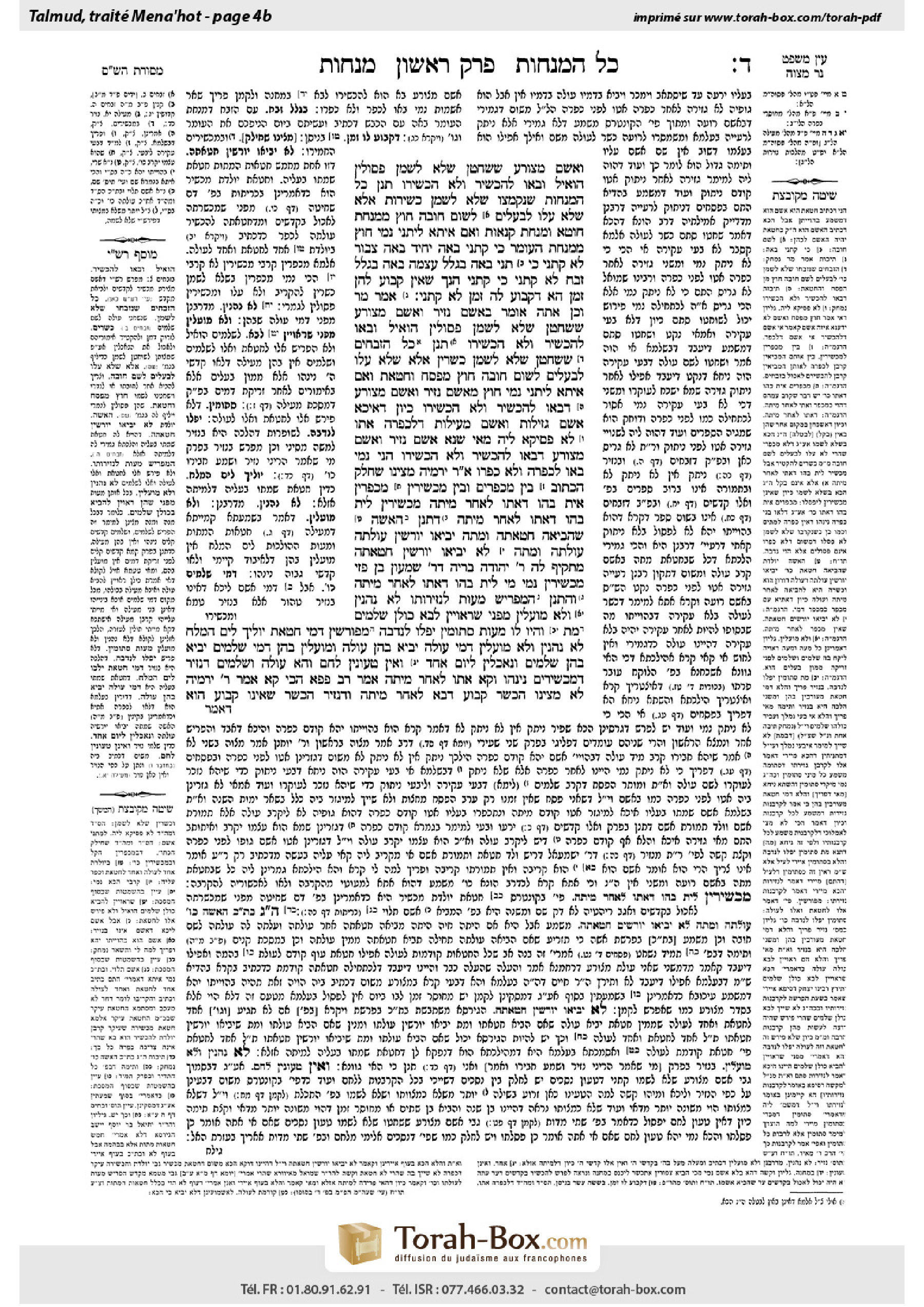
Menachot 4b: Talmud study for Daf Yomi
Daf Yomi is the daily study of one Talmud folio. Explore 37 tractates with scans, Hebrew text, Sefaria English and AI-generated French translations where annotated.
Passage selection and English or AI-generated French translation are available where the scan has annotations. Daf Study is independent of Torah-Box and Sefaria.
Browse Menachot · מנחות · All tractatesMenachot 4b text and translations
This page of Menachot includes the Aramaic text, an English translation and an AI-generated French translation, alongside the scan above.
מנחות ד׳ ב · Aramaic and Hebrew text
וַאֲשַׁם מְצוֹרָע שֶׁשְּׁחָטָן שֶׁלֹּא לִשְׁמָן – פְּסוּלִין, הוֹאִיל וּבָאוּ לְהַכְשִׁיר וְלֹא הִכְשִׁירוּ.
תְּנַן: כׇּל הַמְּנָחוֹת שֶׁנִּקְמְצוּ שֶׁלֹּא לִשְׁמָן – כְּשֵׁירוֹת, אֶלָּא שֶׁלֹּא עָלוּ לַבְּעָלִים לְשׁוּם חוֹבָה, חוּץ מִמִּנְחַת חוֹטֵא וּמִנְחַת קְנָאוֹת. וְאִם אִיתָא, לִיתְנֵי נָמֵי: ״חוּץ מִמִּנְחַת הָעוֹמֶר״!
כִּי קָתָנֵי בָּאָה יָחִיד, בָּאָה צִבּוּר לָא קָתָנֵי; כִּי תָנֵי בָּאָה בִּגְלַל עַצְמָהּ, בָּאָה בִּגְלַל זֶבַח – לָא קָתָנֵי.
כִּי קָתָנֵי הָנָךְ שֶׁאֵין קָבוּעַ לָהֶן זְמַן, הָא דְּקָבוּעַ לָהּ זְמַן – לָא קָתָנֵי.
אָמַר מָר: וְכֵן אַתָּה אוֹמֵר בַּאֲשַׁם נָזִיר וַאֲשַׁם מְצוֹרָע שֶׁשְּׁחָטָן שֶׁלֹּא לִשְׁמָן פְּסוּלִין, הוֹאִיל וּבָאוּ לְהַכְשִׁיר וְלֹא הִכְשִׁירוּ.
תְּנַן: כׇּל הַזְּבָחִים שֶׁשְּׁחָטָן שֶׁלֹּא לִשְׁמָן כְּשֵׁרִין, אֶלָּא שֶׁלֹּא עָלוּ לַבְּעָלִים לְשׁוּם חוֹבָה, חוּץ מִפֶּסַח וְחַטָּאת. וְאִם אִיתָא – לִיתְנֵי נָמֵי: חוּץ מֵאֲשַׁם נָזִיר וַאֲשַׁם מְצוֹרָע, דְּבָאוּ לְהַכְשִׁיר וְלֹא הִכְשִׁירוּ!
כֵּיוָן דְּאִיכָּא אֲשַׁם גְּזֵילוֹת וַאֲשַׁם מְעִילוֹת, דִּלְכַפָּרָה אָתוּ – לָא פְּסִיקָא לֵיהּ.
מַאי שְׁנָא אֲשַׁם נָזִיר וַאֲשַׁם מְצוֹרָע, דְּבָאוּ לְהַכְשִׁיר וְלֹא הִכְשִׁירוּ? הָנֵי נָמֵי בָּאוּ לְכַפָּרָה וְלֹא כִּפְּרוּ!
אָמַר רַבִּי יִרְמְיָה: מָצִינוּ שֶׁחִלֵּק הַכָּתוּב בֵּין מְכַפְּרִים וּבֵין מַכְשִׁירִין, מְכַפְּרִין אִית בְּהוּ דְּאָתוּ לְאַחַר מִיתָה, מַכְשִׁירִין לֵית בְּהוּ דְּאָתוּ לְאַחַר מִיתָה. דִּתְנַן: הָאִשָּׁה שֶׁהֵבִיאָה חַטָּאתָהּ וּמֵתָה – יָבִיאוּ יוֹרְשִׁין עוֹלָתָהּ, עוֹלָתָהּ וּמֵתָה – לֹא יָבִיאוּ יוֹרְשִׁין חַטָּאתָהּ.
מַתְקֵיף לַהּ רַבִּי יְהוּדָה בְּרֵיהּ דְּרַבִּי שִׁמְעוֹן בֶּן פַּזִּי: מַכְשִׁירִין נָמֵי, מִי לֵית בְּהוּ דְּאָתוּ לְאַחַר מִיתָה? וְהָתְנַן: הַמַּפְרִישׁ מָעוֹת לִנְזִירוּתוֹ – לֹא נֶהֱנִין וְלֹא מוֹעֲלִין, מִפְּנֵי שֶׁרְאוּיִין לָבֹא כּוּלָּן שְׁלָמִים.
מֵת וְהָיוּ לוֹ מָעוֹת סְתוּמִין – יִפְּלוּ לִנְדָבָה; מְפוֹרָשִׁין: דְּמֵי חַטָּאת – יוֹלִיךְ לְיָם הַמֶּלַח, לֹא נֶהֱנִין וְלֹא מוֹעֲלִין; דְּמֵי עוֹלָה – יָבִיא בָּהֶן עוֹלָה, וּמוֹעֲלִין בָּהֶן.
דְּמֵי שְׁלָמִים – יָבִיא בָּהֶן שְׁלָמִים, וְנֶאֱכָלִין לְיוֹם אֶחָד, וְאֵין טְעוּנִין לֶחֶם. וְהָא עוֹלָה וּשְׁלָמִים דְּנָזִיר דְּמַכְשִׁירִים נִינְהוּ, וְקָא אָתוּ לְאַחַר מִיתָה!
אָמַר רַב פָּפָּא: הָכִי קָא אָמַר רַבִּי יִרְמְיָה: לֹא מָצִינוּ הֶכְשֵׁר קָבוּעַ דְּבָא לְאַחַר מִיתָה, וּדְנָזִיר הֶכְשֵׁר שֶׁאֵינוֹ קָבוּעַ הוּא,
Menachot 4b · English translation
and so you say with regard to the guilt offering of a leper, whose proper sacrifice enables the leper to enter the Israelite camp and to partake of offerings of sanctity, that if one slaughtered these offerings not for their sake, they are disqualified. They are disqualified since their sacrifice came to render the nazirite and leper fit, and these guilt offerings did not render them fit.
The Gemara asks: We learned in the mishna that all the meal offerings from which a handful was removed not for their sake are fit for sacrifice but they did not satisfy the obligation of the owner, except for the meal offering of a sinner and the meal offering of jealousy. And if it is so that an omer meal offering from which a handful was removed not for its own sake is disqualified, then let the mishna also teach: Except for the omer meal offering.
The Gemara responds: When the mishna teaches this halakha, it teaches it only with regard to meal offerings that come on behalf of an individual. The mishna does not teach the halakha with regard to those meal offerings that come on behalf of the community. Additionally, when the mishna teaches this halakha, it is only with regard to a meal offering that comes on account of itself, i.e., as an independent offering. The mishna does not teach the halakha with regard to a meal offering that comes on account of, i.e., together with, a slaughtered offering, e.g., the omer meal offering, which is brought along with two sheep.
The Gemara adds: Furthermore, when the mishna teaches this halakha, it is only with regard to those meal offerings whose time is not set, i.e., they may be sacrificed on any date. The mishna does not teach the halakha with regard to this omer meal offering, whose time for offering is set on the sixteenth of Nisan.
§ The Gemara analyzes the statement of Rav. The Master said: And so you say with regard to the guilt offering of a nazirite who became ritually impure, and so you say with regard to the guilt offering of a leper, that if one slaughtered these offerings not for their sake, they are disqualified. They are disqualified since their proper sacrifice came to render the nazirite and leper fit, and they did not render them fit.
The Gemara asks: We learned in a mishna (Zevaḥim 2a): All slaughtered offerings that one slaughtered not for their sake are fit, but they did not satisfy the obligation of the owner. This is the halakha with regard to all offerings except for the Paschal offering and the sin offering, which are disqualified when slaughtered not for their sake. And if it is so that the halakha is in accordance with the statement of Rav, let the mishna also teach: Except for the guilt offering of a nazirite and the guilt offering of a leper, since they came to render one fit and they did not render one fit.
The Gemara answers: Since there are other guilt offerings, i.e., the guilt offering for robbery, which one brings for taking a false oath denying an accusation of robbery, and the guilt offering brought for misuse of consecrated property, that come for atonement, which do not render one fit and are fit for sacrifice if they were slaughtered not for their sake, the tanna of the mishna could not state the halakha with regard to guilt offerings in an absolute manner, and therefore he refrains from mentioning guilt offerings at all.
The Gemara asks: What is different about the guilt offering of a nazirite and the guilt offering of a leper? Why are they disqualified when slaughtered not for their sake since they came to render fit and they did not render fit? These, i.e., the guilt offerings for robbery and for misuse of consecrated property, should likewise be disqualified when slaughtered not for their sake, since they came for atonement and they did not atone.
Rabbi Yirmeya said in response: We find that the Torah differentiates between those guilt offerings that atone and those that render fit, and the halakha is more stringent with regard to those that render fit. Rabbi Yirmeya elaborates: With regard to those guilt offerings that atone, there are among them offerings that come after death, i.e., they are sacrificed after the death of their owners, whereas with regard to those that render fit, there are none among them that come after death. As we learned in a mishna (Kinnim 2:5): With regard to a woman after childbirth who brought her sin offering for her ritual purification and died, the heirs shall bring her burnt offering, which comes to atone. If she set aside her burnt offering and died, the heirs shall not bring her sin offering, as it comes to render her fit to partake of offerings.
Rabbi Yehuda, son of Rabbi Shimon ben Pazi, objects to this: With regard to offerings that render fit as well, are there not among them offerings that come after death? But didn’t we learn in a mishna (Me’ila 11a): In the case of one who separates funds for the offerings of his naziriteship, i.e., his sin offering, burnt offering, and peace offering, a person may not derive benefit from them ab initio, but if one benefited from them after the fact, he is not liable for misuse of consecrated property, i.e., he is not required to bring a guilt offering and is not obligated to repay the principal and an additional fifth. This is because the coins are all fit for bringing peace offerings, and there is no misuse of consecrated property with regard to funds fit for a peace offering.
The mishna continues: If the nazirite died and he had undesignated funds that he set aside to pay for his nazirite offerings without specifying how much money should be allocated toward each offering, they will be allocated for communal gift offerings. If he left behind allocated funds, then with regard to the money for a sin offering, one must take it and cast it into the Dead Sea; one may not benefit from it ab initio, but if one benefited from it after the fact, he is not liable for misuse of consecrated property. With regard to the money for a burnt offering, one brings with it a burnt offering, and one is liable for misusing them.
The mishna concludes: With the money for a peace offering, one brings a peace offering with it, and these offerings are eaten for one day, like the peace offering brought by a nazirite, and do not require the loaves that are normally bought with the peace offering of a nazirite. Rabbi Yehuda explains his question: But the burnt offering and peace offering of a nazirite are offerings that render the nazirite fit to drink wine, and yet they come after death.
Rav Pappa said in response that this is what Rabbi Yirmeya is saying: We do not find an instance of a fixed manner of rendering fit that comes after death, i.e., there is no instance where the only offering that will render one fit to act in a manner previously prohibited to him may be sacrificed after death. And the offerings of a nazirite are examples of a means of rendering fit that is not fixed,
Menachot 4b · Traduction française (IA)
Et de même, tu dis au sujet du sacrifice de culpabilité d’un lépreux, dont l’offrande conforme aux règles permet au lépreux d’entrer dans le camp d’Israël et de consommer des offrandes saintes, que si l’on a égorgé ces offrandes sans les destiner à cet effet, elles sont invalides. Elles le sont parce que leur offrande devait rendre le nazir et le lépreux aptes, mais que ces sacrifices de culpabilité ne les ont pas rendus aptes.
La Guemara demande : Nous avons appris dans la Michna que toutes les offrandes végétales dont on a prélevé une poignée sans les destiner à cet effet sont aptes à être offertes, mais n’acquittent pas l’obligation de leur propriétaire, à l’exception de l’offrande végétale du pécheur et de l’offrande végétale de jalousie. Or, s’il en est ainsi, si une offrande de l’omer dont on a prélevé une poignée sans la destiner à cet effet est invalide, que la Michna enseigne également : « À l’exception de l’offrande végétale de l’omer ».
La Guemara répond : Lorsque la Michna enseigne cette halakha, elle ne traite que des offrandes végétales apportées au nom d’un particulier, et non de celles apportées au nom de la communauté. En outre, elle ne traite que d’une offrande végétale apportée en tant qu’offrande autonome, et non d’une offrande végétale apportée avec une offrande animale égorgée, comme l’offrande de l’omer, qui est apportée avec deux moutons.
La Guemara ajoute : De plus, lorsque la Michna enseigne cette halakha, elle ne traite que des offrandes végétales dont la date n’est pas fixée, c’est-à-dire qui peuvent être offertes n’importe quel jour. Elle ne traite pas de cette offrande de l’omer, dont la date d’offrande est fixée au 16 nissan.
§ La Guemara examine la déclaration de Rav. Le maître a dit : « Et de même, tu dis au sujet du sacrifice de culpabilité d’un nazir devenu rituellement impur, et de même au sujet du sacrifice de culpabilité d’un lépreux, que si l’on a égorgé ces offrandes sans les destiner à cet effet, elles sont invalides. Elles le sont parce que leur offrande conforme aux règles devait rendre le nazir et le lépreux aptes, mais qu’elles ne les ont pas rendus aptes. »
La Guemara demande : Nous avons appris dans une Michna (Zevaḥim 2a) : Toutes les offrandes animales que l’on a égorgées sans les destiner à cet effet sont aptes, mais n’acquittent pas l’obligation de leur propriétaire. Cette halakha s’applique à toutes les offrandes, à l’exception de l’offrande pascale et du sacrifice expiatoire, qui sont invalides lorsqu’on les égorge sans les destiner à cet effet. Or, s’il en est ainsi, si la halakha suit la déclaration de Rav, que la Michna enseigne également : « À l’exception du sacrifice de culpabilité d’un nazir et de celui d’un lépreux », puisqu’ils devaient rendre quelqu’un apte, mais ne l’ont pas rendu apte.
La Guemara répond : Puisqu’il existe d’autres sacrifices de culpabilité, à savoir celui pour vol, que l’on apporte après avoir prêté un faux serment niant une accusation de vol, et celui que l’on apporte pour l’usage illicite de biens consacrés, lesquels sont apportés en expiation, mais ne rendent personne apte et restent aptes à être offerts même s’ils ont été égorgés sans être destinés à cet effet, le tanna de la Michna ne pouvait pas énoncer cette halakha de manière absolue au sujet des sacrifices de culpabilité ; il s’abstient donc de les mentionner.
La Guemara demande : En quoi le sacrifice de culpabilité d’un nazir et celui d’un lépreux sont-ils différents ? Pourquoi sont-ils invalides lorsqu’on les égorge sans les destiner à cet effet, puisqu’ils devaient rendre quelqu’un apte, mais ne l’ont pas rendu apte ? Ces autres sacrifices, c’est-à-dire ceux de culpabilité pour vol et pour usage illicite de biens consacrés, devraient eux aussi être invalides lorsqu’on les égorge sans les destiner à cet effet, puisqu’ils devaient expier, mais n’ont pas expié.
Rabbi Yirmeya répondit : Nous constatons que la Torah distingue les sacrifices de culpabilité qui expient de ceux qui rendent apte, et que la halakha est plus stricte à l’égard de ceux qui rendent apte. Rabbi Yirmeya développe : Parmi les sacrifices de culpabilité qui expient, certains sont apportés après la mort, c’est-à-dire qu’ils sont offerts après la mort de leurs propriétaires ; en revanche, parmi ceux qui rendent apte, aucun n’est apporté après la mort. En effet, nous avons appris dans une Michna (Kinnim 2:5) : Si une femme après l’accouchement a apporté son sacrifice expiatoire pour sa purification rituelle, puis est morte, ses héritiers apportent son holocauste, qui sert à expier. Si elle avait mis son holocauste à part et qu’elle est morte, ses héritiers n’apportent pas son sacrifice expiatoire, car celui-ci sert à la rendre apte à consommer des offrandes.
Rabbi Yehuda, fils de Rabbi Shimon ben Pazi, objecte : Même parmi les offrandes qui rendent apte, n’en trouve-t-on pas qui sont apportées après la mort ? N’avons-nous pas appris dans une Michna (Me’ila 11a) : Si quelqu’un met de l’argent à part pour les offrandes de son naziréat, à savoir son sacrifice expiatoire, son holocauste et son offrande de paix, il est interdit d’en tirer profit a priori ; toutefois, si quelqu’un en a tiré profit après coup, il n’est pas coupable d’usage illicite de biens consacrés, c’est-à-dire qu’il n’est pas tenu d’apporter un sacrifice de culpabilité ni de rembourser le principal augmenté d’un cinquième. En effet, toutes ces pièces peuvent servir à apporter des offrandes de paix, et l’usage de fonds pouvant servir à une offrande de paix ne constitue pas un usage illicite de biens consacrés.
La Michna poursuit : Si le nazir est mort et qu’il avait mis de côté des fonds non affectés pour payer ses offrandes de naziréat, sans préciser quelle somme devait être attribuée à chacune d’elles, ces fonds seront affectés aux offrandes volontaires de la communauté. S’il a laissé des fonds affectés, on prend l’argent destiné au sacrifice expiatoire et on le jette dans la mer Morte ; il est interdit d’en tirer profit a priori, mais si quelqu’un en a tiré profit après coup, il n’est pas coupable d’usage illicite de biens consacrés. Avec l’argent destiné à l’holocauste, on apporte un holocauste, et l’on est coupable d’usage illicite de biens consacrés.
La Michna conclut : Avec l’argent destiné à l’offrande de paix, on apporte une offrande de paix ; celle-ci est consommée pendant un jour, comme l’offrande de paix apportée par un nazir, et ne nécessite pas les pains que l’on apporte habituellement avec l’offrande de paix d’un nazir. Rabbi Yehuda précise son objection : Mais l’holocauste et l’offrande de paix d’un nazir sont des offrandes qui rendent le nazir apte à boire du vin, et pourtant elles sont apportées après sa mort.
Rav Pappa répondit que voici ce que dit Rabbi Yirmeya : Nous ne trouvons pas de cas où une manière fixe de rendre apte survienne après la mort, c’est-à-dire qu’il n’existe aucun cas où la seule offrande susceptible de rendre quelqu’un apte à faire ce qui lui était auparavant interdit puisse être offerte après sa mort. Les offrandes d’un nazir, elles, illustrent une manière non fixe de le rendre apte,
Traduction française générée par IA à partir de l’édition anglaise de Sefaria. Vérifie toujours un passage avec le texte source.
Text from Sefaria: William Davidson Edition - Vocalized Aramaic (unknown); William Davidson Edition - English (CC BY NC).