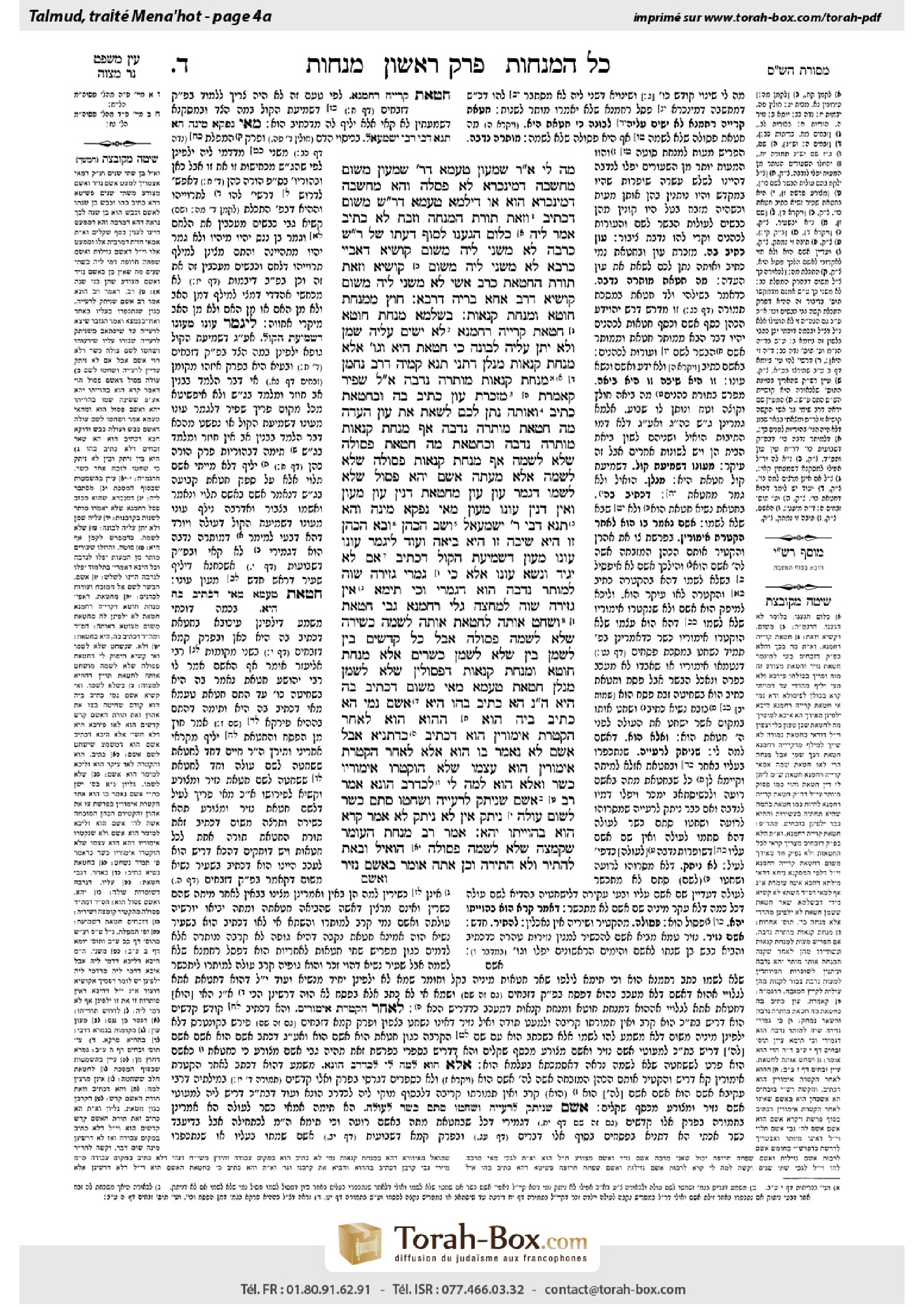
Menachot 4a: Talmud study for Daf Yomi
Daf Yomi is the daily study of one Talmud folio. Explore 37 tractates with scans, Hebrew text, Sefaria English and AI-generated French translations where annotated.
Passage selection and English or AI-generated French translation are available where the scan has annotations. Daf Study is independent of Torah-Box and Sefaria.
Browse Menachot · מנחות · All tractatesMenachot 4a text and translations
This page of Menachot includes the Aramaic text, an English translation and an AI-generated French translation, alongside the scan above.
מנחות ד׳ א · Aramaic and Hebrew text
מָה לִי אָמַר רַבִּי שִׁמְעוֹן? טַעְמָא דְּרַבִּי שִׁמְעוֹן מִשּׁוּם מַחְשָׁבָה דְּמִינַּכְרָא לָא פָּסְלָה, וְהָא מַחְשָׁבָה דְּמִינַּכְרָא הוּא.
אוֹ דִילְמָא טַעְמָא דְּרַבִּי שִׁמְעוֹן מִשּׁוּם דִּכְתִיב: ״וְזֹאת תּוֹרַת הַמִּנְחָה״, וְזֶבַח לָא כְּתִיב. אֲמַר לֵיהּ: כְּלוּם הִגַּעְנוּ לְסוֹף דַּעְתּוֹ שֶׁל רַבִּי שִׁמְעוֹן?
כְּרַבָּה לָא מְשַׁנֵּי לֵיהּ, מִשּׁוּם קוּשְׁיָא דְאַבָּיֵי.
כְּרָבָא לָא מְשַׁנֵּי לֵיהּ, מִשּׁוּם קוּשְׁיָא ״וְזֹאת תּוֹרַת הַחַטָּאת״.
כְּרַב אָשֵׁי לָא מְשַׁנֵּי לֵיהּ, מִשּׁוּם קוּשְׁיָא דְּרַב אַחָא בְּרֵיהּ דְּרָבָא.
חוּץ מִמִּנְחַת חוֹטֵא וּמִנְחַת קְנָאוֹת. בִּשְׁלָמָא מִנְחַת חוֹטֵא – ״חַטָּאת״ קַרְיַיהּ רַחֲמָנָא, ״לֹא יָשִׂים עָלֶיהָ שֶׁמֶן וְלֹא יִתֵּן עָלֶיהָ לְבוֹנָה כִּי חַטָּאת הִיא וְגוֹ׳״, אֶלָּא מִנְחַת קְנָאוֹת מְנָלַן?
דְּתָנֵי תַּנָּא קַמֵּיהּ דְּרַב נַחְמָן: מִנְחַת קְנָאוֹת מוֹתָרָהּ נְדָבָה.
אֲמַר לֵיהּ: שַׁפִּיר קָאָמְרַתְּ, ״מַזְכֶּרֶת עָוֹן״ כְּתִיב בָּהּ, וּבְחַטָּאת כְּתִיב: ״וְאֹתָהּ נָתַן לָכֶם לָשֵׂאת אֶת עֲוֹן הָעֵדָה״, מָה חַטָּאת מוֹתָרָהּ נְדָבָה – אַף מִנְחַת קְנָאוֹת מוֹתָרָהּ נְדָבָה. וְכַחַטָּאת, מָה חַטָּאת פְּסוּלָה שֶׁלֹּא לִשְׁמָהּ – אַף מִנְחַת קְנָאוֹת פְּסוּלָה שֶׁלֹּא לִשְׁמָהּ.
אֶלָּא מֵעַתָּה, אָשָׁם יְהֵא פָּסוּל שֶׁלֹּא לִשְׁמוֹ, דְּגָמַר ״עָוֹן״ ״עָוֹן״ מֵחַטָּאת.
דָּנִין ״עָוֹן״ מֵ״עָוֹן״, וְאֵין דָּנִין ״עֲוֹנוֹ״ מֵ״עָוֹן״.
מַאי נָפְקָא מִינַּהּ? וְהָא תָּנָא דְּבֵי רַבִּי יִשְׁמָעֵאל: ״וְשָׁב הַכֹּהֵן״ ״וּבָא הַכֹּהֵן״ – זוֹ הִיא שִׁיבָה זוֹ הִיא בִּיאָה.
וְעוֹד, לִיגְמַר ״עֲוֹנוֹ״ ״עֲוֹנוֹ״ מֵעָוֹן דִּשְׁמִיעַת הַקּוֹל, דִּכְתִיב: ״אִם לֹא יַגִּיד וְנָשָׂא עֲוֹנוֹ״.
אֶלָּא, כִּי גָמְרִי גְּזֵירָה שָׁוָה, לְמוֹתַר נְדָבָה הוּא דְּגָמְרִי.
וְכִי תֵימָא: אֵין גְּזֵירָה שָׁוָה לְמֶחֱצָה – גַּלִּי רַחֲמָנָא גַּבֵּי חַטָּאת, ״וְשָׁחַט אוֹתָהּ לְחַטָּאת״ – אוֹתָהּ לִשְׁמָהּ כְּשֵׁירָה, שֶׁלֹּא לִשְׁמָהּ פְּסוּלָה. אֲבָל כׇּל קָדָשִׁים, בֵּין לִשְׁמָן בֵּין שֶׁלֹּא לִשְׁמָן – כְּשֵׁרִים.
אֶלָּא, מִנְחַת חוֹטֵא וּמִנְחַת קְנָאוֹת דִּפְסוּלִין שֶׁלֹּא לִשְׁמָן, מְנָלַן?
חַטָּאת טַעְמָא מַאי, מִשּׁוּם דִּכְתִיב בַּהּ ״הִיא״, הָכִי נָמֵי, הָא כְּתִיב בְּהוּ ״הִיא״.
אָשָׁם נָמֵי, הָא כְּתִיב בֵּיהּ ״הוּא״, הָהוּא ״הוּא״ לְאַחַר הַקְטָרַת אֵימוּרִין הוּא דִּכְתִיב.
כִּדְתַנְיָא: אֲבָל אָשָׁם לֹא נֶאֱמַר בּוֹ ״הוּא״ אֶלָּא לְאַחַר הַקְטָרַת אֵימוּרִין, הוּא עַצְמוֹ שֶׁלֹּא הוּקְטְרוּ אֵימוּרָיו כָּשֵׁר.
וְאֶלָּא ״הוּא״ לְמָה לִי? לְכִדְרַב הוּנָא אָמַר רַב: אָשָׁם שֶׁנִּיתַּק לִרְעִיָּיה, וּשְׁחָטוֹ סְתָם – כָּשֵׁר לְשׁוּם עוֹלָה.
נִיתַּק – אִין, לֹא נִיתַּק – לָא. אָמַר קְרָא: ״הוּא״, בַּהֲוָיָיתוֹ יְהֵא.
אָמַר רַב: מִנְחַת הָעוֹמֶר שֶׁקְּמָצָהּ שֶׁלֹּא לִשְׁמָהּ – פְּסוּלָה, הוֹאִיל וּבָאת לְהַתִּיר וְלֹא הִתִּירָה. וְכֵן אַתָּה אוֹמֵר בַּאֲשַׁם נָזִיר
Menachot 4a · English translation
what should I understand that Rabbi Shimon says with regard to such a case? Is the reason of Rabbi Shimon, who says that a meal offering from which a handful was removed for the sake of another meal offering is valid and effects acceptance, that intent that is recognizably false does not disqualify an offering? And if so, this meal offering from which a handful is removed for the sake of an animal offering is also a case of intent that is recognizably false, and therefore the meal offering should not be disqualified.
Or perhaps the reason of Rabbi Shimon is that it is written: “And this is the law of the meal offering” (Leviticus 6:7), which indicates that there is one law for all meal offerings. If so, then a meal offering from which a handful was removed for the sake of an animal offering should be disqualified, since it is not written: And this is the law of the meal offering and a slaughtered offering. Rav Asi said to Rav Hoshaya: Have we ascertained the depth of the opinion of Rabbi Shimon in this matter? In other words, Rabbi Shimon’s reasoning is not known.
The Gemara explains why Rav Asi did not resolve this dilemma. Rav Asi did not resolve the dilemma of Rav Hoshaya in accordance with the resolution stated by Rabba, that there is a distinction between one who removes the handful of a meal offering for the sake of another meal offering and one who removes it for the sake of another owner, because of the difficulty posed by Abaye (2b), that the halakha of both these cases is derived from the same comparison in the Torah between meal offerings and animal offerings.
Likewise, Rav Asi did not resolve the dilemma in accordance with the resolution stated by Rava, that the verse “And this is the law of the meal offering” teaches that a meal offering from which a handful was removed for the sake of another meal offering is valid, whereas a meal offering from which a handful was removed for the sake of an animal offering is disqualified. This is because of the difficulty arising from the verse: “And this is the law of the sin offering” (Leviticus 6:18), i.e., despite this verse, the halakha is that a sin offering that was slaughtered for the sake of another sin offering is not valid.
Finally, Rav Asi did not resolve the dilemma in accordance with the resolution stated by Rav Ashi, that there is a distinction between one who removes the handful of a meal offering prepared in one vessel for the sake of a different vessel, and one who removes it for the sake of a meal offering prepared in a different vessel, because of the difficulty posed by Rav Aḥa, son of Rava. This difficulty concerns a case where one removes the handful of a dry meal offering for the sake of one mixed with oil; Rabbi Shimon holds that such a meal offering is valid despite the fact that the person’s intent referred to the meal offering itself, not the vessel.
§ The mishna teaches that all meal offerings from which a handful was removed not for their sake but for the sake of another meal offering are fit for sacrifice, except for the meal offering of a sinner and the meal offering of jealousy. The Gemara asks: Granted, the meal offering of a sinner is disqualified when a handful is removed from it not for its own sake, as the Merciful One calls it a sin offering, in the verse: “He shall put no oil upon it, neither shall he put any frankincense upon it, for it is a sin offering. And he shall bring it to the priest, and the priest shall take his handful” (Leviticus 5:11–12). This verse indicates that just as a sin offering is disqualified when sacrificed not for its own sake, so too, the meal offering of a sinner is disqualified when a handful is removed from it not for its own sake. But with regard to the meal offering of jealousy, from where do we derive that this is the halakha?
The Gemara answers that this halakha may be derived from a baraita, as a tanna taught a baraita before Rav Naḥman: With regard to money that was designated for a meal offering of jealousy, its surplus, i.e., the money remaining after the purchase of the meal offering, is used to purchase communal gift offerings.
Rav Naḥman said to him: You are saying well, as it is written with regard to a meal offering of jealousy: “Bringing iniquity to remembrance” (Numbers 5:15), and it is written with regard to a sin offering: “And He has given it you to bear the iniquity of the congregation” (Leviticus 10:17). A verbal analogy is drawn between the two uses of the term “iniquity” in these verses. This teaches that just as in the case of a sin offering, its surplus is used to purchase communal gift offerings, so too, with regard to a meal offering of jealousy, its surplus is used to purchase communal gift offerings. And a meal offering of jealousy is also like a sin offering in another aspect: Just as a sin offering is disqualified when sacrificed not for its own sake, so too, a meal offering of jealousy is disqualified when a handful is removed from it not for its own sake.
The Gemara asks: If that is so, that the halakha of a meal offering of jealousy is derived from a verbal analogy to a sin offering based on the word “iniquity,” then a guilt offering should also be disqualified if it was sacrificed not for its own sake, as a similar verbal analogy may be derived from the verse that states: “The iniquity [avon] of the congregation” (Leviticus 10:17), with regard to a sin offering, and the verse that states: “And shall bear his iniquity” (Leviticus 5:17), in connection with a guilt offering.
The Gemara responds: One derives a verbal analogy based on the word “iniquity” from a verse that likewise uses the term “iniquity,” but one does not derive a verbal analogy based on the term “his iniquity [avono]” from a verse that uses the term “iniquity.”
The Gemara asks: What difference is there? Didn’t the school of Rabbi Yishmael teach the following verbal analogy with regard to leprosy of houses? The verse states: “And the priest shall return [veshav] on the seventh day” (Leviticus 14:39), and another verse concerning the priest’s visit seven days later states: “And the priest shall come [uva] and look” (Leviticus 14:44). This returning and this coming have the same meaning, and one can therefore derive by verbal analogy that the halakha that applies if the leprosy had spread at the conclusion of the first week applies if it had spread again by the end of the following week. All the more so should a less pronounced difference of one letter between avon and avono not prevent the teaching of a verbal analogy.
And furthermore, let one derive a verbal analogy through the term “his iniquity” stated with regard to a guilt offering, and the term “his iniquity” from the verse concerning the sin offering brought for the iniquity for hearing the voice, i.e., the sin offering of one who takes a false oath that he does not have any information relevant to a matter when another requests that he testify about it, as it is written: “If he does not utter it, then he shall bear his iniquity” (Leviticus 5:1).
Rather, it must be that when the verbal analogy was derived, it was derived only with regard to the halakha that the surplus from the money designated for a meal offering of jealousy is used to purchase communal gift offerings, and not with regard to the halakha that a meal offering of jealousy from which a handful was removed not for its own sake is disqualified.
And if you would say that there is a principle that there is no partial verbal analogy, that principle does not apply in this instance. As the Merciful One revealed with regard to a sin offering that the halakha of other offerings may not be derived from this case, as the verse states: “And slaughter it for a sin offering” (Leviticus 4:33). This verse indicates that it, i.e., a sin offering, when slaughtered for its own sake is valid, and when slaughtered not for its own sake is disqualified. But all other sacrificial animals, whether sacrificed for their sake or not for their sake, are valid.
The Gemara asks: But if the Merciful One revealed that one cannot derive the halakha of other offerings that were sacrificed not for their sake from a sin offering, then from where do we derive the halakha that the meal offering of a sinner and the meal offering of jealousy are disqualified when a handful is removed from them not for their sake?
The Gemara explains: With regard to a sin offering, what is the reason that it is disqualified when sacrificed not for its own sake? It is because it is written with regard to this offering: “It,” in a verse discussing the sin offering of the Nasi: “It is a sin offering” (Leviticus 4:24). This indicates that a sin offering is valid only when it is sacrificed for its own sake. So too, it is written with regard to them, i.e., the meal offering of a sinner and the meal offering of jealousy: “It.” In the case of the meal offering of a sinner the verse states: “It is a sin offering” (Leviticus 5:11), and with regard to the meal offering of jealousy it is written: “It is a meal offering of jealousy” (Numbers 5:15).
The Gemara challenges: But if so, concerning a guilt offering as well, it is written about this offering: “It,” as the verse states: “It is a guilt offering” (Leviticus 7:5). Accordingly, a guilt offering should likewise be disqualified if it is slaughtered not for its own sake. The Gemara responds: That term “it” is written with regard to the stage after the burning of the sacrificial portions [eimurin] of a guilt offering, which are intended for burning upon the altar.
As it is taught in a baraita: One derives from the word “it” that if the offering was slaughtered not for its own sake it is disqualified only in the case of a sin offering. But concerning a guilt offering, it is stated about this offering: “It is a guilt offering,” only with regard to the stage after the burning of the sacrificial portions. The baraita adds: One cannot derive that if these portions were burned not for the sake of a guilt offering then the offering is disqualified, since the guilt offering itself is valid if its sacrificial portions were not burned upon the altar at all.
The Gemara asks: But if so, why do I need the word “it” stated with regard to a guilt offering? The Gemara answers: It is necessary for that which Rav Huna says that Rav says: With regard to a guilt offering whose owner died or whose transgression was otherwise atoned for, and that was therefore consigned by the court to grazing until it develops a blemish so that it can be sold and the proceeds used to purchase a burnt offering, if, before it developed a blemish, someone slaughtered it without specification of its purpose, it is fit if it was sacrificed as a burnt offering.
The Gemara infers: If it was consigned to grazing, yes, it is fit if it was sacrificed as a burnt offering if slaughtered. By inference, if it was not consigned to grazing, it is not fit. What is the reason for this? The verse states: “It is a guilt offering,” indicating that it shall remain as it is, i.e., as a guilt offering, unless it is consigned by the court to another purpose.
§ The mishna teaches that all the meal offerings from which a handful was removed not for their sake are fit for sacrifice but they do not fulfill the owner’s obligation. Concerning this, Rav says: With regard to the omer meal offering, i.e., the measure of barley brought as a communal offering on the sixteenth of Nisan (see Leviticus 23:9–14), if the priest removed a handful from it not for its own sake it is disqualified. It is disqualified since an omer meal offering came for a specific purpose, namely, to permit the consumption of the new crop, and this meal offering did not permit the consumption of the new crop because its rites were performed not for its own sake. And so you say with regard to the guilt offering of a nazirite who became ritually impure, whose proper sacrifice enables the nazirite to restart his naziriteship afresh in purity,
Menachot 4a · Traduction française (IA)
Que dois-je comprendre de l’opinion de Rabbi Shimon dans un tel cas ? Rabbi Shimon affirme-t-il qu’une oblation dont on a prélevé une poignée pour une autre oblation est valide et agréée parce qu’une intention manifestement erronée ne disqualifie pas une offrande ? Si tel est le cas, cette oblation dont on prélève une poignée pour une offrande animale relève elle aussi d’une intention manifestement erronée, et ne devrait donc pas être disqualifiée.
Ou peut-être Rabbi Shimon se fonde-t-il sur ce qui est écrit : « Telle est la loi de l’oblation » (Lévitique 6:7), ce qui indique qu’il existe une seule loi pour toutes les oblations. Dans ce cas, une oblation dont on a prélevé une poignée pour une offrande animale devrait être disqualifiée, puisqu’il n’est pas écrit : « Telle est la loi de l’oblation et de l’offrande égorgée. » Rav Asi dit à Rav Hoshaya : Avons-nous sondé jusqu’au fond l’opinion de Rabbi Shimon sur cette question ? Autrement dit, le raisonnement de Rabbi Shimon ne nous est pas connu.
La Guemara explique pourquoi Rav Asi n’a pas résolu cette question. Rav Asi n’a pas retenu la réponse de Rabba, qui distingue celui qui prélève la poignée d’une oblation pour une autre oblation de celui qui la prélève pour un autre propriétaire, en raison de la difficulté soulevée par Abaye (2b) : la halakha concernant ces deux cas est déduite de la même comparaison que la Torah établit entre les oblations et les offrandes animales.
De même, Rav Asi n’a pas retenu la réponse de Rava, selon laquelle le verset « Telle est la loi de l’oblation » enseigne qu’une oblation dont on a prélevé une poignée pour une autre oblation est valide, tandis qu’une oblation dont on a prélevé une poignée pour une offrande animale est disqualifiée. Cela s’explique par la difficulté que soulève le verset : « Telle est la loi du sacrifice expiatoire » (Lévitique 6:18) : malgré ce verset, la halakha est qu’un sacrifice expiatoire égorgé pour un autre sacrifice expiatoire n’est pas valide.
Enfin, Rav Asi n’a pas retenu la réponse de Rav Ashi, qui distingue celui qui prélève la poignée d’une oblation préparée dans un récipient pour une oblation préparée dans un autre récipient de celui qui la prélève pour une oblation préparée dans un récipient différent, en raison de la difficulté soulevée par Rav Aḥa, fils de Rava. Cette difficulté porte sur le cas où l’on prélève la poignée d’une oblation sèche pour une oblation mélangée à de l’huile ; Rabbi Shimon considère cette oblation comme valide, bien que l’intention de la personne ait porté sur l’oblation elle-même et non sur le récipient.
§ La Michna enseigne que toutes les oblations dont on a prélevé une poignée non pour elles-mêmes, mais pour une autre oblation, sont aptes à être offertes, à l’exception de l’oblation du pécheur et de l’oblation de jalousie. La Guemara demande : Il est compréhensible que l’oblation du pécheur soit disqualifiée lorsqu’on en prélève une poignée non pour elle-même, car le Miséricordieux la qualifie de sacrifice expiatoire dans le verset : « Il n’y mettra ni huile ni encens, car c’est un sacrifice expiatoire. Il l’apportera au prêtre, et le prêtre en prélèvera une poignée » (Lévitique 5:11–12). Ce verset indique que, de même qu’un sacrifice expiatoire est disqualifié lorsqu’il est offert non pour lui-même, l’oblation du pécheur est elle aussi disqualifiée lorsqu’on en prélève une poignée non pour elle-même. Mais pour ce qui est de l’oblation de jalousie, d’où déduisons-nous que telle est la halakha ?
La Guemara répond que cette halakha peut être déduite d’une baraïta, car un tanna enseigna une baraïta devant Rav Naḥman : l’argent destiné à une oblation de jalousie dont il reste un surplus, c’est-à-dire l’argent restant après l’achat de l’oblation, sert à acheter des offrandes volontaires communautaires.
Rav Naḥman lui dit : Tu as raison, car il est écrit à propos d’une oblation de jalousie : « Faisant remonter le souvenir de la faute » (Nombres 5:15), et il est écrit à propos d’un sacrifice expiatoire : « Il vous l’a donnée pour porter la faute de la communauté » (Lévitique 10:17). On établit une analogie verbale entre les deux occurrences du terme « faute » dans ces versets. Cela enseigne que, de même que, dans le cas d’un sacrifice expiatoire, son surplus sert à acheter des offrandes volontaires communautaires, de même, le surplus d’une oblation de jalousie sert à acheter des offrandes volontaires communautaires. L’oblation de jalousie est également semblable au sacrifice expiatoire sous un autre aspect : de même qu’un sacrifice expiatoire est disqualifié lorsqu’il est offert non pour lui-même, l’oblation de jalousie est disqualifiée lorsqu’on en prélève une poignée non pour elle-même.
La Guemara demande : S’il en est ainsi, et que la halakha de l’oblation de jalousie est déduite d’une analogie verbale avec le sacrifice expiatoire fondée sur le terme « faute », un sacrifice de culpabilité devrait lui aussi être disqualifié s’il est offert non pour lui-même, puisqu’on peut établir une analogie verbale similaire entre le verset qui dit, à propos d’un sacrifice expiatoire, « la faute [avon] de la communauté » (Lévitique 10:17), et celui qui dit, à propos d’un sacrifice de culpabilité : « Il portera sa faute » (Lévitique 5:17).
La Guemara répond : On établit une analogie verbale fondée sur le terme « faute » à partir d’un verset qui emploie également le terme « faute », mais on n’établit pas une analogie verbale fondée sur l’expression « sa faute [avono] » à partir d’un verset qui emploie le terme « faute ».
La Guemara demande : Quelle différence cela fait-il ? L’école de Rabbi Yishmael n’a-t-elle pas enseigné l’analogie verbale suivante concernant la lèpre des maisons ? Le verset dit : « Le prêtre reviendra [veshav] le septième jour » (Lévitique 14:39), et un autre verset, au sujet de la visite du prêtre sept jours plus tard, dit : « Le prêtre viendra [uva] et regardera » (Lévitique 14:44). « Revenir » et « venir » ont ici le même sens ; on peut donc déduire par analogie verbale que la halakha applicable si la lèpre s’était étendue à la fin de la première semaine s’applique aussi si elle s’est de nouveau étendue à la fin de la semaine suivante. À plus forte raison, une différence aussi minime qu’une seule lettre entre avon et avono ne devrait-elle pas empêcher l’établissement d’une analogie verbale.
De plus, établissons une analogie verbale entre l’expression « sa faute » employée à propos d’un sacrifice de culpabilité et la même expression dans le verset relatif au sacrifice expiatoire apporté pour la faute consistant à ne pas témoigner, c’est-à-dire le sacrifice expiatoire de celui qui fait un faux serment en affirmant qu’il n’a aucun renseignement pertinent alors qu’une autre personne lui demande de témoigner à ce sujet, comme il est écrit : « S’il ne le déclare pas, il portera sa faute » (Lévitique 5:1).
Il faut plutôt conclure que l’analogie verbale a été établie uniquement pour la halakha selon laquelle le surplus de l’argent destiné à une oblation de jalousie sert à acheter des offrandes volontaires communautaires, et non pour la halakha selon laquelle une oblation de jalousie dont on a prélevé une poignée non pour elle-même est disqualifiée.
Et si tu dis qu’il existe un principe selon lequel une analogie verbale ne peut être partielle, ce principe ne s’applique pas ici. En effet, le Miséricordieux a révélé, à propos d’un sacrifice expiatoire, qu’on ne peut pas en déduire la halakha applicable aux autres offrandes, comme le dit le verset : « Il l’égorgera en sacrifice expiatoire » (Lévitique 4:33). Ce verset indique que celui-ci, c’est-à-dire un sacrifice expiatoire, est valide lorsqu’il est égorgé pour lui-même et disqualifié lorsqu’il est égorgé non pour lui-même. En revanche, toutes les autres offrandes animales sont valides, qu’elles soient offertes pour elles-mêmes ou non.
La Guemara demande : Mais si le Miséricordieux a révélé qu’on ne peut pas déduire d’un sacrifice expiatoire la halakha concernant les autres offrandes offertes non pour elles-mêmes, d’où déduisons-nous que l’oblation du pécheur et l’oblation de jalousie sont disqualifiées lorsqu’on en prélève une poignée non pour elles-mêmes ?
La Guemara explique : Pour quelle raison un sacrifice expiatoire est-il disqualifié lorsqu’il est offert non pour lui-même ? Parce qu’il est écrit à propos de cette offrande : « Elle », dans un verset relatif au sacrifice expiatoire du nassi : « C’est un sacrifice expiatoire » (Lévitique 4:24). Cela indique qu’un sacrifice expiatoire n’est valide que lorsqu’il est offert pour lui-même. De même, le terme « elle » est écrit à leur propos, c’est-à-dire à propos de l’oblation du pécheur et de l’oblation de jalousie. Dans le cas de l’oblation du pécheur, le verset dit : « C’est un sacrifice expiatoire » (Lévitique 5:11), et, à propos de l’oblation de jalousie, il est écrit : « C’est une oblation de jalousie » (Nombres 5:15).
La Guemara objecte : Mais s’il en est ainsi, le texte dit aussi, à propos d’un sacrifice de culpabilité : « Lui », comme le dit le verset : « C’est un sacrifice de culpabilité » (Lévitique 7:5). Un sacrifice de culpabilité devrait donc lui aussi être disqualifié s’il est égorgé non pour lui-même. La Guemara répond : Le terme « lui » est écrit à propos de l’étape qui suit la combustion des parties sacrificielles [eimurin] d’un sacrifice de culpabilité, lesquelles sont destinées à être brûlées sur l’autel.
Comme l’enseigne une baraïta : du mot « lui », on déduit qu’une offrande égorgée non pour elle-même n’est disqualifiée que dans le cas d’un sacrifice expiatoire. Mais, à propos d’un sacrifice de culpabilité, le terme « lui » apparaît dans l’expression « c’est un sacrifice de culpabilité » uniquement au sujet de l’étape qui suit la combustion des parties sacrificielles. La baraïta ajoute : On ne peut pas en déduire que l’offrande est disqualifiée si ces parties sont brûlées non pour un sacrifice de culpabilité, car le sacrifice de culpabilité lui-même reste valide même si ses parties sacrificielles ne sont pas du tout brûlées sur l’autel.
La Guemara demande : Mais s’il en est ainsi, pourquoi le mot « lui » est-il nécessaire à propos d’un sacrifice de culpabilité ? La Guemara répond : Il est nécessaire pour enseigner ce que Rav Huna rapporte au nom de Rav : un sacrifice de culpabilité dont le propriétaire est mort ou dont la faute a été expiée d’une autre manière, et que le tribunal a donc envoyé paître jusqu’à ce qu’il développe un défaut, afin qu’il puisse être vendu et que le produit de la vente serve à acheter un holocauste, reste apte à être offert comme holocauste si quelqu’un l’égorge sans préciser son intention avant qu’il ait développé un défaut.
La Guemara déduit : s’il a été envoyé paître, alors il reste apte à être offert comme holocauste lorsqu’il est égorgé. On en déduit que s’il n’a pas été envoyé paître, il n’est pas apte. Pour quelle raison ? Le verset dit : « C’est un sacrifice de culpabilité », ce qui indique qu’il doit rester tel qu’il est, c’est-à-dire un sacrifice de culpabilité, à moins que le tribunal ne l’affecte à une autre destination.
§ La Michna enseigne que toutes les oblations dont on a prélevé une poignée non pour elles-mêmes sont aptes à être offertes, mais ne permettent pas à leur propriétaire de s’acquitter de son obligation. À ce sujet, Rav dit : si le prêtre a prélevé une poignée de l’oblation de l’omer — la mesure d’orge offerte par la communauté le seize Nissan (voir Lévitique 23:9–14) — non pour elle-même, elle est disqualifiée. Elle l’est parce que l’oblation de l’omer était destinée à un but précis, à savoir permettre la consommation de la nouvelle récolte, et qu’elle n’a pas permis cette consommation, puisque ses rites ont été accomplis non pour elle-même. Il en va de même pour le sacrifice de culpabilité du nazir devenu rituellement impur, dont le sacrifice conforme aux règles permet au nazir de reprendre son naziréat dans la pureté,
Traduction française générée par IA à partir de l’édition anglaise de Sefaria. Vérifie toujours un passage avec le texte source.
Text from Sefaria: William Davidson Edition - Vocalized Aramaic (unknown); William Davidson Edition - English (CC BY NC).