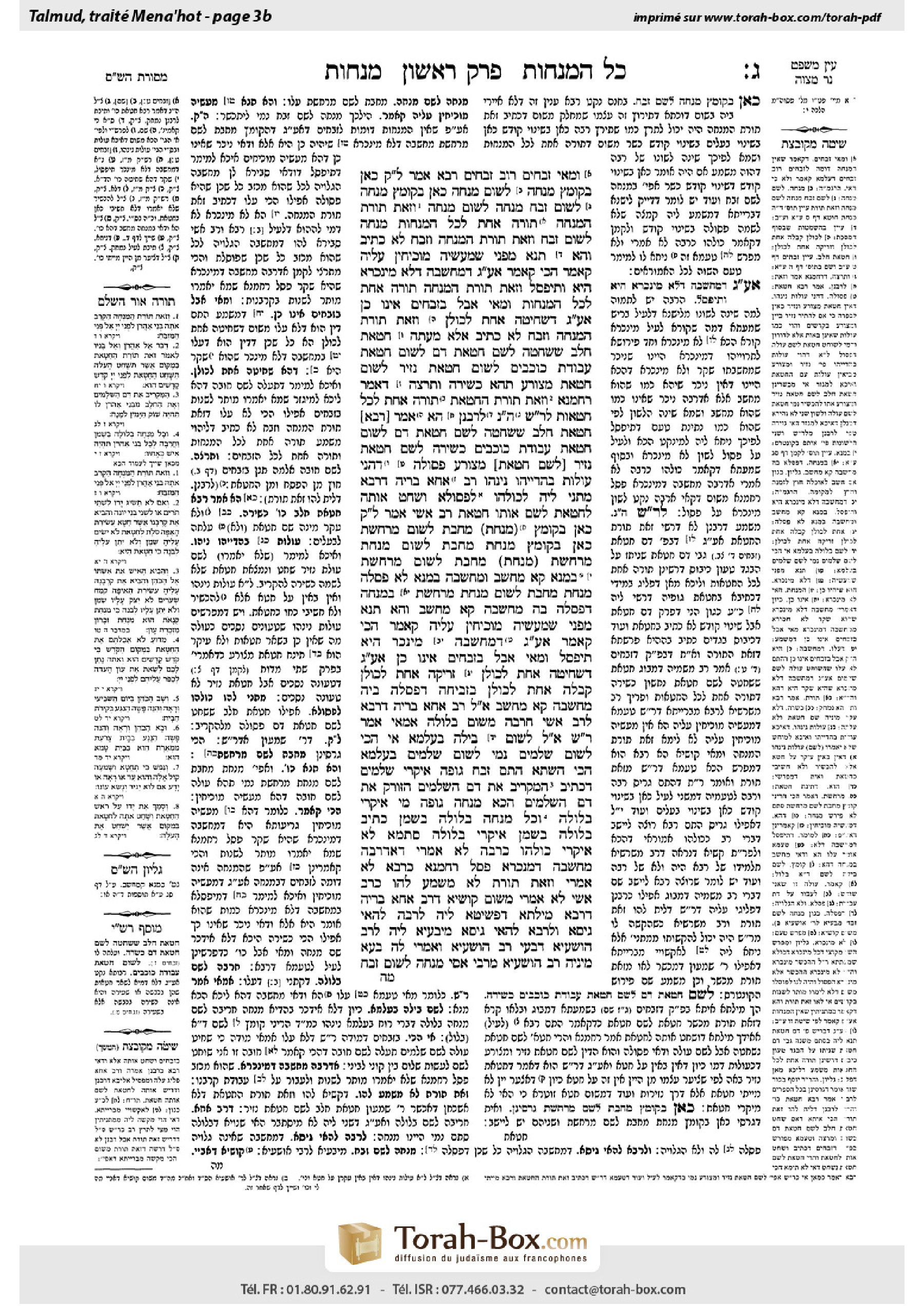
Menachot 3b: Talmud study for Daf Yomi
Daf Yomi is the daily study of one Talmud folio. Explore 37 tractates with scans, Hebrew text, Sefaria English and AI-generated French translations where annotated.
Passage selection and English or AI-generated French translation are available where the scan has annotations. Daf Study is independent of Torah-Box and Sefaria.
Browse Menachot · מנחות · All tractatesMenachot 3b text and translations
This page of Menachot includes the Aramaic text, an English translation and an AI-generated French translation, alongside the scan above.
מנחות ג׳ ב · Aramaic and Hebrew text
וּמַאי זְבָחִים? רוֹב זְבָחִים.
רָבָא אָמַר, לָא קַשְׁיָא: כָּאן – בְּקוֹמֵץ מִנְחָה לְשׁוּם מִנְחָה, כָּאן – בְּקוֹמֵץ מִנְחָה לְשׁוּם זֶבַח.
מִנְחָה לְשׁוּם מִנְחָה – ״וְזֹאת תּוֹרַת הַמִּנְחָה״, תּוֹרָה אַחַת לְכׇל הַמְּנָחוֹת; מִנְחָה לְשׁוּם זֶבַח – ״וְזֹאת תּוֹרַת הַמִּנְחָה וְזֶבַח״ לָא כְּתִיב.
וְהָא תַּנָּא ״מִפְּנֵי שֶׁמַּעֲשֶׂיהָ מוֹכִיחִין עָלֶיהָ״ קָאָמַר? הָכִי קָאָמַר: אַף עַל גַּב דְּמַחְשָׁבָה דְּלָא מִינַּכְרָא הִיא, וְתִיפְּסֵל, ״וְזֹאת תּוֹרַת הַמִּנְחָה״ – תּוֹרָה אַחַת לְכׇל הַמְּנָחוֹת.
וּמַאי אֲבָל בִּזְבָחִים אֵינוֹ כֵן?
אַף עַל גַּב דִּשְׁחִיטָה אַחַת לְכוּלָּן, ״וְזֹאת תּוֹרַת הַמִּנְחָה וְזֶבַח״ לָא כְּתִיב.
אֶלָּא מֵעַתָּה, חַטַּאת חֵלֶב שֶׁשְּׁחָטָהּ לְשֵׁם חַטַּאת דָּם, לְשׁוּם חַטַּאת עֲבוֹדָה זָרָה, לְשׁוּם חַטַּאת נָזִיר, לְשׁוּם חַטַּאת מְצוֹרָע – תְּהֵא כְּשֵׁירָה וּתְרַצֶּה, דְּאָמַר רַחֲמָנָא: ״וְזֹאת תּוֹרַת הַחַטָּאת״, תּוֹרָה אַחַת לְכׇל חַטָּאוֹת!
לְרַבִּי שִׁמְעוֹן הָכִי נָמֵי, לְרַבָּנַן הָא אָמַר: חַטַּאת חֵלֶב שֶׁשְּׁחָטָהּ לְשֵׁם חַטַּאת דָּם, לְשׁוּם חַטַּאת עֲבוֹדָה זָרָה – כְּשֵׁירָה, לְשֵׁם חַטַּאת נָזִיר מְצוֹרָע – פְּסוּלָה, דְּהָנֵי עוֹלוֹת בַּהֲדַיְיהוּ נִינְהוּ.
רַב אַחָא בְּרֵיהּ דְּרָבָא מַתְנֵי לֵיהּ לְכוּלְּהוּ לִפְסוּלָא, ״וְשָׁחַט אוֹתָהּ לְחַטָּאת״ – לְשֵׁם אוֹתוֹ חַטָּאת.
רַב אָשֵׁי אָמַר, לָא קַשְׁיָא: כָּאן – בְּקוֹמֵץ מִנְחַת מַחֲבַת לְשׁוּם מַרְחֶשֶׁת, כָּאן – בְּקוֹמֵץ מִנְחַת מַחֲבַת לְשׁוּם מִנְחַת מַרְחֶשֶׁת.
מִנְחַת מַחֲבַת לְשׁוּם מַרְחֶשֶׁת – בְּמָנָא קָא מְחַשֵּׁב, וּמַחְשָׁבָה בְּמָנָא לָא פָּסְלָה; מִנְחַת מַחֲבַת לְשׁוּם מִנְחַת מַרְחֶשֶׁת – בְּמִנְחָה דְּפָסְלָה בָּהּ מַחְשָׁבָה קָא מְחַשֵּׁב.
וְהָא תַּנָּא ״מִפְּנֵי שֶׁמַּעֲשֶׂיהָ מוֹכִיחִין עָלֶיהָ״ קָאָמַר? הָכִי קָאָמַר: אַף עַל גַּב דְּמַחְשָׁבָה מִינְּכַר הִיא, תִּיפְּסֵל.
וּמַאי אֲבָל בִּזְבָחִים אֵינוֹ כֵן? אַף עַל גַּב דִּשְׁחִיטָה אַחַת לְכוּלָּן, זְרִיקָה אַחַת לְכוּלָּן, קַבָּלָה אַחַת לְכוּלָּן – בִּזְבִיחָה דְּפָסְלָה בֵּיהּ מַחְשָׁבָה קָא מְחַשֵּׁב.
אֲמַר לֵיהּ רַב אַחָא בְּרֵיהּ דְּרָבָא לְרַב אָשֵׁי: חֲרֵבָה מִשּׁוּם בְּלוּלָה, אַמַּאי אָמַר רַבִּי שִׁמְעוֹן? אֲמַר לֵיהּ: לְשׁוּם בִּילָּה בְּעָלְמָא.
אִי הָכִי, לְשׁוּם שְׁלָמִים נָמֵי, לְשׁוּם שְׁלָמִים בְּעָלְמָא?
הָכִי הַשְׁתָּא? הָתָם זֶבַח גּוּפֵהּ אִיקְּרִי שְׁלָמִים, דִּכְתִיב: ״הַמַּקְרִיב אֶת דַּם הַשְּׁלָמִים״, ״הַזֹּרֵק אֶת דַּם הַשְּׁלָמִים״. הָכָא מִנְחָה גּוּפַהּ מִי אִיקְּרַי בְּלוּלָה? ״וְכׇל מִנְחָה בְלוּלָה בַשֶּׁמֶן״ כְּתִיב, ״בְּלוּלָה בַשֶּׁמֶן״ אִיקְּרַי, ״בְּלוּלָה״ סְתָמָא לָא אִיקְּרַי.
כּוּלְּהוּ כְּרַבָּה לָא אָמְרִי, דְּאַדְּרַבָּה, מַחְשָׁבָה דְּמִנַּכְרָא פְּסַל רַחֲמָנָא.
כְּרָבָא לָא אָמְרִי, ״וְזֹאת תּוֹרַת״ לָא מַשְׁמַע לְהוּ.
כְּרַב אָשֵׁי לָא אָמְרִי, מִשּׁוּם קוּשְׁיָא דְּרַב אַחָא בְּרֵיהּ דְּרָבָא.
מִילְּתָא דִּפְשִׁיטָא לֵיהּ לְרַבָּה לְהַאי גִּיסָא, וּלְרָבָא לְהַאי גִּיסָא, מִיבַּעְיָא לֵיהּ לְרַב הוֹשַׁעְיָא. דְּבָעֵי רַב הוֹשַׁעְיָא, וְאָמְרִי לַהּ: בְּעָא מִינֵּיהּ רַב הוֹשַׁעְיָא מֵרַבִּי אַסִּי: מִנְחָה לְשׁוּם זֶבַח
Menachot 3b · English translation
And what does Rabbi Shimon mean when he says that meal offerings are not similar to slaughtered offerings? He means that they are not similar to most slaughtered offerings. There are, however, certain slaughtered offerings whose preparation, which is unique to that particular offering, is proof that it is that offering. In those instances, Rabbi Shimon maintains that the offerings fulfill the obligations of their respective owners despite the improper intent.
§ The Gemara cites another resolution of the apparent contradiction between the two baraitot that report conflicting opinions of Rabbi Shimon. Rava said: It is not difficult. Here, where Rabbi Shimon says that a meal offering that was sacrificed not for its own sake fulfills the owner’s obligation, he is referring to a case where one removes a handful from a meal offering for the sake of a meal offering. There, where he says that it does not fulfill the owner’s obligation, he is referring to a case where one removes a handful from a meal offering for the sake of a slaughtered offering.
Rava elaborates: If one removes a handful from a meal offering for the sake of a different meal offering he fulfills his obligation, as the verse states: “And this is the law of the meal offering” (Leviticus 6:7). This indicates that there is one law for all the meal offerings, i.e., they are all considered variations of the same offering, and are different only with regard to how they should be sacrificed ab initio. Conversely, if one sacrificed a meal offering for the sake of a slaughtered offering, since the phrase: And this is the law of the meal offering and a slaughtered offering, is not written anywhere, there is no reason to conclude that one fulfills his obligation under such circumstances.
The Gemara questions how Rava can say that the verse “And this is the law of the meal offering” serves as the basis for the opinion of Rabbi Shimon: But doesn’t the tanna, i.e., Rabbi Shimon, say that his reasoning is that for any particular meal offering, its mode of preparation proves what it is? The Gemara explains that this is what Rabbi Shimon is saying: Even though sacrificing a meal offering for the sake of a different meal offering is a case where it is not recognizable that the intention fits the offering, i.e., the intent does not match the rites being performed, and the offering should therefore be disqualified, the verse states: “And this is the law of the meal offering,” which teaches that there is one law for all the meal offerings.
And what does Rabbi Shimon mean when he says: But with regard to slaughtered offerings it is not so? This clause indicates that the similarity between the rites of various slaughtered offerings is a reason why they should not be valid, whereas according to the above reasoning the opposite is so.
The Gemara explains this part of Rabbi Shimon’s statement: Even though there is one manner of slaughter for all animal offerings, and therefore one might think that the owner has fulfilled his obligation despite the improper intent, the phrase: And this is the law of the meal offering and a slaughtered offering, is not written. In other words, it is not stated: This is the law of a slaughtered offering, in the manner that a verse states: “This is the law of the meal offering.” Therefore, the owner of a slaughtered offering does not fulfill his obligation if there is improper intent, notwithstanding the similarity between the acts of slaughter.
The Gemara asks: If that is so, that the phrase “And this is the law of the meal offering” teaches that a meal offering is not disqualified despite the improper intent for a different meal offering, then analogously, a sin offering brought to atone for eating forbidden fat that one slaughtered for the sake of a sin offering to atone for drinking blood, or for the sake of a sin offering to atone for idol worship, or for the sake of a sin offering of a nazirite, or for the sake of a sin offering of a leper should be valid and effect acceptance. As the Merciful One states: “And this is the law of the sin offering” (Leviticus 6:18), from which it should be derived that there is one law for all sin offerings.
The Gemara responds: According to the opinion of Rabbi Shimon, such a sin offering is indeed valid and effects acceptance for its owner. The Gemara notes: According to the Rabbis, Rava says: A sin offering brought to atone for eating forbidden fat that one slaughtered for the sake of a sin offering to atone for drinking blood or for the sake of a sin offering to atone for idol worship is valid. But if he slaughtered it for the sake of a sin offering of a nazirite or for the sake of a sin offering of a leper it is disqualified, as with regard to these offerings, there are burnt offerings brought together with them.
Rav Aḥa, son of Rava, teaches that Rava holds that the halakha in all of these cases is disqualification of the sin offering. The reason is that the verse states: “And slaughter it for a sin offering” (Leviticus 4:33). The word “it” indicates that it must be sacrificed for the sake of that particular sin offering, and it may not be slaughtered for the sake of a different one.
§ The Gemara cites a third resolution of the apparent contradiction between the two baraitot that report conflicting opinions of Rabbi Shimon. Rav Ashi said that it is not difficult. Here, where Rabbi Shimon says that the meal offering is fit and fulfills the obligation of the owner, he is referring to a case where one states that he is removing a handful from a pan meal offering for the sake of a deep pan, i.e., he mentions only the vessel and not the offering. There, where it does not fulfill the owner’s obligation, he states that he is removing a handful from a pan meal offering for the sake of a deep-pan meal offering.
Rav Ashi elaborates: When one bringing a pan meal offering states that he is removing a handful from a pan meal offering for the sake of a deep pan, he has intent only with regard to the type of vessel, and intention with regard to the type of vessel does not disqualify offerings, as he is not sacrificing the vessel, and therefore the owner’s obligation is fulfilled. By contrast, when he states that he is removing a handful from a pan meal offering for the sake of a deep-pan meal offering, he has intent with regard to the type of meal offering, which improper intention does disqualify. Consequently, the owner’s obligation is not fulfilled.
The Gemara questions how Rav Ashi can maintain that this is the reasoning of Rabbi Shimon: But doesn’t the tanna, i.e., Rabbi Shimon, say that his reasoning is that for any particular meal offering, its mode of preparation proves what it is? The Gemara explains that this is what Rabbi Shimon is saying: Even though when he removes a handful from a pan meal offering explicitly for the sake of a deep pan, it is a case where the falseness of the intention is recognizable and the offering should therefore be disqualified, it is nevertheless valid and fulfills the owner’s obligation, as intentions with regard to the vessel are irrelevant.
The Gemara asks: And what does Rabbi Shimon mean when he says: But with regard to slaughtered offerings it is not so? He means that even though there is one manner of slaughter for all offerings, and one manner of sprinkling of the blood for all offerings, and one manner of collection of the blood for all offerings, i.e., if one performs any of these rites for the sake of a different offering it is not recognizable that his intent is false, and therefore it might have been thought that the owner does fulfill his obligation, nevertheless he has improper intent with regard to an aspect of slaughtering, such as slaughtering a burnt offering for the sake of a peace offering, which improper intention does disqualify.
Rav Aḥa, son of Rava, said to Rav Ashi: If this is the reasoning of Rabbi Shimon, then with regard to a case where one removes a handful from a dry meal offering for the sake of a meal offering mixed with oil, why did Rabbi Shimon say that it fulfills the owner’s obligation? Since his intent concerns the meal offering itself, it should disqualify the offering. Rav Ashi said to him: When Rabbi Shimon says that such a meal offering fulfills the owner’s obligation he is referring to a case where one removes a handful merely for the sake of mixing, not for the sake of a meal offering mixed with oil.
The Gemara challenges: If so, then when one slaughters a burnt offering for the sake of a peace offering as well, one can say that his intent is merely for the sake of peace [shelamim] between himself and God. Why then does Rabbi Shimon say that this burnt offering does not fulfill the obligation of the owner?
The Gemara rejects this challenge: How can these cases be compared? There, the offering itself is called shelamim, as it is written: “Who sacrifices the blood of the peace offering [shelamim]” (Leviticus 7:33), and it is also written: “Who sprinkles the blood of the peace offering” (Leviticus 7:14). Here, by contrast, is a meal offering itself called mixed? It is written: “And every meal offering, mixed with oil” (Leviticus 7:10), indicating that there is a meal offering that is called: Mixed with oil, but it is not simply called: Mixed. One’s intent to sacrifice a dry meal offering for the sake of mixing is therefore not a reference to the offering itself.
§ Three resolutions have been suggested for the apparent contradiction between the statements of Rabbi Shimon in two baraitot concerning whether or not a meal offering whose handful was removed not for its own sake fulfills the obligation of its owner. Rabba’s answer was that there is a difference between intent for another meal offering, in which case the owner fulfills his obligation, as the intent is recognizably improper, and intent for someone else, which is not recognizably improper. The Gemara comments: All the other Sages, i.e., Rava and Rav Ashi, do not say as Rabba did in resolving the contradiction, as they do not accept his reasoning, claiming that on the contrary, the Merciful One disqualifies recognizably false intent.
The Gemara continues: Rava resolved the contradiction by saying that a meal offering from which a handful was removed for the sake of another meal offering effects acceptance for the owner, as the verse states: “And this is the law of the meal offering” (Leviticus 6:7), indicating that there is one law for all meal offerings, whereas a meal offering from which a handful was removed for the sake of an animal offering does not effect acceptance. Rabba and Rav Ashi do not say as Rava did in resolving the contradiction, as the verse that states: “And this is the law of the meal offering,” does not indicate to them that there should be one law for all meal offerings.
The Gemara continues: Rav Ashi resolved the contradiction by saying that when one removes the handful from a meal offering for the sake of a vessel the meal offering effects acceptance for the owner, as intent concerning the vessel itself is inconsequential, whereas when one removes the handful for the sake of another meal offering, the meal offering does not fulfill the owner’s obligation. Rabba and Rava did not say as Rav Ashi did in resolving the contradiction because of the difficulty posed by Rav Aḥa, son of Rava, from a case where one removes the handful of a dry meal offering for the sake of a mixed one. Rabbi Shimon holds that such a meal offering fulfills the owner’s obligation even though his intent concerns the meal offering itself, not the vessel.
The Gemara notes: The matter that is obvious to Rabba in one way, i.e., that with regard to meal offerings recognizably false intention is disregarded, but when the false intention is not recognizable the offering does not fulfill the owner’s obligation, and that is obvious to Rava in the other way, i.e., that in cases of recognizably false intention the offering should not fulfill the owner’s obligation, is a dilemma for Rav Hoshaya. As Rav Hoshaya raises a dilemma, and some say that Rav Hoshaya raises this dilemma before Rav Asi: In the case of one who sacrifices a meal offering for the sake of a slaughtered offering,
Menachot 3b · Traduction française (IA)
Et que veut dire Rabbi Shimon lorsqu’il affirme que les offrandes de farine ne sont pas comparables aux sacrifices animaux ? Il veut dire qu’elles ne sont pas comparables à la plupart des sacrifices animaux. Il existe toutefois certains sacrifices animaux dont le mode de préparation, propre à chacun d’eux, permet de reconnaître de quel sacrifice il s’agit. Dans ces cas, Rabbi Shimon estime que les sacrifices acquittent les obligations de leurs propriétaires malgré l’intention inadéquate.
§ La Guemara cite une autre résolution de la contradiction apparente entre les deux baraïtot qui rapportent des opinions divergentes de Rabbi Shimon. Rava dit : Il n’y a pas de difficulté. Ici, lorsque Rabbi Shimon affirme qu’une offrande de farine sacrifiée sans être destinée à elle-même acquitte l’obligation du propriétaire, il s’agit d’un cas où l’on prélève une poignée d’une offrande de farine en vue d’une autre offrande de farine. Là, lorsqu’il affirme qu’elle n’acquitte pas l’obligation du propriétaire, il s’agit d’un cas où l’on prélève une poignée d’une offrande de farine en vue d’un sacrifice animal.
Rava précise : Si l’on prélève une poignée d’une offrande de farine en vue d’une autre offrande de farine, on s’acquitte de son obligation, comme le dit le verset : « Et voici la loi de l’offrande de farine » (Lévitique 6:7). Cela indique qu’il existe une seule loi pour toutes les offrandes de farine, c’est-à-dire qu’elles sont toutes considérées comme des variantes d’un même sacrifice et ne diffèrent que par la manière dont elles doivent être offertes a priori. À l’inverse, si l’on sacrifie une offrande de farine en vue d’un sacrifice animal, puisque l’expression « Et voici la loi de l’offrande de farine et du sacrifice animal » ne figure nulle part, rien ne permet de conclure que, dans de telles circonstances, on s’acquitte de son obligation.
La Guemara demande comment Rava peut affirmer que le verset « Et voici la loi de l’offrande de farine » fonde l’opinion de Rabbi Shimon : le tanna, c’est-à-dire Rabbi Shimon, ne dit-il pas que son raisonnement est que, pour toute offrande de farine particulière, son mode de préparation permet de reconnaître de quelle offrande il s’agit ? La Guemara explique que voici ce que dit Rabbi Shimon : même si sacrifier une offrande de farine en vue d’une autre offrande de farine est un cas où l’intention ne correspond pas aux rites accomplis et où l’on ne peut donc pas reconnaître qu’elle convient à l’offrande, de sorte que celle-ci devrait être invalidée, le verset dit : « Et voici la loi de l’offrande de farine », ce qui enseigne qu’il existe une seule loi pour toutes les offrandes de farine.
Et que veut dire Rabbi Shimon lorsqu’il dit : « Mais, en ce qui concerne les sacrifices animaux, il n’en va pas ainsi » ? Cette clause indique que la similitude entre les rites de divers sacrifices animaux est une raison de les considérer comme valides, alors que, selon le raisonnement exposé plus haut, c’est le contraire.
La Guemara explique cette partie de la déclaration de Rabbi Shimon : même s’il existe une seule manière d’abattre tous les sacrifices animaux, et que l’on pourrait donc penser que le propriétaire s’est acquitté de son obligation malgré l’intention inadéquate, l’expression « Et voici la loi de l’offrande de farine et du sacrifice animal » ne figure pas dans le texte. Autrement dit, il n’est pas écrit : « Voici la loi d’un sacrifice animal », comme il est écrit : « Voici la loi de l’offrande de farine ». Par conséquent, le propriétaire d’un sacrifice animal ne s’acquitte pas de son obligation si son intention est inadéquate, malgré la similitude des actes d’abattage.
La Guemara demande : Si tel est le cas, si l’expression « Et voici la loi de l’offrande de farine » enseigne qu’une offrande de farine n’est pas invalidée malgré une intention visant une autre offrande de farine, alors, par analogie, un sacrifice expiatoire apporté pour expier la consommation de graisse interdite, qu’on a abattu en vue d’un sacrifice expiatoire destiné à expier la consommation de sang, ou en vue d’un sacrifice expiatoire destiné à expier le culte idolâtre, ou en vue du sacrifice expiatoire d’un nazir, ou en vue du sacrifice expiatoire d’un lépreux, devrait être valide et produire l’agrément. Car le Miséricordieux dit : « Et voici la loi du sacrifice expiatoire » (Lévitique 6:18), d’où l’on devrait déduire qu’il existe une seule loi pour tous les sacrifices expiatoires.
La Guemara répond : selon l’opinion de Rabbi Shimon, un tel sacrifice expiatoire est effectivement valide et produit l’agrément pour son propriétaire. La Guemara note : selon les Rabbins, Rava dit qu’un sacrifice expiatoire apporté pour expier la consommation de graisse interdite, qu’on a abattu en vue d’un sacrifice expiatoire destiné à expier la consommation de sang ou le culte idolâtre, est valide. Mais si on l’a abattu en vue du sacrifice expiatoire d’un nazir ou d’un lépreux, il est invalidé, car ces sacrifices sont accompagnés d’holocaustes.
Rav Aḥa, fils de Rava, enseigne que, selon Rava, la halakha dans tous ces cas est que le sacrifice expiatoire est invalidé. La raison en est que le verset dit : « Et il l’abattra en sacrifice expiatoire » (Lévitique 4:33). Le mot « il » indique que l’animal doit être sacrifié en vue de ce sacrifice expiatoire particulier et qu’il ne peut pas être abattu en vue d’un autre.
§ La Guemara cite une troisième résolution de la contradiction apparente entre les deux baraïtot qui rapportent des opinions divergentes de Rabbi Shimon. Rav Ashi dit qu’il n’y a pas de difficulté. Ici, lorsque Rabbi Shimon affirme que l’offrande de farine est valide et acquitte le propriétaire de son obligation, il s’agit d’un cas où l’on déclare prélever une poignée d’une offrande de farine cuite dans une poêle en vue d’une poêle profonde, c’est-à-dire qu’on ne mentionne que le récipient et non l’offrande. Là, lorsqu’elle n’acquitte pas l’obligation du propriétaire, on déclare prélever une poignée d’une offrande de farine cuite dans une poêle en vue d’une offrande de farine cuite dans une poêle profonde.
Rav Ashi précise : lorsqu’on apporte une offrande de farine cuite dans une poêle et qu’on déclare prélever une poignée de cette offrande en vue d’une poêle profonde, l’intention ne porte que sur le type de récipient, et une intention relative au type de récipient n’invalide pas les sacrifices, puisqu’on ne sacrifie pas le récipient ; l’obligation du propriétaire est donc acquittée. En revanche, lorsqu’on déclare prélever une poignée d’une offrande de farine cuite dans une poêle en vue d’une offrande de farine cuite dans une poêle profonde, l’intention porte sur le type d’offrande de farine ; cette intention inadéquate invalide l’offrande. Par conséquent, l’obligation du propriétaire n’est pas acquittée.
La Guemara demande comment Rav Ashi peut soutenir qu’il s’agit là du raisonnement de Rabbi Shimon : le tanna, c’est-à-dire Rabbi Shimon, ne dit-il pas que son raisonnement est que, pour toute offrande de farine particulière, son mode de préparation permet de reconnaître de quelle offrande il s’agit ? La Guemara explique que voici ce que dit Rabbi Shimon : même lorsqu’on prélève explicitement une poignée d’une offrande de farine cuite dans une poêle en vue d’une poêle profonde, et que la fausseté de l’intention est manifeste, de sorte que l’offrande devrait être invalidée, elle est néanmoins valide et acquitte l’obligation du propriétaire, car les intentions relatives au récipient ne sont pas pertinentes.
La Guemara demande : Et que veut dire Rabbi Shimon lorsqu’il dit : « Mais, en ce qui concerne les sacrifices animaux, il n’en va pas ainsi » ? Il veut dire que, même s’il existe une seule manière d’abattre tous les sacrifices, une seule manière d’asperger le sang de tous les sacrifices et une seule manière de recueillir le sang de tous les sacrifices — c’est-à-dire que, si l’on accomplit l’un de ces rites en vue d’un autre sacrifice, il n’est pas manifeste que l’intention soit fausse, et l’on aurait donc pu penser que le propriétaire s’acquitte de son obligation —, il a néanmoins une intention inadéquate concernant un aspect de l’abattage, par exemple en abattant un holocauste en vue d’un sacrifice de paix ; cette intention inadéquate invalide l’offrande.
Rav Aḥa, fils de Rava, dit à Rav Ashi : Si tel est le raisonnement de Rabbi Shimon, alors, dans le cas où l’on prélève une poignée d’une offrande de farine sèche en vue d’une offrande de farine mélangée à de l’huile, pourquoi Rabbi Shimon dit-il que cela acquitte l’obligation du propriétaire ? Puisque son intention porte sur l’offrande de farine elle-même, elle devrait invalider l’offrande. Rav Ashi lui dit : lorsque Rabbi Shimon affirme qu’une telle offrande de farine acquitte l’obligation du propriétaire, il s’agit d’un cas où l’on prélève une poignée simplement en vue du mélange, et non en vue d’une offrande de farine mélangée à de l’huile.
La Guemara objecte : Si tel est le cas, lorsqu’on abat un holocauste en vue d’un sacrifice de paix, on peut également dire que l’intention vise simplement la paix [shelamim] entre soi et Dieu. Pourquoi Rabbi Shimon dit-il alors que cet holocauste n’acquitte pas l’obligation du propriétaire ?
La Guemara écarte cette objection : comment comparer ces cas ? Là, le sacrifice lui-même est appelé shelamim, comme il est écrit : « Celui qui offre le sang du sacrifice de paix [shelamim] » (Lévitique 7:33), et il est aussi écrit : « Celui qui asperge le sang du sacrifice de paix » (Lévitique 7:14). Ici, en revanche, l’offrande de farine elle-même est-elle appelée « mélangée » ? Il est écrit : « Et toute offrande de farine mélangée à de l’huile » (Lévitique 7:10), ce qui indique qu’il existe une offrande de farine appelée « mélangée à de l’huile », mais qu’elle n’est pas simplement appelée « mélangée ». L’intention d’offrir une offrande de farine sèche en vue du mélange ne renvoie donc pas à l’offrande elle-même.
§ Trois résolutions ont été proposées à la contradiction apparente entre les déclarations de Rabbi Shimon dans deux baraïtot quant à savoir si une offrande de farine dont la poignée a été prélevée sans être destinée à elle-même acquitte ou non l’obligation de son propriétaire. La réponse de Rabba était qu’il existe une différence entre une intention visant une autre offrande de farine — auquel cas le propriétaire s’acquitte de son obligation, car le caractère inadéquat de l’intention est manifeste — et une intention visant l’offrande de quelqu’un d’autre, dont le caractère inadéquat n’est pas manifeste. La Guemara commente : les autres Sages, c’est-à-dire Rava et Rav Ashi, ne répondent pas comme Rabba pour résoudre la contradiction, car ils n’acceptent pas son raisonnement et soutiennent qu’au contraire, le Miséricordieux invalide une intention manifestement fausse.
La Guemara poursuit : Rava a résolu la contradiction en disant qu’une offrande de farine dont la poignée a été prélevée en vue d’une autre offrande de farine produit l’agrément pour le propriétaire, comme le dit le verset : « Et voici la loi de l’offrande de farine » (Lévitique 6:7), ce qui indique qu’il existe une seule loi pour toutes les offrandes de farine ; en revanche, une offrande de farine dont la poignée a été prélevée en vue d’un sacrifice animal ne produit pas l’agrément. Rabba et Rav Ashi ne répondent pas comme Rava pour résoudre la contradiction, car, à leurs yeux, le verset qui dit : « Et voici la loi de l’offrande de farine » n’indique pas qu’il devrait exister une seule loi pour toutes les offrandes de farine.
La Guemara poursuit : Rav Ashi a résolu la contradiction en disant que, lorsqu’on prélève la poignée d’une offrande de farine en vue d’un récipient, l’offrande de farine produit l’agrément pour le propriétaire, car l’intention relative au récipient lui-même est sans conséquence ; en revanche, lorsqu’on prélève la poignée en vue d’une autre offrande de farine, l’offrande de farine n’acquitte pas l’obligation du propriétaire. Rabba et Rava n’ont pas répondu comme Rav Ashi pour résoudre la contradiction, en raison de la difficulté soulevée par Rav Aḥa, fils de Rava, à propos du cas où l’on prélève la poignée d’une offrande de farine sèche en vue d’une offrande mélangée. Rabbi Shimon estime que cette offrande de farine acquitte l’obligation du propriétaire, même si son intention porte sur l’offrande de farine elle-même, et non sur le récipient.
La Guemara note : ce qui est évident pour Rabba d’une certaine manière — à savoir que, concernant les offrandes de farine, une intention manifestement fausse est ignorée, mais que lorsque l’intention fausse n’est pas manifeste, l’offrande n’acquitte pas l’obligation du propriétaire — et ce qui est évident pour Rava de la manière opposée — à savoir que, dans les cas où l’intention fausse est manifeste, l’offrande ne devrait pas acquitter l’obligation du propriétaire — constitue un dilemme pour Rav Hoshaya. Rav Hoshaya soulève en effet un dilemme, et certains disent qu’il le soulève devant Rav Asi : dans le cas de celui qui sacrifie une offrande de farine en vue d’un sacrifice animal,
Traduction française générée par IA à partir de l’édition anglaise de Sefaria. Vérifie toujours un passage avec le texte source.
Text from Sefaria: William Davidson Edition - Vocalized Aramaic (unknown); William Davidson Edition - English (CC BY NC).