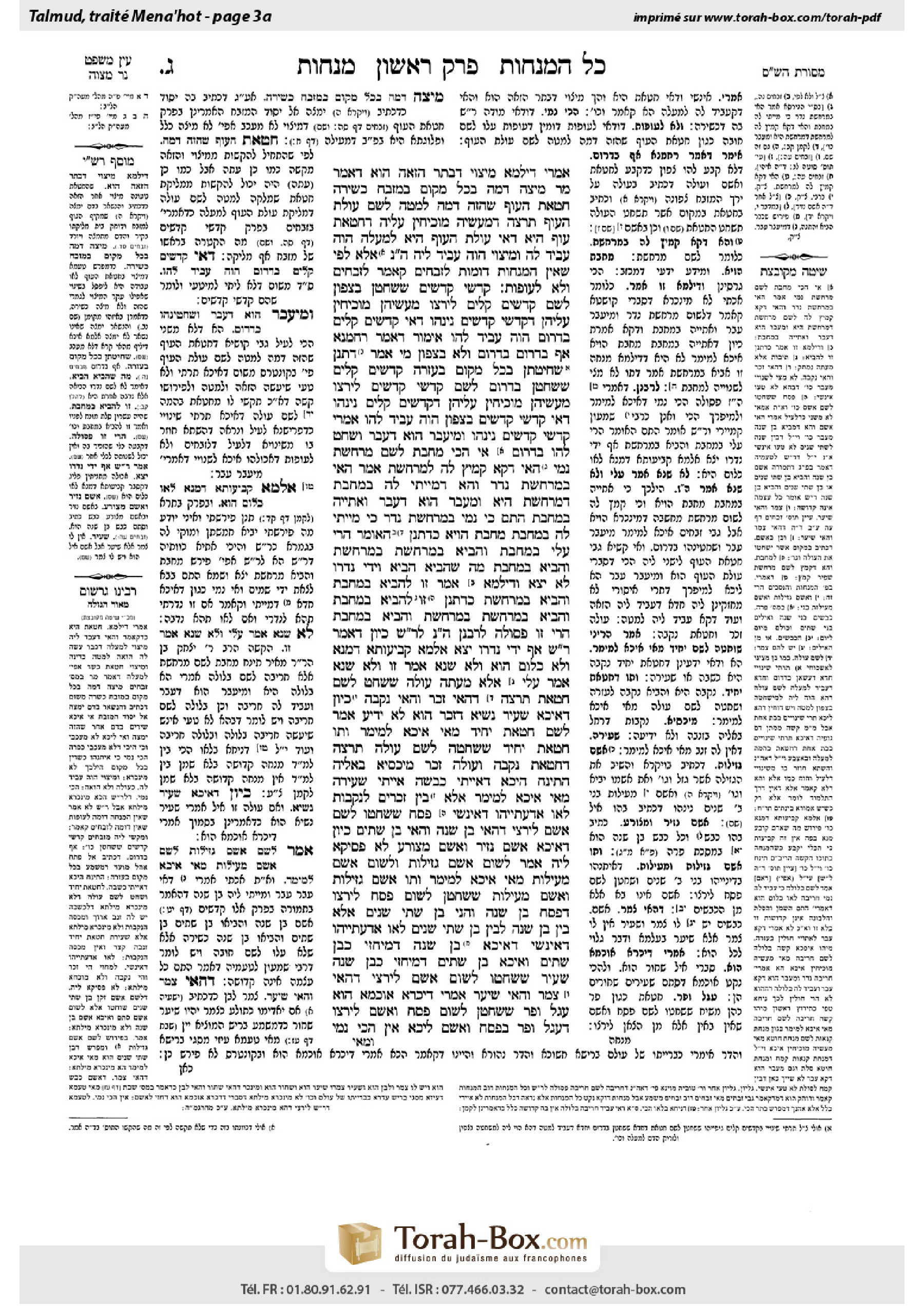
Menachot 3a: Talmud study for Daf Yomi
Daf Yomi is the daily study of one Talmud folio. Explore 37 tractates with scans, Hebrew text, Sefaria English and AI-generated French translations where annotated.
Passage selection and English or AI-generated French translation are available where the scan has annotations. Daf Study is independent of Torah-Box and Sefaria.
Browse Menachot · מנחות · All tractatesMenachot 3a text and translations
This page of Menachot includes the Aramaic text, an English translation and an AI-generated French translation, alongside the scan above.
מנחות ג׳ א · Aramaic and Hebrew text
אָמְרִי: דִּילְמָא מִיצּוּי דְּבָתַר הַזָּאָה הוּא, דְּאָמַר מָר: מִיצָּה דָּמָהּ בְּכׇל מָקוֹם בַּמִּזְבֵּחַ כְּשֵׁירָה.
חַטַּאת הָעוֹף שֶׁהִזָּה דָּמָהּ לְמַטָּה לְשֵׁם עוֹלַת הָעוֹף תְּרַצֶּה, דְּמַעֲשֶׂיהָ מוֹכִיחִין עָלֶיהָ דְּחַטַּאת עוֹף הִיא, דְּאִי עוֹלַת הָעוֹף הִיא – לְמַעְלָה הֲוָה עָבֵיד לַהּ, וּמִיצּוּי הֲוָה עָבֵיד לַיהּ!
הָכִי נָמֵי, אֶלָּא לְפִי שֶׁאֵין הַמְּנָחוֹת דּוֹמוֹת לַזְּבָחִים קָאָמַר – לַזְּבָחִים, וְלֹא לָעוֹפוֹת.
קׇדְשֵׁי קָדָשִׁים שֶׁשְּׁחָטָן בַּצָּפוֹן לְשֵׁם קָדָשִׁים קַלִּים, לִירַצּוֹ, מַעֲשֵׂיהֶן מוֹכִיחִין עֲלֵיהֶן דְּקׇדְשֵׁי קָדָשִׁים נִינְהוּ, דְּאִי קָדָשִׁים קַלִּים – בַּדָּרוֹם הֲוָה עָבֵיד לְהוּ.
אֵימוֹר דְּאָמַר רַחֲמָנָא אַף בַּדָּרוֹם, בַּדָּרוֹם וְלֹא בַּצָּפוֹן מִי אָמַר? דִּתְנַן: שְׁחִיטָתָן בְּכׇל מָקוֹם בָּעֲזָרָה.
קָדָשִׁים קַלִּים שֶׁשְּׁחָטָן בַּדָּרוֹם לְשֵׁם קׇדְשֵׁי קָדָשִׁים לִירַצּוֹ, מַעֲשֵׂיהֶן מוֹכִיחִין עֲלֵיהֶן, דְּקָדָשִׁים קַלִּים נִינְהוּ, דְּאִי קׇדְשֵׁי קָדָשִׁים – בַּצָּפוֹן הֲוָה עָבֵיד לְהוּ.
אָמְרִי: קׇדְשֵׁי קָדָשִׁים נִינְהוּ, וּמִיעְבָּר הוּא דַּעֲבַר, וּשְׁחַט לְהוּ בַּדָּרוֹם.
אִי הָכִי, מַחֲבַת לְשֵׁם מַרְחֶשֶׁת נָמֵי, הַאי דְּקָא קָמֵיץ לֵהּ לְמַרְחֶשֶׁת, אֲמַר: הַאי בְּמַרְחֶשֶׁת נְדַר, וְהָא דְּמַיְיתֵי לַהּ בְּמַחֲבַת – דְּמַרְחֶשֶׁת הִיא, וּמִעְבָּר הוּא דַּעֲבַר וְאַתְיַיהּ בְּמַחֲבַת!
הָתָם, כִּי נָמֵי בְּמַרְחֶשֶׁת נָדַר, כִּי מַיְיתֵי לַהּ בְּמַחֲבַת – מַחֲבַת הָוְיָא.
כְּדִתְנַן: הָאוֹמֵר ״הֲרֵי עָלַי בְּמַחֲבַת״ וְהֵבִיא בְּמַרְחֶשֶׁת, ״בְּמַרְחֶשֶׁת״ וְהֵבִיא בְּמַחֲבַת – מַה שֶּׁהֵבִיא הֵבִיא, וִידֵי נִדְרוֹ לֹא יָצָא.
וְדִילְמָא אָמַר ״זוֹ לְהָבִיא בְּמַחֲבַת״ וְהֵבִיא בְּמַרְחֶשֶׁת, כְּדִתְנַן: זוֹ לְהָבִיא בְּמַחֲבַת וְהֵבִיא בְּמַרְחֶשֶׁת, בְּמַרְחֶשֶׁת וְהֵבִיא בְּמַחֲבַת – הֲרֵי זוֹ פְּסוּלָה.
לְרַבָּנַן הָכִי נָמֵי, לְרַבִּי שִׁמְעוֹן, כֵּיוָן דְּאָמַר רַבִּי שִׁמְעוֹן: ״אַף יְדֵי נִדְרוֹ יָצָא״, אַלְמָא קְבִיעוּתָא דְמָנָא וְלָא כְּלוּם הוּא, וְלָא שְׁנָא אָמַר ״זוֹ״, וְלָא שְׁנָא אָמַר ״עָלַי״.
אֶלָּא מֵעַתָּה, עוֹלָה שֶׁשָּׁחַט לְשֵׁם חַטָּאת תְּרַצֶּה, דְּהַאי זָכָר וְהַאי נְקֵבָה, כֵּיוָן דְּאִיכָּא שְׂעִיר נָשִׂיא דְּזָכָר הוּא – לָא יְדִיעַ.
אָמַר: ״לְשֵׁם חַטַּאת יָחִיד״, מַאי אִיכָּא לְמֵימַר? וְתוּ, חַטַּאת יָחִיד שֶׁשְּׁחָטָהּ לְשֵׁם עוֹלָה תְּרַצֶּה, דְּחַטָּאת נְקֵבָה וְעוֹלָה זָכָר? מִיכַּסְּיָא בְּאַלְיָה.
הָתִינַח הֵיכָא דְּאַיְיתִי כִּבְשָׂה, אַיְיתִי שְׂעִירָה, מַאי אִיכָּא לְמֵימַר? אֶלָּא, בֵּין זְכָרִים לִנְקֵבוֹת לָאו אַדַּעְתַּיְיהוּ דְאִינָשֵׁי.
פֶּסַח שֶׁשְּׁחָטוֹ לְשֵׁם אָשָׁם לִירַצֵּי, דְּהַאי בֶּן שָׁנָה, וְהַאי בֶּן שְׁתַּיִם, כֵּיוָן דְּאִיכָּא אֲשַׁם נָזִיר וַאֲשַׁם מְצוֹרָע, לָא פְּסִיקָא לֵיהּ.
אָמַר: ״לְשׁוּם אֲשַׁם גְּזֵילוֹת וּלְשׁוּם אֲשַׁם מְעִילוֹת״, מַאי אִיכָּא לְמֵימַר? וְתוּ, אֲשַׁם גְּזֵילוֹת וַאֲשַׁם מְעִילוֹת שֶׁשְּׁחָטָן לְשׁוּם פֶּסַח לִירַצּוֹ, דְּפֶסַח בֶּן שָׁנָה וְהָנֵי בֶּן שְׁתֵּי שָׁנִים!
אֶלָּא, בֵּין בֶּן שָׁנָה לְבֵין בֶּן שְׁתֵּי שָׁנִים לָאו אַדַּעְתַּיְיהוּ דְאִינָשֵׁי, דְּאִיכָּא בֶּן שָׁנָה דְּמִיחֲזֵי כְּבֶן שְׁתַּיִם, וְאִיכָּא בֶּן שְׁתַּיִם דְּמִיחֲזֵי כְּבֶן שָׁנָה.
שָׂעִיר שֶׁשְּׁחָטוֹ לְשׁוּם אָשָׁם לִירַצֵּי, דְּהַאי צֶמֶר וְהַאי שֵׂיעָר, אָמְרִי: דִּיכְרָא אוּכָּמָא הוּא.
עֵגֶל וּפַר שֶׁשְּׁחָטָן לְשׁוּם פֶּסַח וְאָשָׁם, לִירַצּוֹ, דְּעֵגֶל וּפַר בְּפֶסַח וְאָשָׁם לֵיכָּא! אִין הָכִי נָמֵי,
Menachot 3a · English translation
The Gemara responds: This is not considered recognizably false intent, as people might say: Perhaps it is actually a sin offering and he has already sprinkled its blood below the red line. And as for the fact that he squeezed its blood above the red line, they will say: It is the squeezing that follows sprinkling, which may be performed above the red line in the case of a sin offering. As the Master said: If one squeezed the blood of a bird sin offering in any place on the altar, the offering is valid. Since people might erroneously think that this bird is actually a sin offering, this intent is not considered recognizably false, so the offering is disqualified.
The Gemara asks another question: According to Rabba’s resolution, a bird sin offering whose blood a priest sprinkled below the red line for the sake of a bird burnt offering should effect acceptance, as the actions performed on it prove that it is a bird sin offering. Because if it is in fact a bird burnt offering, he would have performed it above the red line, and he would have performed the act of squeezing instead of sprinkling.
The Gemara responds: Indeed, according to Rabbi Shimon such a bird offering effects acceptance and fulfills the obligation of the owner. In fact, bird offerings were not discussed by Rabbi Shimon at all. Rather, he said: Because meal offerings are not similar to slaughtered offerings, which means that they are not similar to slaughtered animal offerings, but he did not say that they are not similar to bird offerings.
The Gemara asks: But if so, then offerings of the most sacred order that one slaughtered in the northern part of the Temple courtyard, which is a requirement that applies only to offerings of the most sacred order, for the sake of offerings of lesser sanctity, should effect acceptance for their owners, as the actions performed on them prove that they are offerings of the most sacred order. Because if they are in fact offerings of lesser sanctity, he would have performed their slaughter in the southern part of the Temple courtyard.
The Gemara answers: The slaughter of an offering in the northern part of the Temple courtyard is not indicative of the type of offering one intends it to be, as one can say that the Merciful One states that offerings of lesser sanctity may be slaughtered even in the southern part of the courtyard. Did He say that these offerings must be slaughtered specifically in the southern part and not in the northern part? This is as we learned in a mishna (Zevaḥim 55a), that the slaughter of offerings of lesser sanctity may be performed in any place within the Temple courtyard.
The Gemara asks: If so, then offerings of lesser sanctity that one slaughtered in the southern part of the Temple courtyard for the sake of offerings of the most sacred order should effect acceptance for their owners, as the actions performed on them prove that they are offerings of lesser sanctity. Because if they are in fact offerings of the most sacred order, he would have performed their slaughter in the northern part of the Temple courtyard.
The Gemara responds: The fact that an offering was slaughtered in the southern part of the Temple courtyard is not a clear indication that it was intended as an offering of lesser sanctity, as people might say: They are in fact offerings of the most sacred order, but the priest transgressed the mitzva to slaughter them in the northern part of the courtyard and slaughtered them in the southern part.
The Gemara asks: If so, i.e., if people might suspect an individual of performing the rite of an offering in an improper manner, then if a priest removes a handful from a pan meal offering for the sake of a deep-pan meal offering as well, one who sees that this priest removes a handful for the sake of a deep-pan meal offering might say: This owner took a vow to bring a meal offering in a deep pan, and as for the fact that he brings it in a pan, it is actually the meal offering of a deep pan and the owner transgressed the mitzva to bring it in a deep pan, and brought it in a pan. Why, then, does Rabbi Shimon maintain that such a meal offering satisfies the obligation of its owner?
The Gemara explains: There, where the priest removed the handful from a pan meal offering for the sake of a deep-pan meal offering, even if the owner took a vow to bring a meal offering in a deep pan, when he brings it in a pan it is considered a valid pan meal offering, and therefore the priest’s intention is recognizably false.
This is as we learned in a mishna (102b): One who says: It is incumbent upon me to bring a meal offering prepared in a pan, and he brought it in a deep pan, or if he says: It is incumbent upon me to bring a meal offering prepared in a deep pan, and he brought it in a pan, the meal offering that he brought, he brought, i.e., it is valid and the priest performs the rites of the meal offering that he actually brought, but he did not fulfill the obligation resulting from his vow, and he must bring another meal offering to fulfill that obligation.
The Gemara asks: But even so, the priest’s improper intent remains indiscernible, as people might think: Perhaps the owner said: This tenth of an ephah of flour is a meal offering that I must bring in a pan, and in spite of this he brought it in a deep pan. Such a meal offering is disqualified and is not considered a valid pan meal offering, as we learned in that same mishna: One who took a vow, saying: This tenth of an ephah of flour is a meal offering that I must bring in a pan, and he brought it in a deep pan, or if he vowed: This tenth of an ephah of flour is a meal offering that I must bring in a deep pan, and he brought it in a pan, it is disqualified, as he did not fulfill his vow. If so, how can Rabbi Shimon say that such a meal offering satisfies the owner’s obligation, when the intent is not recognizably false?
The Gemara responds: According to the Rabbis, i.e., according to the opinion of the mishna just cited, there is indeed a difficulty. But according to Rabbi Shimon there is no difficulty, since with regard to a case where one took a vow, saying: It is incumbent upon me to bring a pan meal offering, and then he brought it in a deep pan, Rabbi Shimon says: He has fulfilled even the obligation resulting from his vow. Evidently, the designation of the vessel for a meal offering is nothing according to Rabbi Shimon, and there is no difference in this regard whether he said: This is for a particular type of meal offering, and there is no difference whether he said: It is incumbent upon me to bring a particular meal offering. In both instances the unique actions of each particular meal offering prove its identity, and therefore the owner fulfills his obligation regardless of the priest’s improper intent.
The Gemara asks: If that is so, that in a case where the manner of its preparation proves the identity of an offering the owner fulfills his obligation, then a burnt offering that one slaughtered for the sake of a sin offering should effect acceptance. His actions prove that it is a burnt offering, as this, a burnt offering, is always male, and that, a sin offering, is female. The Gemara answers: Since there is one sin offering, the goat of the Nasi, which is male, it is unknown whether this animal was a burnt offering or the sin offering of the Nasi, and its gender is not conclusive proof.
The Gemara continues to ask: But in a case where one said: I am hereby slaughtering this animal for the sake of a sin offering of an individual, which is always female, what can be said? Since a male animal cannot be mistaken for such a sin offering, why doesn’t this burnt offering satisfy the obligation of the owner? And furthermore, a sin offering of an individual that one slaughtered for the sake of a burnt offering should effect acceptance, as such a sin offering is always female, and a burnt offering is always male. The Gemara responds: It is difficult to discern whether a lamb is male or female, as its genitals are covered by its tail. Accordingly, its gender is not considered proof of the type of offering being sacrificed.
The Gemara asks: This works out well in a case where one brought a female lamb as his sin offering, as its tail makes it difficult to discern its sex. But in a case where he brought a female goat, what can be said? Its gender is easily recognized, as goats do not have tails that cover their genitals. The Gemara answers: Rather, discerning between males and females is not on people’s minds, i.e., they do not take notice of the offering’s gender and therefore this aspect of an animal is not considered discernible.
The Gemara continues to challenge the opinion of Rabba: A Paschal offering that one slaughtered for the sake of a guilt offering should effect acceptance, as this, the Paschal offering, is in its first year, and that, a guilt offering, is in its second year. The Gemara answers: Since there are two guilt offerings that are brought from lambs in their first year, i.e., the guilt offering of a nazirite (see Numbers 6:12) and the guilt offering of a leper (see Leviticus 14:10), it is not definitively clear to an onlooker what type of offering this lamb is.
The Gemara asks: But if one said: I am hereby slaughtering this lamb for the sake of a guilt offering for robbery, or if he said: I am slaughtering it for the sake of a guilt offering for misuse of consecrated property, what can be said? These guilt offerings must each be brought from an animal in its second year, and therefore they cannot be mistaken for a Paschal offering, which is in its first year. And furthermore, a guilt offering for robbery or a guilt offering for misuse of consecrated property that one slaughtered for the sake of a Paschal offering should effect acceptance, as a Paschal offering is always in its first year, and these are in their second year.
The Gemara answers: Rather, the difference in appearance between an animal that is in its first year and one that is in its second year is not on people’s minds, i.e., this is not a clearly recognizable difference, as there can be an animal in its first year that appears as though it is in its second year, and there can be an animal in its second year that appears as though it is in its first year.
The Gemara challenges: A goat sin offering that one slaughtered for the sake of a guilt offering should effect acceptance. It is clearly not a guilt offering, as this, a guilt offering, is a ram, with white wool, and that, a goat, has black hair. The Gemara responds: People will say that this goat is actually a black ram, and they may indeed mistake it for a guilt offering.
The Gemara challenges: A calf or a bull that one slaughtered for the sake of either a Paschal offering or a guilt offering should effect acceptance. It is clear that such animals cannot be either offering, as a calf or bull offering is not sacrificed either as a Paschal offering or as a guilt offering. The Gemara responds: Yes, it is indeed so, as according to Rabbi Shimon such offerings effect acceptance for their owners.
Menachot 3a · Traduction française (IA)
La Guemara répond : Cela n’est pas considéré comme une intention manifestement erronée, car les gens pourraient dire : « Peut-être s’agit-il en réalité d’un sacrifice expiatoire et son sang a déjà été aspergé au-dessous de la ligne rouge. » Quant au fait que le prêtre a pressé son sang au-dessus de la ligne rouge, ils diront qu’il s’agit de la pression qui suit l’aspersion, laquelle peut être effectuée au-dessus de la ligne rouge dans le cas d’un sacrifice expiatoire. Car le maître a dit : « Si l’on presse le sang d’un sacrifice expiatoire d’oiseau en quelque endroit que ce soit de l’autel, le sacrifice est valide. » Puisque les gens pourraient croire à tort que cet oiseau est en réalité un sacrifice expiatoire, cette intention n’est pas considérée comme manifestement erronée ; le sacrifice est donc invalidé.
La Guemara pose une autre question : Selon la réponse de Rabba, un sacrifice expiatoire d’oiseau dont un prêtre a aspergé le sang au-dessous de la ligne rouge au nom d’un holocauste d’oiseau devrait produire l’acceptation, puisque les actes accomplis sur lui prouvent qu’il s’agit d’un sacrifice expiatoire d’oiseau. En effet, s’il s’agissait réellement d’un holocauste d’oiseau, le prêtre l’aurait accompli au-dessus de la ligne rouge et aurait pressé le sang au lieu de l’asperger.
La Guemara répond : En effet, selon Rabbi Chimon, un tel sacrifice d’oiseau produit l’acceptation et acquitte son propriétaire. En fait, Rabbi Chimon n’a pas du tout parlé des sacrifices d’oiseaux. Il a plutôt dit : « Parce que les offrandes de farine ne ressemblent pas aux sacrifices abattus », c’est-à-dire qu’elles ne ressemblent pas aux sacrifices d’animaux abattus ; mais il n’a pas dit qu’elles ne ressemblent pas aux sacrifices d’oiseaux.
La Guemara demande : Mais alors, des sacrifices de sainteté supérieure que l’on a abattus dans la partie nord de la cour du Temple, conformément à une exigence qui ne s’applique qu’à ces sacrifices, au nom de sacrifices de sainteté moindre, devraient produire l’acceptation pour leurs propriétaires, puisque les actes accomplis sur eux prouvent qu’il s’agit de sacrifices de sainteté supérieure. En effet, s’il s’agissait réellement de sacrifices de sainteté moindre, on les aurait abattus dans la partie sud de la cour du Temple.
La Guemara répond : Le fait qu’un sacrifice soit abattu dans la partie nord de la cour du Temple n’indique pas le type de sacrifice auquel on le destine, car on peut dire que le Miséricordieux a établi que les sacrifices de sainteté moindre peuvent être abattus même dans la partie sud de la cour. A-t-Il dit que ces sacrifices doivent être abattus précisément dans la partie sud, et non dans la partie nord ? C’est ce que nous avons appris dans une Michna (Zevaḥim 55a) : l’abattage des sacrifices de sainteté moindre peut être effectué en tout endroit de la cour du Temple.
La Guemara demande : Dans ce cas, des sacrifices de sainteté moindre que l’on a abattus dans la partie sud de la cour du Temple au nom de sacrifices de sainteté supérieure devraient produire l’acceptation pour leurs propriétaires, puisque les actes accomplis sur eux prouvent qu’il s’agit de sacrifices de sainteté moindre. En effet, s’il s’agissait réellement de sacrifices de sainteté supérieure, on les aurait abattus dans la partie nord de la cour du Temple.
La Guemara répond : Le fait qu’un sacrifice ait été abattu dans la partie sud de la cour du Temple n’indique pas clairement qu’il était destiné à être un sacrifice de sainteté moindre, car les gens pourraient dire : « Il s’agit en réalité de sacrifices de sainteté supérieure, mais le prêtre a transgressé la mitsva de les abattre dans la partie nord de la cour et les a abattus dans la partie sud. »
La Guemara demande : Dans ce cas, c’est-à-dire si les gens peuvent soupçonner quelqu’un d’accomplir le rite d’un sacrifice de manière incorrecte, alors, si un prêtre prélève une poignée d’une offrande de farine préparée dans un récipient plat au nom d’une offrande de farine préparée dans un récipient profond, celui qui le voit prélever la poignée au nom d’une offrande de farine préparée dans un récipient profond pourrait dire : « Ce propriétaire a fait vœu d’apporter une offrande de farine préparée dans un récipient profond ; s’il l’apporte dans un récipient plat, c’est qu’il s’agit en réalité de l’offrande de farine préparée dans un récipient profond, et que le propriétaire a transgressé la mitsva de l’apporter dans un récipient profond et l’a apportée dans un récipient plat. » Pourquoi Rabbi Chimon maintient-il alors qu’une telle offrande de farine acquitte son propriétaire ?
La Guemara explique : Dans ce cas, lorsque le prêtre prélève une poignée d’une offrande de farine préparée dans un récipient plat au nom d’une offrande de farine préparée dans un récipient profond, même si le propriétaire a fait vœu d’apporter une offrande de farine préparée dans un récipient profond, celle qu’il apporte dans un récipient plat est considérée comme une offrande de farine valide préparée dans un récipient plat ; l’intention du prêtre est donc manifestement erronée.
C’est ce que nous avons appris dans une Michna (102b) : Celui qui dit : « Je suis tenu d’apporter une offrande de farine préparée dans un récipient plat », et qui l’apporte dans un récipient profond ; ou celui qui dit : « Je suis tenu d’apporter une offrande de farine préparée dans un récipient profond », et qui l’apporte dans un récipient plat : l’offrande de farine qu’il a apportée, il l’a bien apportée, c’est-à-dire qu’elle est valide et que le prêtre accomplit les rites de l’offrande de farine qu’il a effectivement apportée ; mais il ne s’est pas acquitté de l’obligation résultant de son vœu et doit apporter une autre offrande de farine pour s’en acquitter.
La Guemara demande : Pourtant, l’intention incorrecte du prêtre reste indiscernable, car les gens pourraient penser : « Peut-être le propriétaire a-t-il dit : “Ce dixième d’épha de farine est une offrande de farine que je dois apporter dans un récipient plat”, et l’a malgré tout apportée dans un récipient profond. » Une telle offrande de farine est invalidée et n’est pas considérée comme une offrande valide préparée dans un récipient plat, comme nous l’avons appris dans cette même Michna : Celui qui a fait le vœu suivant : « Ce dixième d’épha de farine est une offrande de farine que je dois apporter dans un récipient plat », et l’a apportée dans un récipient profond ; ou qui a fait le vœu suivant : « Ce dixième d’épha de farine est une offrande de farine que je dois apporter dans un récipient profond », et l’a apportée dans un récipient plat : elle est invalidée, car il n’a pas accompli son vœu. Comment Rabbi Chimon peut-il donc dire qu’une telle offrande de farine acquitte le propriétaire, alors que l’intention n’est pas manifestement erronée ?
La Guemara répond : Selon les Rabbins, c’est-à-dire selon l’opinion exprimée dans la Michna citée, il y a effectivement une difficulté. Mais il n’y en a pas selon Rabbi Chimon, car dans le cas où quelqu’un a fait le vœu suivant : « Je suis tenu d’apporter une offrande de farine préparée dans un récipient plat », puis l’a apportée dans un récipient profond, Rabbi Chimon dit qu’il s’est acquitté même de l’obligation résultant de son vœu. Il ressort de là que, selon Rabbi Chimon, la désignation du récipient destiné à une offrande de farine ne compte pas ; et il n’y a pas de différence à cet égard entre dire : « Ceci est destiné à un type particulier d’offrande de farine » et dire : « Je suis tenu d’apporter une offrande de farine particulière ». Dans les deux cas, les actes propres à chaque offrande de farine permettent d’en établir l’identité ; le propriétaire s’acquitte donc de son obligation malgré l’intention incorrecte du prêtre.
La Guemara demande : Si c’est ainsi, si le propriétaire s’acquitte de son obligation lorsque le mode de préparation prouve l’identité d’un sacrifice, alors un holocauste que l’on a abattu au nom d’un sacrifice expiatoire devrait produire l’acceptation. Les actes accomplis prouvent qu’il s’agit d’un holocauste, car celui-ci, l’holocauste, est toujours mâle, tandis que celui-là, le sacrifice expiatoire, est femelle. La Guemara répond : Puisqu’il existe un sacrifice expiatoire mâle, le bouc du nassi, on ne peut savoir si cet animal était un holocauste ou le sacrifice expiatoire du nassi ; son sexe ne constitue donc pas une preuve concluante.
La Guemara poursuit sa question : Mais que peut-on répondre dans le cas où quelqu’un a dit : « J’abats cet animal au nom d’un sacrifice expiatoire individuel », lequel est toujours femelle ? Puisqu’un animal mâle ne peut être pris à tort pour un tel sacrifice expiatoire, pourquoi cet holocauste n’acquitte-t-il pas l’obligation de son propriétaire ? En outre, un sacrifice expiatoire individuel que l’on a abattu au nom d’un holocauste devrait produire l’acceptation, car un tel sacrifice expiatoire est toujours femelle, tandis qu’un holocauste est toujours mâle. La Guemara répond : Il est difficile de distinguer le sexe d’un agneau, car ses organes génitaux sont cachés par sa queue. Par conséquent, son sexe n’est pas considéré comme une preuve du type de sacrifice offert.
La Guemara demande : Cela convient dans le cas où quelqu’un a apporté une agnelle comme sacrifice expiatoire, car sa queue rend son sexe difficile à distinguer. Mais que peut-on dire dans le cas où il a apporté une chèvre ? Son sexe est facilement reconnaissable, car les chèvres n’ont pas de queue qui couvre leurs organes génitaux. La Guemara répond : En réalité, les gens ne prêtent pas attention à la distinction entre mâles et femelles, c’est-à-dire qu’ils ne remarquent pas le sexe du sacrifice ; cet aspect de l’animal n’est donc pas considéré comme discernable.
La Guemara poursuit sa réfutation de l’opinion de Rabba : Un sacrifice de Pessa’h que l’on a abattu au nom d’un sacrifice de culpabilité devrait produire l’acceptation, car celui-ci, le sacrifice de Pessa’h, est dans sa première année, tandis que celui-là, le sacrifice de culpabilité, est dans sa deuxième année. La Guemara répond : Puisqu’il existe deux sacrifices de culpabilité offerts à partir d’agneaux dans leur première année, à savoir le sacrifice de culpabilité du nazir (voir Nombres 6:12) et celui du lépreux (voir Lévitique 14:10), un observateur ne peut déterminer avec certitude de quel type de sacrifice il s’agit.
La Guemara demande : Mais que peut-on répondre si quelqu’un a dit : « J’abats cet agneau au nom d’un sacrifice de culpabilité pour vol », ou : « Je l’abats au nom d’un sacrifice de culpabilité pour détournement de biens consacrés » ? Chacun de ces sacrifices de culpabilité doit être offert à partir d’un animal dans sa deuxième année ; ils ne peuvent donc être pris à tort pour un sacrifice de Pessa’h, qui est dans sa première année. En outre, un sacrifice de culpabilité pour vol ou pour détournement de biens consacrés que l’on a abattu au nom d’un sacrifice de Pessa’h devrait produire l’acceptation, car un sacrifice de Pessa’h est toujours dans sa première année, tandis que ceux-ci sont dans leur deuxième année.
La Guemara répond : En réalité, la différence d’apparence entre un animal dans sa première année et un animal dans sa deuxième année n’attire pas l’attention des gens, c’est-à-dire qu’il ne s’agit pas d’une différence clairement reconnaissable : un animal dans sa première année peut paraître être dans sa deuxième année, et un animal dans sa deuxième année peut paraître être dans sa première année.
La Guemara objecte : Un sacrifice expiatoire de chèvre que l’on a abattu au nom d’un sacrifice de culpabilité devrait produire l’acceptation. Il ne peut clairement pas s’agir d’un sacrifice de culpabilité, car celui-ci, le sacrifice de culpabilité, est un bélier à la laine blanche, tandis que celle-là, la chèvre, a le poil noir. La Guemara répond : Les gens diront que cette chèvre est en réalité un bélier noir et pourront donc la prendre pour un sacrifice de culpabilité.
La Guemara objecte : Un veau ou un taureau que l’on a abattu au nom d’un sacrifice de Pessa’h ou d’un sacrifice de culpabilité devrait produire l’acceptation. Il est évident que de tels animaux ne peuvent correspondre ni à l’un ni à l’autre de ces sacrifices, car ni un veau ni un taureau n’est offert comme sacrifice de Pessa’h ou comme sacrifice de culpabilité. La Guemara répond : Oui, c’est bien le cas ; selon Rabbi Chimon, de tels sacrifices produisent l’acceptation pour leurs propriétaires.
Traduction française générée par IA à partir de l’édition anglaise de Sefaria. Vérifie toujours un passage avec le texte source.
Text from Sefaria: William Davidson Edition - Vocalized Aramaic (unknown); William Davidson Edition - English (CC BY NC).