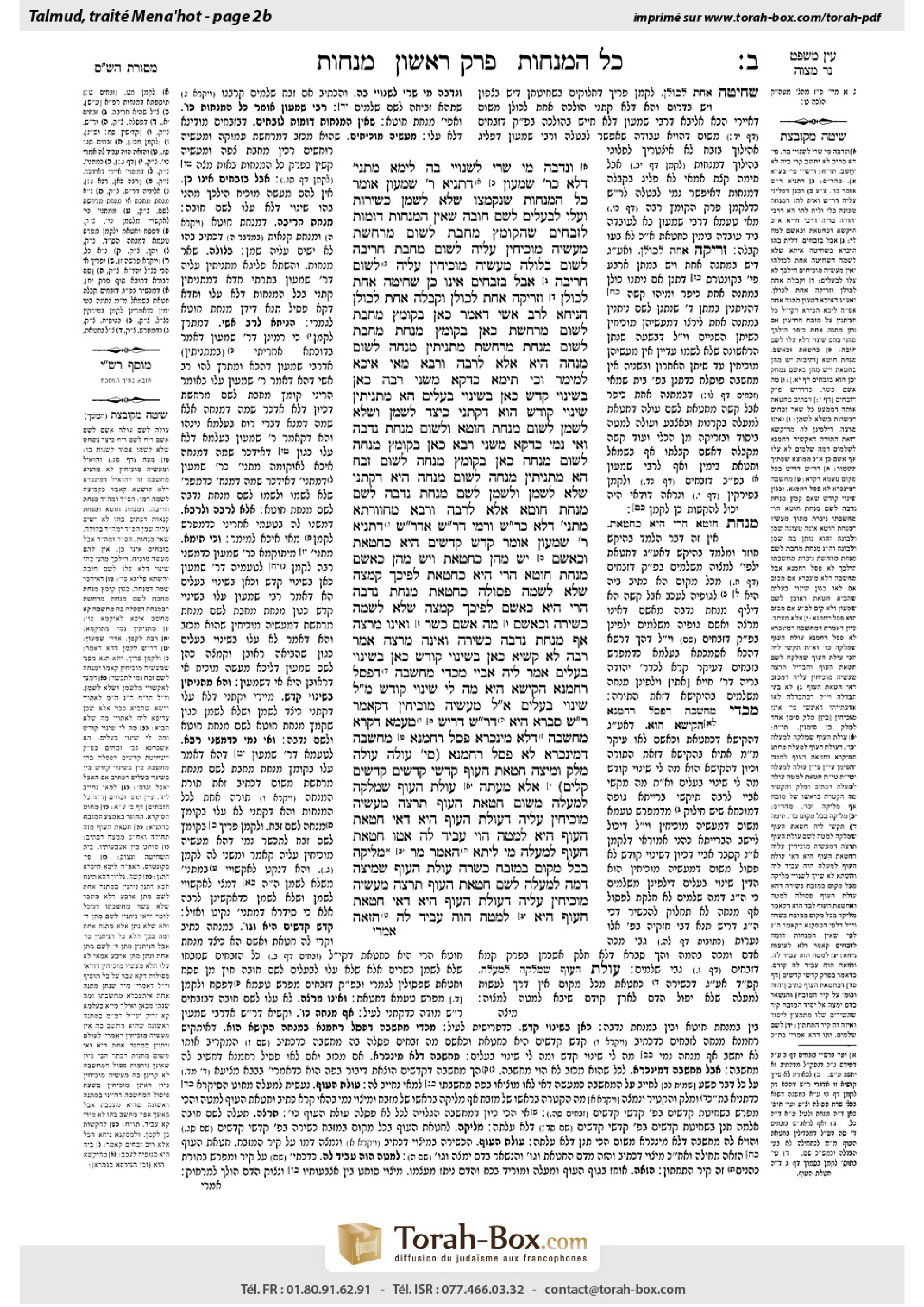
Menachot 2b: Talmud study for Daf Yomi
Daf Yomi is the daily study of one Talmud folio. Explore 37 tractates with scans, Hebrew text, Sefaria English and AI-generated French translations where annotated.
Passage selection and English or AI-generated French translation are available where the scan has annotations. Daf Study is independent of Torah-Box and Sefaria.
Browse Menachot · מנחות · All tractatesMenachot 2b text and translations
This page of Menachot includes the Aramaic text, an English translation and an AI-generated French translation, alongside the scan above.
מנחות ב׳ ב · Aramaic and Hebrew text
וּנְדָבָה מִי שְׁרֵי לְשַׁנּוֹיֵי בַּהּ?
לֵימָא מַתְנִיתִין דְּלָא כְּרַבִּי שִׁמְעוֹן, דְּתַנְיָא: רַבִּי שִׁמְעוֹן אוֹמֵר: כׇּל הַמְּנָחוֹת שֶׁנִּקְמְצוּ שֶׁלֹּא לִשְׁמָן כְּשֵׁירוֹת, וְעָלוּ לַבְּעָלִים לְשֵׁם חוֹבָה.
שֶׁאֵין הַמְּנָחוֹת דּוֹמוֹת לִזְבָחִים, שֶׁהַקּוֹמֵץ מַחֲבַת לְשׁוּם מַרְחֶשֶׁת – מַעֲשֶׂיהָ מוֹכִיחִין עָלֶיהָ לְשׁוּם מַחֲבַת, חֲרֵיבָה לְשׁוּם בְּלוּלָה – מַעֲשֶׂיהָ מוֹכִיחִין עָלֶיהָ לְשׁוּם חֲרֵיבָה.
אֲבָל בִּזְבָחִים אֵינוֹ כֵן, שְׁחִיטָה אַחַת לְכוּלָּן, וּזְרִיקָה אַחַת לְכוּלָּן, וְקַבָּלָה אַחַת לְכוּלָּן.
הָנִיחָא לְרַב אָשֵׁי, דְּאָמַר: כָּאן בְּקוֹמֵץ מַחֲבַת לְשׁוּם מַרְחֶשֶׁת, כָּאן בְּקוֹמֵץ מִנְחַת מַחֲבַת לְשׁוּם מִנְחַת מַרְחֶשֶׁת –
מַתְנִיתִין מִנְחָה לְשׁוּם מִנְחָה הִיא. אֶלָּא לְרַבָּה וְרָבָא מַאי אִיכָּא לְמֵימַר?
וְכִי תֵימָא, כִּדְקָא מְשַׁנֵּי רַבָּה: כָּאן בְּשִׁינּוּי קֹדֶשׁ, כָּאן בְּשִׁינּוּי בְּעָלִים –
הָא מַתְנִיתִין שִׁינּוּי קוֹדֶשׁ הוּא, דְּקָתָנֵי: ״כֵּיצַד לִשְׁמָן וְשֶׁלֹּא לִשְׁמָן״ – לְשׁוּם מִנְחַת חוֹטֵא וּלְשׁוּם מִנְחַת נְדָבָה.
וְאִי נָמֵי כִּדְקָא מְשַׁנֵּי רָבָא: כָּאן בְּקוֹמֵץ מִנְחָה לְשׁוּם מִנְחָה, כָּאן בְּקוֹמֵץ מִנְחָה לְשׁוּם זֶבַח –
הָא מַתְנִיתִין מִנְחָה לְשׁוּם מִנְחָה הִיא, דְּקָתָנֵי: ״שֶׁלֹּא לִשְׁמָן וְלִשְׁמָן״ – לְשֵׁם מִנְחַת נְדָבָה לְשֵׁם מִנְחַת חוֹטֵא. אֶלָּא לְרַבָּה וְרָבָא מְחַוַּורְתָּא מַתְנִיתִין דְּלָא כְּרַבִּי שִׁמְעוֹן.
וְרָמֵי דְּרַבִּי שִׁמְעוֹן אַדְּרַבִּי שִׁמְעוֹן, דְּתַנְיָא: רַבִּי שִׁמְעוֹן אוֹמֵר: ״קֹדֶשׁ קָדָשִׁים הִיא כְּחַטָּאת וּכְאָשָׁם״ – יֵשׁ מֵהֶן כְּחַטָּאת, וְיֵשׁ מֵהֶן כְּאָשָׁם.
מִנְחַת חוֹטֵא הֲרֵי הִיא כְּחַטָּאת, לְפִיכָךְ קְמָצָהּ שֶׁלֹּא לִשְׁמָהּ – פְּסוּלָה, כַּחַטָּאת; מִנְחַת נְדָבָה הֲרֵי הִיא כְּאָשָׁם, לְפִיכָךְ קְמָצָהּ שֶׁלֹּא לִשְׁמָהּ – כְּשֵׁירָה.
וּכְאָשָׁם – מָה אָשָׁם כָּשֵׁר וְאֵינוֹ מְרַצֶּה, אַף מִנְחַת נְדָבָה כְּשֵׁירָה וְאֵינָהּ מְרַצָּה.
אָמַר רַבָּה, לָא קַשְׁיָא: כָּאן בְּשִׁינּוּי קוֹדֶשׁ, כָּאן בְּשִׁינּוּי בְּעָלִים.
אֲמַר לֵיהּ אַבָּיֵי: מִכְּדֵי מַחְשָׁבָה דִּפְסַל רַחֲמָנָא הֶקֵּישָׁא הִיא, מָה לִי שִׁינּוּי קוֹדֶשׁ, מָה לִי שִׁינּוּי בְּעָלִים?
אֲמַר לֵיהּ: מַעֲשֶׂיהָ מוֹכִיחִין דְּקָאָמַר רַבִּי שִׁמְעוֹן, סְבָרָא הִיא, דְּרַבִּי שִׁמְעוֹן דָּרֵישׁ טַעְמָא דִּקְרָא.
מַחְשָׁבָה דְּלָא מִינַּכְרָא – פְּסַל רַחֲמָנָא, מַחְשָׁבָה דְמִינַּכְרָא – לָא פְּסַל רַחֲמָנָא.
(סִימָן: עוֹלָה, עוֹלָה, מָלַק וּמִיצָּה, חַטַּאת הָעוֹף, קׇדְשֵׁי קָדָשִׁים, קָדָשִׁים קַלִּים.)
אֶלָּא מֵעַתָּה, עוֹלַת הָעוֹף שֶׁמְּלָקָהּ לְמַעְלָה מִשּׁוּם חַטַּאת הָעוֹף, תְּרַצֶּה? מַעֲשֶׂיהָ מוֹכִיחִין עָלֶיהָ דְּעוֹלַת הָעוֹף הִיא, דְּאִי חַטַּאת הָעוֹף הִיא – לְמַטָּה הֲוֵי עָבֵיד לַהּ.
אַטּוּ חַטַּאת הָעוֹף לְמַעְלָה מִי לֵיתָא? הָאָמַר מָר: מְלִיקָה בְּכׇל מָקוֹם בַּמִּזְבֵּחַ כְּשֵׁרָה!
עוֹלַת הָעוֹף שֶׁמִּיצָּה דָּמָהּ לְמַעְלָה לְשֵׁם חַטַּאת הָעוֹף תְּרַצֶּה, מַעֲשֶׂיהָ מוֹכִיחִין עָלֶיהָ דְּעוֹלַת הָעוֹף הִיא, דְּאִי חַטַּאת הָעוֹף הִיא – לְמַטָּה הֲוָה עָבֵיד לַהּ הַזָּאָה.
Menachot 2b · English translation
The Gemara concludes the proof from the verse: And with regard to a gift offering, is it permitted to deviate from its protocol ab initio? Clearly one may not do so. Accordingly, if one of the sacrificial rites of a meal offering was performed for the sake of a different meal offering, it is still prohibited to perform any of its other sacrificial rites improperly.
§ The mishna teaches that all the meal offerings from which a handful was removed not for their sake are fit for sacrifice but they do not fulfill the obligation of the owner. The Gemara suggests: Let us say that the mishna is not in accordance with the opinion of Rabbi Shimon, as it is taught in a baraita that Rabbi Shimon says: All the meal offerings from which a handful was removed not for their sake are fit for sacrifice and they even satisfy the obligation of the owner.
The baraita continues: Conversely, consecrated animals that were sacrificed not for their sake do not fulfill the obligation of the owner, as in this regard meal offerings are not similar to slaughtered offerings. The difference is that when one removes a handful from a pan meal offering for the sake of a deep-pan meal offering, its mode of preparation proves that it is in fact for the sake of a pan meal offering, as the two offerings differ in appearance. Similarly, with regard to a dry meal offering, e.g., the meal offering of a sinner, which contains no oil, whose handful is removed for the sake of a meal offering that is mixed with oil, its mode of preparation proves that it is for the sake of a dry meal offering, and one’s improper intent is therefore disregarded.
But with regard to slaughtered offerings it is not so, as there is one manner of slaughter for all offerings, and one manner of sprinkling the blood for all offerings, and one manner of collection of the blood for all offerings. Since the differentiation between slaughtered offerings is established only through intention, one who sacrifices an animal offering not for its own sake does not fulfill the obligation of the owner. Rabbi Shimon apparently disagrees with the tanna of the mishna on two counts: First, he claims that if the handful of a meal offering was removed not for its own sake it satisfies the obligation of the owner, whereas the mishna teaches that the obligation is not fulfilled. Second, Rabbi Shimon does not differentiate between the meal offering of a sinner or the meal offering of jealousy, and the other types of meal offerings.
The Gemara comments: This works out well, i.e., the mishna can be explained in accordance with the opinion of Rabbi Shimon, according to Rav Ashi, who says (3b), in a resolution of two apparently contradictory statements of Rabbi Shimon: Here, where Rabbi Shimon says that the meal offering is fit and fulfills the owner’s obligation, he is referring to a case where one states that he is removing a handful from a pan meal offering for the sake of a deep pan, i.e., he mentions only the vessel, not the type of meal offering. Conversely, there, where Rabbi Shimon says that the meal offering does not satisfy the owner’s obligation, he is referring to a case where one states that he is removing a handful from a pan meal offering for the sake of a deep-pan meal offering.
Accordingly, it can be explained that the mishna is referring to a case where one removes a handful from a meal offering for the sake of another meal offering, which is why it does not satisfy the obligation of the owner. But according to the statements of Rabba and Rava, who resolved that contradiction in a different manner, what can be said?
The Gemara elaborates: And if you would say that the contradiction addressed by Rav Ashi is resolved as Rabba answers, this is problematic. Rabba resolved the contradiction as follows: Here, where Rabbi Shimon says that the meal offering satisfies the owner’s obligation, he is referring to a change of sanctity, i.e., it was sacrificed for the sake of another type of meal offering, whereas there, where Rabbi Shimon says that it does not fulfill the owner’s obligation, he is referring to a change of owner, e.g., the meal offering of Reuven was sacrificed for the sake of Shimon.
The Gemara explains that the reason this is problematic is that if one accepts Rabba’s resolution, how can the mishna be explained in accordance with the opinion of Rabbi Shimon? The mishna is clearly discussing the case of a change of sanctity, as it teaches: How are these rites performed for their sake and then not for their sake, whereby the offering does not satisfy the owner’s obligation? It is in a case where one initially removed the handful for the sake of the meal offering of a sinner and then for the sake of a voluntary meal offering. This is a change involving a different type of meal offering.
And alternatively, if you would say that the contradiction addressed by Rav Ashi is resolved as Rava answers, this is equally problematic. Rava resolved the contradiction as follows: Here, where Rabbi Shimon says that the meal offering satisfies the owner’s obligation, he is referring to a case where one removes a handful from a meal offering for the sake of another meal offering, whereas there, where Rabbi Shimon says that it does not satisfy the owner’s obligation, he is referring to a case where one removes a handful from a meal offering for the sake of a slaughtered offering.
The Gemara explains that if one accepts Rava’s resolution, the mishna cannot be in accordance with the opinion of Rabbi Shimon: The mishna is discussing a case where one removes a handful from a meal offering for the sake of another meal offering, as it teaches: How are these rites performed not for their sake and for their sake? It is a case where one removed the handful for the sake of a voluntary meal offering and then for the sake of the meal offering of a sinner. The Gemara concludes: Rather, according to the resolutions offered by Rabba and Rava, it is clear that the mishna is not in accordance with the opinion of Rabbi Shimon.
§ The Gemara cites the baraita that is the basis for the apparent contradiction between the statements of Rabbi Shimon, which was mentioned in the previous discussion: And a Sage raises a contradiction from one statement of Rabbi Shimon and another statement of Rabbi Shimon, as it is taught in a baraita: Rabbi Shimon says that the verse written concerning the meal offering: “It is most sacred, as the sin offering, and as the guilt offering” (Leviticus 6:10), indicates that there are some meal offerings whose halakha is like that of a sin offering, and there are some whose halakha is like that of a guilt offering.
Rabbi Shimon elaborates: The halakha with regard to the meal offering of a sinner is like that of a sin offering. Therefore, if one removed a handful from it not for its own sake, it is disqualified, just like a sin offering that was slaughtered not for its own sake. Conversely, the halakha with regard to a voluntary meal offering is like that of a guilt offering. Therefore, if one removed a handful from it not for its own sake, it is valid, like a guilt offering that was slaughtered not for its own sake.
Rabbi Shimon adds: And a voluntary meal offering is like a guilt offering in another aspect as well: Just as a guilt offering is valid but it does not effect acceptance, i.e., it does not satisfy the owner’s obligation, so too, a voluntary meal offering is valid but it does not effect acceptance. Rabbi Shimon here apparently contradicts his ruling that all meal offerings from which a handful was removed not for their sake satisfy the obligation of the owner.
Rabba said in resolution of this contradiction: This is not difficult. Here, where Rabbi Shimon says that the meal offering satisfies the owner’s obligation, he is referring to a change of sanctity, i.e., it was sacrificed for the sake of another type of meal offering, whereas there, where he says that it does not fulfill the owner’s obligation, he is referring to a change of owner, e.g., the meal offering of Reuven was sacrificed for the sake of Shimon.
Abaye said to Rabba: Now consider, the fact that the Merciful One disqualifies a meal offering due to improper intent is derived from the Torah’s comparison of meal offerings to sin offerings and guilt offerings. If so, what difference is there to me if there was a change of sanctity, and what difference is there to me if there was a change of owner? In the case of a guilt offering either of these changes prevents it from satisfying the obligation of the owner.
Rabba said to Abaye: The claim that its mode of preparation proves one’s intent, which Rabbi Shimon states in explanation of why offerings are disqualified through improper intent, is based on logical reasoning, as Rabbi Shimon interprets the reason behind the mitzva in the verse and draws halakhic conclusions based on that interpretation.
Rabba continues: This is significant, as Rabbi Shimon holds that the Merciful One disqualifies improper intent that is not recognizably false, i.e., when the intent is not in clear contradiction to the sacrificial rites performed. The intent to sacrifice an offering for the sake of another owner does not include a change in the sacrificial rites and it therefore disqualifies the offering. The Merciful One does not disqualify improper intent that is recognizably false and contradicts the sacrificial rites performed, e.g., if one removes a handful from a pan meal offering for the sake of a deep-pan meal offering, as the different substance itself indicates that it is a pan meal offering.
The Gemara lists several questions with regard to Rabba’s statement, for which it provides a mnemonic: Burnt offering, burnt offering, pinched and squeezed, bird sin offering, offerings of the most sacred order, offerings of lesser sanctity.
The Gemara first asks: But if that is so, that only intent that is not recognizably false disqualifies an offering, then in the case of a bird burnt offering where one pinched the nape of its neck above the red line that divides the upper and lower halves of the altar for the sake of a bird sin offering, it should effect acceptance according to Rabbi Shimon. The reason is the actions performed on it prove that it is a bird burnt offering. Because if it is in fact a bird sin offering, he would have performed the pinching below the red line while standing beside the altar. Nevertheless, Rabbi Shimon agrees with the ruling of the mishna (Zevaḥim 64b) that this bird offering does not satisfy its owner’s obligation.
The Gemara rejects this: Is that to say that a case of a bird sin offering that is pinched above the red line is not possible? Didn’t the Master say: The pinching of a bird sin offering that is performed in any place on the altar is valid after the fact? Accordingly, there is no discernible difference between the pinching of a bird burnt offering and the pinching of a bird sin offering, so the owner’s obligation is not fulfilled.
The Gemara raises another difficulty: If recognizably false intent does not disqualify an offering, then a bird burnt offering where a priest squeezed its blood above the red line for the sake of a bird sin offering should effect acceptance, as the actions performed on it prove that it is a bird burnt offering. Because if it is in fact a bird sin offering, he would have performed the required act of holding the body of the bird and sprinkling its blood below the red line, instead of squeezing out its blood above that line.
Menachot 2b · Traduction française (IA)
La Guemara conclut la preuve à partir du verset : s’agissant d’une offrande volontaire, est-il permis de s’écarter de la procédure prescrite a priori ? Il est clair que non. Par conséquent, si l’un des rites sacrificiels d’une oblation a été accompli pour une autre oblation, il reste interdit d’accomplir incorrectement l’un de ses autres rites sacrificiels.
§ La Michna enseigne que toutes les oblations dont la poignée a été prélevée non pour elles-mêmes sont aptes à être offertes, mais ne remplissent pas l’obligation du propriétaire. La Guemara suggère : disons que la Michna ne suit pas l’opinion de Rabbi Shimon, car il est enseigné dans une baraïta que Rabbi Shimon dit : toutes les oblations dont la poignée a été prélevée non pour elles-mêmes sont aptes à être offertes et remplissent même l’obligation du propriétaire.
La baraïta poursuit : à l’inverse, les animaux consacrés qui ont été sacrifiés non pour eux-mêmes ne remplissent pas l’obligation du propriétaire, car, sur ce point, les oblations ne sont pas comparables aux sacrifices abattus. La différence est que, lorsqu’on prélève la poignée d’une oblation cuite dans un récipient plat pour une oblation cuite dans un récipient profond, son mode de préparation prouve qu’elle est en réalité destinée à une oblation cuite dans un récipient plat, car les deux offrandes diffèrent par leur apparence. De même, pour une oblation sèche, par exemple l’oblation d’un pécheur, qui ne contient pas d’huile et dont la poignée est prélevée pour une oblation mélangée à de l’huile, son mode de préparation prouve qu’elle est destinée à une oblation sèche ; l’intention incorrecte est donc écartée.
Mais il n’en va pas ainsi des sacrifices abattus, car la manière d’abattre est la même pour tous les sacrifices, la manière d’asperger le sang est la même pour tous les sacrifices et la manière de recueillir le sang est la même pour tous les sacrifices. Puisque la distinction entre les sacrifices abattus repose uniquement sur l’intention, celui qui sacrifie un animal non pour lui-même ne remplit pas l’obligation du propriétaire. Rabbi Shimon semble donc être en désaccord avec le tanna de la Michna sur deux points : premièrement, il affirme que, si la poignée d’une oblation a été prélevée non pour elle-même, elle remplit l’obligation du propriétaire, tandis que la Michna enseigne que l’obligation n’est pas remplie. Deuxièmement, Rabbi Shimon ne distingue pas l’oblation d’un pécheur ou l’oblation de jalousie des autres types d’oblations.
La Guemara remarque : cela s’accorde bien, c’est-à-dire que la Michna peut être expliquée conformément à l’opinion de Rabbi Shimon, selon Rav Ashi, qui dit (3b), pour résoudre deux déclarations apparemment contradictoires de Rabbi Shimon : ici, lorsqu’il dit que l’oblation est apte et remplit l’obligation du propriétaire, il parle d’un cas où quelqu’un déclare qu’il prélève la poignée d’une oblation cuite dans un récipient plat pour un récipient profond, c’est-à-dire qu’il ne mentionne que le récipient et non le type d’oblation. À l’inverse, là, lorsqu’il dit que l’oblation ne remplit pas l’obligation du propriétaire, il parle d’un cas où quelqu’un déclare qu’il prélève la poignée d’une oblation cuite dans un récipient plat pour une oblation cuite dans un récipient profond.
On peut donc expliquer que la Michna parle d’un cas où quelqu’un prélève la poignée d’une oblation pour une autre oblation, raison pour laquelle cela ne remplit pas l’obligation du propriétaire. Mais, selon les propos de Rabba et de Rava, qui ont résolu cette contradiction autrement, que peut-on répondre ?
La Guemara développe : et si tu dis que la contradiction examinée par Rav Ashi est résolue comme l’explique Rabba, cela pose problème. Rabba a résolu la contradiction ainsi : ici, lorsque Rabbi Shimon dit que l’oblation remplit l’obligation du propriétaire, il parle d’un changement de sainteté, c’est-à-dire qu’elle a été sacrifiée pour un autre type d’oblation ; là, lorsqu’il dit qu’elle ne remplit pas l’obligation du propriétaire, il parle d’un changement de propriétaire, par exemple l’oblation de Réouven sacrifiée pour Shim’on.
La Guemara explique pourquoi cela pose problème : si l’on accepte la résolution de Rabba, comment expliquer la Michna conformément à l’opinion de Rabbi Shimon ? La Michna traite manifestement d’un changement de sainteté, puisqu’elle enseigne : comment ces rites sont-ils accomplis pour elles-mêmes, puis non pour elles-mêmes, de sorte que l’offrande ne remplit pas l’obligation du propriétaire ? Il s’agit d’un cas où l’on a d’abord prélevé la poignée pour l’oblation d’un pécheur, puis pour une oblation volontaire. C’est un changement impliquant un autre type d’oblation.
Et si tu dis que la contradiction examinée par Rav Ashi est résolue comme l’explique Rava, cela pose tout autant problème. Rava a résolu la contradiction ainsi : ici, lorsque Rabbi Shimon dit que l’oblation remplit l’obligation du propriétaire, il parle d’un cas où l’on prélève la poignée d’une oblation pour une autre oblation ; là, lorsqu’il dit qu’elle ne remplit pas l’obligation du propriétaire, il parle d’un cas où l’on prélève la poignée d’une oblation pour un sacrifice abattu.
La Guemara explique que si l’on accepte la résolution de Rava, la Michna ne peut pas suivre l’opinion de Rabbi Shimon : la Michna traite d’un cas où l’on prélève la poignée d’une oblation pour une autre oblation, puisqu’elle enseigne : comment ces rites sont-ils accomplis non pour elles-mêmes, puis pour elles-mêmes ? Il s’agit d’un cas où l’on a prélevé la poignée pour une oblation volontaire, puis pour l’oblation d’un pécheur. La Guemara conclut : au contraire, selon les résolutions proposées par Rabba et Rava, il est clair que la Michna ne suit pas l’opinion de Rabbi Shimon.
§ La Guemara cite la baraïta à l’origine de la contradiction apparente entre les déclarations de Rabbi Shimon, mentionnée dans la discussion précédente : un Sage soulève une contradiction entre une déclaration de Rabbi Shimon et une autre déclaration de Rabbi Shimon, car il est enseigné dans une baraïta : Rabbi Shimon dit que le verset relatif à l’oblation : « Elle est très sainte, comme le sacrifice expiatoire et comme le sacrifice de culpabilité » (Lévitique 6:10), indique que certaines oblations ont une halakha semblable à celle d’un sacrifice expiatoire, et que d’autres ont une halakha semblable à celle d’un sacrifice de culpabilité.
Rabbi Shimon précise : la halakha concernant l’oblation d’un pécheur est semblable à celle d’un sacrifice expiatoire. Par conséquent, si la poignée en a été prélevée non pour elle-même, l’oblation est disqualifiée, comme un sacrifice expiatoire abattu non pour lui-même. À l’inverse, la halakha concernant une oblation volontaire est semblable à celle d’un sacrifice de culpabilité. Par conséquent, si la poignée en a été prélevée non pour elle-même, l’oblation est valable, comme un sacrifice de culpabilité abattu non pour lui-même.
Rabbi Shimon ajoute : une oblation volontaire est également semblable à un sacrifice de culpabilité sous un autre aspect : de même qu’un sacrifice de culpabilité est valable, mais ne produit pas l’agrément, c’est-à-dire ne remplit pas l’obligation du propriétaire, de même une oblation volontaire est valable, mais ne produit pas l’agrément. Rabbi Shimon semble ici contredire sa décision selon laquelle toutes les oblations dont la poignée a été prélevée non pour elles-mêmes remplissent l’obligation du propriétaire.
Rabba a résolu cette contradiction ainsi : il n’y a pas de difficulté. Ici, lorsque Rabbi Shimon dit que l’oblation remplit l’obligation du propriétaire, il parle d’un changement de sainteté, c’est-à-dire qu’elle a été sacrifiée pour un autre type d’oblation ; là, lorsqu’il dit qu’elle ne remplit pas l’obligation du propriétaire, il parle d’un changement de propriétaire, par exemple l’oblation de Réouven sacrifiée pour Shim’on.
Abayé dit à Rabba : or, considère ceci : le fait que le Miséricordieux disqualifie une oblation en raison d’une intention incorrecte se déduit de la comparaison que la Torah établit entre les oblations et les sacrifices expiatoires et les sacrifices de culpabilité. Dès lors, quelle différence cela fait-il qu’il y ait eu un changement de sainteté, ou un changement de propriétaire ? Dans le cas d’un sacrifice de culpabilité, chacun de ces changements l’empêche de remplir l’obligation du propriétaire.
Rabba dit à Abayé : l’argument selon lequel le mode de préparation révèle l’intention, que Rabbi Shimon avance pour expliquer pourquoi les offrandes sont disqualifiées en raison d’une intention incorrecte, repose sur un raisonnement logique, car Rabbi Shimon interprète la raison de la mitsva dans le verset et tire des conclusions halakhiques de cette interprétation.
Rabba poursuit : cela est important, car Rabbi Shimon estime que le Miséricordieux disqualifie une intention incorrecte qui n’est pas manifestement fausse, c’est-à-dire lorsque l’intention ne contredit pas clairement les rites sacrificiels accomplis. L’intention de sacrifier une offrande pour un autre propriétaire n’implique aucun changement dans les rites sacrificiels et disqualifie donc l’offrande. Le Miséricordieux ne disqualifie pas une intention incorrecte manifestement fausse et contredite par les rites sacrificiels accomplis, par exemple si l’on prélève la poignée d’une oblation cuite dans un récipient plat pour une oblation cuite dans un récipient profond, car la substance différente elle-même indique qu’il s’agit d’une oblation cuite dans un récipient plat.
La Guemara énumère plusieurs questions relatives à la déclaration de Rabba, et fournit pour les retenir un aide-mémoire : holocauste, holocauste, pincée et pressée, sacrifice expiatoire d’oiseau, sacrifices de sainteté éminente, sacrifices de moindre sainteté.
La Guemara demande d’abord : mais si c’est ainsi, si seule une intention qui n’est pas manifestement fausse disqualifie une offrande, alors, dans le cas d’un holocauste d’oiseau dont on a pincé la nuque au-dessus de la ligne rouge qui sépare les moitiés supérieure et inférieure de l’autel pour un sacrifice expiatoire d’oiseau, l’offrande devrait produire l’agrément selon Rabbi Shimon. En effet, les gestes accomplis prouvent qu’il s’agit d’un holocauste d’oiseau. Car, s’il s’agissait en réalité d’un sacrifice expiatoire d’oiseau, il aurait pincé la nuque sous la ligne rouge en se tenant près de l’autel. Pourtant, Rabbi Shimon est d’accord avec la décision de la Michna (Zevaḥim 64b), selon laquelle cette offrande d’oiseau ne remplit pas l’obligation de son propriétaire.
La Guemara rejette cette objection : est-il donc impossible qu’un sacrifice expiatoire d’oiseau soit pincé au-dessus de la ligne rouge ? Le Maître n’a-t-il pas dit que le pincement d’un sacrifice expiatoire d’oiseau effectué n’importe où sur l’autel est valable a posteriori ? Par conséquent, il n’y a pas de différence discernable entre le pincement d’un holocauste d’oiseau et celui d’un sacrifice expiatoire d’oiseau ; l’obligation du propriétaire n’est donc pas remplie.
La Guemara soulève une autre difficulté : si une intention manifestement fausse ne disqualifie pas une offrande, alors, dans le cas d’un holocauste d’oiseau dont un prêtre a pressé le sang au-dessus de la ligne rouge pour un sacrifice expiatoire d’oiseau, l’offrande devrait produire l’agrément, puisque les gestes accomplis prouvent qu’il s’agit d’un holocauste d’oiseau. Car, s’il s’agissait en réalité d’un sacrifice expiatoire d’oiseau, il aurait accompli le geste requis, à savoir tenir le corps de l’oiseau et asperger son sang sous la ligne rouge, au lieu d’en presser le sang au-dessus de cette ligne.
Traduction française générée par IA à partir de l’édition anglaise de Sefaria. Vérifie toujours un passage avec le texte source.
Text from Sefaria: William Davidson Edition - Vocalized Aramaic (unknown); William Davidson Edition - English (CC BY NC).