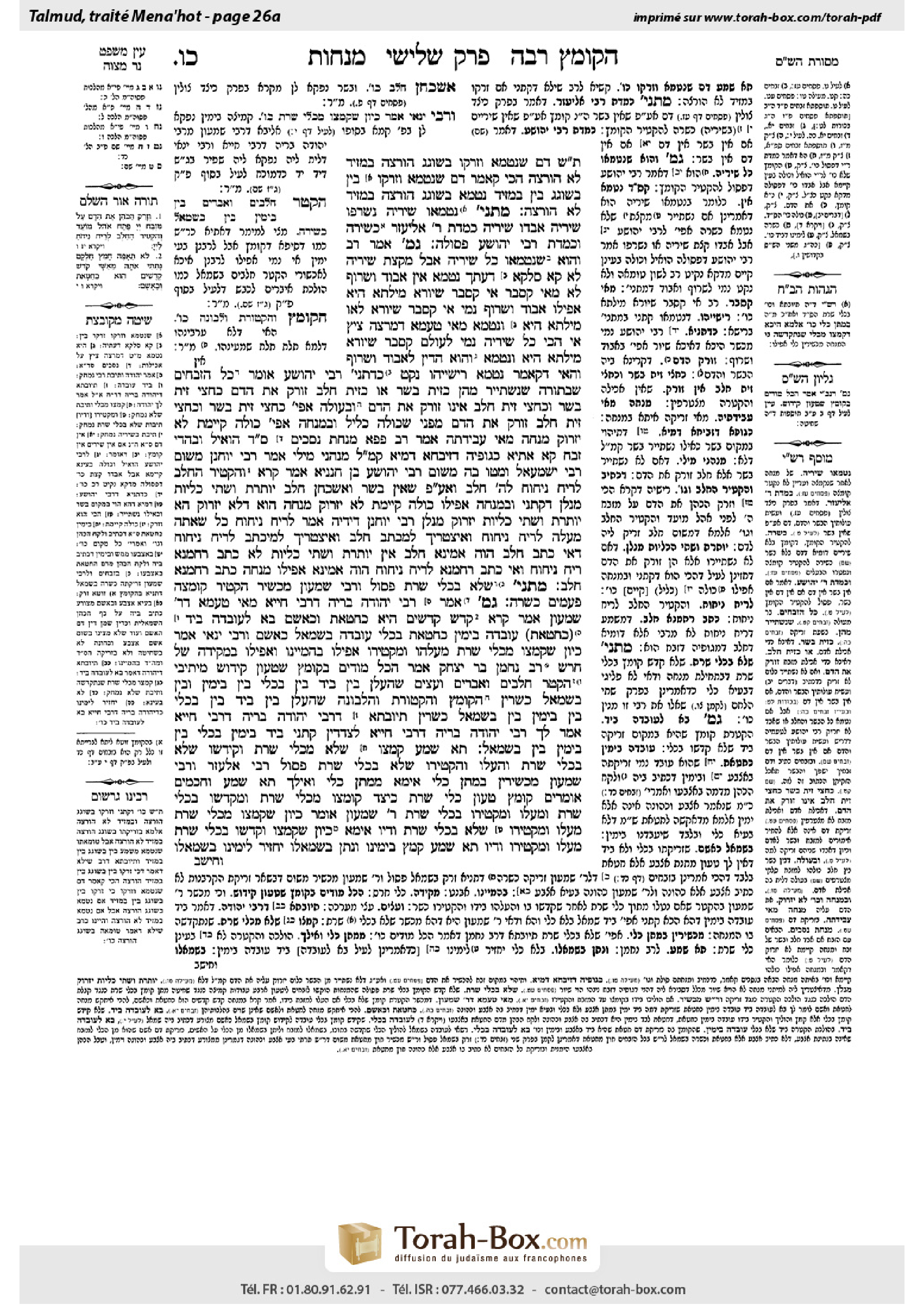
Menachot 26a: Talmud study for Daf Yomi
Daf Yomi is the daily study of one Talmud folio. Explore 37 tractates with scans, Hebrew text, Sefaria English and AI-generated French translations where annotated.
Passage selection and English or AI-generated French translation are available where the scan has annotations. Daf Study is independent of Torah-Box and Sefaria.
Browse Menachot · מנחות · All tractatesMenachot 26a text and translations
This page of Menachot includes the Aramaic text, an English translation and an AI-generated French translation, alongside the scan above.
מנחות כ״ו א · Aramaic and Hebrew text
תָּא שְׁמַע: דָּם שֶׁנִּטְמָא וּזְרָקוֹ בְּשׁוֹגֵג הוּרְצָה, בְּמֵזִיד לֹא הוּרְצָה – הָכִי קָאָמַר: דָּם שֶׁנִּטְמָא וּזְרָקוֹ, בֵּין בְּשׁוֹגֵג בֵּין בְּמֵזִיד – נִטְמָא בְּשׁוֹגֵג הוּרְצָה, בְּמֵזִיד לֹא הוּרְצָה.
מַתְנִי׳ נִטְמְאוּ שְׁיָרֶיהָ, נִשְׂרְפוּ שְׁיָרֶיהָ, אָבְדוּ שְׁיָרֶיהָ – כְּמִדַּת רַבִּי אֱלִיעֶזֶר כְּשֵׁירָה, וּכְמִדַּת רַבִּי יְהוֹשֻׁעַ פְּסוּלָה.
גְּמָ׳ אָמַר רַב: וְהוּא שֶׁנִּטְמְאוּ כׇּל שְׁיָרֶיהָ, אֲבָל מִקְצָת שְׁיָרֶיהָ – לָא.
קָא סָלְקָא דַּעְתָּךְ: נִטְמָא – אִין, אָבוּד וְשָׂרוּף – לָא. מַאי קָסָבַר? אִי קָסָבַר: שִׁיּוּרָא מִילְּתָא הִיא – אֲפִילּוּ אָבוּד וְשָׂרוּף נָמֵי! אִי קָסָבַר: שִׁיּוּרָא לָאו מִילְּתָא הִיא, וְנִטְמָא מַאי טַעְמָא – דִּמְרַצֵּה צִיץ? אִי הָכִי, כׇּל שְׁיָרֶיהָ נָמֵי!
לְעוֹלָם קָסָבַר: שִׁיּוּרָא מִילְּתָא הִיא, וְנִטְמָא – וְהוּא הַדִּין לְאָבוּד וְשָׂרוּף, וְהַאי דְּקָאָמַר ״נִטְמָא״ – רֵישַׁיְיהוּ נָקֵט.
כִּדְתַנְיָא, רַבִּי יְהוֹשֻׁעַ אוֹמֵר: כׇּל הַזְּבָחִים שֶׁבְּתוֹרָה שֶׁנִּשְׁתַּיֵּיר מֵהֶן כְּזַיִת בָּשָׂר אוֹ כְּזַיִת חֵלֶב – זוֹרֵק אֶת הַדָּם.
כַּחֲצִי זַיִת בָּשָׂר וְכַחֲצִי זַיִת חֵלֶב – אֵינוֹ זוֹרֵק אֶת הַדָּם, וּבָעוֹלָה אֲפִילּוּ כַּחֲצִי זַיִת בָּשָׂר וְכַחֲצִי זַיִת חֵלֶב – זוֹרֵק אֶת הַדָּם, מִפְּנֵי שֶׁכּוּלָּהּ כָּלִיל, וּבַמִּנְחָה אֲפִילּוּ כּוּלָּהּ קַיֶּימֶת – לֹא יִזְרוֹק.
מִנְחָה מַאי עֲבִידְתַּהּ? אָמַר רַב פָּפָּא: מִנְחַת נְסָכִים, סָלְקָא דַּעְתָּךְ – הוֹאִיל וּבַהֲדֵי זֶבַח קָא אָתְיָא, כְּגוּפֵיהּ דְּזִיבְחָא דָּמְיָא, קָא מַשְׁמַע לַן.
מְנָהָנֵי מִילֵּי? אָמַר רַבִּי יוֹחָנָן מִשּׁוּם רַבִּי יִשְׁמָעֵאל, וּמָטוּ בַּהּ מִשּׁוּם רַבִּי יְהוֹשֻׁעַ בֶּן חֲנַנְיָא: אָמַר קְרָא ״וְהִקְטִיר הַחֵלֶב לְרֵיחַ נִיחֹחַ לַה׳״, חֵלֶב – וְאַף עַל פִּי שֶׁאֵין בָּשָׂר.
וְאַשְׁכְּחַן חֵלֶב, יוֹתֶרֶת וּשְׁתֵּי כְּלָיוֹת מְנָלַן? דְּקָתָנֵי: וּבַמִּנְחָה, אֲפִילּוּ כּוּלָּהּ קַיֶּימֶת לֹא יִזְרוֹק. מִנְחָה הוּא דְּלֹא יִזְרוֹק, הָא יוֹתֶרֶת וּשְׁתֵּי כְּלָיוֹת – יִזְרוֹק.
מְנָלַן? רַבִּי יוֹחָנָן דִּידֵיהּ אָמַר: ״לְרֵיחַ נִיחֹחַ״ – כֹּל שֶׁאַתָּה מַעֲלֶה לְרֵיחַ נִיחוֹחַ.
וְאִיצְטְרִיךְ לְמִכְתַּב ״חֵלֶב״, וְאִיצְטְרִיךְ לְמִיכְתַּב ״לְרֵיחַ נִיחֹחַ״, דְּאִי כְּתַב ״חֵלֶב״ הֲוָה אָמֵינָא: חֵלֶב – אִין, יוֹתֶרֶת וּשְׁתֵּי כְּלָיוֹת – לָא, כְּתַב רַחֲמָנָא ״רֵיחַ נִיחֹחַ״. וְאִי כְּתַב רַחֲמָנָא ״לְרֵיחַ נִיחֹחַ״ הֲוָה אָמֵינָא: אֲפִילּוּ מִנְחָה, כְּתַב רַחֲמָנָא ״חֵלֶב״.
מַתְנִי׳ שֶׁלֹּא בִּכְלֵי שָׁרֵת – פָּסוּל, וְרַבִּי שִׁמְעוֹן מַכְשִׁיר. הִקְטִיר קוּמְצָהּ פַּעֲמַיִם – כְּשֵׁרָה.
גְּמָ׳ אָמַר רַבִּי יְהוּדָה בְּרֵיהּ דְּרַבִּי חִיָּיא: מַאי טַעְמָא דְּרַבִּי שִׁמְעוֹן? אָמַר קְרָא ״קֹדֶשׁ קָדָשִׁים הִיא כַּחַטָּאת וְכָאָשָׁם״. בָּא לְעוֹבְדָהּ בַּיָּד כְּחַטָּאת – עוֹבְדָהּ בְּיָמִין, כְּחַטָּאת. בִּכְלִי – עוֹבְדָהּ בִּשְׂמֹאל, כְּאָשָׁם.
וְרַבִּי יַנַּאי אָמַר: כֵּיוָן שֶׁקְּמָצוֹ מִכְּלֵי שָׁרֵת, מַעֲלֵהוּ וּמַקְטִירוֹ אֲפִילּוּ בְּהֶמְיָינוֹ, וַאֲפִילּוּ בִּמְקִידָּה שֶׁל חֶרֶשׂ. רַב נַחְמָן בַּר יִצְחָק אָמַר: הַכֹּל מוֹדִים בַּקּוֹמֶץ שֶׁטָּעוּן קִידּוּשׁ.
מֵיתִיבִי: הֶקְטֵר חֲלָבִים וְאֵבָרִים וְעֵצִים שֶׁהֶעֱלָן, בֵּין בַּיָּד בֵּין בִּכְלִי, בֵּין בְּיָמִין וּבֵין בִּשְׂמֹאל – כְּשֵׁרִין; הַקּוֹמֶץ וְהַקְּטוֹרֶת וְהַלְּבוֹנָה שֶׁהֶעֱלָן, בֵּין בַּיָּד בֵּין בִּכְלִי, בֵּין בְּיָמִין בֵּין בִּשְׂמֹאל – כְּשֵׁרִין. תְּיוּבְתָּא דְּרַבִּי יְהוּדָה בְּרֵיהּ דְּרַבִּי חִיָּיא!
אָמַר לָךְ רַבִּי יְהוּדָה בְּרֵיהּ דְּרַבִּי חִיָּיא: לִצְדָדִין קָתָנֵי – בַּיָּד בְּיָמִין, בִּכְלִי – בֵּין בְּיָמִין בֵּין בִּשְׂמֹאל.
תָּא שְׁמַע: קְמָצוֹ שֶׁלֹּא מִכְּלֵי שָׁרֵת, וְקִידְּשׁוֹ שֶׁלֹּא בִּכְלֵי שָׁרֵת, וְהֶעֱלוֹ וְהִקְטִירוֹ שֶׁלֹּא בִּכְלִי שָׁרֵת – פָּסוּל, רַבִּי אֶלְעָזָר וְרַבִּי שִׁמְעוֹן מַכְשִׁירִין בְּמַתַּן כְּלִי.
אֵימָא: מִמַּתַּן כְּלִי וְאֵילָךְ.
תָּא שְׁמַע: וַחֲכָמִים אוֹמְרִים: קוֹמֶץ טָעוּן כְּלִי שָׁרֵת, כֵּיצַד? קוֹמְצוֹ מִכְּלִי שָׁרֵת, וּמְקַדְּשׁוֹ בִּכְלִי שָׁרֵת, וּמַעֲלוֹ וּמַקְטִירוֹ בִּכְלִי שָׁרֵת. רַבִּי שִׁמְעוֹן אוֹמֵר: כֵּיוָן שֶׁקְּמָצוֹ מִכְּלִי שָׁרֵת, מַעֲלוֹ וּמַקְטִירוֹ שֶׁלֹּא בִּכְלִי שָׁרֵת וְדַיּוֹ.
אֵימָא: כֵּיוָן שֶׁקְּמָצוֹ וְקִדְּשׁוֹ בִּכְלִי שָׁרֵת, מַעֲלוֹ וּמַקְטִירוֹ וְדַיּוֹ.
תָּא שְׁמַע: קָמַץ בִּימִינוֹ וְנָתַן בִּשְׂמֹאלוֹ – יַחְזִיר לִימִינוֹ, בִּשְׂמֹאלוֹ
Menachot 26a · English translation
The Gemara suggests a refutation of Rav Sheila’s opinion based on the first baraita: Come and hear: In the case of blood of an offering that became impure and a priest sprinkled it on the altar, if he did so unwittingly, the offering is accepted and achieves atonement for the owner of the offering. If he sprinkled the blood intentionally, the offering is not accepted. This contradicts Rav Sheila’s statement that even if the priest sprinkled the blood intentionally, it is accepted. The Gemara rejects this proof: According to Rav Sheila, this is what the baraita is saying: In the case of blood that became impure and a priest sprinkled it, whether it was sprinkled unwittingly or intentionally, if it was rendered impure unwittingly it is accepted, but if it was rendered impure intentionally then it is not accepted.
MISHNA: If after the handful was removed the remainder of the meal offering became ritually impure, or if the remainder of the meal offering was burned, or if the remainder of the meal offering was lost, according to the principle of Rabbi Eliezer, who says that with regard to an animal offering the blood is fit for sprinkling even if there is no meat that can be eaten, the meal offering is fit, and the priest burns the handful. But according to the principle of Rabbi Yehoshua, who says that with regard to an animal offering the blood is fit for sprinkling only if there is meat that can be eaten, it is unfit and the priest does not burn the handful, as the handful serves to render permitted the remainder.
GEMARA: With regard to the mishna’s statement that according to Rabbi Yehoshua the meal offering is unfit if its remainder is rendered impure, Rav says: And this is the halakha only when all of its remainder became impure. But if only a part of its remainder became impure, the meal offering is not unfit.
The Gemara comments: It enters your mind that Rav holds that only if a part of the remainder became impure, then yes, the meal offering is fit; but if part of the remainder was lost or burned, then the meal offering is not fit. The Gemara asks: What does Rav hold? If he holds that what remains is significant, so that even if a portion of the remainder cannot be eaten the handful is still sacrificed to render the rest permitted, then why would this not also be the halakha even if part of the remainder was lost or burned? Alternatively, if he holds that what remains is not significant, and the Gemara interjects: And accordingly, what is the reason that the handful is sacrificed if a part of the remainder became impure? It is because the frontplate effects acceptance for the impurity; if that is so, then even if all of the remainder became impure, the handful should still be sacrificed.
The Gemara explains: Actually, he holds that what remains is significant, and just as when a part of the remainder became impure but the offering is still fit, the rest of the remainder is sacrificed, the same is true with regard to a case where a part of the remainder was lost or burned. And the reason that he stated this halakha specifically in a case where it became impure is that he employed the terminology of the beginning of the mishna, which discusses a case where the remainder became impure.
Rava’s statement accords with the opinion of Rabbi Yehoshua, as it is taught in a baraita: Rabbi Yehoshua says: With regard to all the offerings in the Torah from which there remains an olive-bulk of meat that is fit to be eaten or an olive-bulk of fat that is fit to be sacrificed on the altar, the priest sprinkles the blood. Similarly, if a part of the remainder can be eaten the handful is still sacrificed, as the status of the remainder relative to the handful corresponds to the status of the meat relative to the blood.
The Gemara cites the continuation of the baraita: If all that remains is half an olive-bulk of meat and half an olive-bulk of fat, the priest does not sprinkle the blood. This is because the half olive-bulk of meat and the half olive-bulk of fat do not combine to form one olive-bulk, since the former is eaten and the latter is sacrificed on the altar. And with regard to a burnt offering, even if all that was left was half an olive-bulk of meat and half an olive-bulk of fat, the priest sprinkles the blood, because it is consumed on the altar in its entirety. Since both the meat and the fat are sacrificed on the altar, they combine to form one olive-bulk. And with regard to a meal offering, although all of it remains pure, the priest shall not sprinkle the blood.
The Gemara questions the last ruling of the baraita: What is the mention of a meal offering doing here? The discussion is about sprinkling blood, which is not relevant in the case of a meal offering. Rav Pappa said: The meal offering mentioned is the meal offering that accompanies the libations that accompany animal offerings. It could enter your mind to say: Since this meal offering accompanies the animal offering, it is comparable to the offering itself, and therefore if the offering became impure but the meal offering remained pure, the blood of the offering is sprinkled due to the remaining meal offering. To counter this, the baraita teaches us that this is not the halakha.
The Gemara returns to its discussion of the halakha that if only an olive-bulk of the fat remains, the priest sprinkles the blood of the offering. From where is this matter derived? Rabbi Yoḥanan says in the name of Rabbi Yishmael, and there are those who determined that it was stated in the name of Rabbi Yehoshua ben Ḥananya: The verse states: “And the priest shall sprinkle the blood against the altar of the Lord at the door of the Tent of Meeting, and he shall make the fat smoke for a pleasing aroma to the Lord” (Leviticus 17:6). This verse never mentions the meat, but only the fat, indicating that the blood is sprinkled even if there is no ritually pure meat, but only fat.
The Gemara asks: And we found a source for the halakha that the priest sprinkles the blood if only fat remains. From where do we derive that the priest sprinkles the blood if all that is left is the lobe of the liver or the two kidneys, which are also sacrificed on the altar? The Gemara answers: The halakha that the priest sprinkles the blood in that case is derived from that which is taught at the end of the baraita: And with regard to a meal offering, although all of it remains pure, the priest shall not sprinkle the blood. This teaches that it is in the case of a meal offering that the priest shall not sprinkle the blood, as the meal offering is not part of the animal; but if the lobe of the liver or the two kidneys remain, the priest sprinkles the blood.
The Gemara asks: From where do we derive this halakha? The Gemara answers that Rabbi Yoḥanan himself says: The verse states: “For a pleasing aroma to the Lord” (Leviticus 17:6). This teaches that the blood is sprinkled whenever anything that you offer up on the altar for a pleasing aroma remains. This includes anything burned on the altar.
The Gemara notes: And it was necessary to write “fat” in that verse, and it was necessary to write “for a pleasing aroma.” As, if the Merciful One had written only “fat,” I would say that if fat remains, yes, the priest sprinkles the blood, but if only the lobe of the liver or the two kidneys remain, since they are not as significant as the fat, the blood is not sprinkled. Therefore, the Merciful One wrote “for a pleasing aroma.” And if the Merciful One had written only “for a pleasing aroma,” I would say that it includes even a meal offering brought with the libations that accompany animal offerings. Therefore, the Merciful One wrote “fat,” to teach that this halakha applies only to sacrificial parts of the animal, but not to accompanying libations and meal offerings.
MISHNA: A handful of a meal offering that was not sanctified in a service vessel is unfit, and Rabbi Shimon deems it fit. If the priest burned the handful of a meal offering twice, i.e., in two increments, it is fit.
GEMARA: Rabbi Yehuda, son of Rabbi Ḥiyya, says: What is the reasoning of Rabbi Shimon? The verse states with regard to a meal offering: “It is most holy, as the sin offering, and as the guilt offering” (Leviticus 6:10). Rabbi Shimon derives from here that the handful of the meal offering may be placed on the altar in the manner of the blood of either a sin offering or a guilt offering. If a priest comes to perform the sacrificial rites of a meal offering with his hand, as one performs the sprinkling of the blood of a sin offering, which is performed with the priest’s right index finger, he must perform its rites with his right hand, like the sin offering. If he performs the sacrificial rites with a vessel, as one performs the sprinkling of the blood of a guilt offering, whose blood is sprinkled from a vessel on the altar and whose sprinkling may be performed with the priest’s left hand, he may perform its rites with his left hand, like the guilt offering.
And Rabbi Yannai says: According to Rabbi Shimon there are no restrictions on the manner in which the handful is sacrificed, as once the priest has removed the handful from a service vessel, he may bring it up and burn it even if he placed it in his belt, or even in an earthenware vessel. Rav Naḥman bar Yitzḥak says: All concede that the handful requires sanctification in a service vessel before it is sacrificed.
The Gemara raises an objection to the statement of Rabbi Yehuda, son of Rabbi Ḥiyya, from a baraita (Tosefta, Zevaḥim 1:11): With regard to the burning of the fats, and the limbs, and the wood that were brought up to the altar, that the priest brought them up to the altar, whether by hand or with a vessel, whether with the right hand or with the left hand, they are fit. With regard to the handful, and the incense, and the frankincense, that the priest brought them up to the altar, whether by hand or with a vessel, whether with the right hand or with the left hand, they are fit. The Gemara suggests: This is a conclusive refutation of the opinion of Rabbi Yehuda, son of Rabbi Ḥiyya, who stated that if the handful is sacrificed by hand, it must be sacrificed only with the right hand.
The Gemara responds: Rabbi Yehuda, son of Rabbi Ḥiyya, could say to you that the tanna of the baraita teaches it disjunctively, and the statement should be understood as follows: If these items are brought up by hand, with the right hand, or with a vessel, whether with the right hand or with the left, they are fit.
The Gemara attempts to refute the opinion of Rav Naḥman bar Yitzḥak that all concede that the handful requires sanctification in a service vessel before it is sacrificed. Come and hear that which is taught in a baraita: If the priest removed the handful, but not from a service vessel, and sanctified it, but not in a service vessel, and brought it up and burned it, but not in a service vessel, then it is unfit. Rabbi Elazar and Rabbi Shimon deem it fit in a case where the handful had been placed in any type of vessel. This contradicts Rav Naḥman bar Yitzḥak’s claim that all concede that the handful must be sanctified in a service vessel.
The Gemara responds: Say that according to Rabbi Elazar and Rabbi Shimon, from the point when the handful has been placed in a service vessel and sanctified and onward, it is no longer necessary to take it in a service vessel to the altar to sacrifice it. Therefore, the baraita does not contradict Rav Naḥman bar Yitzḥak’s statement.
The Gemara suggests another refutation of Rav Naḥman bar Yitzḥak’s opinion from a baraita (Tosefta 4:15). Come and hear: And the Rabbis say: The handful requires sanctification in a service vessel. How is this sanctification performed? The priest removes the handful from a service vessel, and sanctifies it in a service vessel, and brings it up and burns it in a service vessel. Rabbi Shimon says: Once the handful is removed from a service vessel, the priest may bring it up and burn it even if it is not in a service vessel, and this is sufficient for it. This baraita demonstrates that, in contrast to Rav Naḥman bar Yitzḥak’s statement, Rabbi Shimon does not hold that the handful must be sanctified in a service vessel.
The Gemara answers: Say that according to Rabbi Shimon, once the priest removes the handful and sanctifies it in a service vessel, he may bring it up and burn it, and this is sufficient for it.
The Gemara suggests another proof. Come and hear: If the priest removed the handful with his right hand and put it in his left hand, he shall return it to his right hand. If the handful was in his left hand
Menachot 26a · Traduction française (IA)
La Guemara propose de réfuter l’opinion de Rav Sheila à partir de la première baraïta : « Viens et entends : si le sang d’une offrande est devenu impur et qu’un prêtre l’a aspergé sur l’autel, l’offrande est agréée et procure l’expiation à son propriétaire si le prêtre l’a fait par inadvertance. S’il a aspergé le sang intentionnellement, l’offrande n’est pas agréée. » Cela contredit la déclaration de Rav Sheila, selon laquelle l’offrande est agréée même si le prêtre a aspergé le sang intentionnellement. La Guemara rejette cette preuve : selon Rav Sheila, voici ce que dit la baraïta : si le sang est devenu impur et qu’un prêtre l’a aspergé, que l’aspersion ait été faite par inadvertance ou intentionnellement, l’offrande est agréée si le sang est devenu impur par inadvertance, mais elle ne l’est pas s’il est devenu impur intentionnellement.
Michna : Si, après le prélèvement de la poignée, le reste de l’offrande de farine est devenu rituellement impur, a été brûlé ou a été perdu, l’offrande est apte selon le principe de Rabbi Eliezer, qui dit qu’en ce qui concerne une offrande animale, le sang peut être aspergé même s’il n’y a pas de viande propre à la consommation ; le prêtre brûle alors la poignée. Mais selon le principe de Rabbi Yehoshua, qui dit qu’en ce qui concerne une offrande animale, le sang ne peut être aspergé que s’il y a de la viande propre à la consommation, l’offrande est inapte et le prêtre ne brûle pas la poignée, car celle-ci sert à rendre le reste permis.
Guemara : À propos de la déclaration de la Michna selon laquelle, d’après Rabbi Yehoshua, l’offrande de farine est inapte si son reste devient impur, Rav dit : cette halakha ne s’applique que si tout le reste est devenu impur. Mais si seule une partie du reste est devenue impure, l’offrande de farine n’est pas inapte.
La Guemara relève qu’on pourrait penser que Rav considère l’offrande de farine comme apte uniquement si une partie du reste est devenue impure, mais qu’elle est inapte si une partie du reste a été perdue ou brûlée. La Guemara demande : Quelle est l’opinion de Rav ? S’il considère que ce qui reste est significatif, de sorte que même si une partie du reste ne peut être consommée, la poignée est tout de même sacrifiée afin de rendre le reste permis, pourquoi cette halakha ne s’appliquerait-elle pas aussi si une partie du reste a été perdue ou brûlée ? Ou bien considère-t-il que ce qui reste n’est pas significatif ? La Guemara interrompt alors le raisonnement : dans ce cas, pourquoi la poignée est-elle sacrifiée si une partie du reste est devenue impure ? C’est parce que le tsits permet l’acceptation malgré l’impureté. Si tel est le cas, alors même si tout le reste était devenu impur, la poignée devrait tout de même être sacrifiée.
La Guemara explique : En réalité, Rav considère que ce qui reste est significatif. De même que lorsque seule une partie du reste est devenue impure, l’offrande demeure apte et la partie restante est sacrifiée, il en va de même si une partie du reste a été perdue ou brûlée. S’il a énoncé cette halakha précisément à propos d’un cas où le reste est devenu impur, c’est parce qu’il a repris la terminologie du début de la Michna, qui traite d’un cas où le reste est devenu impur.
La déclaration de Rava concorde avec l’opinion de Rabbi Yehoshua, comme l’enseigne une baraïta : Rabbi Yehoshua dit : Pour toutes les offrandes mentionnées dans la Torah, si l’on en trouve encore un volume d’olive de viande propre à la consommation ou un volume d’olive de graisse propre à être sacrifiée sur l’autel, le prêtre asperge le sang. De même, si une partie du reste peut être consommée, la poignée est tout de même sacrifiée, car le statut du reste par rapport à la poignée correspond à celui de la viande par rapport au sang.
La Guemara cite la suite de la baraïta : s’il ne reste qu’un demi-volume d’olive de viande et un demi-volume d’olive de graisse, le prêtre n’asperge pas le sang. En effet, le demi-volume d’olive de viande et celui de graisse ne s’additionnent pas pour former un volume d’olive, puisque la première est consommée et la seconde est sacrifiée sur l’autel. Mais, pour un holocauste, même s’il ne reste qu’un demi-volume d’olive de viande et un demi-volume d’olive de graisse, le prêtre asperge le sang, car tout est consumé sur l’autel. Puisque la viande et la graisse sont toutes deux sacrifiées sur l’autel, elles s’additionnent pour former un volume d’olive. Et, pour une offrande de farine, même si elle demeure entièrement pure, le prêtre n’asperge pas le sang.
La Guemara s’interroge sur la dernière règle de la baraïta : que vient faire ici la mention d’une offrande de farine ? La discussion porte sur l’aspersion du sang, qui ne concerne pas une offrande de farine. Rav Pappa dit : l’offrande de farine mentionnée est celle qui accompagne les libations associées aux offrandes animales. On pourrait penser que, puisqu’elle accompagne l’offrande animale, elle lui est assimilée et que, par conséquent, si l’offrande animale devenait impure tandis que l’offrande de farine demeurait pure, le sang de l’offrande serait aspergé en raison de l’offrande de farine restante. La baraïta nous enseigne que telle n’est pas la halakha.
La Guemara revient à la halakha selon laquelle, s’il ne reste qu’un volume d’olive de graisse, le prêtre asperge le sang de l’offrande. D’où tire-t-on cette règle ? Rabbi Yoḥanan dit au nom de Rabbi Yishmael — et certains rapportent qu’elle a été énoncée au nom de Rabbi Yehoshua ben Ḥananya : le verset dit : « Le prêtre aspergera le sang contre l’autel du Seigneur, à l’entrée de la Tente d’assignation, et il fera fumer la graisse en odeur agréable pour le Seigneur » (Lévitique 17:6). Ce verset ne mentionne pas la viande, mais seulement la graisse, ce qui indique que le sang est aspergé même s’il ne reste pas de viande rituellement pure, mais seulement de la graisse.
La Guemara demande : Nous avons trouvé une source pour la halakha selon laquelle le prêtre asperge le sang s’il ne reste que de la graisse. D’où apprend-on qu’il asperge le sang s’il ne reste que le lobe du foie ou les deux reins, qui sont eux aussi sacrifiés sur l’autel ? La Guemara répond : cette règle se déduit de ce qui est enseigné à la fin de la baraïta : « Et, pour une offrande de farine, même si elle demeure entièrement pure, le prêtre n’asperge pas le sang. » Cela enseigne que c’est dans le cas d’une offrande de farine que le prêtre n’asperge pas le sang, car l’offrande de farine ne fait pas partie de l’animal ; mais si le lobe du foie ou les deux reins restent, le prêtre asperge le sang.
La Guemara demande : D’où apprend-on cette halakha ? Elle répond que Rabbi Yoḥanan lui-même dit : le verset dit : « En odeur agréable pour le Seigneur » (Lévitique 17:6). Cela enseigne que le sang est aspergé dès lors qu’il reste quelque chose que l’on offre sur l’autel en odeur agréable. Cela inclut tout ce qui est brûlé sur l’autel.
La Guemara note qu’il fallait mentionner « la graisse » dans ce verset et qu’il fallait aussi mentionner « en odeur agréable ». En effet, si le Miséricordieux n’avait écrit que « la graisse », j’aurais dit que le prêtre asperge le sang s’il reste de la graisse, mais qu’il ne l’asperge pas s’il ne reste que le lobe du foie ou les deux reins, puisqu’ils ont moins d’importance que la graisse. C’est pourquoi le Miséricordieux a écrit « en odeur agréable ». Et si le Miséricordieux n’avait écrit que « en odeur agréable », j’aurais dit que cela inclut aussi une offrande de farine apportée avec les libations associées aux offrandes animales. C’est pourquoi le Miséricordieux a écrit « la graisse », pour enseigner que cette halakha s’applique uniquement aux parties sacrificielles de l’animal, mais pas aux libations et aux offrandes de farine qui l’accompagnent.
Michna : Une poignée d’offrande de farine qui n’a pas été sanctifiée dans un vase de service est inapte, mais Rabbi Shimon la déclare apte. Si le prêtre a brûlé la poignée d’une offrande de farine en deux fois, c’est-à-dire en deux portions, elle est apte.
Guemara : Rabbi Yehuda, fils de Rabbi Ḥiyya, dit : Quel est le raisonnement de Rabbi Shimon ? À propos de l’offrande de farine, le verset dit : « Elle est très sainte, comme le sacrifice expiatoire et comme le sacrifice de culpabilité » (Lévitique 6:10). Rabbi Shimon en déduit que la poignée de l’offrande de farine peut être placée sur l’autel à la manière du sang d’un sacrifice expiatoire ou d’un sacrifice de culpabilité. Si le prêtre accomplit les rites sacrificiels de l’offrande de farine avec sa main, comme pour l’aspersion du sang d’un sacrifice expiatoire, qui se fait avec l’index droit du prêtre, il doit accomplir ces rites de la main droite, comme pour le sacrifice expiatoire. S’il accomplit les rites sacrificiels avec un vase, comme pour l’aspersion du sang d’un sacrifice de culpabilité, dont le sang est aspergé sur l’autel depuis un vase et dont l’aspersion peut être faite de la main gauche du prêtre, il peut accomplir ces rites de la main gauche, comme pour le sacrifice de culpabilité.
Et Rabbi Yannai dit : selon Rabbi Shimon, il n’y a aucune restriction quant à la manière de sacrifier la poignée. Une fois que le prêtre l’a retirée d’un vase de service, il peut la porter et la brûler même s’il l’a placée dans sa ceinture ou dans un récipient en terre cuite. Rav Naḥman bar Yitzḥak dit : tous reconnaissent que la poignée doit être sanctifiée dans un vase de service avant d’être sacrifiée.
La Guemara soulève une objection à la déclaration de Rabbi Yehuda, fils de Rabbi Ḥiyya, à partir d’une baraïta (Tossefta, Zevaḥim 1:11) : pour la combustion des graisses, des membres et du bois portés sur l’autel, s’ils ont été portés sur l’autel par le prêtre, que ce soit à la main ou avec un vase, de la main droite ou de la main gauche, ils sont aptes. Quant à la poignée, à l’encens et à l’oliban portés sur l’autel, s’ils ont été portés sur l’autel par le prêtre, que ce soit à la main ou avec un vase, de la main droite ou de la main gauche, ils sont aptes. La Guemara suggère : voilà une réfutation décisive de l’opinion de Rabbi Yehuda, fils de Rabbi Ḥiyya, qui a déclaré que si la poignée est sacrifiée à la main, elle doit l’être uniquement de la main droite.
La Guemara répond : Rabbi Yehuda, fils de Rabbi Ḥiyya, pourrait te dire que le tanna de la baraïta énumère les cas de manière disjonctive et que la déclaration doit être comprise ainsi : si ces éléments sont portés à la main, ils le sont de la main droite ; s’ils le sont avec un vase, ils le sont de la main droite ou de la main gauche ; dans tous ces cas, ils sont aptes.
La Guemara tente de réfuter l’opinion de Rav Naḥman bar Yitzḥak, selon laquelle tous reconnaissent que la poignée doit être sanctifiée dans un vase de service avant d’être sacrifiée. « Viens et entends » ce qui est enseigné dans une baraïta : si le prêtre a prélevé la poignée, mais pas à partir d’un vase de service, l’a sanctifiée, mais pas dans un vase de service, puis l’a portée et brûlée, mais pas dans un vase de service, elle est inapte. Rabbi Elazar et Rabbi Shimon la déclarent apte si la poignée a été placée dans un récipient quelconque. Cela contredit l’affirmation de Rav Naḥman bar Yitzḥak selon laquelle tous reconnaissent que la poignée doit être sanctifiée dans un vase de service.
La Guemara répond : comprends que, selon Rabbi Elazar et Rabbi Shimon, à partir du moment où la poignée a été placée dans un vase de service et sanctifiée, il n’est plus nécessaire de la transporter dans un vase de service jusqu’à l’autel pour la sacrifier. La baraïta ne contredit donc pas la déclaration de Rav Naḥman bar Yitzḥak.
La Guemara propose une autre réfutation de l’opinion de Rav Naḥman bar Yitzḥak à partir d’une baraïta (Tossefta 4:15). « Viens et entends : les Sages disent que la poignée doit être sanctifiée dans un vase de service. Comment cette sanctification s’effectue-t-elle ? Le prêtre prélève la poignée dans un vase de service, la sanctifie dans un vase de service, puis la porte et la brûle dans un vase de service. Rabbi Shimon dit : une fois la poignée prélevée d’un vase de service, le prêtre peut la porter et la brûler même si elle n’est pas dans un vase de service ; cela suffit. » Cette baraïta montre que, contrairement à la déclaration de Rav Naḥman bar Yitzḥak, Rabbi Shimon ne considère pas que la poignée doit être sanctifiée dans un vase de service.
La Guemara répond : comprends que, selon Rabbi Shimon, une fois que le prêtre a prélevé la poignée et l’a sanctifiée dans un vase de service, il peut la porter et la brûler ; cela suffit.
La Guemara propose une autre preuve. « Viens et entends : si le prêtre a prélevé la poignée de la main droite et l’a placée dans sa main gauche, il doit la remettre dans sa main droite. Si la poignée se trouvait dans sa main gauche
Traduction française générée par IA à partir de l’édition anglaise de Sefaria. Vérifie toujours un passage avec le texte source.
Text from Sefaria: William Davidson Edition - Vocalized Aramaic (unknown); William Davidson Edition - English (CC BY NC).