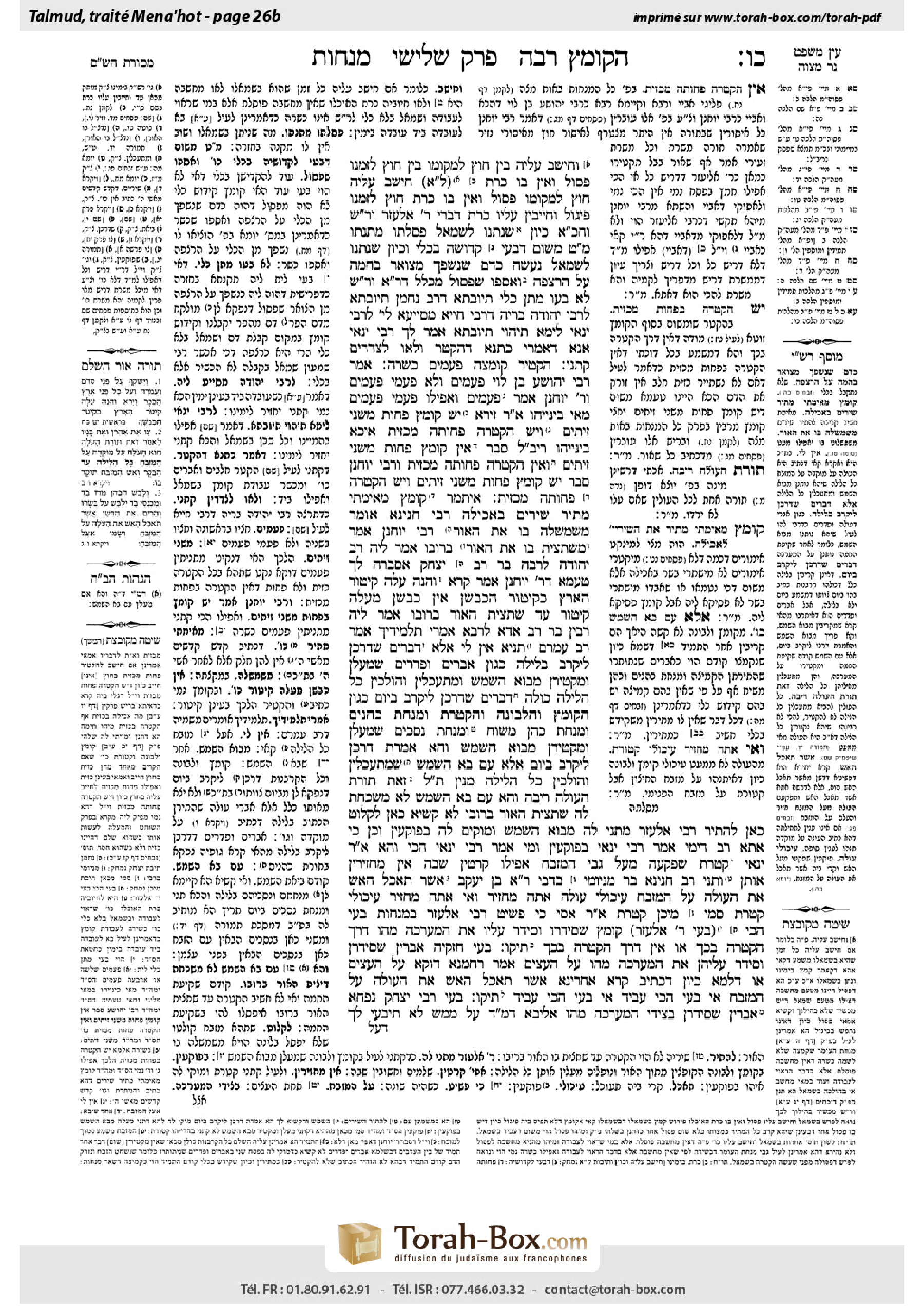
Menachot 26b: Talmud study for Daf Yomi
Daf Yomi is the daily study of one Talmud folio. Explore 37 tractates with scans, Hebrew text, Sefaria English and AI-generated French translations where annotated.
Passage selection and English or AI-generated French translation are available where the scan has annotations. Daf Study is independent of Torah-Box and Sefaria.
Browse Menachot · מנחות · All tractatesMenachot 26b text and translations
This page of Menachot includes the Aramaic text, an English translation and an AI-generated French translation, alongside the scan above.
מנחות כ״ו ב · Aramaic and Hebrew text
וְחִישֵּׁב עָלֶיהָ בֵּין חוּץ לִמְקוֹמוֹ בֵּין חוּץ לִזְמַנּוֹ – פָּסוּל, וְאֵין בּוֹ כָּרֵת.
(לֹא) חִישֵּׁב עָלֶיהָ חוּץ לִמְקוֹמוֹ – פָּסוּל, וְאֵין בּוֹ כָּרֵת. חוּץ לִזְמַנּוֹ – פִּיגּוּל, וְחַיָּיבִין עָלָיו כָּרֵת, דִּבְרֵי רַבִּי אֶלְעָזָר וְרַבִּי שִׁמְעוֹן.
וַחֲכָמִים אוֹמְרִים: כֵּיוָן שֶׁנְּתָנוֹ לִשְׂמֹאל – פְּסָלַתּוּ מַתְּנָתוֹ, מַאי טַעְמָא? מִשּׁוּם דְּבָעֵי קְדוּשָּׁה בִּכְלִי, וְכֵיוָן שֶׁנְּתָנוֹ לִשְׂמֹאל – נַעֲשָׂה כְּדָם שֶׁנִּשְׁפַּךְ מִצַּוַּאר בְּהֵמָה עַל הָרִצְפָּה וַאֲסָפוֹ, שֶׁפָּסוּל.
מִכְּלָל דְּרַבִּי אֶלְעָזָר וְרַבִּי שִׁמְעוֹן לָא בָּעוּ מַתַּן כְּלִי, תְּיוּבְתָּא דְּרַב נַחְמָן, תְּיוּבְתָּא.
לְרַבִּי יְהוּדָה בְּרֵיהּ דְּרַבִּי חִיָּיא מְסַיְּיעָא לֵיהּ, לְרַבִּי יַנַּאי לֵימָא תֶּיהְוֵי תְּיוּבְתָּא?
אָמַר לָךְ רַבִּי יַנַּאי: אֲנָא דַּאֲמַרִי כְּתַנָּא דְּהֶקְטֵר, וְלָאו לִצְדָדִים קָתָנֵי.
הִקְטִיר קוּמְצָהּ פַּעֲמַיִם – כְּשֵׁרָה. אָמַר רַבִּי יְהוֹשֻׁעַ בֶּן לֵוִי: ״פַּעֲמַיִם״ – וְלֹא פַּעֲמֵי פַעֲמַיִם, וְרַבִּי יוֹחָנָן אָמַר: ״פַּעֲמַיִם״ – וַאֲפִילּוּ פַּעֲמֵי פַעֲמַיִם.
מַאי בֵּינַיְיהוּ? אָמַר רַבִּי זֵירָא: יֵשׁ קוֹמֶץ פָּחוֹת מִשְּׁנֵי זֵיתִים, וְיֵשׁ הַקְטָרָה פְּחוּתָה מִכְּזַיִת אִיכָּא בֵּינַיְיהוּ.
רַבִּי יְהוֹשֻׁעַ בֶּן לֵוִי סָבַר: אֵין קוֹמֶץ פָּחוֹת מִשְּׁנֵי זֵיתִים, וְאֵין הַקְטָרָה פְּחוּתָה מִכְּזַיִת. וְרַבִּי יוֹחָנָן סָבַר: יֵשׁ קוֹמֶץ פָּחוֹת מִשְּׁנֵי זֵיתִים, וְיֵשׁ הַקְטָרָה פְּחוּתָה מִכְּזַיִת.
אִיתְּמַר: קוֹמֶץ מֵאֵימָתַי מַתִּיר שִׁירַיִם בַּאֲכִילָה? רַבִּי חֲנִינָא אוֹמֵר: מִשֶּׁמָּשְׁלָה בּוֹ (אֶת) הָאוּר, רַבִּי יוֹחָנָן אָמַר: מִשֶּׁתַּצִּית בּוֹ (אֶת) הָאוּר בְּרוּבּוֹ.
אֲמַר לֵיהּ רַב יְהוּדָה לְרַבָּה בַּר רַב יִצְחָק: אַסְבְּרַהּ לָךְ טַעְמָא דְּרַבִּי יוֹחָנָן, אָמַר קְרָא: ״וְהִנֵּה עָלָה קִיטֹר הָאָרֶץ כְּקִיטֹר הַכִּבְשָׁן״, אֵין כִּבְשָׁן מַעֲלֶה קִיטוֹר עַד שֶׁתַּצִּית הָאוּר בְּרוּבּוֹ.
אֲמַר לֵיהּ רָבִין בַּר רַב אַדָּא לְרָבָא: אָמְרִי תַּלְמִידֶיךָ אָמַר רַב עַמְרָם, תַּנְיָא: אֵין לִי אֶלָּא דְּבָרִים שֶׁדַּרְכָּן לִיקְרַב בַּלַּיְלָה, כְּגוֹן אֵבָרִים וּפְדָרִים, שֶׁמַּעֲלָן וּמַקְטִירָן מִבּוֹא הַשֶּׁמֶשׁ, וּמִתְעַכְּלִין וְהוֹלְכִין כׇּל הַלַּיְלָה כּוּלָּהּ.
דְּבָרִים שֶׁדַּרְכָּן לִיקְרַב בַּיּוֹם, כְּגוֹן: הַקּוֹמֶץ, וְהַלְּבוֹנָה, וְהַקְּטֹרֶת, וּמִנְחַת כֹּהֲנִים, וּמִנְחַת כֹּהֵן מָשׁוּחַ, וּמִנְחַת נְסָכִים, שֶׁמַּעֲלָן וּמַקְטִירָן מִבּוֹא הַשֶּׁמֶשׁ?
וְהָא אָמְרַתְּ דַּרְכָּן לִיקְרַב בַּיּוֹם! אֶלָּא, עִם בֹּא הַשֶּׁמֶשׁ, שֶׁמִּתְעַכְּלִין וְהוֹלְכִין כׇּל הַלַּיְלָה – מִנַּיִן? תַּלְמוּד לוֹמַר: ״זֹאת תּוֹרַת הָעֹלָה״ – רִיבָּה.
וְהָא עִם בֹּא הַשֶּׁמֶשׁ – לָא מַשְׁכַּחַתְּ לַהּ שֶׁתַּצִּית הָאוּר בְּרוּבּוֹ. לָא קַשְׁיָא: כָּאן לִקְלוֹט, כָּאן לְהַתִּיר.
רַבִּי אֶלְעָזָר מַתְנֵי לַהּ ״מִבּוֹא הַשֶּׁמֶשׁ״, וּמוֹקֵים לַהּ בְּפוֹקְעִין, וְכֵן כִּי אֲתָא רַב דִּימִי אָמַר רַבִּי יַנַּאי: בְּפוֹקְעִין.
וּמִי אָמַר רַבִּי יַנַּאי הָכִי? וְהָא אָמַר רַבִּי יַנַּאי: קְטֹרֶת שֶׁפָּקְעָה מֵעַל גַּבֵּי הַמִּזְבֵּחַ, אֲפִילּוּ קְרָטִין שֶׁבָּהּ אֵין מַחֲזִירִין אוֹתָן! וְתָנֵי רַב חֲנִינָא בַּר מִנְיוֹמֵי בִּדְבֵי רַבִּי אֱלִיעֶזֶר בֶּן יַעֲקֹב: ״אֲשֶׁר תֹּאכַל הָאֵשׁ אֶת הָעֹלָה עַל הַמִּזְבֵּחַ״ – עִיכּוּלֵי עוֹלָה אַתָּה מַחְזִיר, וְאִי אַתָּה מַחְזִיר עִיכּוּלֵי קְטֹרֶת! סְמִי מִיכָּן קְטֹרֶת.
אָמַר רַבִּי אַסִּי: כִּי פָּשֵׁיט רַבִּי אֶלְעָזָר בִּמְנָחוֹת, בָּעֵי הָכִי – בָּעֵי רַבִּי אֶלְעָזָר: קוֹמֶץ שֶׁסִּידְּרוֹ, וְסִידֵּר עָלָיו אֶת הַמַּעֲרָכָה, מַהוּ? דֶּרֶךְ הַקְטָרָה בְּכָךְ, אוֹ אֵין דֶּרֶךְ הַקְטָרָה בְּכָךְ? תֵּיקוּ.
בָּעֵי חִזְקִיָּה: אֵבָרִין שֶׁסִּידְרָן וְסִידֵּר עֲלֵיהֶן אֶת הַמַּעֲרָכָה, מַהוּ? ״עַל הָעֵצִים״ אָמַר רַחְמָנָא דַּוְקָא עַל הָעֵצִים, אוֹ דִלְמָא כֵּיוָן דִּכְתִיב קְרָא אַחֲרִינָא: ״אֲשֶׁר תֹּאכַל הָאֵשׁ אֶת הָעֹלָה עַל הַמִּזְבֵּחַ״, אִי בָּעֵי הָכִי עָבֵיד, אִי בָּעֵי הָכִי עָבֵיד? תֵּיקוּ.
בָּעֵי רַבִּי יִצְחָק נַפָּחָא: אֵבָרִין שֶׁסִּידְּרָן בְּצִידֵּי הַמַּעֲרָכָה, מַהוּ? אַלִּיבָּא דְּמַאן דְּאָמַר ״עַל״ מַמָּשׁ – לָא תִּיבְּעֵי לָךְ,
Menachot 26b · English translation
and he intended to partake of the meal offering in an improper manner, whether outside its designated area or beyond its designated time, the offering is not valid, but there is no liability to receive karet if one partakes of it.
The Gemara presents an alternative version of this baraita: If, while the handful was in his right hand, he intended to partake of the meal offering outside its designated area, the offering is not valid, but there is no liability to receive karet if one partakes of it. If he intended to partake of it beyond its designated time, then the offering is piggul and one who partakes of it is liable to receive karet. This is the statement of Rabbi Elazar and Rabbi Shimon.
And the Rabbis say: Once he put the handful in his left hand, the placing of it in his left hand renders it unfit and it cannot be rendered fit by returning it to his right hand. What is the reason? It is because it requires sanctification in a service vessel, and once he put it in his left hand, it is considered like blood that spilled from an animal’s neck onto the floor before being collected in a service vessel and one then gathered it, which is unfit and cannot be rendered fit by then being placed in a service vessel.
The Gemara notes: By inference, one can conclude that Rabbi Elazar and Rabbi Shimon do not require sanctification of the handful by placing it in a service vessel. Accordingly, this serves as a conclusive refutation of the opinion of Rav Naḥman bar Yitzḥak, who stated that even Rabbi Shimon requires sanctification in a service vessel. The Gemara affirms: This is a conclusive refutation of his opinion.
The baraita teaches that according to Rabbi Shimon, if the priest transferred the handful to his left hand he should return the handful to his right hand. The Gemara comments: This supports the statement of Rabbi Yehuda, son of Rabbi Ḥiyya, as he said that according to the opinion of Rabbi Shimon the rites of the meal offering must be performed with the priest’s right hand. The Gemara asks: Shall we say that this baraita is a conclusive refutation of the opinion of Rabbi Yannai, as it teaches that the handful must be transferred back to his right hand, whereas he states that once the handful has been removed from a service vessel it may be sacrificed in any manner?
The Gemara answers: Rabbi Yannai could say to you: I stated my ruling in accordance with the opinion of the tanna who taught that the burning of the fats and the limbs and the sacrifice of the meal offering can all take place with either the right or left hand. And I hold that he does not teach it disjunctively, as it was explained in order to reconcile the baraita with the statement of Rabbi Yehuda, son of Rabbi Ḥiyya. Rather, it is to be understood according to its straightforward meaning.
§ The mishna teaches: If the priest burned the handful of a meal offering twice, i.e., in two increments, it is fit. The Gemara comments: Rabbi Yehoshua ben Levi says: The handful is fit if it is burned twice, where half of the handful is burned each time, but not if it is burned several times, in smaller increments. And Rabbi Yoḥanan says: It is fit if it is burned twice, and it is fit even if it is burned several times.
The Gemara asks: What is the basis for the dispute between the two opinions? Rabbi Zeira said: The dispute between the two is with regard to whether there is significance to a handful that is less than the size of two olives and whether there is significance to the burning of less than an olive-bulk on the altar.
Rabbi Yehoshua ben Levi holds that there is no significance to a handful that is less than the size of two olives and there is no significance to the burning of less than an olive-bulk on the altar. Therefore, the mishna’s statement that the handful may be burned in two increments is meant literally, and the handful may be divided into only two equal portions, where each one contains exactly one olive-bulk. It may not be divided further, since doing so would result in the burning of less than an olive-bulk on the altar. And Rabbi Yoḥanan holds that there is significance to a handful that is less than the size of two olives and there is significance to the burning of less than an olive-bulk on the altar. Therefore, if the handful was divided into several small portions and each portion was burned separately, it is fit.
§ It was stated: From when precisely does the sacrifice of the handful render permitted the remainder of the meal offering for consumption by the priests? Rabbi Ḥanina says: From when the fire takes hold of it, i.e., when it ignites. Rabbi Yoḥanan says: From when the fire consumes most of the handful.
Rav Yehuda said to Rabba bar Rav Yitzḥak: I will explain to you the reasoning of Rabbi Yoḥanan. The verse states: “And behold, the smoke of the land went up as the smoke of a furnace” (Genesis 19:28), and a furnace does not release smoke until the fire takes hold of the majority of the fuel. Rabbi Yoḥanan derived from this verse that the majority of the handful must be consumed by the fire, since the priests are instructed to make the handful smoke, as it is written: “And the priest shall make the memorial part thereof smoke upon the altar” (Leviticus 2:2).
Ravin bar Rav Adda said to Rava: Your students say that Rav Amram said that it is taught in a baraita: I have derived only with regard to items whose usual manner is to be sacrificed at night, for example, the limbs of the burnt offering and the fats [pedarim] of the burnt offering, that the priest may bring them up and burn them after sunset and they are consumed throughout the entire night. This is derived from the verse: “This is the law of the burnt offering: It is that which goes up on its firewood upon the altar all night unto the morning” (Leviticus 6:2).
The baraita continues: With regard to items whose usual manner is to be sacrificed during the day, for example, the handful of the meal offering, the frankincense, the incense, the meal offering of priests, the meal offering of the anointed priest, i.e., the High Priest, and the meal offering that accompanies the libations, from where is it derived that the priest may bring them up and burn them after sunset?
The Gemara interjects: Why would they be allowed to be burned after sunset? But didn’t you say that these are items whose usual manner is to be sacrificed during the day? The Gemara clarifies: Rather, the question of the baraita is as follows: From where is it derived that these items may be brought up and burned concurrent with the setting of the sun, in which case they are consumed throughout the entire night and not during the day? The verse states: “This is the law of the burnt offering” (Leviticus 6:2), which included everything that is sacrificed on the altar.
Ravin bar Rav Adda challenges: But if the handful is brought up and burned concurrent with the setting of the sun, you do not find that the majority of it is consumed by the fire before sunset. How does this baraita accord with Rabbi Yoḥanan’s statement that the majority of the handful must be consumed by the fire in order to render permitted the consumption of the remainder by the priests? The Gemara answers: This is not difficult. Here, where the baraita does not require the consumption by fire of the majority of the handful, it is referring only to that which is required in order for the altar to receive the handful, so that it is considered the food of the altar and may continue to burn all night long. There, Rabbi Yoḥanan states that in order to render permitted the consumption of the remainder by the priests, the majority of the handful must be consumed by the fire.
The Gemara notes: Rabbi Elazar teaches the baraita the way it was initially presented, as asking how it is known that items that are usually sacrificed during the day may be burned after sunset. And he interprets the baraita as referring to parts of the offering that were dislodged from the fire after sunset, which may be returned to the fire throughout the night. And similarly, when Rav Dimi came from Eretz Yisrael to Babylonia he said that Rabbi Yannai said the baraita is referring to parts that were dislodged from the fire after sunset.
The Gemara asks: And did Rabbi Yannai in fact say this? But doesn’t Rabbi Yannai say: In the case of incense that was dislodged from on top of the altar, the priests may not return even small lumps of it to the fire? And similarly, Rav Ḥanina bar Minyumi from the school of Rabbi Eliezer ben Ya’akov taught in a baraita: The verse states: “That which the fire will consume of the burnt offering on the altar” (Leviticus 6:3). This teaches that if parts of a burnt offering that were partially consumed were dislodged from the external altar you shall return them, but you do not return incense that was partially consumed and was dislodged from the internal altar. The Gemara answers: Remove from the baraita here the word incense, so that it is not included in the list of items that may be burned throughout the night.
Rabbi Asi said: When Rabbi Elazar would explain the halakhot of the meal offerings, he would raise this dilemma: Rabbi Elazar raises a dilemma: With regard to a handful that a priest arranged on the altar, and he arranged the arrangement of wood on the altar on top of it, what is the halakha? Is this considered a proper manner of burning, or is this not considered a proper manner of burning, since the handful is not arranged on top of the wood? The Gemara comments: No answer was found, and the dilemma shall stand unresolved.
Ḥizkiyya raises a dilemma: With regard to the limbs of the burnt offering that a priest arranged on the altar and arranged the arrangement of wood on the altar on top of them, what is the halakha? Do we say that the Merciful One states: “And Aaron’s sons, the priests, shall lay the pieces and the head, and the fat, in order upon the wood that is on the fire upon the altar” (Leviticus 1:8), teaching that they must be placed specifically upon the wood? Or perhaps, since it is written in another verse: “That which the fire will consume of the burnt offering on the altar” (Leviticus 6:3), indicating that the burnt offering may be arranged directly on the altar, if the priest desires to arrange the limbs in this manner he may do so, and if he desires to arrange them in that manner he may also do so. The Gemara comments: No answer was found, and the dilemma shall stand unresolved.
Rabbi Yitzḥak Nappaḥa raises a dilemma: With regard to the limbs of an offering that a priest arranged adjacent to the arrangement of wood on the altar, what is the halakha? The Gemara explains: Do not raise the dilemma according to the opinion of the one who says that the phrase “upon [al] the wood” is meant literally,
Menachot 26b · Traduction française (IA)
Et s’il avait l’intention de consommer l’offrande de farine de manière irrégulière, soit hors de son lieu désigné, soit après le délai prescrit, l’offrande n’est pas valide, mais celui qui la consomme n’encourt pas la peine de karet.
La Guemara présente une autre version de cette baraïta : si, alors que la poignée se trouvait dans sa main droite, il avait l’intention de consommer l’offrande de farine hors de son lieu désigné, l’offrande n’est pas valide, mais celui qui la consomme n’encourt pas la peine de karet. S’il avait l’intention de la consommer après le délai prescrit, elle est piggoul et celui qui la consomme encourt la peine de karet. Telle est l’opinion de Rabbi Elazar et de Rabbi Shimon.
Et les Sages disent : dès qu’il a placé la poignée dans sa main gauche, le fait de l’y placer la rend impropre, et il est impossible de la rendre apte en la remettant dans sa main droite. Pour quelle raison ? Parce qu’elle doit être sanctifiée dans un ustensile de service. Une fois placée dans sa main gauche, elle est considérée comme du sang qui s’est écoulé du cou d’un animal sur le sol avant d’être recueilli dans un ustensile de service, puis qui a été recueilli : ce sang est impropre, et il est impossible de le rendre apte en le plaçant ensuite dans un ustensile de service.
La Guemara relève : on peut en déduire que, selon Rabbi Elazar et Rabbi Shimon, la poignée n’a pas besoin d’être sanctifiée en étant placée dans un ustensile de service. Par conséquent, cela constitue une réfutation définitive de l’avis de Rav Naḥman bar Yitzḥak, qui a affirmé que même Rabbi Shimon exige une sanctification dans un ustensile de service. La Guemara confirme : son avis est définitivement réfuté.
La baraïta enseigne que, selon Rabbi Shimon, si le prêtre a transféré la poignée dans sa main gauche, il doit la remettre dans sa main droite. La Guemara fait remarquer : cela appuie l’affirmation de Rabbi Yehuda, fils de Rabbi Ḥiyya, selon laquelle, d’après Rabbi Shimon, les rites de l’offrande de farine doivent être accomplis de la main droite du prêtre. La Guemara demande : faut-il en conclure que cette baraïta réfute définitivement l’avis de Rabbi Yannai, puisqu’elle enseigne que la poignée doit être remise dans sa main droite, tandis que Rabbi Yannai affirme qu’une fois la poignée retirée d’un ustensile de service, elle peut être offerte de n’importe quelle manière ?
La Guemara répond : Rabbi Yannai pourrait te dire : j’ai formulé ma décision conformément à l’avis du tanna qui enseigne que la combustion des graisses et des membres, ainsi que le sacrifice de l’offrande de farine, peuvent tous être accomplis de la main droite ou de la main gauche. Je considère qu’il n’énonce pas cette règle de manière disjonctive, comme on l’a expliqué pour concilier la baraïta avec l’affirmation de Rabbi Yehuda, fils de Rabbi Ḥiyya. Il faut plutôt la comprendre selon son sens simple.
§ La Michna enseigne : si le prêtre a brûlé la poignée d’une offrande de farine en deux fois, c’est-à-dire en deux portions, elle est valide. La Guemara fait remarquer : Rabbi Yehoshua ben Levi dit que la poignée est valide si elle est brûlée en deux fois, une moitié étant brûlée à chaque fois, mais pas si elle est brûlée en plusieurs fois, en portions plus petites. Rabbi Yoḥanan dit qu’elle est valide si elle est brûlée en deux fois, et même si elle est brûlée en plusieurs fois.
La Guemara demande : sur quoi porte le désaccord entre ces deux opinions ? Rabbi Zeira dit : leur désaccord porte sur la question de savoir si une poignée dont la quantité est inférieure à deux olives a une valeur significative, et si la combustion sur l’autel d’une quantité inférieure au volume d’une olive a une valeur significative.
Rabbi Yehoshua ben Levi estime qu’une poignée d’une quantité inférieure à deux olives n’a pas de valeur significative, et que la combustion sur l’autel d’une quantité inférieure au volume d’une olive n’a pas de valeur significative. Par conséquent, la déclaration de la Michna selon laquelle la poignée peut être brûlée en deux fois doit être prise au pied de la lettre : elle ne peut être divisée qu’en deux portions égales, chacune contenant exactement le volume d’une olive. Elle ne peut pas être divisée davantage, car cela entraînerait la combustion sur l’autel d’une quantité inférieure au volume d’une olive. Rabbi Yoḥanan, lui, estime qu’une poignée d’une quantité inférieure à deux olives a une valeur significative, et que la combustion sur l’autel d’une quantité inférieure au volume d’une olive a une valeur significative. Par conséquent, si la poignée a été divisée en plusieurs petites portions et que chacune a été brûlée séparément, elle est valide.
§ Il a été enseigné : à partir de quel moment précis le sacrifice de la poignée rend-il le reste de l’offrande de farine permis à la consommation des prêtres ? Rabbi Ḥanina dit : dès que le feu s’en empare, c’est-à-dire dès qu’il prend. Rabbi Yoḥanan dit : dès que le feu a consumé la majeure partie de la poignée.
Rav Yehuda dit à Rabba bar Rav Yitzḥak : je vais t’expliquer le raisonnement de Rabbi Yoḥanan. Le verset dit : « Et voici que la fumée de la terre montait comme la fumée d’une fournaise » (Genèse 19:28), et une fournaise ne dégage pas de fumée avant que le feu ne se soit emparé de la majeure partie du combustible. Rabbi Yoḥanan a déduit de ce verset que le feu doit consumer la majeure partie de la poignée, car les prêtres ont reçu l’ordre de faire fumer la poignée, comme il est écrit : « Le prêtre en fera fumer la partie mémoriale sur l’autel » (Lévitique 2:2).
Ravin bar Rav Adda dit à Rava : tes élèves disent que Rav Amram a enseigné ce qui suit dans une baraïta : je n’ai déduit cette règle que pour les éléments qui sont habituellement sacrifiés la nuit, par exemple les membres de l’holocauste et les graisses [pedarim] de l’holocauste. Le prêtre peut les placer sur l’autel et les brûler après le coucher du soleil, et ils sont consumés pendant toute la nuit. Cela se déduit du verset : « Voici la loi de l’holocauste : c’est ce qui monte sur son bois, sur l’autel, toute la nuit jusqu’au matin » (Lévitique 6:2).
La baraïta poursuit : pour les éléments qui sont habituellement sacrifiés pendant la journée, par exemple la poignée de l’offrande de farine, l’encens, l’encens du Sanctuaire, l’offrande de farine des prêtres, l’offrande de farine du prêtre oint, c’est-à-dire du Grand Prêtre, et l’offrande de farine qui accompagne les libations, de quoi déduit-on que le prêtre peut les placer sur l’autel et les brûler après le coucher du soleil ?
La Guemara intervient : pourquoi serait-il permis de les brûler après le coucher du soleil ? N’as-tu pas dit qu’il s’agit d’éléments qui sont habituellement sacrifiés pendant la journée ? La Guemara précise : la question de la baraïta est plutôt la suivante : de quoi déduit-on que ces éléments peuvent être placés sur l’autel et brûlés au moment même du coucher du soleil, auquel cas ils sont consumés pendant toute la nuit, et non pendant la journée ? Le verset dit : « Voici la loi de l’holocauste » (Lévitique 6:2), ce qui inclut tout ce qui est sacrifié sur l’autel.
Ravin bar Rav Adda objecte : mais si la poignée est placée sur l’autel et brûlée au moment même du coucher du soleil, le feu ne peut en avoir consumé la majeure partie avant le coucher du soleil. Comment cette baraïta s’accorde-t-elle avec l’affirmation de Rabbi Yoḥanan, selon laquelle le feu doit consumer la majeure partie de la poignée pour que la consommation du reste par les prêtres soit permise ? La Guemara répond : il n’y a pas de difficulté. Ici, où la baraïta n’exige pas que le feu consume la majeure partie de la poignée, il s’agit uniquement de ce qui est nécessaire pour que l’autel reçoive la poignée, de sorte qu’elle soit considérée comme une nourriture destinée à l’autel et puisse continuer à brûler toute la nuit. Là, Rabbi Yoḥanan affirme que, pour rendre permise la consommation du reste par les prêtres, le feu doit consumer la majeure partie de la poignée.
La Guemara relève : Rabbi Elazar enseigne la baraïta dans sa formulation initiale, qui demande comment on sait que les éléments habituellement sacrifiés pendant la journée peuvent être brûlés après le coucher du soleil. Il interprète la baraïta comme portant sur les parties de l’offrande qui se sont détachées du feu après le coucher du soleil et peuvent être remises au feu pendant toute la nuit. De même, lorsque Rav Dimi vint d’Eretz Israël en Babylonie, il dit que Rabbi Yannai affirmait que la baraïta porte sur les parties qui se sont détachées du feu après le coucher du soleil.
La Guemara demande : Rabbi Yannai a-t-il réellement dit cela ? Ne dit-il pas que, dans le cas de l’encens qui s’est détaché du sommet de l’autel, les prêtres ne peuvent pas remettre au feu même les petits morceaux ? De même, Rav Ḥanina bar Minyumi, de l’école de Rabbi Eliezer ben Ya’akov, a enseigné dans une baraïta : le verset dit : « Ce que le feu consumera de l’holocauste sur l’autel » (Lévitique 6:3). Cela enseigne que, si des parties d’un holocauste partiellement consumées se sont détachées de l’autel extérieur, on les remet au feu ; mais on ne remet pas au feu l’encens partiellement consumé qui s’est détaché de l’autel intérieur. La Guemara répond : supprime de la baraïta, ici, le mot « encens », afin qu’il ne figure pas parmi les éléments qui peuvent être brûlés toute la nuit.
Rabbi Asi dit : lorsque Rabbi Elazar expliquait les lois des offrandes de farine, il soulevait cette question : si un prêtre a disposé une poignée sur l’autel, puis a disposé le bûcher sur elle, quelle est la halakha ? Est-ce une manière correcte de la brûler, ou non, puisque la poignée n’est pas disposée sur le bois ? La Guemara fait remarquer : aucune réponse n’a été trouvée, et la question reste sans solution.
Ḥizkiyya soulève une question : si un prêtre a disposé les membres de l’holocauste sur l’autel, puis a disposé le bûcher sur eux, quelle est la halakha ? Faut-il dire que le Miséricordieux déclare : « Les fils d’Aaron, les prêtres, disposeront les morceaux, la tête et la graisse en ordre sur le bois qui est sur le feu, sur l’autel » (Lévitique 1:8), ce qui enseigne qu’ils doivent être placés précisément sur le bois ? Ou peut-être, puisqu’un autre verset dit : « Ce que le feu consumera de l’holocauste sur l’autel » (Lévitique 6:3), indiquant que l’holocauste peut être disposé directement sur l’autel, le prêtre peut disposer les membres de l’une ou l’autre manière, selon son choix. La Guemara fait remarquer : aucune réponse n’a été trouvée, et la question reste sans solution.
Rabbi Yitzḥak Nappaḥa soulève une question : si un prêtre a disposé les membres d’une offrande à côté du bûcher sur l’autel, quelle est la halakha ? La Guemara explique : ne soulève pas cette question selon l’avis de celui qui dit que l’expression « sur [al] le bois » doit être comprise au sens littéral,
Traduction française générée par IA à partir de l’édition anglaise de Sefaria. Vérifie toujours un passage avec le texte source.
Text from Sefaria: William Davidson Edition - Vocalized Aramaic (unknown); William Davidson Edition - English (CC BY NC).