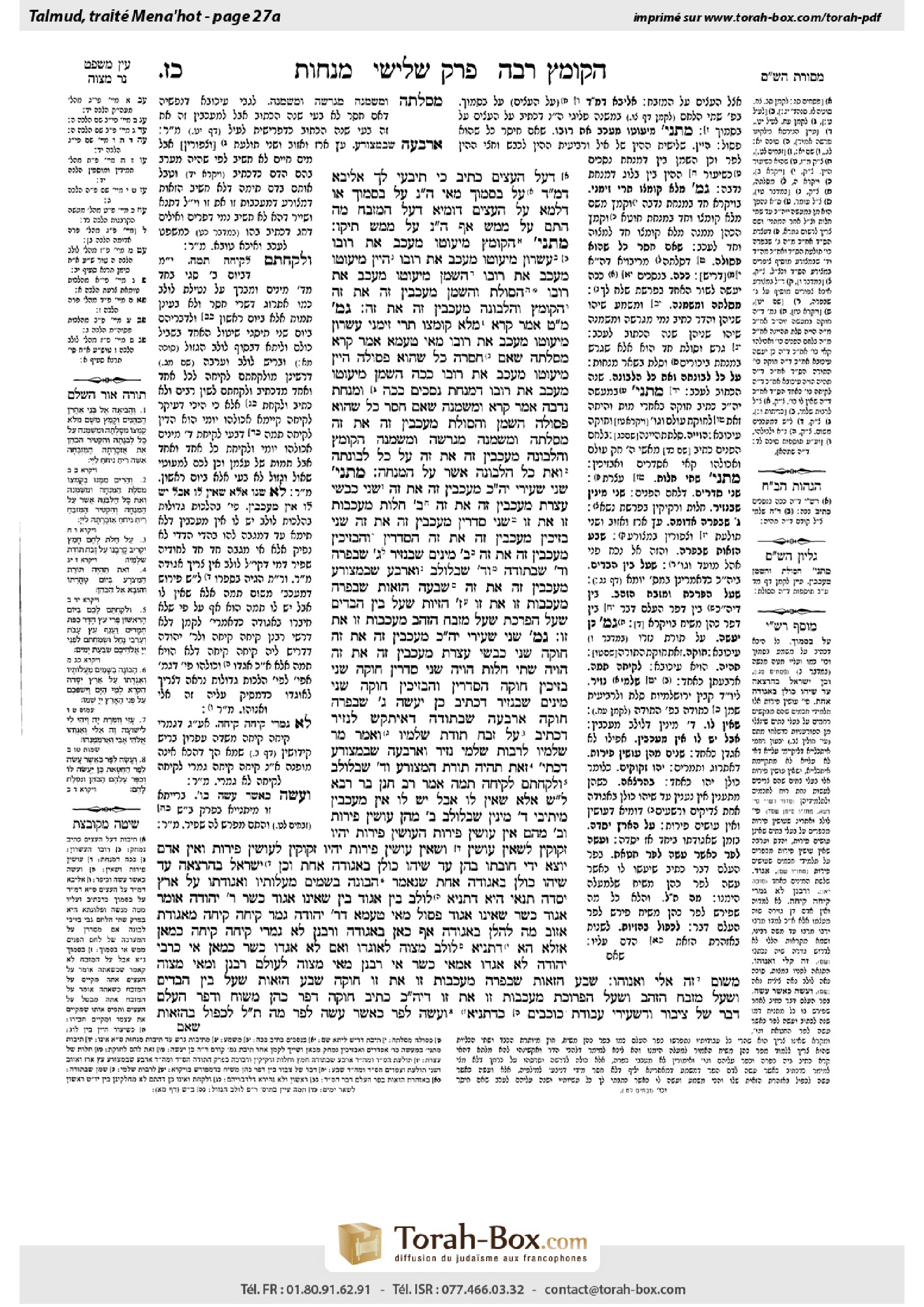
Menachot 27a: Talmud study for Daf Yomi
Daf Yomi is the daily study of one Talmud folio. Explore 37 tractates with scans, Hebrew text, Sefaria English and AI-generated French translations where annotated.
Passage selection and English or AI-generated French translation are available where the scan has annotations. Daf Study is independent of Torah-Box and Sefaria.
Browse Menachot · מנחות · All tractatesMenachot 27a text and translations
This page of Menachot includes the Aramaic text, an English translation and an AI-generated French translation, alongside the scan above.
מנחות כ״ז א · Aramaic and Hebrew text
דְּעַל הָעֵצִים כְּתִיב.
כִּי תִּיבְּעֵי לָךְ, אַלִּיבָּא דְּמַאן דְּאָמַר ״עַל״ בְּסָמוּךְ, מַאי? הָכָא נָמֵי ״עַל״ בְּסָמוּךְ, אוֹ דִלְמָא ״עַל הָעֵצִים״ דּוּמְיָא דְּ״עַל הַמִּזְבֵּחַ״ – מָה הָתָם עַל מַמָּשׁ, אַף הָכָא נָמֵי עַל מַמָּשׁ? תֵּיקוּ.
מַתְנִי׳ הַקּוֹמֶץ מִיעוּטוֹ מְעַכֵּב אֶת רוּבּוֹ, עִשָּׂרוֹן מִיעוּטוֹ מְעַכֵּב אֶת רוּבּוֹ, הַיַּיִן מִיעוּטוֹ מְעַכֵּב אֶת רוּבּוֹ, הַשֶּׁמֶן מִיעוּטוֹ מְעַכֵּב אֶת רוּבּוֹ.
הַסּוֹלֶת וְהַשֶּׁמֶן מְעַכְּבִין זֶה אֶת זֶה, הַקּוֹמֶץ וְהַלְּבוֹנָה מְעַכְּבִין זֶה אֶת זֶה.
גְּמָ׳ מַאי טַעְמָא? אָמַר קְרָא ״מְלֹא קֻמְצוֹ״ תְּרֵי זִימְנֵי.
עִשָּׂרוֹן מִיעוּטוֹ מְעַכֵּב אֶת רוּבּוֹ, מַאי טַעְמָא? אָמַר קְרָא: ״מִסׇּלְתָּהּ״, שֶׁאִם חָסְרָה כׇּל שֶׁהוּא – פְּסוּלָה.
הַיַּיִן מִיעוּטוֹ מְעַכֵּב אֶת רוּבּוֹ, ״כָּכָה״.
הַשֶּׁמֶן מִיעוּטוֹ מְעַכֵּב אֶת רוּבּוֹ, דְּמִנְחַת נְסָכִים – ״כָּכָה״, וּמִנְחַת נְדָבָה – אָמַר קְרָא: ״וּמִשַּׁמְנָהּ״, שֶׁאִם חָסַר כׇּל שֶׁהוּא – פְּסוּלָה.
הַשֶּׁמֶן וְהַסּוֹלֶת מְעַכְּבִין זֶה אֶת זֶה, ״מִסׇּלְתָּהּ וּמִשַּׁמְנָהּ״, ״מִגִּרְשָׂהּ וּמִשַּׁמְנָהּ״.
הַקּוֹמֶץ וְהַלְּבוֹנָה מְעַכְּבִין זֶה אֶת זֶה, ״עַל כׇּל לְבוֹנָתָהּ״, ״וְאֵת כׇּל הַלְּבוֹנָה אֲשֶׁר עַל הַמִּנְחָה״.
מַתְנִי׳ שְׁנֵי שְׂעִירֵי יוֹם הַכִּפּוּרִים מְעַכְּבִין זֶה אֶת זֶה, שְׁנֵי כִּבְשֵׂי עֲצֶרֶת מְעַכְּבִין זֶה אֶת זֶה, שְׁתֵּי חַלּוֹת מְעַכְּבוֹת זוֹ אֶת זוֹ.
שְׁנֵי סְדָרִין מְעַכְּבִין זֶה אֶת זֶה. שְׁנֵי בָּזִיכִין מְעַכְּבִין זֶה אֶת זֶה. הַסְּדָרִין וְהַבָּזִיכִין מְעַכְּבִין זֶה אֶת זֶה.
שְׁנֵי מִינִים שֶׁבַּנָּזִיר, שְׁלֹשָׁה שֶׁבַּפָּרָה, וְאַרְבָּעָה שֶׁבַּתּוֹדָה, וְאַרְבָּעָה שֶׁבַּלּוּלָב, (וארבע) [וְאַרְבָּעָה] שֶׁבַּמְּצוֹרָע – מְעַכְּבִין זֶה אֶת זֶה.
שֶׁבַע הַזָּאוֹת שֶׁבַּפָּרָה מְעַכְּבוֹת זוֹ אֶת זוֹ, שֶׁבַע הַזָּיוֹת שֶׁעַל בֵּין הַבַּדִּים, שֶׁעַל הַפָּרֹכֶת, שֶׁעַל מִזְבַּח הַזָּהָב – מְעַכְּבוֹת זוֹ אֶת זוֹ.
גְּמָ׳ שְׁנֵי שְׂעִירֵי יוֹם הַכִּפּוּרִים מְעַכְּבִין זֶה אֶת זֶה – חוּקָּה.
שְׁנֵי כִּבְשֵׂי עֲצֶרֶת מְעַכְּבִין זֶה אֶת זֶה – הֲוָיָה, שְׁתֵּי חַלּוֹת – הֲוָיָה.
שְׁנֵי סְדָרִין – חוּקָּה, שְׁנֵי בָּזִיכִין – חוּקָּה, הַסְּדָרִין וְהַבָּזִיכִין – חוּקָּה.
שְׁנֵי מִינִים שֶׁבַּנָּזִיר, דִּכְתִיב: ״כֵּן יַעֲשֶׂה״, שְׁלֹשָׁה שֶׁבַּפָּרָה – חוּקָּה.
אַרְבָּעָה שֶׁבַּתּוֹדָה, דְּאִיתַּקַּשׁ לְנָזִיר, דִּכְתִיב: ״עַל זֶבַח תּוֹדַת שְׁלָמָיו״, וְאָמַר מָר: ״שְׁלָמָיו״ – לְרַבּוֹת שַׁלְמֵי נָזִיר.
וְאַרְבָּעָה שֶׁבִּמְצוֹרָע, דִּכְתִיב: ״זֹאת תִּהְיֶה תּוֹרַת הַמְּצֹרָע״, וְאַרְבָּעָה שֶׁבַּלּוּלָב – ״וּלְקַחְתֶּם״, לְקִיחָה תַּמָּה.
אָמַר רַב חָנָן בַּר רָבָא: לֹא שָׁנוּ אֶלָּא שֶׁאֵין לוֹ, אֲבָל יֵשׁ לוֹ – אֵין מְעַכְּבִין.
מֵיתִיבִי: אַרְבָּעָה מִינִין שֶׁבַּלּוּלָב, שְׁנַיִם מֵהֶן עוֹשִׂין פֵּירוֹת, וּשְׁנַיִם מֵהֶם אֵין עוֹשִׂין פֵּירוֹת; הָעוֹשִׂין פֵּירוֹת יִהְיוּ זְקוּקִין לְשֶׁאֵין עוֹשִׂין, וְשֶׁאֵין עוֹשִׂין פֵּירוֹת יִהְיוּ זְקוּקִין לְעוֹשִׂין פֵּירוֹת, וְאֵין אָדָם יוֹצֵא יְדֵי חוֹבָתוֹ בָּהֶן עַד שֶׁיְּהוּ כּוּלָּן בַּאֲגוּדָּה אֶחָת.
וְכֵן יִשְׂרָאֵל בְּהַרְצָאָה, עַד שֶׁיְּהוּ כּוּלָּן בַּאֲגוּדָּה אֶחָת, שֶׁנֶּאֱמַר: ״הַבּוֹנֶה בַשָּׁמַיִם מַעֲלוֹתָיו וַאֲגֻדָּתוֹ עַל אֶרֶץ יְסָדָהּ״.
תַּנָּאֵי הִיא, דְּתַנְיָא: לוּלָב בֵּין אָגוּד בֵּין שֶׁאֵינוֹ אָגוּד – כָּשֵׁר; רַבִּי יְהוּדָה אוֹמֵר: אָגוּד – כָּשֵׁר, שֶׁאֵינוֹ אָגוּד – פָּסוּל.
מַאי טַעְמָא דְּרַבִּי יְהוּדָה? גָּמַר קִיחָה קִיחָה מֵ״אֲגוּדַּת אֵזוֹב״,
מָה לְהַלָּן בַּאֲגוּדָּה – אַף כָּאן בַּאֲגוּדָּה. וְרַבָּנַן, לָא גָּמְרִי ״קִיחָה קִיחָה״.
כְּמַאן אָזְלָא הָא דְּתַנְיָא: לוּלָב מִצְוָה לְאוֹגְדוֹ, וְאִם לֹא אֲגָדוֹ – כָּשֵׁר? כְּמַאן? אִי כְּרַבִּי יְהוּדָה, לֹא אֲגָדוֹ אַמַּאי כָּשֵׁר? אִי רַבָּנַן, מַאי מִצְוָה?
לְעוֹלָם רַבָּנַן, וּמַאי מִצְוָה? מִשּׁוּם ״זֶה אֵלִי וְאַנְוֵהוּ״.
שֶׁבַע הַזָּאוֹת שֶׁבַּפָּרָה מְעַכְּבוֹת זוֹ אֶת זוֹ – חוּקָּה.
שֶׁבַע הַזָּאוֹת שֶׁעַל בֵּין הַבַּדִּים, וְשֶׁעַל מִזְבַּח הַזָּהָב, וְשֶׁעַל הַפָּרוֹכֶת – מְעַכְּבוֹת זוֹ אֶת זוֹ; דְּיוֹם הַכִּפּוּרִים כְּתִיב חוּקָּה.
דְּפַר כֹּהֵן מָשׁוּחַ, וּדְפַר הֶעְלֵם דָּבָר שֶׁל צִיבּוּר, וְדִשְׂעִירֵי עֲבוֹדָה זָרָה – כִּדְתַנְיָא: ״וְעָשָׂה לַפָּר כַּאֲשֶׁר עָשָׂה לְפַר״, מָה תַּלְמוּד לוֹמַר? לִכְפּוֹל בְּהַזָּאוֹת,
Menachot 27a · English translation
as “upon [al] the wood” is written, and not: Next to the wood.
When should you raise the dilemma? Raise it according to the opinion of the one who says in the mishna (96a) that the term “upon [al]” (see Numbers 2:20) means adjacent to. According to that tanna, what is the halakha in this case? Is it explained that here, too, the phrase “upon [al] the wood” can mean adjacent to the wood? Or perhaps, the phrase “upon [al] the wood that is on the fire upon the altar” teaches that “upon the wood” is to be understood as similar to “upon the altar”: Just as there “upon the altar” is meant literally, so too here, the phrase “upon the wood” is meant literally. The Gemara comments: No answer was found, and the dilemma shall stand unresolved.
MISHNA: With regard to the handful, failure to sacrifice the minority of it prevents the majority of it, which was sacrificed, from rendering it permitted for the priests to consume the remainder of the meal offering. With regard to a tenth of an ephah of flour brought as a meal offering, failure to sacrifice the minority of it prevents the majority of it, which was sacrificed, from qualifying as a proper meal offering. With regard to the wine poured as a libation, failure to pour the minority of it prevents the majority of it, which was poured, from qualifying as a proper libation. With regard to the log of oil that is required for the meal offering, failure to add the minority of it prevents the majority of it, which was added, from being a sufficient measure of oil.
With regard to the fine flour and the oil, failure to bring each prevents fulfillment of the mitzva with the other. With regard to the handful and the frankincense, failure to burn each prevents fulfillment of the mitzva with the other.
GEMARA: What is the reason that the failure to sacrifice the minority of the handful disqualifies the entire offering? This is derived from the fact that the verse states “his handful” twice, once with regard to the voluntary meal offering (Leviticus 2:2) and once with regard to the meal offering of a sinner (Leviticus 5:12), and any halakha repeated in the verses is deemed indispensable.
The mishna teaches: With regard to a tenth of an ephah of flour brought as a meal offering, failure to sacrifice the minority of it prevents the majority of it from qualifying as a proper meal offering. What is the reason? The verse states: “The priest shall remove of it a handful of its fine flour” (Leviticus 2:2). The usage of the term “of its fine flour” instead of: Of the fine flour, teaches that if any amount of its flour was missing, it is not valid.
The mishna teaches: With regard to the wine poured as a libation, failure to pour the minority of it prevents the majority of it from qualifying as a proper libation. What is the reason? The verse states concerning the libations: “So shall it be done” (Numbers 15:11). The term “so” indicates that the libations must be sacrificed exactly in the manner described, without any deviation.
The mishna teaches: With regard to the log of oil that is required for the meal offering, failure to add the minority of it prevents the majority of it from being a sufficient measure of oil. In the case of the oil of the meal offering that accompanies the libations, this halakha is learned from the term: “So” (Numbers 15:11), stated with regard to the libations. And in the case of the log of oil that accompanies a voluntary meal offering, the verse states: “And of its oil” (Leviticus 2:2), demonstrating that if any amount of its oil was missing, it is not valid.
The mishna teaches: With regard to the fine flour and the oil, failure to bring each prevents fulfillment of the mitzva with the other. The halakha that each is indispensable is derived from the fact that the two are juxtaposed in the verse: “The priest shall remove of it a handful of its fine flour and of its oil” (Leviticus 2:2), and the fact that this requirement is repeated in the verse: “Of its groats, and of its oil” (Leviticus 2:16), teaches that each is indispensable.
The mishna teaches: With regard to the handful and the frankincense, failure to burn each prevents fulfillment of the mitzva with the other. The halakha that each is indispensable is derived from the repetition of the mention of the two together in the verse, as it is written: “The priest shall remove of it a handful of its fine flour and of its oil, as well as all of its frankincense” (Leviticus 2:2), and again with regard to the meal offering of a sinner it is stated: “And all the frankincense which is upon the meal offering” (Leviticus 6:8).
MISHNA: With regard to the two goats of Yom Kippur, the absence of each goat prevents fulfillment of the mitzva with the other. With regard to the two sheep brought together with the meal offering of the two loaves on Shavuot, failure to bring each of the sheep prevents fulfillment of the mitzva with the other. With regard to the two loaves brought on Shavuot, failure to bring each of the loaves prevents fulfillment of the mitzva with the other.
With regard to the two arrangements of the shewbread, failure to place each of the arrangements prevents fulfillment of the mitzva with the other. With regard to the two bowls of frankincense that accompany the shewbread, failure to place each of the bowls prevents fulfillment of the mitzva with the other. With regard to the arrangements of the shewbread and the bowls of frankincense, failure to bring each of them prevents fulfillment of the mitzva with the other.
With regard to the two types of loaves that accompany the offerings of a nazirite: The bread and wafers (see Numbers 6:15); the three species that are part of the rite of the red heifer: The cedar, hyssop, and scarlet wool (see Numbers 19:6); and the four types of loaves that accompany the thanks offering: The loaves, wafers, loaves soaked in hot water, and leavened bread (see Leviticus 7:12); and the four species of the lulav: The lulav, etrog, myrtle, and willow (see Leviticus 23:40); and the four species that are used in the purification process of the leper: The cedar, hyssop, scarlet wool, and birds (see Leviticus 14:4), failure to bring each of the components prevents fulfillment of the mitzva with the others.
With regard to the seven sprinklings of the blood of the red heifer that the priest sprinkles opposite the entrance to the Sanctuary (see Numbers 19:4), failure to sprinkle each prevents fulfillment of the mitzva with the others. With regard to the seven sprinklings of the blood of the bull and goat of Yom Kippur that are sprinkled on the Ark between the staves (see Leviticus 16:14–15), the seven sprinklings that are sprinkled on the Curtain separating the Sanctuary and Holy of Holies, and the sprinklings that are sprinkled on the golden altar on Yom Kippur, and from all other inner sin offerings, failure to sprinkle each prevents fulfillment of the mitzva with the others.
GEMARA: The mishna teaches: With regard to the two goats of Yom Kippur, the absence of each goat prevents fulfillment of the mitzva with the other. This is derived from the verse that states with regard to the Yom Kippur service: “And it shall be a statute forever” (Leviticus 16:29), since wherever the term “statute” appears concerning a sacrificial rite, it signifies that the rite is an indispensable requirement.
The mishna teaches: With regard to the two sheep brought together with the meal offering of the two loaves on Shavuot, failure to bring each of the sheep prevents fulfillment of the mitzva with the other. This is derived from the verse: “They shall be holy” (Leviticus 23:20), since the employment of a term of being indicates an indispensable requirement. Similarly, with regard to the two loaves brought on Shavuot, the reason failure to bring each of the loaves prevents fulfillment of the mitzva with the other is that the verse states: “They shall be of fine flour” (Leviticus 23:17), employing a term of being.
With regard to the two arrangements of the shewbread, the reason failure to place each of the arrangements prevents fulfillment of the mitzva with the other is that the verse employs the term statute concerning them (see Leviticus 24:9). With regard to the two bowls of frankincense that accompany the shewbread, the reason failure to place each of the bowls prevents fulfillment of the mitzva with the other is that the verse employs the term statute concerning them (see Leviticus 24:9). With regard to the arrangements of the shewbread and the bowls of frankincense, the reason failure to bring each of them prevents fulfillment of the mitzva with the other is that the verse employs the term statute concerning them, as that verse addresses each of these two components.
With regard to the two types of loaves that accompany the offerings of a nazirite, each prevents fulfillment of the mitzva with the others, as it is written with regard to the nazirite: “So he must do after the law of his naziriteship” (Numbers 6:21), demonstrating that he must bring his offerings precisely as detailed in the verse. With regard to the three species that are part of the rite of the red heifer, each prevents fulfillment of the mitzva with the others, since the term statute is written about them: “This is the statute of the law” (Numbers 19:2).
With regard to the four types of loaves that accompany the thanks offering, each prevents fulfillment of the mitzva with the others, since the thanks offering is juxtaposed to the offerings of a nazirite, as it is written with regard to the thanks offering: “With the sacrifice of his peace offerings for thanksgiving” (Leviticus 7:13). And the Master said: The term “his peace offerings” serves to include the loaves of the peace offering of a nazirite, and it has already been demonstrated that with regard to the loaves that accompany the offerings of a nazirite, each prevents fulfillment of the mitzva with the others.
And with regard to the four species that are in the purification process of the leper, each prevents fulfillment of the mitzva with the others, as it is written: “This shall be the law of the leper” (Leviticus 14:2), and the term “shall be” indicates an indispensable requirement. And with regard to the four species of the lulav, each prevents fulfillment of the mitzva with the others, as the verse states: “And you shall take” [ulkaḥtem]” (Leviticus 23:40), which alludes to: A complete taking [lekiḥa tamma], comprising all four species.
§ Rav Ḥanan bar Rava says: The mishna taught that the four species of the lulav are necessary for the fulfillment of the mitzva only in a case where one did not have all four species; but if one has all four species, failure to take each of the components does not prevent fulfillment of the mitzva with the others, and he fulfills the mitzva by taking each species individually.
The Gemara raises an objection from a baraita: With regard to the four species of the lulav, two of them, the lulav and etrog, produce fruit, and two of them, the myrtle and willow, do not produce fruit. Those that produce fruit have a bond with those that do not produce fruit, and those that do not produce fruit have a bond with those that produce fruit. And a person does not fulfill his obligation of taking the lulav until they are all bound together in a single bundle.
And so too, when the Jewish people fast and pray for acceptance of their repentance, this is not accomplished until they are all bound together in a single bundle, as it is stated: “It is He that builds His upper chambers in the Heaven, and has established His bundle upon the earth” (Amos 9:6), which is interpreted as stating that only when the Jewish people are bound together are they established upon the earth. This baraita contradicts Rav Ḥanan bar Rava’s statement, since it teaches that the four species of the lulav must be taken together in order for one to fulfill his obligation of taking the lulav.
The Gemara answers: Whether the different species must be taken together is a dispute between tanna’im; as it is taught in a baraita: A lulav, whether it is bound with the myrtle and willow or whether it is not bound, is fit. Rabbi Yehuda says: If it is bound, it is fit; if it is not bound, it is unfit.
The Gemara asks: What is the reasoning of Rabbi Yehuda? The Gemara answers: By means of a verbal analogy, he derives the term taking, written with regard to the four species, from the term taking written with regard to the bundle of hyssop. It is written there, in the context of the sacrifice of the Paschal offering in Egypt: “Take a bundle of hyssop” (Exodus 12:22), and it is written here, with regard to the four species: “And you shall take for you on the first day the fruit of a beautiful tree, branches of a date palm, boughs of dense-leaved trees, and willows of the brook” (Leviticus 23:40).
Just as there, with regard to the Paschal offering, the mitzva to take the hyssop is specifically in a bundle, so too here, the mitzva to take the four species is specifically in a bundle. The Gemara asks: And what is the reasoning of the Rabbis? The Gemara answers: They do not derive the meaning of the term taking from the meaning of the term taking by means of the verbal analogy.
The Gemara asks: In accordance with whose opinion is that which is taught in a baraita: There is a mitzva to bind the myrtle and the willow together with the lulav, but if one did not bind it, it is fit? In accordance with whose opinion is the baraita? If it is in accordance with the opinion of Rabbi Yehuda, if one did not bind it, why is it fit? If it is in accordance with the opinion of the Rabbis, what mitzva is one fulfilling by binding it?
The Gemara answers: Actually, it is in accordance with the opinion of the Rabbis. And what mitzva is one fulfilling? The mitzva is due to the fact that it is stated: “This is my God and I will beautify Him” (Exodus 15:2), which is interpreted to mean that one should beautify himself before God in the performance of the mitzvot. The Rabbis agree that although failure to bind the three species does not render them unfit for performing the mitzva, the performance of the mitzva is more beautiful when the lulav is bound.
§ The mishna teaches: With regard to the seven sprinklings of the blood of the heifer that the priest sprinkles opposite the entrance to the Sanctuary, failure to sprinkle each prevents fulfillment of the mitzva with the others, since the term statute is written about them (see Numbers 19:2).
The mishna further teaches: With regard to the seven sprinklings of the blood of the bull and goat of Yom Kippur that are sprinkled on the Ark between the staves, and the sprinklings that are sprinkled on the golden altar on Yom Kippur, and the sprinklings from all other inner sin offerings that are sprinkled on the golden altar, and the seven sprinklings that are sprinkled on the Curtain separating the Sanctuary and Holy of Holies, failure to sprinkle each prevents fulfillment of the mitzva with the others. With regard to the sprinklings of Yom Kippur, the reason that each prevents fulfillment of the mitzva with the others is that the term “statute” is written about the Yom Kippur service (see Leviticus 16:29).
With regard to the sprinklings of the bull of the anointed priest, i.e., the High Priest, and of the bull for an unwitting communal sin, and those of the goats of idol worship, which are sprinkled on the Curtain and on the golden altar, the reason that each prevents fulfillment of the mitzva with the others is as it is taught in a baraita: The verse states with regard to the bull for an unwitting communal sin: “So shall he do with the bull; as he did with the bull of the sin offering” of the anointed priest (Leviticus 4:20). Why must the verse state that the bull offering for an unwitting communal sin is sacrificed in the same manner as the bull of the anointed priest, when the Torah has already explicitly specified the manner in which the service should take place? The reason it states it is in order to repeat the command of the sprinklings,
Menachot 27a · Traduction française (IA)
car il est écrit « sur [al] le bois », et non « à côté du bois ».
Dans quel cas faut-il soulever cette question ? Selon l’avis de celui qui dit dans la Michna (96a) que le terme « sur [al] » (voir Nombres 2:20) signifie « à côté de ». Selon ce tanna, quelle est la halakha dans ce cas ? Est-il possible d’expliquer qu’ici aussi, l’expression « sur [al] le bois » signifie « à côté du bois » ? Ou peut-être l’expression « sur [al] le bois qui est sur le feu, sur l’autel » enseigne-t-elle que « sur le bois » doit être compris comme « sur l’autel » : de même que là, « sur l’autel » s’entend au sens littéral, de même ici, « sur le bois » s’entend au sens littéral. La Guemara commente : aucune réponse n’a été trouvée, et la question demeure sans solution.
MICHNA : Pour ce qui est de la poignée, si une partie, même minoritaire, n’est pas offerte, la partie majoritaire qui l’a été ne peut rendre le reste de l’offrande végétale permis à la consommation des prêtres. Pour un dixième d’épha de farine apporté comme offrande végétale, si une partie, même minoritaire, n’est pas offerte, la partie majoritaire qui l’a été ne constitue pas une offrande végétale valide. Pour le vin versé en libation, si une partie, même minoritaire, n’est pas versée, la partie majoritaire qui l’a été ne constitue pas une libation valide. Pour le log d’huile requis pour l’offrande végétale, si une partie, même minoritaire, n’est pas ajoutée, la partie majoritaire qui l’a été ne constitue pas une mesure d’huile suffisante.
Pour la farine fine et l’huile, l’absence de l’une empêche l’accomplissement de la mitsva avec l’autre. Pour la poignée et l’encens, si l’un n’est pas brûlé, l’accomplissement de la mitsva avec l’autre est empêché.
GUEMARA : Pour quelle raison l’absence de la partie minoritaire de la poignée invalide-t-elle toute l’offrande ? Cela découle du fait que le verset mentionne deux fois « sa poignée », une fois à propos de l’offrande végétale volontaire (Lévitique 2:2) et une fois à propos de l’offrande végétale d’un pécheur (Lévitique 5:12) ; toute halakha répétée dans les versets est considérée comme indispensable.
La Michna enseigne : Pour un dixième d’épha de farine apporté comme offrande végétale, si la partie minoritaire n’est pas offerte, la partie majoritaire qui l’a été ne constitue pas une offrande végétale valide. Pour quelle raison ? Le verset dit : « Le prêtre en prélèvera une poignée de sa farine fine » (Lévitique 2:2). L’emploi de l’expression « de sa farine fine » plutôt que « de la farine fine » enseigne que si la moindre quantité de sa farine manque, l’offrande n’est pas valide.
La Michna enseigne : Pour le vin versé en libation, si la partie minoritaire n’est pas versée, la partie majoritaire qui l’a été ne constitue pas une libation valide. Pour quelle raison ? Le verset dit au sujet des libations : « Ainsi sera-t-il fait » (Nombres 15:11). Le terme « ainsi » indique que les libations doivent être offertes exactement de la manière décrite, sans aucun écart.
La Michna enseigne : Pour le log d’huile requis pour l’offrande végétale, si la partie minoritaire n’est pas ajoutée, la partie majoritaire qui l’a été ne constitue pas une mesure d’huile suffisante. Dans le cas de l’huile de l’offrande végétale qui accompagne les libations, cette halakha est déduite du terme « ainsi » (Nombres 15:11), énoncé à propos des libations. Quant au log d’huile qui accompagne une offrande végétale volontaire, le verset dit : « et de son huile » (Lévitique 2:2), ce qui montre que si la moindre quantité de son huile manque, l’offrande n’est pas valide.
La Michna enseigne : Pour la farine fine et l’huile, l’absence de l’une empêche l’accomplissement de la mitsva avec l’autre. Le fait que chacune soit indispensable se déduit de leur juxtaposition dans le verset : « Le prêtre en prélèvera une poignée de sa farine fine et de son huile » (Lévitique 2:2) ; et le fait que cette exigence soit répétée dans le verset « de sa semoule et de son huile » (Lévitique 2:16) enseigne que chacune est indispensable.
La Michna enseigne : Pour la poignée et l’encens, si l’un n’est pas brûlé, l’accomplissement de la mitsva avec l’autre est empêché. Le fait que chacun soit indispensable se déduit de la répétition de leur mention conjointe dans le verset, comme il est écrit : « Le prêtre en prélèvera une poignée de sa farine fine et de son huile, ainsi que tout son encens » (Lévitique 2:2), et, de nouveau à propos de l’offrande végétale d’un pécheur, il est dit : « et tout l’encens qui est sur l’offrande végétale » (Lévitique 6:8).
MICHNA : Pour les deux boucs de Yom Kippour, l’absence de l’un empêche l’accomplissement de la mitsva avec l’autre. Pour les deux agneaux apportés avec l’offrande végétale des deux pains à Chavouot, si l’un des agneaux n’est pas apporté, l’accomplissement de la mitsva avec l’autre est empêché. Pour les deux pains apportés à Chavouot, si l’un des pains n’est pas apporté, l’accomplissement de la mitsva avec l’autre est empêché.
Pour les deux rangées des pains de proposition, si l’une des rangées n’est pas disposée, l’accomplissement de la mitsva avec l’autre est empêché. Pour les deux coupes d’encens accompagnant les pains de proposition, si l’une des coupes n’est pas placée, l’accomplissement de la mitsva avec l’autre est empêché. Pour les rangées des pains de proposition et les coupes d’encens, si l’un de ces éléments n’est pas apporté, l’accomplissement de la mitsva avec l’autre est empêché.
Pour les deux sortes de pains accompagnant les offrandes d’un nazirite — les pains et les galettes (voir Nombres 6:15) —, les trois espèces entrant dans le rite de la vache rousse — le cèdre, l’hysope et la laine écarlate (voir Nombres 19:6) —, les quatre sortes de pains accompagnant le sacrifice de reconnaissance — les pains, les galettes, les pains trempés dans l’eau chaude et le pain levé (voir Lévitique 7:12) —, les quatre espèces du loulav — le loulav, l’étrog, le myrte et le saule (voir Lévitique 23:40) —, et les quatre espèces utilisées dans le processus de purification du lépreux — le cèdre, l’hysope, la laine écarlate et les oiseaux (voir Lévitique 14:4) —, l’absence de l’un des éléments empêche l’accomplissement de la mitsva avec les autres.
Pour les sept aspersions du sang de la vache rousse que le prêtre asperge en direction de l’entrée du Sanctuaire (voir Nombres 19:4), l’absence de l’une empêche l’accomplissement de la mitsva avec les autres. Pour les sept aspersions du sang du taureau et du bouc de Yom Kippour effectuées sur l’Arche, entre les barres (voir Lévitique 16:14–15), pour les sept aspersions effectuées sur le voile séparant le Sanctuaire du Saint des saints, pour les aspersions effectuées sur l’autel d’or à Yom Kippour, ainsi que pour celles de tous les autres sacrifices expiatoires intérieurs, l’absence de l’une empêche l’accomplissement de la mitsva avec les autres.
GUEMARA : La Michna enseigne : Pour les deux boucs de Yom Kippour, l’absence de l’un empêche l’accomplissement de la mitsva avec l’autre. Cela se déduit du verset qui dit au sujet du service de Yom Kippour : « Ce sera pour vous une loi perpétuelle » (Lévitique 16:29), car, lorsqu’il apparaît au sujet d’un rite sacrificiel, le terme « loi » indique que le rite constitue une exigence indispensable.
La Michna enseigne : Pour les deux agneaux apportés avec l’offrande végétale des deux pains à Chavouot, si l’un des agneaux n’est pas apporté, l’accomplissement de la mitsva avec l’autre est empêché. Cela se déduit du verset : « Ils seront saints » (Lévitique 23:20), car l’emploi d’un terme exprimant l’être indique une exigence indispensable. De même, pour les deux pains apportés à Chavouot, si l’un des pains n’est pas apporté, l’accomplissement de la mitsva avec l’autre est empêché parce que le verset dit : « Ils seront de farine fine » (Lévitique 23:17), en employant un terme exprimant l’être.
Pour les deux rangées des pains de proposition, l’absence de l’une empêche l’accomplissement de la mitsva avec l’autre parce que le verset emploie à leur sujet le terme « loi » (voir Lévitique 24:9). Pour les deux coupes d’encens accompagnant les pains de proposition, l’absence de l’une empêche l’accomplissement de la mitsva avec l’autre parce que le verset emploie à leur sujet le terme « loi » (voir Lévitique 24:9). Pour les rangées des pains de proposition et les coupes d’encens, si l’un de ces éléments n’est pas apporté, l’accomplissement de la mitsva avec l’autre est empêché parce que le verset emploie à leur sujet le terme « loi », puisqu’il porte sur chacun de ces deux éléments.
Pour les deux sortes de pains accompagnant les offrandes d’un nazirite, chacune empêche l’accomplissement de la mitsva avec les autres, comme il est écrit au sujet du nazirite : « Il devra agir selon la loi de son naziréat » (Nombres 6:21), ce qui montre qu’il doit apporter ses offrandes exactement selon les modalités détaillées dans le verset. Pour les trois espèces entrant dans le rite de la vache rousse, chacune empêche l’accomplissement de la mitsva avec les autres, puisque le terme « loi » est écrit à leur sujet : « Voici la loi de la Torah » (Nombres 19:2).
Pour les quatre sortes de pains accompagnant le sacrifice de reconnaissance, chacun empêche l’accomplissement de la mitsva avec les autres, puisque le sacrifice de reconnaissance est rapproché des offrandes d’un nazirite, comme il est écrit au sujet du sacrifice de reconnaissance : « avec le sacrifice de ses offrandes de paix en action de grâce » (Lévitique 7:13). Et le Maître a dit : le terme « ses offrandes de paix » sert à inclure les pains de l’offrande de paix d’un nazirite ; or il a déjà été démontré que, pour les pains accompagnant les offrandes d’un nazirite, chacun empêche l’accomplissement de la mitsva avec les autres.
Pour les quatre espèces entrant dans le processus de purification du lépreux, chacune empêche l’accomplissement de la mitsva avec les autres, comme il est écrit : « Telle sera la loi du lépreux » (Lévitique 14:2), et le terme « sera » indique une exigence indispensable. Pour les quatre espèces du loulav, chacune empêche l’accomplissement de la mitsva avec les autres, comme le dit le verset : « Vous prendrez » [ulkaḥtem] (Lévitique 23:40), ce qui évoque une prise [lekiḥa tamma] complète, comprenant les quatre espèces.
§ Rav Ḥanan bar Rava dit : La Michna a enseigné que les quatre espèces du loulav sont nécessaires à l’accomplissement de la mitsva uniquement dans le cas où l’on ne disposait pas des quatre espèces ; mais si l’on dispose des quatre espèces, le fait de ne pas prendre chacune d’elles n’empêche pas l’accomplissement de la mitsva avec les autres, et l’on accomplit la mitsva en prenant chaque espèce séparément.
La Guemara soulève une objection à partir d’une baraïta : parmi les quatre espèces du loulav, deux — le loulav et l’étrog — portent des fruits, et deux — le myrte et le saule — n’en portent pas. Celles qui portent des fruits sont liées à celles qui n’en portent pas, et celles qui n’en portent pas sont liées à celles qui portent des fruits. On ne s’acquitte pas de l’obligation de prendre le loulav tant qu’elles ne sont pas toutes liées ensemble en un seul faisceau.
De même, lorsque le peuple juif jeûne et prie pour que son repentir soit agréé, cela ne se réalise que lorsqu’ils sont tous liés ensemble en un seul faisceau, comme il est dit : « C’est Lui qui bâtit dans les cieux ses chambres hautes et qui a établi son faisceau sur la terre » (Amos 9:6), ce qui est interprété comme signifiant que le peuple juif n’est établi sur la terre que lorsqu’il est lié ensemble. Cette baraïta contredit la déclaration de Rav Ḥanan bar Rava, puisqu’elle enseigne que les quatre espèces du loulav doivent être prises ensemble pour que l’on s’acquitte de l’obligation de prendre le loulav.
La Guemara répond : La question de savoir si les différentes espèces doivent être prises ensemble fait l’objet d’une controverse entre les tannaïm, comme il est enseigné dans une baraïta : un loulav, qu’il soit lié ou non au myrte et au saule, est valide. Rabbi Yehouda dit : s’il est lié, il est valide ; s’il ne l’est pas, il est invalide.
La Guemara demande : Quel est le raisonnement de Rabbi Yehouda ? La Guemara répond : au moyen d’une analogie verbale, il déduit le terme « prendre », employé à propos des quatre espèces, du terme « prendre » employé à propos du faisceau d’hysope. Il est écrit là, dans le contexte du sacrifice de l’agneau pascal en Égypte : « Prenez un faisceau d’hysope » (Exode 12:22), et il est écrit ici, au sujet des quatre espèces : « Vous prendrez pour vous, le premier jour, le fruit d’un bel arbre, des branches de palmier, des rameaux d’arbres touffus et des saules de rivière » (Lévitique 23:40).
De même que là, à propos du sacrifice pascal, la mitsva de prendre l’hysope consiste précisément à le prendre en faisceau, de même ici, la mitsva de prendre les quatre espèces consiste précisément à les prendre en faisceau. La Guemara demande : Et quel est le raisonnement des rabbins ? La Guemara répond : ils ne déduisent pas, au moyen de l’analogie verbale, le sens du terme « prendre » de celui du terme « prendre ».
La Guemara demande : Selon l’avis de qui est enseignée cette baraïta : il y a une mitsva de lier le myrte et le saule au loulav, mais, si on ne les a pas liés, ils restent valides ? Selon l’avis de qui cette baraïta est-elle enseignée ? Si elle est conforme à l’avis de Rabbi Yehouda, pourquoi sont-ils valides si on ne les a pas liés ? Si elle est conforme à l’avis des rabbins, quelle mitsva accomplit-on en les liant ?
La Guemara répond : En réalité, cela est conforme à l’avis des rabbins. Et quelle mitsva accomplit-on ? Il s’agit de la mitsva découlant du verset : « C’est là mon Dieu, et je Le glorifierai » (Exode 15:2), qui est interprété comme signifiant qu’on doit embellir les mitsvot devant Dieu. Les rabbins admettent que, même si l’absence du lien entre les trois espèces ne les rend pas impropres à l’accomplissement de la mitsva, celle-ci est accomplie de façon plus belle lorsque le loulav est lié.
§ La Michna enseigne : Pour les sept aspersions du sang de la vache rousse que le prêtre asperge en direction de l’entrée du Sanctuaire, l’absence de l’une empêche l’accomplissement de la mitsva avec les autres, car le terme « loi » est écrit à leur sujet (voir Nombres 19:2).
La Michna enseigne en outre : Pour les sept aspersions du sang du taureau et du bouc de Yom Kippour effectuées sur l’Arche, entre les barres, pour les aspersions effectuées sur l’autel d’or à Yom Kippour, pour celles des autres sacrifices expiatoires intérieurs effectuées sur l’autel d’or, ainsi que pour les sept aspersions effectuées sur le voile séparant le Sanctuaire du Saint des saints, l’absence de l’une empêche l’accomplissement de la mitsva avec les autres. Pour les aspersions de Yom Kippour, la raison pour laquelle chacune empêche l’accomplissement de la mitsva avec les autres est que le terme « loi » est écrit au sujet du service de Yom Kippour (voir Lévitique 16:29).
Pour les aspersions du taureau du prêtre oint, c’est-à-dire du grand prêtre, du taureau offert pour une faute involontaire de la communauté et des boucs destinés au culte idolâtre, qui sont aspergés sur le voile et sur l’autel d’or, la raison pour laquelle chacune empêche l’accomplissement de la mitsva avec les autres est exposée dans une baraïta : le verset dit au sujet du taureau offert pour une faute involontaire de la communauté : « Il agira avec le taureau comme il a agi avec le taureau du sacrifice expiatoire du prêtre oint » (Lévitique 4:20). Pourquoi le verset doit-il préciser que le taureau offert pour une faute involontaire de la communauté est sacrifié de la même manière que le taureau du prêtre oint, alors que la Torah a déjà explicitement décrit la manière dont le service doit être accompli ? Cette précision sert à répéter l’ordre des aspersions,
Traduction française générée par IA à partir de l’édition anglaise de Sefaria. Vérifie toujours un passage avec le texte source.
Text from Sefaria: William Davidson Edition - Vocalized Aramaic (unknown); William Davidson Edition - English (CC BY NC).