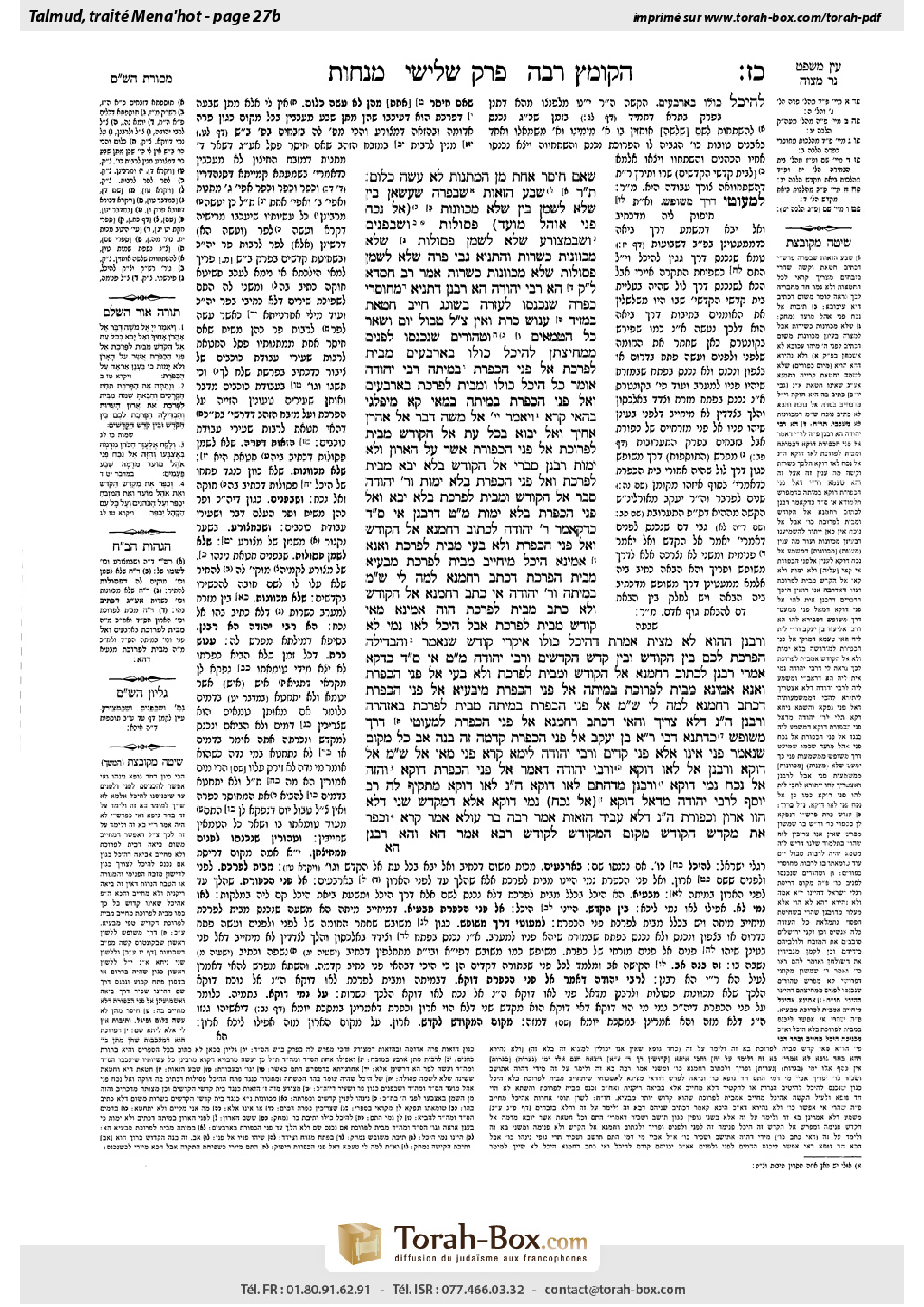
Menachot 27b: Talmud study for Daf Yomi
Daf Yomi is the daily study of one Talmud folio. Explore 37 tractates with scans, Hebrew text, Sefaria English and AI-generated French translations where annotated.
Passage selection and English or AI-generated French translation are available where the scan has annotations. Daf Study is independent of Torah-Box and Sefaria.
Browse Menachot · מנחות · All tractatesMenachot 27b text and translations
This page of Menachot includes the Aramaic text, an English translation and an AI-generated French translation, alongside the scan above.
מנחות כ״ז ב · Aramaic and Hebrew text
שֶׁאִם חִיסֵּר אַחַת מִן הַמַּתָּנוֹת לֹא עָשָׂה כְּלוּם.
תָּנוּ רַבָּנַן: שֶׁבַע הַזָּאוֹת שֶׁבַּפָּרָה, שֶׁעֲשָׂאָן – בֵּין שֶׁלֹּא לִשְׁמָן, בֵּין שֶׁלֹּא מְכוָּּונוֹת אֶל נֹכַח פְּנֵי אוֹהֶל מוֹעֵד – פְּסוּלוֹת.
וְשֶׁבִּפְנִים, וְשֶׁבִּמְצוֹרָע – שֶׁלֹּא לִשְׁמָן, פְּסוּלוֹת; שֶׁלֹּא מְכוָּּונוֹת, כְּשֵׁרוֹת.
וְהָתַנְיָא גַּבֵּי פָּרָה: שֶׁלֹּא לִשְׁמָן – פְּסוּלוֹת, שֶׁלֹּא מְכוָּּונוֹת – כְּשֵׁרוֹת. אָמַר רַב חִסְדָּא: לָא קַשְׁיָא, הָא רַבִּי יְהוּדָה, הָא רַבָּנַן.
דְּתַנְיָא: מְחוּסְּרֵי כַפָּרָה שֶׁנִּכְנְסוּ לָעֲזָרָה בְּשׁוֹגֵג – חַיָּיב חַטָּאת, בְּמֵזִיד – עָנוּשׁ כָּרֵת, וְאֵין צָרִיךְ לוֹמַר טְבוּל יוֹם וּשְׁאָר כׇּל הַטְּמֵאִים.
וּטְהוֹרִים שֶׁנִּכְנְסוּ לִפְנִים מִמְּחִיצָתָן, לַהֵיכָל כּוּלּוֹ – בְּאַרְבָּעִים, מִבֵּית לַפָּרֹכֶת אֶל פְּנֵי הַכַּפֹּרֶת – בְּמִיתָה. רַבִּי יְהוּדָה אוֹמֵר: כׇּל הֵיכָל כּוּלּוֹ וּמִבֵּית לַפָּרֹכֶת – בְּאַרְבָּעִים, וְאֶל פְּנֵי הַכַּפֹּרֶת – בְּמִיתָה.
בְּמַאי קָא מִיפַּלְגִי? בְּהַאי קְרָא: ״וַיֹּאמֶר ה׳ אֶל מֹשֶׁה דַּבֵּר אֶל אַהֲרֹן אָחִיךָ וְאַל יָבוֹא בְכׇל עֵת אֶל הַקֹּדֶשׁ מִבֵּית לַפָּרֹכֶת אֶל פְּנֵי הַכַּפֹּרֶת אֲשֶׁר עַל הָאָרוֹן וְלֹא יָמוּת״. רַבָּנַן סָבְרִי: ״אֶל הַקּוֹדֶשׁ״ – בְּ״לֹא יָבֹא״, ״מִבֵּית לַפָּרֹכֶת״ וְ״אֶל פְּנֵי הַכַּפֹּרֶת״ – בְּ״לֹא יָמוּת״.
וְרַבִּי יְהוּדָה סָבַר: ״אֶל הַקּוֹדֶשׁ״ וּ״מִבֵּית לַפָּרֹכֶת״ – בְּ״לֹא יָבֹא״, וְ״אֶל פְּנֵי הַכַּפֹּרֶת״ – בְּ״לֹא יָמוּת״.
מַאי טַעְמָא דְּרַבָּנַן? אִי סָלְקָא דַעְתָּךְ כִּדְקָאָמַר רַבִּי יְהוּדָה, לִכְתּוֹב רַחֲמָנָא ״אֶל הַקּוֹדֶשׁ״ וְ״אֶל פְּנֵי הַכַּפֹּרֶת״, וְלָא בָּעֵי ״מִבֵּית לַפָּרֹכֶת״, וַאֲנָא אָמֵינָא: הֵיכָל מִיחַיַּיב, מִבֵּית לַפָּרֹכֶת מִבַּעְיָא? ״מִבֵּית הַפָּרֹכֶת״ דִּכְתַב רַחֲמָנָא לְמָה לִי? שְׁמַע מִינַּהּ בְּמִיתָה.
וְרַבִּי יְהוּדָה: אִי כְּתַב רַחֲמָנָא ״אֶל הַקּוֹדֶשׁ״ וְלָא כְּתַב ״מִבֵּית לַפָּרֹכֶת״, הֲוָה אָמֵינָא: מַאי קוֹדֶשׁ – מִבֵּית לַפָּרֹכֶת, אֲבָל הֵיכָל לָאו נָמֵי לָא. וְרַבָּנַן: הָהוּא לָא מָצֵית אָמְרַתְּ, דְּהֵיכָל כּוּלּוֹ אִיקְּרִי ״קוֹדֶשׁ״, שֶׁנֶּאֱמַר: ״וְהִבְדִּילָה הַפָּרֹכֶת לָכֶם בֵּין הַקֹּדֶשׁ וּבֵין קֹדֶשׁ הַקֳּדָשִׁים״.
וְרַבִּי יְהוּדָה מַאי טַעְמָא? אִי סָלְקָא דַעְתָּךְ כִּדְקָא אָמְרִי רַבָּנַן, לִכְתּוֹב רַחֲמָנָא ״אֶל הַקּוֹדֶשׁ״ וּ״מִבֵּית לַפָּרֹכֶת״, וְלָא בָּעֵי ״אֶל פְּנֵי הַכַּפֹּרֶת״, וַאֲנָא אָמֵינָא: ״מִבֵּית לַפָּרוֹכֶת״ בְּמִיתָה, ״אֶל פְּנֵי הַכַּפֹּרֶת״ מִיבַּעְיָא? ״אֶל פְּנֵי הַכַּפֹּרֶת״ דִּכְתַב רַחֲמָנָא לְמָה לִי? שְׁמַע מִינַּהּ: ״אֶל פְּנֵי הַכַּפֹּרֶת״ בְּמִיתָה, ״מִבֵּית לַפָּרֹכֶת״ בְּאַזְהָרָה.
וְרַבָּנַן? [אִין] הָכִי נָמֵי דְּלָא צְרִיךְ, וְהַאי דִּכְתַב רַחֲמָנָא ״אֶל פְּנֵי הַכַּפֹּרֶת״ לְמַעוֹטֵי דֶּרֶךְ מְשׁוּפָּשׁ.
כִּדְתָנָא דְּבֵי רַבִּי אֱלִיעֶזֶר בֶּן יַעֲקֹב: ״אֶל פְּנֵי הַכַּפֹּרֶת קֵדְמָה״ – זֶה בָּנָה אָב, כׇּל מָקוֹם שֶׁנֶּאֱמַר ״פְּנֵי״ אֵינוֹ אֶלָּא פְּנֵי קָדִים.
וְרַבִּי יְהוּדָה, לֵימָא קְרָא ״פְּנֵי״, מַאי ״אֶל״? שְׁמַע מִינַּהּ ״אֶל״ דַּוְקָא, וְרַבָּנַן – ״אֶל״ לָאו דַּוְקָא.
וְרַבִּי יְהוּדָה, דְּאָמַר ״אֶל פְּנֵי הַכַּפֹּרֶת״ דַּוְקָא, וְ״הִזָּה אֶל נֹכַח״ נָמֵי דַּוְקָא.
וְרַבָּנַן: מִדְּהָתָם לָאו דַּוְקָא, הָכָא נָמֵי לָאו דַּוְקָא.
מַתְקֵיף לַהּ רַב יוֹסֵף לְרַבִּי יְהוּדָה: מִדְּ״אֶל״ דַּוְקָא, (אֶל נֹכַח) [עַל] נָמֵי דַּוְקָא? אֶלָּא דְּמִקְדָּשׁ שֵׁנִי דְּלָא הֲווֹ אָרוֹן וְכַפּוֹרֶת, הָכִי נָמֵי דְּלָא עָבֵיד הַזָּאוֹת?
אָמַר רַבָּה בַּר עוּלָּא, אָמַר קְרָא: ״וְכִפֶּר אֶת מִקְדַּשׁ הַקֹּדֶשׁ״ – מְקוֹם הַמְקוּדָּשׁ לַקּוֹדֶשׁ.
רָבָא אָמַר: הָא וְהָא רַבָּנַן,
Menachot 27b · English translation
to teach that if one omitted one of the placements of blood, he has done nothing.
§ The Sages taught in a baraita: If the priest performed the seven sprinklings of the blood of the red heifer improperly, either by performing them not for their own sake or performing them not precisely toward the entrance of the Tent of Meeting of the Tabernacle (Numbers 19:4), which corresponds to the Sanctuary in the Temple, they are not valid.
But with regard to the sprinkling of the blood that takes place inside the Sanctuary, of inner sin offerings, the blood of the bull and goat of Yom Kippur, the blood of the bull of the anointed priest, the blood of the bull for an unwitting communal sin, and the blood of the goats of idol worship, which are to be sprinkled “before the Lord, in front of the Curtain of the Sanctuary” (Leviticus 4:6), and the sprinkling of the oil that takes place during the purification of the leper, which is done “seven times before the Lord” (Leviticus 14:16), if these are performed not for their own sake, then they are not valid. But if they are performed not precisely toward the direction where they should be sprinkled, they are valid.
The Gemara asks: But isn’t it taught in a baraita concerning the sprinklings of the blood of the red heifer that if they were performed not for their own sake, they are not valid, but if they were performed not precisely toward the entrance of the Tent of Meeting or Sanctuary, they are valid? Rav Ḥisda said: This is not difficult; this second baraita is in accordance with the opinion of Rabbi Yehuda, whereas that first baraita is in accordance with the opinion of the Rabbis.
As it is taught in a baraita (Tosefta, Kelim 1:10): With regard to those who have not yet brought an atonement offering to complete the purification process, and therefore are not permitted to enter the Temple or partake of sacrificial meat, who entered the Temple courtyard unwittingly, they are liable to bring a sin offering. If they entered intentionally, then this is punishable by karet. And needless to say, the same applies to one who was ritually impure who immersed that day and is waiting for nightfall for the purification process to be completed and all the others who are ritually impure and have not yet immersed.
And with regard to those who are pure who entered beyond their boundaries, i.e., beyond where it is permitted for them to enter, such as a priest who enters the Sanctuary for a purpose other than performing the Temple service, if one entered any part of the Sanctuary, he is liable to receive forty lashes. If he entered within the Curtain separating the Sanctuary and Holy of Holies, i.e., into the Holy of Holies, or he entered the Holy of Holies all the way until he was before the Ark Cover, he is liable to receive death at the hand of Heaven. Rabbi Yehuda says: If he entered any part of the Sanctuary or within the Curtain separating the Sanctuary and Holy of Holies, he is liable to receive forty lashes; but if he entered the Holy of Holies all the way until he was before the Ark Cover, he is liable to receive death at the hand of Heaven.
With regard to what issue do the Rabbis and Rabbi Yehuda disagree? They disagree with regard to the proper understanding of this verse: “And the Lord said to Moses: Speak to Aaron your brother, that he not come at all times into the holy place, within the Curtain, before the Ark Cover which is upon the Ark, that he not die” (Leviticus 16:2). The Rabbis hold that entering into the holy place, i.e., the Sanctuary, is subject to the prohibition of: He shall not come, and one who violates it is punished with lashes, whereas entering within the Curtain separating the Sanctuary and Holy of Holies and before the Ark Cover is subject to the warning of: He shall not die, and entering there is punished by death at the hand of Heaven.
And Rabbi Yehuda holds that entering into the holy place, i.e., the Sanctuary, and within the Curtain separating the Sanctuary and Holy of Holies is subject to the prohibition of: He shall not come, and one who violates it is punished with lashes, whereas entering before the Ark Cover is subject to the warning of: He shall not die, and entering there is punished by death at the hand of Heaven.
The Gemara asks: What is the reason for the interpretation of the Rabbis? The Gemara answers: If it should enter your mind to explain the verse as Rabbi Yehuda says, then let the Merciful One write: That he not come at all times into the holy place and before the Ark Cover that he not die, and there is no need to write “within the Curtain,” and I would say: If one becomes liable to receive lashes for even entering the Sanctuary, is it necessary to teach that one incurs this punishment for entering within the Curtain? Why do I need the phrase “within the Curtain” that the Merciful One wrote? Learn from that seemingly extraneous term that entering the Holy of Holies is punishable by death at the hand of Heaven.
And Rabbi Yehuda understands: If the Merciful One had written only that it is prohibited to come “into the holy place” and did not write “within the Curtain,” I would say: What is the holy place? It is within the Curtain, i.e., the Holy of Holies, and one who enters it violates a prohibition, but if one enters the Sanctuary he does not even violate a prohibition. And the Rabbis respond to this claim: You cannot say that, as the entire Sanctuary is called “the holy place,” as it is stated: “And the Curtain shall divide for you between the holy place and the Holy of Holies” (Exodus 26:33).
And what is the reason for the interpretation of Rabbi Yehuda? Why does he hold that one who enters the Holy of Holies violates a prohibition but is not punished with death at the hand of Heaven? The Gemara answers: Rabbi Yehuda holds that if it should enter your mind to explain as the Rabbis say, that entering the Holy of Holies is punishable by death at the hand of Heaven, let the Merciful One write: That he not come at all times into the holy place and within the Curtain that he not die, and there is no need to write “before the Ark Cover.” And I would say: If entering within the Curtain, i.e., the Holy of Holies, is punished with death at the hand of Heaven, is it necessary to teach that one incurs this punishment for entering before the Ark Cover? Why do I need the phrase “before the Ark Cover” that the Merciful One wrote? Learn from that seemingly extraneous term that entering before the Ark Cover is punishable by death at the hand of Heaven, but entering within the Curtain merely violates a prohibition.
And the Rabbis understand: Indeed, it is so that in order to teach the punishment of death at the hand of Heaven it is not necessary for the verse to also state “before the Ark Cover.” And the reason that the Merciful One wrote “before [el penei] the Ark Cover” was in order to exclude one who entered the Holy of Holies through a roundabout path, as one who did not enter facing the Ark Cover, i.e., from the east, is not punished with death at the hand of Heaven.
This is as the school of Rabbi Eliezer ben Ya’akov taught: With regard to the verse: “And he shall sprinkle it with his finger before [el penei] the Ark Cover to the east” (Leviticus 16:14), this established a paradigm that any place in the Torah where it is stated: “Before [penei],” it is referring to nothing other than before the eastern side.
The Gemara asks: And how does Rabbi Yehuda respond to this, as it is clear that the term “before [el penei] the Ark Cover” is necessary to exclude one who entered the Holy of Holies through a roundabout path? The Gemara answers: According to Rabbi Yehuda, if the purpose was for that reason, let the verse say: Before [penei] the Ark Cover. What is the purpose of the word el? Learn from that seemingly extraneous term that one is punished with death at the hand of Heaven specifically if he entered directly before the Ark, but not if he merely entered the Holy of Holies. And the Rabbis hold that the term “el” does not mean specifically one who enters directly before the Ark Cover.
The Gemara now returns to its suggestion that the contradiction between the two baraitot with regard to whether the sprinklings of the red heifer are valid or not when performed not precisely toward the entrance of the Tent of Meeting can be resolved by explaining that one baraita is in accordance with the opinion of Rabbi Yehuda and the other is in accordance with the opinion of the Rabbis. And Rabbi Yehuda, who says that the expression “before [el penei] the Ark Cover” teaches that the punishment is limited to one who specifically entered directly before the Ark Cover, holds that the expression: “And sprinkle of its blood toward [el] the front” (Numbers 19:4), also means that the sprinklings must be performed specifically toward the front of the Sanctuary.
And the Rabbis are of the opinion that from the fact that there the term el does not mean specifically that one is liable to be punished with death at the hand of Heaven only if he enters directly before the Ark Cover, here too they hold that it is not meant specifically, and therefore the sprinklings are valid even when performed not precisely toward the entrance of the Tent of Meeting.
Rav Yosef objects to this explanation: According to Rabbi Yehuda, from the fact that there the term el is used specifically, the verse: “And he shall sprinkle of the blood before [al penei] the Ark Cover” (Leviticus 16:14) should also mean that the sprinkling must be performed specifically upon the Ark Cover. But in the time of the Second Temple, where there was no Ark or Ark Cover, would Rabbi Yehuda then say that indeed the sprinklings were not performed? This is clearly not correct, as all agree that the sprinklings were performed in the Second Temple (see Yoma 53b).
Rabba bar Ulla said in response: The verse states with regard to the Yom Kippur service: “And he shall make atonement for the most holy place [mikdash hakodesh]” (Leviticus 16:33), which is interpreted as follows: He will sprinkle the blood to make atonement not specifically on the Ark [hakodesh], but even on the place that is dedicated [hamkudash] for the Ark [lakodesh].
The Gemara offers another resolution of the contradiction between the baraitot concerning whether the sprinklings of the red heifer are valid or invalid when performed not precisely toward the entrance of the Tent of Meeting. Rava said: Both this baraita and that baraita are in accordance with the opinion of the Rabbis:
Menachot 27b · Traduction française (IA)
pour enseigner que si l’on a omis l’un des placements du sang, on n’a rien fait.
§ Les Sages ont enseigné dans une baraïta : si le prêtre a effectué de manière incorrecte les sept aspersions du sang de la vache rousse, soit en les faisant sans l’intention requise, soit en ne les dirigeant pas précisément vers l’entrée de la Tente d’assignation du Tabernacle (Nombres 19:4), qui correspond au Sanctuaire dans le Temple, elles ne sont pas valides.
Mais, en ce qui concerne les aspersions du sang effectuées à l’intérieur du Sanctuaire — celles des sacrifices expiatoires intérieurs, le sang du taureau et du bouc de Yom Kippour, le sang du taureau du prêtre oint, le sang du taureau offert pour une faute involontaire de la communauté et le sang des boucs offerts pour l’idolâtrie — qui doivent être aspergés « devant le Seigneur, en face du rideau du Sanctuaire » (Lévitique 4:6), ainsi que l’aspersion de l’huile effectuée lors de la purification du lépreux, qui doit être faite « sept fois devant le Seigneur » (Lévitique 14:16), si ces aspersions sont faites sans l’intention requise, elles ne sont pas valides. En revanche, si elles ne sont pas dirigées précisément dans la direction où elles doivent être effectuées, elles sont valides.
La Guemara demande : Mais n’enseigne-t-on pas dans une baraïta, au sujet des aspersions du sang de la vache rousse, que si elles ont été faites sans l’intention requise, elles ne sont pas valides, mais que si elles n’ont pas été dirigées précisément vers l’entrée de la Tente d’assignation ou du Sanctuaire, elles sont valides ? Rav Ḥisda a dit : Il n’y a pas de difficulté ; cette seconde baraïta suit l’opinion de Rabbi Yehouda, tandis que la première suit celle des Rabbins.
Comme on l’enseigne dans une baraïta (Tosefta, Kelim 1:10) : ceux qui n’ont pas encore apporté de sacrifice expiatoire pour achever le processus de purification et qui, par conséquent, ne sont pas autorisés à entrer dans le parvis du Temple ni à consommer de la viande sacrificielle, s’ils sont entrés par inadvertance dans le parvis du Temple, sont tenus d’apporter un sacrifice expiatoire. S’ils y sont entrés intentionnellement, ils encourent le karet. Il va sans dire qu’il en va de même de celui qui est rituellement impur, s’est immergé ce jour-là et attend la nuit pour que le processus de purification s’achève, ainsi que de tous les autres impurs qui ne se sont pas encore immergés.
Quant aux personnes rituellement pures qui ont dépassé les limites de la zone où elles sont autorisées à entrer — par exemple, un prêtre qui entre dans le Sanctuaire pour une raison autre que l’accomplissement du service du Temple —, si quelqu’un est entré dans une partie quelconque du Sanctuaire, il est passible de quarante coups de fouet. S’il est entré derrière le rideau séparant le Sanctuaire du Saint des Saints, c’est-à-dire dans le Saint des Saints, ou s’il a pénétré dans le Saint des Saints jusqu’à se trouver devant le propitiatoire, il est passible de mort par la main du Ciel. Rabbi Yehouda dit : s’il est entré dans une partie quelconque du Sanctuaire ou derrière le rideau séparant le Sanctuaire du Saint des Saints, il est passible de quarante coups de fouet ; mais s’il a pénétré dans le Saint des Saints jusqu’à se trouver devant le propitiatoire, il est passible de mort par la main du Ciel.
Sur quel point les Rabbins et Rabbi Yehouda sont-ils en désaccord ? Ils divergent sur la bonne interprétation de ce verset : « Le Seigneur dit à Moïse : Parle à Aaron, ton frère, afin qu’il n’entre pas à tout moment dans le lieu saint, derrière le rideau, devant le propitiatoire qui est sur l’Arche, de peur qu’il ne meure » (Lévitique 16:2). Les Rabbins considèrent que l’interdiction « qu’il n’entre pas » vise l’entrée dans le lieu saint, c’est-à-dire le Sanctuaire, et que celui qui l’enfreint est puni de coups de fouet ; en revanche, l’entrée derrière le rideau séparant le Sanctuaire du Saint des Saints, devant le propitiatoire, est visée par l’avertissement « de peur qu’il ne meure », et celui qui y entre est puni de mort par la main du Ciel.
Rabbi Yehouda considère que l’interdiction « qu’il n’entre pas » vise l’entrée dans le lieu saint, c’est-à-dire le Sanctuaire, ainsi que l’entrée derrière le rideau séparant le Sanctuaire du Saint des Saints, et que celui qui l’enfreint est puni de coups de fouet ; en revanche, l’entrée devant le propitiatoire est visée par l’avertissement « de peur qu’il ne meure », et celui qui y entre est puni de mort par la main du Ciel.
La Guemara demande : Quelle est la raison de l’interprétation des Rabbins ? La Guemara répond : Si l’on pouvait envisager d’expliquer le verset comme le fait Rabbi Yehouda, alors le Miséricordieux aurait écrit : « Afin qu’il n’entre pas à tout moment dans le lieu saint et devant le propitiatoire, de peur qu’il ne meure », sans qu’il soit nécessaire d’écrire « derrière le rideau ». J’aurais alors dit : si l’on est passible de coups de fouet pour être entré dans le Sanctuaire, faut-il préciser que l’on encourt cette peine en entrant derrière le rideau ? Pourquoi le Miséricordieux a-t-il écrit l’expression « derrière le rideau » ? Déduis de ce terme apparemment superflu que l’entrée dans le Saint des Saints est punie de mort par la main du Ciel.
Et Rabbi Yehouda comprend ainsi : si le Miséricordieux avait seulement écrit qu’il est interdit d’entrer « dans le lieu saint », sans écrire « derrière le rideau », j’aurais dit : qu’est-ce que le lieu saint ? C’est l’espace derrière le rideau, c’est-à-dire le Saint des Saints ; celui qui y entre enfreint une interdiction, mais celui qui entre dans le Sanctuaire n’enfreint même pas une interdiction. Les Rabbins répondent à cette affirmation : on ne peut pas dire cela, car tout le Sanctuaire est appelé « le lieu saint », comme il est dit : « Le rideau séparera pour vous le lieu saint du Saint des Saints » (Exode 26:33).
Et quelle est la raison de l’interprétation de Rabbi Yehouda ? Pourquoi considère-t-il que celui qui entre dans le Saint des Saints enfreint une interdiction, mais n’est pas puni de mort par la main du Ciel ? La Guemara répond : Rabbi Yehouda considère que si l’on pouvait envisager d’expliquer le verset comme le font les Rabbins, selon qui l’entrée dans le Saint des Saints est punie de mort par la main du Ciel, alors le Miséricordieux aurait écrit : « Afin qu’il n’entre pas à tout moment dans le lieu saint et derrière le rideau, de peur qu’il ne meure », sans qu’il soit nécessaire d’écrire « devant le propitiatoire ». J’aurais alors dit : si l’entrée derrière le rideau, c’est-à-dire dans le Saint des Saints, est punie de mort par la main du Ciel, faut-il préciser que l’on encourt cette peine en entrant devant le propitiatoire ? Pourquoi le Miséricordieux a-t-il écrit l’expression « devant le propitiatoire » ? Déduis de ce terme apparemment superflu que l’entrée devant le propitiatoire est punie de mort par la main du Ciel, tandis que l’entrée derrière le rideau ne fait qu’enfreindre une interdiction.
Et les Rabbins comprennent ainsi : en effet, il est vrai que le verset n’a pas besoin de préciser « devant le propitiatoire » pour enseigner la peine de mort par la main du Ciel. Si le Miséricordieux a écrit « devant [el penei] le propitiatoire », c’est pour exclure celui qui est entré dans le Saint des Saints par un chemin détourné : celui qui n’y est pas entré en faisant face au propitiatoire, c’est-à-dire par l’est, n’est pas puni de mort par la main du Ciel.
C’est ce qu’enseignait l’école de Rabbi Eliezer ben Ya’akov : le verset « Il en aspergera avec son doigt devant [el penei] le propitiatoire, vers l’est » (Lévitique 16:14) établit un principe : partout dans la Torah où figure l’expression « devant [penei] », elle désigne uniquement l’endroit situé devant le côté oriental.
La Guemara demande : Et comment Rabbi Yehouda répond-il à cela, puisqu’il est clair que l’expression « devant [el penei] le propitiatoire » est nécessaire pour exclure celui qui est entré dans le Saint des Saints par un chemin détourné ? La Guemara répond : selon Rabbi Yehouda, si tel était le but, que le verset dise « devant [penei] le propitiatoire ». À quoi sert le mot « el » ? Déduis de ce terme apparemment superflu que l’on est puni de mort par la main du Ciel uniquement si l’on est entré directement devant l’Arche, mais pas si l’on s’est simplement introduit dans le Saint des Saints. Les Rabbins, eux, considèrent que le terme « el » ne signifie pas que seul celui qui entre directement devant le propitiatoire est concerné.
La Guemara revient maintenant à la proposition selon laquelle la contradiction entre les deux baraïtot, au sujet de la validité des aspersions de la vache rousse lorsqu’elles ne sont pas dirigées précisément vers l’entrée de la Tente d’assignation, peut être résolue en expliquant que l’une des baraïtot suit l’opinion de Rabbi Yehouda et l’autre celle des Rabbins. Rabbi Yehouda, qui dit que l’expression « devant [el penei] le propitiatoire » enseigne que la peine ne s’applique qu’à celui qui est entré précisément et directement devant le propitiatoire, considère également que l’expression « Il aspergera de son sang vers [el] la face » (Nombres 19:4) signifie que les aspersions doivent être effectuées précisément en direction de la façade du Sanctuaire.
Les Rabbins considèrent que, puisque là-bas le terme « el » ne signifie pas que l’on est passible de mort par la main du Ciel uniquement si l’on entre directement devant le propitiatoire, ici aussi il ne désigne pas une direction précise ; les aspersions sont donc valides même lorsqu’elles ne sont pas dirigées précisément vers l’entrée de la Tente d’assignation.
Rav Yosef objecte à cette explication : selon Rabbi Yehouda, puisque là-bas le terme « el » est employé au sens précis, le verset « Il aspergera le sang devant [al penei] le propitiatoire » (Lévitique 16:14) devrait également signifier que l’aspersion doit être faite précisément sur le propitiatoire. Mais, à l’époque du Second Temple, où il n’y avait ni Arche ni propitiatoire, Rabbi Yehouda dirait-il alors que les aspersions n’ont effectivement pas été faites ? C’est manifestement faux, car tous conviennent que les aspersions étaient faites au Second Temple (voir Yoma 53b).
Rabba bar Ulla répondit : concernant le service de Yom Kippour, le verset dit : « Il fera l’expiation pour le lieu très saint [mikdash hakodesh] » (Lévitique 16:33), ce qui s’interprète ainsi : il aspergera le sang pour faire expiation, non pas précisément sur l’Arche [hakodesh], mais aussi sur l’endroit consacré [hamkudash] à l’Arche [lakodesh].
La Guemara propose une autre résolution de la contradiction entre les baraïtot concernant la validité ou l’invalidité des aspersions de la vache rousse lorsqu’elles ne sont pas dirigées précisément vers l’entrée de la Tente d’assignation. Rava a dit : ces deux baraïtot, l’une comme l’autre, suivent l’opinion des Rabbins :
Traduction française générée par IA à partir de l’édition anglaise de Sefaria. Vérifie toujours un passage avec le texte source.
Text from Sefaria: William Davidson Edition - Vocalized Aramaic (unknown); William Davidson Edition - English (CC BY NC).