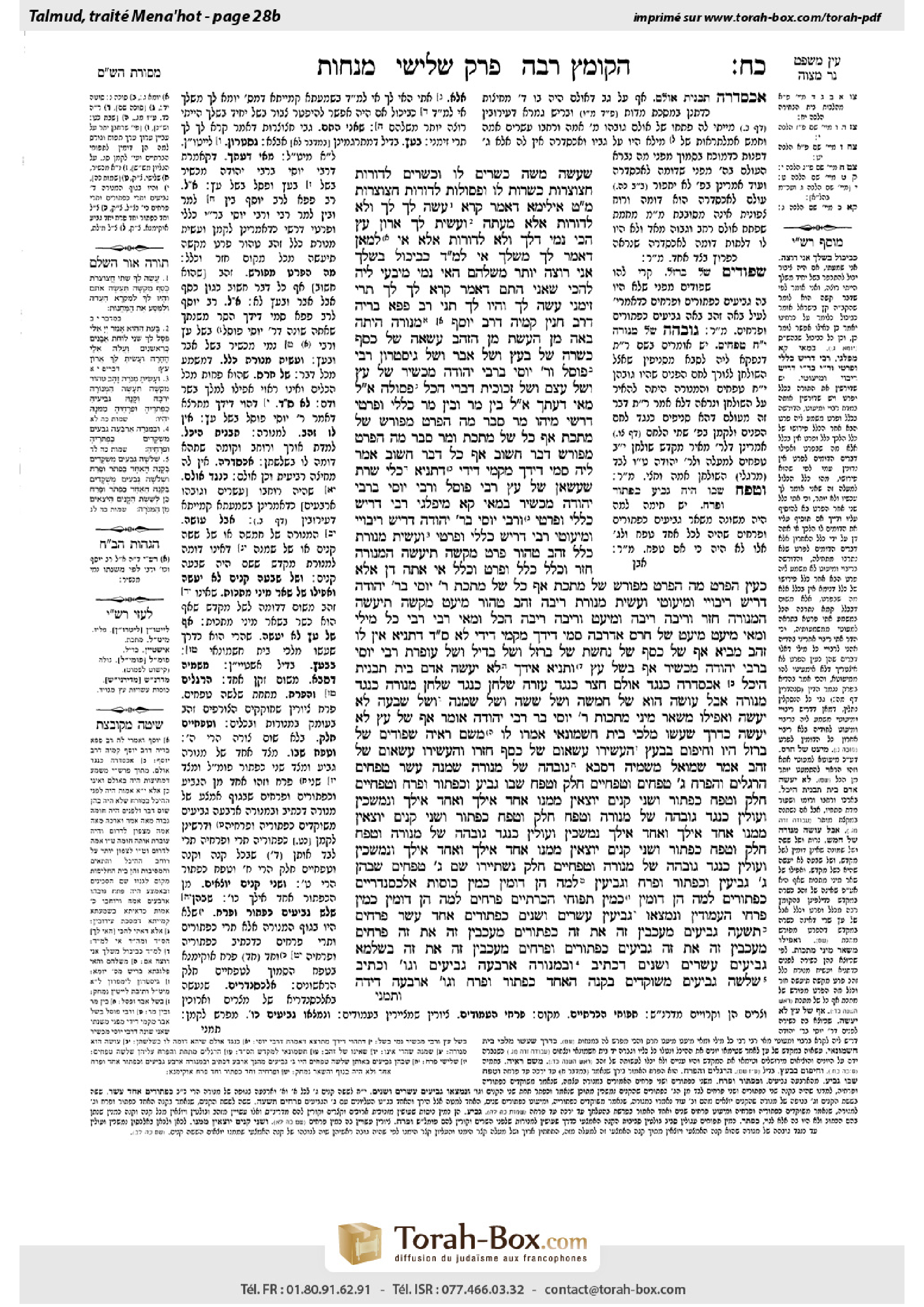
Menachot 28b: Talmud study for Daf Yomi
Daf Yomi is the daily study of one Talmud folio. Explore 37 tractates with scans, Hebrew text, Sefaria English and AI-generated French translations where annotated.
Passage selection and English or AI-generated French translation are available where the scan has annotations. Daf Study is independent of Torah-Box and Sefaria.
Browse Menachot · מנחות · All tractatesMenachot 28b text and translations
This page of Menachot includes the Aramaic text, an English translation and an AI-generated French translation, alongside the scan above.
מנחות כ״ח ב · Aramaic and Hebrew text
שֶׁעָשָׂה מֹשֶׁה, כְּשֵׁרִים לוֹ וּכְשֵׁרִים לְדוֹרוֹת. חֲצוֹצְרוֹת, כְּשֵׁרוֹת לוֹ וּפְסוּלוֹת לְדוֹרוֹת.
חֲצוֹצְרוֹת מַאי טַעְמָא? אִילֵימָא דְּאָמַר קְרָא ״עֲשֵׂה לְךָ״, לְךָ וְלֹא לְדוֹרוֹת, אֶלָּא מֵעַתָּה ״וְעָשִׂיתָ לְּךָ אֲרוֹן עֵץ״, הָכִי נָמֵי דִּלְךָ וְלֹא לְדוֹרוֹת?
אֶלָּא, אִי לְמַאן דְּאָמַר: ״לְךָ״ – מִשֶּׁלְּךָ, אִי לְמַאן דְּאָמַר: כִּבְיָכוֹל בְּשֶׁלְּךָ אֲנִי רוֹצֶה יוֹתֵר מִשֶּׁלָּהֶם, הַאי נָמֵי מִיבְּעֵי לֵיהּ לְהָכִי. שָׁאנֵי הָתָם, דְּאָמַר קְרָא ״לְךָ״ ״לְךָ״ תְּרֵי זִימְנֵי: ״עֲשֵׂה לְךָ״ ״וְהָיוּ לְךָ״.
תָּנֵי רַב פָּפָּא בְּרֵיהּ דְּרַב חָנִין קַמֵּיהּ דְּרַב יוֹסֵף: מְנוֹרָה הָיְתָה בָּאָה מִן הָעֶשֶׁת מִן הַזָּהָב, עֲשָׂאָהּ שֶׁל כֶּסֶף – כְּשֵׁרָה, שֶׁל בַּעַץ וְשֶׁל אֲבָר וְשֶׁל גִּיסְטְרוֹן – רַבִּי פּוֹסֵל וְרַבִּי יוֹסֵי בְּרַבִּי יְהוּדָה מַכְשִׁיר, שֶׁל עֵץ וְשֶׁל עֶצֶם וְשֶׁל זְכוּכִית – דִּבְרֵי הַכֹּל פְּסוּלָה.
אֲמַר לֵיהּ: מַאי דַּעְתָּךְ? אֲמַר לֵיהּ: בֵּין מָר וּבֵין מָר כְּלָלֵי וּפְרָטֵי דָּרְשִׁי.
מִיהוּ, מָר סָבַר: מָה הַפְּרָט מְפוֹרָשׁ שֶׁל מַתֶּכֶת – אַף כֹּל שֶׁל מַתֶּכֶת, וּמָר סָבַר: מָה הַפְּרָט מְפוֹרָשׁ דָּבָר חָשׁוּב – אַף כׇּל דָּבָר חָשׁוּב. אֲמַר לֵיהּ: סְמִי דִּידָךְ מִקַּמֵּי דִּידִי.
דְּתַנְיָא: כְּלֵי שָׁרֵת שֶׁעֲשָׂאָן שֶׁל עֵץ, רַבִּי פּוֹסֵל, וְרַבִּי יוֹסֵי בְּרַבִּי יְהוּדָה מַכְשִׁיר. בְּמַאי קָא מִיפַּלְגִי? רַבִּי דָּרֵישׁ כְּלָלֵי וּפְרָטֵי, וְרַבִּי יוֹסֵי בְּרַבִּי יְהוּדָה דָּרֵישׁ רִיבּוּיֵי וּמִיעוּטֵי.
רַבִּי דָּרֵישׁ כְּלָלֵי וּפְרָטֵי, ״וְעָשִׂיתָ מְנֹרַת״ – כָּלַל, ״זָהָב טָהוֹר״ – פָּרַט, ״מִקְשָׁה תֵּיעָשֶׂה הַמְּנוֹרָה״ – חָזַר וְכָלַל, כְּלָל וּפְרָט וּכְלָל, אִי אַתָּה דָן אֶלָּא כְּעֵין הַפְּרָט: מָה הַפְּרָט מְפוֹרָשׁ שֶׁל מַתֶּכֶת, אַף כֹּל שֶׁל מַתֶּכֶת.
רַבִּי יוֹסֵי בְּרַבִּי יְהוּדָה דָּרֵישׁ רִיבּוּיֵי וּמִיעוּטֵי: ״וְעָשִׂיתָ מְנוֹרַת״ – רִיבָּה, ״זָהָב טָהוֹר״ – מִיעֵט, ״מִקְשָׁה תֵּיעָשֶׂה הַמְּנוֹרָה״ – חָזַר וְרִיבָּה. רִיבָּה וּמִיעֵט וְרִיבָּה – רִיבָּה הַכֹּל, וּמַאי רַבִּי? רַבִּי כֹּל מִילֵּי, וּמַאי מַיעֵט? מַיעֵט שֶׁל חֶרֶס.
אַדְּרַבָּה, סְמִי דִּידָךְ מִקַּמֵּי דִּידִי! לָא סָלְקָא דַּעְתָּךְ, דְּתַנְיָא: אֵין לוֹ זָהָב מֵבִיא אַף שֶׁל כֶּסֶף, שֶׁל נְחֹשֶׁת, שֶׁל בַּרְזֶל, וְשֶׁל בְּדִיל, וְשֶׁל עוֹפֶרֶת. רַבִּי יוֹסֵי בְּרַבִּי יְהוּדָה מַכְשִׁיר אַף בְּשֶׁל עֵץ.
וְתַנְיָא אִידַּךְ: לֹא יַעֲשֶׂה אָדָם בַּיִת תַּבְנִית הֵיכָל, אַכְסַדְרָה כְּנֶגֶד אוּלָם, חָצֵר כְּנֶגֶד עֲזָרָה, שֻׁלְחָן כְּנֶגֶד שֻׁלְחָן, מְנוֹרָה כְּנֶגֶד מְנוֹרָה, אֲבָל עוֹשֶׂה הוּא שֶׁל חֲמִשָּׁה וְשֶׁל שִׁשָּׁה וְשֶׁל שְׁמֹנָה, וְשֶׁל שִׁבְעָה לֹא יַעֲשֶׂה, וַאֲפִילּוּ מִשְּׁאָר מִינֵי מַתָּכוֹת.
רַבִּי יוֹסֵי בַּר רַבִּי יְהוּדָה אוֹמֵר: אַף שֶׁל עֵץ לֹא יַעֲשֶׂה, כְּדֶרֶךְ שֶׁעָשׂוּ מַלְכֵי בֵּית חַשְׁמוֹנַאי. אָמְרוּ לוֹ: מִשָּׁם רְאָיָה? שַׁפּוּדִים שֶׁל בַּרְזֶל הָיוּ, וְחִיפּוּם בְּבַעַץ. הֶעֱשִׁירוּ – עֲשָׂאוּם שֶׁל כֶּסֶף, חָזְרוּ וְהֶעֱשִׁירוּ – עֲשָׂאוּם שֶׁל זָהָב.
אָמַר שְׁמוּאֵל מִשְּׁמֵיהּ דְּסָבָא: גּוֹבְהָהּ שֶׁל מְנוֹרָה שְׁמֹנָה עָשָׂר טְפָחִים, הָרַגְלַיִם וְהַפֶּרַח שְׁלֹשָׁה טְפָחִים, וְטִפְחַיִים חָלָק, וְטֶפַח שֶׁבּוֹ גְּבִיעַ וְכַפְתּוֹר וָפֶרַח, וְטִפְחַיִים חָלָק, וְטֶפַח כַּפְתּוֹר.
וּשְׁנֵי קָנִים יוֹצְאִין מִמֶּנּוּ, אֶחָד אֵילָךְ וְאֶחָד אֵילָךְ, וְנִמְשָׁכִין וְעוֹלִין כְּנֶגֶד גּוֹבְהָהּ שֶׁל מְנוֹרָה, וְטֶפַח חָלָק, וְטֶפַח כַּפְתּוֹר וּשְׁנֵי קָנִים יוֹצְאִין מִמֶּנּוּ, אֶחָד אֵילָךְ וְאֶחָד אֵילָךְ, נִמְשָׁכִין וְעוֹלִין כְּנֶגֶד גּוֹבְהָהּ שֶׁל מְנוֹרָה, וְטֶפַח חָלָק, וְטֶפַח כַּפְתּוֹר וּשְׁנֵי קָנִים יוֹצְאִין מִמֶּנּוּ, אֶחָד אֵילָךְ וְאֶחָד אֵילָךְ, וְנִמְשָׁכִין וְעוֹלִין כְּנֶגֶד גּוֹבְהָהּ שֶׁל מְנוֹרָה, וְטִפְחַיִים חָלָק, נִשְׁתַּיְּירוּ שָׁם שְׁלֹשָׁה טְפָחִים שֶׁבָּהֶן שְׁלֹשָׁה גְּבִיעִין וְכַפְתּוֹר וָפֶרַח.
וּגְבִיעִין לְמָה הֵן דּוֹמִין? כְּמִין כּוֹסוֹת אֲלֶכְּסַנְדְּרִיִּים, כַּפְתּוֹרִים לְמָה הֵן דּוֹמִין? כְּמִין תַּפּוּחֵי הַכְּרֵתִיִּים, פְּרָחִים לְמָה הֵן דּוֹמִין? כְּמִין פִּרְחֵי הָעַמּוּדִין, וְנִמְצְאוּ גְּבִיעִין עֶשְׂרִים וּשְׁנַיִם, כַּפְתּוֹרִים אַחַד עָשָׂר, פְּרָחִים תִּשְׁעָה.
גְּבִיעִים מְעַכְּבִין זֶה אֶת זֶה, כַּפְתּוֹרִים מְעַכְּבִין זֶה אֶת זֶה, פְּרָחִים מְעַכְּבִין זֶה אֶת זֶה, גְּבִיעִים כַּפְתּוֹרִים וּפְרָחִים מְעַכְּבִין זֶה אֶת זֶה.
בִּשְׁלָמָא גְּבִיעִים עֶשְׂרִים וּשְׁנַיִם, דִּכְתִיב: ״וּבַמְּנֹרָה אַרְבָּעָה גְבִעִים וְגוֹ׳״, וּכְתִיב: ״שְׁלֹשָׁה גְבִעִים מְשֻׁקָּדִים בַּקָּנֶה הָאֶחָד כַּפְתּוֹר וָפֶרַח וְגוֹ׳״, אַרְבְּעָה דִּידַהּ
Menachot 28b · English translation
that Moses fashioned were fit for his generation and were fit for future generations. Yet the trumpets that Moses fashioned were fit for his generation but were unfit for future generations.
The Gemara asks: What is the reason that the trumpets were unfit for future generations? If we say that it is because the verse states: “Make for you two silver trumpets” (Numbers 10:2), meaning that they are fit for you, but not for future generations, that is difficult; if that is so, then the verse: “Make for you an Ark of wood” (Deuteronomy 10:1), should also teach that the Ark is fit only for you, but not for future generations. This cannot be the halakha, as the baraita stated explicitly that all vessels, other than the trumpets, that were fashioned by Moses were fit for future generations.
Rather, the term “for you” that is written with regard to the fashioning of the Ark should be understood either according to the one who says that “for you” means from your own property, or according to the one who says that God said to Moses: I desire, as it were, that the Ark be fashioned from your property more than I desire that it be fashioned from the property of the rest of the nation (see Yoma 3b). Accordingly, here too, with regard to the trumpets, the term “for you” should be understood in this manner. The Gemara responds: There, with regard to the trumpets, it is different, as the verse states “for you” twice: “Make for you two trumpets of silver, of beaten work you shall make them, and they shall be for you for the calling of the congregation” (Numbers 10:2).
§ The Gemara relates: Rav Pappa, son of Rav Ḥanin, taught a baraita before Rav Yosef: The Candelabrum could be fashioned from a complete block and from gold. If one fashioned it from silver, it is fit. If one fashioned it from tin, or from lead, or from other types of metal [gisteron], Rabbi Yehuda HaNasi deems it unfit, and Rabbi Yosei, son of Rabbi Yehuda, deems it fit. If one fashioned it from wood, or from bone, or from glass, everyone agrees that it is unfit.
Rav Yosef said to him: What, in your opinion, is the explanation of the dispute between Rabbi Yehuda HaNasi and Rabbi Yosei, son of Rabbi Yehuda? Rav Pappa, son of Rav Ḥanin, said to him: Both this Sage and that Sage interpret the verse: “And you will make a Candelabrum of pure gold; of beaten work will the Candelabrum be made” (Exodus 25:31), by means of the principle of generalizations and details. The verse begins with a generalization: “And you will make a Candelabrum,” followed by a detail: “Of pure gold,” which is then followed by a generalization: “Will the Candelabrum be made.” According to the hermeneutic principle of generalizations and details, this teaches that any item that is similar to the detail is also deemed fit.
But one Sage, Rabbi Yosei, son of Rabbi Yehuda, holds that just as the item mentioned in the detail is clearly defined as a type of metal, so too, all other types of metal may be used in fashioning the Candelabrum. And one Sage, Rabbi Yehuda HaNasi, holds that just as the item mentioned in the detail is clearly defined as an item of substantial value, so too, all items of substantial value may be used in fashioning the Candelabrum. Rav Yosef said to him: Remove your baraita in light of my baraita.
Rav Yosef continued: As it is taught in a baraita: With regard to Temple service vessels that one fashioned from wood, Rabbi Yehuda HaNasi deems them unfit and Rabbi Yosei, son of Rabbi Yehuda, deems them fit. According to this baraita, their dispute was with regard to a Candelabrum fashioned from wood, not from metal. Rav Yosef explains: With regard to what principle do they disagree? Rabbi Yehuda HaNasi interprets verses by means of the principle of generalizations and details, and Rabbi Yosei, son of Rabbi Yehuda, interprets verses by means of the principle of amplifications and restrictions.
Rabbi Yehuda HaNasi interprets the verse: “And you will make a Candelabrum of pure gold; of beaten work will the Candelabrum be made” (Exodus 25:31), by means of the principle of generalizations and details. “And you will make a Candelabrum of” is a generalization, as the material of the Candelabrum is not specified; “pure gold” is a detail, limiting the material exclusively to gold; and by then stating: “Of beaten work will the Candelabrum be made,” the verse then makes a generalization. The result is a generalization and a detail and a generalization, from which you may deduce that the verse is referring only to items similar to the detail, leading to this conclusion: Just as the item mentioned in the detail is clearly defined as a type of metal, so too, all other types of metal may be used in fashioning the Candelabrum.
By contrast, Rabbi Yosei, son of Rabbi Yehuda, interprets the verse by means of the principle of amplifications and restrictions. “And you will make a Candelabrum of” is an amplification, as the material of the Candelabrum is not specified; “pure gold” is a restriction, limiting the material exclusively to gold; and by then stating: “Of beaten work will the Candelabrum be made,” the verse repeated and amplified. There is a hermeneutical principle that when a verse amplified and then restricted and then amplified, it amplified the relevant category to include everything except the specific matter excluded in the restriction. And what did the verse include? It includes all materials, even wood. And what did the verse exclude with this restriction? It excluded a Candelabrum fashioned from earthenware, which is furthest in quality from gold.
Rav Pappa, son of Rav Ḥanin, said to him: On the contrary, remove your baraita in light of my baraita. Rav Yosef responded: That cannot enter your mind, as it is taught in another baraita: If the one who is fashioning the Candelabrum has no gold, he may bring even a Candelabrum made of silver, of copper, of iron, of tin, or of lead. Rabbi Yosei, son of Rabbi Yehuda, deems it fit even if it was fashioned from wood. It is evident from this baraita that the dispute pertains only to a Candelabrum fashioned from wood, and Rabbi Yehuda HaNasi agrees that it may be fashioned from other types of metal.
And it is taught in another baraita: A person may not construct a house in the exact form of the Sanctuary, nor a portico [akhsadra] corresponding to the Entrance Hall of the Sanctuary, nor a courtyard corresponding to the Temple courtyard, nor a table corresponding to the Table in the Temple, nor a candelabrum corresponding to the Candelabrum in the Temple. But one may fashion a candelabrum of five or of six or of eight branches. And one may not fashion a candelabrum of seven branches, and this is the halakha even if he constructs it from other kinds of metal rather than gold, since the Candelabrum used in the Temple may be fashioned from other metals.
The baraita continues: Rabbi Yosei, son of Rabbi Yehuda, says: One may not even fashion a candelabrum from wood, in the manner that the kings of the Hasmonean monarchy did in the Temple. The Candelabrum used in the Temple in the time of the Hasmonean kings was fashioned from wood. The Rabbis said to Rabbi Yosei, son of Rabbi Yehuda: You seek to bring a proof from there? In the time of the Hasmoneans the Candelabrum was not fashioned from wood but from spits [shappudim] of iron, and they covered them with tin. Later, when they grew richer and could afford to fashion a Candelabrum of higher-quality material, they fashioned the Candelabrum from silver. When they again grew richer, they fashioned the Candelabrum from gold.
§ Shmuel says in the name of a certain elder: The height of the Candelabrum was eighteen handbreadths. The base and the flower that was upon the base were a height of three handbreadths; and two handbreadths above that were bare; and there was above that one handbreadth, which had a goblet, knob, and flower on it. And two handbreadths above that were bare, and there was above that one handbreadth that had a knob.
And two branches emerge from the knob, one toward this direction and one toward that direction, and they extend and rise up to the height of the Candelabrum. And one handbreadth above that was bare, and there was above that one handbreadth that had a knob. And two branches emerge from the knob, one toward this direction and one toward that direction, and they extend and rise up to the height of the Candelabrum. And one handbreadth above that was bare, and there was above that one handbreadth that had a knob. And two branches emerge from the knob, one toward this direction and one toward that direction, and they extend and rise up to the height of the Candelabrum. And two handbreadths above that were bare. There then remained there three handbreadths in which there were three goblets, and a knob, and a flower.
And the goblets of the Candelabrum, to what are they similar? They were like Alexandrian goblets, which are long and narrow. The knobs, to what are they similar? They were like the shape of the apples of the Cherethites. The flowers, to what are they similar? They were like the ornaments that are etched in columns. And there are found to be a total of twenty-two goblets, eleven knobs, and nine flowers on the Candelabrum.
With regard to the goblets, the absence of each prevents fulfillment of the mitzva with the others; with regard to the knobs, the absence of each prevents fulfillment of the mitzva with the others; with regard to the flowers, the absence of each prevents fulfillment of the mitzva with the others. With regard to the goblets, knobs, and flowers, the absence of each prevents fulfillment of the mitzva with the others.
The Gemara asks: Granted, there were twenty-two goblets on the Candelabrum, as it is written: “And in the Candelabrum four goblets made like almond blossoms” (Exodus 25:34), and it is written: “Three goblets made like almond blossoms in one branch, a knob, and a flower; and three goblets made like almond blossoms in the other branch, a knob, and a flower; so for the six branches going out of the Candelabrum” (Exodus 25:33). Therefore, the Candelabrum contains the four goblets of its main shaft,
Menachot 28b · Traduction française (IA)
que Moïse avait façonnés convenaient à sa génération ainsi qu’aux générations futures. En revanche, les trompettes que Moïse avait façonnées convenaient à sa génération, mais pas aux générations futures.
La Guemara demande : Pour quelle raison les trompettes ne convenaient-elles pas aux générations futures ? Si l’on dit que c’est parce que le verset déclare : « Fais-toi deux trompettes d’argent » (Nombres 10, 2), ce qui signifie qu’elles te conviennent, mais pas aux générations futures, cela pose une difficulté : dans ce cas, le verset « Fais-toi une arche de bois » (Deutéronome 10, 1) devrait également enseigner que l’arche ne convient qu’à toi, mais pas aux générations futures. Or, telle ne peut être la halakha, puisque la baraïta a explicitement déclaré que tous les ustensiles façonnés par Moïse, hormis les trompettes, convenaient aux générations futures.
Il faut plutôt comprendre l’expression « pour toi », écrite à propos de la fabrication de l’arche, soit selon celui qui dit que « pour toi » signifie qu’elle doit être faite avec tes propres biens, soit selon celui qui dit que Dieu a dit à Moïse : Je désire, pour ainsi dire, que l’arche soit faite avec tes biens plus qu’avec ceux du reste du peuple (voir Yoma 3b). De même, ici, à propos des trompettes, l’expression « pour toi » devrait être comprise de cette façon. La Guemara répond : Le cas des trompettes est différent, car le verset mentionne deux fois « pour toi » : « Fais-toi deux trompettes d’argent ; tu les feras en ouvrage martelé, et elles te serviront à convoquer l’assemblée » (Nombres 10, 2).
§ La Guemara rapporte : Rav Pappa, fils de Rav Ḥanin, enseigna une baraïta devant Rav Yosef : le candélabre peut être façonné d’un seul bloc et en or. S’il est façonné en argent, il est valide. S’il est façonné en étain, en plomb ou dans d’autres sortes de métaux [gisteron], Rabbi Yehuda HaNasi le déclare invalide, tandis que Rabbi Yosei, fils de Rabbi Yehuda, le déclare valide. S’il est façonné en bois, en os ou en verre, tous conviennent qu’il est invalide.
Rav Yosef lui dit : À ton avis, quelle est l’explication du désaccord entre Rabbi Yehuda HaNasi et Rabbi Yosei, fils de Rabbi Yehuda ? Rav Pappa, fils de Rav Ḥanin, lui répondit : Les deux sages interprètent le verset « Tu feras un candélabre d’or pur ; le candélabre sera fait en ouvrage martelé » (Exode 25, 31) selon le principe des règles générales et particulières. Le verset commence par une règle générale : « Tu feras un candélabre », suivie d’un détail : « d’or pur », puis d’une règle générale : « le candélabre sera fait ». Selon le principe herméneutique des règles générales et particulières, cela enseigne que tout objet semblable à l’élément mentionné dans le détail est également valide.
Mais un sage, Rabbi Yosei, fils de Rabbi Yehuda, estime que, de même que l’élément mentionné dans le détail est clairement défini comme un type de métal, de même toutes les autres sortes de métaux peuvent être utilisées pour façonner le candélabre. L’autre sage, Rabbi Yehuda HaNasi, estime que, de même que l’élément mentionné dans le détail est clairement défini comme un objet de grande valeur, de même tous les objets de grande valeur peuvent être utilisés pour façonner le candélabre. Rav Yosef lui dit : Écarte ta baraïta à la lumière de ma baraïta.
Rav Yosef poursuivit : Car il est enseigné dans une baraïta : en ce qui concerne les ustensiles du service du Temple façonnés en bois, Rabbi Yehuda HaNasi les déclare invalides, et Rabbi Yosei, fils de Rabbi Yehuda, les déclare valides. Selon cette baraïta, leur désaccord porte sur un candélabre façonné en bois, et non en métal. Rav Yosef explique : Sur quel principe sont-ils en désaccord ? Rabbi Yehuda HaNasi interprète les versets selon le principe des règles générales et particulières, tandis que Rabbi Yosei, fils de Rabbi Yehuda, les interprète selon le principe des amplifications et des restrictions.
Rabbi Yehuda HaNasi interprète le verset « Tu feras un candélabre d’or pur ; le candélabre sera fait en ouvrage martelé » (Exode 25, 31) selon le principe des règles générales et particulières. « Tu feras un candélabre de… » est une règle générale, car le matériau du candélabre n’est pas précisé ; « or pur » est un détail, qui limite le matériau exclusivement à l’or ; puis, en disant « le candélabre sera fait en ouvrage martelé », le verset énonce une règle générale. On obtient ainsi une règle générale, un détail et une règle générale, dont on peut déduire que le verset ne concerne que les éléments semblables à celui mentionné dans le détail, d’où la conclusion suivante : de même que l’élément mentionné dans le détail est clairement défini comme un type de métal, de même toutes les autres sortes de métaux peuvent être utilisées pour façonner le candélabre.
À l’inverse, Rabbi Yosei, fils de Rabbi Yehuda, interprète le verset selon le principe des amplifications et des restrictions. « Tu feras un candélabre de… » est une amplification, car le matériau du candélabre n’est pas précisé ; « or pur » est une restriction, qui limite le matériau exclusivement à l’or ; puis, en disant « le candélabre sera fait en ouvrage martelé », le verset amplifie de nouveau. Selon un principe herméneutique, lorsqu’un verset amplifie, puis restreint, puis amplifie de nouveau, il étend la catégorie concernée à tout, à l’exception de l’élément précis exclu par la restriction. Et qu’a inclus le verset ? Il inclut tous les matériaux, même le bois. Et qu’a exclu le verset par cette restriction ? Il a exclu un candélabre façonné en terre cuite, matériau qui est le plus éloigné de l’or par sa qualité.
Rav Pappa, fils de Rav Ḥanin, lui dit : Au contraire, écarte ta baraïta à la lumière de ma baraïta. Rav Yosef répondit : Cela ne peut pas être le cas, car il est enseigné dans une autre baraïta : si celui qui façonne le candélabre ne dispose pas d’or, il peut apporter même un candélabre en argent, en cuivre, en fer, en étain ou en plomb. Rabbi Yosei, fils de Rabbi Yehuda, le déclare valide même s’il a été façonné en bois. Cette baraïta montre que le désaccord porte uniquement sur un candélabre façonné en bois, et que Rabbi Yehuda HaNasi convient qu’il peut être façonné dans d’autres sortes de métaux.
Et il est enseigné dans une autre baraïta : on ne peut pas construire une maison ayant exactement la forme du Sanctuaire, ni un portique [akhsadra] correspondant au vestibule du Sanctuaire, ni une cour correspondant à la cour du Temple, ni une table correspondant à la Table du Temple, ni un candélabre correspondant au candélabre du Temple. Mais on peut façonner un candélabre à cinq, six ou huit branches. On ne peut pas façonner un candélabre à sept branches ; telle est la halakha même s’il est fabriqué avec d’autres sortes de métaux que l’or, puisque le candélabre utilisé dans le Temple peut être façonné dans d’autres métaux.
La baraïta poursuit : Rabbi Yosei, fils de Rabbi Yehuda, dit : on ne peut même pas façonner un candélabre en bois, comme le firent les rois de la dynastie hasmonéenne dans le Temple. Le candélabre utilisé dans le Temple à l’époque des rois hasmonéens avait été façonné en bois. Les Sages dirent à Rabbi Yosei, fils de Rabbi Yehuda : Tu veux en tirer une preuve ? À l’époque des Hasmonéens, le candélabre n’avait pas été façonné en bois, mais avec des broches [shappudim] en fer, qu’ils avaient recouvertes d’étain. Plus tard, lorsqu’ils s’enrichirent et purent se permettre de façonner un candélabre dans un matériau de meilleure qualité, ils le façonnèrent en argent. Lorsqu’ils s’enrichirent de nouveau, ils le façonnèrent en or.
§ Shmuel dit au nom d’un certain ancien : la hauteur du candélabre était de dix-huit palmes. Le socle et la fleur qui se trouvait dessus mesuraient trois palmes de haut ; au-dessus, deux palmes étaient nues ; puis venait une palme portant une coupe, un bouton et une fleur. Au-dessus, deux palmes étaient nues, puis venait une palme portant un bouton.
Deux branches partaient du bouton, l’une dans cette direction et l’autre dans l’autre direction, et elles s’étendaient en montant jusqu’à la hauteur du candélabre. Au-dessus, une palme était nue, puis venait une palme portant un bouton. Deux branches partaient du bouton, l’une dans cette direction et l’autre dans l’autre direction, et elles s’étendaient en montant jusqu’à la hauteur du candélabre. Au-dessus, une palme était nue, puis venait une palme portant un bouton. Deux branches partaient du bouton, l’une dans cette direction et l’autre dans l’autre direction, et elles s’étendaient en montant jusqu’à la hauteur du candélabre. Au-dessus, deux palmes étaient nues. Il restait alors trois palmes, sur lesquelles se trouvaient trois coupes, un bouton et une fleur.
À quoi ressemblaient les coupes du candélabre ? Elles ressemblaient aux coupes d’Alexandrie, longues et étroites. À quoi ressemblaient les boutons ? Ils avaient la forme des pommes des Crétois. À quoi ressemblaient les fleurs ? Elles ressemblaient aux ornements gravés sur les colonnes. On trouve ainsi sur le candélabre un total de vingt-deux coupes, onze boutons et neuf fleurs.
Pour les coupes, l’absence de chacune empêche l’accomplissement de la mitsva avec les autres ; pour les boutons, l’absence de chacun empêche l’accomplissement de la mitsva avec les autres ; pour les fleurs, l’absence de chacune empêche l’accomplissement de la mitsva avec les autres. Pour les coupes, les boutons et les fleurs, l’absence de chacun empêche l’accomplissement de la mitsva avec les autres.
La Guemara demande : Il est compréhensible qu’il y ait vingt-deux coupes sur le candélabre, puisqu’il est écrit : « Et sur le candélabre, quatre coupes en forme de fleurs d’amandier » (Exode 25, 34), et qu’il est écrit : « Trois coupes en forme de fleurs d’amandier sur une branche, un bouton et une fleur ; trois coupes en forme de fleurs d’amandier sur l’autre branche, un bouton et une fleur ; ainsi pour les six branches qui partent du candélabre » (Exode 25, 33). Le candélabre comprend donc les quatre coupes de sa tige centrale,
Traduction française générée par IA à partir de l’édition anglaise de Sefaria. Vérifie toujours un passage avec le texte source.
Text from Sefaria: William Davidson Edition - Vocalized Aramaic (unknown); William Davidson Edition - English (CC BY NC).