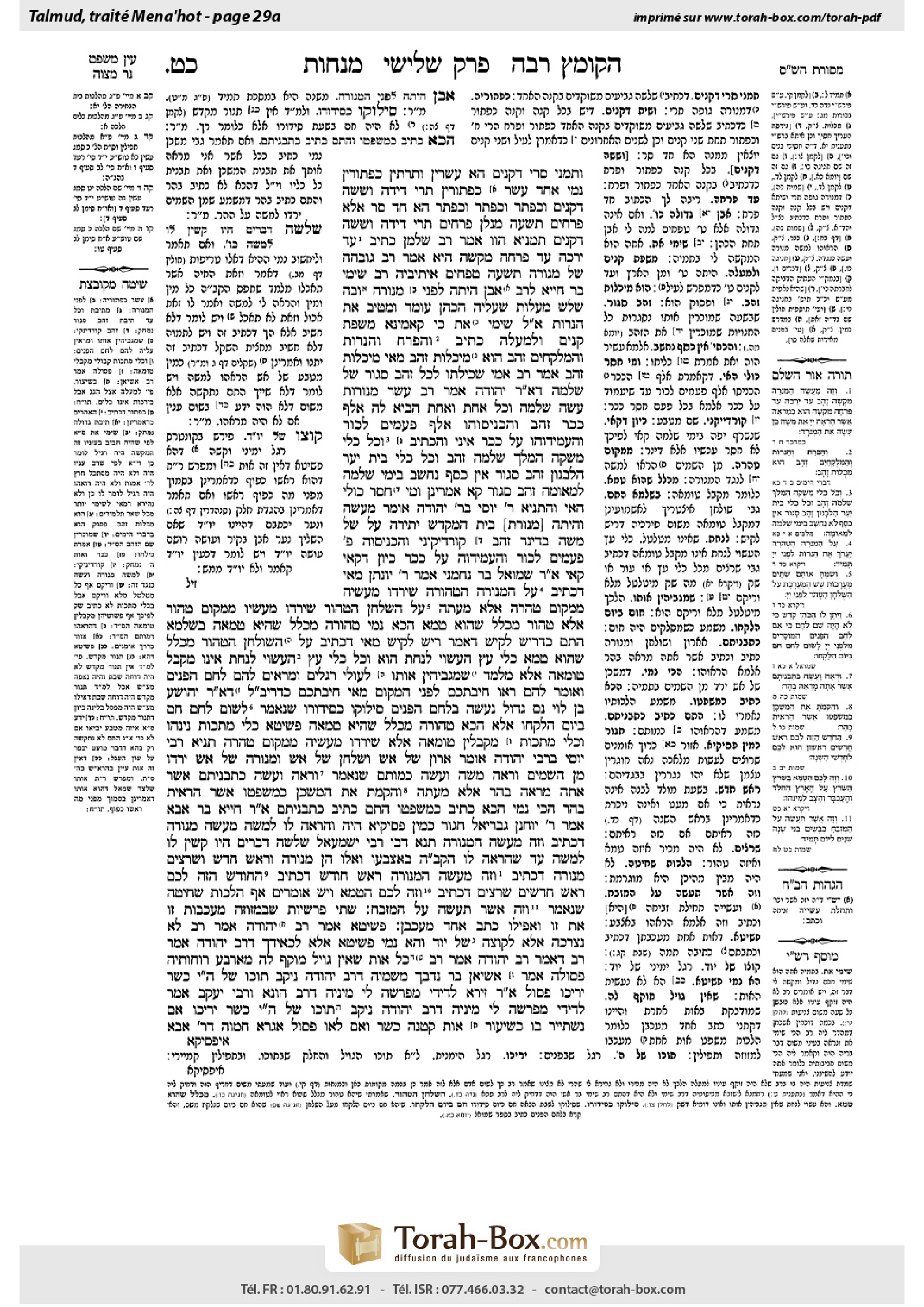
Menachot 29a: Talmud study for Daf Yomi
Daf Yomi is the daily study of one Talmud folio. Explore 37 tractates with scans, Hebrew text, Sefaria English and AI-generated French translations where annotated.
Passage selection and English or AI-generated French translation are available where the scan has annotations. Daf Study is independent of Torah-Box and Sefaria.
Browse Menachot · מנחות · All tractatesMenachot 29a text and translations
This page of Menachot includes the Aramaic text, an English translation and an AI-generated French translation, alongside the scan above.
מנחות כ״ט א · Aramaic and Hebrew text
וְתַמְנֵי סְרֵי דְּקָנִים, הָא עֶשְׂרִין וְתַרְתֵּין. כַּפְתּוֹרִין נָמֵי אַחַד עָשָׂר כַּפְתּוֹרִין: תְּרֵי דִּידַהּ, וְשִׁשָּׁה דְּקָנִים, וְכַפְתֹּר וְכַפְתֹּר וְכַפְתֹּר, הָא חַד סָר.
אֶלָּא פְּרָחִים תִּשְׁעָה מְנָלַן? פְּרָחִים תְּרֵי דִּידַהּ, וְשִׁשָּׁה דְּקָנִים – תְּמָנְיָא הָווּ! אָמַר רַב שַׁלְמָן: כְּתִיב ״עַד יְרֵכָהּ עַד פִּרְחָהּ מִקְשָׁה הִיא״.
אָמַר רַב: גּוֹבְהָהּ שֶׁל מְנוֹרָה תִּשְׁעָה טְפָחִים. אֵיתִיבֵיהּ רַב שִׁימִי בַּר חִיָּיא לְרַב: אֶבֶן הָיְתָה לִפְנֵי מְנוֹרָה וּבָהּ שָׁלֹשׁ מַעֲלוֹת, שֶׁעָלֶיהָ הַכֹּהֵן עוֹמֵד וּמֵטִיב אֶת הַנֵּרוֹת.
אֲמַר לֵיהּ: שִׁימִי אַתְּ? כִּי קָאָמֵינָא מִשְּׂפַת קָנִים וּלְמַעְלָה.
כְּתִיב: ״וְהַפֶּרַח וְהַנֵּרוֹת וְהַמֶּלְקַחַיִם זָהָב הוּא מִכְלוֹת זָהָב״. מַאי ״מִיכְלוֹת זָהָב״? אָמַר רַב אַמֵּי: שֶׁכִּילַּתּוּ לְכׇל זָהָב סָגוּר שֶׁל שְׁלֹמֹה, דְּאָמַר רַב יְהוּדָה אָמַר רַב: עֶשֶׂר מְנוֹרוֹת עָשָׂה שְׁלֹמֹה, וְכׇל אַחַת וְאַחַת הֵבִיא לָהּ אֶלֶף כִּכַּר זָהָב, וְהִכְנִיסוּהוּ אֶלֶף פְּעָמִים לְכוֹר, וְהֶעֱמִידוּהוּ עַל כִּכָּר.
אִינִי? וְהָכְתִיב: ״וְכׇל כְּלֵי מַשְׁקֵה הַמֶּלֶךְ שְׁלֹמֹה זָהָב וְכֹל כְּלֵי בֵּית יַעַר הַלְּבָנוֹן זָהָב סָגוּר אֵין כֶּסֶף נֶחְשָׁב בִּימֵי שְׁלֹמֹה לִמְאוּמָה״! זָהָב סָגוּר קָא אָמְרִינַן.
וּמִי חֲסַר כּוּלֵּי הַאי? וְהָתַנְיָא: רַבִּי יוֹסֵי בְּרַבִּי יְהוּדָה אוֹמֵר: מַעֲשֶׂה וְהָיְתָה [מְנוֹרַת] בֵּית הַמִּקְדָּשׁ יְתֵירָה עַל שֶׁל מֹשֶׁה בְּדִינַר זָהָב קוּרְדְיָקֵינִי, וְהִכְנִיסוּהָ שְׁמוֹנִים פְּעָמִים לְכוֹר, וְהֶעֱמִידוּהָ עַל כִּכָּר. כֵּיוָן דְּקָאֵי קָאֵי.
אָמַר רַבִּי שְׁמוּאֵל בַּר נַחְמָנִי, אָמַר רַבִּי יוֹנָתָן, מַאי דִּכְתִיב: ״עַל הַמְּנֹרָה הַטְּהֹרָה״, שֶׁיָּרְדוּ מַעֲשֶׂיהָ מִמְּקוֹם טׇהֳרָה. אֶלָּא מֵעַתָּה, ״עַל הַשֻּׁלְחָן הַטָּהוֹר״ שֶׁיָּרְדוּ מַעֲשָׂיו מִמָּקוֹם טָהוֹר? אֶלָּא טָהוֹר – מִכְּלָל שֶׁהוּא טָמֵא, הָכָא נָמֵי טְהוֹרָה – מִכְּלָל שֶׁהִיא טְמֵאָה.
בִּשְׁלָמָא הָתָם, כִּדְרֵישׁ לָקִישׁ, דְּאָמַר רֵישׁ לָקִישׁ: מַאי דִּכְתִיב ״עַל הַשֻּׁלְחָן הַטָּהוֹר״, מִכְּלָל שֶׁהוּא טָמֵא? כְּלִי עֵץ הֶעָשׂוּי לְנַחַת הוּא, וְכׇל כְּלִי עֵץ הֶעָשׂוּי לְנַחַת אֵינוֹ מְקַבֵּל טוּמְאָה! אֶלָּא מְלַמֵּד שֶׁמַּגְבִּיהִין אוֹתוֹ לְעוֹלֵי רְגָלִים, וּמַרְאִים לָהֶם לֶחֶם הַפָּנִים, וְאוֹמֵר לָהֶם: רְאוּ חִיבַּתְכֶם לִפְנֵי הַמָּקוֹם.
מַאי חִיבַּתְכֶם? כִּדְרַבִּי יְהוֹשֻׁעַ בֶּן לֵוִי, דְּאָמַר רַבִּי יְהוֹשֻׁעַ בֶּן לֵוִי: נֵס גָּדוֹל נַעֲשָׂה בְּלֶחֶם הַפָּנִים, סִילּוּקוֹ כְּסִידּוּרוֹ, שֶׁנֶּאֱמַר: ״לָשׂוּם לֶחֶם חֹם בְּיוֹם הִלָּקְחוֹ״.
אֶלָּא הָכָא, ״טְהוֹרָה״ מִכְּלָל שֶׁהִיא טְמֵאָה? פְּשִׁיטָא, כְּלֵי מַתָּכוֹת נִינְהוּ, וּכְלֵי מַתָּכוֹת מְקַבְּלִין טוּמְאָה! אֶלָּא, שֶׁיָּרְדוּ מַעֲשֶׂיהָ מִמְּקוֹם טׇהֳרָה.
תַּנְיָא, רַבִּי יוֹסֵי בְּרַבִּי יְהוּדָה אוֹמֵר: אָרוֹן שֶׁל אֵשׁ וְשֻׁלְחָן שֶׁל אֵשׁ וּמְנוֹרָה שֶׁל אֵשׁ יָרְדוּ מִן הַשָּׁמַיִם, וְרָאָה מֹשֶׁה וְעָשָׂה כְּמוֹתָם, שֶׁנֶּאֱמַר: ״וּרְאֵה וַעֲשֵׂה כְּתַבְנִיתָם אֲשֶׁר אַתָּה מׇרְאֶה בָּהָר״.
אֶלָּא מֵעַתָּה, ״וַהֲקֵמֹתָ אֶת הַמִּשְׁכָּן כְּמִשְׁפָּטוֹ אֲשֶׁר הׇרְאֵיתָ בָּהָר״, הָכִי נָמֵי? הָכָא כְּתִיב ״כְּמִשְׁפָּטוֹ״, הָתָם כְּתִיב ״כְּתַבְנִיתָם״.
אָמַר רַבִּי חִיָּיא בַּר אַבָּא, אָמַר רַבִּי יוֹחָנָן: גַּבְרִיאֵל חָגוּר כְּמִין פְּסִיקְיָא הָיָה, וְהֶרְאָה לוֹ לְמֹשֶׁה מַעֲשֵׂה מְנוֹרָה, דִּכְתִיב: ״וְזֶה מַעֲשֵׂה הַמְּנֹרָה״.
תָּנָא דְּבֵי רַבִּי יִשְׁמָעֵאל: שְׁלֹשָׁה דְּבָרִים הָיוּ קָשִׁין לוֹ לְמֹשֶׁה, עַד שֶׁהֶרְאָה לוֹ הַקָּדוֹשׁ בָּרוּךְ הוּא בְּאֶצְבָּעוֹ, וְאֵלּוּ הֵן: מְנוֹרָה, וְרֹאשׁ חֹדֶשׁ, וּשְׁרָצִים. מְנוֹרָה – דִּכְתִיב: ״וְזֶה מַעֲשֵׂה הַמְּנֹרָה״, רֹאשׁ חוֹדֶשׁ – דִּכְתִיב: ״הַחֹדֶשׁ הַזֶּה לָכֶם רֹאשׁ חֳדָשִׁים״, שְׁרָצִים – דִּכְתִיב: ״וְזֶה לָכֶם הַטָּמֵא״. וְיֵשׁ אוֹמְרִים: אַף הִלְכוֹת שְׁחִיטָה, שֶׁנֶּאֱמַר: ״וְזֶה אֲשֶׁר תַּעֲשֶׂה עַל הַמִּזְבֵּחַ״.
שְׁתֵּי פָּרָשִׁיּוֹת שֶׁבַּמְּזוּזָה מְעַכְּבוֹת זוֹ אֶת זוֹ, וַאֲפִילּוּ כְּתָב אֶחָד מְעַכְּבָן. פְּשִׁיטָא!
אָמַר רַב יְהוּדָה, אָמַר רַב: לֹא נִצְרְכָה אֶלָּא לְקוֹצָהּ שֶׁל יוֹד. וְהָא נָמֵי פְּשִׁיטָא! אֶלָּא לִכְאִידַּךְ דְּרַב יְהוּדָה אָמַר רַב, דְּאָמַר רַב יְהוּדָה אָמַר רַב: כׇּל אוֹת שֶׁאֵין גְּוִיל מוּקָּף לָהּ מֵאַרְבַּע רוּחוֹתֶיהָ – פְּסוּלָה.
אָמַר אַשְׁיָאן בַּר נַדְבָּךְ מִשְּׁמֵיהּ דְּרַב יְהוּדָה: נִיקַּב תּוֹכוֹ שֶׁל הֵ״י כָּשֵׁר, יְרֵיכוֹ פָּסוּל. אָמַר רַבִּי זֵירָא: לְדִידִי מִפָּרְשָׁה לִי מִינֵּיהּ דְּרַב הוּנָא, וְרַבִּי יַעֲקֹב אָמַר: לְדִידִי מִפָּרְשָׁה לִי מִינֵּיהּ דְּרַב יְהוּדָה: נִיקַּב תּוֹכוֹ שֶׁל הֵ״י כָּשֵׁר, יְרֵיכוֹ – אִם נִשְׁתַּיֵּיר בּוֹ כְּשִׁיעוּר אוֹת קְטַנָּה כָּשֵׁר, וְאִם לָאו – פָּסוּל.
אַגְרָא חֲמוּהּ דְּרַבִּי אַבָּא,
Menachot 29a · English translation
and the eighteen of the six branches; this equals twenty-two goblets. Concerning the knobs as well, it is clear how the number eleven was reached. The Candelabrum contains the two knobs of its main shaft, as the verse states: “Its knobs” (Exodus 25:34), with the plural “knobs” indicating that there were two, and the six of the six branches, as it is written: “In one branch, a knob and a flower” (Exodus 25:33). In addition to these eight knobs, the verse states: “And a knob under two branches of one piece with it, and a knob under two branches of one piece with it, and a knob under two branches of one piece with it” (Exodus 25:35); this equals eleven knobs.
But from where do we derive that the Candelabrum contained nine flowers? According to the verse there are the two flowers of its main shaft, as it is written: “And its flowers” (Exodus 25:34), and the six of the six branches, as it is written: “In one branch, a knob and a flower” (Exodus 25:33), meaning that there are eight, not nine, flowers on the Candelabrum. Rav Shalman said in response: It is written: “It was a beaten work, from the base to the flower” (Numbers 8:4), which teaches that there was a ninth flower near the base.
Rav says: The height of the Candelabrum is nine handbreadths. Rav Shimi bar Ḥiyya raised an objection to the statement of Rav: We learned in a mishna (Tamid 30b): There was a stone before the Candelabrum and it had three steps, upon which the priest would stand and prepare the lamps for kindling. If the Candelabrum was only nine handbreadths high, why would it be necessary for the priest to stand on an elevated surface to reach the lamps?
Rav said to him: Shimi, is it you who is asking me such a question? When I said that the height of the Candelabrum is nine handbreadths, I was referring not to the total height, which is eighteen handbreadths; rather, I meant that the Candelabrum is nine handbreadths from the point at which the branches extend from the main shaft and above.
§ It is written: “And the flowers, and the lamps, and the tongs, of gold, and that perfect gold [mikhlot zahav]” (II Chronicles 4:21). The Gemara asks: What is meant by mikhlot zahav? Rav Ami says: It is a reference to the fact that the Candelabrum and its vessels exhausted [kilattu] all of Solomon’s pure [sagur] gold [zahav], which was used in its fashioning in such great quantities. As Rav Yehuda says that Rav said: Solomon made ten Candelabrums, and for each and every one he brought one thousand talents of gold, and they placed the gold in the furnace to refine it one thousand times, until they reduced the gold to one talent for each Candelabrum, as it is stated: “Of a talent of pure gold shall it be made” (Exodus 25:39).
The Gemara asks: Is that so that all of Solomon’s gold was exhausted for the fashioning of the Candelabrum and its vessels? But isn’t it written: “And all King Solomon’s drinking vessels were of gold, and all the vessels of the house of the forest of Lebanon were of pure gold; silver was nothing accounted of in the days of Solomon” (II Chronicles 9:20)? The Gemara answers: We are saying that Solomon’s pure gold was exhausted for the fashioning of the Candelabrum, but not all of his gold.
The Gemara asks: And would refining the gold reduce it to this extent, that one thousand talents of gold would be reduced to one talent? But isn’t it taught in a baraita: Rabbi Yosei, son of Rabbi Yehuda, says: An incident occurred where the weight of the Candelabrum of the Temple was found to be greater than the weight of the Candelabrum of Moses by one Kordikini gold dinar, and they placed it in the furnace eighty times until the weight of the Candelabrum stood at precisely one talent. Evidently, putting the Candelabrum into a furnace reduces its weight by very little. The Gemara answers: Once it is standing, it is standing, i.e., since the gold was refined to such a degree in the time of Solomon, later when it was refined eighty times it was reduced by the weight of only one dinar.
§ Rabbi Shmuel bar Naḥmani says that Rabbi Yonatan says: What is the meaning of that which is written: “Upon the pure Candelabrum” (Leviticus 24:4)? It teaches that the procedure for fashioning it descended, i.e., was shown to Moses, from the place of purity, i.e., by God, who showed Moses a model of the Candelabrum. The Gemara asks: If that is so, is that to say that phrase “upon the pure Table” (Leviticus 24:6) also teaches that the procedure for fashioning it was shown to Moses from the place of purity? Rather, the expression “the pure Table” teaches, by inference, that it is susceptible to becoming ritually impure. Here too, the expression “the pure Candelabrum” teaches, by inference, that it is susceptible to becoming ritually impure.
The Gemara rejects this: Granted, the inference drawn there with regard to the Table is in accordance with that which Reish Lakish says; as Reish Lakish says: What is the meaning of that which is written: “Upon the pure Table” (Leviticus 24:6)? The expression “pure Table” teaches, by inference, that it is susceptible to becoming ritually impure, but why? Isn’t the Table a wooden vessel designated to rest in a fixed place, and any wooden vessel that is designated to rest in a fixed place is not susceptible to becoming ritually impure? Rather, this teaches that the Table was not always left in a fixed place; the priests would lift the Table with its shewbread to display the shewbread to the pilgrims standing in the Temple courtyard, and a priest would say to them: See your affection before the Omnipresent. For this reason, the Table is susceptible to becoming ritually impure.
Parenthetically, the Gemara asks: What is meant by: See your affection before God? It is in accordance with that which Rabbi Yehoshua ben Levi says, as Rabbi Yehoshua ben Levi says: A great miracle was performed with the shewbread: Its condition at the time of its removal from the Table, after having been left there for a week, was like its condition at the time of its arrangement on the Table, as it is stated: “To place hot bread on the day when it was taken away” (I Samuel 21:7), indicating that it was as hot on the day of its removal as it was on the day when it was placed on the Table.
The Gemara resumes stating its objection: But here, with regard to the Candelabrum, there is no reason to explain that the expression “the pure Candelabrum” teaches, by inference, that it is susceptible to becoming ritually impure; this is obvious, as the Candelabrums are metal vessels, and metal vessels are susceptible to becoming ritually impure whether or not they remain in a fixed location. Rather, it must be that the expression “the pure Candelabrum” teaches that the procedure for fashioning it descended, i.e., was shown to Moses, from the place of purity.
§ It is taught in a baraita: Rabbi Yosei, son of Rabbi Yehuda, says: An Ark of fire and a Table of fire and a Candelabrum of fire descended from the Heavens, and Moses saw their format and fashioned the vessels for the Tabernacle in their likeness. As it is stated after the command to fashion these items: “And see that you make them after their pattern, which is being shown to you in the mount” (Exodus 25:40).
The Gemara asks: If that is so, is that to say that the verse: “And you shall set up the Tabernacle according to its fashion which has been shown to you in the mount” (Exodus 26:30), also indicates that God showed Moses a Tabernacle of fire? The Gemara answers: Here, with regard to the Tabernacle, it is written: “According to its fashion,” meaning that it should be built according to the instructions given to Moses, whereas there, with regard to the Ark, Table, and Candelabrum, it is written: “After their pattern,” indicating that an actual model of the items was shown to Moses.
Apropos this discussion the Gemara relates: Rabbi Ḥiyya bar Abba says that Rabbi Yoḥanan says: The angel Gabriel was girded with a type of wide belt [pesikiyya] in the manner of artisans who tie up their clothes to prevent these clothes from hindering them in their work. And he showed the precise way to fashion the Candelabrum to Moses, as it is written: “And this is the work of the Candelabrum” (Numbers 8:4), and the term “this” indicates that an exact replica was shown to him.
The school of Rabbi Yishmael taught: Three matters were difficult for Moses to comprehend precisely, until the Holy One, Blessed be He, showed them to him with His finger, and these are the three matters: The form of the Candelabrum, and the exact size of the new moon, and the impure creeping animals. The Candelabrum was shown to him, as it is written: “And this is the work of the Candelabrum” (Numbers 8:4). The new moon was shown to him, as it is written: “This month shall be for you the beginning of months” (Exodus 12:2). The creeping animals were shown to him, as it is written: “And these are they which are unclean for you among the swarming things” (Leviticus 11:29). And there are those who say that God also showed Moses the halakhot of slaughtering, as it is stated: “Now this is that which you shall sacrifice upon the altar” (Exodus 29:38), and slaughtering is the first ritual of sacrifice.
§ The mishna teaches: With regard to the two passages that are in the mezuza, the absence of each prevents fulfillment of the mitzva with the others. And furthermore, the absence of even one letter prevents fulfillment of the mitzva with the rest of them. The Gemara asks: Isn’t it obvious that the absence of even one letter prevents fulfillment of the mitzva, since it is written: “And you shall write them [ukhtavtam]” (Deuteronomy 6:9), which teaches that the writing [ketav] must be complete [tam]?
Rav Yehuda says that Rav says: It was necessary to state that only to teach that even the absence of the thorn, i.e., the small stroke, of a letter yod prevents fulfillment of the mitzva. The Gemara asks: But isn’t this also obvious, since the letter is not formed properly? Rather, it is necessary according to another statement that Rav Yehuda says that Rav says, as Rav Yehuda says that Rav says: Any letter that is not encircled with blank parchment on all four of its sides, i.e., where its ink connects to the letter above it, below it, preceding it, or succeeding it, is unfit. When the mishna makes reference to one letter preventing fulfillment of the mitzva, it is referring to a letter that touches an adjacent letter.
Ashiyan bar Nadbakh says in the name of Rav Yehuda: If the inner part of the letter heh was perforated it is fit, but if the perforation was in the leg of the letter heh it is unfit. Rabbi Zeira says: This matter was explained to me by Rav Huna, and Rabbi Ya’akov says: This matter was explained to me by Rav Yehuda: If the inner part of the letter heh was perforated it is fit. In a case where the perforation was in the leg of the letter heh, then if there remained in the leg that is attached to the roof of the letter the equivalent of the measure of a small letter, i.e., the letter yod, then it is fit. But if not, it is unfit.
The Gemara relates: Agra, the father-in-law of Rabbi Abba,
Menachot 29a · Traduction française (IA)
et les dix-huit des six branches, soit vingt-deux coupes. Pour les pommeaux également, on comprend clairement comment on arrive au nombre de onze. La Ménora comporte les deux pommeaux de sa tige centrale, comme l’indique le verset : « Ses pommeaux » (Exode 25,34) ; le pluriel « pommeaux » indique qu’il y en avait deux. Elle comporte aussi les six pommeaux des six branches, comme il est écrit : « Sur une branche, un pommeau et une fleur » (Exode 25,33). À ces huit pommeaux, le verset ajoute : « Un pommeau sous deux branches, d’une seule pièce avec elle, un pommeau sous deux branches, d’une seule pièce avec elle, et un pommeau sous deux branches, d’une seule pièce avec elle » (Exode 25,35), soit onze pommeaux.
Mais d’où déduit-on que la Ménora comportait neuf fleurs ? D’après le verset, il y a les deux fleurs de sa tige centrale, comme il est écrit : « Et ses fleurs » (Exode 25,34), ainsi que les six fleurs des six branches, comme il est écrit : « Sur une branche, un pommeau et une fleur » (Exode 25,33). Cela fait huit fleurs sur la Ménora, et non neuf. Rav Shalman répondit : Il est écrit : « Elle était ouvragée au marteau, depuis sa base jusqu’à sa fleur » (Nombres 8,4), ce qui enseigne qu’une neuvième fleur se trouvait près de la base.
Rav dit : La hauteur de la Ménora est de neuf téfaḥim. Rav Shimi bar Ḥiyya objecta à l’enseignement de Rav : Nous avons appris dans une Michna (Tamid 30b) : Il y avait devant la Ménora une pierre pourvue de trois marches, sur lesquelles le prêtre se tenait pour préparer les lampes à être allumées. Si la Ménora ne mesurait que neuf téfaḥim de haut, pourquoi le prêtre aurait-il eu besoin de se tenir sur une surface surélevée pour atteindre les lampes ?
Rav lui dit : Shimi, c’est toi qui me poses une telle question ? Quand j’ai dit que la Ménora mesurait neuf téfaḥim de haut, je ne parlais pas de sa hauteur totale, qui était de dix-huit téfaḥim ; je voulais dire qu’elle mesurait neuf téfaḥim depuis le point où les branches partent de la tige centrale jusqu’à son sommet.
§ Il est écrit : « Les fleurs, les lampes et les mouchettes, en or, et cet or parfait [mikhlot zahav] » (II Chroniques 4,21). La Guemara demande : Que signifie mikhlot zahav ? Rav Ami dit : Cela fait référence au fait que la Ménora et ses ustensiles épuisèrent tout l’or pur [sagur] [zahav] de Salomon [kilattu], qui fut utilisé en si grande quantité pour leur fabrication. Car Rav Yehuda dit au nom de Rav : Salomon fabriqua dix Ménorot, et pour chacune, il apporta mille talents d’or. On mit l’or dans le creuset pour l’affiner mille fois, jusqu’à le réduire à un talent pour chaque Ménora, comme il est dit : « Elle sera faite d’un talent d’or pur » (Exode 25,39).
La Guemara demande : Est-il vrai que tout l’or de Salomon fut épuisé pour fabriquer la Ménora et ses ustensiles ? N’est-il pas écrit : « Tous les vases à boire du roi Salomon étaient d’or, et tous les ustensiles de la maison de la forêt du Liban étaient d’or pur ; l’argent n’était compté pour rien aux jours de Salomon » (II Chroniques 9,20) ? La Guemara répond : Nous disons que l’or pur de Salomon fut épuisé pour fabriquer la Ménora, mais non pas tout son or.
La Guemara demande : L’affinage de l’or pouvait-il le réduire à ce point, au point que mille talents d’or soient ramenés à un seul talent ? N’est-il pas enseigné dans une baraïta : Rabbi Yosei, fils de Rabbi Yehuda, dit : Un événement se produisit : on constata que la Ménora du Temple pesait un dinar d’or de Kordikini de plus que celle de Moïse. On la plaça dans le creuset quatre-vingts fois, jusqu’à ce que son poids soit exactement d’un talent. Il ressort donc que la placer dans un creuset ne réduit son poids que très peu. La Guemara répond : Une fois qu’elle est debout, elle reste debout, c’est-à-dire que, puisque l’or avait été affiné à un tel degré à l’époque de Salomon, lorsqu’on l’affina par la suite quatre-vingts fois, son poids ne diminua que d’un dinar.
§ Rabbi Shmuel bar Naḥmani dit au nom de Rabbi Yonatan : Que signifie ce qui est écrit : « Sur la Ménora pure » (Lévitique 24,4) ? Cela enseigne que le procédé de fabrication de la Ménora descendit du lieu de pureté, c’est-à-dire qu’il fut montré à Moïse par Dieu, qui lui présenta un modèle de la Ménora. La Guemara demande : Si c’est le cas, faut-il comprendre que l’expression « sur la Table pure » (Lévitique 24,6) enseigne elle aussi que le procédé de fabrication de la Table fut montré à Moïse depuis le lieu de pureté ? En réalité, l’expression « la Table pure » enseigne par déduction que celle-ci est susceptible de devenir rituellement impure. De même ici, l’expression « la Ménora pure » enseigne par déduction qu’elle est susceptible de devenir rituellement impure.
La Guemara rejette cette interprétation : certes, la déduction faite là-bas au sujet de la Table est conforme à l’enseignement de Reish Lakish. Car Reish Lakish dit : Que signifie ce qui est écrit : « Sur la Table pure » (Lévitique 24,6) ? L’expression « Table pure » enseigne par déduction que celle-ci est susceptible de devenir rituellement impure. Mais pourquoi ? La Table n’est-elle pas un ustensile en bois destiné à rester en place, et tout ustensile en bois destiné à rester en place n’est-il pas insusceptible de devenir rituellement impur ? Cela enseigne plutôt que la Table ne restait pas toujours en place : les prêtres la soulevaient avec les pains de proposition afin de les montrer aux pèlerins qui se tenaient dans la cour du Temple, et un prêtre leur disait : « Voyez combien vous êtes chers devant le Tout-Puissant. » C’est pour cette raison que la Table est susceptible de devenir rituellement impure.
Incidemment, la Guemara demande : Que signifie : « Voyez combien vous êtes chers devant Dieu » ? Cela correspond à l’enseignement de Rabbi Yehoshua ben Levi, car Rabbi Yehoshua ben Levi dit : Un grand miracle s’accomplissait avec les pains de proposition : lorsqu’on les retirait de la Table, après qu’ils y étaient restés une semaine, ils étaient dans le même état qu’au moment où on les disposait sur la Table, comme il est écrit : « Pour mettre du pain chaud le jour où il fut enlevé » (I Samuel 21,7). Cela indique qu’ils étaient aussi chauds le jour où on les retirait que le jour où on les avait placés sur la Table.
La Guemara reprend son objection : Mais ici, au sujet de la Ménora, rien ne justifie d’expliquer que l’expression « la Ménora pure » enseigne par déduction qu’elle est susceptible de devenir rituellement impure ; c’est évident, puisque les Ménorot sont des ustensiles en métal, et que les ustensiles en métal sont susceptibles de devenir rituellement impurs, qu’ils restent ou non en place. Il faut donc plutôt comprendre que l’expression « la Ménora pure » enseigne que le procédé de sa fabrication descendit du lieu de pureté, c’est-à-dire qu’il fut montré à Moïse.
§ Il est enseigné dans une baraïta : Rabbi Yosei, fils de Rabbi Yehuda, dit : Une Arche de feu, une Table de feu et une Ménora de feu descendirent des Cieux, et Moïse en vit la forme puis fabriqua les ustensiles du Tabernacle à leur ressemblance. Comme il est dit, après l’ordre de fabriquer ces objets : « Veille à les faire d’après le modèle qui t’est montré sur la montagne » (Exode 25,40).
La Guemara demande : Si c’est le cas, faut-il comprendre que le verset « Tu dresseras le Tabernacle selon son modèle qui t’a été montré sur la montagne » (Exode 26,30) indique lui aussi que Dieu montra à Moïse un Tabernacle de feu ? La Guemara répond : Ici, au sujet du Tabernacle, il est écrit : « Selon son modèle », ce qui signifie qu’il devait être construit conformément aux instructions données à Moïse, tandis que là-bas, au sujet de l’Arche, de la Table et de la Ménora, il est écrit : « D’après leur modèle », ce qui indique qu’un modèle concret de ces objets fut montré à Moïse.
À propos de cette discussion, la Guemara rapporte : Rabbi Ḥiyya bar Abba dit au nom de Rabbi Yoḥanan : L’ange Gabriel était ceint d’une sorte de large ceinture [pesikiyya], à la manière des artisans qui relèvent et attachent leurs vêtements pour qu’ils ne les gênent pas dans leur travail. Il montra à Moïse la manière précise de fabriquer la Ménora, comme il est écrit : « Et voici le travail de la Ménora » (Nombres 8,4) ; le terme « voici » indique qu’une réplique exacte lui fut présentée.
L’école de Rabbi Yishmael enseigna : Trois choses furent difficiles à comprendre précisément pour Moïse, jusqu’à ce que le Saint, béni soit-Il, les lui montre du doigt. Ce sont la forme de la Ménora, la taille exacte de la nouvelle lune et les animaux rampants impurs. La Ménora lui fut montrée, comme il est écrit : « Et voici le travail de la Ménora » (Nombres 8,4). La nouvelle lune lui fut montrée, comme il est écrit : « Ce mois-ci sera pour vous le commencement des mois » (Exode 12,2). Les animaux rampants lui furent montrés, comme il est écrit : « Et voici ceux qui sont impurs pour vous parmi les êtres qui grouillent » (Lévitique 11,29). Certains disent que Dieu montra aussi à Moïse les halakhot de l’abattage rituel, comme il est dit : « Voici ce que tu sacrifieras sur l’autel » (Exode 29,38), l’abattage rituel étant le premier rite du sacrifice.
§ La Michna enseigne : Concernant les deux passages qui se trouvent dans la mezouza, l’absence de l’un empêche d’accomplir la mitsva avec l’autre. De plus, l’absence d’une seule lettre empêche d’accomplir la mitsva avec le reste. La Guemara demande : N’est-il pas évident que l’absence d’une seule lettre empêche d’accomplir la mitsva, puisqu’il est écrit : « Et tu les écriras [ukhtavtam] » (Deutéronome 6,9), ce qui enseigne que l’écriture [ketav] doit être complète [tam] ?
Rav Yehuda dit au nom de Rav : Il était nécessaire de l’enseigner uniquement pour apprendre que même l’absence du petit trait de la lettre yod empêche d’accomplir la mitsva. La Guemara demande : N’est-ce pas évident également, puisque la lettre n’est pas correctement formée ? Il faut plutôt comprendre cet enseignement à la lumière d’une autre déclaration de Rav Yehuda au nom de Rav. Car Rav Yehuda dit au nom de Rav : Toute lettre qui n’est pas entourée de parchemin vierge sur ses quatre côtés — c’est-à-dire lorsque son encre touche la lettre au-dessus, au-dessous, devant ou derrière elle — est impropre. Lorsque la Michna évoque une lettre dont l’absence empêche d’accomplir la mitsva, elle parle d’une lettre qui touche une lettre voisine.
Ashiyan bar Nadbakh dit au nom de Rav Yehuda : Si la partie intérieure de la lettre heh est perforée, elle est valide ; mais si la perforation se trouve dans la jambe de la lettre heh, elle est impropre. Rabbi Zeira dit : Rav Huna m’a expliqué cette règle, et Rabbi Ya’akov dit : Rav Yehuda m’a expliqué cette règle : si la partie intérieure de la lettre heh est perforée, elle est valide. Si la perforation se trouve dans la jambe de la lettre heh, elle est valide à condition que la partie de la jambe reliée au toit de la lettre conserve une longueur équivalente à celle d’une petite lettre, c’est-à-dire d’un yod. Sinon, elle est impropre.
La Guemara rapporte : Agra, le beau-père de Rabbi Abba,
Traduction française générée par IA à partir de l’édition anglaise de Sefaria. Vérifie toujours un passage avec le texte source.
Text from Sefaria: William Davidson Edition - Vocalized Aramaic (unknown); William Davidson Edition - English (CC BY NC).