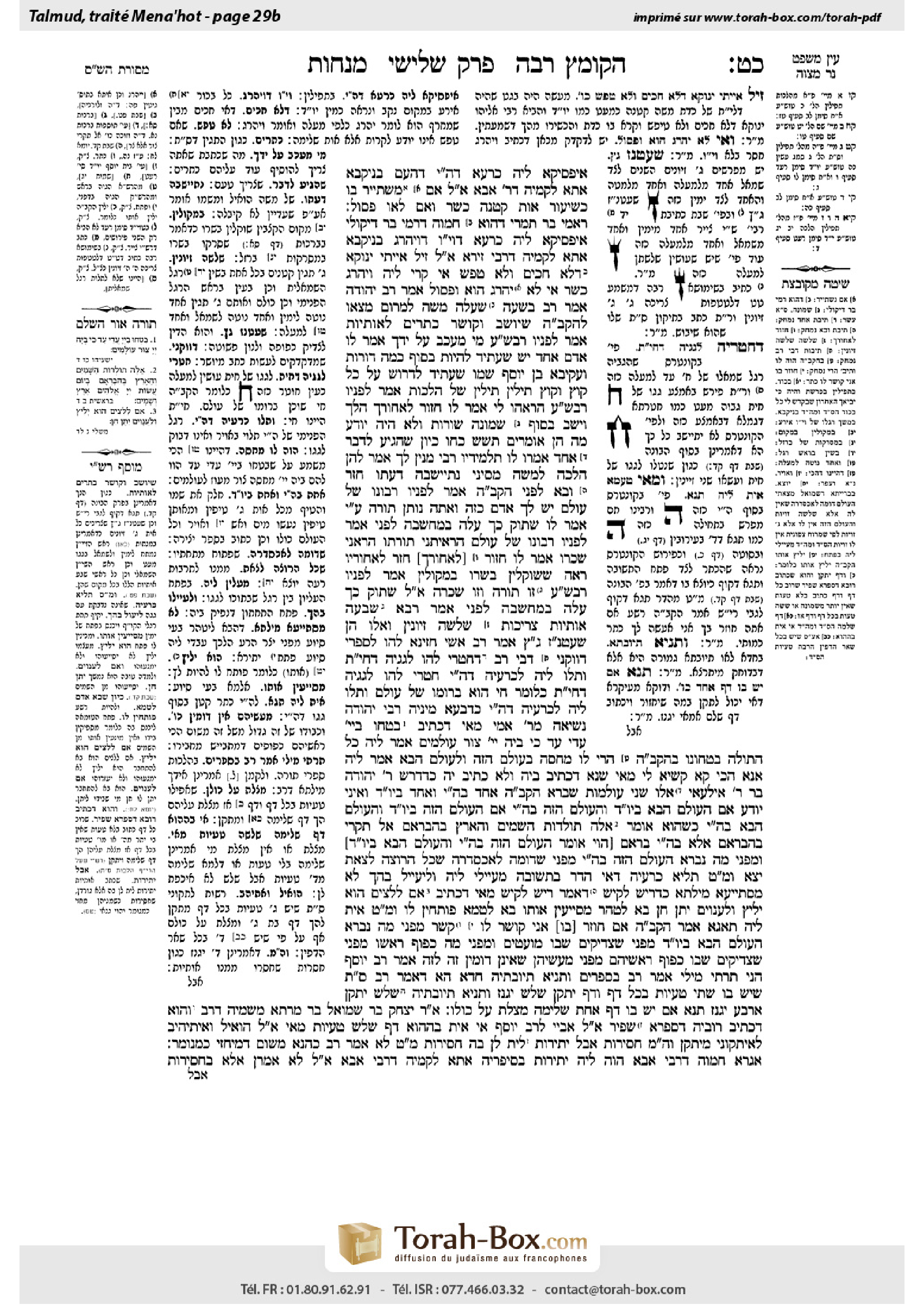
Menachot 29b: Talmud study for Daf Yomi
Daf Yomi is the daily study of one Talmud folio. Explore 37 tractates with scans, Hebrew text, Sefaria English and AI-generated French translations where annotated.
Passage selection and English or AI-generated French translation are available where the scan has annotations. Daf Study is independent of Torah-Box and Sefaria.
Browse Menachot · מנחות · All tractatesMenachot 29b text and translations
This page of Menachot includes the Aramaic text, an English translation and an AI-generated French translation, alongside the scan above.
מנחות כ״ט ב · Aramaic and Hebrew text
אִיפְּסִיקָא לֵיהּ כַּרְעָא דְּהֵ״י דְּ״הָעָם״ בְּנִיקְבָּא, אֲתָא לְקַמֵּיהּ דְּרַבִּי אַבָּא. אֲמַר לֵיהּ: אִם (מִשְׁתַּיַּיר) [נִשְׁתַּיֵּיר] בּוֹ כְּשִׁיעוּר אוֹת קְטַנָּה – כָּשֵׁר, וְאִם לָאו – פָּסוּל.
רָאמֵי בַּר תַּמְרֵי, דְּהוּא חֲמוּהּ דְּרָמֵי בַּר דִּיקּוּלֵי, אִיפְּסִיקָא לֵיהּ כַּרְעָא דְּוָי״ו דְּ״וַיַהֲרֹג״ בְּנִיקְבָּא, אֲתָא לְקַמֵּיהּ דְּרַבִּי זֵירָא. אֲמַר לֵיהּ: זִיל אַיְיתִי יָנוֹקָא דְּלָא חַכִּים וְלָא טִפֵּשׁ – אִי קָרֵי לֵיהּ ״וַיַּהֲרֹג״ כָּשֵׁר, אִי לָא – ״יֵהָרֵג״ הוּא, וּפָסוּל.
אָמַר רַב יְהוּדָה, אָמַר רַב: בְּשָׁעָה שֶׁעָלָה מֹשֶׁה לַמָּרוֹם, מְצָאוֹ לְהַקָּדוֹשׁ בָּרוּךְ הוּא שֶׁיּוֹשֵׁב וְקוֹשֵׁר כְּתָרִים לָאוֹתִיּוֹת, אָמַר לְפָנָיו: רִבּוֹנוֹ שֶׁל עוֹלָם, מִי מְעַכֵּב עַל יָדֶךָ? אָמַר לוֹ: אָדָם אֶחָד יֵשׁ שֶׁעָתִיד לִהְיוֹת בְּסוֹף כַּמָּה דּוֹרוֹת וַעֲקִיבָא בֶּן יוֹסֵף שְׁמוֹ, שֶׁעָתִיד לִדְרוֹשׁ עַל כׇּל קוֹץ וָקוֹץ תִּילִּין תִּילִּין שֶׁל הֲלָכוֹת.
אָמַר לְפָנָיו: רִבּוֹנוֹ שֶׁל עוֹלָם, הַרְאֵהוּ לִי, אָמַר לוֹ: חֲזוֹר לַאֲחוֹרֶךָ. הָלַךְ וְיָשַׁב בְּסוֹף שְׁמוֹנֶה שׁוּרוֹת, וְלֹא הָיָה יוֹדֵעַ מָה הֵן אוֹמְרִים, תָּשַׁשׁ כֹּחוֹ. כֵּיוָן שֶׁהִגִּיעַ לְדָבָר אֶחָד, אָמְרוּ לוֹ תַּלְמִידָיו: רַבִּי, מִנַּיִן לָךְ? אָמַר לָהֶן: ״הֲלָכָה לְמֹשֶׁה מִסִּינַי״, נִתְיַישְּׁבָה דַּעְתּוֹ.
חָזַר וּבָא לִפְנֵי הַקָּדוֹשׁ בָּרוּךְ הוּא, אָמַר לְפָנָיו: רִבּוֹנוֹ שֶׁל עוֹלָם, יֵשׁ לְךָ אָדָם כָּזֶה וְאַתָּה נוֹתֵן תּוֹרָה עַל יָדִי? אָמַר לוֹ: שְׁתוֹק, כָּךְ עָלָה בְּמַחְשָׁבָה לְפָנַי. אָמַר לְפָנָיו: רִבּוֹנוֹ שֶׁל עוֹלָם, הִרְאִיתַנִי תּוֹרָתוֹ, הַרְאֵנִי שְׂכָרוֹ. אָמַר לוֹ: חֲזוֹר. חָזַר לַאֲחוֹרָיו, רָאָה שֶׁשּׁוֹקְלִין בְּשָׂרוֹ בְּמָקוֹלִין. אָמַר לְפָנָיו: רִבּוֹנוֹ שֶׁל עוֹלָם, זוֹ תּוֹרָה וְזוֹ שְׂכָרָהּ? אָמַר לוֹ: שְׁתוֹק, כָּךְ עָלָה בְּמַחְשָׁבָה לְפָנַי.
אָמַר רָבָא: שֶׁבַעה אוֹתִיּוֹת צְרִיכוֹת שְׁלֹשָׁה זִיּוּנִין, וְאֵלּוּ הֵן: שעטנ״ז ג״ץ. אָמַר רַב אָשֵׁי: חֲזֵינָא לְהוּ לְסָפְרֵי דַּוְוקָנֵי דְּבֵי רַב, דְּחָטְרִי לְהוּ לְגַגֵּיהּ דְּחֵי״ת, וְתָלוּ לֵיהּ לְכַרְעֵיהּ דְּהֵ״י.
חׇטְרִי לְהוּ לְגַגֵּיהּ דְּחֵי״ת, כְּלוֹמַר: חַי הוּא בְּרוּמוֹ שֶׁל עוֹלָם, וְתָלוּ לֵיהּ לְכַרְעֵיהּ דְּהֵ״י, כְּדִבְעָא מִינֵּיהּ רַבִּי יְהוּדָה נְשִׂיאָה מֵרַבִּי אַמֵּי: מַאי דִּכְתִיב ״בִּטְחוּ בַּייָ עֲדֵי עַד כִּי בְּיָהּ יְיָ צוּר עוֹלָמִים״? אֲמַר לֵיהּ: כָּל הַתּוֹלֶה בִּטְחוֹנוֹ בְּהַקָּדוֹשׁ בָּרוּךְ הוּא הֲרֵי לוֹ מַחְסֶה בָּעוֹלָם הַזֶּה וְלָעוֹלָם הַבָּא.
אֲמַר לֵיהּ: אֲנָא הָכִי קָא קַשְׁיָא לִי, מַאי שְׁנָא דִּכְתִיב ״בְּיָהּ״ וְלָא כְּתִיב ״יָהּ״?
כִּדְדָרֵשׁ רַבִּי יְהוּדָה בַּר רַבִּי אִילְעַאי: אֵלּוּ שְׁנֵי עוֹלָמוֹת שֶׁבָּרָא הַקָּדוֹשׁ בָּרוּךְ הוּא, אֶחָד בְּהֵ״י וְאֶחָד בְּיוֹ״ד, וְאֵינִי יוֹדֵעַ אִם הָעוֹלָם הַבָּא בְּיוֹ״ד וְהָעוֹלָם הַזֶּה בְּהֵ״י, אִם הָעוֹלָם הַזֶּה בְּיוֹ״ד וְהָעוֹלָם הַבָּא בְּהֵ״י.
כְּשֶׁהוּא אוֹמֵר: ״אֵלֶּה תוֹלְדוֹת הַשָּׁמַיִם וְהָאָרֶץ בְּהִבָּרְאָם״, אַל תִּקְרֵי ״בְּהִבָּרְאָם״ אֶלָּא: בְּהֵ״י בְּרָאָם.
וּמִפְּנֵי מָה נִבְרָא הָעוֹלָם הַזֶּה בְּהֵ״י? מִפְּנֵי שֶׁדּוֹמֶה לְאַכְסַדְרָה, שֶׁכׇּל הָרוֹצֶה לָצֵאת יֵצֵא. וּמַאי טַעְמָא תַּלְיָא כַּרְעֵיהּ? דְּאִי הָדַר בִּתְשׁוּבָה מְעַיְּילִי לֵיהּ.
וְלִיעַיֵּיל בְּהָךְ, לָא מִסְתַּיְּיעָא מִילְּתָא, כִּדְרֵישׁ לָקִישׁ, דְּאָמַר רֵישׁ לָקִישׁ: מַאי דִּכְתִיב ״אִם לַלֵּצִים הוּא יָלִיץ וְלַעֲנָוִים יִתֶּן חֵן״? בָּא לִטָּהֵר – מְסַיְּיעִין אוֹתוֹ, בָּא לִטַּמֵּא – פּוֹתְחִין לוֹ. וּמַאי טַעְמָא אִית לֵיהּ תָּאגָא? אָמַר הַקָּדוֹשׁ בָּרוּךְ הוּא: אִם חוֹזֵר – אֲנִי קוֹשֵׁר לוֹ קֶשֶׁר.
מִפְּנֵי מָה נִבְרָא הָעוֹלָם הַבָּא בְּיוֹ״ד? מִפְּנֵי שֶׁצַּדִּיקִים שֶׁבּוֹ מוּעָטִים. וּמִפְּנֵי מָה כָּפוּף רֹאשׁוֹ? מִפְּנֵי שֶׁצַּדִּיקִים שֶׁבּוֹ כָּפוּף רָאשֵׁיהֶם מִפְּנֵי מַעֲשֵׂיהֶן, שֶׁאֵינָן דּוֹמִין זֶה לָזֶה.
אָמַר רַב יוֹסֵף: הָנֵי תַּרְתֵּי מִילֵּי אָמַר רַב בִּסְפָרִים, וְתַנְיָא תְּיוּבְתֵּיהּ. חֲדָא, הָא דְּאָמַר רַב: סֵפֶר תּוֹרָה שֶׁיֵּשׁ בּוֹ שְׁתֵּי טָעִיּוֹת בְּכׇל דַּף וָדַף – יְתַקֵּן, שָׁלֹשׁ – יִגָּנֵז.
וְתַנְיָא תְּיוּבְתֵּיהּ: שָׁלֹשׁ – יְתַקֵּן, אַרְבַּע – יִגָּנֵז. תָּנָא: אִם יֵשׁ בּוֹ דַּף אַחַת שְׁלֵימָה – מַצֶּלֶת עַל כּוּלּוֹ. אָמַר רַבִּי יִצְחָק בַּר שְׁמוּאֵל בַּר מָרְתָא מִשְּׁמֵיהּ דְּרַב: וְהוּא דִּכְתִיב רוּבֵּיהּ דְּסִפְרָא שַׁפִּיר.
אֲמַר לֵיהּ אַבָּיֵי לְרַב יוֹסֵף: אִי אִית בְּהָהוּא דַּף שָׁלֹשׁ טָעִיּוֹת, מַאי? אֲמַר לֵיהּ: הוֹאִיל וְאִיתְיְהֵיב לְאִיתְּקוֹנֵי מִיתְּקַן. וְהָנֵי מִילֵּי חֲסֵירוֹת, אֲבָל יְתֵירוֹת לֵית לַן בַּהּ. חֲסֵירוֹת מַאי טַעְמָא לָא? אָמַר רַב כָּהֲנָא: מִשּׁוּם דְּמִיחֲזֵי כִּמְנוּמָּר.
אַגְרָא חֲמוּהּ דְּרַבִּי אַבָּא הֲוָה לֵיהּ יְתֵירוֹת בְּסִיפְרֵיהּ, אֲתָא לְקַמֵּיהּ דְּרַבִּי אַבָּא, אֲמַר לֵיהּ: לָא אֲמַרַן אֶלָּא בַּחֲסֵירוֹת,
Menachot 29b · English translation
had the leg of the letter heh in the term: “The nation [ha’am]” (Exodus 13:3), written in his phylacteries, severed by a perforation. He came before his son-in-law Rabbi Abba to clarify the halakha. Rabbi Abba said to him: If there remains in the leg that is attached to the roof of the letter the equivalent of the measure of a small letter, i.e., the letter yod, it is fit. But if not, it is unfit.
The Gemara relates: Rami bar Tamrei, who was the father-in-law of Rami bar Dikkulei, had the leg of the letter vav in the term: “And the Lord slew [vayaharog] all the firstborn” (Exodus 13:15), written in his phylacteries, severed by a perforation. He came before Rabbi Zeira to clarify the halakha. Rabbi Zeira said to him: Go bring a child who is neither wise nor stupid, but of average intelligence; if he reads the term as “And the Lord slew [vayaharog]” then it is fit, as despite the perforation the letter is still seen as a vav. But if not, then it is as though the term were: Will be slain [yehareg], written without the letter vav, and it is unfit.
§ Rav Yehuda says that Rav says: When Moses ascended on High, he found the Holy One, Blessed be He, sitting and tying crowns on the letters of the Torah. Moses said before God: Master of the Universe, who is preventing You from giving the Torah without these additions? God said to him: There is a man who is destined to be born after several generations, and Akiva ben Yosef is his name; he is destined to derive from each and every thorn of these crowns mounds upon mounds of halakhot. It is for his sake that the crowns must be added to the letters of the Torah.
Moses said before God: Master of the Universe, show him to me. God said to him: Return behind you. Moses went and sat at the end of the eighth row in Rabbi Akiva’s study hall and did not understand what they were saying. Moses’ strength waned, as he thought his Torah knowledge was deficient. When Rabbi Akiva arrived at the discussion of one matter, his students said to him: My teacher, from where do you derive this? Rabbi Akiva said to them: It is a halakha transmitted to Moses from Sinai. When Moses heard this, his mind was put at ease, as this too was part of the Torah that he was to receive.
Moses returned and came before the Holy One, Blessed be He, and said before Him: Master of the Universe, You have a man as great as this and yet You still choose to give the Torah through me. Why? God said to him: Be silent; this intention arose before Me. Moses said before God: Master of the Universe, You have shown me Rabbi Akiva’s Torah, now show me his reward. God said to him: Return to where you were. Moses went back and saw that they were weighing Rabbi Akiva’s flesh in a butcher shop [bemakkulin], as Rabbi Akiva was tortured to death by the Romans. Moses said before Him: Master of the Universe, this is Torah and this is its reward? God said to him: Be silent; this intention arose before Me.
§ The Gemara continues its discussion of the crowns on letters of the Torah: Rava says: Seven letters require three crowns [ziyyunin], and they are the letters shin, ayin, tet, nun, zayin; gimmel and tzadi. Rav Ashi says: I have seen that the exacting scribes of the study hall of Rav would put a hump-like stroke on the roof of the letter ḥet and they would suspend the left leg of the letter heh, i.e., they would ensure that it is not joined to the roof of the letter.
Rava explains: They would put a hump-like stroke on the roof of the letter ḥet as if to thereby say: The Holy One, Blessed be He, lives [ḥai] in the heights of the universe. And they would suspend the left leg of the letter heh, as Rabbi Yehuda Nesia asked Rabbi Ami: What is the meaning of that which is written: “Trust in the Lord forever, for in the Lord [beYah] is God, an everlasting [olamim] Rock” (Isaiah 26:4)? Rabbi Ami said to him: Anyone who puts their trust in the Holy One, Blessed be He, will have Him as his refuge in this world and in the World-to-Come. This is alluded to in the word “olamim,” which can also mean: Worlds.
Rabbi Yehuda Nesia said to Rabbi Ami: I was not asking about the literal meaning of the verse; this is what poses a difficulty for me: What is different about that which is written: “For in the Lord [beYah],” and it is not written: For the Lord [Yah]?
Rav Ashi responded: It is as Rabbi Yehuda bar Rabbi Elai taught: The verse “For in the Lord [beYah] is God, an everlasting Rock [Tzur olamim]” is understood as follows: The term “Tzur olamim” can also mean Creator of worlds. These letters yod and heh that constitute the word yah are referring to the two worlds that the Holy One, Blessed be He, created; one with [be] the letter heh and one with [be] the letter yod. And I do not know whether the World-to-Come was created with the letter yod and this world was created with the letter heh, or whether this world was created with the letter yod and the World-to-Come was created with the letter heh.
When the verse states: “These are the generations of the heaven and of the earth when they were created [behibare’am]” (Genesis 2:4), do not read it as behibare’am, meaning: When they were created; rather, read it as beheh bera’am, meaning: He created them with the letter heh. This verse demonstrates that the heaven and the earth, i.e., this world, were created with the letter heh, and therefore the World-to-Come must have been created with the letter yod.
And for what reason was this world created specifically with the letter heh? It is because the letter heh, which is open on its bottom, has a similar appearance to a portico, which is open on one side. And it alludes to this world, where anyone who wishes to leave may leave, i.e., every person has the ability to choose to do evil. And what is the reason that the left leg of the letter heh is suspended, i.e., is not joined to the roof of the letter? It is because if one repents, he is brought back in through the opening at the top.
The Gemara asks: But why not let him enter through that same way that he left? The Gemara answers: That would not be effective, since one requires assistance from Heaven in order to repent, in accordance with the statement of Reish Lakish. As Reish Lakish says: What is the meaning of that which is written: “If it concerns the scorners, He scorns them, but to the humble He gives grace” (Proverbs 3:34)? Concerning one who comes in order to become pure, he is assisted from Heaven, as it is written: “But to the humble He gives grace.” Concerning one who comes to become impure, he is provided with an opening to do so. The Gemara asks: And what is the reason that the letter heh has a crown on its roof? The Gemara answers: The Holy One, Blessed be He, says: If a sinner returns, repenting for his sin, I tie a crown for him from above.
The Gemara asks: For what reason was the World-to-Come created specifically with the letter yod, the smallest letter in the Hebrew alphabet? The Gemara answers: It is because the righteous of the world are so few. And for what reason is the left side of the top of the letter yod bent downward? It is because the righteous who are in the World-to-Come hang their heads in shame, since the actions of one are not similar to those of another. In the World-to-Come some of the righteous will be shown to be of greater stature than others.
§ Rav Yosef says: Rav states these two matters with regard to scrolls, and in each case a statement is taught in a baraita that constitutes a refutation of his ruling. One is that which Rav says: A Torah scroll that contains two errors on each and every column may be corrected, but if there are three errors on each and every column then it shall be interred.
And a statement is taught in a baraita that constitutes a refutation of his ruling: A Torah scroll that contains three errors on every column may be corrected, but if there are four errors on every column then it shall be interred. A tanna taught in a baraita: If the Torah scroll contains one complete column with no errors, it saves the entire Torah scroll, and it is permitted to correct the scroll rather than interring it. Rabbi Yitzḥak bar Shmuel bar Marta says in the name of Rav: And this is the halakha only when the majority of the scroll is written properly and is not full of errors.
Abaye said to Rav Yosef: If that column contained three errors, what is the halakha? Rav Yosef said to him: Since the column itself may be corrected, it enables the correction of the entire scroll. The Gemara adds: And with regard to the halakha that a Torah scroll may not be fixed if it is full of errors, this statement applies when letters are missing and must be added in the space between the lines. But if there were extraneous letters, we have no problem with it, since they can easily be erased. The Gemara asks: What is the reason that a scroll with letters missing may not be corrected? Rav Kahana said: Because it would look speckled if one adds all of the missing letters in the spaces between the lines.
The Gemara relates: Agra, the father-in-law of Rabbi Abba, had many extraneous letters in his scroll. He came before Rabbi Abba to clarify the halakha. Rabbi Abba said to him: We said that one may not correct the scroll only in a case where the letters are missing.
Menachot 29b · Traduction française (IA)
La hampe de la lettre hé du mot « le peuple [ha’am] » (Exode 13, 3), dans ses téfilines, était sectionnée par une perforation. Il vint consulter son gendre, Rabbi Abba, pour éclaircir la halakha. Rabbi Abba lui dit : « S’il reste, sur la partie de la hampe attachée au toit de la lettre, l’équivalent de la taille d’une petite lettre, c’est-à-dire d’un yod, elle est valide. Sinon, elle est invalide. »
La Guemara rapporte : Rami bar Tamrei, qui était le beau-père de Rami bar Dikkulei, avait la hampe de la lettre vav du mot « et le Seigneur tua [vayaharog] tous les premiers-nés » (Exode 13, 15), dans ses téfilines, sectionnée par une perforation. Il vint consulter Rabbi Zeira pour éclaircir la halakha. Rabbi Zeira lui dit : « Va chercher un enfant qui ne soit ni particulièrement intelligent ni stupide, mais d’intelligence moyenne. S’il lit le mot « et le Seigneur tua [vayaharog] », la lettre est valide, car, malgré la perforation, elle est encore reconnue comme un vav. Sinon, c’est comme si le mot « sera tué [yehareg] » avait été écrit sans la lettre vav, et la lettre est invalide. »
§ Rav Yehouda dit au nom de Rav : Lorsque Moïse monta au Ciel, il trouva le Saint, béni soit-Il, assis et ajoutant des couronnes aux lettres de la Torah. Moïse dit devant Dieu : « Maître de l’Univers, qu’est-ce qui Vous empêche de donner la Torah sans ces ajouts ? » Dieu lui dit : « Un homme naîtra dans plusieurs générations ; il s’appellera Akiva ben Yossef. Il déduira de chaque petite pointe de ces couronnes des monceaux de halakhot. C’est pour lui que les couronnes doivent être ajoutées aux lettres de la Torah. »
Moïse dit devant Dieu : « Maître de l’Univers, montrez-le-moi. » Dieu lui dit : « Retourne derrière toi. » Moïse s’en alla et s’assit au dernier rang, le huitième, dans la maison d’étude de Rabbi Akiva, sans comprendre ce qu’ils disaient. Ses forces déclinèrent, car il pensait que sa connaissance de la Torah était insuffisante. Lorsque Rabbi Akiva en vint à discuter d’un sujet, ses élèves lui demandèrent : « Mon maître, d’où déduisez-vous cela ? » Rabbi Akiva leur répondit : « C’est une halakha transmise à Moïse au Sinaï. » En entendant cela, Moïse fut rasséréné, car cela aussi faisait partie de la Torah qu’il devait recevoir.
Moïse revint auprès du Saint, béni soit-Il, et lui dit : « Maître de l’Univers, Vous avez un homme aussi grand que lui, et pourtant Vous choisissez de donner la Torah par mon intermédiaire. Pourquoi ? » Dieu lui dit : « Tais-toi ; telle est Mon intention. » Moïse dit devant Dieu : « Maître de l’Univers, Vous m’avez montré la Torah de Rabbi Akiva ; montrez-moi maintenant sa récompense. » Dieu lui dit : « Retourne là où tu étais. » Moïse y retourna et vit que l’on pesait la chair de Rabbi Akiva dans une boucherie [bemakkulin], car Rabbi Akiva avait été torturé à mort par les Romains. Moïse lui dit : « Maître de l’Univers, voilà la Torah, et voilà sa récompense ? » Dieu lui dit : « Tais-toi ; telle est Mon intention. »
§ La Guemara poursuit son examen des couronnes des lettres de la Torah. Rava dit : « Sept lettres nécessitent trois couronnes [ziyyunin] : shin, ayin, tet, noun, zayin, guimel et tsadi. » Rav Ashi dit : « J’ai vu les scribes minutieux de la maison d’étude de Rav tracer une sorte de bosse sur le toit de la lettre ḥet et laisser suspendue la hampe gauche de la lettre hé, c’est-à-dire veiller à ce qu’elle ne soit pas reliée au toit de la lettre. »
Rava explique : ils traçaient une sorte de bosse sur le toit de la lettre ḥet, comme pour dire ainsi : « Le Saint, béni soit-Il, vit [ḥai] dans les hauteurs de l’univers. » Et ils laissaient suspendue la hampe gauche de la lettre hé, comme lorsque Rabbi Yehouda Nesia demanda à Rabbi Ami : « Quel est le sens de ce qui est écrit : “Confiez-vous au Seigneur à jamais, car en le Seigneur [beYah] est le Rocher éternel [olamim]” (Isaïe 26, 4) ? » Rabbi Ami lui dit : « Quiconque place sa confiance dans le Saint, béni soit-Il, L’aura pour refuge dans ce monde et dans le Monde à venir. » Cela est suggéré par le mot « olamim », qui peut aussi signifier « mondes ».
Rabbi Yehouda Nesia dit à Rabbi Ami : « Je ne vous interrogeais pas sur le sens littéral du verset ; voici ce qui me pose difficulté : pourquoi est-il écrit “car en le Seigneur [beYah]”, et non “car le Seigneur [Yah]” ? »
Rav Ashi répondit : c’est comme l’enseigna Rabbi Yehouda bar Rabbi Elai. Le verset « car en le Seigneur [beYah] est le Rocher éternel [Tzur olamim] » s’interprète ainsi : l’expression « Tzur olamim » peut aussi signifier « Créateur des mondes ». Les lettres yod et hé qui forment le mot Yah font référence aux deux mondes que le Saint, béni soit-Il, a créés : l’un avec [be] la lettre hé et l’autre avec [be] la lettre yod. Je ne sais pas si le Monde à venir a été créé avec la lettre yod et ce monde avec la lettre hé, ou si ce monde a été créé avec la lettre yod et le Monde à venir avec la lettre hé.
Lorsque le verset dit : « Telles sont les générations du ciel et de la terre lorsqu’ils furent créés [behibare’am] » (Genèse 2, 4), ne lis pas behibare’am, « lorsqu’ils furent créés », mais beheh bera’am, « Il les créa avec la lettre hé ». Ce verset montre que le ciel et la terre, c’est-à-dire ce monde, ont été créés avec la lettre hé ; le Monde à venir a donc dû être créé avec la lettre yod.
Et pourquoi ce monde a-t-il précisément été créé avec la lettre hé ? Parce que la lettre hé, ouverte en bas, ressemble à un portique ouvert d’un côté. Elle évoque ce monde, où quiconque souhaite sortir peut sortir, c’est-à-dire que chacun a la possibilité de choisir le mal. Et pourquoi la hampe gauche de la lettre hé est-elle suspendue, c’est-à-dire non reliée au toit de la lettre ? Parce que si quelqu’un se repent, il est ramené à l’intérieur par l’ouverture du haut.
La Guemara demande : « Mais pourquoi ne le laisserait-on pas entrer par le même endroit que celui par lequel il est sorti ? » La Guemara répond : « Cela ne serait pas efficace, car il faut l’aide du Ciel pour se repentir, conformément à ce qu’a dit Reish Lakish. » En effet, Reish Lakish dit : « Quel est le sens de ce qui est écrit : “Il se moque des moqueurs, mais il accorde sa grâce aux humbles” (Proverbes 3, 34) ? Celui qui vient pour se purifier reçoit l’aide du Ciel, comme il est écrit : “mais il accorde sa grâce aux humbles”. À celui qui vient pour se souiller, on ouvre la voie. » La Guemara demande : « Et pourquoi la lettre hé porte-t-elle une couronne sur son toit ? » La Guemara répond : « Le Saint, béni soit-Il, dit : “Si un pécheur revient et se repent de son péché, Je lui noue une couronne au-dessus.” »
La Guemara demande : « Pourquoi le Monde à venir a-t-il précisément été créé avec la lettre yod, la plus petite lettre de l’alphabet hébreu ? » La Guemara répond : « Parce que les justes du monde sont si peu nombreux. » Et pourquoi le côté gauche de la partie supérieure de la lettre yod est-il recourbé vers le bas ? Parce que les justes qui se trouvent dans le Monde à venir baissent la tête de honte, puisque les actes de l’un ne sont pas semblables à ceux de l’autre. Dans le Monde à venir, certains justes apparaîtront de plus grande stature que d’autres.
§ Rav Yossef dit : Rav énonce ces deux règles au sujet des rouleaux, et, dans chaque cas, une baraïta rapporte un enseignement qui réfute sa décision. La première est celle-ci : Rav dit qu’un rouleau de la Torah qui comporte deux erreurs dans chaque colonne peut être corrigé, mais que s’il comporte trois erreurs dans chaque colonne, il doit être enfoui.
Or, une baraïta rapporte un enseignement qui réfute sa décision : un rouleau de la Torah qui comporte trois erreurs dans chaque colonne peut être corrigé, mais s’il en comporte quatre dans chaque colonne, il doit être enfoui. Un tanna a enseigné dans une baraïta : si le rouleau de la Torah comporte une colonne entière sans aucune erreur, cela sauve l’ensemble du rouleau et permet de le corriger plutôt que de l’enfouir. Rabbi Yitzḥak bar Shmuel bar Marta dit au nom de Rav : cette règle ne s’applique que lorsque la majorité du rouleau est correctement écrite et n’est pas remplie d’erreurs.
Abaye dit à Rav Yossef : « Quelle est la halakha si cette colonne comporte trois erreurs ? » Rav Yossef lui dit : « Puisque la colonne elle-même peut être corrigée, cela permet de corriger tout le rouleau. » La Guemara ajoute : quant à la règle selon laquelle un rouleau de la Torah ne peut pas être corrigé s’il est rempli d’erreurs, elle s’applique lorsque des lettres manquent et doivent être ajoutées dans l’espace entre les lignes. Mais s’il y a des lettres en trop, cela ne pose pas de problème, car elles peuvent facilement être effacées. La Guemara demande : « Pourquoi un rouleau auquel manquent des lettres ne peut-il pas être corrigé ? » Rav Kahana dit : « Parce que l’ajout de toutes les lettres manquantes dans les espaces entre les lignes lui donnerait un aspect tacheté. »
La Guemara rapporte : Agra, le beau-père de Rabbi Abba, avait de nombreuses lettres en trop dans son rouleau. Il vint consulter Rabbi Abba pour éclaircir la halakha. Rabbi Abba lui dit : « Nous avons dit qu’on ne peut pas corriger le rouleau uniquement dans le cas où des lettres manquent. »
Traduction française générée par IA à partir de l’édition anglaise de Sefaria. Vérifie toujours un passage avec le texte source.
Text from Sefaria: William Davidson Edition - Vocalized Aramaic (unknown); William Davidson Edition - English (CC BY NC).