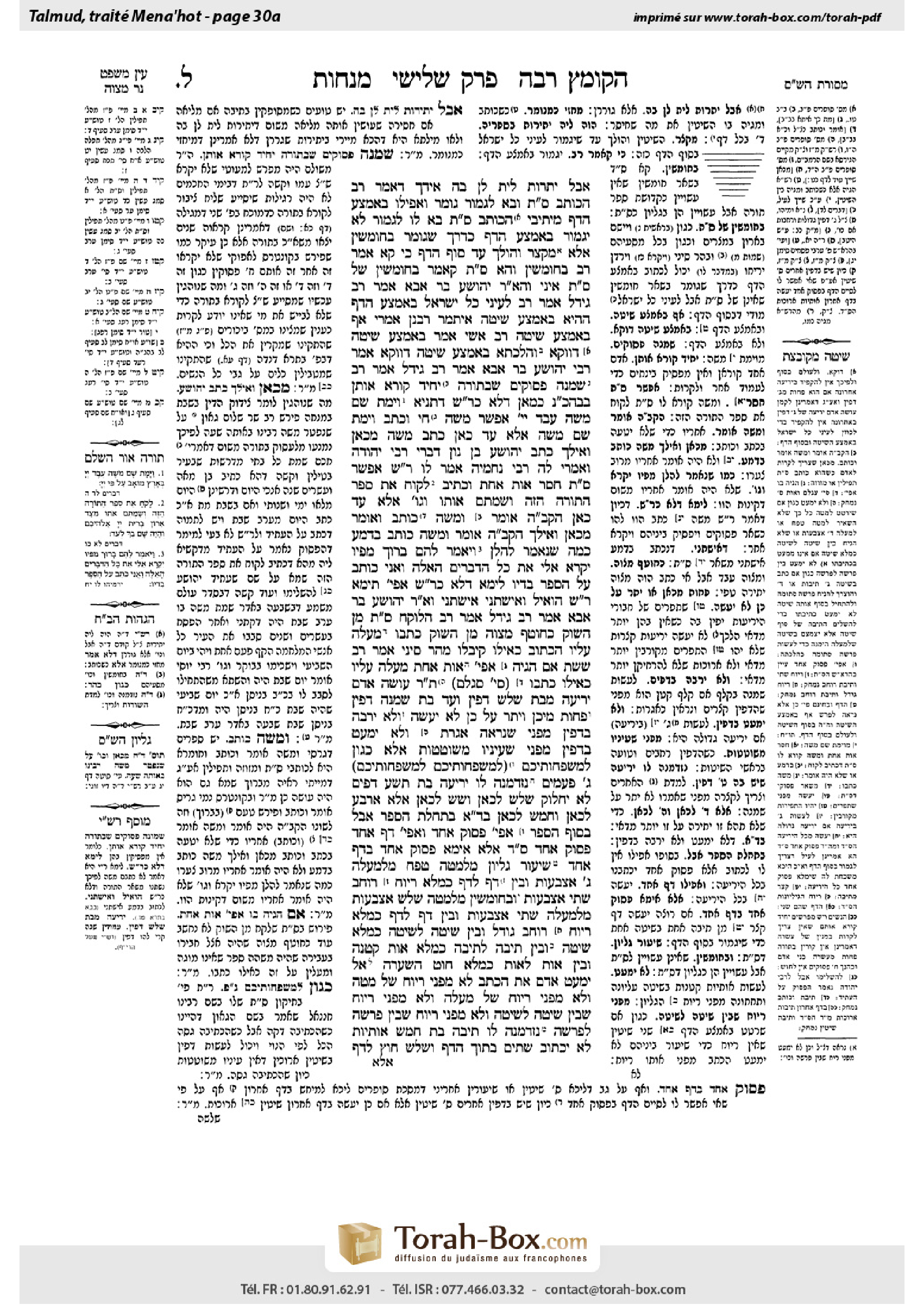
Menachot 30a: Talmud study for Daf Yomi
Daf Yomi is the daily study of one Talmud folio. Explore 37 tractates with scans, Hebrew text, Sefaria English and AI-generated French translations where annotated.
Passage selection and English or AI-generated French translation are available where the scan has annotations. Daf Study is independent of Torah-Box and Sefaria.
Browse Menachot · מנחות · All tractatesMenachot 30a text and translations
This page of Menachot includes the Aramaic text, an English translation and an AI-generated French translation, alongside the scan above.
מנחות ל׳ א · Aramaic and Hebrew text
אֲבָל יְתֵרוֹת לֵית לַן בַּהּ.
אִידַּךְ, דְּאָמַר רַב: הַכּוֹתֵב סֵפֶר תּוֹרָה וּבָא לִגְמוֹר – גּוֹמֵר, וַאֲפִילּוּ בְּאֶמְצַע הַדַּף. מֵיתִיבִי: הַכּוֹתֵב סֵפֶר תּוֹרָה, בָּא לוֹ לִגְמוֹר – לֹא יִגְמוֹר בָּאֶמְצַע הַדַּף כְּדֶרֶךְ שֶׁגּוֹמֵר בַּחוּמָּשִׁין, אֶלָּא מְקַצֵּר וְהוֹלֵךְ עַד סוֹף הַדַּף! כִּי קָא אָמַר רַב – בְּחוּמָּשִׁין.
וְהָא סֵפֶר תּוֹרָה קָאָמַר? בְּחוּמָּשִׁין שֶׁל סֵפֶר תּוֹרָה. אִינִי? וְהָאָמַר רַבִּי יְהוֹשֻׁעַ בַּר אַבָּא אָמַר רַב גִּידֵּל אָמַר רַב: ״לְעֵינֵי כׇּל יִשְׂרָאֵל״ בְּאֶמְצַע הַדַּף? הָהִיא בְּאֶמְצַע שִׁיטָה אִיתְּמַר.
רַבָּנַן אָמְרִי: אַף בְּאֶמְצַע שִׁיטָה, רַב אָשֵׁי אָמַר: בְּאֶמְצַע שִׁיטָה דַּוְוקָא, וְהִלְכְתָא: בְּאֶמְצַע שִׁיטָה דַּוְוקָא.
אָמַר רַבִּי יְהוֹשֻׁעַ בַּר אַבָּא, אָמַר רַב גִּידֵּל, אָמַר רַב: שְׁמֹנָה פְּסוּקִים שֶׁבַּתּוֹרָה, יָחִיד קוֹרֵא אוֹתָן בְּבֵית הַכְּנֶסֶת. כְּמַאן? דְּלָא כְּרַבִּי שִׁמְעוֹן.
דְּתַנְיָא: ״וַיָּמׇת שָׁם מֹשֶׁה עֶבֶד ה׳״, אֶפְשָׁר מֹשֶׁה חַי וְכָתַב ״וַיָּמׇת שָׁם מֹשֶׁה״? אֶלָּא עַד כָּאן כָּתַב מֹשֶׁה, מִכָּאן וְאֵילָךְ כָּתַב יְהוֹשֻׁעַ בִּן נוּן, דִּבְרֵי רַבִּי יְהוּדָה, וְאָמְרִי לַהּ רַבִּי נְחֶמְיָה.
אָמַר לוֹ רַבִּי שִׁמְעוֹן: אֶפְשָׁר סֵפֶר תּוֹרָה חָסֵר אוֹת אַחַת? וּכְתִיב ״לָקֹחַ אֵת סֵפֶר הַתּוֹרָה הַזֶּה וְשַׂמְתֶּם אֹתוֹ וְגוֹ׳״.
אֶלָּא, עַד כָּאן – הַקָּדוֹשׁ בָּרוּךְ הוּא אוֹמֵר וּמֹשֶׁה כּוֹתֵב וְאוֹמֵר, מִכָּאן וְאֵילָךְ – הַקָּדוֹשׁ בָּרוּךְ הוּא אוֹמֵר וּמֹשֶׁה כּוֹתֵב בְּדֶמַע, כְּמָה שֶׁנֶּאֱמַר לְהַלָּן: ״וַיֹּאמֶר לָהֶם בָּרוּךְ מִפִּיו יִקְרָא אֵלַי אֵת כׇּל הַדְּבָרִים הָאֵלֶּה וַאֲנִי כֹּתֵב עַל הַסֵּפֶר בַּדְּיוֹ״.
לֵימָא דְּלָא כְּרַבִּי שִׁמְעוֹן? אֲפִילּוּ תֵּימָא רַבִּי שִׁמְעוֹן, הוֹאִיל וְאִישְׁתַּנִּי – אִישְׁתַּנִּי.
וְאָמַר רַבִּי יְהוֹשֻׁעַ בַּר אַבָּא, אָמַר רַב גִּידֵּל, אָמַר רַב: הַלּוֹקֵחַ סֵפֶר תּוֹרָה מִן הַשּׁוּק – כְּחוֹטֵף מִצְוָה מִן הַשּׁוּק, כְּתָבוֹ – מַעֲלֶה עָלָיו הַכָּתוּב כְּאִילּוּ קִיבְּלוֹ מֵהַר סִינַי. אָמַר רַב שֵׁשֶׁת: אִם הִגִּיהַּ אֲפִילּוּ אוֹת אַחַת – מַעֲלֶה עָלָיו כְּאִילּוּ כְּתָבוֹ.
(סִימָן סגל״ם) תָּנוּ רַבָּנַן: עוֹשֶׂה אָדָם יְרִיעָה מִבַּת שָׁלֹשׁ דַּפִּין וְעַד בַּת שְׁמֹנָה דַּפִּין, פָּחוֹת מִיכֵּן וְיָתֵר עַל כֵּן לֹא יַעֲשֶׂה.
וְלֹא יַרְבֶּה בְּדַפִּין, מִפְּנֵי שֶׁנִּרְאֶה אִגֶּרֶת, וְלֹא יְמַעֵט בְּדַפִּין, מִפְּנֵי שֶׁעֵינָיו מְשׁוֹטְטוֹת, אֶלָּא כְּגוֹן ״לְמִשְׁפְּחוֹתֵיכֶם לְמִשְׁפְּחוֹתֵיכֶם לְמִשְׁפְּחוֹתֵיכֶם״ שָׁלֹשׁ פְּעָמִים.
נִזְדַּמְּנָה לוֹ יְרִיעָה בַּת תֵּשַׁע דַּפִּים, לֹא יַחְלוֹק שָׁלֹשׁ לְכָאן וְשֵׁשׁ לְכָאן, אֶלָּא אַרְבַּע לְכָאן וְחָמֵשׁ לְכָאן.
בַּמֶּה דְּבָרִים אֲמוּרִים? בִּתְחִלַּת הַסֵּפֶר, אֲבָל בְּסוֹף הַסֵּפֶר – אֲפִילּוּ פָּסוּק אֶחָד וַאֲפִילּוּ דַּף אֶחָד. פָּסוּק אֶחָד סָלְקָא דַּעְתָּךְ? אֶלָּא אֵימָא: פָּסוּק אֶחָד בְּדַף אֶחָד.
שִׁיעוּר גִּלָּיוֹן מִלְּמַטָּה – טֶפַח, מִלְּמַעְלָה – שָׁלֹשׁ אֶצְבָּעוֹת, וּבֵין דַּף לְדַף – כִּמְלֹא רֶיוַח רוֹחַב שְׁתֵּי אֶצְבָּעוֹת, וּבַחוּמָּשִׁין מִלְּמַטָּה – שָׁלֹשׁ אֶצְבָּעוֹת, מִלְּמַעְלָה – שְׁתֵּי אֶצְבָּעוֹת, וּבֵין דַּף לְדַף – כִּמְלֹא רֶיוַח רוֹחַב גּוּדָל.
וּבֵין שִׁיטָה לְשִׁיטָה כִּמְלֹא שִׁיטָה, וּבֵין תֵּיבָה לְתֵיבָה כִּמְלֹא אוֹת קְטַנָּה, וּבֵין אוֹת לְאוֹת כִּמְלֹא חוּט הַשַּׂעֲרָה.
אַל יְמַעֵט אָדָם אֶת הַכְּתָב, לֹא מִפְּנֵי רֶיוַח שֶׁל מַטָּה, וְלֹא מִפְּנֵי רֶיוַח שֶׁל מַעְלָה, וְלֹא מִפְּנֵי רֶיוַח שֶׁבֵּין שִׁיטָה לְשִׁיטָה, וְלֹא מִפְּנֵי רֶיוַח שֶׁבֵּין פָּרָשָׁה לְפָרָשָׁה.
נִזְדַּמְּנָה לוֹ תֵּיבָה בַּת חָמֵשׁ אוֹתִיּוֹת – לֹא יִכְתּוֹב שְׁתַּיִם בְּתוֹךְ הַדַּף וְשָׁלֹשׁ חוּץ לַדַּף,
Menachot 30a · English translation
But if there are extraneous letters, we have no problem with it, and one may erase them. This is the first halakha that Rav stated, which is refuted in a baraita.
The other is that which Rav says: One who writes a Torah scroll and comes to finish writing it may finish writing it anywhere in the column, and this is the halakha even with regard to finishing it in the middle of the column. The Gemara raises an objection from a baraita: One who writes a Torah scroll and comes to finish writing it may not finish writing it in the middle of the column in the manner that one finishes writing one of the five books of the Torah written as an independent scroll. Rather, he should progressively shorten the width of the lines until he finishes the scroll at the end of the column. The Gemara answers: When Rav says that one may finish writing even in the middle of a column, he was referring to one of the five books of the Torah.
The Gemara asks: But doesn’t Rav say his statement with regard to a Torah scroll? The Gemara answers: He was referring to one of the five books that constitute a Torah scroll. Rav meant that when writing a Torah scroll, one may finish writing any of the first four books in the middle of a column. The Gemara asks: Is that so? But doesn’t Rabbi Yehoshua bar Abba say that Rav Giddel says that Rav says: The words: “In the sight of all Israel” (Deuteronomy 34:12), which conclude the Torah, may be written even in the middle of the column? The Gemara answers: That ruling that was stated is with regard to finishing the Torah scroll in the middle of the line, i.e., in the middle of the width of the column.
The Gemara cites another opinion: The Rabbis say that one may finish writing a Torah scroll even in the middle of the line, but one may finish writing it at the end of the line as well. Rav Ashi says that one must finish writing the Torah scroll specifically in the middle of the line. And the halakha is that it must be ended specifically in the middle of the line.
§ Rabbi Yehoshua bar Abba says that Rav Giddel says that Rav says: With regard to the last eight verses of the Torah (Deuteronomy 32:5–12), a single individual reads them in the synagogue, as that section may not be divided between two readers. The Gemara asks: In accordance with whose opinion is this said? It is not in accordance with the opinion of Rabbi Shimon.
As it is taught in a baraita: The verse states: “And Moses the servant of the Lord died there” (Deuteronomy 34:5). Is it possible that after Moses died, he himself wrote: “And Moses died there”? Rather, Moses wrote the entire Torah until this point, and Joshua bin Nun wrote from this point forward; this is the statement of Rabbi Yehuda. And some say that Rabbi Neḥemya stated this opinion.
Rabbi Shimon said to him: Is it possible that the Torah scroll was missing a single letter? But it is written that God instructed Moses: “Take this Torah scroll and put it by the side of the Ark of the Covenant” (Deuteronomy 31:26), indicating that the Torah was complete as is and that nothing further would be added to it.
Rabbi Shimon explains: Rather, until this point, i.e., the verse describing the death of Moses, the Holy One, Blessed be He, dictated and Moses wrote the text and repeated after Him. From this point forward, with regard to Moses’ death, the Holy One, Blessed be He, dictated and Moses wrote with tears without repeating the words, due to his great sorrow. As it is stated there with regard to Jeremiah’s dictation of the prophecy of the destruction of the Temple to Baruch ben Neriah: “And Baruch said to them: He dictated all these words to me, and I wrote them with ink in the scroll” (Jeremiah 36:18), but he did not repeat the words after Jeremiah.
The Gemara now states its inference: Shall we say that the ruling of Rav that the last verses of the Torah are read by only one reader is not in accordance with the opinion of Rabbi Shimon, since according to Rabbi Shimon these verses are similar to all other verses of the Torah, as they were all written by Moses? The Gemara answers: You may even say that Rav’s ruling was stated in accordance with the opinion of Rabbi Shimon; since they differ from the rest of the Torah in one way, as Moses wrote them without repeating the words, they differ from the rest of the Torah in this way as well, and they may not be divided between two readers.
And Rabbi Yehoshua bar Abba says that Rav Giddel says that Rav says: One who purchases a Torah scroll in the marketplace is akin to one who snatches a mitzva in the marketplace, as the proper manner in which to perform the mitzva of writing a Torah scroll is to write one for himself. And if he himself writes a Torah scroll, the verse ascribes him credit as though he received it at Mount Sinai. Rav Sheshet says: If he emended even a single letter of the Torah scroll, thereby completing it, the verse ascribes him credit as though he had written it in its entirety.
§ Before continuing its discussion of the halakhot of writing a Torah scroll, the Gemara presents a mnemonic for the upcoming halakhot: Samekh, gimmel, lamed, mem. The Sages taught: A person may prepare for a Torah scroll a sheet of parchment of any size from three columns and until eight columns, but one may not prepare a sheet of parchment that has less than three or more than eight columns.
And he may not increase the number of columns, e.g., by writing eight columns on a narrow sheet of parchment, since then each column has the appearance of a missive due to its narrow lines. And he may not decrease the number of columns, e.g., by writing three columns on a wide sheet of parchment, since then the lines will be so wide that the reader’s eyes will wander, as it will be difficult to find the beginning of a line. Rather, the ideal width of a line is, for example, where one can write “lemishpeḥoteikhem,” “lemishpeḥoteikhem,” “lemishpeḥoteikhem,” for a total of three times.
If one happened to acquire a sheet of parchment that has space for nine columns, exceeding the eight-column limit, he should not divide it into two sheets of parchment with three columns here and six columns there; rather, he should divide it into two sheets of parchment with four columns here and five columns there, so that the two sheets will be similar in width.
In what case is this statement that the sheet must contain a minimum of three columns said? It is said with regard to sheets at the beginning and middle of the scroll. But at the end of the scroll, a sheet may consist of even one verse, and even one column. The Gemara asks: Can it enter your mind to say that a sheet may contain one verse? Rather, say that it may consist of even one verse on one column.
The measure of the margin of a Torah scroll is as follows: The size of the lower margin is one handbreadth [tefaḥ]. There is a requirement for a large margin there, so that a reader not inadvertently rest his arm on the writing. The size of the upper margin, which is less susceptible to that occurrence, is three fingerbreadths [etzba’ot], and the space between each column is equal to the full width of two fingerbreadths. And with regard to one of the five books of the Torah that is written as an independent scroll, the size of the lower margin is three fingerbreadths, the size of the upper margin is two fingerbreadths, and the space between each column is equal to the full width of a thumb-breadth [gudal].
And the space between one line of a Torah scroll and the following line must be equal to the space of a full line, and the space between one word and the following word must be equal to a full small letter, and as for the space between one letter and the following letter, it is sufficient for it to be equal to a full hairbreadth.
The halakhot of the margins notwithstanding, a person may not reduce the size of the writing in a manner that the size of the writing is not consistent, not in order to ensure the correct amount of space for the lower margin, nor in order to ensure the correct amount of space for the upper margin, nor in order to ensure the correct amount of space between one line and the following line, nor in order to ensure the correct amount of space between one passage and the following passage, as this is not aesthetically pleasing.
If one happens upon a word that comprises five letters and cannot be written in its entirety within the column, he may not write two letters within the column and three outside of the column, in the margin.
Menachot 30a · Traduction française (IA)
Mais s’il s’agit de lettres superflues, il n’y a pas de difficulté : on peut les effacer. C’est la première halakha énoncée par Rav, qui est réfutée par une baraïta.
L’autre enseignement est celui de Rav : celui qui écrit un rouleau de la Torah et arrive au terme de sa rédaction peut l’achever n’importe où dans la colonne ; cela vaut même s’il l’achève au milieu de la colonne. La Guemara soulève une objection à partir d’une baraïta : celui qui écrit un rouleau de la Torah et arrive au terme de sa rédaction ne peut pas l’achever au milieu de la colonne, comme on achève l’un des cinq livres de la Torah écrit sous la forme d’un rouleau indépendant. Il doit plutôt réduire progressivement la largeur des lignes jusqu’à achever le rouleau à la fin de la colonne. La Guemara répond : lorsque Rav dit qu’on peut achever la rédaction même au milieu d’une colonne, il parlait de l’un des cinq livres de la Torah.
La Guemara demande : Mais Rav ne formule-t-il pas son propos à propos d’un rouleau de la Torah ? La Guemara répond : Il parlait de l’un des cinq livres qui constituent un rouleau de la Torah. Rav voulait dire que, lorsqu’on écrit un rouleau de la Torah, on peut achever chacun des quatre premiers livres au milieu d’une colonne. La Guemara demande : Est-ce bien le cas ? Rabbi Yehoshua bar Abba ne dit-il pas que Rav Giddel dit que Rav dit : les mots « Aux yeux de tout Israël » (Deutéronome 34:12), qui concluent la Torah, peuvent être écrits même au milieu de la colonne ? La Guemara répond : cette décision concerne l’achèvement du rouleau de la Torah au milieu de la ligne, c’est-à-dire au milieu de la largeur de la colonne.
La Guemara cite un autre avis : les Rabbins disent qu’on peut achever la rédaction d’un rouleau de la Torah même au milieu de la ligne, mais qu’on peut aussi l’achever à la fin de la ligne. Rav Ashi dit qu’il faut achever la rédaction du rouleau de la Torah précisément au milieu de la ligne. Et la halakha est qu’il faut le terminer précisément au milieu de la ligne.
§ Rabbi Yehoshua bar Abba dit que Rav Giddel dit que Rav dit : les huit derniers versets de la Torah (Deutéronome 32:5–12) sont lus à la synagogue par un seul lecteur, car ce passage ne peut pas être partagé entre deux lecteurs. La Guemara demande : Selon l’avis de qui cette règle est-elle énoncée ? Elle n’est pas conforme à l’avis de Rabbi Shimon.
Comme il est enseigné dans une baraïta : le verset dit : « Et Moïse, serviteur de l’Éternel, mourut là » (Deutéronome 34:5). Est-il possible qu’après la mort de Moïse, celui-ci ait lui-même écrit : « Moïse mourut là » ? Moïse a plutôt écrit toute la Torah jusqu’à cet endroit, et Josué bin Noun a écrit la suite ; telle est la déclaration de Rabbi Yehouda. Certains disent que Rabbi Neḥemya a formulé cet avis.
Rabbi Shimon lui dit : Est-il possible que le rouleau de la Torah ait été privé d’une seule lettre ? Or, il est écrit que Dieu ordonna à Moïse : « Prends ce rouleau de la Torah et dépose-le à côté de l’Arche de l’Alliance » (Deutéronome 31:26), ce qui indique que la Torah était complète telle quelle et que rien ne devait y être ajouté.
Rabbi Shimon explique : jusqu’à cet endroit, c’est-à-dire jusqu’au verset qui décrit la mort de Moïse, le Saint, béni soit-Il, dictait le texte, Moïse l’écrivait et répétait après Lui. À partir de là, pour ce qui concerne la mort de Moïse, le Saint, béni soit-Il, dictait et Moïse écrivait en pleurant, sans répéter les mots, en raison de son immense chagrin. Il est en effet dit, à propos de la dictée par Jérémie à Baruch ben Néria de la prophétie sur la destruction du Temple : « Baruch leur dit : Il m’a dicté toutes ces paroles et je les ai écrites à l’encre dans le rouleau » (Jérémie 36:18) ; il ne répétait pas les paroles après Jérémie.
La Guemara tire maintenant son déduit : faudrait-il dire que la règle de Rav, selon laquelle les derniers versets de la Torah sont lus par un seul lecteur, n’est pas conforme à l’avis de Rabbi Shimon, puisque, selon Rabbi Shimon, ces versets sont semblables à tous les autres versets de la Torah, car ils ont tous été écrits par Moïse ? La Guemara répond : on peut même dire que la règle de Rav est conforme à l’avis de Rabbi Shimon. Puisqu’ils diffèrent du reste de la Torah sur un point — Moïse les a écrits sans répéter les mots —, ils en diffèrent également sur ce point : ils ne peuvent pas être partagés entre deux lecteurs.
Rabbi Yehoshua bar Abba dit que Rav Giddel dit que Rav dit : celui qui achète un rouleau de la Torah au marché est comparable à celui qui s’empare d’une mitsva au marché, car la manière correcte d’accomplir la mitsva d’écrire un rouleau de la Torah consiste à en écrire un pour soi-même. Et s’il écrit lui-même un rouleau de la Torah, le verset lui en attribue le mérite comme s’il l’avait reçu au mont Sinaï. Rav Sheshet dit : s’il a corrigé ne serait-ce qu’une seule lettre du rouleau de la Torah et l’a ainsi achevé, le verset lui en attribue le mérite comme s’il l’avait écrit dans son intégralité.
§ Avant de poursuivre la discussion des halakhot relatives à l’écriture d’un rouleau de la Torah, la Guemara donne un moyen mnémotechnique pour les halakhot qui suivent : samekh, guimel, lamed, mem. Les Sages ont enseigné : on peut préparer pour un rouleau de la Torah un feuillet de parchemin dont le nombre de colonnes va de trois à huit ; mais on ne peut pas préparer un feuillet comportant moins de trois colonnes ou plus de huit.
Il ne faut pas non plus augmenter le nombre de colonnes, par exemple en écrivant huit colonnes sur un feuillet de parchemin étroit, car chaque colonne aurait alors l’apparence d’une missive, en raison de ses lignes étroites. Il ne faut pas non plus diminuer le nombre de colonnes, par exemple en écrivant trois colonnes sur un feuillet de parchemin large, car les lignes seraient alors si larges que l’œil du lecteur s’égarerait, puisqu’il serait difficile de retrouver le début d’une ligne. La largeur idéale d’une ligne est plutôt, par exemple, celle qui permet d’écrire « lemishpeḥoteikhem », « lemishpeḥoteikhem », « lemishpeḥoteikhem », trois fois au total.
Si quelqu’un se trouve avoir acquis un feuillet de parchemin permettant d’écrire neuf colonnes, dépassant ainsi la limite de huit colonnes, il ne doit pas le diviser en deux feuillets de parchemin, avec trois colonnes sur l’un et six sur l’autre. Il doit plutôt le diviser en deux feuillets, avec quatre colonnes sur l’un et cinq sur l’autre, afin que les deux feuillets aient une largeur similaire.
Dans quel cas dit-on que le feuillet doit comporter au minimum trois colonnes ? Cela concerne les feuillets du début et du milieu du rouleau. Mais à la fin du rouleau, un feuillet peut ne comporter qu’un seul verset, voire une seule colonne. La Guemara demande : Peut-on vraiment envisager qu’un feuillet ne comporte qu’un seul verset ? Il faut plutôt dire qu’il peut ne comporter qu’un seul verset sur une seule colonne.
Les dimensions des marges d’un rouleau de la Torah sont les suivantes : la marge inférieure mesure une largeur de main [tefaḥ]. Elle doit être large afin que le lecteur ne pose pas par inadvertance son bras sur le texte. La marge supérieure, où un tel incident est moins susceptible de se produire, mesure trois largeurs de doigt [etzba’ot], et l’espace entre chaque colonne équivaut à la largeur totale de deux doigts. Quant à l’un des cinq livres de la Torah écrit sous la forme d’un rouleau indépendant, la marge inférieure mesure trois largeurs de doigt, la marge supérieure deux largeurs de doigt, et l’espace entre chaque colonne équivaut à la largeur totale d’un pouce [gudal].
L’espace entre une ligne d’un rouleau de la Torah et la suivante doit équivaloir à une ligne entière ; l’espace entre un mot et le suivant doit équivaloir à la largeur d’une petite lettre entière ; quant à l’espace entre une lettre et la suivante, il suffit qu’il équivaille à l’épaisseur d’un cheveu.
Malgré les halakhot relatives aux marges, on ne peut pas réduire la taille de l’écriture de manière à la rendre irrégulière, ni pour ménager l’espace requis pour la marge inférieure, ni pour celui de la marge supérieure, ni pour l’espace requis entre deux lignes successives, ni pour celui requis entre deux passages successifs, car cela n’est pas esthétique.
Si l’on tombe sur un mot de cinq lettres qui ne peut pas être écrit en entier dans la colonne, on ne peut pas écrire deux lettres dans la colonne et les trois autres à l’extérieur, dans la marge.
Traduction française générée par IA à partir de l’édition anglaise de Sefaria. Vérifie toujours un passage avec le texte source.
Text from Sefaria: William Davidson Edition - Vocalized Aramaic (unknown); William Davidson Edition - English (CC BY NC).