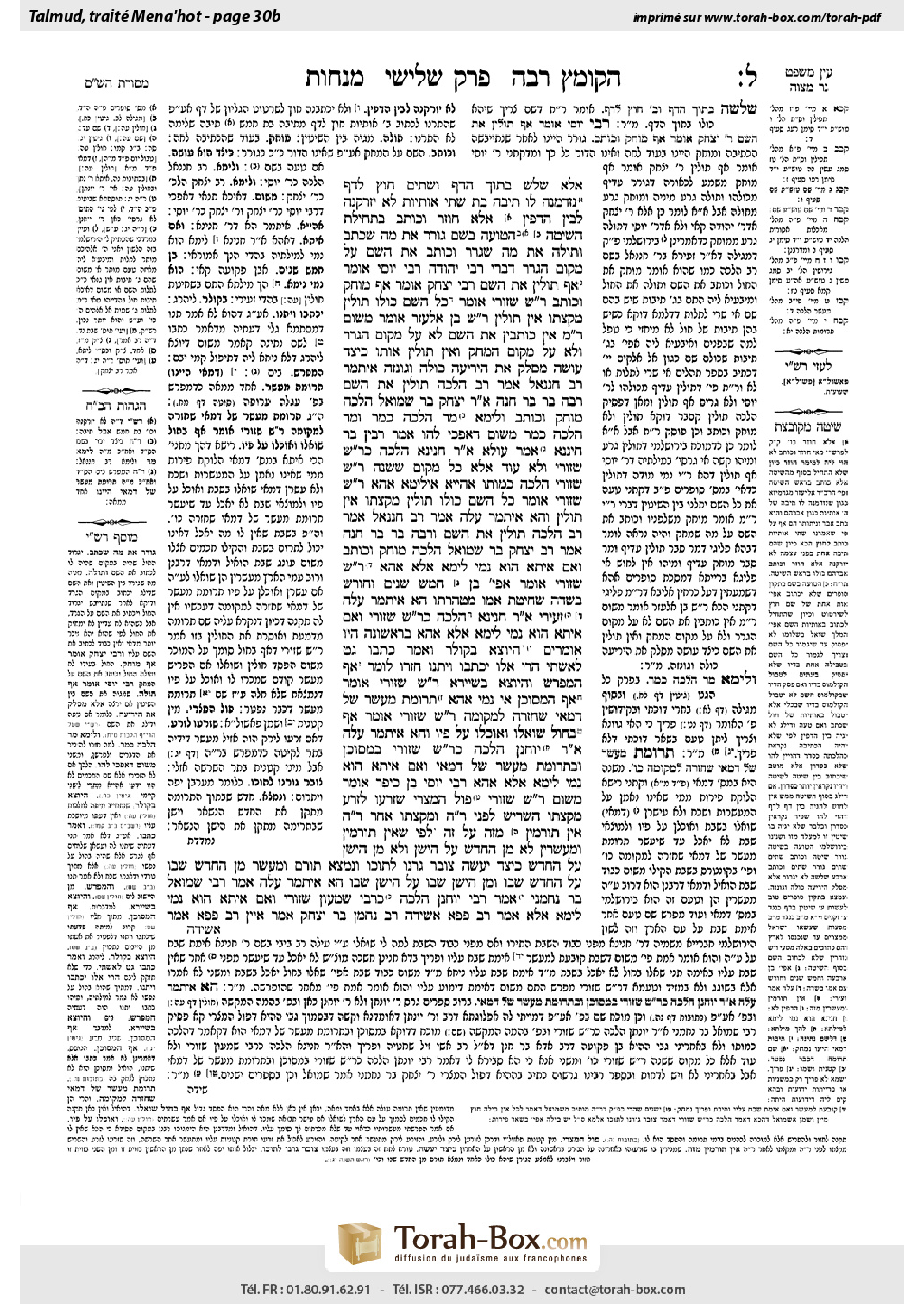
Menachot 30b: Talmud study for Daf Yomi
Daf Yomi is the daily study of one Talmud folio. Explore 37 tractates with scans, Hebrew text, Sefaria English and AI-generated French translations where annotated.
Passage selection and English or AI-generated French translation are available where the scan has annotations. Daf Study is independent of Torah-Box and Sefaria.
Browse Menachot · מנחות · All tractatesMenachot 30b text and translations
This page of Menachot includes the Aramaic text, an English translation and an AI-generated French translation, alongside the scan above.
מנחות ל׳ ב · Aramaic and Hebrew text
אֶלָּא שָׁלֹשׁ בְּתוֹךְ הַדַּף וּשְׁתַּיִם חוּץ לַדַּף. נִזְדַּמְּנָה לוֹ תֵּיבָה בַּת שְׁתֵּי אוֹתִיּוֹת – לֹא יִזְרְקֶנָּה לְבֵין הַדַּפִּין, אֶלָּא חוֹזֵר וְכוֹתֵב בִּתְחִילַּת הַשִּׁיטָה.
הַטּוֹעֶה בַּשֵּׁם, גּוֹרֵר אֶת מַה שֶּׁכָּתַב, וְתוֹלֶה אֶת מַה שֶּׁגָּרַר, וְכוֹתֵב אֶת הַשֵּׁם עַל מְקוֹם הַגְּרָר, דִּבְרֵי רַבִּי יְהוּדָה. רַבִּי יוֹסֵי אוֹמֵר: אַף תּוֹלִין אֶת הַשֵּׁם. רַבִּי יִצְחָק אוֹמֵר: אַף מוֹחֵק וְכוֹתֵב.
רַבִּי שִׁמְעוֹן שֵׁזוּרִי אוֹמֵר: כׇּל הַשֵּׁם כּוּלּוֹ תּוֹלִין, מִקְצָתוֹ אֵין תּוֹלִין. רַבִּי שִׁמְעוֹן בֶּן אֶלְעָזָר אוֹמֵר מִשּׁוּם רַבִּי מֵאִיר: אֵין כּוֹתְבִין אֶת הַשֵּׁם לֹא עַל מְקוֹם הַגְּרָר וְלֹא עַל מְקוֹם הַמְּחָק, וְאֵין תּוֹלִין אוֹתוֹ. כֵּיצַד עוֹשֶׂה? מְסַלֵּק אֶת הַיְרִיעָה כּוּלָּהּ וְגוֹנְזָהּ.
אִיתְּמַר: רַב חֲנַנְאֵל אָמַר רַב, הֲלָכָה: תּוֹלִין אֶת הַשֵּׁם. רַבָּה בַּר בַּר חָנָה אָמַר רַבִּי יִצְחָק בַּר שְׁמוּאֵל, הֲלָכָה: מוֹחֵק וְכוֹתֵב.
וְלֵימָא מָר הֲלָכָה כְּמָר, וּמָר הֲלָכָה כְּמָר, מִשּׁוּם דְּאָפְכִי לְהוּ.
אָמַר רָבִין בַּר חִינָּנָא, אָמַר עוּלָּא, אָמַר רַבִּי חֲנִינָא: הֲלָכָה כְּרַבִּי שִׁמְעוֹן שֵׁזוּרִי, וְלֹא עוֹד, אֶלָּא כׇּל מָקוֹם שֶׁשָּׁנָה רַבִּי שִׁמְעוֹן שֵׁזוּרִי, הֲלָכָה כְּמוֹתוֹ.
אַהֵיָיא? אִילֵּימָא אַהָא: רַבִּי שִׁמְעוֹן שֵׁזוּרִי אוֹמֵר כׇּל הַשֵּׁם כּוּלּוֹ תּוֹלִין, מִקְצָתוֹ אֵין תּוֹלִין – וְהָא אִיתְּמַר עֲלַהּ, אָמַר רַב חֲנַנְאֵל אָמַר רַב: הֲלָכָה תּוֹלִין אֶת הַשֵּׁם, וְרַבָּה בַּר בַּר חָנָה אָמַר רַב יִצְחָק בַּר שְׁמוּאֵל: הֲלָכָה מוֹחֵק וְכוֹתֵב.
וְאִם אִיתַהּ, הוּא נָמֵי לֵימָא.
אֶלָּא אַהָא: רַבִּי שִׁמְעוֹן שֵׁזוּרִי אוֹמֵר אֲפִילּוּ בֶּן חָמֵשׁ שָׁנִים וְחוֹרֵשׁ בַּשָּׂדֶה – שְׁחִיטַת אִמּוֹ מְטַהַרְתּוֹ.
הָא אִיתְּמַר עֲלַהּ, זְעֵירִי אָמַר רַבִּי חֲנִינָא: הֲלָכָה כְּרַבִּי שִׁמְעוֹן שֵׁזוּרִי, וְאִם אִיתַהּ – הוּא נָמֵי לֵימָא.
אֶלָּא אַהָא: בָּרִאשׁוֹנָה הָיוּ אוֹמְרִים הַיּוֹצֵא בְּקוֹלָר וְאָמַר ״כִּתְבוּ גֵּט לְאִשְׁתִּי״, הֲרֵי אֵלּוּ יִכְתְּבוּ וְיִתְּנוּ. חָזְרוּ לוֹמַר: אַף הַמְפָרֵשׁ וְהַיּוֹצֵא בִּשְׁיָירָא. רַבִּי שִׁמְעוֹן שֵׁזוּרִי אוֹמֵר: אַף הַמְסוּכָּן.
אִי נָמֵי אַהָא: תְּרוּמַת מַעֲשֵׂר שֶׁל דְּמַאי שֶׁחָזְרָה לִמְקוֹמָהּ, רַבִּי שִׁמְעוֹן שֵׁזוּרִי אוֹמֵר: אַף בַּחוֹל שׁוֹאֲלוֹ וְאוֹכְלוֹ עַל פִּיו.
וְהָא אִיתְּמַר עֲלַהּ, אָמַר רַבִּי יוֹחָנָן: הֲלָכָה כְּרַבִּי שִׁמְעוֹן שֵׁזוּרִי בִּמְסוּכָּן וּבִתְרוּמַת מַעֲשֵׂר שֶׁל דְּמַאי, וְאִם אִיתָא – הוּא נָמֵי לֵימָא.
אֶלָּא אַהָא: רַבִּי יוֹסֵי בֶּן כִּיפָּר אוֹמֵר מִשּׁוּם רַבִּי שִׁמְעוֹן שֵׁזוּרִי: פּוֹל הַמִּצְרִי שֶׁזְּרָעוֹ לְזֶרַע, מִקְצָתוֹ הִשְׁרִישׁ לִפְנֵי רֹאשׁ הַשָּׁנָה וּמִקְצָתוֹ אַחַר רֹאשׁ הַשָּׁנָה – אֵין תּוֹרְמִין מִזֶּה עַל זֶה, לְפִי שֶׁאֵין תּוֹרְמִין וּמְעַשְּׂרִין לֹא מִן הֶחָדָשׁ עַל הַיָּשָׁן וְלֹא מִן הַיָּשָׁן עַל הֶחָדָשׁ.
כֵּיצַד יַעֲשֶׂה, צוֹבֵר גׇּרְנוֹ לְתוֹכוֹ, וְנִמְצָא תּוֹרֵם וּמְעַשֵּׂר מִן הֶחָדָשׁ שֶׁבּוֹ עַל הֶחָדָשׁ שֶׁבּוֹ, וּמִן הַיָּשָׁן שֶׁבּוֹ עַל הַיָּשָׁן שֶׁבּוֹ.
הָא אִיתְּמַר עֲלַהּ, אָמַר רַבִּי שְׁמוּאֵל בַּר נַחְמָנִי אָמַר רַבִּי יוֹחָנָן: הֲלָכָה כְּרַבִּי שִׁמְעוֹן שֵׁזוּרִי, וְאִם אִיתָא – הוּא נָמֵי לֵימָא.
אֶלָּא אָמַר רַב פָּפָּא: אַשִּׁידָּה, רַב נַחְמָן בַּר יִצְחָק אָמַר: אַיַּיִן, רַב פָּפָּא אָמַר:
Menachot 30b · English translation
Rather, he should write three letters in the column and two outside of the column. If he happens upon a word that comprises two letters and cannot be written in its entirety within the column, he may not cast it in the margin between the two columns; rather, he should return and write the word at the beginning of the following line.
§ One who mistakenly omitted the name of God and wrote the next word before discovering his error should scrape off that which he wrote, and suspend the words that he scraped off above the line, and write the name of God upon the place that had been scraped; this is the statement of Rabbi Yehuda. Rabbi Yosei says: One may even suspend the name of God above the line, without scraping off the word that was written in its place. Rabbi Yitzḥak says: Not only may one scrape off the dry ink of the next word, but one may even wipe away the word while the ink is still wet and write the name of God in its place.
Rabbi Shimon Shezuri says: A scribe may suspend the entire name of God above the line, but he may not suspend part of the name of God above the line. Rabbi Shimon ben Elazar says in the name of Rabbi Meir: A scribe may not write the name of God either upon the place that had been scraped or upon the place that had been wiped away, and he may not suspend it above the line, as none of these options exhibit sufficient respect for the name of God. What should the scribe do? He should remove the entire sheet of parchment and inter it.
It was stated that the amora’im disagreed with regard to the final halakhic ruling: Rav Ḥananel says that Rav says: The halakha is that one suspends the name of God above the line. Rabba bar bar Ḥana says that Rabbi Yitzḥak bar Shmuel says: The halakha is that one may even wipe away the word while the ink is still wet and write the name of God in its place.
The Gemara asks: And why is it necessary to state the actual opinions? Let this Sage, Rav Ḥananel in the name of Rav, say that the halakha is in accordance with the opinion of this Sage, Rabbi Yosei; and let this Sage, Rabba bar bar Ḥana in the name of Rabbi Yitzḥak bar Shmuel, say that the halakha is in accordance with the opinion of that Sage, Rabbi Yitzḥak. The Gemara answers: Since there are those who reverse the opinions of the tanna’im, they needed to state the opinions explicitly.
Ravin bar Ḥinnana says that Ulla says that Rabbi Ḥanina says: The halakha is in accordance with the opinion of Rabbi Shimon Shezuri; and moreover, not only is the halakha in accordance with his opinion with regard to this matter, but in any place where Rabbi Shimon Shezuri taught a halakha, the halakha is in accordance with his opinion.
The Gemara asks: To which statement of Rabbi Shimon Shezuri is this referring? If we say that it is referring to the statement here, where Rabbi Shimon Shezuri says: A scribe may suspend the entire name of God above the line, but he may not suspend part of the name of God above the line, that is difficult: But wasn’t it stated with regard to that baraita that Rav Ḥananel says that Rav says: The halakha is that one suspends the name of God above the line, and Rabba bar bar Ḥana says that Rabbi Yitzḥak bar Shmuel says: The halakha is that one may even wipe away the word while the ink is still wet and write the name of God in its place?
And if it is so that when Rabbi Ḥanina said that the halakha is in accordance with the opinion of Rabbi Shimon Shezuri he was referring to this matter, then let Ravin bar Ḥinnana also say along with those amora’im that the halakha is that one suspends the entire name of God above the line, but not a part of the name.
Rather, say that Rabbi Ḥanina’s statement that the halakha is in accordance with the opinion of Rabbi Shimon Shezuri was referring not to the discussion here, but was stated with regard to this mishna (Ḥullin 74b): Rabbi Shimon Shezuri says: If one ritually slaughtered a pregnant cow and the calf was then removed alive, the ritual slaughter of the mother is effective with regard to the calf as well. And even if the calf is five years old and plowing the field when one wants to eat it, the earlier slaughter of its mother renders it permitted, and it does not require ritual slaughter before it is eaten.
The Gemara asks: But wasn’t it already stated with regard to that mishna that Ze’eiri says that Rabbi Ḥanina says: The halakha is in accordance with the opinion of Rabbi Shimon Shezuri? And if it is so that when Rabbi Ḥanina said that the halakha is in accordance with the opinion of Rabbi Shimon Shezuri he was referring to this matter, then let Ravin bar Ḥinnana also say along with Ze’eiri that the halakha is in accordance with the opinion of Rabbi Shimon Shezuri.
Rather, say that Rabbi Ḥanina’s statement was with regard to this mishna (Gittin 65b): Initially the Sages would say: With regard to one who was taken out in a collar [kolar] to be executed and said: Write a bill of divorce for my wife, these people should write and give her the document. Although he did not explicitly say the word give, this is understood to have been his intention, in order to release her from the obligation to perform levirate marriage or ḥalitza. They then said that this halakha applies even to one who sets sail and one who departs with a caravan to a distant place. A bill of divorce is given to his wife under these circumstances even if her husband said only: Write a bill of divorce for my wife. Rabbi Shimon Shezuri says: Even in the case of one who is dangerously ill who gives that instruction, they write the bill of divorce and give it to his wife.
Alternatively, Rabbi Ḥanina’s statement was with regard to this halakha: In the case of teruma of the tithe of demai, which is separated from the produce received from an am ha’aretz, who is suspected of not separating tithes properly, that returned to its original place, i.e., it became mixed with the produce from which it had been separated, Rabbi Shimon Shezuri says: In this situation, not only did the Sages permit one to ask the am ha’aretz whether he had set aside his tithes in the proper manner and to rely on his response on Shabbat, a day when it is not permitted to separate tithes, but one may ask him and eat based on his statement even on a weekday.
The Gemara asks: But wasn’t it already stated with regard to those mishnayot that Rabbi Yoḥanan says: The halakha is in accordance with the opinion of Rabbi Shimon Shezuri in the case of one who is dangerously ill, and in the case of teruma of the tithe of demai? And if it is so that when Rabbi Ḥanina said that the halakha is in accordance with the opinion of Rabbi Shimon Shezuri he was referring to these mishnayot, then let Ravin bar Ḥinnana also say along with Rabbi Yoḥanan that the halakha is in accordance with the opinion of Rabbi Shimon Shezuri.
Rather, say that Rabbi Ḥanina’s statement was made with regard to this halakha: Rabbi Yosei ben Keifar says in the name of Rabbi Shimon Shezuri: If one planted a cowpea plant for its seed, i.e., not to be eaten as a vegetable but for one to either eat or plant its seeds, and some of the plants took root before Rosh HaShana, while some of them took root only after Rosh HaShana, one may not separate teruma or tithes from this for that, as one may not separate teruma or tithes from the new crop for the old or from the old crop for the new.
How, then, shall one act so that he not err and set aside teruma and tithes incorrectly? It is difficult to know when the plants took root. He shall pile the entire stock onto his threshing floor, into the middle of it, mix the stock together, and then separate teruma and tithes; and consequently it will turn out that he has separated teruma and tithes from the new crop in the mixture for the new crop in it, and from the old crop in the mixture for the old crop in it.
The Gemara asks: Wasn’t it already stated with regard to that baraita that Rabbi Shmuel bar Naḥmani says that Rabbi Yoḥanan says: The halakha is in accordance with the opinion of Rabbi Shimon Shezuri? And if it is so that when Rabbi Ḥanina said that the halakha is in accordance with the opinion of Rabbi Shimon Shezuri he was referring to this baraita, then let Ravin bar Ḥinnana also say along with Rabbi Shmuel bar Naḥmani that the halakha is in accordance with the opinion of Rabbi Shimon Shezuri.
Rather, Rav Pappa said: Rabbi Ḥanina’s statement was with regard to a chest. Rav Naḥman bar Yitzḥak said that it was with regard to wine. The Gemara elaborates: Rav Pappa said
Menachot 30b · Traduction française (IA)
Il doit plutôt écrire trois lettres dans la colonne et deux en dehors de celle-ci. S’il rencontre un mot de deux lettres qui ne peut pas être écrit entièrement dans la colonne, il ne doit pas le placer dans la marge entre les deux colonnes ; il doit plutôt reprendre et écrire le mot au début de la ligne suivante.
§ Si quelqu’un a omis par erreur le nom de Dieu et a écrit le mot suivant avant de s’apercevoir de son erreur, il doit gratter ce qu’il a écrit, suspendre au-dessus de la ligne les mots qu’il a grattés, puis écrire le nom de Dieu à l’endroit gratté. Telle est l’opinion de Rabbi Yehuda. Rabbi Yosei dit : On peut même suspendre le nom de Dieu au-dessus de la ligne, sans gratter le mot écrit à sa place. Rabbi Yitzḥak dit : Non seulement on peut gratter l’encre sèche du mot suivant, mais on peut même effacer le mot alors que l’encre est encore humide et écrire le nom de Dieu à sa place.
Rabbi Shimon Shezuri dit : Un scribe peut suspendre le nom de Dieu tout entier au-dessus de la ligne, mais il ne peut pas en suspendre une partie au-dessus de la ligne. Rabbi Shimon ben Elazar dit au nom de Rabbi Meir : Un scribe ne peut écrire le nom de Dieu ni à l’endroit qui a été gratté ni à celui qui a été effacé, et il ne peut pas non plus le suspendre au-dessus de la ligne, car aucune de ces possibilités ne témoigne d’un respect suffisant envers le nom de Dieu. Que doit faire le scribe ? Il doit retirer toute la feuille de parchemin et l’enterrer.
Il a été rapporté que les amoraïm sont en désaccord au sujet de la décision halakhique finale : Rav Ḥananel dit au nom de Rav : La halakha est que l’on suspend le nom de Dieu au-dessus de la ligne. Rabba bar bar Ḥana dit au nom de Rabbi Yitzḥak bar Shmuel : La halakha est que l’on peut même effacer le mot alors que l’encre est encore humide et écrire le nom de Dieu à sa place.
La Guemara demande : Pourquoi est-il nécessaire d’énoncer les opinions elles-mêmes ? Que Rav Ḥananel, au nom de Rav, dise que la halakha suit l’opinion de Rabbi Yosei ; et que Rabba bar bar Ḥana, au nom de Rabbi Yitzḥak bar Shmuel, dise que la halakha suit l’opinion de Rabbi Yitzḥak. La Guemara répond : Puisque certains inversent les opinions des tannaïm, il fallait énoncer explicitement les opinions.
Ravin bar Ḥinnana dit au nom de Ulla, qui le dit au nom de Rabbi Ḥanina : La halakha suit l’opinion de Rabbi Shimon Shezuri. De plus, non seulement la halakha suit son opinion sur cette question, mais partout où Rabbi Shimon Shezuri a enseigné une halakha, celle-ci suit son opinion.
La Guemara demande : À quelle déclaration de Rabbi Shimon Shezuri cela se rapporte-t-il ? Si l’on dit que cela se rapporte à la déclaration formulée ici, où Rabbi Shimon Shezuri dit : « Un scribe peut suspendre le nom de Dieu tout entier au-dessus de la ligne, mais il ne peut pas en suspendre une partie au-dessus de la ligne », une difficulté se pose. En effet, n’a-t-il pas été rapporté au sujet de cette baraïta que Rav Ḥananel dit au nom de Rav : « La halakha est que l’on suspend le nom de Dieu au-dessus de la ligne », et que Rabba bar bar Ḥana dit au nom de Rabbi Yitzḥak bar Shmuel : « La halakha est que l’on peut même effacer le mot alors que l’encre est encore humide et écrire le nom de Dieu à sa place » ?
Et si, lorsque Rabbi Ḥanina a dit que la halakha suit l’opinion de Rabbi Shimon Shezuri, il faisait référence à cette question, alors Ravin bar Ḥinnana devrait lui aussi dire, avec ces amoraïm, que la halakha est que l’on suspend le nom de Dieu tout entier au-dessus de la ligne, mais pas une partie de ce nom.
Il faut plutôt dire que la déclaration de Rabbi Ḥanina selon laquelle la halakha suit l’opinion de Rabbi Shimon Shezuri ne se rapportait pas à la discussion ici, mais à cette Michna (Ḥullin 74b) : Rabbi Shimon Shezuri dit : Si quelqu’un a abattu rituellement une vache enceinte et que le veau en a ensuite été extrait vivant, l’abattage rituel de la mère est également valable pour le veau. Même si le veau a cinq ans et laboure le champ au moment où l’on veut le manger, l’abattage antérieur de sa mère le rend permis, et il n’a pas besoin d’être abattu rituellement avant d’être mangé.
La Guemara demande : Mais n’a-t-il pas déjà été rapporté au sujet de cette Michna que Ze’eiri dit au nom de Rabbi Ḥanina : « La halakha suit l’opinion de Rabbi Shimon Shezuri » ? Et si, lorsque Rabbi Ḥanina a dit que la halakha suit l’opinion de Rabbi Shimon Shezuri, il faisait référence à cette question, alors Ravin bar Ḥinnana devrait lui aussi dire, avec Ze’eiri, que la halakha suit l’opinion de Rabbi Shimon Shezuri.
Il faut plutôt dire que la déclaration de Rabbi Ḥanina se rapportait à cette Michna (Gittin 65b) : Au début, les Sages disaient : Dans le cas d’un homme qu’on emmenait à l’exécution, le cou entravé par un collier [kolar], et qui disait : « Écrivez un acte de divorce pour ma femme », ces personnes doivent écrire le document et le lui remettre. Bien qu’il n’ait pas explicitement dit le mot « remettre », on comprend que telle était son intention, afin de la libérer de l’obligation de contracter un mariage léviratique ou de subir la ḥalitsa. Les Sages ont ensuite dit que cette halakha s’applique aussi à celui qui prend la mer et à celui qui part avec une caravane vers un lieu lointain. Dans ces circonstances, on remet un acte de divorce à sa femme même si son mari a seulement dit : « Écrivez un acte de divorce pour ma femme. » Rabbi Shimon Shezuri dit : Même dans le cas d’un homme gravement malade qui donne cette instruction, on écrit l’acte de divorce et on le remet à sa femme.
Ou bien, la déclaration de Rabbi Ḥanina se rapportait à cette halakha : Dans le cas de la terouma de la dîme prélevée sur du demaï — des produits reçus d’un am ha’aretz, que l’on soupçonne de ne pas prélever correctement les dîmes — qui est retournée à son emplacement d’origine, c’est-à-dire qui s’est mélangée aux produits dont elle avait été prélevée, Rabbi Shimon Shezuri dit : Dans cette situation, les Sages ont permis non seulement de demander à l’am ha’aretz s’il avait prélevé ses dîmes comme il convient et de se fier à sa réponse pendant Chabbat, jour où il est interdit de prélever les dîmes, mais aussi de le lui demander et de manger en se fondant sur sa déclaration même un jour de semaine.
La Guemara demande : Mais n’a-t-il pas déjà été rapporté au sujet de ces mishnayot que Rabbi Yoḥanan dit : « La halakha suit l’opinion de Rabbi Shimon Shezuri dans le cas d’un homme gravement malade et dans celui de la terouma de la dîme prélevée sur du demaï » ? Et si, lorsque Rabbi Ḥanina a dit que la halakha suit l’opinion de Rabbi Shimon Shezuri, il faisait référence à ces mishnayot, alors Ravin bar Ḥinnana devrait lui aussi dire, avec Rabbi Yoḥanan, que la halakha suit l’opinion de Rabbi Shimon Shezuri.
Il faut plutôt dire que la déclaration de Rabbi Ḥanina se rapportait à cette halakha : Rabbi Yosei ben Keifar dit au nom de Rabbi Shimon Shezuri : Si quelqu’un a planté des niébés pour leurs graines — c’est-à-dire non pas pour les manger comme légume, mais pour manger ou planter leurs graines — et que certaines plantes ont pris racine avant Roch Hachana, tandis que d’autres n’ont pris racine qu’après Roch Hachana, on ne peut pas prélever la terouma ou les dîmes des unes pour les autres, car on ne peut pas prélever la terouma ou les dîmes de la nouvelle récolte pour l’ancienne, ni de l’ancienne pour la nouvelle.
Comment doit-on donc procéder pour ne pas se tromper et prélever la terouma et les dîmes de manière incorrecte ? Il est difficile de savoir quand les plantes ont pris racine. Il doit entasser toute la récolte au milieu de son aire de battage, mélanger les produits, puis prélever la terouma et les dîmes. Ainsi, il aura prélevé, dans le mélange, la terouma et les dîmes de la nouvelle récolte pour la part qui en provient, et celles de l’ancienne récolte pour la part qui en provient.
La Guemara demande : N’a-t-il pas déjà été rapporté au sujet de cette baraïta que Rabbi Shmuel bar Naḥmani dit au nom de Rabbi Yoḥanan : « La halakha suit l’opinion de Rabbi Shimon Shezuri » ? Et si, lorsque Rabbi Ḥanina a dit que la halakha suit l’opinion de Rabbi Shimon Shezuri, il faisait référence à cette baraïta, alors Ravin bar Ḥinnana devrait lui aussi dire, avec Rabbi Shmuel bar Naḥmani, que la halakha suit l’opinion de Rabbi Shimon Shezuri.
Rav Pappa dit plutôt : La déclaration de Rabbi Ḥanina se rapportait à un coffre. Rav Naḥman bar Yitzḥak dit qu’elle se rapportait au vin. La Guemara développe : Rav Pappa dit
Traduction française générée par IA à partir de l’édition anglaise de Sefaria. Vérifie toujours un passage avec le texte source.
Text from Sefaria: William Davidson Edition - Vocalized Aramaic (unknown); William Davidson Edition - English (CC BY NC).